Last Wednesday night, New York Institution Patti Smith appeared at downtown venue Bowery Ballroom with a few friends to read poetry and play some music. The occasion? One of many in an almost two-month-long celebration of Spanish poet and playwright Federico Garcia Lorca’s brief sojourn in New York City in 1929–1930 while he was a student at Columbia University. That year inspired a book, Poet in New York, which has been republished in a revised bilingual edition by Farrar, Straus & Giroux.
In the clip above, watch Smith read a selection of Garcia Lorca’s “Little Viennese Waltz.” Her Jersey/New York inflections make the lines her own (love the way she says “piano”), and her banter with the audience is priceless.
If you would like to support the mission of Open Culture, consider making a donation to our site. It’s hard to rely 100% on ads, and your contributions will help us continue providing the best free cultural and educational materials to learners everywhere. You can contribute through PayPal, Patreon, and Venmo (@openculture). Thanks!
As summer approaches, let us look to Allen Ginsberg when we we feel discouraged by our lack of bikini-body. The author of “Sunflower Sutra” didn’t shy away from having his evolving physique documented shirtless or nude. Narrow minded beauty arbiters be damned. The man was well equipped for tenement living on the Lower East Side of New York in the era before air-conditioning.
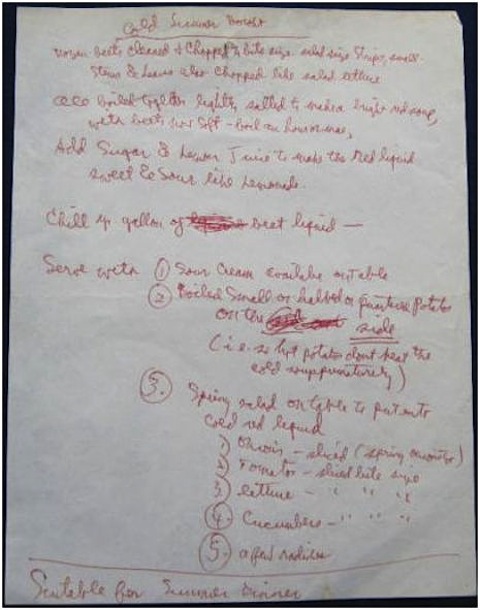
Another Ginsbergian tactic for embracing the season’s heat: borscht. Unlike Rudolph Nureyev’s or Cyndi Lauper’s favorite from Veselka, the round-the-clock Ukrainian diner a few blocks from Ginsberg’s East Village home, Ginsberg’s borscht is vegetarian and cold. See the transcription of Ginsberg’s handwritten recipe below:
COLD SUMMER BORSCHT
Dozen beets cleaned & chopped to bite size salad-size Strips
Stems & leaves also chopped like salad lettuce
All boiled together lightly salted to make a bright red soup,
with beets now soft — boil an hour or more
Add Sugar & Lemon Juice to make the red liquid
sweet & sour like Lemonade
Chill 4 gallon(s) of beet liquid -
Serve with (1) Sour Cream on table
(2) Boiled small or halved potato
on the side
(i.e. so hot potatoes don’t heat the
cold soup prematurely)
(3) Spring salad on table to put into
cold red liquid
1) Onions — sliced (spring onions)
2) Tomatoes — sliced bite-sized
3) Lettuce — ditto
4) Cucumbers — ditto
5) a few radishes
__________________________________
Suitable for Summer Dinner
Cold Summer Borscht was but one of many soups to remerge from Ginsberg’s twelve-gallon stockpot. Read about his final batch here. Bon Apetit.
If anyone should ask you how to promote a celebrity fragrance without losing face, click play and whisper, “Like This.”
It helps if the celeb in question is generally acknowledged to be a class act. Imagine a drunken starlet emerging from her limo sans-drawers to stumble through her favorite poem by a 13th century Sufi mystic. Which would you rather smell like?
Some scholars quibble with the accuracy of this Tilda Swinton-approved translation, but there’s no denying that Coleman Barks’ “perfect satisfaction of all our sexual wanting” stands to move a lot more scent than A.J. Arberry’s terse reference to Houris, viriginal and numerous though they may be.
Speaking of comparisons, take a peek at how another celebrity promotes her fragrance in a video of similar length.
“Add to the available accounts of Plath (there are so many) this, please: nobody brought a house to life the way she did.” So writes Dan Chiasson in a February New Yorker piece commemorating the fiftieth anniversary of Sylvia Plath’s death. Chiasson’s plea is made all the more poignant by his careful readings of the tenderness—amidst the pain and horror—in Plath’s final collection, Ariel, which she left sitting on the kitchen table to be found along with her body. (The collection has recently been restored to correspond to Plath’s final wishes).
Chiasson’s refocusing of Plath’s legacy feels necessary, given that, as James Parker writes in The Atlantic, “Her short life has been trampled and retrampled under the biographer’s hoof, her opus viewed and skewed through every conceivable lens of interpretation.” It is sometimes difficult to connect with work—even with that as stunningly accomplished and resonant as Plath’s—through this thick haze of sensationalism and cult fandom. Even if many of the poems in Ariel—most famously “Lady Lazarus”—seem to request this kind of scrutiny, many others, Chiasson writes, including the title poem, need to be approached afresh, without the morbid celebrity baggage Plath’s name carries.
Is this possible? Perhaps one way to reconnect with the poetry is to hear Plath herself reading it. In these recordings, you can hear her read fifteen poems from Ariel, her New England Brahmin vowels inflecting every line, drawing out internal rhymes and assonance, then clipping at caesuras like a well-bred horse’s trotting hooves.
The title poem “Ariel”—which Chiasson eulogizes as “a perfect poem, perfect in its excesses and stray blasphemies”—is, in fact, partly named after Plath’s favorite horse. Also enfolded in the title is the captive sprite bound to perform tricks for Shakespeare’s mage Prospero in The Tempest, and an Old Testament name given to Jerusalem, meaning “lion of God” (the second stanza begins “God’s lioness…”). Plath’s poetic self-understanding is as complex as this allusive layering suggests, and the poem’s jarring ellipses demand very close attention.
The readings here are from recordings made on October 20, 1962. Poems include: “The Rabbit Catcher,” “A Birthday Present,” “A Secret,” “The Applicant,” “Daddy,” “Medusa,” “Stopped Dead,” “Fever 103°,” “Amnesiac,” “Cut,” “Ariel,” “Poppies In October,” “Nick And The Candlestick,” “Purdah,” and “Lady Lazarus.”
Long before the printing press, before parchment and papyrus, poetry was a strictly oral form. Many of the features we associate with verse—rhyme, meter, repetition, and extended similes—originated as mnemonic devices for poets and their audiences in times when bards composed extemporaneously from predetermined formulas. And while the image of the Homeric poet, strumming a lyre and narrating the deeds of gods and heroes seems quaint, poetry is still very much an oral art, in cultures traditional and modern. Right this very moment, in cities across the world, poets and audiences gather in bars, cafes, bookstores, temples, and libraries to hear poems spoken, rapped, sung, chanted, etc.
But we no longer assign to the poet god-like power and fame. Those accolades are now reserved for actors and musicians. And while poets are often perfectly good readers of their own work, sometimes there’s nothing so exciting as hearing the utterly distinctive voice of, say, James Earl Jones or Anthony Hopkins, turning over the words of a favorite poem, making them rumble and rustle in ways they never did flat on the page. So today we bring you some modern gods reading the ancient form, beginning with the great, gravel-voiced Tom Waits, who reads the great, gravel-voiced Charles Bukowski’s “The Laughing Heart” (top, full text here). A more perfect union of reader and poet you may never find.
Finally, the unmistakable voice of Sean Connery (backed by the music of Vangelis) beautifully conveys the epic journey of C.P. Cavafy’s “Ithaca” (above, full text here). These are but three examples of the art of actors reading poets. Below, you’ll find several others, along with a couple of writers—Tennessee Williams and Harold Bloom—thrown in for good measure. Hearing poetry read, and read well, creates space in a widening sea of distractions for that most ancient of human crafts.
“Argh, you’re all amateurs in a professional universe!” roared Allen Ginsberg to a young class of aspiring poets in 1977 at the Jack Kerouac School of Disembodied Poetics. Their offense? Most of the students had failed to register for meditation instruction. The story comes to us from Steve Silberman, who was then a 19-year-old student in that classroom and a recipient of Ginsberg’s genius that summer.
Only three years earlier, in 1974, Ginsberg and poet Anne Waldman launched the Jack Kerouac School at Naropa Institute (now Naropa University), in Boulder, Colorado. The Institute—founded by Tibetan teacher Chögyam Trungpa Rinpoche—was modeled on ancient Buddhist learning centers in India and described by Waldman and poet Andrew Schelling as “part monastery, part college, part convention hall or alchemist’s lab.”
Ginsberg taught at Naropa until his death in 1997. The class in which he had his outburst was called “Literary History of the Beats,” at the start of which he handed his students a list called “Celestial Homework” (first page above, second and third pages here and here). Silberman describes the list thus (quoting from Ginsberg’s description):
This “celestial homework” is the reading list that Ginsberg handed out on the first day of his course as “suggestions for a quick check-out & taste of antient scriveners whose works were reflected in Beat literary style as well as specific beat pages to dig into.”
It’s a particularly Ginsberg-ian list, with a healthy mix of genres and periods, most of it poetry—by Ginsberg’s fellow beats, to be sure, but also by Melville, Dickinson, Yeats, Milton, Shelley, and several more. Sadly, it’s too late to sit at Ginsberg’s feet, but one can still find guidance from his “Celestial Homework,” and you can even listen to audio recordings from the class online too.
Silberman has done us all the great service of compiling as many free online versions of Ginsberg’s recommended texts as he could. You’ll find them all here, with author bios linked to each photo. Unfortunately, some of the links have gone dead, but with a little bit of searching, you can work your way through most of Ginsberg’s list. Silberman reports another Ginsberg epigram from his 1977 class: “Poetry is the realization of the magnificence of the actual.” The works on the “Celestial Homework,” Silberman comments, “are gates to that magnificence.”
Dylan Thomas’s drinking was legendary. Stories of the debauched and disheveled Welsh poet’s epic drinking binges have had a tendency to drown out serious discussion of his poetry.
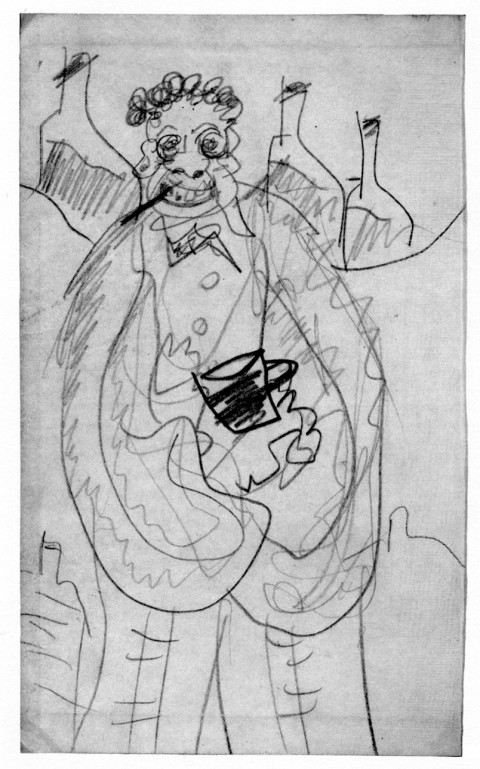
It’s a legend that Thomas helped promote, as this pencil sketch he made of himself attests. The undated self-caricature was published in Donald Friedman’s 2007 book, The Writer’s Brush: Paintings, Drawings, and Sculpture by Writers. It depicts a teetering, goggle-eyed figure with tumbler in hand, happily surrounded by bottles.
Thomas would sometimes tell his friends he had cirrhosis of the liver, but his autopsy eventually disproved this. As legend has it, the poet literally drank himself to death on his American tour in the fall of 1953, when he was 39 years old. In fact, it appears Thomas may have been a victim of medical malpractice. He went to his doctor complaining of difficulty breathing. The doctor was aware of the poet’s reputation as a drinker, and had been informed by Thomas’s companion of his now-famous statement from the night before: “I’ve had 18 straight whiskies. I think that’s the record.”
So the doctor treated Thomas for alcoholism and didn’t discover he was suffering from pneumonia. He gave Thomas three injections of morphine, which can slow respiration. Thomas’s face turned blue and he went into a coma. He died four days later. When Thomas’s friends investigated, they determined he had likely consumed, at most, eight whiskies. That’s still a large amount, but the poet’s exaggeration appears to have led his doctor astray. In a sense, then, Dylan Thomas was killed not by his drinking, but by the legend of his drinking.
In the final months of his short life, Bruce Lee wrote a personal essay, “In My Own Process” where he said, “Basically, I have always been a martial artist by choice and actor by profession. But, above all, I am hoping to actualize myself to be an artist of life along the way.” If you’re familiar with Bruce Lee, you know that he studied philosophy at The University of Washington, and even when he auditioned for The Green Hornet in 1964 (and showed off his amazing kung fu moves), he took pains to explain the philosophy underlying the martial arts.
Lee wasn’t just a philosopher. He was also a poet and a translator of poetry. In the book, Bruce Lee: Artist of Life, John Little has published 21 original poems found within Lee’s personal archive. The poems, Little writes, “are, by American standards, rather dark — reflecting the deeper, less exposed recesses of the human psyche… Many seem to express a returning sentiment of the fleeting nature of life, love and the passion of human longing.” Above, you can see Shannon Lee, the daughter of Bruce Lee, read a poem published in Little’s collection. It’s called “Boating on Lake Washington.” Immediately below, she reads “IF” by Rudyard Kipling, a poem her father loved so much that he had it engraved on a plaque and mounted on the wall in his home.
Finally, we leave you with Lee’s translation of another favorite poem, “The Frost” by Tzu Yeh. The video features pieces of his handwritten translation.
We're hoping to rely on loyal readers, rather than erratic ads. Please click the Donate button and support Open Culture. You can use Paypal, Venmo, Patreon, even Crypto! We thank you!
Open Culture scours the web for the best educational media. We find the free courses and audio books you need, the language lessons & educational videos you want, and plenty of enlightenment in between.