On Monday, the science world joyously celebrated a seminal astrophysics discovery. Using a telescope in the South Pole, researchers from the Harvard-Smithsonian Center for Astrophysics detected ripples in the fabric of space-time, called gravitational waves. These waves confirmed the inflation theory, which stated that for a brief moment — one trillionth of a trillionth of a trillionth of a second after the big bang — the universe was violently expanding faster than the speed of light. Stanford’s Andrei Linde (along with MIT’s Alan Guth) was one of the thinkers responsible for working out this theory in the 1980s. In the video above, another Stanford professor, Chao-Lin Kuo, visits Linde to break the news of the discovery to him on his front porch. Finding out that much of his career had been vindicated in such spectacular fashion, Linde was appropriately moved and stunned. You can learn more about Linde’s work in The Stanford Report.
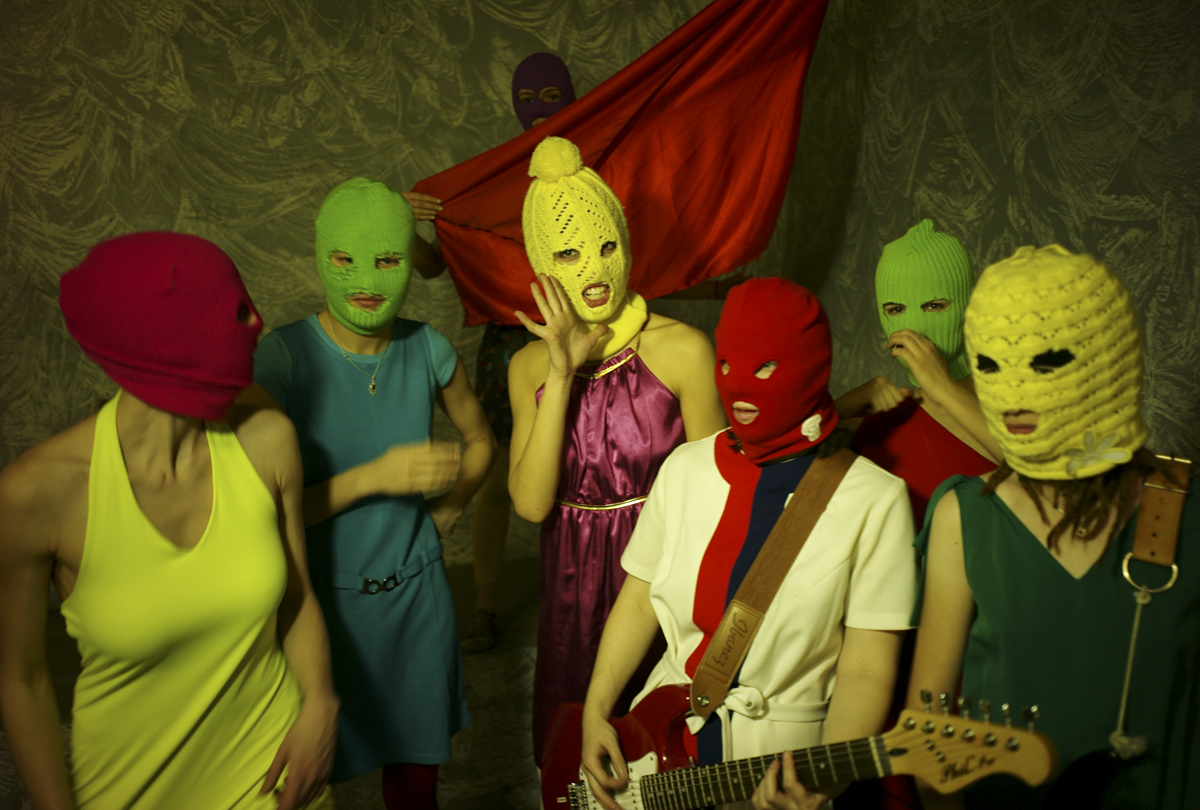
Recently attacked by Cossacks in Sochi and by black-clad men with green antiseptic in Moldova, Nadezhda Tolokonnikova and Maria Alyokhina have, since their December release from a two-year prison sentence, remained the very public faces of the punk band/agit-prop collective known as Pussy Riot. The two also continue to raise the band’s profile in the States. Last month alone, they appeared on The Colbert Report and onstage with Madonna at a star-studded Amnesty International event.
Not only prominent activists for prison reform, Nadia and Masha—as they’re called in the HBO documentary Pussy Riot: A Punk Prayer—have become celebrities. (So much so that other mostly anonymous members of the group have disowned them, citing among other things issues with “personality cult.”) The HBO doc begins with profiles of the women, as does a new book, Words Will Break Cement: The Passion of Pussy Riot, by Russian journalist Masha Gessen.
In an interview Friday for KQED in San Francisco (above), Gessen—a lesbian mother who recently moved to the United States for fear of persecution—describes how Vladimir Putin, Pussy Riot’s primary target, has regained his popularity with the Russian people after his aggressions at the Ukraine border and Crimea’s Sunday vote for secession. She cites, for example, alarming poll numbers of only 6% of Russians who oppose an invasion of Ukraine. Yet at the time of Pussy Riot’s infamous performance at a Moscow cathedral in February of 2012, which led to Tolokinnikova and Alyokhina’s imprisonment, the anti-Putin protest movement made the autocratic ruler very nervous.
Gessen sketches the history of the movement in her interview (and details it in the book). At first the protests involved the situationist antics of performance art collective Voina—“War”—(see Tolokonnikova, above at far right, with other Voina members in 2008). The feminist punk band has only emerged in the past three years, when Voina’s art-school pranks became Pussy Riot’s provocations days after Putin announced his intent to return to the presidency.
One month before the cathedral performance that sent Nadia and Masha to prison, the band appeared in their trademark fluorescent dresses and balaclavas in Red Square (top). Only three months prior, on October 1, 2011, they released their first song, “Ubey seksista” (“Kill the Sexist”) and—as members of Voina—announced the arrival of Pussy Riot, a radical opposition to the authoritarianism, patriarchy, and crony capitalism they allege characterize Putin’s rule.
In November of 2011, Pussy Riot staged its first public performance (above), scaling atop scaffolding and Moscow trolley and subway cars while scattering feathers and dancing to their song “Osvobodi Bruschatku” (“Release the Cobblestones”). The song recommends that Russians throw cobblestones in street protests because–as Salon quotes from the group’s blog—“ballots will be used as toilet paper” in the approaching elections.
The collective next released the video for “Kropotkin Vodka” (above), featuring a montage of public appearances in fashionable locations around Moscow. The locations were chosen, the band writes, specifically as “forbidden sites in Moscow.” More from their (Google-translated) blog below:
The concerts were held in public places [for] wealthy putinists: boutiques in the capital, at fashion shows, luxury cars and roofs close to Kremlin bars […] Performances included arson and a series of musical occupations [of] glamorous areas of the capital.
The song takes its title and inspiration from Peter Kropotkin, the 19th century Russian aristocrat-turned-anarcho-communist intellectual.
In their open letter publicly releasing their two most prominent members from the group, six members of Pussy Riot write that the “ideals of the group” Nadia and Masha have allegedly abandoned were precisely “the cause for their unjust punishment.” The two have become, they say, “institutionalized advocates of prisoners’ rights.” And yet in mid-December, 2011, the band performed their song “Death to Prison, Freedom to Protests” on the rooftop of a detention center holding opposition leaders and activists. This was at the height of the anti-Putin movement when upwards of 100,000 people took to the streets of Moscow chanting “Russia without Putin” and “Putin is a Thief” and demanding free elections.
While most of us only heard of Pussy Riot after their arrest and trial for the cathedral stunt, their “breakthrough performance,” writes Salon, occurred one month earlier at the Red Square appearance at the top of the post. This was when the band decided to “take revolt to the Kremlin,” and coincided with promises from Putin to reform elections. “The revolution should be done by women,” said one member at the time. “For now, they don’t beat us or jail us as much.” The situation would turn rather quickly only weeks later, and it was with Pussy Riot, says Gessen, that the wave of arrests and beatings of protesters began. The band’s current schism comes just as the anti-Putin movement seems to be fracturing and losing resolve, and the future of democratic opposition in Putin’s increasingly belligerent Russia seems entirely uncertain.
Contrary to what the past decade’s TV commercials may indicate, Apple’s advertising hasn’t always been so tepid and generic. Before the era of the much-lampooned “I’m a Mac and I’m a PC” commercials, which starred Justin Long as the chilled out Apple computer and John Hodgman as the shamefully square PC, the company cultivated an iconoclastic image. Who could forget the radical 1984 commercial where Apple slammed 1980s conformity, or the “Think Different” campaign, where Jobs waxed lyrical about the “crazy ones, misfits, rebels and rule breakers?” No surprise, then, that Apple decided to burnish its rebel credentials by hiring none other than the father of gonzo journalism to star in one of its TV spots.
Above, you can view Hunter S. Thompson’s brief “Power is” Apple commercial. The ad seems to date to some point in the 1990s; at least, that’s what the whirlwind of cuts, oddly angled shots, shaky camerawork, and edgy guitar riffs seem to suggest. The commercial’s premise appears to be that Thompson both knows what power is, and how to use it to stick it to The Man.
Presumably, simply having Thompson in the ad gave Apple enough countercultural cachet, since he never mentions either the company or its product. This may have been the result of previous grievances: according to legend, the journalist had received a Mac from the editors of the San Francisco Examiner in the mid-1980s, in hopes that the gadget would help him transmit his perennially late copy to the paper on time. Despite its many features, however, the Mac couldn’t stand up to Thompson’s temper (he was known to lose his cool when dealing with electronics). In a fit of rage, Thompson blew the machine to smithereens with his shotgun, and sent the remains to his editors. Power, indeed.
If you would like to support the mission of Open Culture, consider making a donation to our site. It’s hard to rely 100% on ads, and your contributions will help us continue providing the best free cultural and educational materials to learners everywhere. You can contribute through PayPal, Patreon, and Venmo (@openculture). Thanks!
On Sunday night, Fox viewers were treated to Episode #2 of Neil deGrasse Tyson’s new Cosmos series. (If you’re located in the US, you can watch it free online above.) This episode was called “Some of the Things That Molecules Can Do,” and it gave viewers an hour-long education on the Earth’s many life forms and the well-documented theory of evolution. Along the way, Tyson carefully refuted, as Mother Jones notes, one of “creationist’s favorite canards: The idea that complex organs, like the eye, could not have been produced through evolution.” And, to cap things off, Tyson declared, “Some claim evolution is just a theory, as if it were merely an opinion. The theory of evolution, like the theory of gravity, is a scientific fact. Evolution really happened.” For scientists, it’s not up for debate.
For their annual Lifetime Achievement Awards, the folks over at the Society of Camera Operators put together a lovely, surprisingly rousing video about the evolution of the movie camera over the course of the past century or so of cinema. And, as you can see above, it has changed quite a bit.
Then in the ‘80s, things started to change with the release of analog video. Suddenly, you could capture movement in a manner that didn’t involve exposing frame by frame an unspooling reel of light-sensitive celluloid. And with the digital revolution that started in the ‘90s, cameras, and the very nature of cinema, changed. Dazzling spectacles like Avatarand Gravity could be created almost entirely within a computer, while at the same time the cameras themselves grew smaller and more portable.
To underscore just how democratized the technology of movie making has become, the end of the video shows Hollywood cameramen shooting movies with iPhones. The piece ends with what could only be seen as an ominous technological development for the Society of Camera Operators: Google Glass, which has the potential to turn every single person into a perpetual camera operator.
Jonathan Crow is a Los Angeles-based writer and filmmaker whose work has appeared in Yahoo!, The Hollywood Reporter, and other publications. You can follow him at @jonccrow.
According to Ted Morgan, author of William S. Burroughs biography Literary Outlaw(which Burroughs hated), the hard-living Beat writer added “teacher” to the list of jobs he did not like after an unhappy semester teaching creative writing at the City College of New York. He complained about dimwitted students, and disliked the job—arranged for him by Allen Ginsberg—so much that he later turned down a position at the University of Buffalo that paid $15,000 a semester, even though he desperately needed the money. That Burroughs had recently kicked heroin may have contributed to his unease with the prosaic regularities of college life. Whatever the story, he later remarked that the “teaching gig was a lesson in never again.”
What then could have lured Burroughs out to Boulder Colorado five years later to deliver a series of lectures on creative writing at Naropa University? He’d picked up his heroin habit again, and his friendship with Ginsberg—who co-founded Naropa’s writing program—must have played a part. Whatever the reasons, this assignment differed greatly from his City College stint: no student writing, no office hours or admin. Just Burroughs doing what came naturally—holding court, on literature, parapsychology, occult esoterica, violence, aliens, neuroscience, and his own novels Naked Lunch and The Soft Machine.
Burroughs’ lectures are heavily philosophical, which might have turned off his New York students, but surely turned on his Naropa audience. And if you stopped to listen, it will probably turn you on too, in ways creative and intellectual. Ostensibly on the subject of creative reading, Burroughs also offers creative writing instruction in each talk. His discussions of writers he admires—from Carson McCullers to Aleister Crowley to Stephen King—are fascinating, and he uses no shortage of examples to illustrate various writing techniques. Fortunately for us, the lectures were recorded. Says Dangerous Minds, who provide helpful descriptions of each lecture: “now you can have your very own creative writing class from William S. Burroughs, all thanks to the wonders of YouTube.” Hear all three lectures above, and be by turns inspired, instructed, enlightened, and warped.
If you would like to support the mission of Open Culture, consider making a donation to our site. It’s hard to rely 100% on ads, and your contributions will help us continue providing the best free cultural and educational materials to learners everywhere. You can contribute through PayPal, Patreon, and Venmo (@openculture). Thanks!
A film that began its life as a script called Who Killed Bambi?, written by Roger Ebert and Russ Meyer, The Great Rock and Roll Swindle (trailer below) became a farcical caper starring the Sex Pistols minus their lead singer. Johnny Rotten had quit the band at this point and appears only in archival footage. Mostly The Great Rock and Roll Swindle was a vehicle for Malcolm McLaren to sell himself as the guru of punk and the driving force behind the band. Directed by Julien Temple (who also made the far superior Sex Pistols doc, The Filth and the Fury), Swindle is also notable for almost launching a Sid Vicious solo career, and it might have worked, were it not for his epically destructive flame-out in 1978.
The film saw release two years later, and produced a soundtrack album, which I remember finding in a used record bin—pre-Google—and thinking I’d discovered some long lost Sex Pistols album. One listen disabused me of the notion. Some of album is a snapshot of the band’s shambolic final days, but most of it is devoted to “jokey material” from the movie and most of that is pretty terrible. The sole exception is Sid’s version of Paul Anka’s “My Way” (top), a sneering piss take on the song Sinatra made famous. After some obnoxious faux-crooning, Sid tears through song with punk aplomb. Allmusic aptly describes the performance as “inarguably remarkable” yet showing that Sid was “incapable of comprehending the irony of his situation.”
The moment of the performance itself is bathed in sad irony. I’ve always thought it showed that—had he just a little more instinct for self-preservation—we might have someday seen Sid Vicious recording an album’s worth of bratty takes on the American Songbook, but probably at McLaren’s behest. What more he might have had in him is anyone’s guess; in life he seemed unable to rise above the role McLaren assigned him in the film “Gimmick.” But he made it look good. Those familiar with Alex Cox’s definitive portrait Sid and Nancy will of course remember Gary Oldman’s recreation of Sid’s “My Way” (above). Convincing stuff, but no substitute for the real thing.
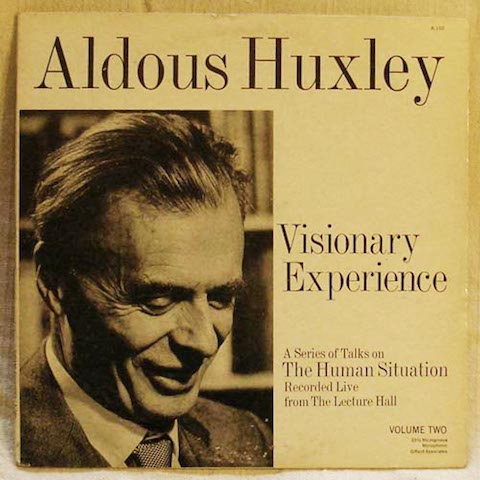
Today, those who get “turned on” to Aldous Huxley (as they might have said back in the 1960s) get it through his books: the dystopian novel Brave New World, usually, or perhaps the mescaline memoir The Doors of Perception. But during Huxley’s lifetime, especially in its final years from the late 1950s to the early 60s, he made no small number of adherents through lecturing. Having transplanted himself from his native England to California in 1937, he eventually achieved great regard among the region’s self-styled intellectuals and spiritual seekers, giving talks at such mystically high-in-the-zeitgeist places as Hollywood and Santa Barbara’s Vedanta temples and even Big Sur’s famous Esalen Institute. But the prolific speech-giver also went farther afield, to far squarer venues such as the Massachusetts Institute of Technology. There, in 1962, he recorded the album Visionary Experience: A Series Of Talks On The Human Situation, which you can hear on Ubuweb, or right below.
At that point, Huxley had already gained worldwide fame for his views on better living, which was sometimes achieved, he believed, through psychedelic drugs. This might have already sounded like old hat in, say, the San Francisco of the late 1960s, let alone the 70s and onward, but in these recordings Huxley says his piece in — I still can’t quite believe it — the MIT of the early 1960s. But Huxley, diagnosed a couple years before with the cancer that would claim his life the next, had nothing to lose by spreading the word of his substance-induced discoveries. These would, as you may remember, even facilitate the death itself, Huxley’s final visionary experience. To learn even more about all those that preceded it, see his collection Writings on Psychedelics and the Visionary Experience (1931–1963), that’s available on the Internet Archive. While we here at Open Culture don’t endorse drug use, we do endorse the words of Huxley as a substitute, and perhaps an even more vivid one.
We're hoping to rely on loyal readers, rather than erratic ads. Please click the Donate button and support Open Culture. You can use Paypal, Venmo, Patreon, even Crypto! We thank you!
Open Culture scours the web for the best educational media. We find the free courses and audio books you need, the language lessons & educational videos you want, and plenty of enlightenment in between.