From the US Chess Federation and director Jenny Schweitzer comes the short documentary, The Magic of Chess. “Filmed at the 2019 Elementary Chess Championships at the Nashville Opryland resort, a group of children share their uninhibited, philosophical insights about the benefits of chess.” Jenny Schweitzer added: “For me, as a mother of a child who simply loves the game, it was my intention to focus not on the competitive aspects of the chess world, but rather what a deep commitment to chess can potentially offer someone, young or old.” If this whets your appetite, explore some of our chess resources below.
If you would like to sign up for Open Culture’s free email newsletter, please find it here. It’s a great way to see our new posts, all bundled in one email, each day.
If you would like to support the mission of Open Culture, consider making a donation to our site. It’s hard to rely 100% on ads, and your contributions will help us continue providing the best free cultural and educational materials to learners everywhere. You can contribute through PayPal, Patreon, and Venmo (@openculture). Thanks!
Among lovers of Vincent van Gogh, the Dutch artist is as well known for his letter writing as for his extraordinary painting. “The personal tone, evocative style and lively language” of his correspondence, writes the Van Gogh Museum, “prompted some people who were in a position to know to accord the correspondence the status of literature. The poet W.H. Auden, who published an anthology with a brief introduction, wrote: ‘there is scarcely one letter by Van Gogh which I, who am certainly no expert, do not find fascinating.’”
Auden was, of course, an expert on the written word, though maybe not on Van Gogh, and he refined his literary expertise the same way the painter did: by reading as copiously as he wrote. “When it was too dark to paint,” writes University of Puerto Rico professor of humanities Jeffrey Herlihy Mera at the Chronicle of Higher Education, “Van Gogh read prodigiously and compiled a tremendous amount of personal correspondence.” Much of his writing, especially his letters to his brother Theo, was in French, a language he learned in his teens and spoke in Belgium, Paris, and Arles.
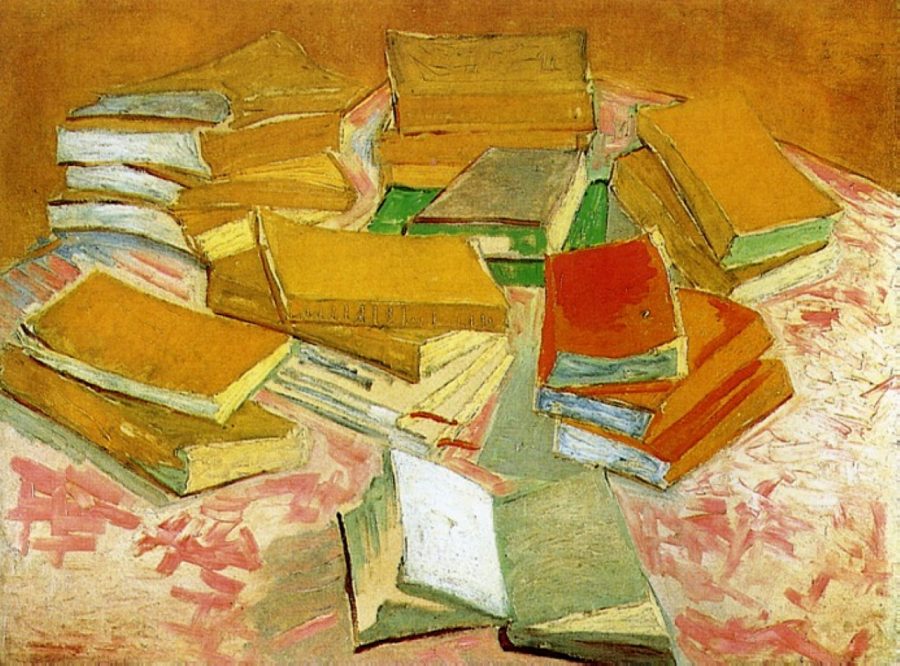
Van Gogh’s command of written French, however, came from his reading of Victor Hugo, Guy de Maupassant, and Émile Zola. “Vincent loved literature,” the Van Gogh Museum writes. “In general, the books he read reflected what was going on in his own life. When he wanted to follow in his father’s footsteps and become a minister, he read books of a religious nature. He devoured Parisian novels when he was considering moving to the French capital.”
In his letters to Theo, he weaves together the sacred and profane, describing his spiritual and creative strivings and his unrequited obsessions. In his reading, he tested his values and desires. We get a sense of how Van Gogh’s reading complemented his pious, yet romantic nature in the list of some of his favorites, below, compiled by the Van Gogh Museum.
Charles Dickens, A Christmas Carol (1843)
Jules Michelet, L’amour (1858)
Émile Zola, L’Oeuvre (1886)
Alphonse Daudet, Tartarin de Tarascon (1887)
The Bible
John Keats, The Eve of St. Agnes (1820)
George Eliot, Scenes of Clerical Life (1857)
Henry Wadsworth Longfellow, The Poetical Works of Henry Wadsworth Longfellow (1887)
Hans Christian Andersen, What the Moon Saw (1862)
Thomas a Kempis, The Imitation of Christ (1471–1472)
“Vincent read moralistic books often favoured among members of the Protestant Christian community” in which he was raised by his minister father. He looked also to the morality of Charles Dickens, whose works he “read and reread… throughout his life.” Zola’s “rough, direct naturalism” appealed to Van Gogh’s desire “to give an honest depiction of what he saw around him: farm labourers, a weathered little old man, dejected or working women, a soup kitchen, a tree, dunes and fields.”
In Alphonse Daudet’s 1887 Tartarin de Tarascon, “an entertaining caricature of the southern Frenchman,” Van Gogh satisfied his “need for humor and satire.” Despite the stereotype of the artist as perpetually tortured, his letters consistently reveal his good-natured sense of humor. From French historian Jules Michelet’s 1858 L’amour, the artist “found wisdom he could apply to his own love life,” tumultuous as it was. He used Michelet’s insights “to justify his choices,” such as “when he fell in love with his cousin Kee Vos.”
In a letter to Theo, Vincent expressed his emotional struggles over Vos’s rejection of him as “a great many ‘petty miseries of human life,’ which, if they were written down in a book, could perhaps serve to amuse some people, though they can hardly be considered pleasant if one experiences them oneself.” He is at a loss for what to do with himself, he writes, but “‘wandering we find our way,’ and not by sitting still.” For Van Gogh, “wandering” just as often took the form of sitting still with a good book.
We all know what to think of when we hear the term bonsai: dwarf trees. Or so Shinobu Nozaki titled his book, the very first major publication on the subject in English. Dwarf Trees came out in the 1930s, not long after the Japanese art of bonsai started drawing serious international attention. But the art itself goes back as far as the sixth century, when Japanese embassy employees and students of Buddhism returning from sojourns in China brought back all the latest things Chinese, including plants growing in containers. By six or seven centuries later, as scrolls show us today, Japan had taken that horticultural technique and refined it into a practice based on not just miniaturization but proportion, asymmetry, poignancy, and erasure of the artist’s traces, one that produces the kind of trees-in-miniature we recognize as artworks, and even masterworks, today.
It hardly needs saying that bonsai trees don’t take shape by themselves. As the name, which means “tray planting” (盆栽), suggests, a work of bonsai must begin by planting a specimen in a small container. From then on, it demands daily attention in not just the provision of the proper amounts of water and sunlight but also careful trimming and adjustment with trimmers, hooks, wire, and everything else in the bonsai cultivator’s surprisingly large suite of tools.
You can see a Japanese master of the art named Chiako Yamamoto in action in “Bonsai: The Endless Ritual,” the BBC Earth Unplugged video at the top of the post. “Shaping nature in this way demands everlasting devotion without the prospect of completion,” says its narrator, a point underscored by one bonsai under Yamamoto’s care, originally planted by her grandfather over a century ago.
You’ll find even older bonsai at the National Bonsai Museum at the U.S. National Arboretum in Washington D.C. In the video “Bonsai Will Make You a Better Person,” curator Jack Sustic — an American first exposed to bonsai in the military, while stationed in Korea — shows off a Japanese white pine “in training” since the year 1625. That unusual terminology reflects the fact that no work of bonsai even attains a state of completeness. “They’re always growing,” say Sustic. “They’re always changing. It’s never a finished artwork.” In National Geographic’s “American Shokunin” just above, the titular bonsai cultivator (shokunin has a meaning similar to “craftsman” or “artisan”), Japan-trained, Oregon-based Ryan Neil, expands on what bonsai teaches: not just how to artistically grow small trees that resemble big ones, but what it takes to commune with nature and attain mastery.
“A master is somebody who, every single day, tries to pursue perfection at their chosen endeavor,” says Neil. “A master doesn’t retire. A master doesn’t stop. They do it until they’re dead.” And as a work of bonsai literally outlives its creator, the pursuit continues long after they’re dead. The bonsai master must be aware of the aesthetic and philosophical values held by the generations who came before them as well as the generations that will come after. Wabi sabi, as bonsai practitioner Pam Woythal defines it, is “the Japanese art of finding beauty in imperfection and profundity in nature, of accepting the natural cycle of growth, decay, and death.” Shibumi (or in its adjectival form shibui) is, in the words of I Am Bonsai’s Jonathan Rodriguez, “the simple subtle details of the subject,” manifest for example in “the apparent simple texture that balances simplicity and complexity.” Looked at correctly, a bonsai tree — leaves, branches, pot, and all — reminds us of the important elements of life and the important elements of art, and of the fact that those elements aren’t as far apart as we assume.
Based in Seoul, Colin Marshall writes and broadcasts on cities, language, and culture. His projects include the book The Stateless City: a Walk through 21st-Century Los Angeles and the video series The City in Cinema. Follow him on Twitter at @colinmarshall or on Facebook.
Perhaps the most lauded graphic novel has been sequelized for HBO, and amazingly, it turned out pretty darn well (with a 96% Rotten Tomatoes rating!).
Your hosts Mark Linsenmayer, Erica Spyres, and Brian Hirt are joined by the Cornell’s David Pizarro, host of the popular Very Bad Wizards podcast. We consider Alan Moore’s 1986 graphic novel, the 2009 Zack Snyder film, and of course mostly the recently completed (we hope) show by Damon Lindelof, the creator of Lost and The Leftovers.
How does Moore’s idiosyncratic writing style translate to the screen? Did the show make best use of its nine hours? Are there other stories in this alternate history that should still be told, perhaps to reflect on other recurrent social ills or crises of whatever moment might be depicted? Was Lindelof really the guy to tell this story about race, and does making the show about racism (which is bad!) undermine Moore’s rejection of (morally) black-and-white heroes and villains?
Some of the articles we used to warm up for this discussion included:
You might want to also check out HBO’s Watchmen page, which includes extra essays and the official podcast with Damon Lindelof commenting on the episodes.
We all remember the first Disney movie we ever saw. In most of our childhoods, one Disney movie led to another, which stoked in us the desire for Disney toys, Disney games, Disney comics, Disney music, and so on. If we were lucky, we might also take a trip to Disneyland or one of its descendants elsewhere in the world. Many of us spent the bulk of our youngest years as happy residents of the Disney entertainment empire; some of us, into adulthood or even old age, remain there still.
Die-hard Disney fans appreciate that the world of Disney — comprising not just films and theme parks but television shows, printed matter, attractions on the internet, and merchandise of nearly every kind — is too vast ever to comprehend, let alone fully explore.
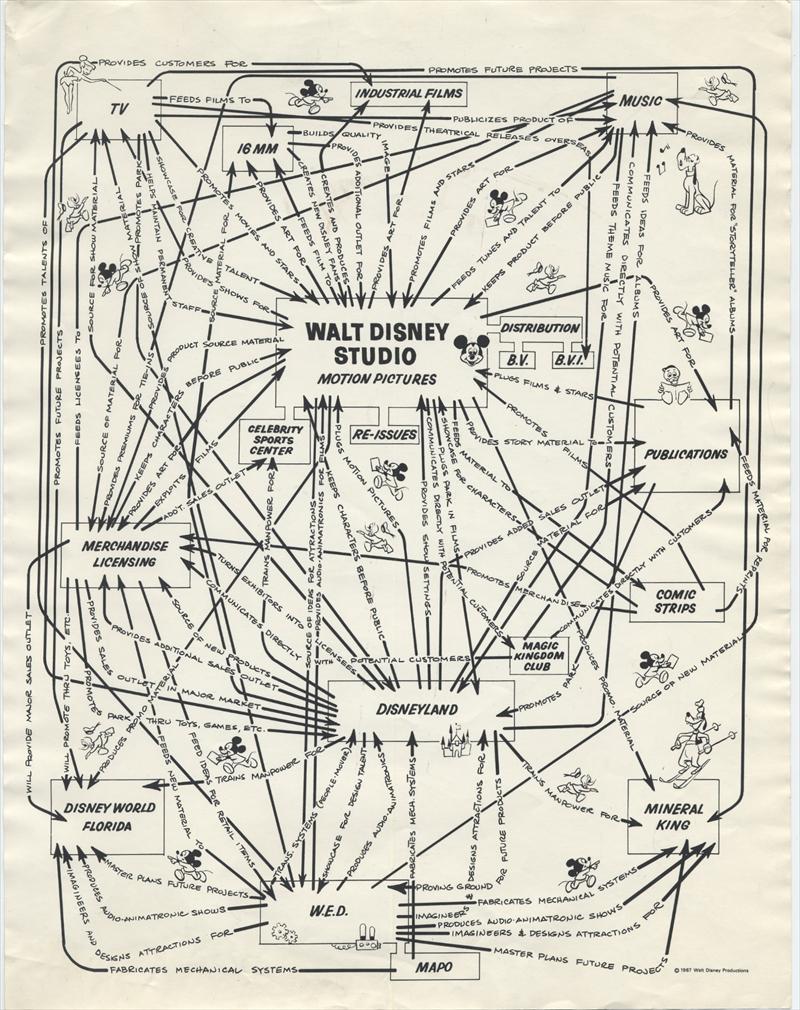
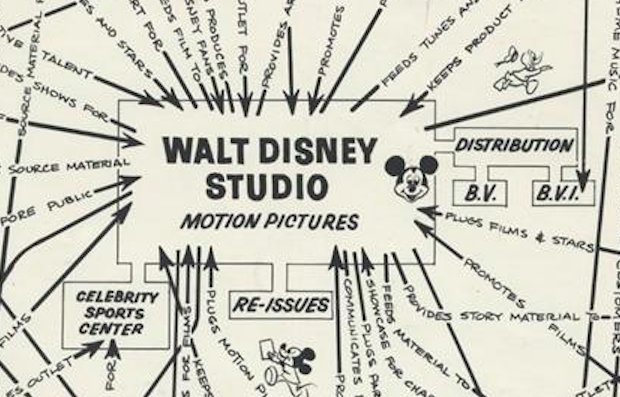
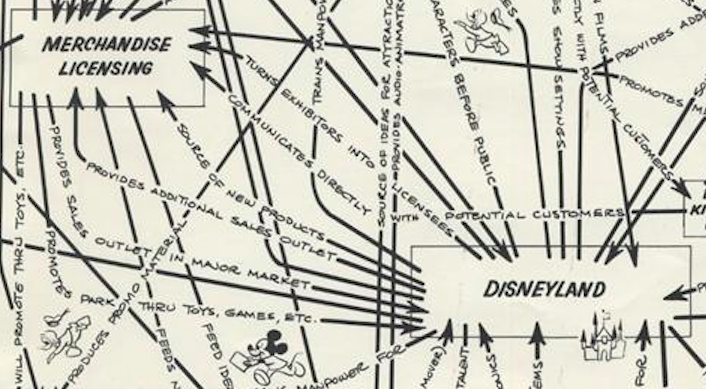
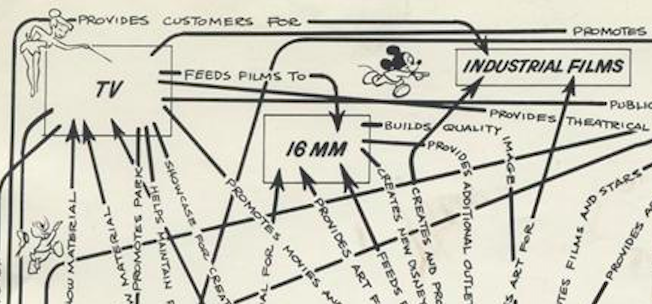
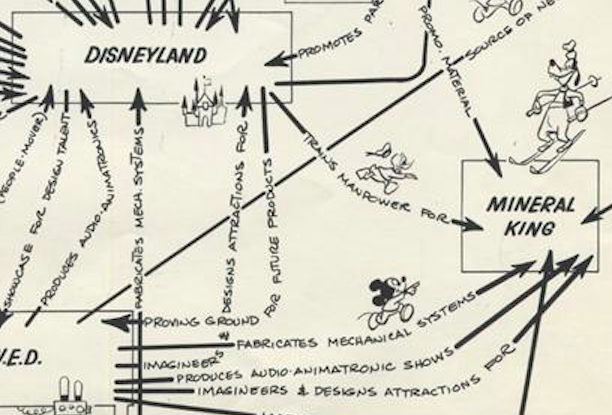
It was already big half a century ago, but not too big to grasp. You can see the whole of the operation laid out in this organizational synergy diagram created by Walt Disney Productions in 1967. Depicting “the many and varied synergistic relationships between the divisions of Walt Disney Productions,” the information graphic reveals the links between each division.
Along the arrowheaded lines indicating the flows of manpower, material, and intellectual property, “short textual descriptions show what each division supplies and contributes to the others.” The motion picture division “feeds tunes and talent” to the music division, for example, which “promotes premiums for tie-ins” to the merchandise licensing department, which “feeds ideas for retail items” to WED Enterprises (the holding company founded by Walt Disney in 1950), which produces “audio-animatronics” for Disneyland.
Some of the nexuses on the diagram will be as familiar as Mickey Mouse, Goofy, Tinkerbell, and the characters cavorting here and there around it. Others will be less so: the 16-millimeter films division, for instance, which would eventually be replaced by a colossal home-video division (itself surely being eaten into, now, by streaming). The Celebrity Sports Center, an indoor entertainment complex outside Denver, closed in 1994. MAPO refers to a theme-park animatronics unit formed in the 1960s with the profits of Mary Poppins (hence its name) and dissolved in 2012. And as for Mineral King, a proposed ski resort in California’s Sequoia National Park, it was never even built.
“The ski resort was one of several ambitious projects that Walt Disney spearheaded in the years before his death in 1966,” writes Nathan Masters at Gizmodo. But as the size of the Mineral King plans grew, wilderness-activist opposition intensified. After years of opposition by the Sierra Club, as well as the passage of the National Environmental Policy Act 1970 and the National Parks and Recreation Act of 1978, corporate interest in the project finally fizzled out. Though that would no doubt have come as a disappointment to Walt Disney himself, he might also have known to keep the failure in perspective. As he once said of the empire bearing his name, “I only hope that we never lose sight of one thing — that it was all started by a mouse.”
Based in Seoul, Colin Marshall writes and broadcasts on cities, language, and culture. His projects include the book The Stateless City: a Walk through 21st-Century Los Angeles and the video series The City in Cinema. Follow him on Twitter at @colinmarshall or on Facebook.
If you would like to sign up for Open Culture’s free email newsletter, please find it here. It’s a great way to see our new posts, all bundled in one email, each day.
If you would like to support the mission of Open Culture, consider making a donation to our site. It’s hard to rely 100% on ads, and your contributions will help us continue providing the best free cultural and educational materials to learners everywhere. You can contribute through PayPal, Patreon, and Venmo (@openculture). Thanks!
Even as an avid horror movie fan, I find it hard to suspend disbelief when Ouija boards show up, and they show up often enough, in classics like The Exorcist and modern favorites like Paranormal Activity. Ouija boards have always seemed more like wands with plastic flowers in them than telegraphs to the afterlife or the infernal abyss. But I grew up with people who considered it a gateway to hell, just as spiritualists have considered it a portal to the beyond, where their dead relatives waited to give them messages.
So, how did this novelty item become such a potent figure of fear and fascination in America? When it was mass-marketed by “a Pittsburgh toy and novelty shop” in the late 19th century, as Linda Rodriquez McRobbie writes at Smithsonian, “this mysterious talking board was basically what’s sold in board game aisles today.” Its advertisements promised “never failing amusement and recreation for all the classes,” and a bridge “between the known and unknown, the material and immaterial.”
The Ouija board might have become a toy by the end of the century, but throughout the earlier decades, belief in the supernatural held serious sway among “all the classes.” The average lifespan was less than 50. “Women died in childbirth; children died of disease; and men died in war. Even Mary Todd Lincoln, wife of the venerable president, conducted séances in the White House after their 11-year-old son died of a fever in 1862.” Disease epidemics and the Civil War left millions bereft.
“Communicating with the dead was common,” says Ouija historian Robert Murch. “It wasn’t seen as bizarre or weird,” even among the staunchest religious people who filled the pews each Sunday. “It’s hard to imagine that now, we look at that and think, ‘Why are you opening the gates of hell?’” These commonly held beliefs may not have damned anyone’s soul, but they made even the rarest minds, like Sherlock Holmes’ creator Arthur Conan Doyle, susceptible to fraud and trickery.
It was only a matter of time before believers in spiritualism became a target demographic for the cheap commodities spreading across the country with the railroads. “People were desperate for methods of communication” with the dead “that would be quicker” than the local medium. “While several entrepreneurs realized that,” McRobbie writes, “it was the Kennard Novelty Company that really nailed it” with their 1886 product. But they didn’t invent it. Such devices date back years earlier.
Some early versions “looked like Ouija boards, and some didn’t,” notes Vox. “Some devices even used planchettes (that’s the name for the thing you hold when you operate a Ouija.” (Planchette, from medieval French, means a small board.) As for the nonsense word “Ouija,” one legend has it that the name came from an 1890 session in which the board was asked what it would like itself to be called. Learn more in the Vox video above about why the Ouija board came to loom so large, or in their words, became so “overrated,” in the American imagination.
From Peter Kropotkin to Leo Tolstoy to Noam Chomsky, some of the most revered anarchist thinkers have exhausted page after page explaining why power over others is unjustified, no matter how it justifies itself. To those who say the wealthy and powerful benefit society with charitable works and occasionally humane policy, Tolstoy might reply with the following illustration, which opens Time editor Anand Giridharadas’ talk above, “Winner Take All,” as animated by the RSA:
I sit on a man’s back, choking him and making him carry me, and yet assure myself and others that I am sorry for him and wish to lighten his load by all means possible… except by getting off his back.
The author of Winners Take All: The Elite Charade of Changing the World, Giridharadas doesn’t make the case for anarchism here, except perhaps by the slightest implication in his choice of epigraph. But he does call out the “winners of our age,” no matter how much they determine to make a difference with humanitarian aid, for being “unwilling to get off the man’s back.” Unwilling to pay taxes, close loopholes and tax shelters, pay higher wages, or stop lobbying to slash public services. Unwilling to reinvest in the communities that made them.
“What does it look like to imagine the kind of change,” Giridharadas asks, “that would involve the winners of our age stepping off that guy’s back? Or being made to step off that guy’s back?” Here, he leaves us with an ellipses and moves to critique the idea of the “win-win” as a means of making change, rather than just exchange.
The market economy has imported the criteria of exchange into politics and social action. Everything is transactional. But in order to address the gross inequities that result in people figuratively sitting on the backs of others, some must gain more power and others must have less. The parties do not meet in a state of ceteris paribus.
One might take issue with the very terms used in “win-win” thinking. Rather than winners, some would call powerful capitalists opportunists, profiteers, and worse. (The term “robber baron” was once in common circulation.) To claim that good works and good intentions obviate massive power imbalances is to presume that such imbalances are justifiable in the first place. Answering this theoretical question doesn’t, however, address the practical problem.
In the current system of corporate misrule, says Giridharadas, “when everything is couched as a win-win, what you are really saying… is that the best kinds of solutions don’t ask anyone to get off anyone’s back.” Unfettered capitalism has brought us the “privatization of public problems.” That is to say, companies profit from the same issues they help create through pollution, predatory schemes, and undue political influence.
You don’t have to be an anarchist to see a serious problem with that. But if you see the problem, you should want to imagine how things could be otherwise.
We're hoping to rely on loyal readers, rather than erratic ads. Please click the Donate button and support Open Culture. You can use Paypal, Venmo, Patreon, even Crypto! We thank you!
Open Culture scours the web for the best educational media. We find the free courses and audio books you need, the language lessons & educational videos you want, and plenty of enlightenment in between.