Is Mail-In Voting New in the United States?: It Actually Goes Back to the Civil War

Let’s say you go home for the hol­i­days. Anything’s pos­si­ble, who knows. It’s a wild world. Let’s say you get there and some­one starts lay­ing on you that trip about how Q Con­tin­u­um said mail-in vot­ing was orches­trat­ed by satan­ic cables from Anar­chist HQ. Let’s say you over­hear some­thing more down-to-earth, like how if mail-in vot­ing hap­pens, bil­lions of peo­ple will vote ille­gal­ly… even more peo­ple than live in the coun­try, which is how you’ll know….

Maybe you’ll want to speak up and say, hey I know some­thing about this top­ic, except then maybe you real­ize you don’t actu­al­ly know much, but you know some­thing ain’t right with this talk and maybe it’s prob­a­bly good to have a func­tion­ing Postal Ser­vice and maybe peo­ple should be able to vote. In such sit­u­a­tions (who can say how often these things hap­pen), you might wish to have a lit­tle infor­ma­tion at the ready, to edu­cate your­self and share with oth­ers.

You might share infor­ma­tion about how mail-in vot­ing has been around since 1775. It has worked pret­ty well at scale since “about 150,000 of the 1 mil­lion Union sol­diers were able to vote absen­tee in the 1864 pres­i­den­tial elec­tion in what became the first wide­spread use of non-in per­son vot­ing in Amer­i­can his­to­ry,” Alex Seitz-Wald explains at NBC News. Since the fed­er­al gov­ern­ment has man­aged to make mail-in vot­ing work for sol­diers serv­ing away from home for over 150 years, “it’s now eas­i­er in some ways for a Marine in Afghanistan to vote than it is for an Amer­i­can stuck at home dur­ing the COVID-19 lock­down.”

“Some part of the mil­i­tary has been vot­ing absen­tee since the Amer­i­can Rev­o­lu­tion,” Don­ald Inbody, for­mer Navy Cap­tain turned polit­i­cal sci­ence pro­fes­sor at Texas State Uni­ver­si­ty, tells NBC News. Inbody refers to one of the first doc­u­ment­ed instances, when Con­ti­nen­tal Army sol­diers vot­ed in a town meet­ing by proxy in New Hamp­shire. But his­to­ry is com­pli­cat­ed, and “mail-in vot­ing has worked just fine so shut up” needs some nuance.

In the very same elec­tion in which 150,000 Union sol­diers mailed their bal­lots, Lin­coln urged Sher­man to send troops sta­tioned in Demo­c­ra­t­ic-con­trolled Indiana—which had banned absen­tee voting—back to their home states so that they could vote. The prac­tice has always had its vocal crit­ics and suf­fered accu­sa­tions of fraud from all sides, though lit­tle evi­dence seems to have emerged. Absen­tee vot­ing helped win the Civ­il War, Blake Stil­well argues at Military.com, in spite of a con­spir­a­cy the­o­ry alleg­ing fraud that might have unseat­ed Lin­coln.

There are sev­er­al rem­nants from the time of care­ful record-keep­ing, like the pre-print­ed enve­lope above that “con­tained a tal­ly sheet of votes from the sol­diers of High­land Coun­ty the Field Hos­pi­tal 2nd Divi­sion 23rd Army Corps,” notes the Smith­son­ian Nation­al Postal Muse­um. (The draw­ing at the top shows Penn­syl­va­nia sol­diers vot­ing in 1864.) And this is all fas­ci­nat­ing stuff. But sol­diers are actu­al­ly absent, which is why they vote absen­tee, right? I mean, if you’re at home, why can’t you just go to the polling place in the glob­al pan­dem­ic in your city that closed all the polling places?

It’s true that civil­ian mail-in vot­ing often works dif­fer­ent­ly from mil­i­tary absen­tee vot­ing. While every state offers some ver­sion, some restrict it to vot­ers tem­porar­i­ly out of state or suf­fer­ing an ill­ness. Cur­rent­ly, only “30 states have adopt­ed ‘no-excuse absen­tee bal­lot­ing,’ which allows any­one to request an absen­tee bal­lot,” Nina Strochlic reports at Nation­al Geo­graph­ic. State laws vary fur­ther among those 30.

“In 2000,” for exam­ple, “Ore­gon became the first state to switch to ful­ly vote-by-mail elec­tions.” Things have rapid­ly changed, how­ev­er. “In the face of the coro­n­avirus pan­dem­ic, vot­ers in every state but Mis­sis­sip­pi and Texas were allowed to vote by mail or by absen­tee bal­lot in this year’s pri­maries.” If you live in the U.S. (or out­side it) and don’t know what hap­pened next… bless you. It involves defund­ing the post office instead of the police.

Vot­ing by mail has expand­ed to meet major crises through­out his­to­ry, says Alex Keyssar, his­to­ry pro­fes­sor at the Kennedy School of Gov­ern­ment at Har­vard. “That’s the log­i­cal tra­jec­to­ry” and “we are not in nor­mal times.” If a high­ly infec­tious dis­ease that has killed at least 200,000 Amer­i­cans on top of ongo­ing vot­er sup­pres­sion and an elec­tion secu­ri­ty cri­sis and mas­sive civ­il unrest and eco­nom­ic tur­moil aren’t rea­sons enough to expand the vote-by-mail fran­chise to every state, I couldn’t say what is.

Should only sol­diers have the abil­i­ty to vote eas­i­ly? I imag­ine some­one might say YES, loud­ly over the cen­ter­piece, because vot­ing is a priv­i­lege not a right!

You, empow­ered pur­vey­or of accu­rate infor­ma­tion, under­stander of absen­tee vot­ing his­to­ry, change-mak­er, will pull out your pock­et Con­sti­tu­tion and ask some­one to find the word “priv­i­lege” in amend­ments that start with “The right of cit­i­zens of the Unit­ed States to vote shall not be denied or abridged by the Unit­ed States or by any State,” etc. That’ll show ’em. But if the gam­bit fails to impress, you’ve still got a bet­ter under­stand­ing of why vot­ing by mail may not be one of the signs of the end times.

Relat­ed Con­tent:

Take The Near Impos­si­ble Lit­er­a­cy Test Louisiana Used to Sup­press the Black Vote (1964)

Three Pub­lic Ser­vice Announce­ments by Frank Zap­pa: Vote, Brush Your Teeth, and Don’t Do Speed

Sal Khan & the Mup­pets’ Grover Explain the Elec­toral Col­lege

The Psy­chol­o­gy That Leads Peo­ple to Vote for Extrem­ists & Auto­crats: The The­o­ry of Cog­ni­tive Clo­sure

Josh Jones is a writer and musi­cian based in Durham, NC. Fol­low him at @jdmagness

30 Buster Keaton Films: “The Greatest of All Comic Actors,” “One of the Greatest Filmmakers of All Time”

The great­est of the silent clowns is Buster Keaton, not only because of what he did, but because of how he did it. —Roger Ebert

In 1987, Video mag­a­zine pub­lished a sto­ry titled “Where’s Buster?” lament­ing the lack of Buster Keaton films avail­able on video­tape, “despite renewed inter­est” in a leg­end who was “about to regain his right­ful place next to Chap­lin in silent comedy’s pan­theon.” How things have changed for Keaton fans and admir­ers. Not only are most of the stone-faced com­ic genius’ films avail­able online, but he has maybe eclipsed Chap­lin as the most pop­u­lar­ly revered silent film star of the 1920s.

Keaton has always been held in the high­est esteem by his fel­low artists. He was dubbed “the great­est of all the clowns in the his­to­ry of the cin­e­ma” by Orson Welles, and served as a sig­nif­i­cant inspi­ra­tion for Samuel Beck­ett. (He was the playwright’s first choice to play Wait­ing for Godot’s Lucky, though he was too per­plexed by the script to take the role). In Peter Bogdanovich’s new doc­u­men­tary, The Great Buster: A Cel­e­bra­tion, Mel Brooks and Carl Rein­er dis­cuss his foun­da­tion­al influ­ence on their com­e­dy, and Wern­er Her­zog calls him “the essence of movies.”

For many years, how­ev­er, the state of Keaton’s fil­mog­ra­phy made it hard for the gen­er­al pub­lic to ful­ly appraise his work. “The Gen­er­al, with Buster as a train engi­neer in the Civ­il War, has always been avail­able,” Roger Ebert wrote in 2002, and has been “hailed as one of the supreme mas­ter­pieces of silent film­mak­ing. But oth­er fea­tures and shorts exist­ed in shab­by, incom­plete prints, if at all, and it was only in the 1960s that film his­to­ri­ans began to assem­ble and restore Keaton’s life­work. Now almost every­thing has been recov­ered, restored, and is avail­able on DVDs and tapes that range from watch­able to sparkling.”


Access to Keaton’s films has fur­ther expand­ed as a dozen or so entered the pub­lic domain in recent years, includ­ing two fea­tures, Sher­lock, Jr. and The Nav­i­ga­tor, this year and three more to come in 2021. You can watch thir­ty-one of Keaton’s restored, recov­ered films on YouTube, at the links below, shared by MetaFil­ter user Going to Maine, who writes, “where, oh where, in this mod­ern world, can we find the gems of his gold­en era? The obvi­ous place.”

Keaton starred in his first fea­ture-length film, The Sap­head, in 1920. For the next decade, until the end of the silent era, he dom­i­nat­ed the box office, along­side Chap­lin and Harold Lloyd, with his can­ny blend of dare­dev­il slap­stick and every­man pathos. After the twen­ties, his career floun­dered, then rebound­ed. His last pic­ture was a return to silent film in Beckett’s 1966 short, “Film,” made the year of his death. Since then, Keaton appre­ci­a­tion has become almost a form of wor­ship.

In 2018, The Gen­er­al came in at num­ber 34 on Sight & Sound’s Great­est Films of All Time list. But the BFI’s Geoff Andrew argued that it deserved the top spot, and Keaton deserves recog­ni­tion as “not mere­ly the great­est of the silent come­di­ans,” but “the great­est of all com­ic actors to have appeared on the sil­ver screen… not only a great Amer­i­can film­mak­er of the silent era,” but “one of the great­est film­mak­ers of all time, any­where.” Andrew likens him to a god, but “unlike gods… Buster has the advan­tage of being able to make us laugh. And laugh. And laugh.”

Don’t we all need a steady sup­ply of that med­i­cine these days? See Keaton’s clas­sic silent com­e­dy The Gen­er­al fur­ther up and watch 29 more Keaton films at the links below. Many will be added to our col­lec­tion, 4,000+ Free Movies Online: Great Clas­sics, Indies, Noir, West­erns, Doc­u­men­taries & More.

Short Films

One Week (Sep­tem­ber 1, 1920)
Con­vict 13 (Octo­ber 27, 1920)
Neigh­bors (Decem­ber 22, 1920)
The Scare­crow (Decem­ber 22, 1920)
The Haunt­ed House (Feb­ru­ary 10, 1921)
Hard Luck (March 14, 1921)
The High Sign (April 12, 1921)
The Goat (May 18, 1921)
The Play­house (Octo­ber 6, 1921) (This con­tains a faux min­strel show seg­ment with black­face.)
The Boat (Novem­ber 10, 1921)
The Pale­face (Jan­u­ary, 1922) (Racist depic­tions of Native Amer­i­cans)
Cops (March, 1922)
My Wife’s Rela­tions (May, 1922)
The Black­smith (July 21, 1922)
The Frozen North (August 28, 1922)
The Elec­tric House (Octo­ber, 1922)
Day Dreams (Novem­ber, 1922)
The Bal­loonat­ic (Jan­u­ary 22, 1923)
The Love Nest (March, 1923)

Fea­tures

Three Ages (Sep­tem­ber 24, 1923)
Our Hos­pi­tal­i­ty (Novem­ber 19, 1923)
Sher­lock Jr. (May 11, 1924)
The Nav­i­ga­tor (Octo­ber 13, 1924)
Sev­en Chances (March 15, 1925)
Go West (Novem­ber 1, 1925)
Bat­tling But­ler (Sep­tem­ber 19, 1926)
The Gen­er­al (Decem­ber 31, 1926)
Col­lege (Novem­ber 1927)
Steam­boat Bill, Jr. (May 20, 1928)

Bonus! Two of Keaton’s Last Films

The Rail­rod­der, for the Nation­al Film Board of Cana­da (Octo­ber 2, 1965)
Film, direct­ed by Samuel Beck­ett (Jan­u­ary 8, 1965)

Relat­ed Con­tent: 

A Super­cut of Buster Keaton’s Most Amaz­ing Stunts

Buster Keaton: The Won­der­ful Gags of the Found­ing Father of Visu­al Com­e­dy

List of Great Pub­lic Domain Films 

Josh Jones is a writer and musi­cian based in Durham, NC. Fol­low him at @jdmagness

How Bong Joon-ho’s Storyboards for Parasite (Now Published as a Graphic Novel) Meticulously Shaped the Acclaimed Film

In Seoul, where I live, the suc­cess of Bong Joon-ho’s Par­a­site at this year’s Acad­e­my Awards — unprece­dent­ed for a non-Amer­i­can film, let alone a Kore­an one — did not go unno­ticed. But even then, the cel­e­bra­tion had already been under­way at least since the movie won the Palme d’Or at Cannes. Some­thing of a home­com­ing for Bong after Snow­piercer and Okja, two projects made whol­ly or par­tial­ly abroad, Par­a­site takes place entire­ly in Seoul, stag­ing a socioe­co­nom­ic grudge match between three fam­i­lies occu­py­ing stark­ly dis­parate places in the human hier­ar­chy. The denoue­ment is chaot­ic, but arrived at through the pre­ci­sion film­mak­ing with which Bong has made his name over the past two decades.

When Par­a­site’s sto­ry­boards were pub­lished in graph­ic-nov­el form here a few months ago, I noticed ads in the sub­way promis­ing a look into the mind of “Bong­tail.” Though Bong has pub­licly declared his con­tempt for that nick­name, it has nev­er­the­less stuck as a reflec­tion of his metic­u­lous way of work­ing.

The son of a graph­ic design­er, he grew up not just watch­ing movies but draw­ing comics, a prac­tice that would lat­er place him well to cre­ate his own sto­ry­boards. In so doing he assem­bles an entire film in his mind before shoot­ing its first frame (a work­ing process not dis­sim­i­lar to that of West­ern film­mak­ers like the Coen broth­ers), which enables him and his col­lab­o­ra­tors to exe­cute com­plex sequences such as what the Nerd­writer calls Par­a­site’s “per­fect mon­tage.”

With the Eng­lish trans­la­tion of Par­a­site: A Graph­ic Nov­el in Sto­ry­boards now avail­able, video essay­ists like Thomas Flight have made com­par­isons between Bong’s draw­ings and the film. Start­ing with that cel­e­brat­ed mon­tage, Flight shows that, where the final prod­uct departs from its plan, it usu­al­ly does so to sim­pli­fy the hand-drawn action, mak­ing it more leg­i­ble and ele­gant. In the short video just above, you can watch one minute of Par­a­site lined up with its cor­re­spond­ing sto­ry­board pan­els, one of which incor­po­rates a pho­to­graph of the real Seoul neigh­bor­hood in which Bong locat­ed the main char­ac­ters’ home. This is rich sto­ry­board­ing indeed, but in his intro­duc­tion to the book, Bong explains that he does­n’t con­sid­er it essen­tial to film­mak­ing, just essen­tial to him: “I actu­al­ly sto­ry­board to quell my own anx­i­ety.” Would that we could all draw world­wide acclaim from doing the same.

Relat­ed Con­tent:

The Secret of the “Per­fect Mon­tage” at the Heart of Par­a­site, the Kore­an Film Now Sweep­ing World Cin­e­ma

Mar­tin Scors­ese Intro­duces Film­mak­er Hong Sang­soo, “The Woody Allen of Korea”

Watch More Than 400 Clas­sic Kore­an Films Free Online Thanks to the Kore­an Film Archive

How the Coen Broth­ers Sto­ry­board­ed Blood Sim­ple Down to a Tee (1984)

Aki­ra Kuro­sawa Paint­ed the Sto­ry­boards For Scenes in His Epic Films: Com­pare Can­vas to Cel­lu­loid

Rid­ley Scott Demys­ti­fies the Art of Sto­ry­board­ing (and How to Jump­start Your Cre­ative Project)

Based in Seoul, Col­in Mar­shall writes and broad­casts on cities, lan­guage, and cul­ture. His projects include the Sub­stack newslet­ter Books on Cities, the book The State­less City: a Walk through 21st-Cen­tu­ry Los Ange­les and the video series The City in Cin­e­ma. Fol­low him on Twit­ter at @colinmarshall, on Face­book, or on Insta­gram.

The Internet Archive Will Digitize & Preserve Millions of Academic Articles with Its New Database, “Internet Archive Scholar”

Open access pub­lish­ing has, indeed, made aca­d­e­m­ic research more acces­si­ble, but in “the move from phys­i­cal aca­d­e­m­ic jour­nals to dig­i­tal­ly-acces­si­ble papers,” Saman­tha Cole writes at Vice, it has also become “more pre­car­i­ous to pre­serve…. If an insti­tu­tion stops pay­ing for web host­ing or changes servers, the research with­in could dis­ap­pear.” At least a cou­ple hun­dred open access jour­nals van­ished in this way between 2000 and 2019, a new study pub­lished on arx­iv found. Anoth­er 900 jour­nals are in dan­ger of meet­ing the same fate.

The jour­nals in per­il include schol­ar­ship in the human­i­ties and sci­ences, though many pub­li­ca­tions may only be of inter­est to his­to­ri­ans, giv­en the speed at which sci­en­tif­ic research tends to move. In any case, “there shouldn’t real­ly be any decay or loss in sci­en­tif­ic pub­li­ca­tions, par­tic­u­lar­ly those that have been open on the web,” says study co-author Mikael Laasko, infor­ma­tion sci­en­tist at the Han­ken School of Eco­nom­ics in Helsin­ki. Yet, in dig­i­tal pub­lish­ing, there are no print­ed copies in uni­ver­si­ty libraries, cat­a­logued and main­tained by librar­i­ans.

To fill the need, the Inter­net Archive has cre­at­ed its own schol­ar­ly search plat­form, a “full­text search index” that includes “over 25 mil­lion research arti­cles and oth­er schol­ar­ly doc­u­ments” pre­served on its servers. These col­lec­tions span dig­i­tized and orig­i­nal dig­i­tal arti­cles pub­lished from the 18th cen­tu­ry to “the lat­est Open Access con­fer­ence pro­ceed­ings and pre-prints crawled from the World Wide Web.” Con­tent in this search index comes in one of three forms:

  • pub­lic web con­tent in the Way­back Machine web archives (web.archive.org), either iden­ti­fied from his­toric col­lect­ing, crawled specif­i­cal­ly to ensure long-term access to schol­ar­ly mate­ri­als, or crawled at the direc­tion of Archive-It part­ners
  • dig­i­tized print mate­r­i­al from paper and micro­form col­lec­tions pur­chased and scanned by Inter­net Archive or its part­ners
  • gen­er­al mate­ri­als on the archive.org col­lec­tions, includ­ing con­tent from part­ner orga­ni­za­tions, uploads from the gen­er­al pub­lic, and mir­rors of oth­er projects

The project is still in “alpha” and “has sev­er­al bugs,” the site cau­tions, but it could, when it’s ful­ly up and run­ning, become part of a much-need­ed rev­o­lu­tion in aca­d­e­m­ic research—that is if the major aca­d­e­m­ic pub­lish­ers don’t find some legal pre­text to shut it down.

Aca­d­e­m­ic pub­lish­ing boasts one of the most rapa­cious legal busi­ness mod­els on the glob­al mar­ket, and one of the most exploita­tive: a dou­ble stan­dard in which schol­ars freely pub­lish and review research for the pub­lic ben­e­fit (osten­si­bly) and very often on the pub­lic dime; while pri­vate inter­me­di­aries rake in astro­nom­i­cal sums for them­selves with pay­walls. The open access mod­el has changed things, but the only way to tru­ly serve the “best inter­ests of researchers and the pub­lic,” neu­ro­sci­en­tist Shaun Khoo argues, is through pub­lic infra­struc­ture and ful­ly non-prof­it pub­li­ca­tion.

Maybe Inter­net Archive Schol­ar can go some way toward bridg­ing the gap, as a pub­licly acces­si­ble, non-prof­it search engine, dig­i­tal cat­a­logue, and library for research that is worth pre­serv­ing, read­ing, and build­ing upon even if it does­n’t gen­er­ate share­hold­er rev­enue. For a deep­er dive into how the Archive built its for­mi­da­ble, still devel­op­ing, new data­base, see the video pre­sen­ta­tion above from Jef­fer­son Bai­ley, Direc­tor of Web Archiv­ing & Data Ser­vices. And have a look at Inter­net Archive Schol­ar here. It cur­rent­ly lacks advanced search func­tions, but plug in any search term and pre­pare to be amazed by the incred­i­ble vol­ume of archived full text arti­cles you turn up.

Relat­ed Con­tent:

The Inter­net Archive Makes 2,500 More Clas­sic MS-DOS Video Games Free to Play Online: Alone in the Dark, Doom, Microsoft Adven­ture, and Oth­ers

Libraries & Archivists Are Dig­i­tiz­ing 480,000 Books Pub­lished in 20th Cen­tu­ry That Are Secret­ly in the Pub­lic Domain

The Boston Pub­lic Library Will Dig­i­tize & Put Online 200,000+ Vin­tage Records

Josh Jones is a writer and musi­cian based in Durham, NC. Fol­low him at @jdmagness

Why The Wire is One of the Most Brilliant TV Shows Ever

There were a lot of moments dur­ing my first view of The Wire when I real­ized I wasn’t watch­ing the usu­al cop pro­ce­dur­al. But the one that sticks in my head was when an obvi­ous­ly blitzed and blast­ed McNul­ty, the Irish-Amer­i­can detec­tive that you *might* think is the hero of the show, leaves a bar, gets into his car and prompt­ly totals it. In any oth­er show this would have been the turn­ing point for the char­ac­ter, either as a wake-up call, a rea­son for his boss to throw him off the case, or to gin up some sus­pense. But no. McNul­ty walks away from the acci­dent and…it’s nev­er real­ly spo­ken about. The cops took care of their own.

Life does not fol­low the con­tours of a tele­vi­sion dra­ma, and nei­ther did David Simon’s ground­break­ing HBO series. Beloved char­ac­ters get killed, or not, or they just trans­fer out of the show as in life. Nobody real­ly gets what they want. Nei­ther good nor evil wins.

As Simon told an audi­ence at Loy­ola Uni­ver­si­ty, Bal­ti­more in 2007: ““What we were try­ing to do was take the notion of Greek tragedy, of fat­ed and doomed peo­ple, and instead of these Olympian gods, indif­fer­ent, venal, self­ish, hurl­ing light­ning bolts and hit­ting peo­ple in the ass for no reason—instead of those guys whip­ping it on Oedi­pus or Achilles, it’s the post­mod­ern insti­tu­tions … those are the indif­fer­ent gods.”

The Wire still feels recent despite pre­mier­ing in 2002 and in 4:3 ratio, no widescreen HD here. It feels recent because the prob­lems depict­ed in the show still exist: cor­rup­tion at all lev­els of city gov­ern­ment and gov­er­nance, insti­tu­tion­al­ized racism, failed schools, a col­laps­ing fourth estate, a gut­ted econ­o­my, weak­ened unions, and a gen­er­al nihilism and despon­den­cy. Simon may not have seen the Black Lives Mat­ter move­ment com­ing, but the recipe for it, the warn­ing of it, is there in the show.

So there’s def­i­nite­ly a rea­son to give it a re-watch to see how we’ve changed. The above essay from 2019 makes the case for The Wire as a sub­ver­sion of the usu­al cop show, with Thomas Flight not­ing it “doesn’t try to grab and keep your atten­tion. It requires it. And if you give it your atten­tion it will reward you.”

It also reminds us of the lit­er­ary giants in the writ­ers’ room: crime nov­el­ists Den­nis Lehane, George Pele­canos, and Richard Price were on the team, as was jour­nal­ist Rafael Alvarez, and William F. Zorzi. That com­bined with David Simon’s years in jour­nal­ism cov­er­ing Bal­ti­more and Ed Burns’ expe­ri­ence on the police force meant the show feels right, and the writ­ers did research and actu­al Bal­ti­more extras were encour­aged to speak up if some­thing didn’t.

If that video essay intrigues you, there’s more in the series, though with many more spoil­ers, such as this one on Char­ac­ter and Theme.

Not long after The Wire fin­ished its fifth and final sea­son, there were plen­ty of books pub­lished on the show. And now we’re near­ly two decades in from its pre­miere, The Atlantic’s Jemele Hill and The Ringer’s Van Lath­an decid­ed to spend quar­an­tine kick­ing off a pod­cast where the two black cul­tur­al crit­ics give the show a spir­it­ed re-watch. Does the show fea­ture too much “copa­gan­da” as my left­ist crit­ics now con­tend? Does it hold up like white lib­er­als (its biggest fans, let’s be hon­est, despite Pres­i­dent Obama’s shout out) think it does? The hosts just wrapped up Sea­son Three, but if you’re ready to start the show again with com­men­tary, here’s their first episode:

Relat­ed Con­tent:

Pres­i­dent Oba­ma Chats with David Simon About Drugs, The Wire & Omar

Revis­it­ing The Wire Dur­ing 2020’s Black Lives Mat­ter Move­ment
“The Wire” @ Har­vard

Ted Mills is a free­lance writer on the arts who cur­rent­ly hosts the Notes from the Shed pod­cast and is the pro­duc­er of KCR­W’s Curi­ous Coast. You can also fol­low him on Twit­ter at @tedmills, and/or watch his films here.

Ruth Bader Ginsburg’s Favorite Opera Recordings (and Her First Appearance in an Opera)

U.S. Supreme Court jus­tice Ruth Bad­er Ginsburg’s death has thrown an unbear­ably fraught polit­i­cal year into fur­ther dis­ar­ray, a fact that has sad­ly over­shad­owed memo­ri­al­iza­tion of her inspir­ing life and career. Gins­burg was a per­son­al hero for mil­lions of activists and students—from grade school to law school; an icon casu­al­ly iden­ti­fied by her ini­tials by those who felt like they knew her. “For many women, and many girls,” Sheryl Gay Stol­berg writes in a New York Times trib­ute, her loss is “deeply per­son­al.”

How should we remem­ber such a fig­ure at such a time? If you hap­pen to find the news numb­ing, full of ener­vat­ing ran­cor and alarm…. If you want to bring the focus back to the per­son we have lost, might we sug­gest a sound­track? The sug­ges­tions come from Gins­burg her­self, from the art form—opera—closest to her heart. “She was our great­est advo­cate and our great­est spokesper­son,” says Francesca Zam­bel­lo, direc­tor of the Wash­ing­ton Nation­al Opera, “the ide­al attendee… who knows every­thing but is open to inter­pre­ta­tions.”

Ginsburg’s com­mit­ment to the opera spans decades. She and her hus­band Mar­ty were in the audi­ence when Leon­tyne Price made her debut at the Met in 1961. Forty-sev­en years lat­er, the Jus­tice had occa­sion to hon­or Pryce at a 2008 Nation­al Endow­ment for the Arts lun­cheon. Also in atten­dance: Antonin Scalia, Ginsburg’s noto­ri­ous rival. The only thing the two may have agreed on was a pas­sion for the opera. It formed the basis of a frag­ile peace, and the sub­ject of its own opera, Scalia v. Gins­burg, that explores extreme judi­cial dif­fer­ences through “Ver­di, Puc­ci­ni, Christ­mas car­ols, ‘The Star-Span­gled Ban­ner,’ and jazz.”

Scalia v. Gins­berg com­pos­er Der­rick Wang heard the grandios­i­ty of opera when he read the fierce­ly oppos­ing writ­ten opin­ions of the two jus­tices. It’s safe to assume that both were lis­ten­ing to their favorite works while they com­posed. In 2012, Gins­burg gave her list of favorites to Alex Ross at The New York­er, who points to oth­er Gins­burg con­nec­tions to the clas­si­cal world like her son, James Gins­burg, “pro­pri­etor of Cedille Records, an inde­pen­dent clas­si­cal label based in Chica­go.” (Read their state­ment on Ginsburg’s pass­ing here.)

There is far too much to say about Ruth Bad­er Ginsburg’s judi­cial influ­ence, and about the pow­er vac­u­um left behind by her loss. But if we want to under­stand what mat­tered to her most as an indi­vid­ual, we should turn to the music she most loved. “Her life was about under­stand­ing people’s sto­ries,” says Zam­bel­lo. The kinds of cas­es “she made her career of are the stuff of opera.” At the top, see Ginsburg’s first appear­ance onstage, in a non-singing role as the Duchess of Krak­en­thor­pe in the The Daugh­ter of the Reg­i­ment at the Kennedy Cen­ter. Just below, see her list of favorite works, pep­pered with occa­sion­al com­men­tary from the late, beloved R.B.G. her­self. This list orig­i­nal­ly comes from The New York­er. If you have a Spo­ti­fy account, you can stream the music in this 30-hour playlist.

Ver­di, “Aida”; Zin­ka Milanov, Jus­si Björ­ling, Leonard War­ren, Fedo­ra Bar­bi­eri, Boris Christoff, Jonel Per­lea con­duct­ing the Rome Opera Orches­tra and Cho­rus (RCA).

Ver­di, “Otel­lo”; Plá­ci­do Domin­go, Rena­ta Scot­to, Sher­rill Milnes, James Levine con­duct­ing the Nation­al Phil­har­mon­ic and Ambrosian Opera Cho­rus (RCA).

Dvořák, “Rusal­ka”; Renée Flem­ing, Ben Hep­p­n­er, Dolo­ra Zajick, Franz Hawla­ta, Charles Mack­er­ras con­duct­ing the Czech Phil­har­mon­ic and Kühn Mixed Choir (Dec­ca).

Han­del, “Julius Cae­sar”; Nor­man Trei­gle, Bev­er­ly Sills, Mau­reen For­rester, Bev­er­ly Wolff, Julius Rudel con­duct­ing the New York City Opera Orches­tra and Cho­rus (RCA).

Jus­tice Gins­burg com­ments: “Lis­tened to LP record­ing many times. Pro­duc­tion was Julius Rudel’s tri­umph, opened in the State The­atre the year the Met moved to Lin­coln Cen­ter. Met opened with the not at all tri­umphant pro­duc­tion of Barber’s ‘Antony and Cleopa­tra.’ Next, my two best-loved operas.”

Mozart, “Don Gio­van­ni”; Cesare Siepi, Fer­nan­do Core­na, Suzanne Dan­co, Lisa Del­la Casa, Anton Der­mo­ta, Hilde Gue­den, Wal­ter Berry, Kurt Böhme, Josef Krips con­duct­ing the Vien­na Phil­har­mon­ic and Vien­na State Opera Cho­rus (Dec­ca).

Mozart, “The Mar­riage of Figaro”; Samuel Ramey, Lucia Popp, Thomas Allen, Kiri Te Kanawa, Fred­er­i­ca von Stade, Kurt Moll, Robert Tear, Georg Solti con­duct­ing the Lon­don Phil­har­mon­ic and Lon­don Opera Cho­rus (Dec­ca).

Strauss, “Der Rosenkava­lier”; Elis­a­beth Schwarzkopf, Christa Lud­wig, Tere­sa Stich-Ran­dall, Otto Edel­mann, Eber­hard Wächter, Lju­ba Welitsch, Nico­lai Ged­da, Her­bert von Kara­jan con­duct­ing the Phil­har­mo­nia Orches­tra and Cho­rus (EMI).

Tchaikovsky, “Eugene One­gin”; Thomas Allen, Mirella Freni, Neil Shicoff, Anne Sofie von Otter, James Levine con­duct­ing the Dres­den Staatskapelle and Leipzig Radio Cho­rus (DG).

Puc­ci­ni, “Tosca”; Maria Callas, Giuseppe Di Ste­fano, Tito Gob­bi, Vic­tor de Saba­ta con­duct­ing the La Scala orches­tra and cho­rus (EMI).

Menot­ti, “The Medi­um”; Joyce Cas­tle, Patrice Michaels, Lawrence Rapchak con­duct­ing the Chica­go Opera The­atre (Cedille).

Kur­ka, “The Good Sol­dier Schweik”; Jason Collins, Marc Embree, Kel­li Har­ring­ton, Buffy Bag­gott, Alexan­der Platt con­duct­ing the Chica­go Opera The­atre (Cedille).

Jus­tice Gins­burg com­ments: “Glim­mer­glass Opera lat­er mount­ed ‘Schweik’ with per­fect-for-the-part Antho­ny Dean Grif­fey.”

Stravin­sky, “The Rake’s Progress”; Philip Lan­gridge, Samuel Ramey, Cathryn Pope, Stafford Dean, Sarah Walk­er, John Dob­son, Astrid Var­nay, Ric­car­do Chail­ly con­duct­ing the Lon­don Sin­foni­et­ta and Cho­rus (Dec­ca).

Brit­ten, “Bil­ly Budd”; Nathan Gunn, Ian Bostridge, Gidon Saks, Daniel Hard­ing con­duct­ing the Lon­don Sym­pho­ny Orches­tra and Cho­rus (Vir­gin Clas­sics).

Jus­tice Gins­burg com­ments: “Two Lieder record­ings I now and then play when work­ing at home: **Schu­bert, ‘An mein Herz,’ with Matthias Goerne; and songs by Brahms, with Ange­li­ka Kirch­schlager.”

via The New York­er

Relat­ed Con­tent:

Acclaimed Ruth Bad­er Gins­burg Doc­u­men­tary, RBG, Air­ing Tonight on CNN

When Vladimir Nabokov Taught Ruth Bad­er Gins­burg, His Most Famous Stu­dent, To Care Deeply About Writ­ing

The Opera Data­base: Find Scores, Libret­ti & Syn­opses for Thou­sands of Operas Free Online

Josh Jones is a writer and musi­cian based in Durham, NC. Fol­low him at @jdmagness

Blockbuster Courses on the U.S. Presidential Election Getting Started at Stanford Continuing Studies This Week


This fall, Stan­ford Con­tin­u­ing Stud­ies presents 150+ cours­es in the Lib­er­al Arts & Sci­ences, Cre­ative Writ­ing, and Pro­fes­sion­al Devel­op­ment, includ­ing two major cours­es on the U.S. pres­i­den­tial elec­tion. Taught by Pamela Kar­lan (Stan­ford law pro­fes­sor) and James Stey­er (CEO, Com­mon Sense Media), Elec­tion 2020: A Panoram­ic View of Amer­i­ca’s Deci­sive Elec­tion will fea­ture a line­up of dis­tin­guished guest speakers–from Bill Clin­ton and Kara Swish­er, to Steve Schmidt, David Plouffe and Andrew Yang. The oth­er course focus­es on Tech­nol­o­gy and the 2020 Elec­tion: How Sil­i­con Val­ley Tech­nolo­gies Impact Our Elec­tions and Shape Our Democ­ra­cy. Taught by pro­fes­sor Rob Reich and Dutch politi­cian Mari­et­je Schaake, the course will fea­ture vis­its from Roger McNamee, (author of Zucked: Wak­ing Up to the Face­book Cat­a­stro­phe), Alex Sta­mos (For­mer Chief Secu­ri­ty Offi­cer, Face­book), Shoshana Zuboff, (Har­vard author of The Age of Sur­veil­lance Cap­i­tal­ism), Michael McFaul (for­mer ambas­sador to Rus­sia), and more.

These live online cours­es are open to adults. Although the cours­es aren’t free, they’re time­ly and bound to engage. Elec­tion 2020 starts today. Tech­nol­o­gy and the 2020 Elec­tion starts on Wednes­day. Explore the entire Con­tin­u­ing Stud­ies cat­a­logue here.

Note: High school stu­dents can also enroll in both of these elec­tion cours­es. To explore that oppor­tu­ni­ty, fol­low these links:

Elec­tion 2020: A Panoram­ic View of Amer­i­ca’s Deci­sive Elec­tion

Tech­nol­o­gy and the 2020 Elec­tion: How Sil­i­con Val­ley Tech­nolo­gies Impact Our Elec­tions and Shape Our Democ­ra­cy

If Werner Herzog Reviewed Trader Joe’s on Yelp: “Madness Reigns. The First Challenge Your Soul Must Endure Is the Parking Lot”

I like the Inter­net for var­i­ous things, but it’s lim­it­ed. I’m not on social media, but you will find me in the social media. There’s Face­book, there’s Twit­ters, but it’s all not me.

—Wern­er Her­zog in an inter­view with The Hol­ly­wood Reporter

The night before his 2016 doc­u­men­tary Lo and Behold: Rever­ies of the Con­nect­ed World pre­miered at Sun­dance, direc­tor Wern­er Her­zog declared him­self “still a lib­er­at­ed vir­gin” with regard to his reliance on the Inter­net:

I think we have to aban­don this kind of false secu­ri­ty that every­thing is set­tled now, that we have so much assis­tance by dig­i­tal media and robots and arti­fi­cial intel­li­gence. At the same time, we over­look how vul­ner­a­ble all this is, and how we are los­ing the essen­tials that make us human. That’s my advice … Cook a meal at least three times a week. Play a musi­cal instru­ment. Read books and trav­el on foot.

That said, he’s not immune to the reju­ve­nat­ing effects of ran­dom cat videos at the end of a tir­ing day, as he told Stu­dio 360’s Kurt Ander­sen dur­ing a pro­mo­tion­al vis­it for 2018’s Meet­ing Gor­bachev:

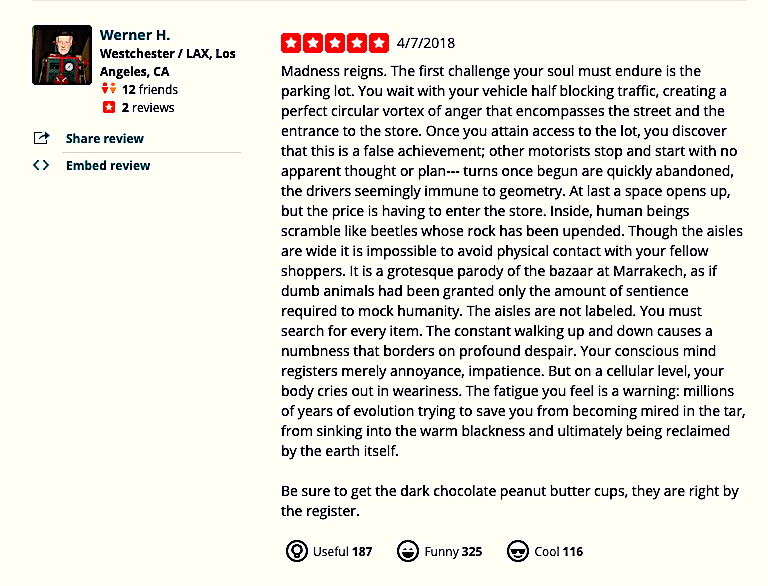
Per­haps guess­ing that Googling his own name is not one of Herzog’s pre­ferred online activ­i­ties, Ander­son took the oppor­tu­ni­ty to hip his guest to come­di­an Paul F. Tomp­kins’ Teu­ton­ic-inflect­ed recita­tion of a noto­ri­ous Yelp review of Trad­er Joe’s in Sil­ver Lake.

To the untrained ear, Tomp­kins’ Her­zog is pitch per­fect.

The spoof’s sub­ject sug­gest­ed that the accent could use improve­ment, but agreed that the text is “very fun­ny.”

And it is, espe­cial­ly giv­en the pedes­tri­an tenor of the same Trad­er Joe’s oth­er 5‑star reviews:

This is the best Trad­er Joe’s loca­tion I’ve been to! Been com­ing here since I was a kid! (I’m 25 now) I’ve moved out of this area but still come to this loca­tion just because it beats the rest of them. — Deb­bie G

TJ is the best!! I’ve been com­ing here for many years, and the food is great!! The employ­ee’s are awe­some! Some of the many things I love to pur­chase here are: salmon balls, smooth­ies like the chia seed straw­ber­ry, pro­tein almond but­ter drinks, coconut smooth­ie, cashew yogurt, south west­ern sal­ad that comes in a bag is BOMB.COM! — Ray­mond M

Tomp­kins tapped Herzog’s fas­ci­na­tion with man’s ani­mal nature and the bru­tal­i­ty of exis­tence for anoth­er Yelp review, award­ing three stars to San Francisco’s Hotel Majes­tic and attribut­ing it to Wern­er H:

Tomp­kins clear­ly savors the oppor­tu­ni­ty to chan­nel Her­zog, log­ging 16 appear­ances for the char­ac­ter on the Com­e­dy Bang Bang pod­cast, includ­ing episodes where­in he dis­cuss­es work­ing with Tom Cruise and his desire to be cast as a clue­less sub­ur­ban hus­band in an appli­ance com­mer­cial. Find them all list­ed here.

Relat­ed Con­tent:

The Dream-Dri­ven Film­mak­ing of Wern­er Her­zog: Watch the Video Essay, “The Inner Chron­i­cle of What We Are: Under­stand­ing Wern­er Her­zog”

Wern­er Her­zog Cre­ates Required Read­ing & Movie View­ing Lists for Enrolling in His Film School

Wern­er Her­zog Offers 24 Pieces of Film­mak­ing and Life Advice

Ayun Hal­l­i­day is an author, illus­tra­tor, the­ater mak­er and Chief Pri­ma­tol­o­gist of the East Vil­lage Inky zine.  Fol­low her @AyunHalliday.

« Go BackMore in this category... »
Quantcast