Today’s Pretty Much Pop features panel of parents: your host Mark Linsenmayer, NY Times Entertainment Writer and Philosophy Professor Lawrence Ware, educator Michelle Parrinello-Cason and pop-culture philosopher Chris Sunami. We take on the mass of largely animated films by Disney, Pixar, Dreamworks, Illumination, etc. We’ve all watched them with our kids, and many adults devour them even in preference to other types of films.
So what’s the underlying ideology of this kind of media? What messages are they conveying, and are these substantial or even coherent? What elements in these films can adults relate to?
We touch on Puss in Boots, Turning Red, Soul, Trolls, Enola Holmes, The Polar Express, toddler edutainment, things we watched as kids, and stories by Roald Dahl, Lewis Carroll and L. Frank Baum. Our hosts recommended The Babysitter’s Club, The Mysterious Benedict Society, the studio Ghibli films, and the Series of Unfortunate Events books.
“Let’s talk about the physics of dead grandmothers.” Thus does theoretical physicist Sabine Hossenfelder start off the Big Think video above, which soon gets into Einstein’s theory of special relativity. The question of how Hossenfelder manages to connect the former to the latter should raise in anyone curiosity enough to give these ten minutes a watch, but she also addresses a certain common category of misconception. It all began, she says, when a young man posed to her the following question: “A shaman told me that my grandmother is still alive because of quantum mechanics. Is this right?”
Upon reflection, Hossenfelder arrived at the conclusion that “it’s not entirely wrong.” For decades now, “quantum mechanics” has been hauled out over and over again to provide vague support to a range of beliefs all along the spectrum of plausibility. But in the dead-grandmother case, at least, it’s not the applicable area of physics. “It’s actually got something to do with Einstein’s theory of special relativity,” she says. With that particular achievement, Einstein changed the way we think about space and time, proving that “everything that you experience, everything that you see, you see as it was a tiny, little amount of time in the past. So how do you know that anything exists right now?”
In Einstein’s description of physical reality, “there is no unambiguous notion to define what happens now; it depends on the observer.” And “if you follow this logic to its conclusion, then the outcome is that every moment could be now for someone. And that includes all moments in your past, and it also includes all moments in your future.” Einstein posits space and time as not two separate concepts, but aspects of a single entity called spacetime, in which “the present moment has no fundamental significance”; in the resulting “block universe,” past, present, and future coexist simultaneously, and no information is ever destroyed, just continually rearranged.
“So if someone you knew dies, then, of course, we all know that you can no longer communicate with this person. That’s because the information that made up their personality disperses into very subtle correlations in the remains of their body, which become entangled with all the particles around them, and slowly, slowly, they spread into radiation that disperses throughout the solar system, and eventually, throughout the entire universe.” But one day could bring “some cosmic consciousnesses which will also be spread out, and this information will be accessible again” — in about a billion years, anyway, which will at least give grandma’s reassembled intelligence plenty to catch up on.
Based in Seoul, Colin Marshall writes and broadcasts on cities, language, and culture. His projects include the Substack newsletterBooks on Cities, the book The Stateless City: a Walk through 21st-Century Los Angeles and the video series The City in Cinema. Follow him on Twitter at @colinmarshall or on Facebook.
“If you want to understand ancient Rome, its architecture, its history, the sprawl of the Roman Empire, you’ve got to go Rome.” So says archaeologist Darius Arya in the video above, making a fair, if obvious, point. “But you also have to go to the Vesuvian cities”: that is, the settlements located near the volcano Mount Vesuvius on the Gulf of Naples. “You have to go to Herculaneum. You must go to Pompeii. Not just because they’re famous, but because of the level of preservation.” This preservation was a side effect of the explosion of Vesuvius in 79 AD, which destroyed all life in Herculaneum and Pompeii, but also kept the basic structures of both cities intact; visiting either one today allows us to “get immersed in the world of the Romans.”
He does so with high-resolution travel footage, but also with his explanations of the city’s architecture and urban planning, breaking down the details of everything from its grand Forum (“anticipating modern practice by almost 2,000 years” as a “pedestrian-only precinct”) to its complexes of baths, to its thermopolia (“essentially ancient fast-food restaurants”). Even more revealing are its humbler features, such as the stepping-stones across streets that allowed citizens to avoid “the rainwater, sewage, and animal waste that would accumulate there.”
“Almost every building in Pompeii has interior wall paintings, from private residences to public spaces such as baths and markets,” says Bravo, and these omnipresent works of art “offer valuable insights into the everyday life and cultural values of ancient Roman society.” (And indeed, they’re still offering new ones: just last month, a rediscovered Pompeiian fresco showed the world an ancient precursor to pizza.) They also evidence the surprising popularity of trompe-l’œil, where artists create the illusion of walls constructed from solid marble, or even lush outdoor spaces. Even the already-grand Domus Romana, the form of housing of choice for affluent Pompeiians, incorporated paintings to look grander still. Even once you make it, as the ancients clearly knew, you’ve still got to fake it.
Based in Seoul, Colin Marshall writes and broadcasts on cities, language, and culture. His projects include the Substack newsletterBooks on Cities, the book The Stateless City: a Walk through 21st-Century Los Angeles and the video series The City in Cinema. Follow him on Twitter at @colinmarshall or on Facebook.
What started as a scheme to get taxpayers on board with pricey rural sewer projects in the 1980s has grown into a countrywide tourist attraction and a matter of civic pride.
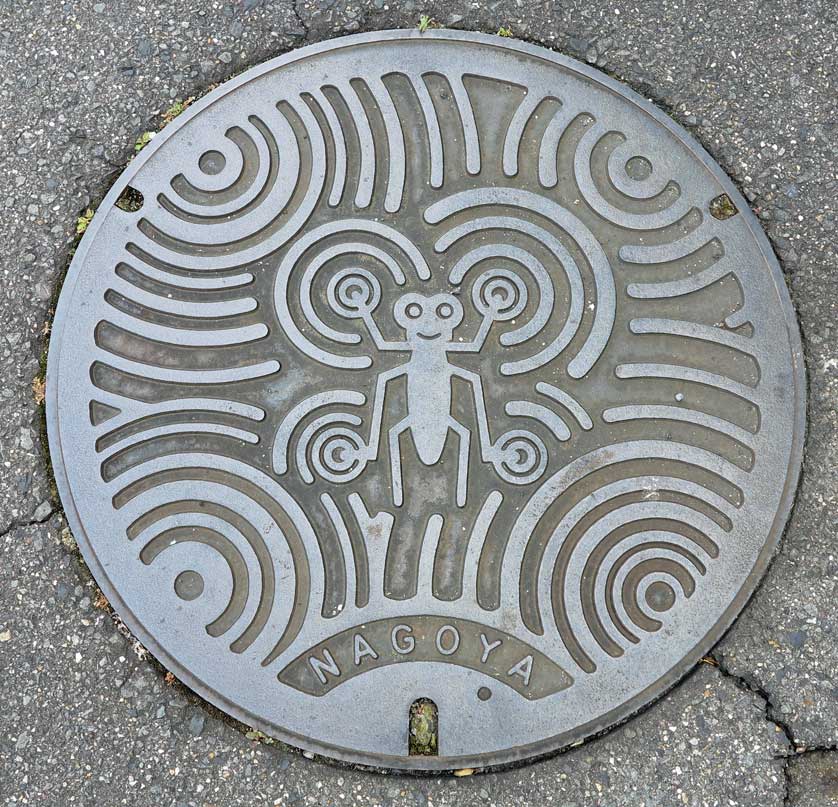
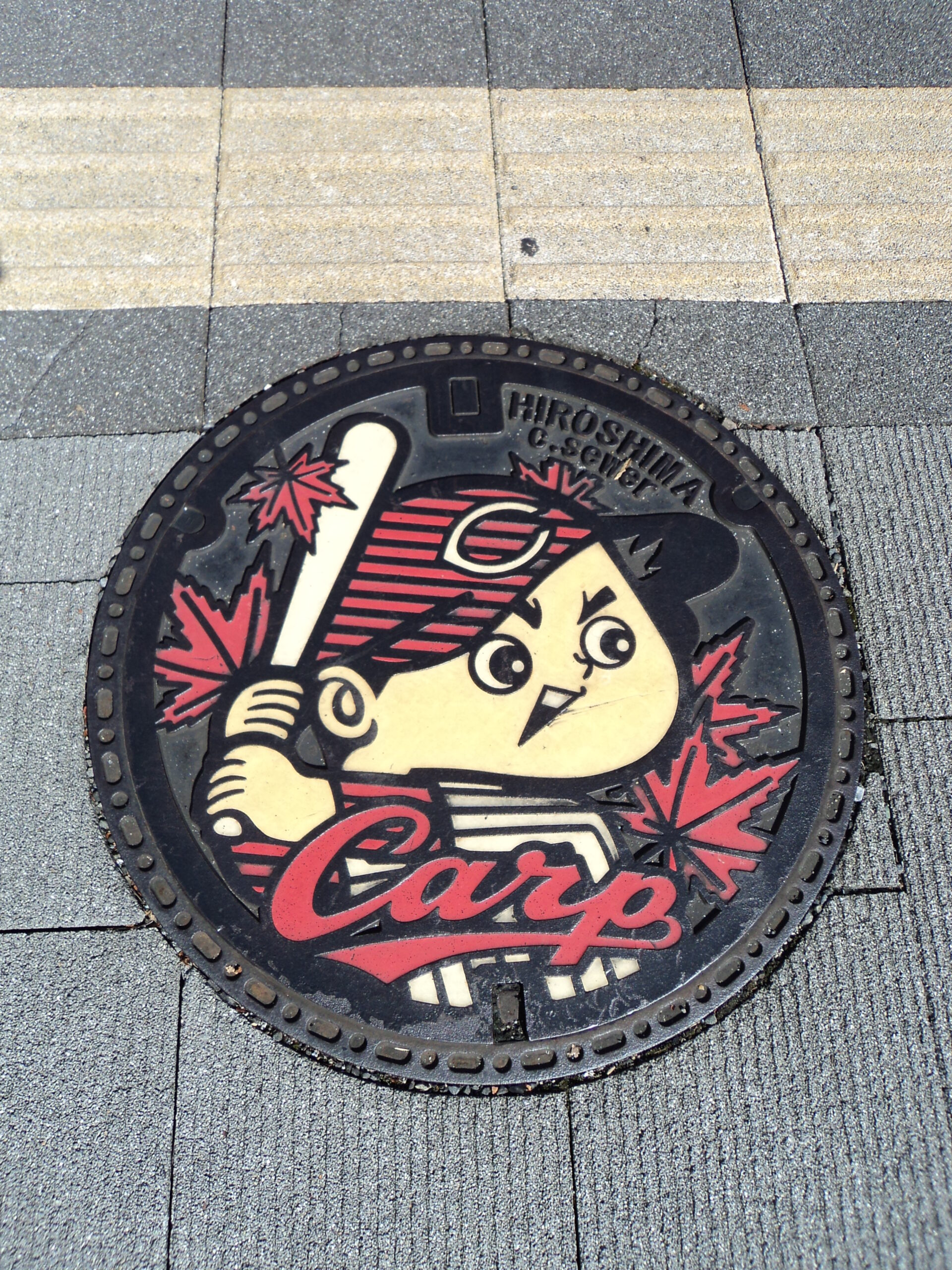
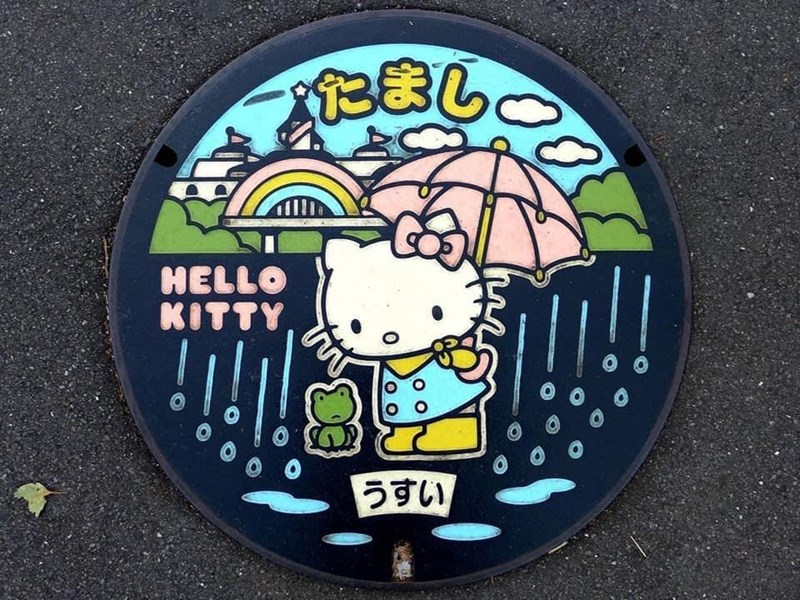
Each municipality boasts its own unique manhole cover designs, inspired by specific regional elements.
A community might opt to rep its local floral or fauna, a famous local landmark or festival, an historic event or bit of folklore.
Matsumoto City highlights one of its popular folk craft souvenirs, the colorful silk temari balls that once served as toys for female children and bridal gifts.
Nagoya touts the purity of its water with a water strider — an insect that requires the most pristine conditions to survive.
Hiroshima pays tribute to its baseball team.
Osaka offers a view of its castle surrounded by cherry blossoms.
Most of Japan’s 15 million artistic manhole covers are monochromatic steel which makes spotting one of the vibrantly colored models even more exciting.
In the fifty some years since their introduction, an entire subculture has emerged. Veteran enthusiast Shoji Morimoto coined the term “manholer” to describe hobbyists participating in this “treasure hunt for adults.”
A lesser advertised joy of working in food service is achieving command of the slang:
Monkey dish…
Deuces and four tops…
Fire, flash, kill…
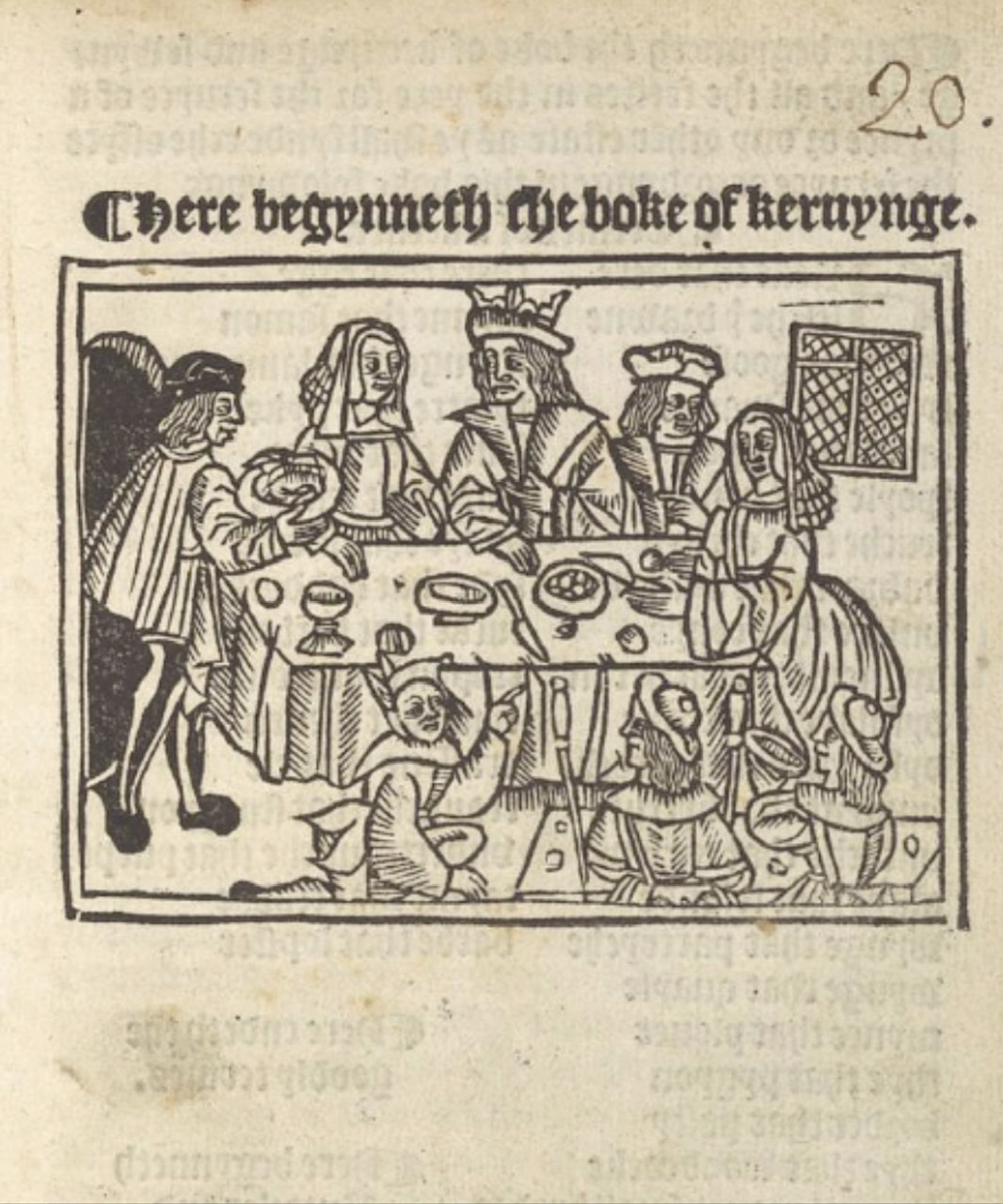
As you may have noticed, we here at Open Culture have an insatiable hunger for vintage lingo and it doesn’t get much more vintage than The Boke of Kervynge (The Book of Carving).
This 1508 manual was published for the benefit of young noblemen who’d been placed in affluent households, to learn the ropes of high society by serving the sovereigns.
Few families could afford to serve meat, let alone whole animals, so understandably, the presentation and carving of these precious entrees was not a thing to be undertaken lightly.
The influential London-based publisher Wynkyn de Worde compiled step-by-step instructions for getting different types of meat, game and fish from kitchen to plate, as well as what to serve on seasonal menus and special occasions like Easter and the Feast of St. John the Baptist.
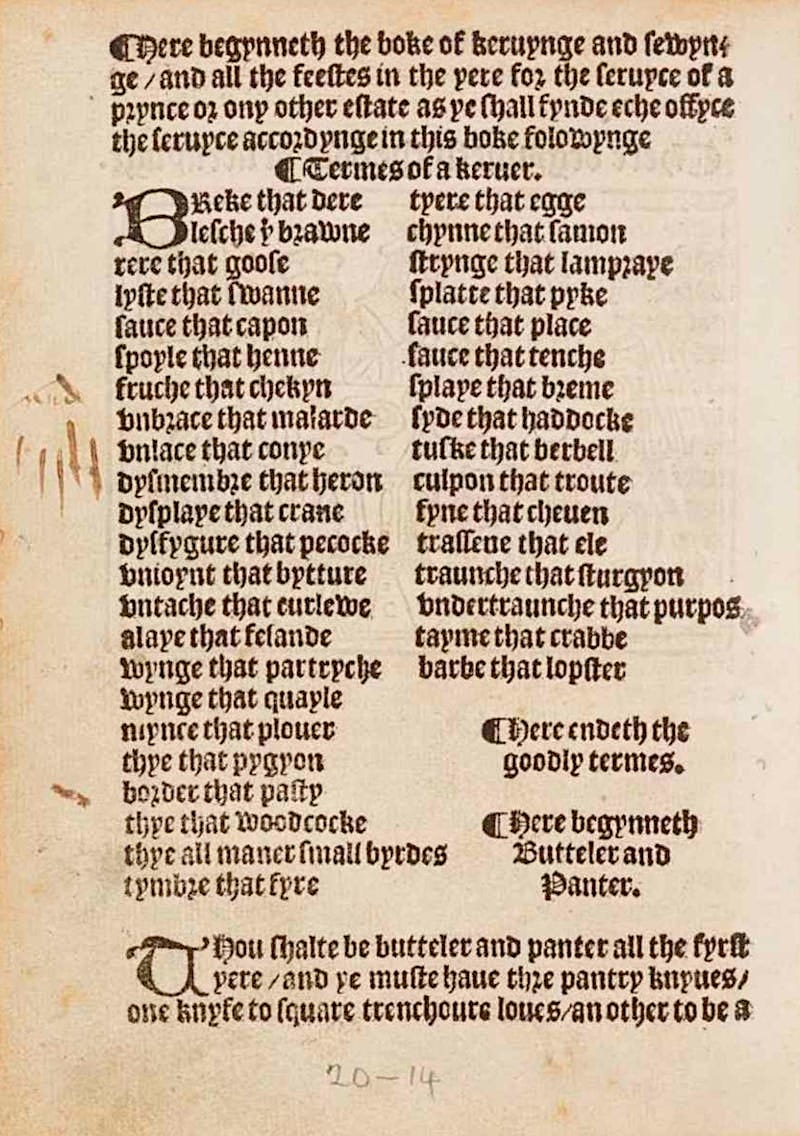
The book opens with the list of “goodly termes” above, essential vocab for any young man eager to prove his skills around the carcass of a deer, goose, or lobster.
There’s nothing here for vegetarians, obviously. And some 21st-century carnivores may find themselves blanching a bit at the thought of tearing into a heron or porpoise.
If, however, you’re a medieval lad tasked with “disfiguring” a peacock, closely observed by an entire dining table of la crème de la crème, The Boke of Kervyngeis a lifesaver.
(It also contains some invaluable tips for meeting expectations should you find yourself in the position of chaumberlayne, Marshall or usher.)
In any event, let’s spice up our vocabulary while rescuing some aged culinary terms from obscurity.
Don’t be surprised if they work their way into an episode of The Bear next season, though you should also feel free to use them metaphorically.
And don’t lose heart if some of the terms are a bit befuddling to modern ears. Lists of Note’s Shaun Usher has taken a stab at truffling up some modern translations for a few of the less familiar sounding words, wisely refraining from hazarding a guess as to the meaning of “fruche that chekyn”.
(It’s not the “chekyn” part giving us pause…)
Termes of a keruer —Terms of a carver
Breke that dere — break that deer
lesche y brawne — leach the brawn
rere that goose — rear that goose
lyft that swanne — lift that swan
sauce that capon — sauce that capon
spoyle that henne — spoil that hen
fruche that chekyn — ? that chicken
vnbrace that malarde — unbrace that mallard
vnlace that cony — unlace that coney
dysmembre that heron — dismember that heron
dysplaye that crane — display that crane
dysfygure that pecocke —disfigure that peacock
vnioynt that bytture — unjoint that bittern
vntache that curlewe — untack that curlew
alaye that fesande — allay that pheasant
wynge that partryche — wing that partridge
wynge that quayle — wing that quail
mynce that plouer — mince that plover
thye that pegyon — thigh that pigeon
border that pasty — border that pasty
thye all maner of small byrdes — thigh all manner of small birds
tymbre that fyre — timber that fire
tyere that egge — tear that egg
chyne that samon — chinethat salmon
strynge that lampraye — string that lamprey
splatte that pyke — splat that pike
sauce that playce — sauce that plaice
sauce that tenche — sauce that tench
splaye that breme — splay that bream
syde that haddocke — side that haddock
tuske that barbell — tusk that barbel
culpon that troute — culponthat trout
fynne that cheuen — fin that cheven
trassene that ele — ? that eel
traunche that sturgyon — tranchethat sturgeon
vndertraunche yt purpos — undertranch that porpoise
Just last month, we featured here on Open Culture the discovery of a Pompeiian fresco purported to depict an ancient ancestor of pizza. For most of us pizza-loving millions — nay, billions — around the world, this was a notable curiosity but for Max Miller, it was clearly a challenge. As the creator of the hit Youtube channel Tasting History, each of whose episodes involves faithful re-creation of dishes from eras past, he couldn’t possibly have ignored this development. But it also poses even stiffer difficulties than most of his culinary projects, providing him not a recipe to work with but a picture, and not a particularly detailed picture at that.
The fresco’s genre is xenia, which, Miller explains in the video above, “comes from the Greek word that referred to a sort of social contract between hosts and guests.” The ancient Roman architect Vitruvius (he whose work inspired Leonardo’s Vitruvian Man) described how the Greeks, after becoming wealthy, “began providing dining rooms, chambers, and storerooms of provisions for their guests.”
The food and drink they brought out for their dinner parties became the subject of xenia artworks like this fresco from Pompeii, which happens to include a familiar-looking round bread. What’s more, “some scholars have suggested that one of the ingredients that probably is on this bread is sort of pizza-like, insofar as it is a kind of spreadable cheese.”
The quality of that ingredient, called moretum, seemingly makes or breaks this ancient pizza, and so Miller spends most of the video explaining its preparation, drawing details from a poem attributed to Virgil. Those following along in their own kitchens will need to gather a couple heads of garlic, large handfuls of parsley and cilantro, a small handful of rue, and ten ounces of white cheese. When you’ve made the moretum, you can bake the Roman bread, loaves of which were preserved by the explosion of Mount Vesuvius, then spread on the moretum and “top it with things like white cheese, dates, pomegranates, or whatever else you saw in the fresco.” Miller notes that actual Pompeiians probably wouldn’t have sliced the final product, but rather picked off and eaten its toppings one-by-one before getting around to the bread: a pizza consumption method practiced by more than a few of us moderns, at least in childhood.
Based in Seoul, Colin Marshall writes and broadcasts on cities, language, and culture. His projects include the Substack newsletterBooks on Cities, the book The Stateless City: a Walk through 21st-Century Los Angeles and the video series The City in Cinema. Follow him on Twitter at @colinmarshall or on Facebook.
Note: Over the weekend, the Princeton philosopher Harry Frankfurt passed away at the age of 94. After a long career, he became the author of the surprise bestselling book, On Bullshit, which we featured in 2016. Please revisit our original post below.
97 percent or more of actively publishing climate scientists agree: Climate-warming trends over the past century are extremely likely due to human activities. In addition, most of the leading scientific organizations worldwide have issued public statements endorsing this position.
In view of such numbers, it’s understandable that a suburban Joe with a freezer full of factory-farmed beef and multiple SUVs in his garage would cling to the position that global warming is a lie. It’s his last resort, really.
But such self-rationalizations are not truth. They are truthiness.
Or to use the old-fashioned word favored by philosopher Harry Frankfurt, above: bullshit!
Frankfurt–a philosopher at Princeton and the author of On Bullshit–allows that bullshit artists are often charming, or at their very least, colorful. They have to be. Achieving their ends involves engaging others long enough to persuade them that they know what they’re talking about, when in fact, that’s the opposite of the truth.
Speaking of opposites, Frankfurt maintains that bullshit is a different beast from an out-and-out lie. The liar makes a specific attempt to conceal the truth by swapping it out for a lie.
The bullshit artist’s approach is far more vague. It’s about creating a general impression.
There are times when I admit to welcoming this sort of manure. As a maker of low budget theater, your honest opinion of any show I have Little Red Hen’ed into existence is the last thing I want to hear upon emerging from the cramped dressing room, unless you truly loved it.
I’d also encourage you to choose your words carefully when dashing a child’s dreams.
But when it comes to matters of public policy, and the public good, yes, transparency is best.
It’s interesting to me that filmmakers James Nee and Christian Britten transformed a portion of their learned subject’s thoughts into voiceover narration for a lightning fast stock footage montage. It’s diverting and funny, featuring such ominous characters as Nosferatu, Bill Clinton, Charlie Chaplin’s Great Dictator, and Donald Trump, but isn’t it also the sort of misdirection sleight of hand at which true bullshitters excel?
Frankfurt expands upon his thoughts on bullshit in his aptly titled bestselling book,On Bullshit and its followup On Truth.
No matter how little we know of the Hindu religion, a line from one of its holy scriptures lives within us all: “Now I am become Death, the destroyer of worlds.” This is one facet of the legacy of J. Robert Oppenheimer, an American theoretical physicist who left an outsized mark on history. For his crucial role in the Manhattan Project that during World War II produced the first nuclear weapons, he’s now remembered as the“father of the atomic bomb.” He secured that title on July 16, 1945, the day of the test in the New Mexican desert that proved these experimental weapons actually work — that is, they could wreak a kind of destruction previously only seen in visions of the end of the world.
“We knew the world would not be the same,” Oppenheimer remembered in 1965. “A few people laughed, a few people cried. Most people were silent. I remembered the line from the Hindu scripture, the Bhagavad Gita; Vishnu is trying to persuade the Prince that he should do his duty and, to impress him, takes on his multi-armed form and says, ‘Now I am become Death, the destroyer of worlds.’ ”
The translation’s grammatical archaism made it even more powerful, resonating with lines in Tennyson (“I am become a name, for always roaming with a hungry heart”), Shakespeare (“I am come to know your pleasure”), and the Bible (“I am come a light into the world, that whosoever believeth on me should not abide in darkness”).
But what is death, as the Gita sees it? In an interview with Wired, Sanskrit scholar Stephen Thompson explains that, in the original, the word that Oppenheimer speaks as “death” refers to “literally the world-destroying time.” This means that “irrespective of what Arjuna does” — Arjuna being the aforementioned prince, the narrative’s protagonist — everything is in the hands of the divine.” Oppenheimer would have learned all this while teaching in the 1930s at UC Berkeley, where he learned Sanskrit and read the Gita in the original. This created in him, said his colleague Isidor Rabi, “a feeling of mystery of the universe that surrounded him like a fog.”
The necessity of the United States’ subsequent dropping of not one but two atomic bombs on Japan, examined in the 1965 documentary The Decision to Drop the Bomb (below), remains a matter of debate. Oppenheimer went on to oppose nuclear weapons, describing himself to an appalled President Harry Truman as having “blood on my hands.” But in developing them, could he have simply seen himself as a modern Prince Arjuna? “It has been argued by scholars,” writes the Economic Times’ Mayank Chhaya, “that Oppenheimer’s approach to the atomic bomb was that of doing his duty as part of his dharma as prescribed in the Gita.” He knew, to quote another line from that scripture brought to mind by the nuclear explosion, that “if the radiance of a thousand suns were to burst into the sky that would be like the splendor of the Mighty One” — and perhaps also that splendor and wrath may be one.
Note: An earlier version of this post appeared on our site in 2020. In the light of the new Oppenheimer film, we’re bringing it back.
Based in Seoul, Colin Marshall writes and broadcasts on cities, language, and culture. His projects include the book The Stateless City: a Walk through 21st-Century Los Angeles and the video series The City in Cinema. Follow him on Twitter at @colinmarshall, on Facebook, or on Instagram.
We're hoping to rely on loyal readers, rather than erratic ads. Please click the Donate button and support Open Culture. You can use Paypal, Venmo, Patreon, even Crypto! We thank you!
Open Culture scours the web for the best educational media. We find the free courses and audio books you need, the language lessons & educational videos you want, and plenty of enlightenment in between.