J. Robert Oppenheimer Explains How, Upon Witnessing the First Nuclear Explosion, He Recited a Line from the Bhagavad Gita: “Now I Am Become Death, the Destroyer of Worlds”

No mat­ter how lit­tle we know of the Hin­du reli­gion, a line from one of its holy scrip­tures lives with­in us all: “Now I am become Death, the destroy­er of worlds.” This is one facet of the lega­cy of J. Robert Oppen­heimer, an Amer­i­can the­o­ret­i­cal physi­cist who left an out­sized mark on his­to­ry. For his cru­cial role in the Man­hat­tan Project that dur­ing World War II pro­duced the first nuclear weapons, he’s now remem­bered as the“father of the atom­ic bomb.” He secured that title on July 16, 1945, the day of the test in the New Mex­i­can desert that proved these exper­i­men­tal weapons actu­al­ly work — that is, they could wreak a kind of destruc­tion pre­vi­ous­ly only seen in visions of the end of the world.

“We knew the world would not be the same,” Oppen­heimer remem­bered in 1965. “A few peo­ple laughed, a few peo­ple cried. Most peo­ple were silent. I remem­bered the line from the Hin­du scrip­ture, the Bha­gavad Gita; Vish­nu is try­ing to per­suade the Prince that he should do his duty and, to impress him, takes on his mul­ti-armed form and says, ‘Now I am become Death, the destroy­er of worlds.’ ”

The trans­la­tion’s gram­mat­i­cal archaism made it even more pow­er­ful, res­onat­ing with lines in Ten­nyson (“I am become a name, for always roam­ing with a hun­gry heart”), Shake­speare (“I am come to know your plea­sure”), and the Bible (“I am come a light into the world, that whoso­ev­er believeth on me should not abide in dark­ness”).

But what is death, as the Gita sees it? In an inter­view with Wired, San­skrit schol­ar Stephen Thomp­son explains that, in the orig­i­nal, the word that Oppen­heimer speaks as “death” refers to “lit­er­al­ly the world-destroy­ing time.” This means that “irre­spec­tive of what Arju­na does” — Arju­na being the afore­men­tioned prince, the nar­ra­tive’s pro­tag­o­nist — every­thing is in the hands of the divine.” Oppen­heimer would have learned all this while teach­ing in the 1930s at UC Berke­ley, where he learned San­skrit and read the Gita in the orig­i­nal. This cre­at­ed in him, said his col­league Isidor Rabi, “a feel­ing of mys­tery of the uni­verse that sur­round­ed him like a fog.”

The neces­si­ty of the Unit­ed States’ sub­se­quent drop­ping of not one but two atom­ic bombs on Japan, exam­ined in the 1965 doc­u­men­tary The Deci­sion to Drop the Bomb (below), remains a mat­ter of debate. Oppen­heimer went on to oppose nuclear weapons, describ­ing him­self to an appalled Pres­i­dent Har­ry Tru­man as hav­ing “blood on my hands.” But in devel­op­ing them, could he have sim­ply seen him­self as a mod­ern Prince Arju­na? “It has been argued by schol­ars,” writes the Eco­nom­ic Times’ Mayank Chhaya, “that Oppen­heimer’s approach to the atom­ic bomb was that of doing his duty as part of his dhar­ma as pre­scribed in the Gita.” He knew, to quote anoth­er line from that scrip­ture brought to mind by the nuclear explo­sion, that “if the radi­ance of a thou­sand suns were to burst into the sky that would be like the splen­dor of the Mighty One” — and per­haps also that splen­dor and wrath may be one.

Note: An ear­li­er ver­sion of this post appeared on our site in 2020. In the light of the new Oppen­heimer film, we’re bring­ing it back.

Relat­ed Con­tent:

Oppen­heimer: The Man Behind the Bomb

The “Shad­ow” of a Hiroshi­ma Vic­tim, Etched into Stone, Is All That Remains After 1945 Atom­ic Blast

Haunt­ing Unedit­ed Footage of the Bomb­ing of Nagasa­ki (1945)

63 Haunt­ing Videos of U.S. Nuclear Tests Now Declas­si­fied and Put Online

53 Years of Nuclear Test­ing in 14 Min­utes: A Time Lapse Film by Japan­ese Artist Isao Hashimo­to

Based in Seoul, Col­in Mar­shall writes and broad­casts on cities, lan­guage, and cul­ture. His projects include the book The State­less City: a Walk through 21st-Cen­tu­ry Los Ange­les and the video series The City in Cin­e­ma. Fol­low him on Twit­ter at @colinmarshall, on Face­book, or on Insta­gram.

by | Permalink | Make a Comment ( 4 ) |

Wes Anderson Explains How He Built Asteroid City, the Fictional American Desert Town in His New Film

Wes Ander­son­’s lat­est pic­ture Aster­oid City is named for the small Ari­zona town (pop­u­la­tion: 87) in which its cen­tral sto­ry takes place. That town, in turn, is named for the inci­dent that made it (mod­est­ly) famous: the impact of an aster­oid that left behind a large crater. That crater was one of the fea­tures that Ander­son and his pro­duc­tion design­ers had to make for the shoot — but then, so was every­thing else in Aster­oid City, which had to be raised whole in an out-of-the-way area of Spain. Unlike­ly though it may sound in itself, the cin­e­mat­ic project of re-cre­at­ing the Amer­i­can West in south­ern Europe isn’t with­out prece­dent: the “Spaghet­ti West­erns” of the nine­teen-six­ties and sev­en­ties also relied on the Span­ish desert to pro­vide the right atmos­phere of sub­lime des­o­la­tion.

Just as movies like A Fist­ful of Dol­lars or Djan­go are root­ed in a cer­tain con­cep­tion of the sec­ond half of the nine­teenth cen­tu­ry, so Aster­oid City is root­ed in a cer­tain con­cep­tion of the mid­dle of the twen­ti­eth. This comes through most clear­ly in the archi­tec­ture of their sets.

“The thing was to try to make build­ings that were as evoca­tive of the time as we pos­si­bly could,” Ander­son says in the short mak­ing-of video above. But this thor­ough­ly mid­cen­tu­ry-provin­cial set­ting also need­ed its mys­te­ri­ous ele­ments: the crater, of course, but also the obser­va­to­ry and “the free­way on-ramp there that goes to nowhere.” The ful­ly assem­bled Aster­oid City felt like not just a set, but some­thing approach­ing an actu­al place: “Once it was built, we could be a tiny group in this what seemed like an aban­doned town.”

Any­one who’s spent enough time road-trip­ping across the Unit­ed States of Amer­i­ca will rec­og­nize that, con­ti­nen­tal loca­tion notwith­stand­ing, Aster­oid City cap­tures some­thing essen­tial about that coun­try’s more remote set­tle­ments, inhab­it­ed or not, locat­ed in arid regions or oth­er­wise. This required the fab­ri­ca­tion of not just build­ings but the flo­ra, fau­na, and geo­log­i­cal for­ma­tions of an entire land­scape, prac­ti­cal­ly all of it adher­ent to Ander­son­’s sig­na­ture hand­made aes­thet­ic scheme, which some­how con­vinces through arti­fi­cial­i­ty. Even detrac­tors of Ander­son­’s work sure­ly derive plea­sure from the result­ing qual­i­ty of sheer phys­i­cal­i­ty, some of which also owes to his still shoot­ing on good old 35-mil­lime­ter film — as this video’s pub­lish­er, Kodak, does­n’t hes­i­tate to remind us.

via Laugh­ing Squid

Relat­ed con­tent:

How Wes Ander­son Uses Minia­tures to Cre­ate His Aes­thet­ic: A Primer from His Mod­el Mak­er & Prop Painter

Wes Ander­son Movie Sets Recre­at­ed in Cute, Minia­ture Dio­ra­mas

Wes Ander­son Explains How He Writes and Directs Movies, and What Goes Into His Dis­tinc­tive Film­mak­ing Style

Pho­tog­ra­ph­er Revis­its Aban­doned Movie Sets for Star Wars and Oth­er Clas­sic Films in North Africa

A Star Wars Film Made in a Wes Ander­son Aes­thet­ic

Based in Seoul, Col­in Marshall writes and broad­casts on cities, lan­guage, and cul­ture. His projects include the Sub­stack newslet­ter Books on Cities, the book The State­less City: a Walk through 21st-Cen­tu­ry Los Ange­les and the video series The City in Cin­e­ma. Fol­low him on Twit­ter at @colinmarshall or on Face­book.

You Can Get Open Culture Posts on Threads, Bluesky & Other Social Media Platforms

As Twit­ter decays, we want to remind you that you can find posts from Open Cul­ture on oth­er social media plat­forms. Find us now on Threads, where have 900+ fol­low­ers in the first 24 hours. We’re also on Blue Sky and Face­book. Or get our dai­ly email newslet­ter. Pick your favorite and keep tabs on our dai­ly posts.…

by | Permalink | Make a Comment ( 5 ) |

The First Known Photograph of People Having a Beer (1843)

It should go with­out say­ing that one should drink respon­si­bly, for rea­sons per­tain­ing to life and limb as well as rep­u­ta­tion. The ubiq­ui­ty of still and video cam­eras means poten­tial­ly embar­rass­ing moments can end up on mil­lions of screens in an instant, copied, down­loaded, and saved for pos­ter­i­ty. Not so dur­ing the infan­cy of pho­tog­ra­phy, when it was a painstak­ing process with min­utes-long expo­sure times and arcane chem­i­cal devel­op­ment meth­ods. Pho­tograph­ing peo­ple gen­er­al­ly meant keep­ing them as still as pos­si­ble for sev­er­al min­utes, a require­ment that ren­dered can­did shots next to impos­si­ble.

We know the results of these ear­ly pho­to­graph­ic por­trai­ture from many a famous Daguerreo­type, named for its French inven­tor, Louis-Jacques-Mandé Daguerre. At the same time, dur­ing the 1830s and 40s, anoth­er process gained pop­u­lar­i­ty in Eng­land, called the Calo­type—or “Tal­bo­type,” for its inven­tor William Hen­ry Fox Tal­bot. “Upon hear­ing of the advent of the Daguerreo­type in 1839,” writes Linz Welch at the Unit­ed Pho­to­graph­ic Artists Gallery site, Tal­bot “felt moved to action to ful­ly refine the process that he had begun work on. He was able to short­en his expo­sure times great­ly and start­ed using a sim­i­lar form of cam­era for expo­sure on to his pre­pared paper neg­a­tives.”

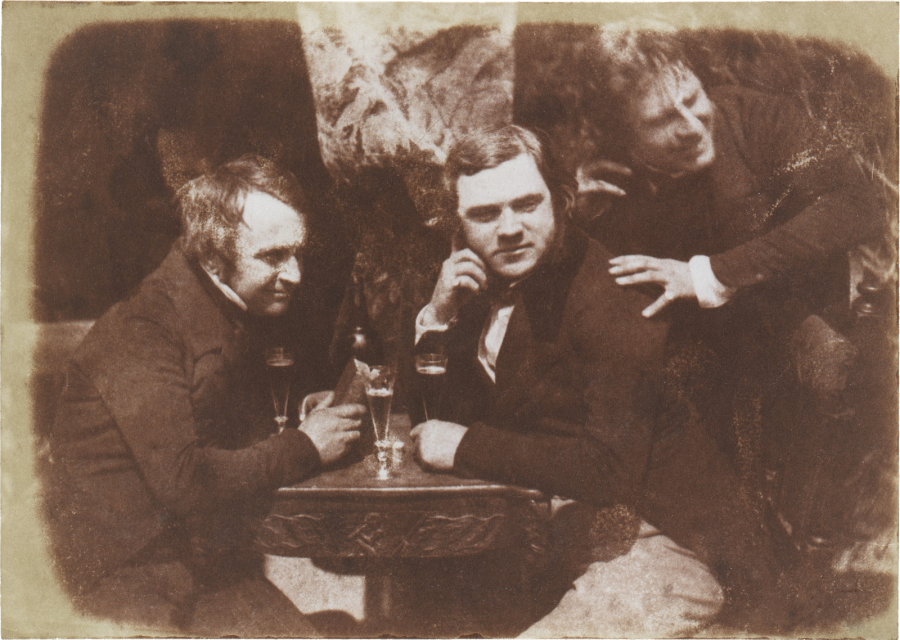
This last fea­ture made the Calo­type more ver­sa­tile and mechan­i­cal­ly repro­ducible. And the short­ened expo­sure times seemed to enable some greater flex­i­bil­i­ty in the kinds of pho­tographs one could take. In the 1843 pho­to above, we have what appears to be an entire­ly unplanned group­ing of rev­el­ers, caught in a moment of cheer at the pub. Cre­at­ed by Scot­tish painter-pho­tog­ra­phers Robert Adam­son and David Octavius Hill—who grins, half-stand­ing, on the right—the image looks like almost no oth­er por­trait from the time. Rather than sit­ting rigid­ly, the fig­ures slouch casu­al­ly; rather than look­ing grim and mourn­ful, they smile and smirk, appar­ent­ly shar­ing a joke. The pho­to­graph is believed to be the first image of alco­holic con­sump­tion, and it does its sub­ject jus­tice.

Though Tal­bot patent­ed his Calo­type process in Eng­land in 1841, the restric­tions did not apply in Scot­land. “In fact,” the Met­ro­pol­i­tan Muse­um of Art writes, “Tal­bot encour­aged its use there.” He main­tained a cor­re­spon­dence with inter­est­ed sci­en­tists, includ­ing Adamson’s old­er broth­er John, a pro­fes­sor of chem­istry. But the Calo­type was more of an artists’ medi­um. Where Daguerreo­types pro­duced, Welch writes, “a star­tling resem­blance of real­i­ty,” with clean lines and even tones, the Calo­type, with its salt print, “tend­ed to have high con­trast between lights and darks…. Addi­tion­al­ly, because of the paper fibers, the image would present with a grain that would dif­fuse the details.” We see this espe­cial­ly in the cap­tur­ing of Octavius Hill, who appears both life­like in motion and ren­dered artis­ti­cal­ly with char­coal or brush.

The oth­er two figures—James Bal­lan­tine, writer, stained-glass artist, and son of an Edin­burgh brew­er, and Dr. George Bell, in the center—have the rak­ish air of char­ac­ters in a William Hog­a­rth scene. The Nation­al Gal­leries of Scot­land attrib­ut­es the nat­u­ral­ness of these pos­es to “Hill’s socia­bil­i­ty, humour and his capac­i­ty to gauge the sit­ters’ char­ac­ters.” Sure­ly the booze did its part in loos­en­ing every­one up. The three men are said to be drink­ing Edin­burgh Ale, “accord­ing to a con­tem­po­rary account… ‘a potent flu­id, which almost glued the lips of the drinker togeth­er.’ ” Such a side effect would, at least, make it extreme­ly dif­fi­cult to over-imbibe.

Note: An ear­li­er ver­sion of this post appeared on our site in 2017.

If you would like to sign up for Open Culture’s free email newslet­ter, please find it here. It’s a great way to see our new posts, all bun­dled in one email, each day.

If you would like to sup­port the mis­sion of Open Cul­ture, con­sid­er mak­ing a dona­tion to our site. It’s hard to rely 100% on ads, and your con­tri­bu­tions will help us con­tin­ue pro­vid­ing the best free cul­tur­al and edu­ca­tion­al mate­ri­als to learn­ers every­where. You can con­tribute through Pay­Pal, Patre­on, and Ven­mo (@openculture). Thanks!

Relat­ed Con­tent

The First Pho­to­graph Ever Tak­en (1826)

See The First “Self­ie” In His­to­ry Tak­en by Robert Cor­nelius, a Philadel­phia Chemist, in 1839

See the First Pho­to­graph of a Human Being: A Pho­to Tak­en by Louis Daguerre (1838)

The First Faked Pho­to­graph (1840)

Behold the Very First Col­or Pho­to­graph (1861): Tak­en by Scot­tish Physi­cist (and Poet!) James Clerk Maxwell

Josh Jones is a writer and musi­cian based in Durham, NC. Fol­low him at @jdmagness

The Oldest Known Footage of London (1890–1920) Features the City’s Great Landmarks

The City of Lon­don has explod­ed like Blade Run­ner in the last cou­ple of decades with glass and con­crete and shrines to glob­al cap­i­tal­ism like St. Mary Axe (aka the Gherkin) and the Shard (aka the Shard). But has the view from the ground stayed the same? Accord­ing to this charm­ing then vs. now video assem­bled by a com­pa­ny called Yester­Vid, yes.

Trawl­ing through the old­est sur­viv­ing pub­lic domain footage from the ear­ly days of film (1890 — 1920), the video­g­ra­phers have placed old and mod­ern-day shots side by side, match­ing as close as they can cam­era place­ment and lens.

Miss­ing from today: the soot, the filth in the gut­ter, and the free-for-all in the streets as horse-drawn car­riages and ear­ly busses bat­tled it out with pedes­tri­ans. Streets are safer now, with rail­ings to pro­tect cit­i­zens, though the signs of increased secu­ri­ty are also appar­ent, and CCTV cam­eras are most prob­a­bly film­ing the director…somewhere!

St. Paul’s still needs room to breathe, and while the Empire The­atre may not show any more Lumiere Cin­e­matogra­phies, it’s still a cin­e­ma show­ing IMAX films. It didn’t suf­fer the fate of many cin­e­mas out­side of Lon­don after the ‘60s: being turned into bin­go halls or just torn down.

Also: the sea of red pop­pies seen at 4:28 dur­ing the shot of the Tow­er of London’s moat is an instal­la­tion work by artist Paul Cum­mins. Blood Swept Lands and Seas of Red was installed between July and Novem­ber of 2014 and, accord­ing to Wikipedia, it con­sist­ed of 888,246 ceram­ic red pop­pies, each intend­ed to rep­re­sent one British or Colo­nial ser­vice­man killed in the Great War.

Final point: the old­est pub in Lon­don, Ye Olde Cheshire Cheese, still stands, and dur­ing the swel­ter­ing sum­mers pro­vides a cool respite, as most of its drink­ing rooms are under­ground. Cheers!

Note: An ear­li­er ver­sion of this post appeared on our site in 2015.

If you would like to sign up for Open Culture’s free email newslet­ter, please find it here. It’s a great way to see our new posts, all bun­dled in one email, each day.

If you would like to sup­port the mis­sion of Open Cul­ture, con­sid­er mak­ing a dona­tion to our site. It’s hard to rely 100% on ads, and your con­tri­bu­tions will help us con­tin­ue pro­vid­ing the best free cul­tur­al and edu­ca­tion­al mate­ri­als to learn­ers every­where. You can con­tribute through Pay­Pal, Patre­on, and Ven­mo (@openculture). Thanks!

Relat­ed Con­tent:

Ani­ma­tions Visu­al­ize the Evo­lu­tion of Lon­don and New York: From Their Cre­ation to the Present Day

The Growth of Lon­don, from the Romans to the 21st Cen­tu­ry, Visu­al­ized in a Time-Lapse Ani­mat­ed Map

Fly Through 17th-Cen­tu­ry London’s Grit­ty Streets with Prize-Win­ning Ani­ma­tions

Ted Mills is a free­lance writer on the arts who cur­rent­ly hosts the FunkZone Pod­cast. You can also fol­low him on Twit­ter at @tedmills, read his oth­er arts writ­ing at tedmills.com and/or watch his films here.

George Bernard Shaw’s Famous Writing Hut, Which Could Be Rotated 360 Degrees to Catch the Sun All Day

Sev­en decades after his death, George Bernard Shaw is remem­bered for his prodi­gious body of work as a play­wright, but also — and at least as much — for his per­son­al eccen­tric­i­ties: the then-unfash­ion­able tee­to­tal­ing veg­e­tar­i­an­ism, the rejec­tion of vac­cines and even the germ the­o­ry of dis­ease, the all-wool wardrobe. Thus, even those casu­al­ly famil­iar with Shaw’s life and work may not be ter­ri­bly sur­prised to learn that he not only had an out­build­ing in which to do his work, but an out­build­ing that could be rotat­ed 360 degrees. “Shaw’s writ­ing refuge was a six-square-meter wood­en sum­mer­house, orig­i­nal­ly intend­ed for his wife Char­lotte,” writes Idler’s Alex John­son. “Built on a revolv­ing base that used cas­tors on a cir­cu­lar track,” it was “essen­tial­ly a shed on a lazy Susan.”

The hut became a part of Shaw’s for­mi­da­ble pub­lic image in a peri­od of the ear­ly twen­ti­eth cen­tu­ry “when there was a grow­ing appre­ci­a­tion of idyl­lic rur­al set­tings — a knock-on effect of which was that peo­ple had gar­den build­ings installed. Shaw made the most of this move­ment, pro­mot­ing him­self as a reclu­sive thinker toil­ing in his rus­tic shel­ter, away from the intru­sions of press and peo­ple alike, while at the same time invit­ing in news­pa­pers and mag­a­zines and pos­ing for pho­tos.”

In 1929, “Shaw stood in front of his hut for a pho­to for Mod­ern Mechan­ics & Inven­tions mag­a­zine to pro­mote the idea of sun­light as a heal­ing agent.” Hence the impor­tance of rotat­ing to catch its rays all day long through win­dows made of Vita­glass, “a recent inven­tion that allowed UV rays to come through, let­ting, the mak­ers said, ‘health into the build­ing.’ ”

How­ev­er odd some of Shaw’s views and prac­tices, one can’t help but imag­ine that at least some of them con­tributed to his longevi­ty. The 1946 British Pathé news­reel above pays him a vis­it just a few years before his death at the age of 94, find­ing him still writ­ing (he still had the play Buoy­ant Bil­lions ahead of him, as well as sev­er­al oth­er mis­cel­la­neous works), and what’s more, doing so in his hut: “Like G. B. S. him­self,” says the nar­ra­tor, “it pre­tends to be strict­ly prac­ti­cal, with no non­sense about it.” Yet Shaw seems to have had a sense of humor about his the­o­ret­i­cal­ly hum­ble work­space, nam­ing it after the Eng­lish cap­i­tal so that unwant­ed vis­i­tors to his home in the vil­lage of Ayot St Lawrence could be told, not untruth­ful­ly, that he was in Lon­don. But one nat­u­ral­ly won­ders: when he rang up the main house with his in-hut tele­phone (anoth­er of its high­ly advanced fea­tures), did his house­keep­er say it was Lon­don call­ing?

via Messy Nessy

Relat­ed con­tent:

Roald Dahl Gives a Tour of the Small Back­yard Hut Where He Wrote All of His Beloved Children’s Books

The Cork-Lined Bed­room & Writ­ing Room of Mar­cel Proust, the Orig­i­nal Mas­ter of Social Dis­tanc­ing

Clas­sic Mon­ty Python: Oscar Wilde and George Bernard Shaw Engage in a Hilar­i­ous Bat­tle of Wits

Who Wrote at Stand­ing Desks? Kierkegaard, Dick­ens and Ernest Hem­ing­way Too

The Dai­ly Habits of Famous Writ­ers: Franz Kaf­ka, Haru­ki Muraka­mi, Stephen King & More

When the Indi­ana Bell Build­ing Was Rotat­ed 90° While Every­one Worked Inside in 1930 (by Kurt Vonnegut’s Archi­tect Dad)

Based in Seoul, Col­in Marshall writes and broad­casts on cities, lan­guage, and cul­ture. His projects include the Sub­stack newslet­ter Books on Cities, the book The State­less City: a Walk through 21st-Cen­tu­ry Los Ange­les and the video series The City in Cin­e­ma. Fol­low him on Twit­ter at @colinmarshall or on Face­book.

Download Instructions for More Than 6,800 LEGO Kits at the Internet Archive

We’ve all come across a LEGO set from child­hood and felt the temp­ta­tion to try build­ing it one more time — mak­ing the gen­er­ous assump­tion, of course, that all the pieces are in the box, to say noth­ing of the instruc­tions. If you’re miss­ing a few bricks, you can always turn to the robust sec­ondary mar­ket in LEGO com­po­nents. If you’re miss­ing the man­u­al, there’s now one place you should look first: the LEGO build­ing instruc­tions col­lec­tion at the Inter­net Archive. There you’ll find dig­i­tized mate­ri­als for more than 6,800 dif­fer­ent sets, includ­ing such pop­u­lar releas­es as the LEGO Chevro­let Camaro Z28, the LEGO Inter­na­tion­al Space Sta­tion, and the LEGO cov­er pho­to of Meet the Bea­t­les.

Since they were first brought to mar­ket in the late nine­teen-fifties, LEGO’s sig­na­ture build­ing bricks have been pri­mar­i­ly con­sid­ered chil­dren’s toys. And of course, most of us got to know LEGO in child­hood; I myself have fond mem­o­ries of work­ing my way up to the Ice Plan­et 2002 series, with its still much-ref­er­enced trans­par­ent orange chain­saws.

But even after com­ing of age, the seri­ous enthu­si­ast need not leave LEGO behind: the com­pa­ny has put out such adult-ori­ent­ed mod­els as the Colos­se­um, Andy Warhol’s Mar­i­lyn Mon­roe, the Eif­fel Tow­er, and the Solomon R. Guggen­heim Muse­um, to name just a few whose instruc­tions are down­load­able from the Inter­net Archive.

The Metafil­ter dis­cus­sion of the Inter­net Archive’s LEGO build­ing instruc­tions col­lec­tion reveals not only that some are excit­ed indeed about the exis­tence of this resource, but also that oth­ers con­sid­er build­ing from instruc­tions to be a mis­use of the medi­um. It may be true that fol­low­ing spe­cif­ic doc­u­ment­ed steps for hours on end may encour­age a cer­tain slack­en­ing of the imag­i­na­tion. But then, it may also be true that phys­i­cal­ly work­ing one’s way through a com­plex assem­bly process can build dex­ter­i­ty and gen­er­ate ideas for lat­er freeform con­struc­tions. How­ev­er we approach LEGO, and what­ev­er age at which we approach it, we need only keep in mind the Dan­ish imper­a­tive that gave the com­pa­ny its name: leg godt — play well. Enter the col­lec­tion of instruc­tions here.

via Metafil­ter

Relat­ed con­tent:

Hokusai’s Icon­ic Print The Great Wave off Kana­gawa Recre­at­ed with 50,000 LEGO Bricks

The LEGO Tur­ing Machine Gives a Quick Primer on How Your Com­put­er Works

The Vin­cent van Gogh Star­ry Night LEGO Set Is Now Avail­able: It’s Cre­at­ed in Col­lab­o­ra­tion with MoMA

With 9,036 Pieces, the Roman Colos­se­um Is the Largest LEGO Set Ever

Ai Wei­wei Recre­ates Monet’s Water Lilies Trip­tych Using 650,000 Lego Bricks

Why Did LEGO Become a Media Empire? Pret­ty Much Pop: A Cul­ture Pod­cast #37

Based in Seoul, Col­in Marshall writes and broad­casts on cities, lan­guage, and cul­ture. His projects include the Sub­stack newslet­ter Books on Cities, the book The State­less City: a Walk through 21st-Cen­tu­ry Los Ange­les and the video series The City in Cin­e­ma. Fol­low him on Twit­ter at @colinmarshall or on Face­book.

How Olive Oil Was Made in Ancient Rome in the Middle Ages (Plus in Modern Times)

If you think cannabis pos­sess­es a broad range of appli­ca­tions, olive oil is going to blow your mind!

Humans have been hip to this mir­a­cle elixir since approx­i­mate­ly 2500 BCE, when Mediter­ranean dwellers used it as lamp fuel and to anoint roy­al­ty, war­riors, and oth­er VIPs. (Not for noth­ing does “mes­si­ah” trans­late to “the anoint­ed one”…)

Its culi­nary appli­ca­tions entered the mix between the 5th and 4th cen­turies BCE.

Even amur­ca, the bit­ter tast­ing, foul smelling liq­uid byprod­uct of the oil press­ing process had numer­ous things to rec­om­mend it, as least as far as the ancient Romans were con­cerned. They used it as a fer­til­iz­er, a pes­ti­cide, a floor plas­ter, a sealant for jars, a fire accel­er­ant, moth repel­lent, axel grease, a sur­face var­nish, a nutri­tion­al sup­ple­ment for live­stock, and a rem­e­dy for skin dis­eases and infec­tions.

It’s also a seri­ous pol­lu­tant, so good on them for divert­ing it from the land­fill.

Meth­ods for extract­ing this prac­ti­cal, nutri­tion­al pow­er­house from the olive fruit have evolved over time.

Bronze Age fres­coes and ancient papyri doc­u­ment the ear­li­est approach.

The Romans and Greeks took things up a notch with mechan­i­cal press­es, such as the repli­ca at the Bib­li­cal His­to­ry Cen­ter, above.

In an episode of his Nation­al Geo­graph­ic Unchart­ed series, chef Gor­don Ram­say trav­eled to Moroc­co to take a turn at one of the man­u­al­ly-turned stone grind­ing wheels that were the Mid­dle Ages’ con­tri­bu­tion to the his­to­ry of olive oil, dis­cov­er­ing in the process that such “bloody hard work” is bet­ter accom­plished by an ass.

His labors were reward­ed with a taste of olive oil straight from the press - oh my lord, that is beau­ti­ful! I’ve heard of extra vir­gin but this is gonna be extra-extra vir­gin!

Insid­er Food tracks olive oil to the 21st cen­tu­ry, where pro­duc­tion is under­way at a mill in Monop­o­li in the south­ern Ital­ian region of Puglia, an area where olive trees out­num­ber humans, 15 to 1.

Puglia’s 1,000-plus mills sup­ply 40% of the country’s olive oil pro­duc­tion, and 12% world­wide.

Con­tem­po­rary olive oil mak­ers obtain a tra­di­tion­al qual­i­ty prod­uct by split­ting the dif­fer­ence between the ancient and the mod­ern, with con­vey­or belts fer­ry­ing the fruit to a vat where machine-dri­ven gran­ite wheels crush them to a pulp.

It’s less pic­turesque, but also more effi­cient and hygien­ic than pre-Indus­tri­al meth­ods, thanks, in part, to rub­ber gloves and stain­less steel.

Grad­ing oil accord­ing to its puri­ty is also a mod­ern inno­va­tion, pro­vid­ing con­sumers a han­dle qual­i­ty, taste and health attrib­ut­es.

Learn more about the his­to­ry of olive oil here, then get cookin’!

Relat­ed Con­tent

Vis­it Monte Tes­tac­cio, the Ancient Roman Hill Made of 50 Mil­lion Crushed Olive Oil Jugs

3,000-Year-Old Olive Tree on the Greek Island of Crete Still Pro­duces Olives Today

Cook Real Recipes from Ancient Rome: Ostrich Ragoût, Roast Wild Boar, Nut Tarts & More

– Ayun Hal­l­i­day is the Chief Pri­ma­tol­o­gist of the East Vil­lage Inky zine and author, most recent­ly, of Cre­ative, Not Famous: The Small Pota­to Man­i­festo and Cre­ative, Not Famous Activ­i­ty Book. Fol­low her @AyunHalliday.

« Go BackMore in this category... »
Quantcast