James Hoffmann, the author of The World Atlas of Coffee and the creator of a coffee-centric YouTube channel, can tell you many things about coffee—from how to roast coffee, to the tools and techniques needed to make espresso, to the ultimate French Press technique. Then he can also get into more tangentially related questions, like why coffee makes you drop the proverbial deuce. Above, Mr. Hoffmann takes you on a short scientific journey through the human body, exploring the effects of coffee on digestion, gut bacteria, and our nervous system. We’ll provide no spoilers or gory details here.
The youngest moviegoers today do not, of course, remember a time before visual effects could be created digitally. What may give us more pause is that, at this point in cinema history, most of their parents don’t remember it either. Consider the fact that Steven Spielberg’s Jurassic Park, with its once impossibly realistic (and still wholly passable) CGI dinosaurs, came out 32 years ago. That may put it, we must acknowledge, into the realm of the “classic,” the kind of picture whose entertainment value holds up despite — or because of — the qualities that fix it in its time. Equally spectacular but longer-canonized classics pose a greater challenge to the imaginations of young viewers, who can hardly guess how they could have been made “before computers.”
After seeing the notable examples provided in the new Primal Space video above, they’ll certainly understand one thing: it wasn’t easy. Even a seemingly simple effect like the pen floating loose through the zero-gravity cabin in 2001: A Space Odyssey required no small degree of ingenuity. We might naturally assume that filmmakers in 1968 would have accomplished it with a couple of pieces of Scotch tape and fishing line, but that would have resulted in unacceptable tangling problems, to say nothing of the trickiness of ensuring, quite literally, that the strings didn’t show. Instead, Kubrick’s team ended up attaching the pen to a sheet of glass — meticulously cleaned, no doubt, to eliminate the possibility of streaks — large enough to occupy the entire frame and thus go unnoticed by the viewer. It was then slowly rotated by a crank-turning assistant.
A few different effects from 2001 come in for explanation throughout the course of the video, including the multiple-exposure photography that made possible shots of spacecraft passing planets as well as the psychedelic “Star Gate” sequence toward the end. Though some of the devices used in these processes were put together just for the production, the underlying techniques had already been evolving for more than 60 years. Indeed, many were pioneered by Georges Méliès, previously featured here on Open Culture for A Trip to the Moon from 1902, the very first science-fiction film. This video goes behind the scenes of a work from the year before: L’Homme à la tête en caoutchouc, or The Man with the Rubber Head, in which Méliès managed a shot in which his own cranium inflates to huge proportions without the use of so much as a zoom lens.
Other examples, drawn from a range of beloved films from Metropolis to Mary Poppins, illustrate the inventiveness born of sheer technical limitation in the days when filmmaking was a wholly analog affair. In some cases, the effects these productions pulled off with miniatures, prisms, and mirrors 60, 80, 100 years ago look as good as anything Hollywood puts on the screen today — or rather better, since the innate physicality behind them makes them feel more “real.” Perhaps unsurprisingly, this video’s artificial-intelligence course sponsor makes reference to the endless range of visual possibilities available to those who master that technology. And it’s not impossible that we now stand on the cusp of a revolution in visual effects for that reason, with at least as much of an upside and downside as CGI. If so, we should prepare ourselves to hear the question, from children born today, of how anyone ever made movies before AI.
Based in Seoul, Colin Marshall writes and broadcasts on cities, language, and culture. His projects include the Substack newsletterBooks on Cities and the book The Stateless City: a Walk through 21st-Century Los Angeles. Follow him on the social network formerly known as Twitter at @colinmarshall.
How many people have ever walked the earth? Good question, even if you’ve never quite pondered it before. According to the Population Reference Bureau, a non-profit research organization, if you travel back to 8000 B.C.E., the world population stood at about 5 million. By 1 C.E., the number climbs to 300 million, before gradually increasing to 500 million in 1650. Once we get beyond the plagues of the medieval period, our population explodes, reaching the 1 billion mark in 1800 and then 8 billion in 2022. Taken together, an estimated 117 billion people have collectively lived on our planet, and, of that total number, 7% are alive right now. A striking figure. Using similar data, video journalist Cleo Abram visualizes the historical trend in a short, succinct video above.
If you want to know what it was like to live in seventeenth-century London, read the diary of Samuel Pepys. While doing so, take note of his frequent references to the uncleanliness of the city’s streets: “very dirty and troublesome to walk through,” “mighty dirty after the rain,” and during the large-scale rebuilding in the aftermath of the Great Fire of 1666, “much built, yet very dirty and encumbered.” If you want to know what it was like to live in nineteenth-century London, read Charles Dickens. However much-lamented the difficulties it presents to young readers, the opening of Bleak House remains highly evocative, setting the scene with “as much mud in the streets, as if the waters had but newly retired from the face of the earth,” “dogs, undistinguishable in mire, and “horses, scarcely better; splashed to their very blinkers.”
This “mud,” an unspeakably foul admixture of substances, only began to recede permanently from London’s streets in the eighteen-fifties, after the installation of sewer systems. So normal for so long, its presence would hardly have been downplayed by the city’s observers back then, whether they recorded their observations on the page or on the canvas.
Even the painter’s idealizing impulse could only do so much, as evidenced by some of the shots included in the new video tour of eighteenth-century London from Majestic Studios above. Turning contemporary paintings and engravings into cinematic animations with artificial intelligence-generated video, it offers the next best thing to actual footage of the city as it would have been seen by the likes of Jonathan Swift, Samuel Johnson, Thomas Gainsborough, and Mary Wollstonecraft.
Seventeenth-century London was the cultural and commercial center of Georgian England, but also a city well on its way to becoming the center of the world. Some of its famous sights seen here in their eighteenth-century urban context include St. Paul’s Cathedral by Sir Christopher Wren, mastermind of the city’s post-Great Fire reconstruction; the old London Bridge, still lined with houses and shops; St. James’s Square after its transformation from a state once considered “muddy, neglected, and frankly, embarrassing for such prestigious addresses”; and the Tower of London on the bank of the River Thames. As for the river itself, it hardly goes ignored by the works of art that shape this video, or indeed un-glorified by them. But if you know anything about its condition before the turn of the twentieth century, you’ll be relieved that AI can’t yet restore its smell.
Based in Seoul, Colin Marshall writes and broadcasts on cities, language, and culture. His projects include the Substack newsletterBooks on Cities and the book The Stateless City: a Walk through 21st-Century Los Angeles. Follow him on the social network formerly known as Twitter at @colinmarshall.
Over the decades, Tom Jones has performed with the best of them. In 1969, we can find him singing “Long Time Gone” with Crosby, Stills, Nash & Young, and taking them delightfully by surprise. The same goes for his duetwith Janis Joplin in that same year. Now fast forward to the 1990s. In this decade, Jones teamed up with the Swedish rock band The Cardigans and performed a rollicking version of the Talking Heads “Burning Down the House.” And, rather unexpectedly, he would get paired with Pink Floyd’s David Gilmour and croon Prince’s “Purple Rain.”
The recording above comes from Jones’ show The Right Time, a six-episode television series that aired in 1992. Tracing the evolution of pop music, the show featured appearances by Bob Geldof, Cyndi Lauper, The Chieftains and Stevie Wonder. When it comes to his version of “Purple Rain,” don’t miss the Gilmour solo midway through. Enjoy!
We didn’t have civilization until we had cities, and we didn’t have cities until we had agriculture. So, at least, goes a widely accepted narrative in “big history” — a narrative somewhat troubled by the discovery of ruins on Göbekli Tepe, or “Potbelly Hill,” in southeastern Turkey. Apparently inhabited from around 9500 to 8000 BC, the ancient settlement predates the Pyramids of Giza by nearly 8,000 years, and Stonehenge by about 6,000 years. Though it was once believed to be a site used for ritual purposes only, later research unearthed evidence that suggests it was host to a variety of activities we associate with urban civilization, rather than what we usually think of hunter-gatherer sites. Does it amount to reason enough to revise our very understanding of the history of humanity?
“Like Stonehenge, Göbekli Tepe’s structure includes circles of T‑shaped limestone pillars, many of them featuring etchings of animals,” says YouTuber Joe Scott in the video above. These pillars are arranged into enclosures, which together constitute a site that “features archaeological complexity that probably would have been too advanced for hunter-gatherers.”
Klaus Schmidt, the archaeologist who led the excavations at Göbekli Tepe between 1996 and 2014, believed that it was “a sanctuary and maybe a regional pilgrimage center where people gathered to perform religious rites.” But since his death, evidence of houses, a cistern, and grain-processing tools has turned up, indicating “a fully fledged settlement with permanent occupation” well before the advent of farming. This finding indicates that social and technological innovations associated with ‘civilization’ may have emerged long before the advent of agriculture, cities, or domesticated animals — under conditions very different from what historians had previously assumed. But as to the reason it was all built in the first place, this new information has led to more questions than answers.
One less than generally accepted theory holds that Göbekli Tepe was an astronomical observatory, and perhaps also a memorial to a devastating comet strike that occurred 13,000 years ago. Maybe it was “a last-ditch effort by a hunter-gatherer society to hang on to their vanishing lifestyle as the world was transitioning to farming.” That could have been the first large-scale technological revolution in human history, but it certainly wouldn’t be the last, and as we here in the twenty-first century consider the ruins of Göbekli Tepe — most of which still have yet to be excavated — we naturally find ourselves thinking about the long-term survival prospects of our own civilization. But the more recent discovery elsewhere in Turkey of other, even older ruins with a distinctly urban structure may also make us feel that our way of life isn’t quite as modern as we’d imagined.
Based in Seoul, Colin Marshall writes and broadcasts on cities, language, and culture. His projects include the Substack newsletterBooks on Cities and the book The Stateless City: a Walk through 21st-Century Los Angeles. Follow him on the social network formerly known as Twitter at @colinmarshall.
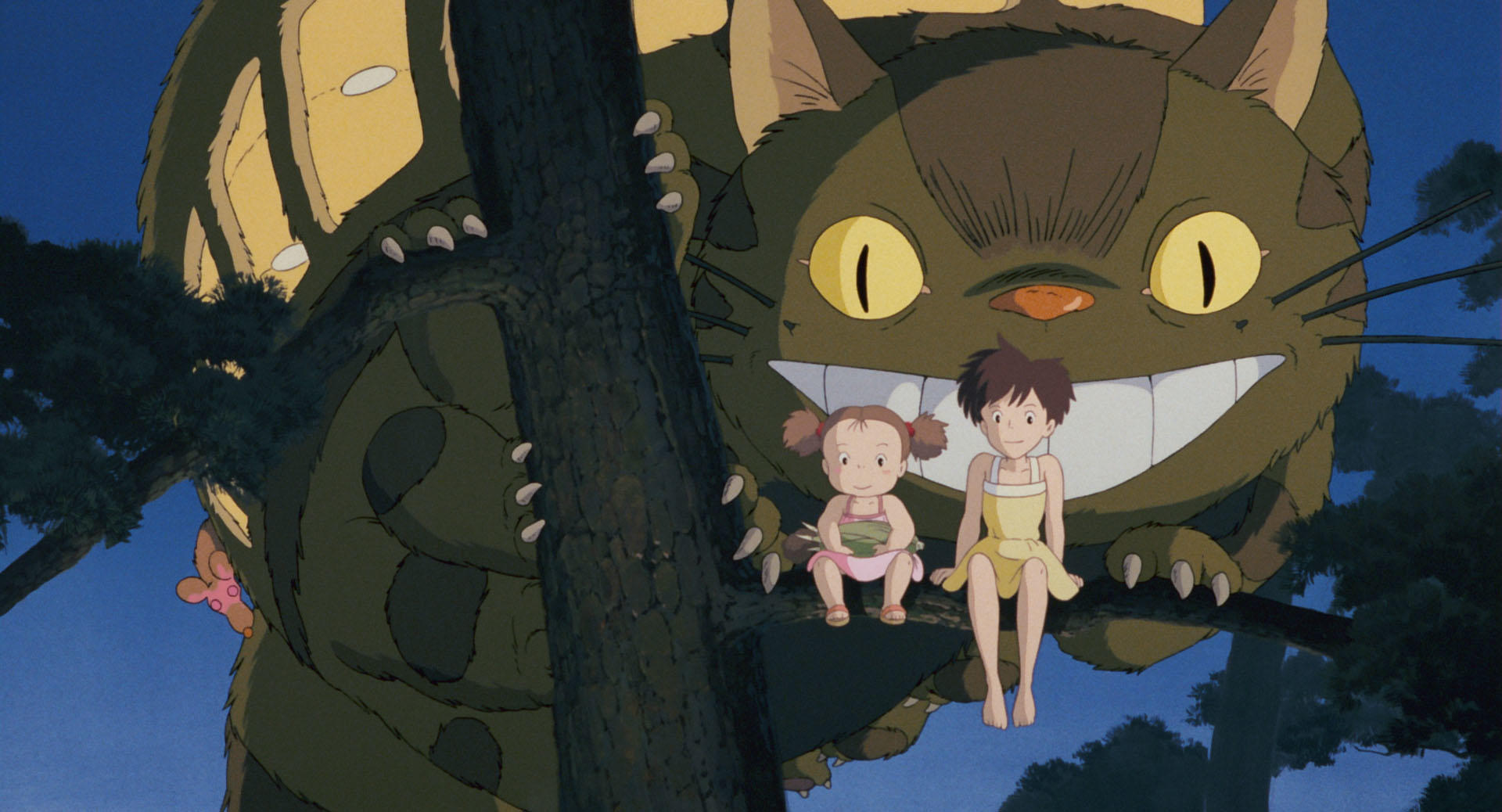
You may have seen every single one of Studio Ghibli’s animated films, going well beyond the Hayao Miyazaki-directed My Neighbor Totoro, Spirited Away, and Kiki’s Delivery Service to the less widely known but also charmingly crafted likes of Ocean Waves, My Neighbors the Yamadas, and The Cat Returns. Even so, the question remains: have you really seen them all? Experiencing them in the theater or on home video is only the first stage of the process. Ideally, each element of a Ghibli movie should subsequently be appreciated in isolation and at length: by listening to the music, for example, hundreds of hours of which, available to stream, we’ve previously featured here on Open Culture.
Still, no matter how captivating Joe Hisaishi’s scores may sound on their own, Ghibli’s work is ultimately made to be seen. Given that 24 frames of their movies go by each second, it can be difficult to pick up all the details their animators include in each and every one of them.
Hence the value of the free archive of stills that the studio first made available online a few years ago, and that has steadily expanded ever since. Though only available in Japanese, it doesn’t present a great challenge even to fans with no knowledge of the language to click on the poster of their Ghibli film of choice, then to browse the variety of downloadable images associated with it.
Many of these stills are drawn from highly memorable moments across the Ghibli filmography: the children’s party on the hero of Porco Rosso’s beloved airplane; the emergence of the kodama in Princess Mononoke; the defeat of the colossal Giant Warrior in Nausicaä of the Valley of the Wind (which predates the studio’s foundation, but in any case now seems to count honorarily among its productions); the sentient flame cooking a skillet of bacon and eggs in Howl’s Moving Castle. Some of them have even been turned into wallpaper for video calls, downloadable from a page of their own. There we have another way to add a touch of Studio Ghibli’s distinctive vision to our everyday lives — and another source of inspiration to watch through the movies themselves one more time.
Based in Seoul, Colin Marshall writes and broadcasts on cities, language, and culture. His projects include the Substack newsletterBooks on Cities and the book The Stateless City: a Walk through 21st-Century Los Angeles. Follow him on the social network formerly known as Twitter at @colinmarshall.
The site Fast Companypublished an article that describes the “Complaint Restraint project,” an initiative that aims to create a “positive life by eliminating negative statements.” It’s an admirable goal. Though most of us have a perverse love of wallowing in our misery—a human trait amplified a thousandfold by the internet—complaining rarely makes things any better. As in the Buddha’s parable of the “second arrow,” our griping can make our sufferings doubly painful; as in the parable of the “poisoned arrow,” it can postpone or substitute for the constructive actions we need to take in order to heal or improve our condition.
But it would be a mistake to think that complaining is somehow a recent phenomenon, though we may hear more of it every day, all the time, from every quarter of the globe. The Buddhist arrow stories are, after all, at least a couple thousand years old; lamentation more or less constitutes its own genre in Biblical literature.
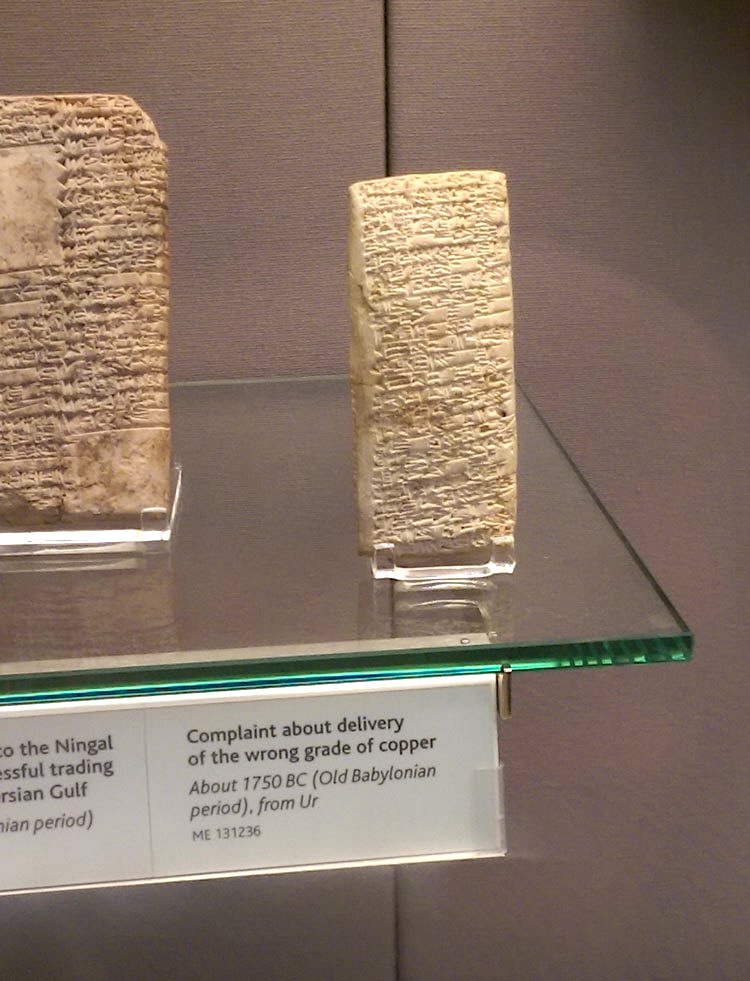
Even older still than these religious sources is the first documented customer service complaint, a specific variety of complaining that we might be forgiven for associating mainly with a modern, consumerist age—and one of the few kinds of complaints that can generate positive results.
Absent a Yelp app, the ancient Babylonian consumer in this case inscribed his complaint on a clay tablet—which now resides at the British Museum—sometime around 1750 B.C. The irate purchaser here, Nanni, writing to someone named Ea-nasir, received a shipment of copper ore of an inferior grade, after some annoying delay and in a damaged condition. In the translation below from Assyriologist A. Leo Oppenheim, Nanni vents his spleen.
Tell Ea-nasir: Nanni sends the following message:
When you came, you said to me as follows : “I will give Gimil-Sin (when he comes) fine quality copper ingots.” You left then but you did not do what you promised me. You put ingots which were not good before my messenger (Sit-Sin) and said: “If you want to take them, take them; if you do not want to take them, go away!”
What do you take me for, that you treat somebody like me with such contempt? I have sent as messengers gentlemen like ourselves to collect the bag with my money (deposited with you) but you have treated me with contempt by sending them back to me empty-handed several times, and that through enemy territory. Is there anyone among the merchants who trade with Telmun who has treated me in this way? You alone treat my messenger with contempt! On account of that one (trifling) mina of silver which I owe(?) you, you feel free to speak in such a way, while I have given to the palace on your behalf 1,080 pounds of copper, and umi-abum has likewise given 1,080 pounds of copper, apart from what we both have had written on a sealed tablet to be kept in the temple of Samas.
How have you treated me for that copper? You have withheld my money bag from me in enemy territory; it is now up to you to restore (my money) to me in full.
Take cognizance that (from now on) I will not accept here any copper from you that is not of fine quality. I shall (from now on) select and take the ingots individually in my own yard, and I shall exercise against you my right of rejection because you have treated me with contempt.
It does seem that Nanni maybe took this poor service a little too personally. In any case, let’s hope he received some satisfaction for the trouble it must have taken to inscribe this angry message.
Note: An earlier version of this post appeared on our site in 2015.
We're hoping to rely on loyal readers, rather than erratic ads. Please click the Donate button and support Open Culture. You can use Paypal, Venmo, Patreon, even Crypto! We thank you!
Open Culture scours the web for the best educational media. We find the free courses and audio books you need, the language lessons & educational videos you want, and plenty of enlightenment in between.