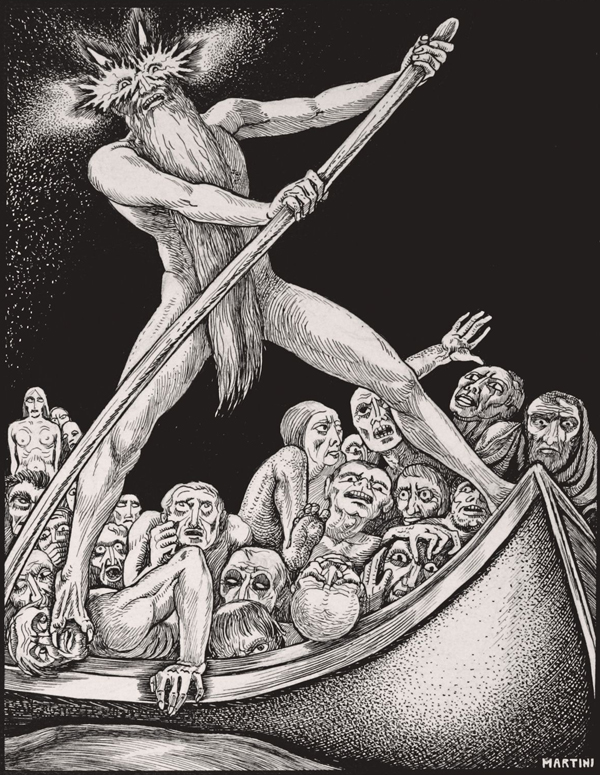
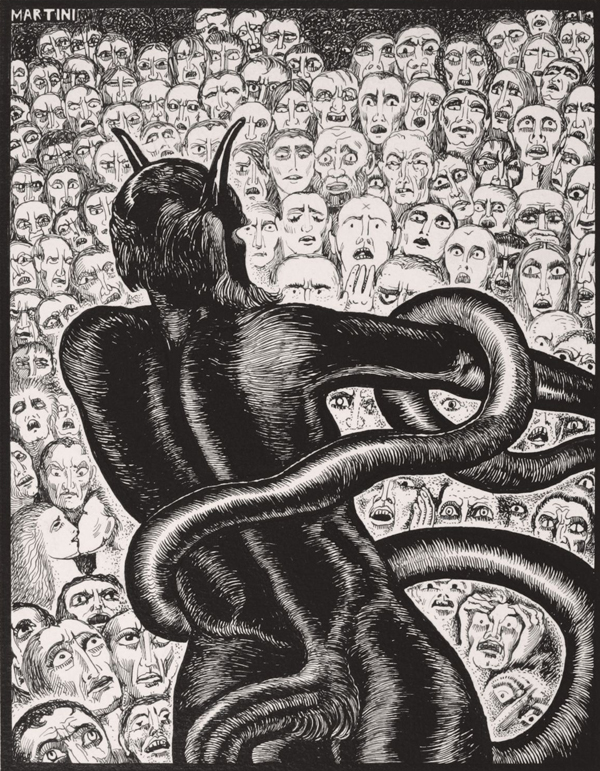
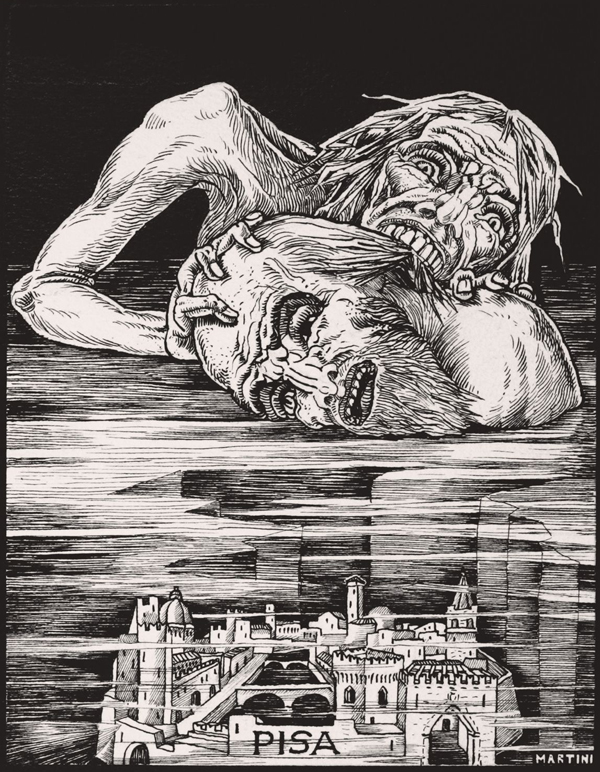
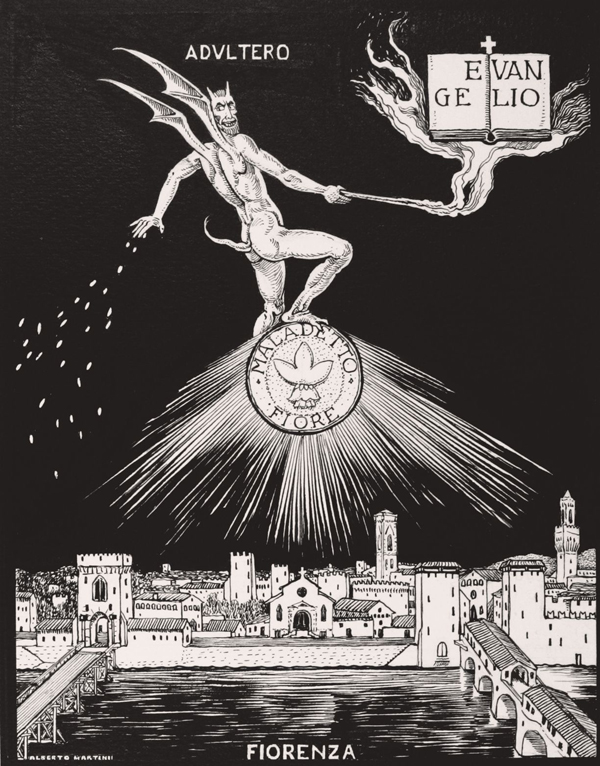
In 1901, Vittorio Alinari, head of Fratelli Alinari, the world’s oldest photographic firm, decided to publish a new illustrated edition of Dante’s Divine Comedy. To do so, Alinari announced a competition for Italian artists: each competitor had to send illustrations of at least two cantos of the epic poem, which would result in one winner and a public exhibition of the drawings. Among the competitors were Alberto Zardo, Armando Spadini, Ernesto Bellandi, and Alberto Martini.
While Martini did not win the competition, he, as Vittorio Sgarbi wrote in his foreword to Martini’s La Divina Commedia, “seemed born to illustrate the Divine Comedy.” The 1901 contest was followed by two more sets of illustrations between 1922 and 1944, which produced altogether almost 300 works in a wide range of styles, including pencil and ink to the watercolor tables painted between 1943 and 1944. While repeatedly rejected publication during his lifetime, a comprehensive edition of Martini’s La Divinia Commedia is available today.
With his feeling for the grotesque and the macabre, Martini’s work was much more influenced by the Northern Mannerism movement than Italian art and is often seen as a precursor to Surrealism, as Martini was a favorite of André Breton. However, while steeped in the surrealism of Odilon Redon and Aubrey Beardsley black and white counterpoints, Martini’s Divine Comedy is filled with an original sense of fantasy and beautifully conveys Dante’s more abstract imagery. Needless to say, Martini’s interpretation was very much in a world apart from the Italian Futurist and Metaphysical movements of the day.
Ignored by Italian critics most his life, Martini continued to produce a large number of illustrations and painting until his death in 1954. As he wrote in his autobiography, “Only the true great artists do not age, because they are able to innovate and invent new forms, new colors, genuine inventions.” Martini’s Divine Comedy is as shocking and beautiful today as it was in the early twentieth century, and is the best example of Martini’s progression as an artist throughout his career.
For a very different artistic interpretation of the Divine Comedy, see our posts on editions by Salvador Dalí and Gustave Doré.
If you want to get familiar with the material covered in Hadfield’s book, I’d encourage you to listen to his recent interview with Terry Gross on Fresh Air.
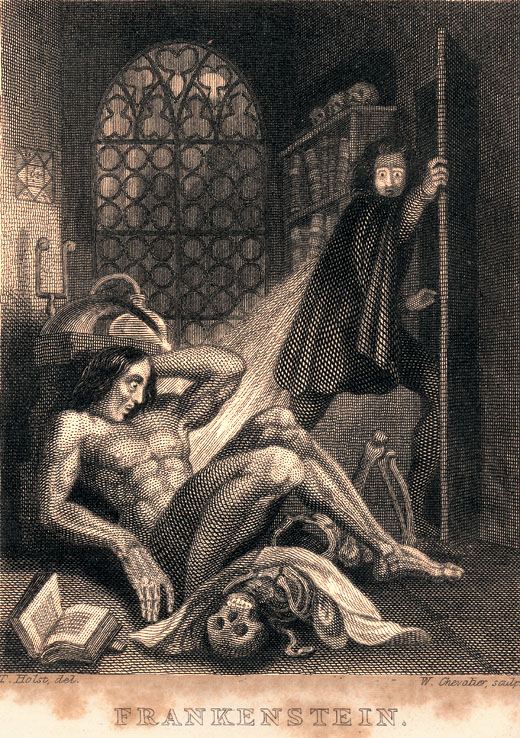
The story behind the writing of Frankenstein is famous. In 1816, Mary Shelley and Percy Bysshe Shelley, summering near Lake Geneva in Switzerland, were challenged by Lord Byron to take part in a competition to write a frightening tale. Mary, only 18 years old, later had a waking dream of sorts where she imagined the premise of her book:
When I placed my head on my pillow, I did not sleep, nor could I be said to think. My imagination, unbidden, possessed and guided me, gifting the successive images that arose in my mind with a vividness far beyond the usual bounds of reverie. I saw — with shut eyes, but acute mental vision, — I saw the pale student of unhallowed arts kneeling beside the thing he had put together. I saw the hideous phantasm of a man stretched out, and then, on the working of some powerful engine, show signs of life, and stir with an uneasy, half vital motion.
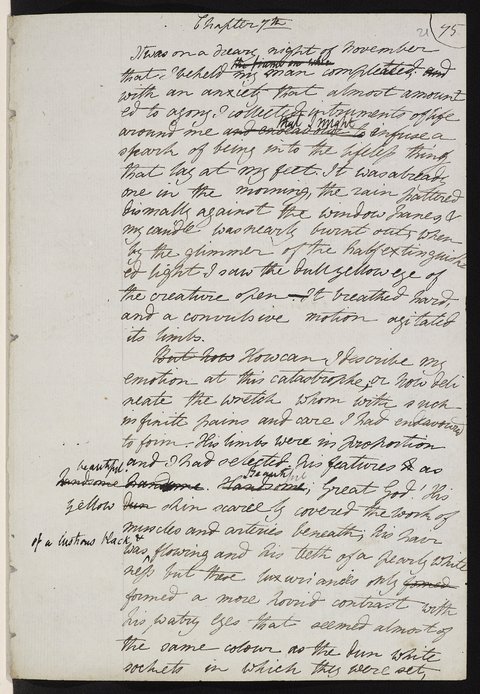
This became the kernel of Frankenstein; or, The Modern Prometheus, the novel first published in London in 1818, with only 500 copies put in circulation. In writing Frankenstein, Shelley used a series of notebooks that “can now be viewed in high quality, resizable page images.” Each hand-written page comes accompanied by a typed transcript. Find them all here.
Down the line, the Shelley-Godwin Archive “will provide the digitized manuscripts of Percy Bysshe Shelley, Mary Wollstonecraft Shelley, William Godwin, and Mary Wollstonecraft, bringing together online for the first time ever the widely dispersed handwritten legacy of this uniquely gifted family of writers.” So stay tuned for more.
Note: The Archive recommends using recent versions of Google’s Chrome browser or the latest version of Safari or Mozilla Firefox when viewing the manuscripts.
There was lots of money to be made at the end of the 19th century and Dudley Docker made his share of it. He was what they called a “baron of industry” at a time when manufacturing was exploding in Britain. Docker made his fortune in paint, motorcycles, arms manufacturing, railways, and banking. He was an industrial booster, acting as one of the three major financiers behind Ernest Shackleton’s Trans-Antarctic Expedition. In 1916, he founded a major association of British industry to promote business interests.
A charming result of that work is a recently digitized film made in 1925 to demonstrate the work inside Oxford University Press. For book arts lovers, this is a fascinating peek into the early days of mechanized printing.
Above we watch a worker use a mould to make lead type, hundreds of them, by pouring the molten lead in at the top, making a quick upward motion and releasing the quickly dried type. A separate team of workers then sets up monotype composing machines, and we watch as men demonstrate their use.
The film follows the process of printing a run of Oxford English Dictionaries. Books were bound by gender-divided teams: A room of women labored in the “girls” bindery section while men bound books in their own separate room. We see the sewing, cutting and the fascinating process of gilding the page edges.
In our digital age, the old analog processes take on a new, deeper significance. This film presents a terrific 18-minute tutorial on one of the greatest achievements of the modern age: printing mass quantities of bound books.
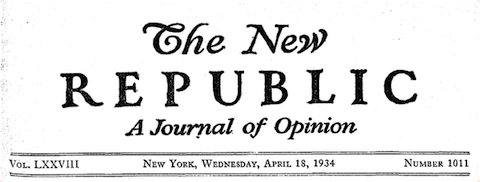
Last week we highlighted a feature from the excellent website Neglected Books detailing two articles that appeared in The New Republic in 1934 on “good books that almost nobody has read.” The articles were the product of a query the magazine’s editor, Malcolm Cowley, sent out to the literary community of his day, asking them to list their favorite unsung books. Such lists are bound fast to their historical context; fame is fleeting, and great works are forgotten and rediscovered in every generation. Some of the books named then—like Franz Kafka’s The Castle or Nathaniel West’s Miss Lonelyhearts—have since gone on to notoriety. Most of them have not. This week, we thought we’d continue the theme with our own list of “neglected books.” I offer mine below, and I encourage readers to name your own in the comments. We’ll feature many of your suggestions in a follow-up post.
A few words about my by-no-means-definitive-and-certainly-incomplete list. These are not obscure works. And you’ll note that there are almost no recent works on it. This is due at least as much to my own lamentable ignorance of much contemporary literature as to a conviction that a work that isn’t widely read months after its publication is not, thereby, “neglected.” In the age of the internet, books can age well even after they’re remaindered, since instant communities of readers spring up overnight on fansites and places like Goodreads. Instead, my list consists of a few neglected classics and a book of poetry that I personally think should all be read by many more people than they are, and that I think are timely for one reason or another. Maybe some of these books have gotten their due in some small circles, and in some cases, their influence is much greater than sales figures can ever reflect. But they’re works more people should read, not simply read about, so I offer you below five titles I think are “neglected books.” You may interpret that phrase any way you like when you submit your own suggestions.
Jean Toomer’s Cane is well-known to students of the Harlem Renaissance, but it isn’t read much outside that academic context, I think, which is a shame because it is a beautiful book. Not a novel, but a collection of short stories, poems, and literary sketches inspired by Toomer’s stint as a substitute principal in Sparta, Georgia in 1921, Cane practically vibrates with the furious and fragile lives of a collection of characters in the Jim Crow South. Yet like all great books, it transcends its setting, elevating its subjects to archetypal status and immortalizing a time and place that seems to live only in caricature now. Read the first sketch, “Karintha,” and see what I mean.
Olive Schreiner is another writer who receives her due in scholarly circles but is little read outside the classroom. Schreiner was a white South African woman who turned her experiences of race, gender, and nation to literary fame with her novel The Story of an African Farm in 1883. The novel’s success at the time did not necessarily grant its author lasting fame, and while Schreiner has been lauded for transforming Victorian literature with her freethinking, feminist views, the book that once made her famous is an almost shockingly un-Victorian work. Short, stark, impressionistic, and very unsentimental, The Story of an African Farm may find purchase with scholars for historical or political reasons, but it should be read for its stunning prose descriptions and piercing dialogue.
Carpentier was a Cuban novelist, scholar, and musicologist who is not much read in the English-speaking world, and perhaps not much in Latin America. Although he coined the term “magical realism” (lo real maravilloso)—as part of his theory that Latin American history is so outlandish as to seem unreal—his literary fame in the States has never reached the degree of more fantastic practitioners of the style. Although perhaps best known, where he is known, for his harsh tale of Haiti’s first king, the brutal Henri Christophe, in The Kingdom of this World, Carpentier’s complex and mysterious 1953 The Lost Steps is a novel that justifies my calling him the Nabokov of Latin American letters.
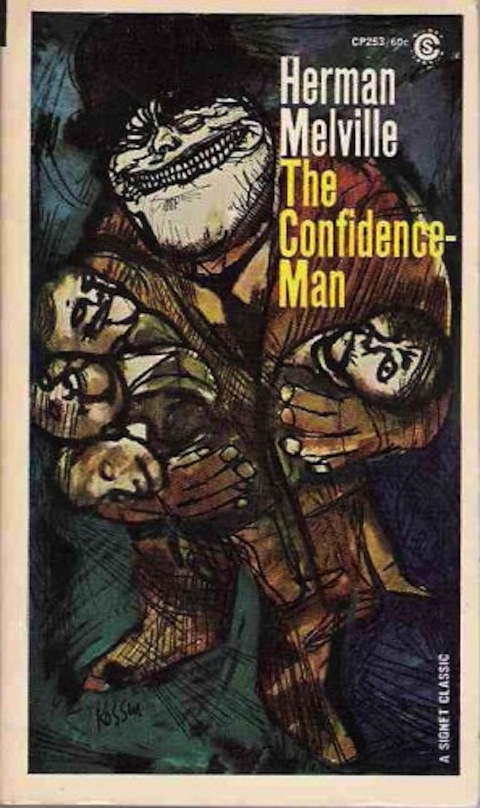
Melville was certainly a neglected writer in his time. He is, it should go without saying, no more. But while everyone knows Moby Dick (if not many finish it), Billy Budd, and “Bartelby,” few people read his, yes difficult, novel The Confidence Man. Also called The Confidence Man: His Masquerade, this was Melville’s last published novel in his lifetime. It’s a darkly comic book that sometimes sounds a bit like Twain in its colorful vernacular and shifting registers, but grows stranger and more unsettling as it progresses, becoming almost a cacophony of disembodied voices in a state of moral panic. The central character, a nameless shape-shifting grifter on a steamboat called the Fidele, takes on a succession of American identities, all of them thoroughly persuasive and all of them thoroughly, calculatedly, false.
The only book of poetry on my list also happens to be the only book by a living writer. It also happens to be a book that makes me tremble each time I think of it. De Kok, a South African poet, takes as her inspiration for her 2002 Terrestrial Things the transcripts from her country’s Truth and Reconciliation Commission. I’ll leave you with an excerpt from “The Sound Engineer,” a poem prefaced by the matter-of-fact statement that the “highest turnover” during the Commission, “was apparently among reporters editing sound for radio.”
Listen, cut; comma, cut;
stammer, cut;
edit, pain; connect, pain; broadcast, pain;
listen, cut; comma, cut.
Bind grammar to horror,
blood heating to the earphones,
beating the airwaves’ wings.
For truth’s sound bite,
tape the teeth, mouth, jaw,
put hesitation in, take it out:
maybe the breath too.
Take away the lips.
Even the tongue.
Leave just sound’s throat.
So there you have my list. I hope it has inspired you to go discover something new (or old). If not, I hope you will submit your own neglected books in the comments below and share your hidden literary treasures with our readers.
Public domain books listed above will be added to our collection of 500 Free eBooks.
Once upon a time Blotto Design, a design firm based in Berlin, wondered: what would happen if you printed an entire book on a single poster? Could you still read it? How would it look when framed and hung on a wall?
And so they developed a prototype, liked what they saw, and have since turned 20 large books into posters — books like Homer’s Iliad, Jane Austen’s Pride and Prejudice, Melville’s Moby Dick, and Joyce’s Ulysses, all 265,222 words of it. Posters cost 20 euros a piece. Browse through the shop here. And get more backstory from Wired here.
Here’s a challenge: for every book recommended to you by Amazon, pick one from the site Neglected Books. No fancy algorithms here, just old-fashioned serendipity, and you’re unlikely to see much overlap. You will be rewarded with book after fascinating book that has slipped through the usual marketing channels and fallen into obscurity. Most of the authors come recommended by well-known names, making them writers’ writers—people whose writerly difficulty or peculiar subject matter can narrow their readership.
This is not entirely a fair assessment, and in many cases, the work that achieves literary notoriety does so by chance, not mass appeal, but it is undoubtedly the case that certain kinds of writers write for certain kinds of readers. The literary editor Malcolm Cowley, helming The New Republic in 1934, thought so, and lamented a system that prevented books from reaching their intended readers. In a call to “America’s leading novelists and critics,” Cowley asked for lists of such books—and in perhaps a retroactive vindication of the listicle—published them in two articles, “Good Books That Almost Nobody Has Read” and “More About Neglected Books.” Neglected Books, the website, quotes Cowley’s announcement:
Each year… a few good books get lost in the shuffle. It may not be the fault of the publisher, the critic, the bookseller, it may not be anybody’s fault except that of the general system by which too many books are distributed with an enormous lot of ballyhoo to not enough readers. Most of the good books are favorably reviewed, yet the fact remains that many of them never reach the people who would like and profit by them, the people for whom they are written.
Cowley asked his targets to suggest “two or three or four” names and “a few sentences identifying them.” He got lists from about a dozen writers, including lions like F. Scott Fitzgerald, John Dos Passos, Sinclair Lewis, Thornton Wilder and critic Edmund Wilson, who gets a mention in both Fitzgerald’s and Dos Passos’ lists. (Fitzgerald also offered three other titles Miss Lonelyhearts by Nathanael West; Sing Before Breakfast by Vincent McHugh and Through the Wheat by Thomas Boyd.) Dos Passos, unlike most of the men, names a few women writers, including Agnes Smedley, now revealed to have been a triple agent for the Soviets, the Chinese, and Indian nationalists, “one of the most prolific female spies of the 20th century.” Dos Passos’ commentary on her autobiography Daughter of Earth—which he misremembers as Woman of Earth—is mostly understated: “An uneven but impressive I suppose autobiographical narrative of a young woman’s life in a Western mining camp and in New York.”
Libertarian journalist Susan La Follette, one of the few women writers surveyed, offers only one suggestion, Ilya Ilf and Evgeny Petrov’s 1931 comedic Russian novel The Golden Calf. The description alone in this L.A. Times review of a 2010 translation has me thinking this may indeed be an overlooked masterwork of totalitarian satire. La Follette said as much three years after its publication, writing of her disappointment, “I take this quite personally, because so few people even know about it that I rarely find anyone who can laugh over it with me.”
While The New Republic is well-known as a left-of-center publication, the meaning of the American Left in the thirties was much more inclusive, even of avowed Marxists like The New Masses editor Isidor Schneider, who names Imperialism, and The State and Revolution by Lenin and Leninism by Joseph Stalin. Next to the irony of naming two books that thousands have been coerced to read, Schneider contrarily names the The Poems of Gerard Manley Hopkins, from the aesthetically radical, but earnestly religiously conservative Irish Jesuit poet. (The latter two suggestions did not make publication since Schneider’s list was already quite long.)
As interesting as the lists themselves is the selection of responses to the second article. William Saroyan writes in to recommend Grace Stone Coates’ Black Cherry as the “finest prose you ever saw.” And legendary publisher Alfred A. Knopf writes with a lengthy and detailed explanation of the books listed that he published. Of one book named, Franz Kafka’s The Castle, Knopf writes, “The Castle is one of my really inglorious failures. It is, as Conrad Aiken says, a masterpiece. But in the original edition it sold only 715 copies, and since January 3, 1933, we have been offering it at the reasonable price of $1 and only 120 copies have been purchased.”
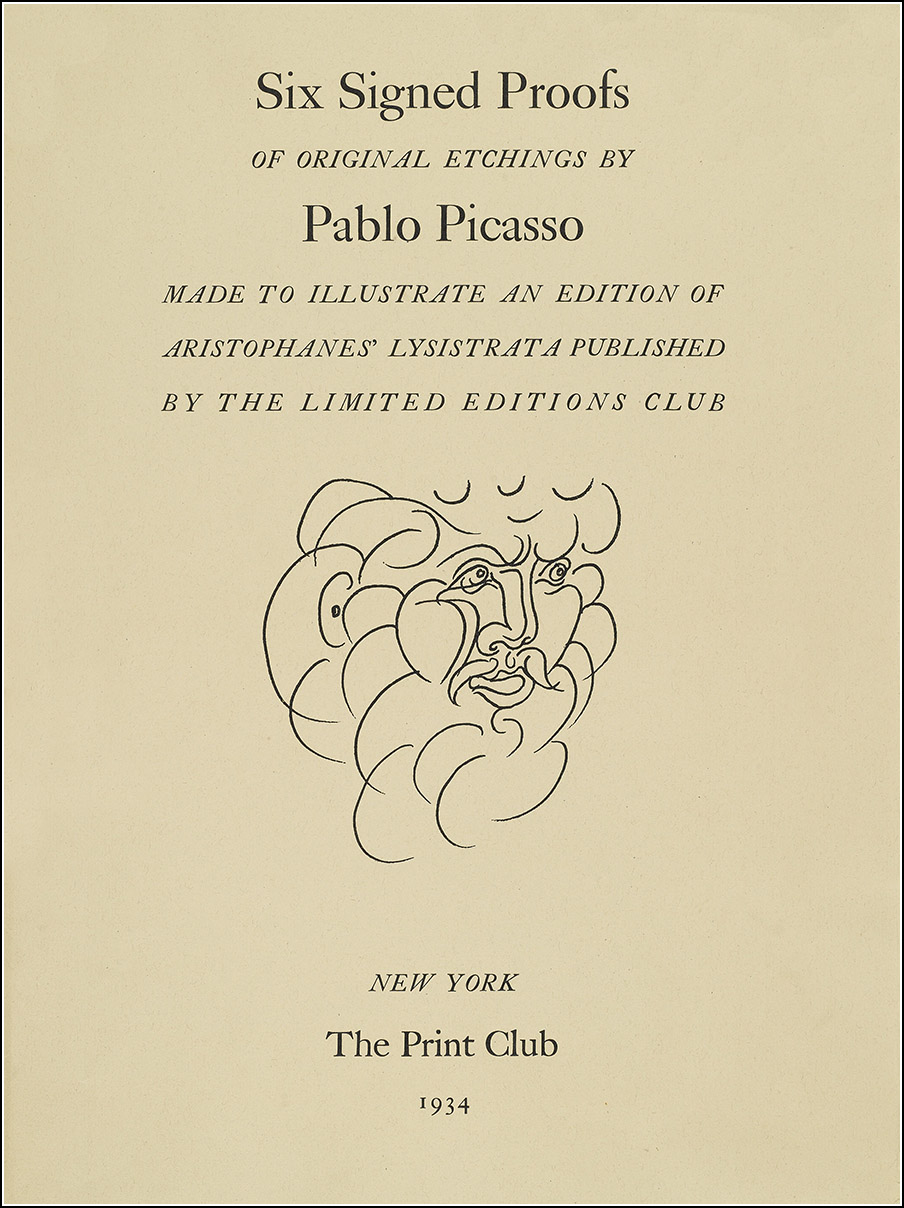
In the mid-1930s, some beautiful, high-quality books were published by a company called Limited Editions Club, which, according to Antiques Roadshow appraiser Ken Sanders, was “famous for re-issuing classics of literature and commissioning contemporary living artists to illustrate 1500-copy signed limited editions.” One of those books—the 1934 Pablo Picasso-illustrated edition of Aristophanes’ Lysistrata—is, next to Henri Matisse’s 1935 edition of Joyce’s Ulysses, one of “the most sought after and desirable limited editions on the market today.”
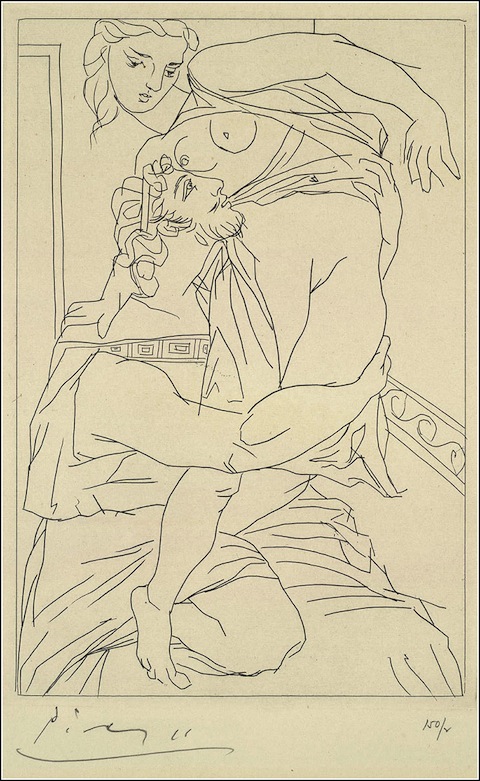
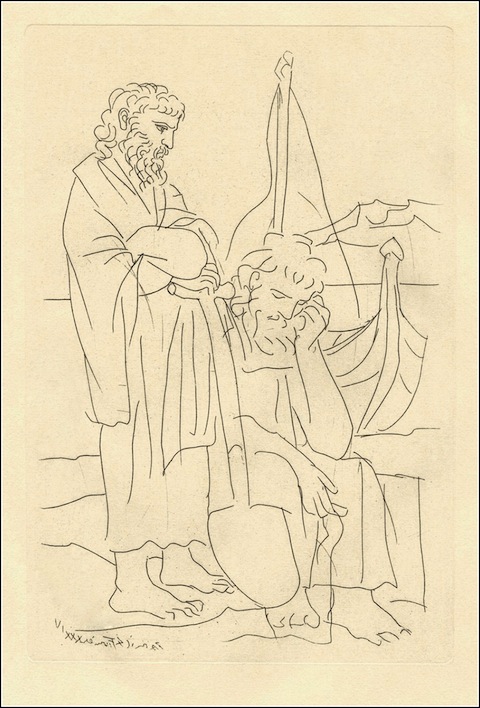
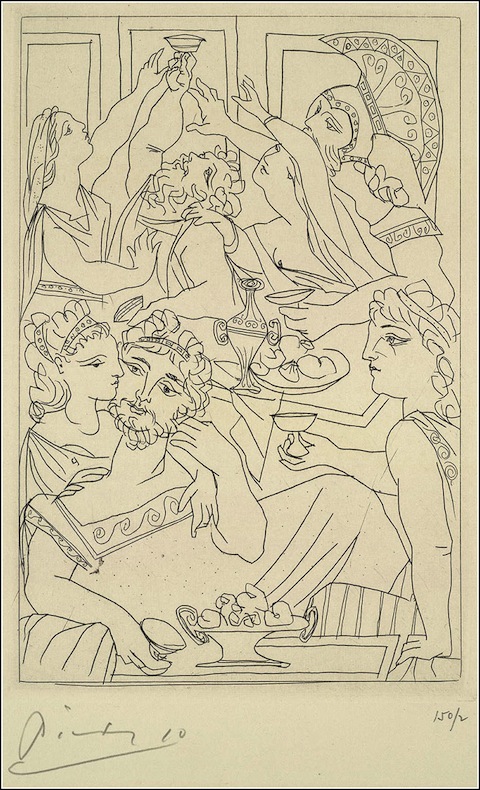
The book’s rarity, of course, renders it more valuable on the market than a mass-produced object, but whether it was worth $5,000 or $50, I think I’d hold onto my copy if I had one (here’s one for $12,000 if you’re buying). While Aubrey Beardsley’s 1896 illustrations do full and stylish justice to the satirical Greek comedy’s bawdy nature, Picasso’s drawings render several scenes as tender, softly sensual tableaux. The almost childlike simplicity of these illustrations of a play about female power and the limits of patriarchy do not seem like the work of a rumored misogynist, but then again, neither do any of Picasso’s other domestic scenes in this spare, rounded style of his.
In Aristophanes’ play, the women of Greece refuse their husbands sex until the men agree to end the Peloponnesian War. The play makes much of the men’s mounting sexual frustration, with several humorous gestures toward its physical manifestations. Beardsley’s drawings offend Victorian eyes by making these scenes into exaggerated nudist farce. Picasso’s modernist sketches all but ignore the overt sexuality of the play, picturing two lovers (2nd from top) almost in the posture of mother and child, the pent up men (image above) as dejected and downcast gentle souls, and the reunion of the sexes (below) as a highly stylized, none too erotic, feast. These images are three of six signed proofs featured on the blog Book Graphics. See their site to view all six illustrations.
We're hoping to rely on loyal readers, rather than erratic ads. Please click the Donate button and support Open Culture. You can use Paypal, Venmo, Patreon, even Crypto! We thank you!
Open Culture scours the web for the best educational media. We find the free courses and audio books you need, the language lessons & educational videos you want, and plenty of enlightenment in between.