Swedish musician Martin Molin’s Marble Machine, above, looks like the kind of top heavy, enchanted contraption one might find in a Miyazaki movie, galloping through the countryside on its skinny legs.
Those slender stems are but one of the design flaws that bother its creator, who notes that he hadn’t really taken into account the destructive power of 2000 flowing marbles (or more accurately, 11mm steel ball bearings).
It’s natural for someone so close to the project to fixate on its imperfections, but I think it’s safe to say that the rest of us will be bedazzled by all the giant musical Rube Goldberg device gets right. Hannes Knutsson’s “making of” videos below detail some of Molin’s labors, from recreating the sound of a snare drum with coasters, a contact mic and a box of basmati rice, to cutting wooden gears from a customizable template that anyone can download off the Internet.
If it looks like a time consuming endeavor, it was. Molin wound up devoting 14 months to what he had conceived of as a short term project, eventually designing and fabricating 3,000 internal parts.
The finished product is a feat of digital, musical, and physical skill. As Molin told Wired,
I grew up making music on Midi, and everyone makes music on a grid nowadays, on computers. Even before digital they made fantastic, programmable music instruments. In bell towers and church towers that play a melody they always have a programming wheel exactly like the one that is on the marble machine.
The “making of” videos highlight the difference between the recorded audio signal and the sound in the room where the machine is being operated. There’s something immensely satisfying about the insect-like click of all those marbles working in concert as they activate the various instruments and notes.
The machine also appears to give its inventor a rather brisk cardio workout.
When my son first started playing the piano, I lost several evenings chasing the holy grail of free online sheet music. Sadly, most of what we were interested in downloading wasn’t really free… just the first page.
It’s hard to rationalize dropping five bucks on one song, when the New York Public Library for the Performing Arts is a short subway ride away. The problem is, I’m not much of a musician, and while there are scores and scores of scores upon their shelves, I rarely understood what it was I was checking out. Often I’d come home with the sought after piece, only to realize that I’d inadvertently checked out a vocal selection, or the chord-rich equivalent of a cocktail pianist’s fake book.
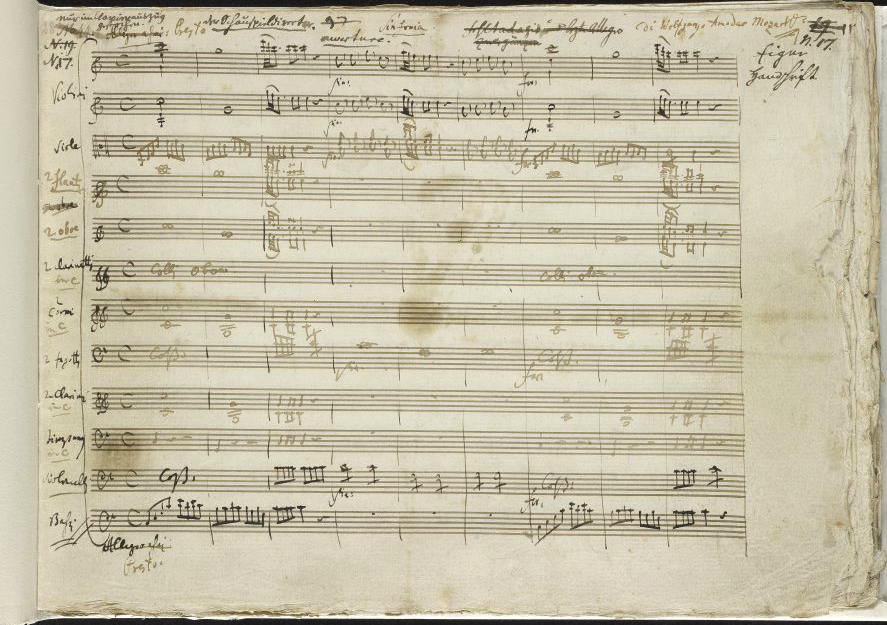
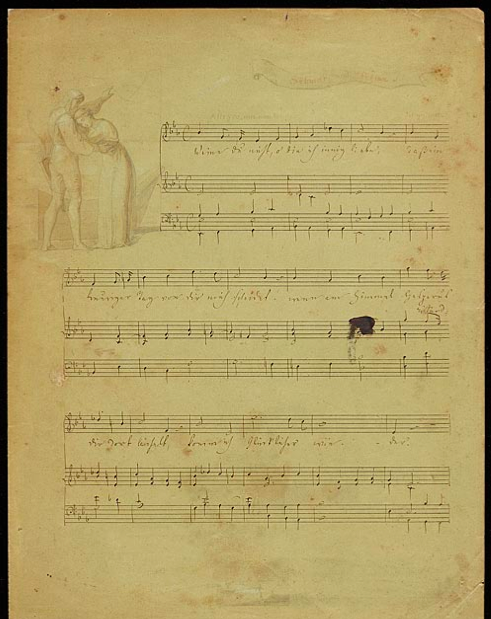
The handwritten manuscript of Mozart’s comic singspiel, Der Schauspieldirektor, above, for instance, autographed by the composer himself. 84 pages worth, not counting covers and endpapers, all free for the downloading!
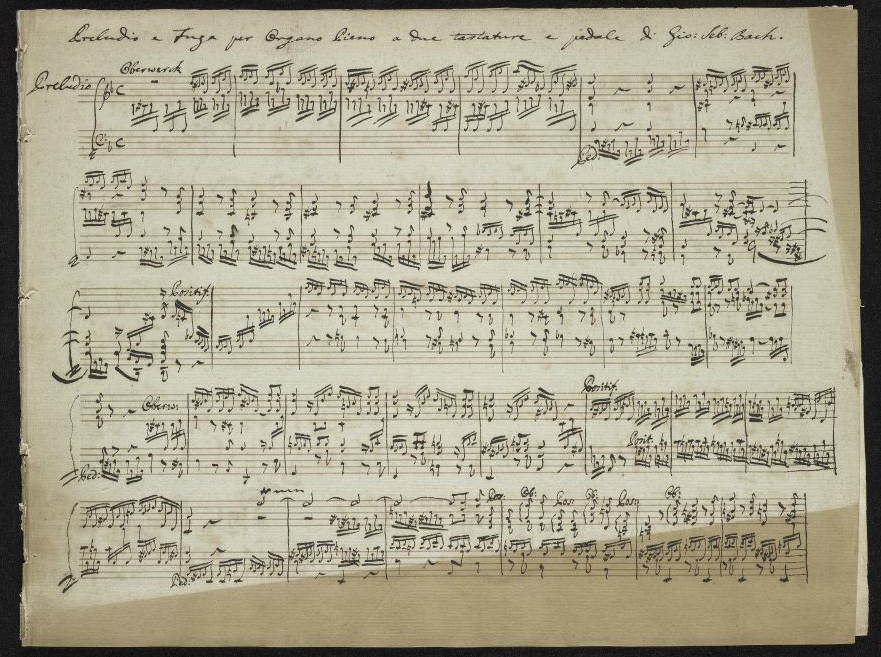
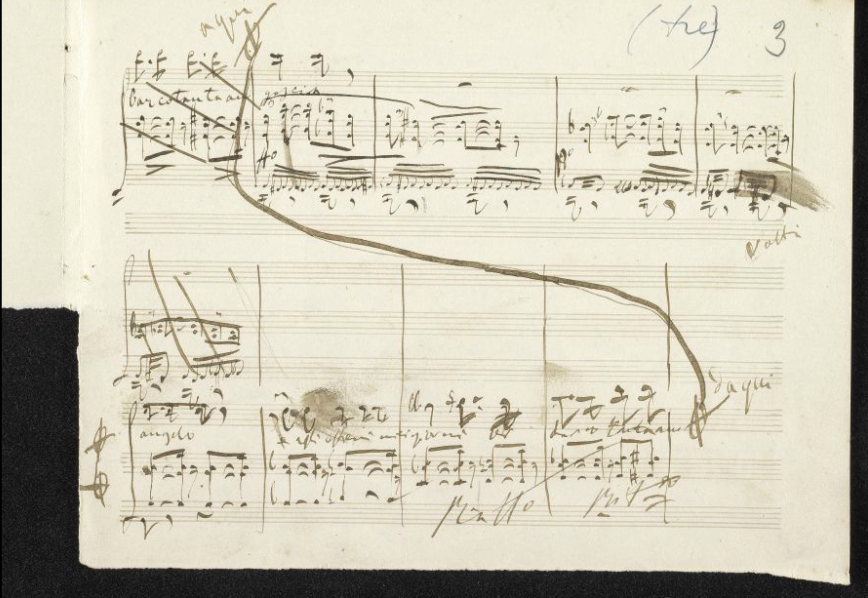
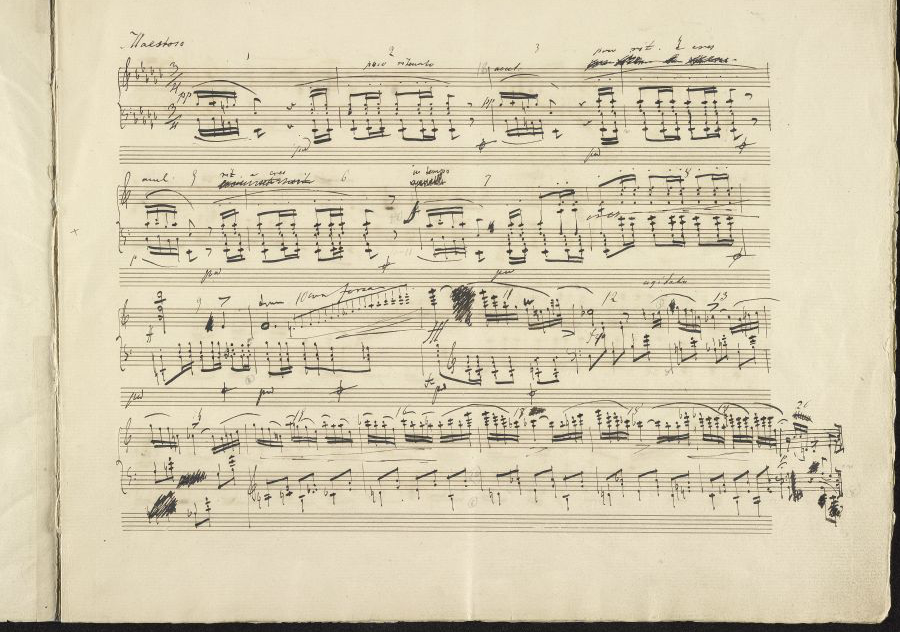
The collection currently offers digitized versions of upwards of 500 musical manuscripts, with more to come as the reviewing process continues.
A common enough sentiment in an election year, but in this case, the speaker is Batman, and the proof is the 30-minute labor of love above.
Five years ago, father and son Batman fans Sean and Aaron Schoenke spent $27,000 to make City of Scars, this thrillingly grim entry into the canon.
The Joker may have escaped, but the Schoenkes part ways with a certain Hollywood franchise by confining the cynicism to the story. The prospect of measly box office returns didn’t stop them! They knew from the get go that their take would be zero. DC Comics allows ordinary mortals to use its characters in their own independent projects, provided they don’t attempt to realize a profit.
Predictably dismal box office figures aside, the Schoenkes’ efforts have paid off splendidly in other ways. City of Scars, and its 2011 sequel, Seeds of Arkham, below, have garnered a generous helping of attention and awards (The Wall Street Journal called City of Scars “impressive”), and the talented volunteer cast and crew have benefited from increased visibility. Rather than rewarding himself with a new car or a mansion in Bel Air, Schoenke the Younger broke with tradition, and cast himself as Nightwing.
Box office totals notwithstanding, the same cannot be said for the stuff the studio churns out. (The system is broken, remember?)
The Schoenkes have channeled their indie success into a franchise of their own, Super Power Beat Down, a monthly web series wherein viewers get to decide which superhero won the staged battle. Watch it below, in preparation for choosing the next victor.
In high school, I had a history teacher who was, in his spare time, a millionaire owner of several marinas. He taught, he told us, because he loved it. Was he a good teacher? Not by the lights of most pedagogical standards, but he did intend, amidst all his lassitude and total lack of organization, to leave us all with something more important than history: the secret of his success. What was it, you ask? Naps. Each day he touted the power of power naps with a proselytizer’s relentless enthusiasm: 15 minutes a few times a day, the key to wealth and happiness.
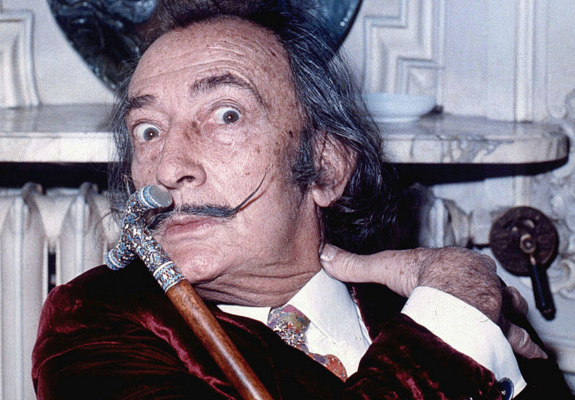
We all thought he was benignly nuts, but maybe he was on to something after all. It seems that many very wise, productive people—such as Albert Einstein, Aristotle, and Salvador Dali—have used power naps as sources of refreshment and inspiration. Except that while my history teacher recommended no less than ten minutes, at least one of these famous gents preferred less than one. Dali used a method of timing his naps that ensured his sleep would not last long. He outlined it thus, according to Lifehacker:
1. Sleep sitting upright (Dali recommends a Spanish-style bony armchair)
2. Hold a key in your hand, between your fingers (for the bohemian, use a skeleton key)
3. Relax and fall asleep (but not for too long…)
4. As you fall asleep, you’ll drop the key. Clang bang clang!
5. Wake up inspired!
Dali called it, fittingly, “Slumber with a key,” and to “accomplish this micro nap,” writes The Art of Manliness, he “placed an upside-down plate on the floor directly below the key.” As soon as he fell asleep, “the key would slip through his fingers, clang the plate, and awaken him from his nascent slumber.” He claimed to have learned this trick from Capuchin monks and recommended it to anyone who worked with ideas, claiming that the micro nap “revivified” the “physical and psychic being.”
Dali included “Slumber with a key” in his book for aspiring painters, 50 Secrets of Magic Craftsmanship, along with such nostrums as “the secret of the reason why a great draughtsman should draw while completely naked” and “the secret of the periods of carnal abstinence and indulgence to be observed by the painter.” We might be inclined to dismiss his nap technique as a surrealist practical joke. Yet The Art of Manliness goes on to explain the creative potential in the kind of nap I used to take in history class—dozing off, then jerking awake just before my head hit the desk:
The experience of this transitional state between wakefulness and sleep is called hypnagogia. You’re floating at the very threshold of consciousness; your mind is sliding into slumber, but still has threads of awareness dangling in the world…. While you’re in this state, you may see visions and hallucinations (often of shapes, patterns, and symbolic imagery), hear noises (including your own name or imagined speech), and feel almost physical sensations…. The experience can essentially be described as “dreaming while awake.”
The benefits for a surrealist painter—or any creative person in need of a jolt out of the ordinary—seem obvious. Many visionaries such as William Blake, John Keats, and Samuel Taylor Coleridge have made use of waking dream states as wellsprings of inspiration. Both Beethoven and Wagner composed while half asleep.
Scientists have found waking dream states useful as well. We’ve already mentioned Einstein. Brilliant mathematician, engineer, philosopher, and theoretical physicist Henri Poincare also found inspiration in micro naps. He pointed out that the important thing is to make ready use of any insights you glean during your few seconds of sleep by writing them down immediately (have pen and paper ready). Then, the conscious mind must take over: “It is necessary,” wrote Poincare, “to put in shape the results of this inspiration, to deduce from them the immediate consequences, to arrange them,” and so forth. He also suggests that “verification” of one’s hypnagogic insights is needed above all, but this step, while critical for the mathematician, seems superfluous for the artist.
So the micro nap comes to us with a very respectable pedigree, but does it really work or is it a psychological placebo? The author of the Almost Bohemian blog writes that he has practiced the technique for several weeks and found it “relatively successful” in restoring energy, though he has yet to harness it for inspiration. If you asked empirical sleep researchers, they might tend to agree with my history teacher: “Sleep laboratory studies show,” writes Lynne Lamberg in her book Bodyrhythms, “that a nap must last at least ten minutes to affect mood and performance.” This says nothing at all, however, about how long it takes to open a doorway to the unconscious and steal a bit of a dream to put to use in one’s waking work.
Aside from the very specific use of the micro nap, the longer power nap—anywhere from 10–40 minutes—can work wonders in improving “mood, alertness and performance,” writes the National Sleep Foundation. Short naps seem to work best as they leave one feeling refreshed but not groggy, and do not interfere with your regular sleep cycle. The Sleep Foundation cites a NASA study “on sleepy military pilots and astronauts” which found that “a 40-minute nap improved performance by 34% and alertness by 100%.” Lifehacker points to studies showing that “power naps, short 10 to 15 minute naps, improve mental efficiency and productivity,” which is why companies like Google and Apple allow their employees to doze off for a bit when drowsy.
One stress management site observes that the 10–15 minute power nap does not even require a pillow or blanket; “you don’t even need to go to sleep! You just need a comfortable place to lie on your back, put your feet up, and breathe comfortably.” Such a practice will not likely turn you into a world famous artist, poet, or scientist (or millionaire marina-owning, altruistic high school teacher). It will likely rejuvenate your mind and body so that you can make much better use of the time you spend not sleeping.
Last year we told you about the importance of messy desks and walking to creativity. This year, the time has come to realize how much creativity also depends on boredom. In a sense, of course, humankind has utterly vanquished boredom, what with our modern technologies — computers, high-speed internet, smartphones — that make possible sources of rich and frequent stimulation such as, well, this very site. But what if we need a little boredom? What if boredom, that state we 21st-century first-worlders worry about avoiding more than any other, actually helps us create?
Even if we feel no boredom in our free time, surely we still endure the occasional bout of it at work. “Admitting that boredom to coworkers or managers is likely something few of us have ever done,” writes the Harvard Business Review’s David Burkus. “It turns out, however, that a certain level of boredom might actually enhance the creative quality of our work.”
He cites a well-known scientific experiment which found that volunteers did better at a creative task (like finding different uses for a pair of plastic cups) when first subjected to a boring one (like copying numbers out of the phone book) which “heightens the ‘daydreaming effect’ on creativity — the more passive the boredom, the more likely the daydreaming and the more creative you could be afterward.”
Burkus also refers to another paper documenting the performance of different subjects on word-association tests after watching different video clips, one of them deliberately boring. Who came up with the most creative associations? You guessed it: those who watched the boring video first. Boredom, the experimenters suggest, “motivates people to approach new and rewarding activities. In other words, an idle mind will seek a toy. (Anyone who has taken a long car ride with a young child has surely experienced some version of this phenomenon.)”
Writing about those same experiments, Fast Company’s Vivian Giang quotes researcher Andreas Elpidorou of the University of Louisville as claiming that “boredom helps to restore the perception that one’s activities are meaningful or significant.” He describes it as a “regulatory state that keeps one in line with one’s projects. In the absence of boredom, one would remain trapped in unfulfilling situations, and miss out on many emotionally, cognitively, and socially rewarding experiences. Boredom is both a warning that we are not doing what we want to be doing and a ‘push’ that motivates us to switch goals and projects.”
“Boredom is a fascinating emotion because it is seen as so negative yet it is such a motivating force,” says Dr. Sandi Mann of the University of Central Lancashire, one of the masterminds of the experiments with the phone book and the plastic cups, quoted by Telegraph science editor Sarah Knapton. “Being bored is not the bad thing everyone makes it out to be. It is good to be bored sometimes! I think up so many ideas when I am commuting to and from work – this would be dead time, but thanks to the boredom it induces, I come up with all sorts of projects.” (This also manifests in her parenting: “I am quite happy when my kids whine that they are bored,” she said: “Finding ways to amuse themselves is an important skill.”)
“Nearly the Weekend,” by David Feltkamp. Creative Commons image
How to make use of all this? “Taken together,” Burkus writes, “these studies suggest that the boredom so commonly felt at work could actually be leveraged to help us get our work done better,” perhaps by “spending some focused time on humdrum activities such as answering emails, making copies, or entering data,” after which “we may be better able to think up more (and more creative) possibilities to explore.” In the words of Dr. Mann herself, “Boredom at work has always been seen as something to be eliminated, but perhaps we should be embracing it in order to enhance our creativity.” And so to an even more interesting question: “Do people who are bored at work become more creative in other areas of their work – or do they go home and write novels?”
David Foster Wallace took on the relationship between boredom and creativity in an ambitious way when he started writing The Pale King, his unfinished novel (which he privately called “the Long Thing”) set in an Internal Revenue Service branch office in mid-1980s Peoria. The papers related to the project he left behind included a note about the book’s larger theme:
It turns out that bliss – a second-by-second joy + gratitude at the gift of being alive, conscious – lies on the other side of crushing, crushing boredom. Pay close attention to the most tedious thing you can find (tax returns, televised golf), and, in waves, a boredom like you’ve never known will wash over you and just about kill you. Ride these out, and it’s like stepping from black and white into color. Like water after days in the desert. Constant bliss in every atom.
This, as well as the more everyday suggestions about working more creatively by doing the boring bits first, would seem to share a basis with the ancient tradition of meditation. If indeed humanity has gone too far in its mission to alleviate the discomfort of boredom, it has produced the even more pernicious condition in which we all feel constantly and unthinkingly desperate for new distractions (which Shop Class as Soulcraft author Matthew B. Crawford memorably called “obesity of the mind”) while knowing full well that those distractions keep us from our important work, be it designing a scientific experiment, coming up with a sales strategy, or writing a novel.
Maybe we can undo some of the damage by deliberately, regularly shutting off our personal flow of interesting sensory input for a while, whether through meditation, data entry, phone-book copying, of whichever method feels right to you. (WNYC’s Manoush Zomorodi even launched a project last year called “Bored and Brilliant: The Lost Art of Spacing Out,” which challenged listeners to minimize their phone-checking and put the time gained to more creative use.) But we all need some high-quality stimulation sooner or later, so when you feel ready for another dose of it, you know where to find us.
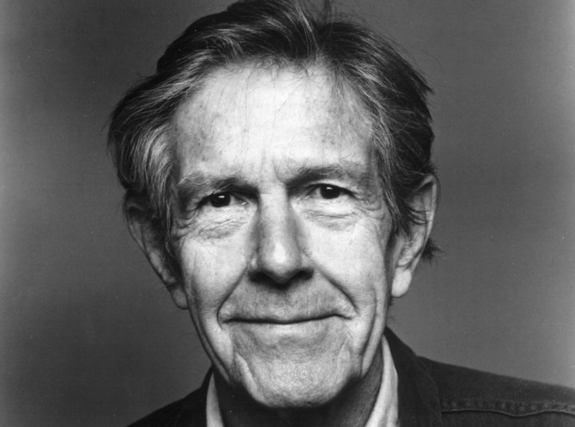
You know what they say: eighty percent of the work you do on a project, you do getting the last twenty percent of that project right. But most of that other twenty percent of the work must go toward getting started in the first place; you’ve got to get over a pretty big hill just to get to the point of writing the first sentence, painting the first stroke, shooting the first shot, or playing the first chords. Avant-garde composer John Cage knew well the challenges of just getting started, and his thoughts on the subject motivated him, toward the end of his career, to do the written, performed, and recorded project we feature today, How to Get Started.
Cage himself only put on How to Get Started once, at an international conference on sound design at George Lucas’ Skywalker Ranch on August 31, 1989. It worked like this: he brought with him ten note cards, each of which contained notes for a particular “idea” he wanted to talk about. On went a tape recorder, and he began speaking improvisationally about the first idea. Then he flipped to the next card, and as he talked about its idea, the recording of the first one played in the background. He continued with this procedure until, by the tenth idea on the tenth card, he had his impromptu speeches on all nine previous ideas playing simultaneously behind him. You can get an idea of what his readings sounded like in the three clips (from howtogetstarted.org) embedded here [first, second, third].
The ten ideas Cage jotted down on his notecards come inspired by, and inspired him to discuss further, his own creative experiences. In the first, he describes a new compositional process that came to him in a dream, which involves crumpling a score into a ball and unfolding it again. In the third, he thinks back to his work Roaratorio, an Irish circus on Finnegans Wake, which converted Joyce’s novel into music, and imagines a way forward that would involve turning into music not one book at a time but several. In the fifth, he references Marcel Duchamp’s “The Creative Act,” which brought home for him the notion of how audiences “finish the work by listening,” which led to his creating works of “musical sculpture,” including one particularly memorable example involving “between 150 and 200” Yugoslavian high school students, all playing their instruments in different places.
Cage’s other stories of creative epiphany in How to Get Started involve a trip to an anechoic chamber; finding out what made one dance performance at the University of North Carolina School of the Arts so “tawdry, shabby, miserable”; discovering the artist’s “inner clock” in Leningrad; and how he works around what no less a musical mind than Arnold Schoenberg diagnosed as his absent sense of harmony. You can read a transcript of all of them in a PDF of How to Get Started’s companion booklet. And depending upon how inspired you find yourself (or how close you live to Philadelphia), you might consider making the trip to the Slought Foundation, who have built a room specially designed for the piece. You might not come out of it feeling like you’ve absorbed all the creativity of John Cage, but he himself points us toward the important thing: not the amorphous quality of creativity, but the action of getting started.
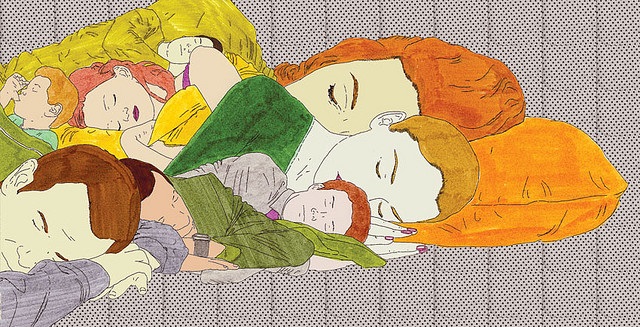
You decide you need some medical advice, so you take to the internet. Whoops! There’s your first mistake. Now you are bombarded with contradictory opinions from questionable sources and you begin to develop symptoms you never knew existed. It’s all downhill from there. So I’ll say this upfront: I have no medical qualifications authorizing me to dispense information about sleep disorders. The only advice I’d venture, should you have such a problem, is to go see a doctor. It might help, or not. I can certainly sympathize. I am a chronic insomniac.
The downside to this condition is obvious. I never get enough sleep. Whenever I consult the internet about this, I learn that it’s probably very dire and that I may lose my mind or die young(ish). The upside—which I learned to master after years of trying and failing to sleep like normal people—is that the nights are quiet and peaceful, and thus a fertile time creatively.
Medical issues aside, what do we know about sleep, insomnia, and creativity? Let us wade into the fray, with the proviso that we will likely reach few conclusions and may have to fall back on our own experience to guide us. In surveying this subject, I was pleased to have my experience validated by an article in Fast Company. Well, not pleased, exactly, as the author, Jane Porter, cites a study in Science that links a lack of sleep to Alzheimer’s and the accumulation of “potentially neurotoxic waste products.”
And yet, in praise of sleeplessness, Porter also recommends turning insomnia into a “productivity tool,” naming famous insomniacs like Margaret Thatcher, Bill Clinton, Charles Dickens, Marcel Proust, and Madonna (not all of whom I’d like to emulate). She then quotes psychologist Tomas Chamorro-Premuzic of University College London, who made the dubious-sounding claim in Psychology Today that “insomnia is to exceptional achievement what mental illness is to creativity.” Everything about this analogy sounds suspect to me.
But there are more substantive views on the matter. Another study, published in Creativity Research Journal, suggests insomnia may be a symptom of “notable creative potential,” though the authors only go as far as saying the two phenomenon are “associated.” The arrow of causality may point in either direction. Perhaps the most pragmatic view on the subject comes from Michael Perlis, psychology professor at the University of Pennsylvania, who says, “What is insomnia, but the gift of more time?”
Dennis Drabelle at The Washington Post, also an insomniac, refers to a recent study (as of 2007) from the University of Canterbury that suggests “insomnia and originality may go hand in hand.” He also points out that the notion of sleeplessness as productive, though “counterintuitive,” has plenty of precedent. Drabelle mentions many more famous cases, from W.C. Fields to Theodore Roosevelt to Franz Kafka. The list could go on and on.
Actor and musician Matt Berry tells The Guardian how, after years of tossing and turning, he finally harnessed his sleepless hours to write and record an album, Music for Insomniacs. “I knew that this was dead time,” says Berry, “and I could be doing something instead of sitting worrying about not being asleep.” Another musician, Dave Bayley of band Glass Animals, “owes his career in music to insomnia,” The Guardian writes, then notes a phenomenon sleep researchers call—with some skepticism—“creative insomnia.” Other musicians like Chris Martin, Moby, Tricky, and King Krule have all suffered the condition and turned it to good account.
The Guardian also notes that each of these poor souls has found “sleepless nights inspiring as well as tormenting.” Insomnia is not, in fact a gift or talent, but a painful condition that Porter and Drabelle both acknowledge can be associated with depression, addiction, and other serious medical conditions. One might make good use of the time—but perhaps only for a time. A site called Sleepdex—-which offers “resources for better sleep”—puts it this way:
Occasional insomnia appears to help some people produce new art and work, but is a detriment to others. It is perhaps true that more people find it a detriment than find it useful. Long-term insomnia and the accompanying sleep debt are almost surely negative for creativity.
This brings us to the subject of sleep—good, restful sleep—and its relationship to creativity. Sleepdex cites several research studies from Swiss and Italian universities, UC San Diego, and UC Davis. The general conclusion is that REM sleep—that period during which dreams “are the most narratively coherent of any during the night”—is also an important stimulus for creativity. There are the numerous anecdotes from artists like Salvador Dali, Paul McCartney, and countless others about famous works of art taking shape in dream states (Keith Richards says he heard the riff from “Satisfaction” in a dream).
And there are the experimental data, purportedly confirming that REM sleep enhances “creative problem solving.” European scientists have found that people were more likely to have creative insights after a long period of restful sleep, when the right brain gets a boost. Likewise, Tom Stafford at the BBC describes the “post-sleep, dreamlike mental state—known as sleep inertia or the hypnopompic state” that infuses our “waking, directed thoughts with a dusting of dreamworld magic.” It isn’t that insomniacs don’t experience this, of course, but we have less of it, as periods of REM sleep can be shorter and often interrupted by the need to scramble out of bed and get to work or get the kids to school not long after hitting the pillow.
Stafford points us toward a UC Berkeley study (apparently the University of California has some sort of monopoly on sleep research) “that helps illustrate the power of sleep to foster unusual connections, or ‘remote associates’ as psychologists call them.” Like nearly all of the scientific literature on sleep, this study expresses little doubt about the importance of sleep to memory function and problem solving. Big Think collects several more studies that confirm the findings.
On the whole, when it comes to the links between sleep—or sleeplessness—and creativity, the data and the stories point in different directions. This is hardly surprising given the slipperiness of that thing we call “creativity.” Like “love” it’s an abstract quality everyone wants and no one knows how to make in a laboratory. If it’s extra time you’re after—and very quiet time at that—I can’t recommend insomnia enough, though I wouldn’t recommend it at all as a voluntary exercise. If it’s the special creative insights only available in dream states, well, you’d best get lots of sleep. If you can, that is. Creative insomniacs—like those wandering in the confines of a dream world—know all too well they don’t have much choice in the matter.
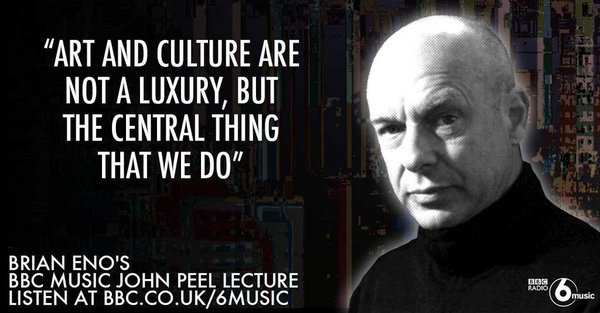
“Symphonies, perfume, sports cars, graffiti, needlepoint, monuments, tattoos, slang, Ming vases, doodles, poodles, apple strudels. Still life, Second Life, bed knobs and boob jobs” — why do we make any of these things? That question has driven much of the career (and indeed life) of Brian Eno, the man who invented ambient music and has brought his distinctive, at once intellectual and visceral sensibility to the work of bands like Roxy Music, U2, and Coldplay as well as the realm of visual art. Back in September, he laid out all the illuminating and entertaining answers at which he has thus far arrived in giving the BBC’s 2015 John Peel Lecture.
We featured Eno’s wide-ranging talk on the nature of art and culture, as well as its utility to the human race, back when the Beeb offered it streaming for a limited time only. But now they’ve made it freely available to download and listen to as you please: you can download the MP3 at this link.
You can also follow along, if you like, with the PDF transcript available here, which will certainly be of assistance when you go to look up all the people, ideas, works of art, and pieces of history Eno references along the way, including but not limited to the “STEM” subjects, Baked Alaska, black Chanel frocks, the Riemann hypothesis, Little Dorrit, Morse Peckham, Coronation Street, airplane simulators, the dole, Lord Reith, John Peel himself, Basic Income, Linux, and collective joy.
If you haven’t had enough Eno after that — and here at Open Culture, we never get enough Eno — have a look at and a listen to clips of a conversation he recently had with science writer Steven Johnson, all of which have an intellectual overlap with the Peel Lecture. The first deals with music, something this self-professed “non-musician” has done much more than his share of thinking about. The second has to do with punchlines, or rather, Eno’s conception of a piece of art, not as a thing with value in and of itself, but as a kind of punchline on the order of “I used to have a car like that.” (To hear its setup, you’ll have to watch the video.)
In the third, Johnson and Eno discuss an idea at the core of the Peel Lecture, Eno’s famous definition of culture, and later art: “Everything you don’t have to do.” That covers all the aforementioned symphonies, perfume, sports cars, graffiti, needlepoint, monuments, tattoos, slang, Ming vases, doodles, poodles, apple strudels, still life, Second Life, bed knobs and boob jobs: “All of those things are sort of unnecessary in the sense that we could all survive without doing any of them,” Eno says, “but in fact we don’t. We all engage with them.” And if you want to know why we should keep engaging with them, and in fact engage with them more vigorously than ever, Eno can tell you.
We're hoping to rely on loyal readers, rather than erratic ads. Please click the Donate button and support Open Culture. You can use Paypal, Venmo, Patreon, even Crypto! We thank you!
Open Culture scours the web for the best educational media. We find the free courses and audio books you need, the language lessons & educational videos you want, and plenty of enlightenment in between.