If you would like to support the mission of Open Culture, consider making a donation to our site. It’s hard to rely 100% on ads, and your contributions will help us continue providing the best free cultural and educational materials to learners everywhere. You can contribute through PayPal, Patreon, and Venmo (@openculture). Thanks!
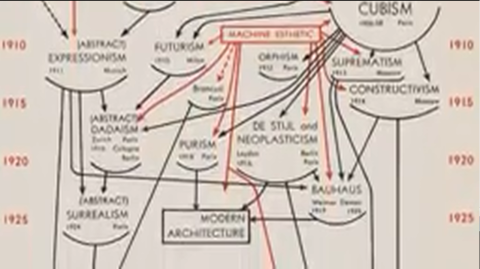
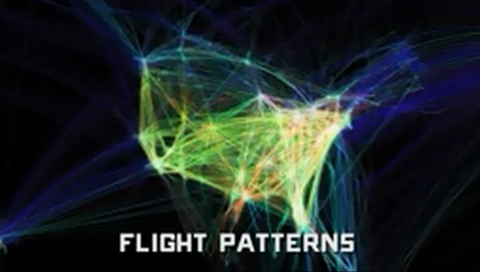
The volume of data in our age is so vast that whole new research fields have blossomed to develop better and more efficient ways of presenting and organizing information. One such field is data visualization, which can be translated in plain English as visual representations of information.
The PBS “Off Book” series turned its attention to data visualization in a short video featuring Edward Tufte, a statistician and professor emeritus at Yale, along with three young designers on the frontiers of data visualization. Titled “The Art of Data Visualization,” the video does a good job of demonstrating how good design—from scientific visualization to pop infographics—is more important than ever.
In much the same way that Marshall McLuhan spoke about principles of communication, Tufte talks in the video about what makes for elegant and effective design. One of his main points: Look after truth and goodness, and beauty will look after herself.
What does Tufte mean by this? That design is only as good as the information at its core.
For those of us who aren’t designers, it’s refreshing to consider the elements of good visual story-telling. And that’s what the best design is, according to the experts in this video. Every data set, or big bunch of information, has its own core concept, just as every story has a main character. The designer’s job is to find the hero in the data and then tell the visual story.
So much of the information we encounter every day is hard to conceptualize. It’s so big and complicated that a visual rendering represents it the best. That’s because human brains are wired to take in a lot of information at once. Good designers know that decision-making isn’t linear. It’s a super-fast process of recognizing patterns and making sense of them.
Information may be more abundant but it isn’t new, and neither is data visualization. In the video, Tufte talks about stone maps carved by early humans and how those ancient graphics form the template for Google maps.
What comes across in PBS’s video is that data visualization is an art, and the simpler the better. Tufte seems to argue that good data guides the designer to do good work, which leads to the question: Is the medium no longer, as McLuhan famously commented, the message?
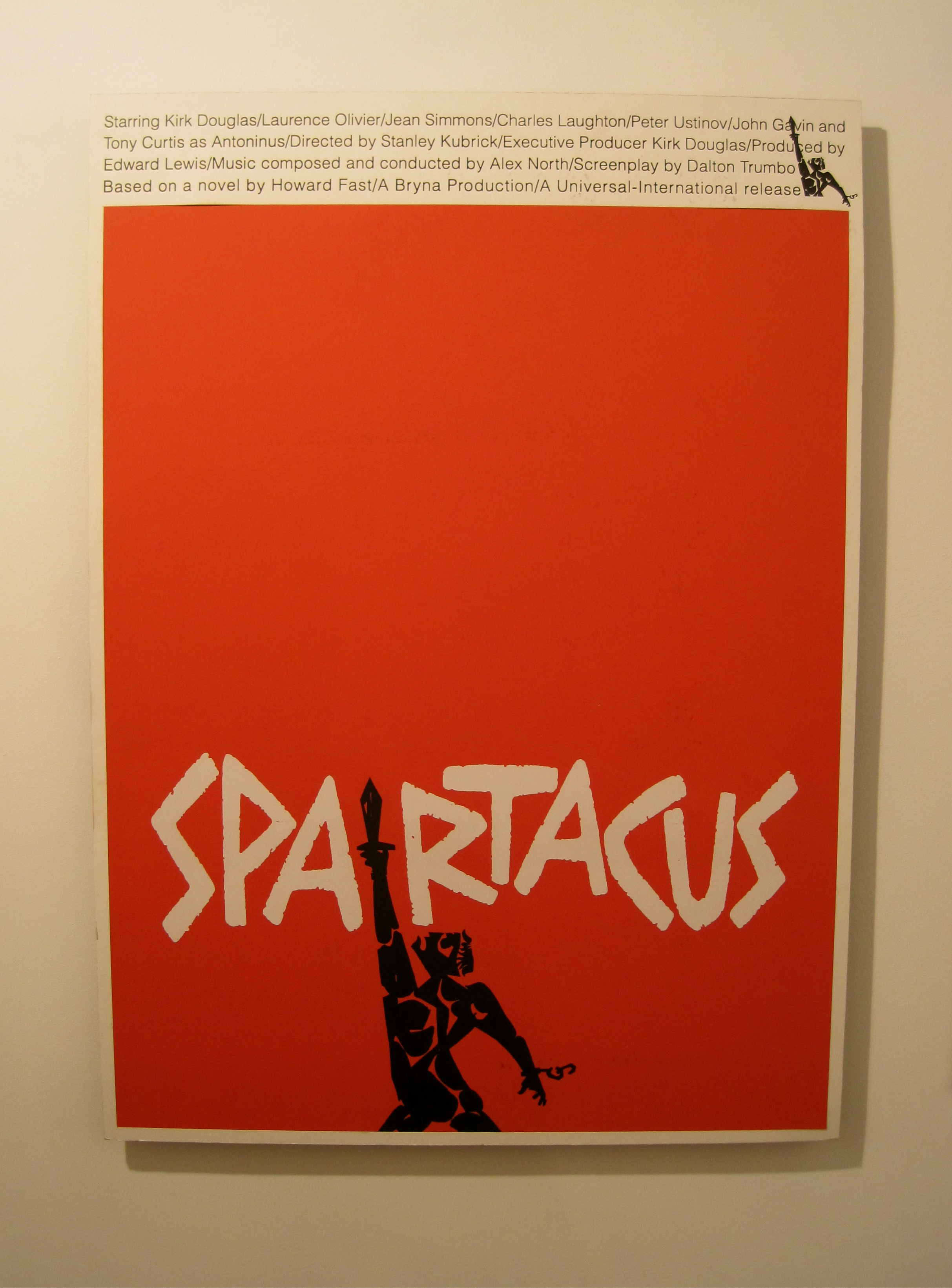
When it comes to title design, no one did it better than Saul Bass (1920–1996). During his long career in Hollywood, Bass designed sequences for Otto Preminger’s The Man with the Golden Arm, Scorsese’s Goodfellas and Cape Fear, Kubrick’s Spartacus, and several classic films by Alfred Hitchcock. And that’s just beginning to scratch the surface. (You can delve into Bass’ other creative work via the links below.)
From Gutenberg’s inky, monk-inspired Blacklister font to the ever-controversial Comic Sans, Barrett-Forrest employs stop motion to spell out the quantifiable reasons that certain serifs and stroke types are easy on the eye. Let’s not tell the creators of Llama Font or Mr. Twiggy, but legibility is the mother of survival in this arena.
If you would like to support the mission of Open Culture, consider making a donation to our site. It’s hard to rely 100% on ads, and your contributions will help us continue providing the best free cultural and educational materials to learners everywhere. You can contribute through PayPal, Patreon, and Venmo (@openculture). Thanks!
Ayun Halliday has devoted the last 15 years to producing The East Village Inky, an entirely handwritten zine whose aging readers complain that they can no long make out the tiny print.
In 1987, Compuserve begatteth Image Format 87A.
Image Format 87A begatteth Graphics Interchange Format or GIF (rhymes with a certain brand of peanut butter, the video history above helpfully points out).
The proliferations of free online GIF generators begatteth the countless annoying, smarmy, boneheaded animated loops you’ve seen junking up emails, profile pictures, and MySpace pages.
Of course, some of them are also pretty cool, which is why they’re being celebrated with a festival at the Brooklyn Academy of Music. No tickets necessary. Moving the Still: A GIF Festival will be screening through June on the outdoor electronic billboard meant to promote upcoming and current attractions. Conceivably, viewers with wheels and time to spare could take it in on an endless loop of their own, by circling up Flatbush to Lafayette, then moving up when the light changes, battling traffic from the nearby Barclays Center on the return leg.
What do we stand to see in this festival? The video history leads us to believe that anything is possible, though certain things—accidental happenings, laser cats, colorful barfing (…wait, colorful barfing?)—have a built in appeal.
This eighteen minute documentary takes you inside the work of David A. Smith, an English artist who specializes in “high-quality ornamental hand-crafted reverse glass signs and decorative silvered and gilded mirrors.” (Got that? You may want to read that last part again.) In something of a departure from earlier projects, Smith designed an ornate “turn-of-the-century, trade-card styled album cover” for John Mayer’s album Born &Raised. His work is meticulous and exacting. And this “Behind The Scenes” film, complete with commentary from Mayer and Smith, captures the artist’s process in loving detail. Now please sit back and enjoy.
Find us on Facebook, Twitter and Google Plus and we’ll make it easy to share intelligent media with your friends!
As gearheads go, Brendan Chilcutt’s a pretty sentimental guy, and not just because he signs his correspondence with “love.” In January, 2012, he founded the Museum of Endangered Sounds to keep outmoded technology’s most iconic noises from vanishing from the collective memory. Click on any image in the museum’s online collection to be transported in the Proustian sense.
Some of the exhibits—a manual typewriter, a rotary phone—were already amply preserved, thanks to a proliferation of cinematic appearances in their heyday.
Others might well have slipped away unnoticed, if not for Chilcutt’s curatorial efforts. Remember that number you could call to have a recorded voice inform you of the correct time? How about the static of an analog TV tuned to an empty station? The hum of a malfunctioning Discman, the chirp of a Tamagotchi…wait, what’s that I hear? The disconcerting whoosh of time speeding up?
Drown it out by activating all thirty exhibits at once. Let them sound their barbaric yawps simultaneously as the kids try to figure out what that racket is.
In 1967, executives at CBS television made a bold move and changed the network’s long-running documentary series, The 20th Century, from a program looking back at the past to one looking ahead to the future. The 21st Century, as it was renamed, was hosted by Walter Cronkite and ran for three seasons. In one of the early episodes, “At Home, 2001,” which aired on March 12, 1967, Cronkite cites a government report predicting that by the year 2000, technology will have lowered the average American work week to 30 hours, with a one-month vacation. What will people do with all that free time? In the scene above, Cronkite makes a fairly accurate prediction of today’s state-of-the-art home entertainment systems. Although the knobs and dials look a bit archaic, the basic principle is there. But whatever happened to that 30-hour work week?
Home office, 2001:
“Now this is where a man might spend most of his time in the 21st century,” says Cronkite as he walks into the home office of the future, above. “This equipment will allow him to carry on normal business activities without ever going to an office away from home.”
In envisioning the office of the future as a masculine domain, Cronkite makes the same mistake as Stanley Kubrick and Arthur C. Clarke of imagining technological change without social change. (Remember the moon shuttle stewardess in 2001: A Space Odyssey?) But he otherwise offers a fairly prescient vision of some of the home computing, Internet and telecommunications advances that have indeed come to pass.
Kitchen, 2001:
Cronkite’s powers of prediction fail him when he reaches the Rube Goldbergian “kitchen of 2001,” which mistakes gratuitous automation for convenience. As one YouTube commentator said of the clip above, the only thing that resembles the kitchen of today is the microwave oven–and microwaves already existed in 1967.
But “At Home, 2001,” is much more thought-provoking than a few “gee whiz” predictions about the gadgets of the future. Cronkite interviews the architect Philip Johnson and other leading designers of his day for a deeper discussion about the tension that exists between our deep-seated, basically agrarian expectations for a home and the realities of urban congestion and suburban sprawl. You can watch the complete 25-minute program at A/V Geeks. And to read more about it, see Matt Novak’s piece at PaleoFuture. “Can we find a compromise between our increasingly urban way of living and the pride and privacy of the individual home?” asks Cronkite at the end of the program. “It will take decisions that go beyond technology, decisions about the quality of the life we want to lead, to answer the question ‘How will we live in the 21st century?’ ”
We're hoping to rely on loyal readers, rather than erratic ads. Please click the Donate button and support Open Culture. You can use Paypal, Venmo, Patreon, even Crypto! We thank you!
Open Culture scours the web for the best educational media. We find the free courses and audio books you need, the language lessons & educational videos you want, and plenty of enlightenment in between.