This Christmas, as our computers fast learn to compose music by themselves, we might gain some perspective by casting our minds back to 66 Christmases ago, a time when a computer’s rendition of anything resembling music at all had thousands and thousands listening in wonder. In December of 1951, the BBC’s holiday broadcast, in most respects a naturally traditional affair, included the sound of the future: a couple of much-loved Christmas carols performed not by a choir, nor by human beings of any kind, but by an electronic machine the likes of which almost nobody had even laid eyes upon.
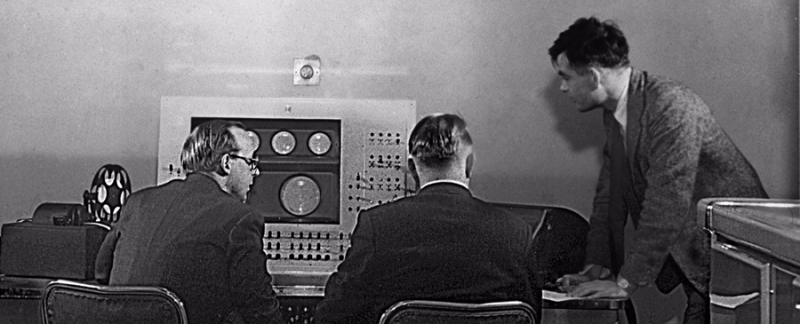
“Among its Christmas fare the BBC broadcast two melodies that, although instantly recognizable, sounded like nothing else on earth,” write Jack Copeland and Jason Long at the British Library’s Sound and Vision Blog. “They were Jingle Bells and Good King Wenceslas, played by the mammoth Ferranti Mark I computer that stood in Alan Turing’s Computing Machine Laboratory” at the Victoria University of Manchester. Turing, whom we now recognize for a variety of achievements in computing, cryptography, and related fields (including cracking the German “Enigma code” during the Second World War), had joined the university in 1948.
That same year, with his former undergraduate colleague D. G. Champernowne, Turing began writing a purely theoretical computer chess program. No computer existed on which he could possibly try running it for the next few years until the Ferranti Mark 1 came along, and even that mammoth proved too slow. But it could, using a function designed to give auditory feedback to its operators, play music — of a kind, anyway. The computer company’s “marketing supremo,” according to Copeland and Long, called its brief Christmas concert “the most expensive and most elaborate method of playing a tune that has ever been devised.”
Since no recording of the broadcast survives, what you hear here is a painstaking reconstruction made from tapes of the computer’s even earlier renditions of “God Save the King,” “Baa Baa Black Sheep,” and “In the Mood.” By manually chopping up the audio, write Copeland and Long, “we created a palette of notes of various pitches and durations. These could then be rearranged to form new melodies. It was musical Lego.” But do “beware of occasional dud notes. Because the computer chugged along at a sedate 4 kilohertz or so, hitting the right frequency was not always possible.” Even so, somewhere in there I hear the historical and technological seeds of the much more elaborate electronic Christmas to come, from Mannheim Steamroller to the Jingle Cats and well beyond.
Based in Seoul, Colin Marshall writes and broadcasts on cities and culture. His projects include the book The Stateless City: a Walk through 21st-Century Los Angeles and the video series The City in Cinema. Follow him on Twitter at @colinmarshall or on Facebook.
What kind of a blighted society turns the word “snowflake” into an insult?, I sometimes catch myself thinking, but then again, I’ve never understood why “treehugger” should offend. All irony aside, being known as a person who loves nature or resembles one of its most elegant creations should be a mark of distinction, no? At least that’s what Wilson “Snowflake” Bentley surely thought.
The Vermont farmer, self-educated naturalist, and avid photographer, was the first person to offer the following wisdom on the record, then illustrate it with hundreds upon hundreds of pictures of snowflakes, 5,000 in all:
I found that snowflakes were miracles of beauty; and it seemed a shame that this beauty should not be seen and appreciated by others. Every crystal was a masterpiece of design and no one design was ever repeated. When a snowflake melted, that design was forever lost. Just that much beauty was gone, without leaving any record behind.
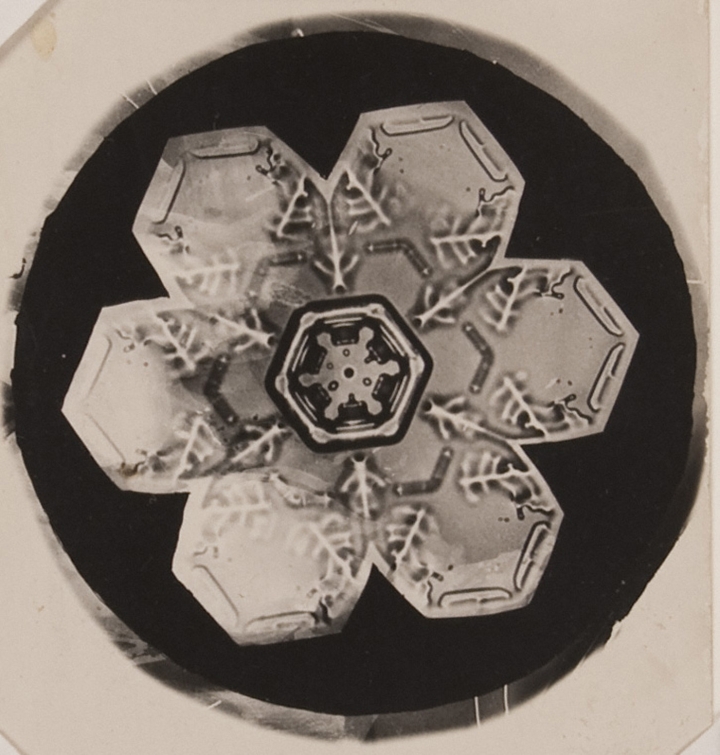
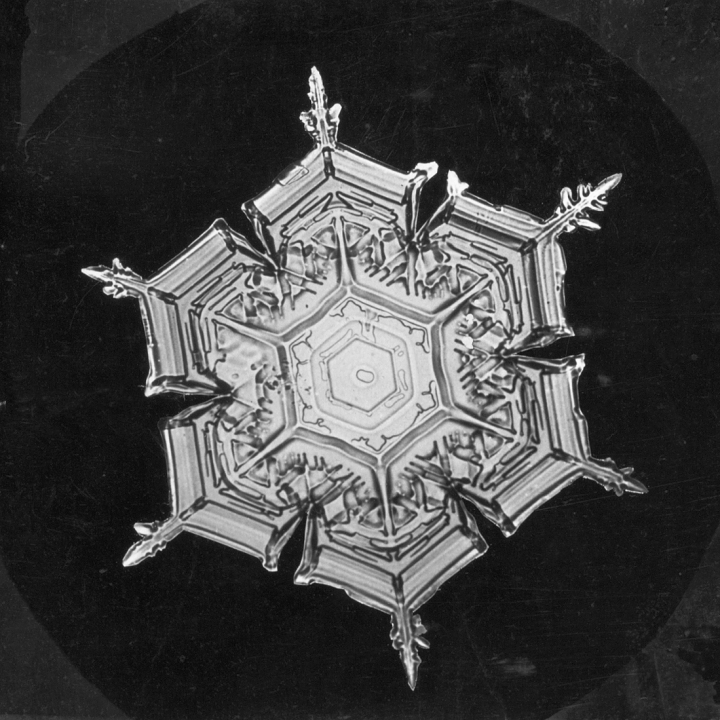
Bentley left a considerable record—though still an insignificant sample size given the scope of the object of study. But his photographs give the impression of an infinite variety of different types, each with the same basic crystalline latticework structure. He took his first photograph of a snowflake, the first ever taken, in 1885, by adapting a microscope to a bellows camera, after years of making sketches and much trial and error.
Some great portion of this work must have been tedious and frustrating—Bentley had to hold his breath for each exposure lest he destroy the photographic subject. But it was worth the effort. Bentley, the Smithsonian informs us, “was a pioneer in ‘photomicrography,’ the photographing of very small objects.” Five hundred of his photographs now reside at the Smithsonian Institution Archives, “offered by Bentley in 1903 to protect against ‘all possibility of loss and destruction, through fire or accident.” You can see a huge digital gallery of those hundreds of photos here.
Along with U.S. Weather Bureau physicist William J. Humphreys, he published 2300 of his snowflake photographs in a monograph titled Snow Crystals. Bentley also published over 60 articles on the subject (read two of them here). Despite his contributions, he receives no mention in most histories of photomicrography. This may be due to his provincial location (he never left Jericho, VT) or his lack of scientific training and credentials, or a lack of interest in photos of snowflakes on the part of most photomicrography historians.
Or it may be because Bentley was thought to be a fraud. When a German meteorologist commissioned some images of his own and got some very different results, he accused the farmer of retouching. Bentley readily admitted it, saying, “a true scientist wishes above all to have his photographs as true to nature as possible, and if retouching will help in this respect, then it is fully justified.”
The defense is a good one. Although the “nature” Bentley’s photos show us may be a theoretical idealization, so too are the hand-rendered illustrations of most scientists throughout history (and nearly every medical diagram today). Take, for example, the psychedelic, brightly colored patterns of accomplished biologist Ernst Haeckel, who turned the micro- and macroscopic world into surreally symmetrical art in his drawings. Though he might not have said so directly, Bentley was doing something similar with a camera. Just listen to him describe his process in a 1900 issue of Harper’s:
Quick, the first flakes are coming; the couriers of the coming snow storm. Open the skylight, and directly under it place the carefully prepared blackboard, on whose ebony surface the most minute form of frozen beauty may be welcome from cloud-land. The mysteries of the upper air are about to reveal themselves, if our hands are deft and our eyes quick enough.
In the “quiet frenzy of his winter’s quest,” writes Allison Meier at Hyperallergic, he produced images of “beautiful ghosts from a winter that bristled the air over a century ago.” Learn more about Bentley’s life, work, and the Smithsonian collection in the short documentary further up, the Washington Post video above, and the Radiolab episode below, in which a breathless Latif Nasser takes us into the heart of Bentley’s origin story, and “snowflake expert and photographer Ken Libbrecht helps set the record straight.”
Real snowflakes have many imperfections, and perhaps Bentley did snow a disservice to so strenuously suggest otherwise. But the record he left us, Meier notes, “is appreciated as much as an artistic archive as a meteorological one.” He might have been a scientist when it came to technique, but Bentley was a romantic when it came to snow. His story is as fascinating as his photographs. Maybe a delightful alternative to the usual Christmas fare. There’s even a children’s book called… what else?… Snowflake Bentley.
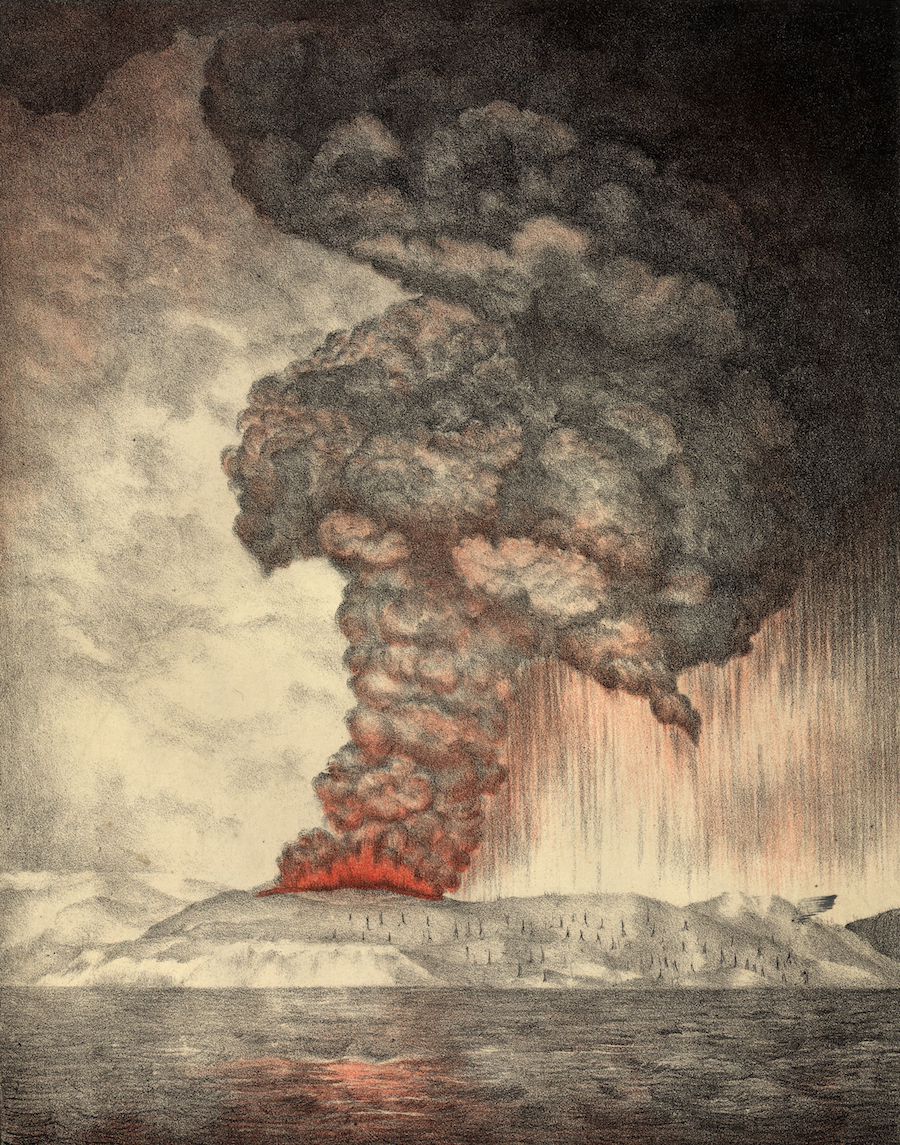
Think of ourselves though we may as living in a noisy era, none of us — not even members of stadium-filling rock bands known specifically for their high-decibel intensity — have experienced anything like the loudest sound in history. That singular sonic event came as a consequence of the explosion of Krakatoa, one of the names (along with Vesuvius) that has become a byword for volcanic disaster. And with good cause: when it blew in modern-day Indonesia on Sunday, 26 August 1883, it caused not only 36,000 deaths at the very least and untold destruction of other kinds, but let out a sound heard 3,000 miles away.
“Think, for a moment, just how crazy this is,” writes Nautilus’ Aatish Bhatia. “If you’re in Boston and someone tells you that they heard a sound coming from New York City, you’re probably going to give them a funny look. But Boston is a mere 200 miles from New York. What we’re talking about here is like being in Boston and clearly hearing a noise coming from Dublin, Ireland. Traveling at the speed of sound (766 miles or 1,233 kilometers per hour), it takes a noise about four hours to cover that distance. This is the most distant sound that has ever been heard in recorded history.”
Anyone who writes about the sound of Krakatoa, which split the island itself, struggles to properly describe it, seeing as even jet mechanics lack a comparable sonic experience. Bhatia quotes the captain of the British ship Norham Castle, 40 miles from Krakatoa when it erupted, writing in his log that “so violent are the explosions that the ear-drums of over half my crew have been shattered. My last thoughts are with my dear wife. I am convinced that the Day of Judgement has come.” Krakatoa’s reverberations – not heard, but felt and recorded as changes in atmospheric pressure – passed across the whole of the Earth not once but four times.
The sound of the explosion aside, “the rest of the world heard such stories almost instantly because a series of underwater telegraph cables had been recently laid traversing the globe,” writes the Independent’s Sanjida O’Connell. “This new technology meant that Krakatoa also generated the first modern scientific study of a volcanic eruption.” A Dutch scientist named Rogier Verbeek turned up first to gather details for a detailed and pioneering report, followed by geologists from London’s Royal Society, whose 627-page The Eruption of Krakatoa and Subsequent Phenomenayou can read at the Internet Archive.
Since nobody would have got the explosion on tape in 1883, such verbal descriptions will have to suffice. Not that even today’s highest-grade recording technology could withstand capturing such a sound, nor could even speakers that go up to a Spinal Tap-level 11 reproduce it. And no other sound is likely to break Krakatoa’s record in our lifetimes – not if we’re lucky, anyway.
Based in Seoul, Colin Marshall writes and broadcasts on cities and culture. His projects include the book The Stateless City: a Walk through 21st-Century Los Angeles and the video series The City in Cinema. Follow him on Twitter at @colinmarshall or on Facebook.
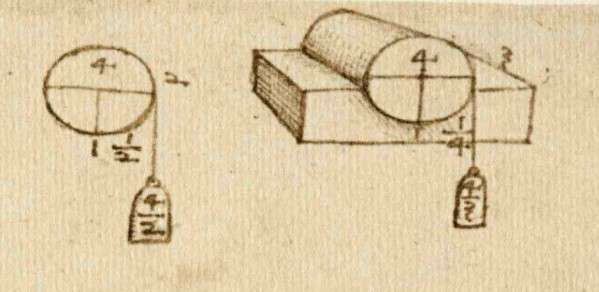
Just like the rest of us, Leonardo da Vinci doodled and scribbled: you can see it in his digitized notebooks, which we featured this past summer. But the prototypical Renaissance man, both unsurprisingly and characteristically, took that scribbling and doodling to a higher level entirely. Not only do his margin notes and sketches look far more elegant than most of ours, some of them turn out to reveal his previously unknown early insight into important subjects. Take, for instance, the study of friction (otherwise known as tribology), which may well have got its start in what at first just looked like doodles of blocks, weights, and pulleys in Leonardo’s notebooks.
This discovery comes from University of Cambridge engineering professor Ian M. Hutchings, whose research, says that department’s site, “examines the development of Leonardo’s understanding of the laws of friction and their application. His work on friction originated in studies of the rotational resistance of axles and the mechanics of screw threads, but he also saw how friction was involved in many other applications.”
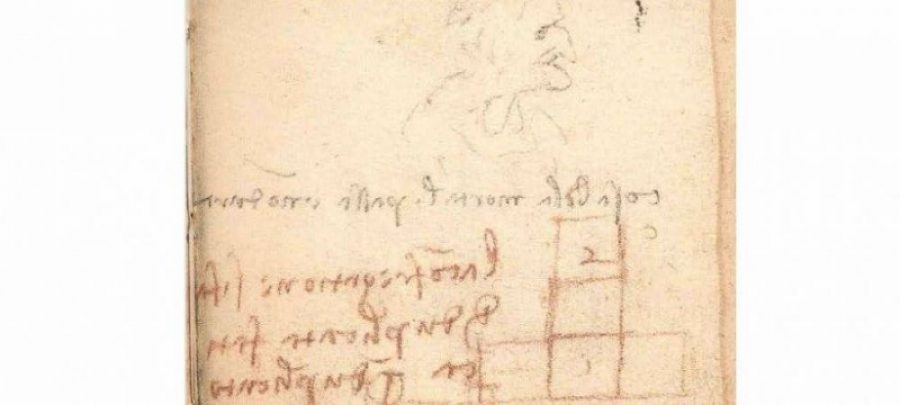
One page, “from a tiny notebook (92 x 63 mm) now in the Victoria and Albert Museum in London, dates from 1493” and “contains Leonardo’s first statement of the laws of friction,” sketches of “rows of blocks being pulled by a weight hanging over a pulley – in exactly the same kind of experiment we might do today to demonstrate the laws of friction.”
“While it may not be possible to identify unequivocally the empirical methods by which Leonardo arrived at his understanding of friction,” Hutchings writes in his paper, “his achievements more than 500 years ago were outstanding. He made tests, he observed, and he made powerful connections in his thinking on this subject as in so many others.” By the year of these sketches Leonardo “had elucidated the fundamental laws of friction,” then “developed and applied them with varying degrees of success to practical mechanical systems.”
And though tribologists had no idea of Leonardo’s work on friction until the twentieth century, seemingly unimportant drawings like these show that he “stands in a unique position as a quite remarkable and inspirational pioneer of tribology.” What other fields of inquiry could Leonardo have pioneered without history having properly acknowledged it? Just as his life inspires us to learn and invent, so research like Hutchings’ inspires us to look closer at what he left behind, especially at that which our eyes may have passed over before. You can open up Leonardo’s notebooks and have a look yourself. Just make sure to learn his mirror writing first.
Based in Seoul, Colin Marshall writes and broadcasts on cities and culture. His projects include the book The Stateless City: a Walk through 21st-Century Los Angeles and the video series The City in Cinema. Follow him on Twitter at @colinmarshall or on Facebook.
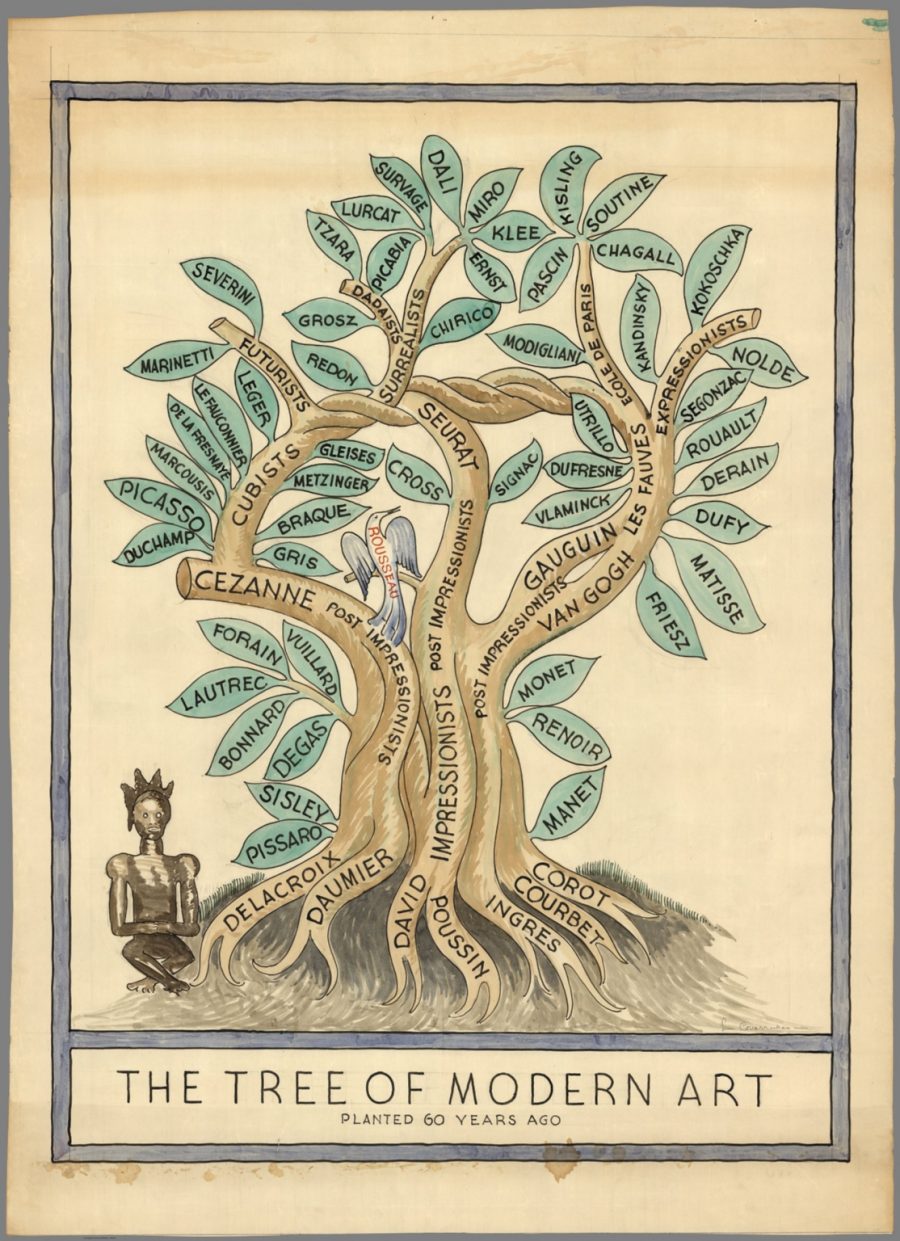
Selecting certain features, simplifying them, exaggerating them, and using them to provide a deep insight, at a glance, into the subject as a whole: such is the art of the caricaturist, one that Miguel Covarrubias elevated to another level in the early- to mid-20th century. Those skills, combined with his knowledge as an art historian, also served him well when he drew “The Tree of Modern Art.” This aesthetically pleasing diagram first appeared in Vanity Fair in May of 1933, a time when many readers of such magazines would have felt a great curiosity about how, exactly, all these new paintings and sculptures and such — many of which didn’t seem to look much like the paintings and sculptures they knew at all — related to one another.
“Because it stops in 1940, the tree fails to account for abstract expressionism and other post–World War II movements,” writes Vox’s Phil Edwards, in a piece that includes a version of the Covarrubias’ 1940 “Tree of Modern Art” revision with clickable examples of relevant artwork.
But “the organizational structure alone reveals a surprisingly large amount about the way art has evolved,” including how it “becomes broader and more inclusive over time,” eventually turning into a “global affair”; how “artistic schools have become more aesthetically diverse”; how “the canon evolved quickly”; and how “all art is intertwined,” created as it has so long been by artists who “work together, borrow from each other, and grow in tandem.”
You can also find the “Tree of Modern Art” at the David Rumsey Historical Map Collection, a holding that illustrates, as it were, just how wide a swath of information design the term “map” can encompass. “The date is estimated based on the verso of the paper being a blue lined base map of the National Park Service dated 12/28/39,” says the collection’s site. “This drawing was found in the papers of B. Ashburton Tripp” — also a mapmaker in the collection — “and we assume that Covarrubias and Tripp were friends (verified by Tripp’s descendants) and that the blue line base map was something Tripp was working on in his landscape architecture business.”
The legend describes the tree as having been “planted 60 years ago,” a number that has now passed 130. Many more leaves have grown off those branches of impressionism, expressionism, post-impressionism, surrealism, cubism, and futurism in the years since Covarrubias drew the tree, but for someone to go back and augment such a fully-realized creation wouldn’t do at all — as with any work of art, modern or otherwise.
Based in Seoul, Colin Marshall writes and broadcasts on cities and culture. His projects include the book The Stateless City: a Walk through 21st-Century Los Angeles and the video series The City in Cinema. Follow him on Twitter at @colinmarshall or on Facebook.
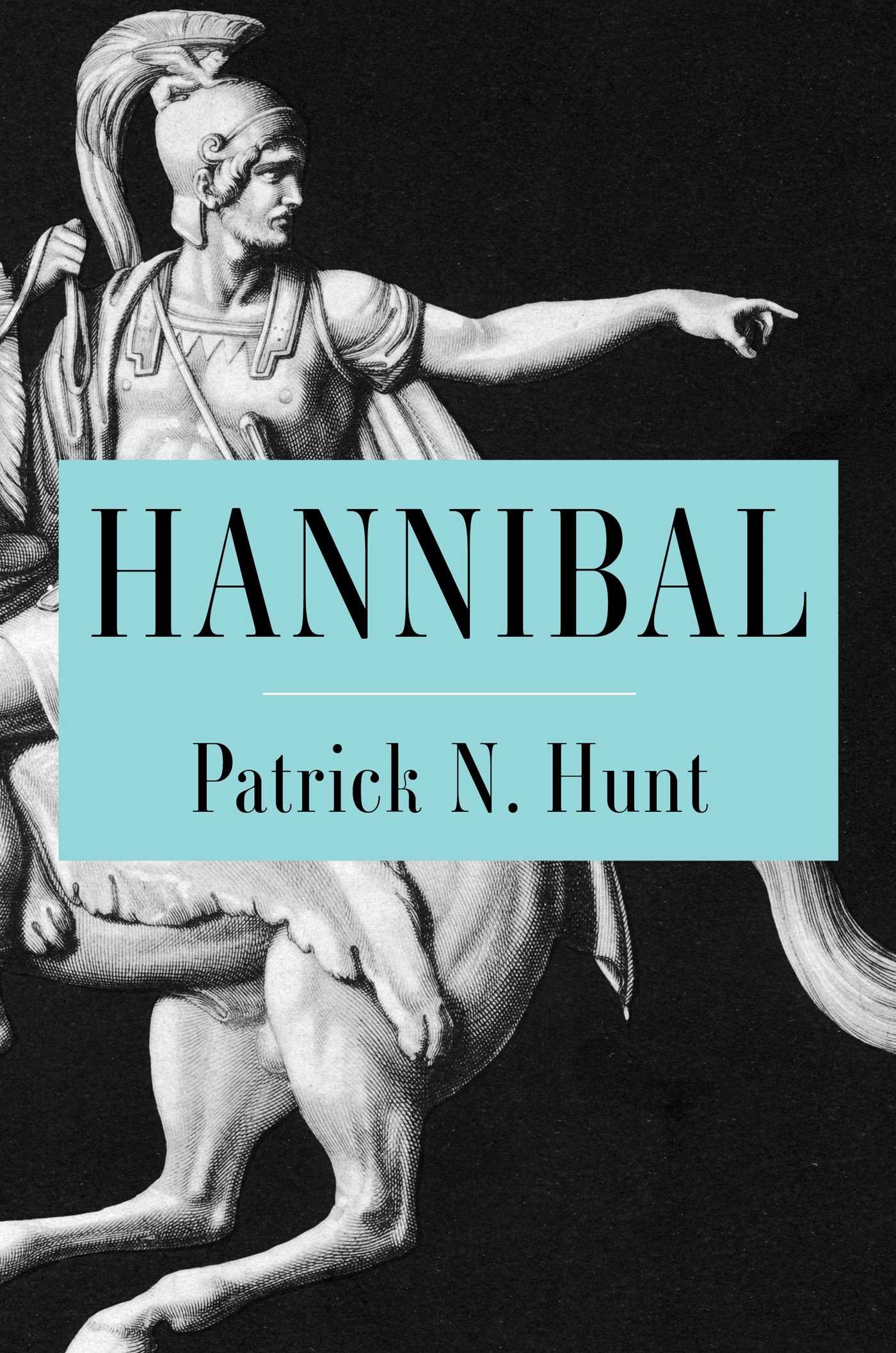
Note: This is a guest post from Patrick Hunt, author of the new book, Hannibal.
Hannibal Barca, otherwise simply known as Hannibal, lived and waged war over two thousand years ago – but is he still relevant in a world where the Romans are long gone? His famous crossing of the Alps in winter with an intrepid army and elephants is unforgettable, but are his brilliant maneuvers and intelligence gathering still worth examining? Despite the enigma of this great Carthaginian general being unable to preserve Carthage after him, Hannibal’s tactics and methods offer great lessons not only for military history but also for civilization at large. History reveals the Romans had a destiny of world conquest, but what is less well known is how much Hannibal changed the ways in which the Romans conducted the wars that eventually brought them Pax Romana, a peace often forged out of violence after a brutal expansion that killed and enslaved millions, including Carthage a century after Hannibal.
Before Hannibal, Rome was hemmed in by seas on almost all sides and could hardly expand except northward into Etruscan and Celtic territory; acquiring Sicily was Rome’s first step outside its mainland. But Hannibal forced Rome to fight a very different kind of war; his victories taught them how exploitable their military organization was, and he pressured Rome to change for survival. More relevant, while Hannibal didn’t invent spycraft, he seemingly used it more effectively than any other ancient general by his careful contingency planning. Hannibal set precedents for spy agencies and intelligence gathering and how to stage battles in any kind of terrain and weather–templates that current nations still study and follow. Every military academy today offers detailed classes and seminars on Hannibal’s tactics. I am frequently invited to lecture on Hannibal’s intelligence gathering in venues like the U.S. Naval War College, where classes are filled with Navy, Army, Marines, and Air Force officers along with representatives of the intelligence agencies. That is also why the National Geographic Society sponsored my Hannibal field research – sending me to every Hannibal battle site and to Carthage in Tunisia, along with Spain, France, Italy and even Turkey where Hannibal concluded his dramatic life — and also why Simon and Schuster published my biography Hannibal this summer. Here are some nuggets from 20 years of Hannibal fieldwork found in this new book.
Hannibal studied his opponents very carefully, employing every means of gathering intelligence in enemy camps, including spies from allied populations who provisioned the Romans.
When necessary, Hannibal paid for credible intelligence with silver supplied from mines in Carthaginian Spain; as long as that silver lasted to pay for good intel, he was unbeatable. Once Rome conquered Spain’s silver mines, Hannibal’s ability to gather and exploit such military intelligence was cut off. There is a direct correlation to Hannibal’s access to silver for intel or mercenary use and his brilliant victories.
Hannibal usually went for the unpredictable surprise maneuver that had never been seen before, including crossing the Alps in winter and forcing the Romans to fight in the dead of winter and at night.
Hannibal got into the minds of his enemies with psy-ops, exposing their weaknesses, triggering their anger and vanity, and making them fall into his traps; undermining the confidence of the Roman foot soldiers in big battles and paralyzing them with fear. Romans taught their children to fear Hannibal as the bogeyman – always warning in crises for centuries that “Hannibal is at the Gates”.
Hannibal proved it’s not the size of your army but how well prepared it is. He epitomizes the old adage, “Better 10 men wisely led than 100 with a fool at the head.” Even if austere, Hannibal’s leadership was legendarily charismatic – he even slept with his men on the ground wrapped in a blanket. He taught his men the brutality of war with likely less PTSD than his enemies because he always prepared them with ideas like “fight or die.” Much later, Machiavelli even alluded to Hannibal in The Prince with the concept that it’s “better to be feared than loved.”
Hannibal effectively used the most mobile units possible with his Numidian cavalry, often outflanking the Roman infantry on multiple campaigns, especially in his famous “double envelopment” or where he finished battles with ambushes from the rear where there was no escape.
Because his armies were almost always smaller – especially after his difficult Alps crossing when he lost many soldiers – Hannibal augmented his arsenal with weapons of nature: forcing the Romans to cross the frozen Trebbia River, hiding his armies in the fog above Lake Trasimene, driving captured cattle with torches tied to their horns to fool the Romans into thinking he was on the move at night at Volturnus, making the Romans face the blinding dust and sand blowing from Africa at Cannae. He even confused the Romans at Cannae with some of his troops outfitted with captured Roman gear.
Similarly, after studying terrain and topography, Hannibal always chose his battle sites when possible for the best possible advantage, especially constricting the larger Roman armies where they would be unable to outflank him and instead they would be hemmed in by rivers or hills, etc., also choosing terrain where he could hide ambushes in nearby forests.
Hannibal sagely exploited the 2‑consul Roman alternating command rotated one day between an experienced military veteran and the next day with a political appointee populist leading. On at least three occasions, Hannibal annihilated the Romans on the days when fools were the supposed commanders. The following Roman generations learned the hard lesson from this and the Senate created a professional army commanded by veteran leadership. Eventually Rome also amped up its cavalry and became less dependent on infantry thanks to Hannibal.
Hannibal taught his one formidable Roman opponent Scipio how to implement brilliant tactics, how to mine data from military intelligence and how to benefit from Spain’s mercenary silver to bribe the Numidians to abandon Carthage. Scipio – the only one to beat Hannibal — respected Hannibal more than any other Roman because he learned so much from him. It’s one of the great ironies in history that Hannibal is apparently more famous than Scipio, and it’s not only because of crossing the Alps with elephants: ultimately the Romans didn’t appreciate a victorious Scipio any more than the Carthaginians appreciated a victorious Hannibal. Hannibal will remain a profound enigma in that he could not ultimately win the war with Rome, yet he could win so many brilliant battles with incredibly memorable tactics still taught today.
The Roman book Stratagemata by Frontinus — a compilation of military stratagems — has more clever ruses of Hannibal than any other commander up to that time. Historic great commanders or officers who studied or emulated Hannibal include but are not limited to Julius Caesar, Belisarius, Charlemagne, Napoleon, Suvorov, Kutuzov, von Clausewitz, Montgomery, Liddell Hart, Rommel, Patton and Schwarzkopf, among many others. Even the term blitzkrieg alluded to Hannibal’s clan (Barca = “lightning”) and his rapid advance in his invasion of Italy.” So, of course, Hannibal is at least as relevant as any other memorable person in history, especially in a time of world chaos and rethinking strategic allegiances.
Postscript: Hannibal (Simon and Schuster 2017) has been acclaimed in reviews from The New York Times, Christian Science Monitor, Philadelphia Inquirer, Ancient History Encyclopedia, a starred Kirkus Review and many others, and also nominated in the Kirkus List of Best Nonfiction Books of 2017.
There has maybe never been a better time to critically examine the granting of special privileges to people for their talent, personality, or wealth. Yet, for all the harm wrought by fame, there have always been celebrities who use the power for good. The twentieth century is full of such figures, men and women of conscience like Muhamad Ali, Nina Simone, and Paul Robeson—extraordinary people who lived extraordinary lives. Yet no celebrity activist, past or present, has lived a life as extraordinary as Josephine Baker’s.
Born Freda Josephine McDonald in 1906 to parents who worked as entertainers in St. Louis, Baker’s early years were marked by extreme poverty. “By the time young Freda was a teenager,” writes Joanne Griffith at the BBC, “she was living on the streets and surviving on food scraps from bins.” Like every rags-to-riches story, Baker’s turns on a chance discovery. While performing on the streets at 15, she attracted the attention of a touring St. Louis vaudeville company, and soon found enormous success in New York, in the chorus lines of a string of Broadway hits.
Baker became professionally known, her adopted son Jean-Claude Baker writes in his biography, as “the highest-paid chorus girl in vaudeville.” A great achievement in and of itself, but then she was discovered again at age 19 by a Parisian recruiter who offered her a lucrative spot in a French all-black revue. “Baker headed to France and never looked back,” parlaying her nearly-nude danse sauvage into international fame and fortune. Topless, or nearly so, and wearing a skirt made from fake bananas, Baker used stereotypes to her advantage—by giving audiences what they wanted, she achieved what few other black women of the time ever could: personal autonomy and independent wealth, which she consistently used to aid and empower others.
Throughout the 20s, she remained an archetypal symbol of jazz-age art and entertainment for her Folies Bergère performances (see her dance the Charleston and make comic faces in 1926 in the looped video above). In 1934, Baker made her second film Zouzou (top), and became the first black woman to star in a major motion picture. But her sly performance of a very European idea of African-ness did not go over well in the U.S., and the country she had left to escape racial animus bared its teeth in hostile receptions and nasty reviews of her star Broadway performance in the 1936 Ziegfeld Follies (a critic at Time referred to her as a “Negro wench”). Baker turned away from America and became a French citizen in 1937.
American racism had no effect on Baker’s status as an international superstar—for a time perhaps the most famous woman of her age and “one of the most popular and highest-paid performers in Europe.” She inspired modern artists like Picasso, Hemingway, E.E. Cummings, and Alexander Calder (who sculpted her in wire). When the war broke out, she hastened to work for the Red Cross, entertaining troops in Africa and the Middle East and touring Europe and South America. During this time, she also worked as a spy for the French Resistance, transmitting messages written in invisible ink on her sheet music.
Her massive celebrity turned out to be the perfect cover, and she often “relayed information,” the Spy Museum writes, “that she gleaned from conversations she overheard between German officers attending her performances.” She became a lieutenant in the Free French Air Force and for her efforts was awarded the Croix de Guerre and the Medal of the Resistance by Charles De Gaulle and lauded by George S. Patton. Nonetheless, many in her home country continued to treat her with contempt. When she returned to the U.S. in 1951, she entertained huge crowds, and dealt with segregation “head –on,” writes Griffith, refusing “to perform in venues that would not allow a racially mixed audience, even in the deeply divided South.” She became the first person to desegregate the Vegas casinos.
But she was also “refused admission to a number of hotels and restaurants.” In 1951, when employees at New York’s Stork Club refused to serve her, she charged the owner with discrimination. The Stork club incident won her the lifelong admiration and friendship of Grace Kelly, but the government decided to revoke her right to perform in the U.S., and she ended up on an FBI watch list as a suspected communist—a pejorative label applied, as you can see from this declassified 1960 FBI report, with extreme prejudice and the presumption that fighting racism was by default “un-American.” Baker returned to Europe, where she remained a superstar (see her perform a medley above in 1955).
She also began to assemble her infamous “Rainbow Tribe,” twelve children adopted from all over the world and raised in a 15th-century chateau in the South of France, an experiment to prove that racial harmony was possible. She charged tourists money to watch the children sing and play, a “little-known chapter in Baker’s life” that is also “an uncomfortable one,” Rebecca Onion notes at Slate. Her estate functioned as a “theme park,” writes scholar Matthew Pratt Guterl, a “Disneyland-in-the-Dordogne, with its castle in the center, its massive swimming pool built in the shape of a “J” for its owner, its bathrooms decorated like an Arpège perfume bottle, its hotels, its performances, and its pageantry.” These trappings, along with a menagerie of exotic pets, make us think of modern celebrity pageantry.
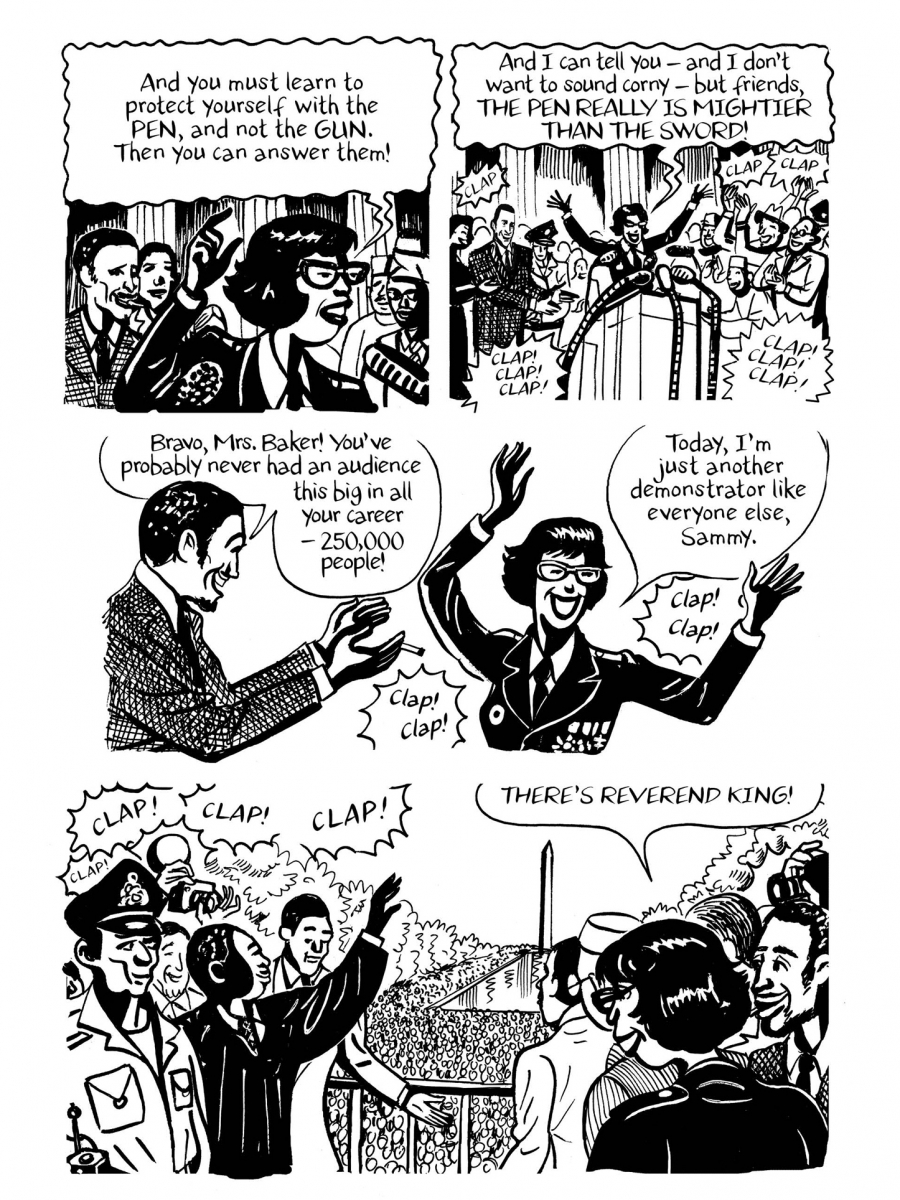
But for all its strange excesses, Guturl maintains, her “idiosyncratic project was in lockstep with the mainstream Civil Rights Movement.” She wouldn’t return to the States until 1963, with the help of Attorney General Robert Kennedy, and when she did, it was as a guest of Martin Luther King, Jr. and the organizers of the March on Washington, where, in her Free French Air Force uniform, she became the only woman to address the crowd. The visual recounting of that moment above comes from a new 600-page graphic biography that follows Baker’s “trajectory from child servant in St. Louis,” PRI writes, “to her days as a vaudeville performer, a major star in France, and later, a member of the French Resistance and an American civil rights activist.”
In her speech, she directly confronted the government who had turned her into an enemy:
They thought they could smear me, and the best way to do that was to call me a communist. And you know, too, what that meant. Those were dreaded words in those days, and I want to tell you also that I was hounded by the government agencies in America, and there was never one ounce of proof that I was a communist. But they were mad. They were mad because I told the truth. And the truth was that all I wanted was a cup of coffee. But I wanted that cup of coffee where I wanted to drink it, and I had the money to pay for it, so why shouldn’t I have it where I wanted it?
Baker made no apologies for her wealth and fame, but she also took every opportunity, even if misguided at times, to use her social and financial capital to better the lives of others. Her plain-speaking demands opened doors not only for performers, but for ordinary people who could look to her as an example of courage and grace under pressure into the 1970s. She continued to perform until her death in 1975. Just below, you can see rehearsal footage and interviews from her final performance, a sold-out retrospective.
The opening night audience included Sophia Lauren, Mick Jagger, Shirley Bassey, Diana Ross, and Liza Minelli. Four days after the show closed, Baker was found dead in her bed at age 68, surrounded by rave reviews of her performance. Her own assessment of her five-decade career was distinctly modest. Earlier that year, Baker told Ebony magazine, “I have never really been a great artist. I have been a human being that has loved art, which is not the same thing. But I have loved and believed in art and the idea of universal brotherhood so much, that I have put everything I have into them, and I have been blessed.” We might not agree with her critical self-evaluation, but her life bears out the strength and authenticity of her convictions.
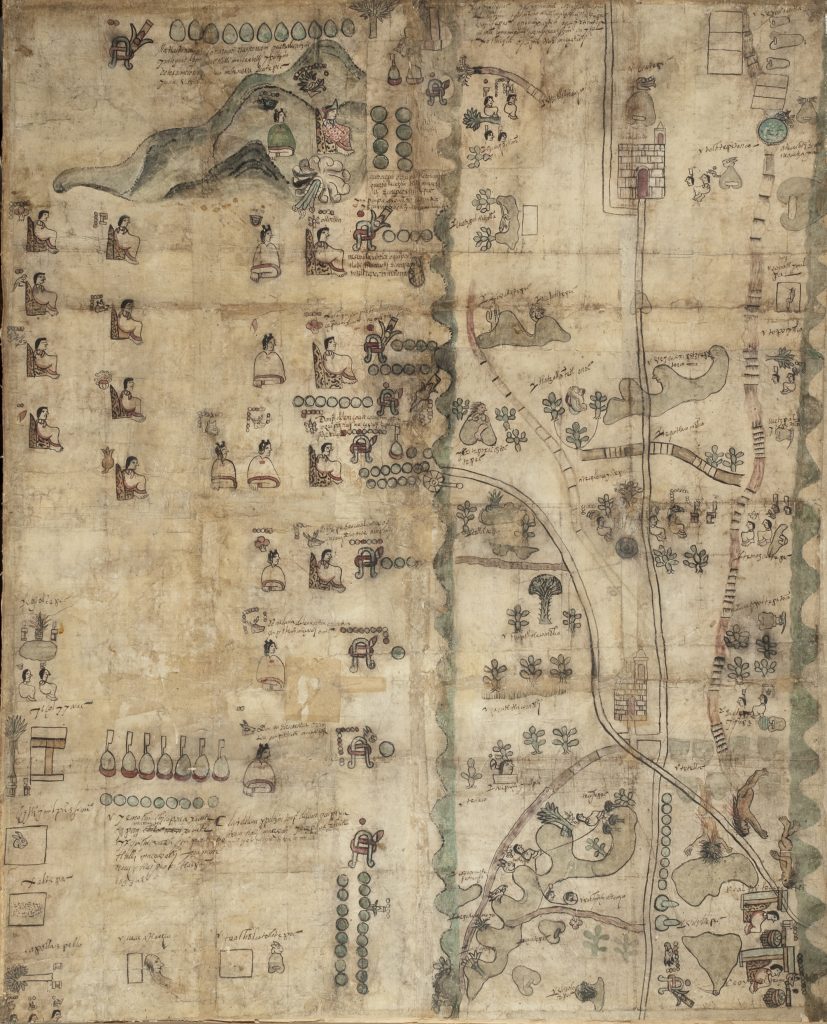
To paraphrase Donald Rumsfeld, there are known knowns in the art world, and there are unknown knowns. The Codex Quetzalecatzin, a rare colored Mesoamerican manuscript, recently went from a unknown known (a French collector owned it, and before them William Randolph Hearst, and many others, for several centuries) to a known known (the French collector donated it to the Library of Congress).
Better still, the Library has scanned the illustrated document–essentially a map of Mexico City and Puebla, drawn up for both Spanish colonizers and indigenous people to lay claim to the land–in super hi-res for the public and scholars worldwide to pore over. It dates from between 1570 and 1595.
According to John Hessler of the Library’s Worlds Revealed blog, the map depicts the land owned by the de Leon family.
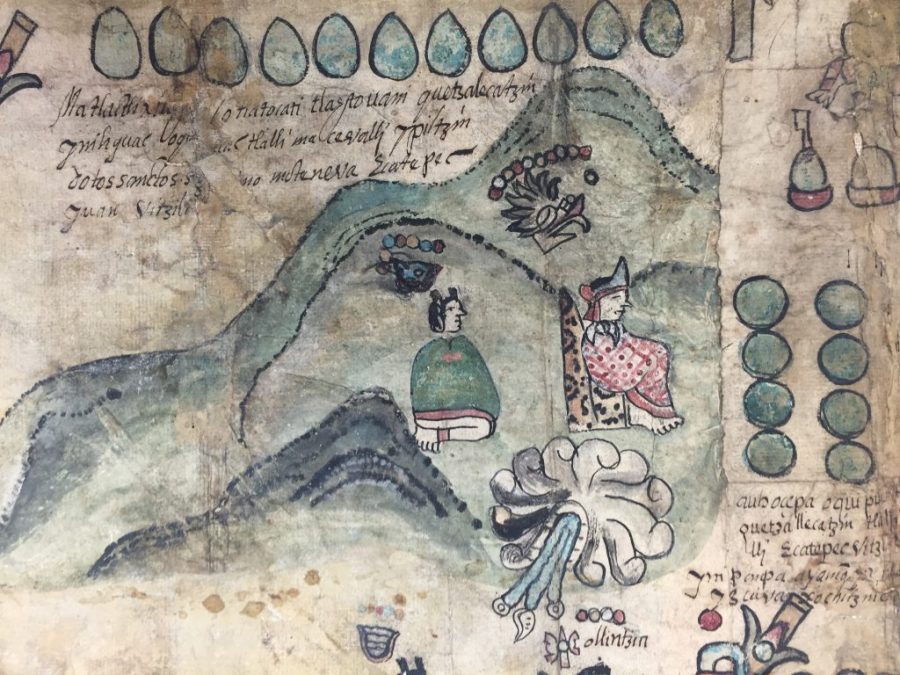
As is typical for an Aztec, or Nahuatl, codex of this early date, it relates the extent of land ownership and properties of a family line known as “de Leon,” most of the members of which are depicted on the manuscript. With Nahuatl stylized graphics and hieroglyphs, it illustrates the family’s genealogy and their descent from Lord-11 Quetzalecatzin, who in 1480, was the major political leader of the region. It is from him the Codex derives one of its many names.
The map is one of 450 surviving pictorial manuscripts of the Mesoamerican period, and contains natural pigments such as Maya blue and cochineal red (made from insects).
If it wasn’t so tied in to bloody Spanish colonialism, you could say the Codex looks like a video game map, a la Legend of Zelda. But instead it shows a region in transition, between the old order and a new world populated by Catholic churches, and is all the more fascinating.
Ted Mills is a freelance writer on the arts who currently hosts the artist interview-based FunkZone Podcast and is the producer of KCRW’s Curious Coast. You can also follow him on Twitter at @tedmills, read his other arts writing at tedmills.com and/or watch his films here.
We're hoping to rely on loyal readers, rather than erratic ads. Please click the Donate button and support Open Culture. You can use Paypal, Venmo, Patreon, even Crypto! We thank you!
Open Culture scours the web for the best educational media. We find the free courses and audio books you need, the language lessons & educational videos you want, and plenty of enlightenment in between.