FYI: Courtesy of Penguin Random House, you can download The Book Lover’s Guide to Coffee. This free guide–a “celebration of ideas that make coffee and literature inseparable”–features:
6 authors on coffee’s cultural significance ;
The rituals of 7 famous coffee-obsessed authors;
Infographics rich with caffeinated, bookish data;
Tips on taking the perfect coffee;
Brewing guides from Birch Coffee.
You can download the coffee guide here. (They do require an email address.) Meanwhile, find more good coffee items in the Relateds below.
“I’m tired of politics, I just want to talk about my art,” I sometimes hear artists—and musicians, actors, writers, etc.—say. And I sometimes see their fans say, “you should shut up about politics and just talk about your art.” Given the current onslaught of political news, commentary, scandal, and alarm, these are both understandable sentiments. But anyone who thinks that art and politics once occupied separate spheres harbors a historically naïve belief. The arts have always been political, and all the more so during times of high drama and tension like the one we live in now. We can look, for example, to John Milton’s Paradise Lost, Jacques-Louis David’s Death of Marat, or Pablo Picasso’s Guernica, just to mention three particularly striking historical examples.
The political acts of avant-garde artists like Picasso in the 20th century were as much revolutions in form as in content, and we begin to see the most radical statements emerge in the teens and twenties with Dada, Surrealism, and other modernisms: sometimes explicitly political in their orientation—spanning the gamut from anarchism to fascism—sometimes more subtly partisan.
This period was also, perhaps not coincidentally, the Golden Age of the arts journal, when every movement, circle, and splinter group in Europe and the U.S. had its own publication. For many years now, Princeton University’s Blue Mountain Project, a joint effort from “scholars, librarians, curators, and digital humanities researchers,” has archived complete issues of several such journals, and we’ve featured a couple notable examples in previous posts.
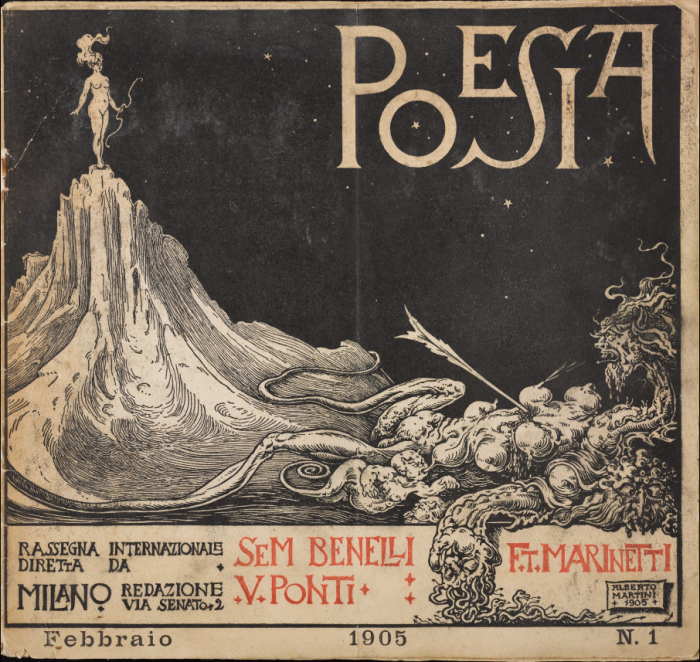
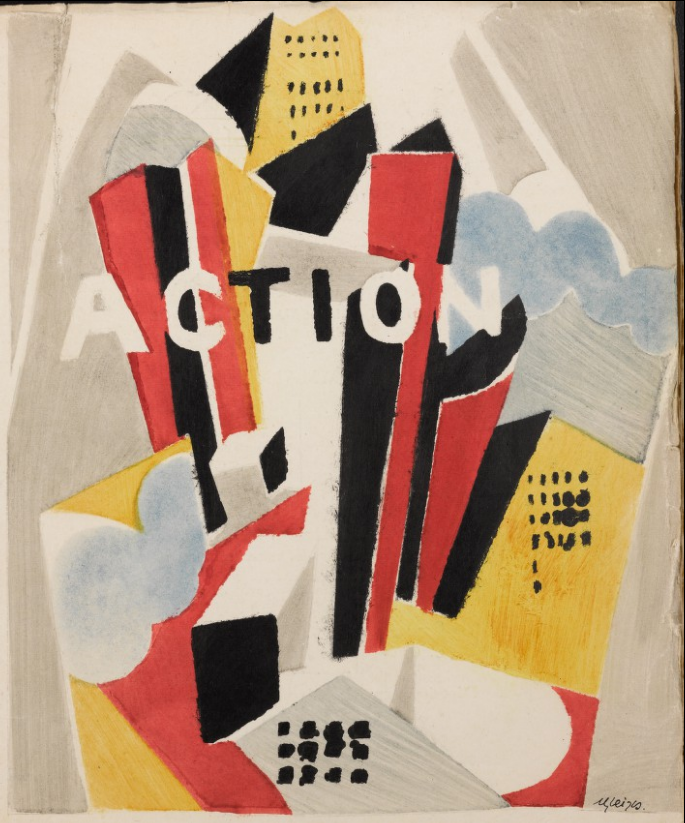
Now we direct your attention to the full online library, where you’ll find issues of Poesia (top), published by F.T. Marinetti between 1905 and 1920. This magazine represents “the transition from Italy’s engagement with an international Symbolist movement to an increasingly nationalist Futurism” and features the work of Marinetti, Alfred Jarry, W.B. Yeats, Paolo Buzzi, Emilio Notte, and James Joyce. Below Poesia, from the other side of the spectrum, we see the cover of a 1920 issue of Action, a “literary and artistic magazine associated with Individualist Anarchism,” and featuring work from writers like André Malraux, Antonin Artaud, and Paul Éluard, and artwork from Demetrios Galanis and Robert Mortier, to name just a few.
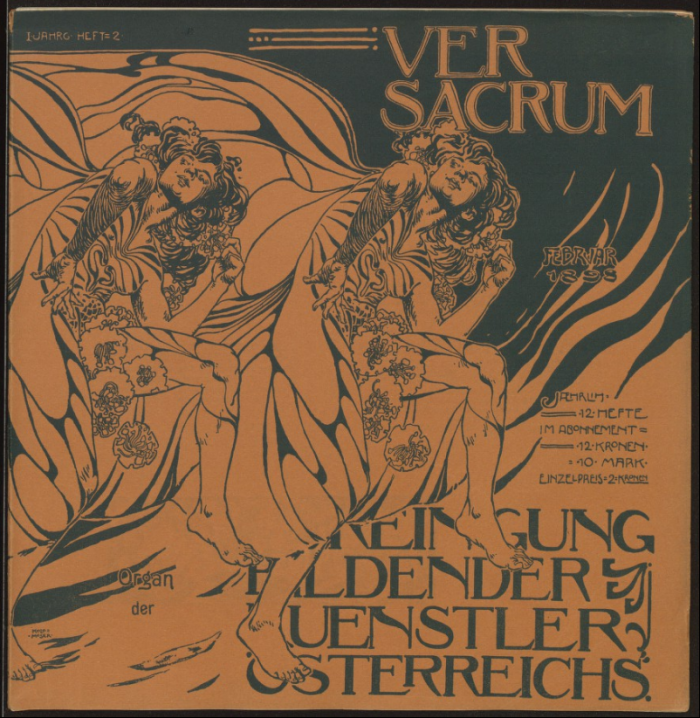
Not every avant-garde arts journal had a clear ideological mission, but they all represented aesthetic programs that strongly reacted against the status quo. The artists of the so-called Vienna Secession broke away from Association of Austrian Artists to protest its conservatism. Their journal, Ver Sacrum, further up, joined the flowing, intricate, and passionate designs of Art Nouveau and German Jugendstil artists, who created the look of the Weimar Republic and the Jazz Age. Contributors included Gustav Klimt, Koloman Moser, and Josef Hoffmann.
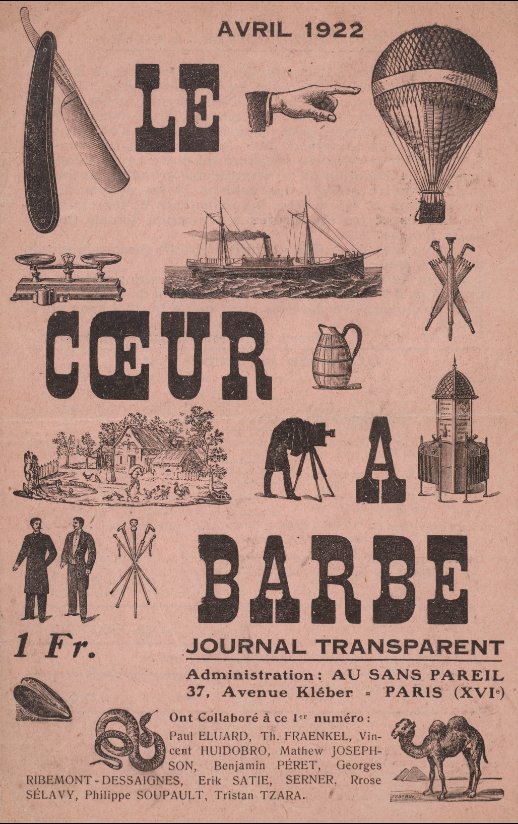
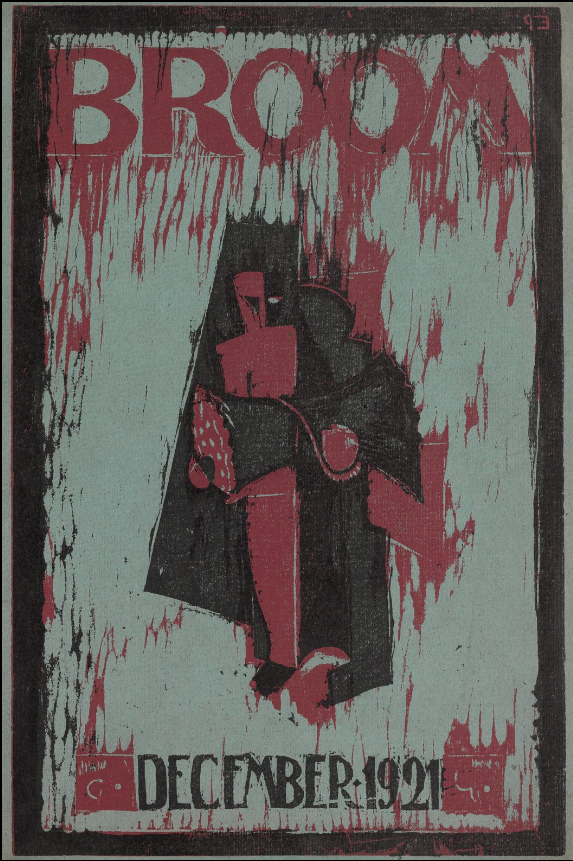
Sometimes avant-garde journals reflected political conflicts between warring factions of artists, as in the example of Le coeur à barbe: journal transparent, “produced by Tristan Tzara as a response to the attacks on him by Francis Picabia and André Breton about the future of the Dada movement.” Other publications aimed to expand the boundaries of national culture, as with Broom, above, a “self-proclaimed international magazine of arts and literature… a sumptuous journal that introduced American audiences to the European avant-garde.” Whatever their stated mission and implicit or explicit slant, it’s fair to say that the radical art published in avant-garde journals between the turn of the century and the end of the 1920s did everything but stand on the sidelines.
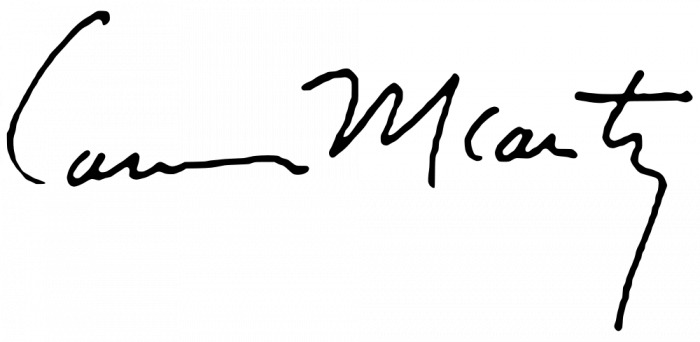
I first came to know the work of Cormac McCarthy through the 1973 novel Child of God, a portrait of a terrifyingly alienated loner who becomes a serial killer. The book so immerses readers in the dank, claustrophobic world of its protagonist, Lester Ballard, that one can almost smell the dirt and rotting flesh. Next, I read Blood Meridian, McCarthy’s psychedelically brutal epic about a mercenary band of scalp hunters who massacred Native Americans in the mid-nineteenth century Southwest. In McCarthy’s avalanche of prose—which lacks commas, apostrophes, quotation marks, and most every other mark of punctuation—long passages of grim death and carnage become hallucinatory trance-inducing incantations.
It’s never a good idea to identify an author too closely with their fiction; the most disturbingly effective works of horror and madness have very often been designed by writers of the highest emotional sensitivity and critical intelligence. This is certainly the case with McCarthy, whose work plumbs the deepest existential abysses. Nevertheless, I harbored certain anxious expectations of him, unsure if he was a writer I’d ever actually want to meet. So like many others, I was more than a little puzzled by McCarthy’s decision to give his first and only TV interview in 2007 on Oprah Winfrey’s wildly popular platform.
But among the many things we learned from their pleasant conversation is that McCarthy doesn’t care much for literary society. He doesn’t like writers so much as he loves writing and thinking, of all kinds. He spends most of his time with scientists, keeping—as we noted in a post last week—an office at a think tank called the Santa Fe Institute and doing most of his writing there on a noisy old typewriter. While developing relationships with physicists, McCarthy took an interest in their writing, and volunteered to copy-edit several scientific books. He overhauled the prose in physicist Lawrence Krauss’s Quantum Man, a biography of Richard Feynman, promising, says Krauss, that he “could excise all the exclamation points and semicolons, both of which he said have no place in literature.”
In 2005, McCarthy read the manuscript of the Harvard physicist Lisa Randall’s first book, Warped Passages: Unraveling the Mysteries of the Universe’s Hidden Dimensions. He “gave it a good copy-edit,” Randall said, and “really smoothed the prose.” Later he did the same for her second book, Knocking on Heaven’s Door. During that experience, she notes, “we had some nice conversations about the material. In fact, I saw a quote where he used a physics example I had given in response to a question about truth and beauty.”
Perhaps McCarthy sees this avocation as a challenge and an opportunity to learn. Perhaps he’s also doing research for his own work. His latest project, The Passenger, includes a character who is a Los Alamos physicist. But what about another, surprisingly out-of-the-blue editorial job he took on in 1996? Before he applied his austerities to Krauss and Randall’s work, he received an article from theoretical economist and friend W. Brian Arthur. The piece, scheduled to be published in the Harvard Business Review, was titled “Increasing Returns and the New World of Business.”
After mailing McCarthy the article, Arthur called and asked him how he liked it. “There was a silence on the line,” he tells Rick Tetzeli in an interview for Fast Company, “and then he said, ‘Would you be interested in some editorial help on that?’” The two spent four hours going over the writing. “Let’s say the piece was better for all the hours Cormac and I spent poring over every sentence,” Arthur says, noting that his editor called in a “slight panic” after hearing about the collaboration. You can read the full article here. It’s “a lot punchier and more sharply worded than you might expect, given its subject matter,” writes The Onion’s A.V. Club. It also contains a lot more punctuation than we might expect, given its copy-editor’s philosophy.
“Increasing Returns and the New World of Business” became one of Harvard Business Review’s “most influential articles” Tetzeli writes. “Even now, the theory of increasing returns is as important as ever: it’s at the heart of the success of companies such as Google, Facebook, Uber, Amazon, and Airbnb.” Did McCarthy’s encounter with Arthur’s theory appear in his later fiction? Who knows. Perhaps where Arthur’s vision of economic growth predicted the massive tech giants to come, McCarthy’s keen mind saw the ever-increasing profits of business savvy drug cartels like those in No Country for Old Men and his Ridley Scott collaboration The Counselor.
It’s been a hallmark of the culture wars in the last few decades for politicians and opinionators to rail against academia. Professors of humanities have in particular come under scrutiny, charged with academic frivolity (sometimes at taxpayer expense), willful obscurantism, and all sorts of ideological crimes and diabolical methods of indoctrination. As an undergrad and graduate student in the humanities during much of the nineties and oughts, I’ve witnessed a few waves of such attacks and found the caricatures drawn by talk radio hosts and cabinet appointees both alarming and amusing. I’ve also learned that mistrust of academia is much older than the many virulent strains of anti-intellectualism in the U.S.
As Yale Professor of British Romantic Poetry Paul Fry points out in an interview with 3:AM Magazine, “satire about any and all professionals with a special vocabulary has been a staple of fiction and popular ridicule since the 18th century… and critic-theorists perhaps more recently have been the easy targets of upper-middle-brow anti-intellectuals continuously since [Henry] Fielding and [Tobias] Smollett.” Though the barbs of these British novelists are more entertaining than anything you’ll hear from current talking heads, the phenomenon remains the same: “Special vocabulary intimidate and are instantly considered obfuscation,” says Fry. “Reactions against them are shamelessly naïve, with no consideration of whether the recondite vocabularies may be serving some necessary and constructive purpose.”
Maybe you’re scratching your chin, shaking or nodding your head, or glazing over. But if you’ve come this far, read on. Fry, after all, acknowledges that jargon-laden scholarly vocabularies can become “self-parody in the hands of fools,” and thus have provided justifiable fodder for cutting wit since even Jonathan Swift’s day. But Fry picks this history up in the 20th century in his Yale course ENGL 300 (Introduction to Theory of Literature), an accessible series of lectures on the history and practice of literary theory, in which he proceeds in a critical spirit to cover everything from Russian Formalism and New Criticism; to Semiotics, Structuralism and Deconstruction; to the Frankfurt School, Post-Colonial Criticism and Queer Theory. Thanks to Open Yale Courses, you can watch the 26 lectures above. Or you can find them on YouTube, iTunes, or Yale’s own web site (where you can also grab a syllabus for the course). These lectures were all recorded in the Spring of 2009. The main text used in the course is David Richter’s The Critical Tradition.
Expanding with the rapid growth and democratizing of universities after World War II, literary and critical theories are often closely tied to the contentious politics of the Cold War. Their decline corresponds to these forces as well. Since the fall of the Soviet Union and the subsequent snowballing of privatization and anti-government sentiment, many sources of funding for the humanities have succumbed, often under very public assaults on their character and utility. Fry’s presentation shows how literary theory has never been a blunt political instrument at any time. Rather it provides ways of doing ethics and philosophies of language, religion, art, history, myth, race, sexuality, etc. Or, put more plainly, the language of literary theory gives us different sets of tools for talking about being human.
Fry tells Yale Daily News that “literature expresses more eloquently and subtly emotions and feelings that we all try to express one way or another.” But why apply theory? Why not simply read novels, stories, and poems and interpret them by our own critical lights? One reason is that we cannot see our own biases and inherited cultural assumptions. One ostensibly theory-free method of an earlier generation of scholars and poets who rejected literary theory often suffers from this problem. The New Critics flourished mainly during the 40s, a fraught time in history when the country’s resources were redirected toward war and economic expansion. For Fry, this “last generation of male WASP hegemony in the academy” reflected “the blindness of the whole middle class,” and the idea “that life as they knew it… was life as everyone knew it, or should if they didn’t.”
Fry admits that theory can seem superfluous and needlessly opaque, “a purely speculative undertaking” without much of an object in view. Yet applied to literature, it provides exciting means of intellectual discovery. Fry himself doesn’t shy away from satirically taking the piss, as a modern-day Swift might say. He begins not with Coleridge or Keats (though he gets there eventually), but with a story for toddlers called “Tony the Tow Truck.” He does this not to mock, but to show us that “reading anything is a complex and potentially unlimited activity”—and as “a facetious reminder,” he tells 3:AM, that “theory is taking itself seriously in the wrong way if it exhausts its reason for being….”
Last summer, a rumor circulated that Cormac McCarthy, one of America’s most beloved living writers, had passed away. In the midst of a devastating year for famous artists and their fans, the announcement appeared on Twitter, but it “was, in fact, a hoax.” As McCarthy’s publisher—recently merged juggernaut Penguin Random House—confirmed, the author of such modern classics as Blood Meridian, All the Pretty Horses, and No Country for Old Men “is alive and well and still doesn’t care about Twitter.” The literary community is better off not only for McCarthy’s good health, but for his disregard of what may be the most fiendishly distracting social media platform of them all. He is still hard at work, on a novel called The Passenger, tentatively slated for release this year.
You can hear excerpts of The Passenger read in the dim, shaky video below, from an event in 2015 at the Santa Fe Institute, an independent scientific think tank where McCarthy keeps an office and where he has plied a secondary trade as a copy-editor for science-themed books, including Quantum Man, physicist Lawrence Krauss’s biography of Richard Feynman. (McCarthy’s “knowledge of physics and maths,” writes Alison Flood at The Guardian, is said to exceed “that of many professionals in the field.”) McCarthy’s latest work seems like a departure for him.
His earlier novels mined the richness of Southern Gothic and Western traditions, and “have subtly woven in science,” writes Babak Dowlatshahi at Newsweek. But The Passenger “will place science in the foreground.” Santa Fe Institute president David Krakauer calls it “full-blown Cormac 3.0—a mathematical [and] analytical novel.”
So we know Cormac McCarthy is a genius, but how is it that he found the time to become a Pulitzer Prize, National Book Award, and Guggenheim and MacArthur Fellowship-winning novelist and, on the side, a student of theoretical physics and math? His secret involves more than staying off Twitter. As McCarthy tells Oprah Winfrey in the video at the top of the post, excerpted from his first television interview ever in 2007, he has made his work the central focus of his life, to the exclusion of everything else, including money and public adulation from fans and admirers. For example, he answers a question about why he turned down lucrative speaking engagements with, “I was busy. I had other things to do.”
It’s not that I don’t like things, I mean some things are very nice, but they certainly take a distant second place to being able to live your life and being able to do what you want to do. I always knew that I didn’t want to work.
How did he pull off not working? “You have to be dedicated… I thought, ‘you’re just here once, life is brief and to have to spend every day of it doing what somebody else wants you to do is not the way to live it.’” McCarthy doesn’t “have any advice for anybody” about how to avoid the daily grind, except, he says, “if you’re really dedicated, you can probably do it.” As Oprah puts it, “you have worked at not working?” To which he replies, “absolutely, it’s the number one priority.”
Lest we immediately dismiss McCarthy’s philosophy as cluelessness or privilege, we should bear in mind that he willingly endured extreme and “truly, truly bleak” poverty to keep working at not working—or working, rather, on the work he wanted to do. There’s a bit more to becoming a multiple award-winning novelist and MacArthur “Genius” than simply avoiding the 9‑to‑5. But McCarthy suggests that unless artists make their own work their first priority, and material comfort and economic security a “distant second,” they may never truly find out what they’re capable of.
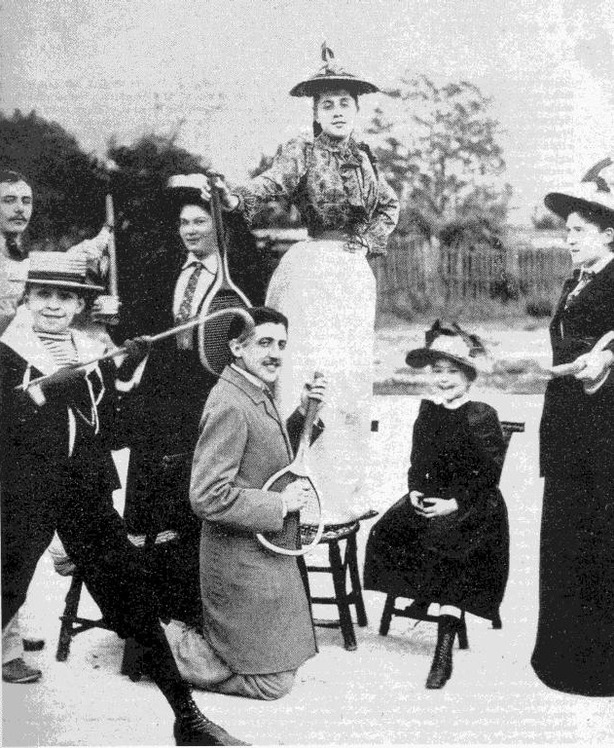
Was “air guitar” a thing back in 1891, when a photographer captured young Marcel Proust in this playful photograph? Probably not. Maybe it’s anachronistic to read the photograph this way. But you have to admit, it’s worth suspending disbelief for a moment and imagining what song Marcel was playing. Any clever guesses?
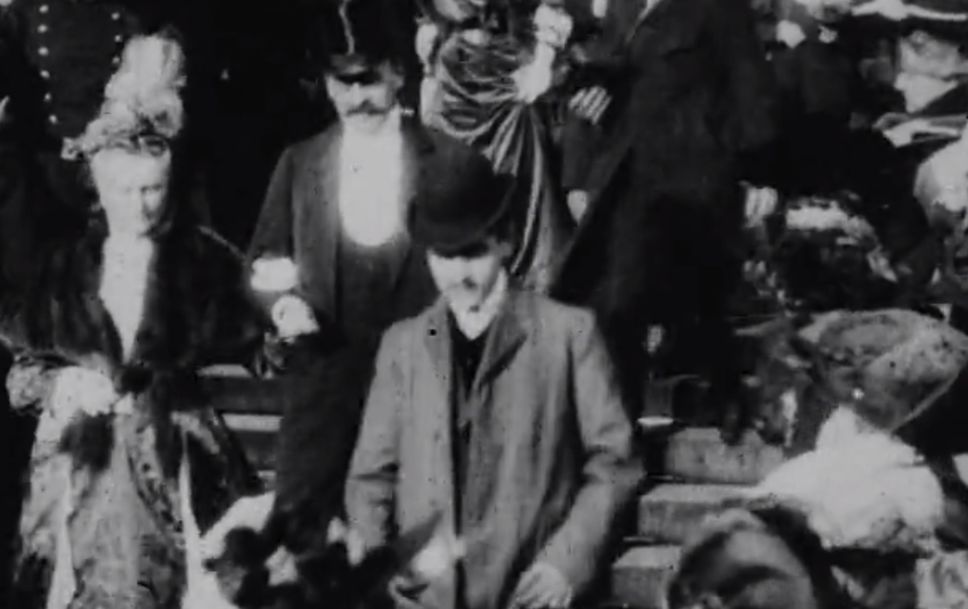
Ladies and gentlemen, we present the first known footage of the French author Marcel Proust.
Announced by ProfessorJean-Pierre Sirois-Trahan in the latest edition of the French journal, Revue d’études proustiennes, the footage was recorded on November 14, 1904 (nine years before Proust published the first volume in his classic work, À la recherche du temps perdu/Remembrance of Things Past). And it shows Proust descending a stairway at the wedding of his close friend, Armand de Guiche. Look for him at the 37 second mark. He’s dressed less formally (in grey, not black) than the aristocrats joining him at the celebration. I’ve added a close up picture below.
If you would like to support the mission of Open Culture, consider making a donation to our site. It’s hard to rely 100% on ads, and your contributions will help us continue providing the best free cultural and educational materials to learners everywhere. You can contribute through PayPal, Patreon, and Venmo (@openculture). Thanks!
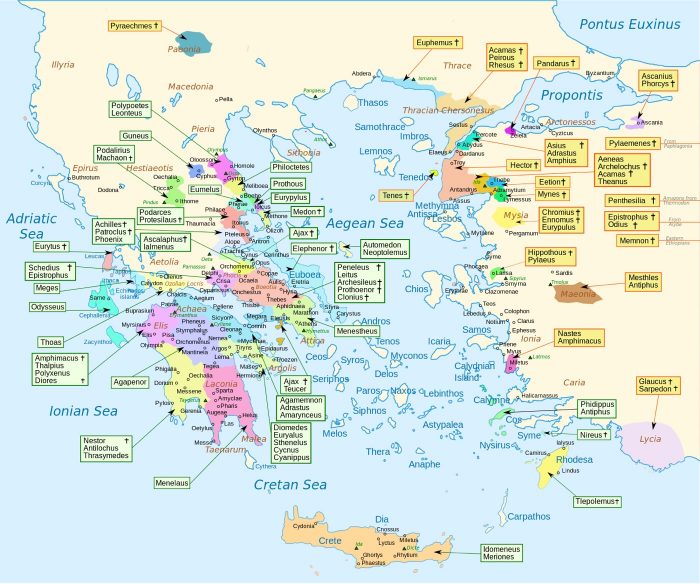
You’ve adjusted to the strangeness of names like Ascalaphus and Phidippus. You’ve more or less figured out who’s on which side in the ancient war between Greece and Troy. But as literary epics will do—from the ancient Greeks and Indians to the 19th century Russians—Homer’s Iliad also presents you with several logistical puzzles you must either ignore or spend countless hours trying to solve: you are given the names of major and minor characters’ hometowns, ranging all over the Adriatic, Ionian, Cretan, and Aegean Seas. Doubtless you have no idea where most of these places were.
Again and again, place names occur in rapid succession, and you’re told not only who hails from where, but who commands and conquers which city. Just a smattering of examples from Book II (in Samuel Butler’s translation):
Ulysses led the brave Cephallenians, who held Ithaca, Neritum with its forests, Crocylea, rugged Aegilips, Samos and Zacynthus, with the mainland also that was over against the islands.
Thoas, son of Andraemon, commanded the Aetolians, who dwelt in Pleuron, Olenus, Pylene, Chalcis by the sea, and rocky Calydon,
And those that held Pherae by the Boebean lake, with Boebe, Glaphyrae, and the populous city of Iolcus
“Huh,” you say, “Okay, Homer, I’ll take your word for it.” Questions of historicity aside, we can at least say that the hundreds of cities and towns mentioned in this culturally formative text did exist, or continue to do so, though it’s debatable, as Jason Kottke writes, whether “that level of mobility was accurate for the time [somewhere in the 11th or 12th century BC] or if Homer simply populated his poem with folks from all over Greece as a way of making listeners from many areas feel connected to the story.”
In any case, you need not despair of ever making sense of Homer’s bewildering geographical lists. The map above (click here to see it in a larger format) handily illustrates the world of the Iliad, showing the places of origins of a few dozen characters, with Greeks in green and Trojans in yellow. Kottke notes in an addendum to his post that “not every character is represented… (particularly the women) and… some of the locations and hometowns are incorrect.” We would welcome corrections—as would Wikipedia—if an enterprising classics scholar has the time and energy to devote to such an effort.
But for the lay reader of Homer’s epic, the map more than suffices as helpful visual context for a very complicated narrative. One defining feature of a war epic well-told, most critics would say, is that the human drama does not get lost in the scale and scope of the action. More than any other form, the epic illustrates what Tolstoy described in War and Peace as the “historical sense” that our conflicts are “bound up with the whole course of history and preordained from all eternity.” But against this kind of determinism, the great poets particularize, making their characters seem not like props in a cosmic drama but like actual people from actual places on earth. Seeing the Iliad mapped above reinforces our sense of the Greek epics as genuine—if fantastical—accounts of meaningful human action in the world.
You can find free versions of the Iliad and the Odyssey in our collection of Free eBooks and Free Audio Books.
We're hoping to rely on loyal readers, rather than erratic ads. Please click the Donate button and support Open Culture. You can use Paypal, Venmo, Patreon, even Crypto! We thank you!
Open Culture scours the web for the best educational media. We find the free courses and audio books you need, the language lessons & educational videos you want, and plenty of enlightenment in between.