In the town of Bradford, near Leeds in the UK, they’ve imported more than 30 tons of sand to build nine sand sculptures across the city, as part of what’s called the Discovering Bradford project. Above, you can see one that caught our eye, thanks to the Vintage Anchor twitter stream. It’s a life-size sand sculpture of Emily Brontë, created by Jamie Wardley, an artist who belongs to the collective, Sand in Your Eye. Brontë was born in Thornton, a short hop, skip and a jump away from Bradford. For more culturally-inspired sand creations, see the Relateds below.
1949’s Death of a Salesman is one of the most enduring plays in the American canon, a staple of both community and professional theater.
Playwright Arthur Miller recalled that when the curtain fell on the first performance, there were “men in the audience sitting there with handkerchiefs over their faces. It was like a funeral.”
Robert Falls, Artistic Director of Chicago’s Goodman Theater, brings the experience of dozens of productions to bear when he describes it as the only play that “sends men weeping into the Men’s room.”
Small wonder that the titular part has become a grail of sorts for aging leading men eager to be taken seriously. Dustin Hoffman, George C. Scott, and Philip Seymour Hoffman have all had a go at Willy Loman, a role still associated with the towering Lee J. Cobb, who originated it.
(Willy’s wife, Linda, with her famous graveside admonition that “attention must be paid,” is considered no less of a plum part.)
On February 2, 1955, Arthur Miller joined Salesman’s first Mrs. Loman, Mildred Dunnock, to read selections from the script before a live audience at Manhattan’s 92nd Street YMCA. In addition to reading the role of Willy Loman, Miller supplied stage directions and explained his rationale for picking the featured scenes. The Pulitzer Prize winner’s New York accent and brusque manner make him a natural, and of course, who better to understand the nuances, motivations, and historical context of this tragically flawed character?
Miller told The New Yorker that he based Loman on his family friend, Manny Newman:
Manny lived in his own mind all the time. He never got out of it. Everything he said was totally unexpected. People regarded him as a kind of strange, completely untruthful personality. Very charming. I thought of him as a kind of wonderful inventor. For example, at will, he would suddenly say, “That’s a lovely suit you have on.” And for no reason at all, he’d say, “Three hundred dollars.” Now, everybody knew he never paid three hundred dollars for a suit in those days. At a party, he would lie down on his wife’s lap and pretend to be sucking her breast. He’d curl up on her lap—she was an immense woman. It was crazy. At the same time, there was something in him which was terribly moving. It was very moving, because his suffering was right on his skin, you see.
Ayun Halliday is an author, illustrator, and Chief Primatologist of the East Village Inky zine. Her play, Fawnbook, is now playing in New York City . Follow her @AyunHalliday
Did Bram Stoker’s world-famous Dracula character—perhaps the most culturally unkillable of all horror monsters—derive from Irish folklore? Search the Gaelic “Droch-Fhoula” (pronounced droc’ola) and, in addition to the requisite metal bands, you’ll find references to the “Castle of the Blood Visage,” to a blood-drinking chieftain named Abhartach, and to other possible native sources of Irish writer Bram Stoker’s 1897 novel. These Celtic legends, the BBC writes, “may have shaped the story as much as European myths and Gothic literature.”
Despite all this intriguing speculation about Dracula’s Irish origins, the actors playing him have come from a variety of places. One recent incarnation, TV series Dracula, did cast an Irish actor, Jonathan Rhys Meyers, in the role.
Hungarian Bela Lugosi comes closest to the fictional character’s nationality, as well as that of another, perhaps dubious source, Romanian warlord Vlad the Impaler. Protean Brit Gary Oldman played up the character as Slavic aristocrat in Francis Ford Coppola’s somewhat more faithful take. But one too-oft-overlooked portrayal by another English actor, Christopher Lee, deserves much more attention than it receives.
The audio here was also recorded in 1966 by the book’s editor Russ Jones. Comics blogger Steven Thompson remarks that “since Dracula is made up of a series of letters, journal and diary entries, the writers here logically take a more straightforward route of telling the tale while maintaining the episodic feel quite well.” Rather than the voice of Count Dracula, Lee reads as the novel’s epistolary narrator Jonathan Harker, and the Dracula in the artwork, drawn by artist Al McWilliams, “bears more than a passing resemblance here to actor John Carradine,” a notable American actor who played the character in Universal’s House of Frankenstein and House of Dracula. Nonetheless, Lee’s voice is enough to conjure his many exceptional performances as the prototypical vampire, a character and concept that will likely never die.
Scholar and writer Bob Curran, a proponent of the Irish origins of Dracula, argues in his book Vampires that legends of undead, blood-drinking ghouls are found all over the world, which goes a long way toward explaining the enduring popularity of Dracula in particular and vampires in general. We’ll probably see another actor inherit the role of Stoker’s seductively creepy count in the near future. Whoever it is will have to measure himself against not only the performances of Lugosi, Carradine, Oldman, and Meyers, but also against the debonair Christopher Lee. He would do well, wherever he comes from, to study Lee’s Dracula films closely, and listen to him read the story in the adaptation above.
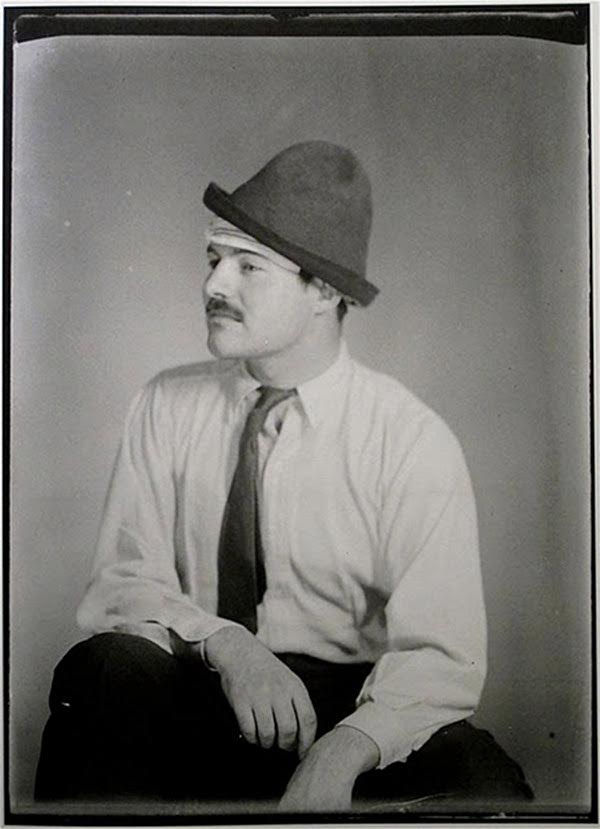
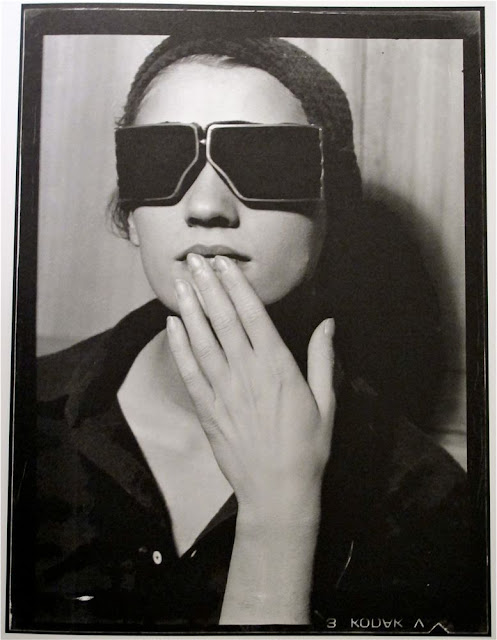
When photographers specialize in portraits of famous people, they often speak of finding a visual way to reveal their oft-photographed subject’s rarely exposed nature; to bring their depths, in other words, to the surface. Man Ray (1890–1976), the Surrealist photographer and artist, had his own way of doing most everything, and he certainly had his own approach to celebrity portraiture. Take, for example, his 1923 shot of Ernest Hemingway above, taken just a couple years after both the writer and photographer joined the moveable feast of Paris, which Man Ray would call home for most of his career.
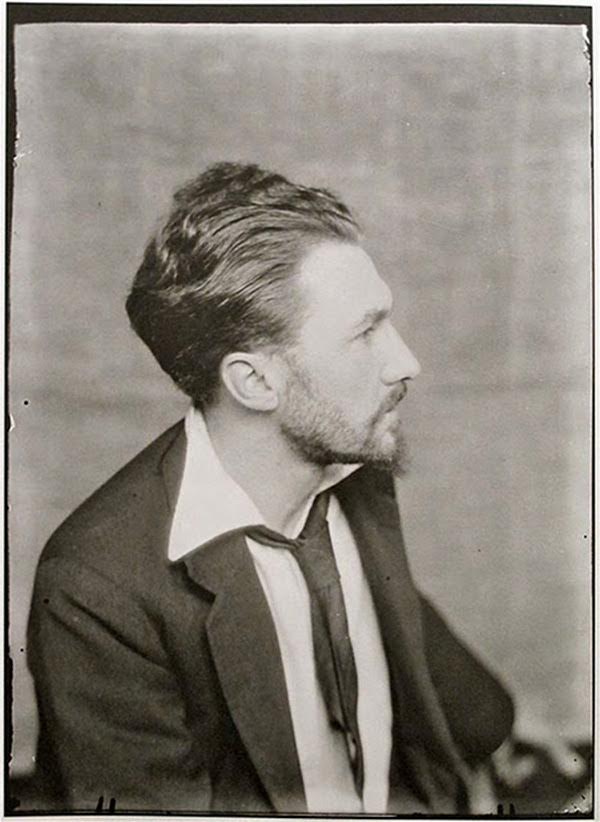
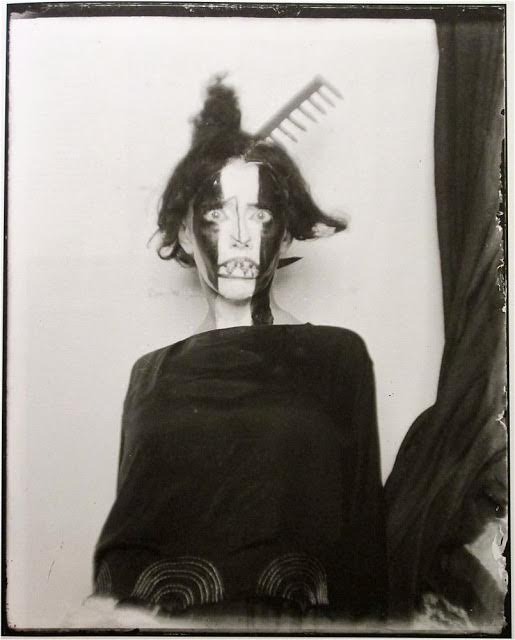
That same year and in that same urban bohemia, Man Ray photographed another famed man of letters, the modernist poet Ezra Pound. You can see the somewhat more conventional-looking result of that encounter just above. Below, we have a far less conventional-looking portrait from 1922, which takes as its subject the dancer Bronislava Nijinska, who perhaps only counts as famous to you if you know the history of 20th-century ballet — but I say anyone willing to appear in a portrait looking that frightening has earned all the fame they can get.
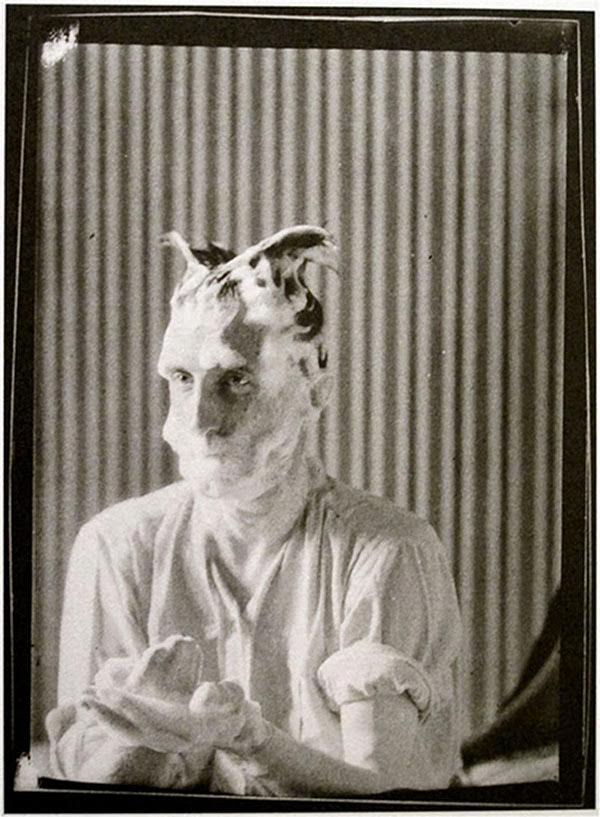
Marcel Duchamp, who appears below, sat for Man Ray in 1921 looking less scary than silly, but as one of the wittiest and most artistically forward-thinking figures of the era, he surely got the joke. These appear in the book Man Ray: Paris — Hollywood — Paris, which collects 500 of the portraits Man Ray left in his archives when he died in 1976, all of “members of Dadaist and Surrealist circles, of artists and painters, of writers and US emigrants of the Lost Generation, of aristocrats, and paragons of the worlds of fashion and theater.”
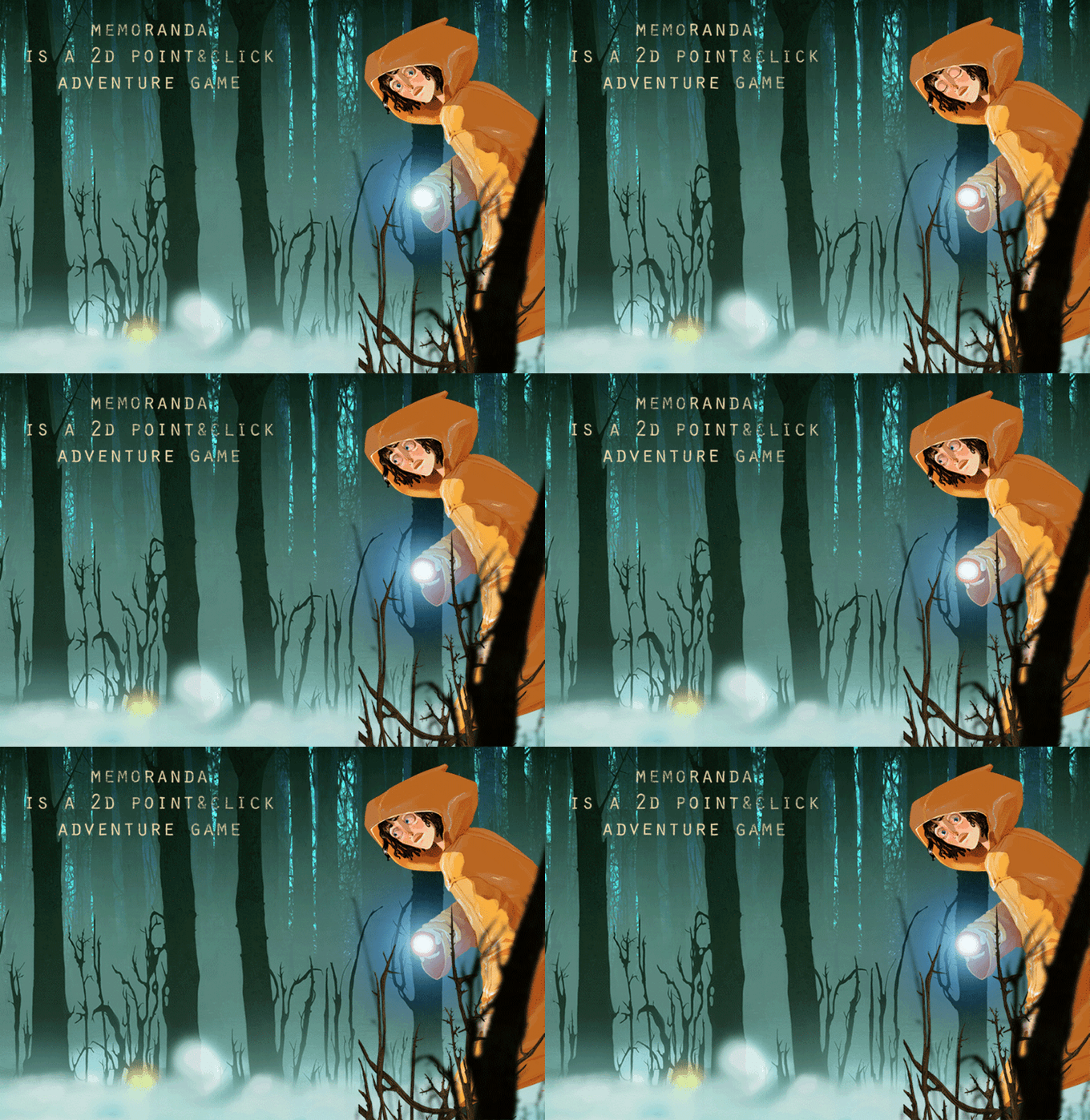
Back in grade school, I got into the genre of computer games known as “graphic adventures,” narrative experiences — and often quite elaborate ones — through which the player guides the protagonist with points and clicks: games like Maniac Mansion, Space Quest, Mean Streets, Zak McCracken and the Alien Mindbenders. In college I got into the writing of Haruki Murakami, the international superstar of Japanese literature specializing in the kind of stories that, in his words, have undergone “a kind of magical baptism to link the world on this side with the world on the other side.” More recently, I’ve cultivated an interest in projects crowdfunded on platforms like Kickstarter. At long last, someone has come up with a creation that unites all three: Memoranda, a Murakami-inspired graphic adventure now raising its budget on Kickstarter.
“Three years ago I sat down with a friend to brainstorm for making a game,” writes one of Memoranda’s developers. Murakami’s work “had inspired us profoundly and we thought that the vague, surrealistic reality of his fictional world would have a great potential for being turned into something visual and could lead to the creation of odd characters, an essential element in game design.” This led to a “script inspired by more than 20 stories by Murakami” involving a little town (which has “European-like architecture but that doesn’t mean it belongs to somewhere in Europe”) “where there are both laptops and bamboo water clocks,” a cast of characters from “a WWII surviving soldier to an elephant taking shelter in a man’s house hoping to become human,” and a protagonist “who little by little realizes she is forgetting her own name.”
Kickstarter has proven a viable financing medium for a new wave of graphic adventure games, some of them by the creators of the old wave: Tim Schafer, known for Maniac Mansion’s beloved sequel Day of the Tentacle, raised $3.3 million for what would become Broken Age, and Space Quest masterminds Scott Murphy and Mark Crowe more recently reunited to raise over $500,000 for SpaceVenture. Memoranda, by comparison, requires no more than a shoestring, and, with ten days to go in its funding drive, it has already raised more than the $13,695 requested by Bit Byterz, its Vancouver-based Iranian developers (how’s that for a demonstration of Murakami’s global appeal?). But you can still contribute at its Kickstarter page, and as a reward could get a copy of the game, its soundtrack, a digital art book, or even — enthusiasts of Murakami tropes, take note — the inclusion of your own cat in the story. No game company ever offered me that in grade school.
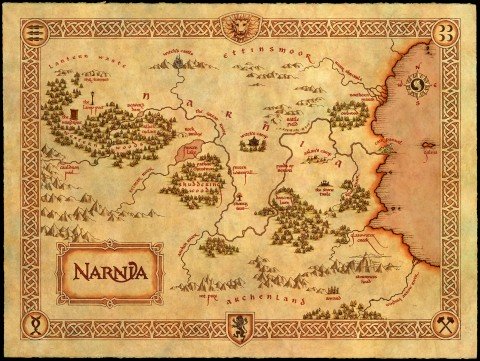
I have not seen the second two of a promised seven films based on the novels in C.S. Lewis’ The Chronicles of Narniaseries. But I tend to agree with several critics of the first filmed adaptation, The Lion, the Witch and the Wardrobe: “The PG-rated movie feels safe and constricted,” Peter Travers observed, “in a way the story never does on the page.” Although Lewis “did nothing to hide his devout Christianity” in his allegorical Narnia books for young adults, nor in his grown-up sci-fi fantasy series, The Space Trilogy, Lewis on the page comes across as a rigorous writer first and a Christian apologist second. Except, I’d argue, for his work of explicitly populist, and rather facile, apologetics, Mere Christianity (originally a series of radio lectures), his fiction and popular non-fiction alike present readers—whatever their beliefs—with challenging, inventive, witty, and moving ways to think about the human condition.
Lewis’ immersion in European Medieval and Renaissance literature in his day-job role as an Oxford don—and his ecumenical, almost Jungian, approach to literature generally—gives his fiction a serious archetypal depth that most modern religious novelists lack, making him, along with fellow “Inkling” J.R.R. Tolkien, something of a literary saint in modern Christianity. Though it may offend the orthodox to say so, Lewis’ novels capture a “deep magic” at the heart of all mythological and literary traditions. And they do so in a way that makes exploring heavy, grown-up themes exciting for both children and adults. Though I’ve personally left behind the beliefs that animated my first readings of his books, I can still return to The Chronicles of Narnia and find in them deep magic and mystery.
There’s no denying the enormous influence these books have had on children’s fantasy literature, from Harry Potter to Lewis’ atheist antagonist Philip Pullman. I look forward to sharing his books with my daughter, whatever she ends up making of their religiosity. I’ve still got my tattered paperback copies, and I’ll gladly read them to her before she can tackle them herself, but I’m also grateful for the complete audio recordings of The Chronicles of Narnia, available free online and read by English child psychologist and author Chrissi Hart. In installments of two chapters at a time, Hart reads all seven of the Narnia books, The Lion, the Witch and the Wardrobe, Prince Caspian, The Voyage of the Dawn Treader, The Silver Chair, The Horse and His Boy, The Magician’s Nephew, and The Last Battle.
And it should be noted that CS Lewis Pte. Ltd. granted permission to put these recordings online, according to the Ancient Faith web site. The recordings are therefore listed in our collection, 1,000 Free Audio Books: Download Great Books for Free. Enjoy.
A couple days ago, we featured some intriguing clips from the new animated Edgar Allan Poe film, Extraordinary Tales. Directed by animator Raul Garcia, the film draws on the voice talents of several classic horror actors and directors, including the late Christopher Lee, Roger Corman, and—in an archival reading of Poe’s “The Tell Tale Heart”—the legendary Bela Lugosi. You can hear his reading above, a recording that seems to date from 1946. The Hungarian actor, who struggled to find work late in his career, and wrestled with a morphine addiction, likely “recorded it for his agent,” writes Ronald L. Smith, “who would have been deputized to make copies and send them out to anyone interested in booking Bela’s solo stage act (which included an enactment of the Poe tale).”
All of the great horror stars of the early twentieth century cut their teeth on Poe, and performed his macabre stories throughout their careers. Lugosi was no exception. After his typecasting as an exotic villain in the stage adaptation of Bram Stoker’s Dracula in the late 20s, then in Tod Browning’s famous 1931 film, Lugosi would remark, “I am definitely typed, doomed to be an exponent of evil.”
He appeared the following year as the mad scientist in Universal’s adaptation of Poe’s Murders in the Rue Morgue (watch here). Then, in 1935, Lugosi played yet another crazed doctor, who is obsessed with all things Poe, in The Raven (view here), a film that also features Universal’s other major horror star of the time, Boris Karloff. The two had teamed up the year previous in Edgar G. Ulmer’s Poe adaptation, The Black Cat, a huge hit for Universal, in which Lugosi plays yet another evil doctor.
After Lugosi’s successes with Poe-inspired films in the thirties, his career precipitously declined, and by the forties, when he made the “Tell Tale Heart” recording at the top of the post, he’d been reduced to playing parodies of his Dracula character, notably in 1948’s Abbott and Costello Meet Frankenstein. Lugosi attempted to bank on earlier successes with Poe, or Poe-like, characters. Before Ed Wood found and resurrected him in now-classic fifties B‑movies like Glen or Glenda, Bride of the Monster, and—posthumously—Plan 9 from Outer Space, Lugosi made one final appearance onscreen in a Poe adaptation. Click here and see him in an adaptation of “The Cask of Amontillado,” an episode from television series Suspense. Set in Italy during World War II, this version of “Amontillado” casts Lugosi as Nazi officer “General Fortunato,” whom one fan describes as a “ruthless, amoral roué, with equally ruthless storm troopers at his beck and call.” It’s not Lugosi’s greatest performance, but it’s “Bela doing his 1949 best,” and an important entry in his catalog of Poe performances, if only because it’s the last of them.
Stephen King has given writers a lot to think about these past few years in his numerous interviews and in his statement of craft, On Writing. He deems one of his most salient pieces of advice on writing so important that he repeats it twice in his Top 20 Rules for Writers: writers, he says, “learn best by reading a lot…. If you don’t have time to read, you don’t have the time (or the tools) to write.” To help his readers discover the right tools, King attached a list of 96 books at the end of On Writing, of which he said, “In some way or other, I suspect each book in the list had an influence on the books I wrote…. a good many of these might show you some new ways of doing your work.”
In this list, the spectrum of accessibility is a little narrower. We have fewer classic writers like Dickens or Conrad and fewer commercial novelists like Nelson DeMille. Instead the list is mostly twentieth century literary fiction by mostly living contemporaries, with little genre fiction save perhaps sci-fi/fantasy writer Neal Stephenson’s Quicksilver, thriller author Lee Child’s Jack Reacher series, hugely popular mystery writer Stieg Larsson’s The Girl With the Dragon Tattoo, and Patrick O’Brian’s adventure series. Below, we’ve excerpted a list of 15 books King recommends—books, he says, “which entertained and taught me.”
King almost shrugs in his short introduction, writing, “you could do worse.” I expect many readers of this post might have suggestions for how they think you could also do better, especially given the five years that have passed since this list’s compilation and some of the blind spots that seem to persist in King’s reading habits. I doubt he would object much to any of us adding to, or subtracting from, his lists—or ignoring them altogether. It seems clear he thinks that like him, we should read what we like, as long as we’re always reading something. See the full list of 82 titles here.
We're hoping to rely on loyal readers, rather than erratic ads. Please click the Donate button and support Open Culture. You can use Paypal, Venmo, Patreon, even Crypto! We thank you!
Open Culture scours the web for the best educational media. We find the free courses and audio books you need, the language lessons & educational videos you want, and plenty of enlightenment in between.