Self-proclaimed traditionalists love to talk about how allowing women in the workforce precipitated social decline. This is a delusion. “Women have always worked,” as American labor historian Alice Kessler-Harris argued in her book of the same name. “In preindustrial societies,” she writes, “nearly everybody worked” in cooperative endeavors, “and almost nobody worked for wages.” And in industrial societies, women have always worked, and they were often the primary earners in their families. But since their stories do not fit a traditional narrative, they’ve been ignored.
Moving goalposts and narrow definitions of what counts as “work” have marginalized women’s contributions in hundreds of fields, including music. But women have always written music, whether or not they’ve been compensated or recognized as professional composers.
In some cases, their careers were cut short before they could begin. Such was the fate of Mozart’s sister, Maria Anna, who was also a child prodigy, traveling Europe with her brother and dazzling the aristocracy in the 1700s. Her accomplishments “were quickly forgotten,” writes Ashifa Kassam at The Guardian, “after she was forced to halt her career when she came of age.”
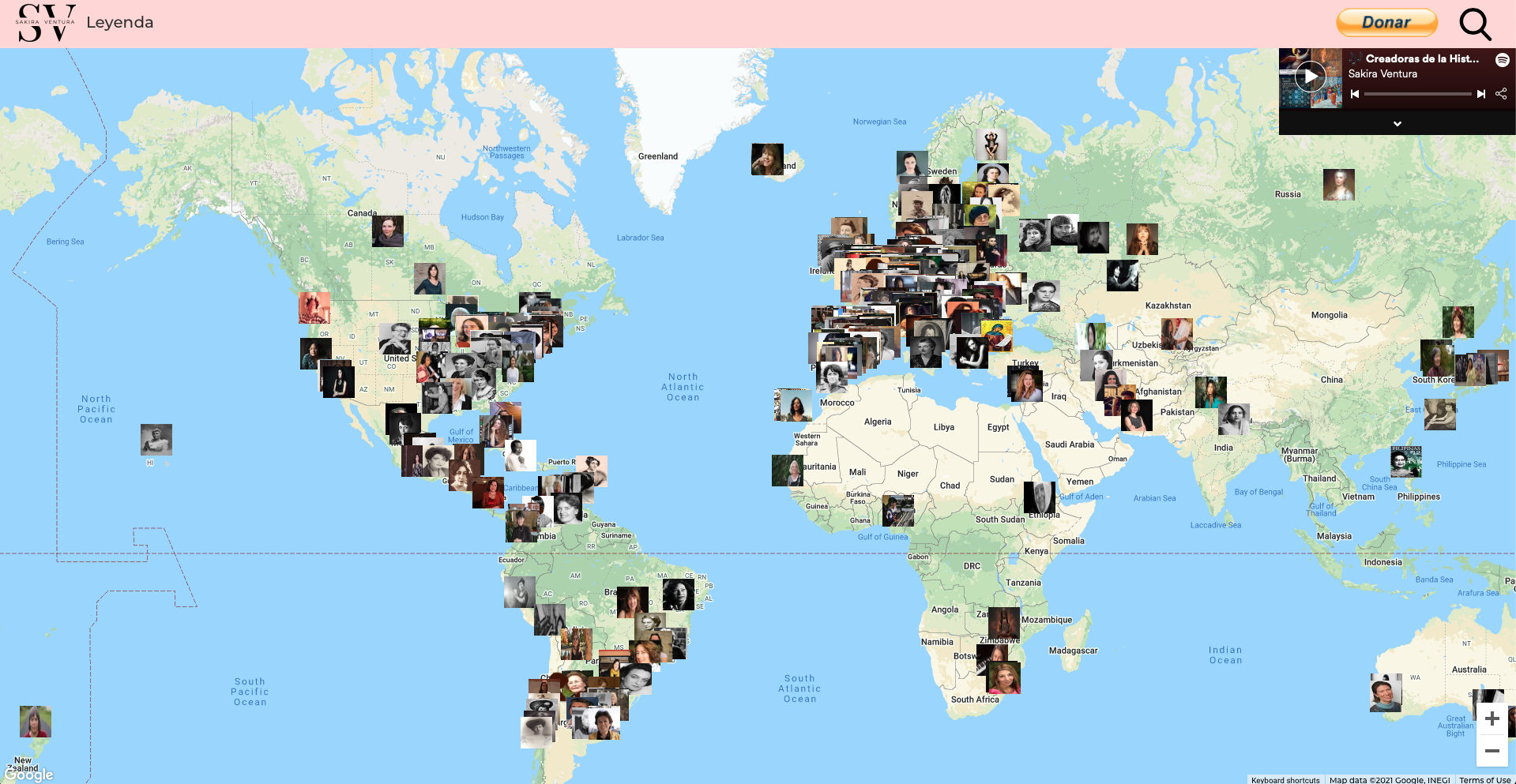
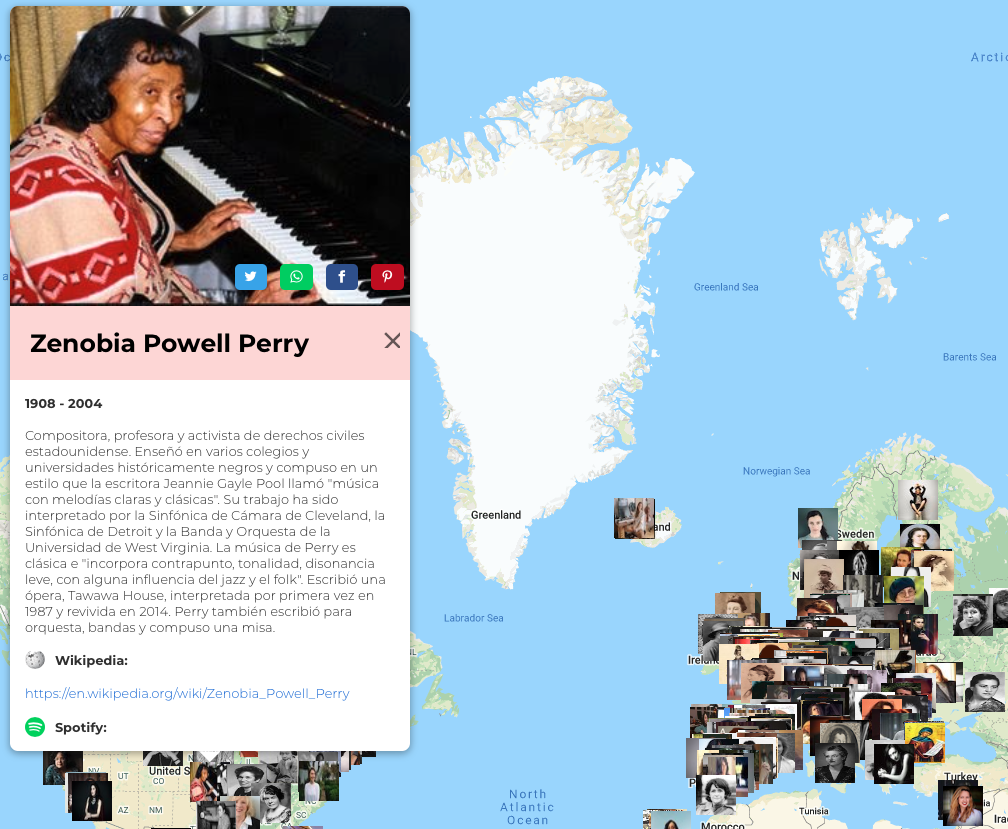
Maria Anna Mozart is one of hundreds of women composers you’ll find in the interactive map created by Sakira Ventura, a music teacher from Valencia, Spain, who has collected 530 composers, placed them geographically on the map, and included links to Wikipedia pages, websites, and Spotify. The map is in Spanish, as are all of the short biographies in each composer’s window, but Ventura links to their English-language Wikipedia pages, making this an excellent resource for English speakers as well, and a much-needed one, Ventura found out when she began her research.
When Mozart’s sister was writing music, “It was taken for granted that a work composed by a woman wouldn’t be of the same quality as that composed by a man,” Ventura says. Not much has changed. When critics have asked why she doesn’t include men on her map, “I have to explain to them that if they want to find out about male composers, they can open any book on music history, go to any concert or tune into any radio station. But if I’m putting together a map of female composers, it is because these women don’t appear anywhere else.” Visit the interactive map, Creadoras de la Historia Música, here.
“There’s no love song finer, but how strange the change from major to minor, everytime we say goodbye.”
In the line above from Cole Porter’s “Every Time We Say Goodbye,” we’re moved from the happiness of love to the sadness of parting, and so too do the chords change, from major to minor, thus subtly changing the mood of the song. The technique is a clever example of a songwriting method called “word painting,” or prosody, when lyrics are accompanied by a rhythmic, melodic, or harmonic shift that complements their meaning. We hear it in pop music all the time, drawing our attention to significant moments, and shaping the emotional impact of words and phrases.
The word “Stop,” for example, appears over and over in pop music, as the video above from David Bennett shows, accompanied by a full stop from the band. Spanish-language hit “Despacito” (which means “slowly”) slows the tempo while the titular word is sung. There are innumerable examples of melodies rising and falling to lyrics like “high, up, down” and “low.” A more sophisticated example of word paining comes from Leonard Cohen’s “Hallelujah,” which tells us exactly what the music’s doing — “It goes like this, the fourth, the fifth, the minor fall, the major lift.”
As ingenious as these moves are, Bennett goes on to show us how word painting can be “even more nuanced” in classics like The Doors’ “Riders on the Storm.” As Ray Manzarek himself explains in an interview clip, his keyboard part led to an onomatopoeia effect: lyrics, melody, and sound effects all coming together to express the entire theme. Bennett shows in his second word painting video, above, how studio effects can also be used to sync music and lyrics, such as the murky eq effect applied to Billie Eilish’s voice on the word “underwater” in her song “Everything I Wanted.”
Examples of effects like this date back at least to Jimi Hendrix, who pioneered the studio as a songwriting tool, but word painting as a songwriting method requires no special technology. The Jackson Five’s “ABC,” for instance, lands on E♭ and C during the line “I before E except after C,” and the famous chorus is sung to the notes A♭, B♭m7, and C. Here, the notes themselves tell the story, simple but undoubtedly effective. All of the examples Bennett adduces may come from popular music, but word painting is as old as poetry, which was once inseparable from song. For as long as humans have communicated with literary epics, funeral rites, tragedies, comedies, and love songs, we have used prosody to shape words with music, and music according to the meaning of our words.
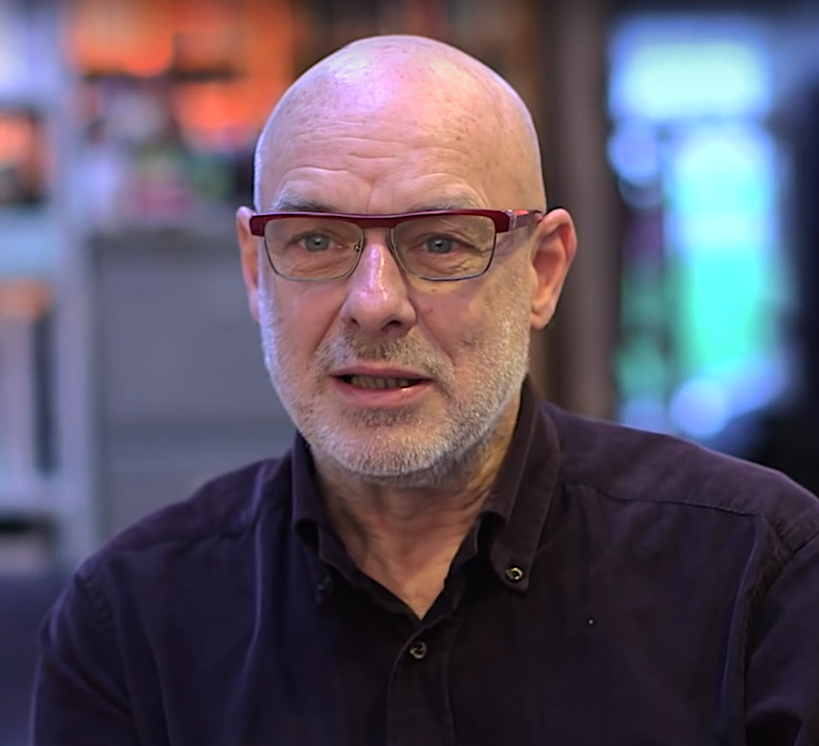
Brian Eno kept busy during last year’s pandemic, telling the L.A. Timesthis past January about one of his latest ideas, an open source Zoom alternative, just one of any number of projects he’s kicking around at any given time. One of the most prolific and influential artists, musicians, producers, and thinkers of the past several decades, Eno is such a cultural institution, he warrants his own appreciation day. That’s just what he got on February 12, 1988 when KPFA (a radio station in Berkeley, CA) turned over an entire day to hosting Eno for wide-ranging interviews, stories about his collaborations, and conversations about the musical genres he invented. He even takes questions, and his replies are illuminating and urbane.
Eno’s always been a generous and witty conversationalist. The Brian Eno Day broadcast hits on nearly all of the major highlights of his career up to that point, with a comprehensive overview of his work, earlier interview recordings, and loads of songs and excerpts from his extensive recorded corpus. Much of this work is obscure and much of it is as well-known as the man himself. One cannot tell the stories of artists like U2, Talking Heads, and David Bowie, for example, without talking about Eno’s guiding hand as a producer. Eno’s renowned for founding glam rock pioneers Roxy Music, inventing ambient music, and for his generative approaches to making art, whether on small paper cards or in software and apps.
Eno once said his first musical instrument was a tape recorder, and he’s been obsessed with recording technology ever since, delivering his influential lecture “The Recording Studio as a Compositional Tool” in 1979 and demonstrating its principles in all of the music he’s made. In these interviews, Eno not only discusses the major plot points, but also “reveals such tasty tidbits as his dislike for computer keyboards; an admission that even he does not know what his lyrics mean; a preference for the music of Stockhausen’s students rather than that of Stockhausen himself; and the differences between New Age, Minimal, and Ambient Music,” notes the description on Internet Archive.
In the 33 years since this broadcast, Eno has produced enough music and visual art to fill another 10-hour day of interviews and overviews. But his methods have not changed: he has pursued his later work with the same openness, curiosity, and collaborative spirit he developed in his first few decades. Hear him in his element, ranging far afield in conversations about architecture, genetic evolution, and his own video installation pieces. Eno rarely gets personal, preferring to talk about his work, but it’s humility, not secrecy, that keeps him off the topic of himself. As he recently told a Guardian interviewer, “I’m not f*cking interested at all in me. I want to talk about ideas.” Hear Eno do exactly that in 10 hours of recordings just above.
In modern society, some facts are simply accepted: one plus one equals two, the Earth revolves around the Sun, and The Beatles are the greatest band in history. “So obviously dazzling was The Beatles’ achievement that few have questioned it,” writes Ian MacDonald in his study of the band Revolution in the Head. “Agreement on them is all but universal: they were far and away the best-ever pop group and their music enriched the lives of millions.” Today, just as half a century ago, most Beatles fans never rigorously examine the basis of the Fab Four’s stature in not just music but culture more broadly. Suffice it to say that no band has ever been as influential, and — more than likely — no band ever will be again.
To each new generation of Beatles fans, however, this very influence has made the band’s innovations more difficult to sense. For decade after decade, practically every major rock and pop band has performed in sports stadia and on international television, made use in the studio of guitar feedback and automatically double-tracked vocals, and shot music videos.
But the Beatles made all these now-common moves first, and others besides, as recounted in the video essay above, “8 Things The Beatles Pioneered.” Its creator David Bennett explains the musical, technological and cultural importance of all these strategies, which have since become so common that they’re seldom named among The Beatles’ many signature qualities.
Not absolutely everyone loves The Beatles, of course. But even those who don’t particularly enjoy their records must acknowledge their Shakespearean, even Biblical super-canonical status in popular music today. This can actually make it somewhat intimidating to approach the music of The Beatles, despite its very popularity, and especially for those of us who weren’t drawn to it growing up. I myself only recently listened through the Beatles canon, at the age of 35, an experience I’d deferred for so long knowing it would send me down an infinitely deep rabbit hole of associated reading. If you, too, consider yourself a candidate for late-onset Beatlemania, consider starting with the half-hour video just above, which tells the story of the band’s origins — and thus the origin, in a sense, of the pop culture that still surrounds us.
Based in Seoul, Colin Marshall writes and broadcasts on cities, language, and culture. His projects include the Substack newsletterBooks on Cities, the book The Stateless City: a Walk through 21st-Century Los Angeles and the video series The City in Cinema. Follow him on Twitter at @colinmarshall or on Facebook.
The life of a Japanese film composer in the 1960s and 70s was very different from their American counterparts. “For Hollywood movies, there is a three-month period to write the music after the film has been finished,” says legendary film and television composer Chumei Watanabe. When Watanabe first began working for Shintoho studios, “at first, they gave us five days. Of course, it would usually be shortened…. One time, there was a Toei movie being filmed in Kyoto. The next day was the recording day for the music…. I had less than 24 hours to write the music!”
Despite the immense pressures on composers for films and TV shows, even those primarily for children, “I kept in mind that I would not compose childish music,” says Watanabe, who worked well into his 90s composing for TV. “That’s why people in their 40s and 50s still listen to my songs and sing them at karaoke.” His music is as widely beloved as that of his prolific contemporary, Dragon Ball Z composer Shunsuke Kikuchi, who passed away this year at 89.
“Over the course of his career,” writes Okay Player, “Kikuchi wrote the music for a number of popular anime series and live-action television shows, including Abarenbo Shogun (800 episodes over 30 years,) Doraemon (26 years on the air,) and Kamen Rider, Key Hunter, and G‑Men ’75.” So iconic was Kikuchi’s music that his “Urami Bushi” — the theme for 1972 Japanese exploitation film Female Prisoner 701: Scorpion — was given pride of place in Quentin Tarantino’s Kill Bill Vol. 2.f
If you aren’t familiar with the music of late-20th century Japanese genre film and television, you’ll be forgiven for thinking the mix at the top of the post comes from Tarantino’s films. Described by its YouTube poster Tripmastermonk as “45 minutes of various funky old japanese soundtrack, samples, breaks, and beats. (all killer, no filler),” it includes classic compositions from Watanabe, Kikuchi, and many other composers from the period who worked as hard on anime series as they did on so-called “pink films” like the “Female Prisoner” series, a vehicle for Japanese star Meiko Kaji (of Lady Snowblood fame), who sang “Urami Bushi” and turned the song into a major hit.
Dig the funky music of Japanese action films from the 60s and 70s in the mix, full name: “Tripmastermonk — Knocksteady Zencast Vol. 2: Ninja Funk & Gangster Ballads: Ode to the Brotherland.” And find more of Tripmastermonk’s musical concoctions on Soundcloud.
Update: Two weeks after bowing out of the upcoming Rolling Stones tour, Charlie Watts has sadly passed away at age 80.
According to Charlie Watts — the Rolling Stones’ drummer and rock’s best dressed man — his playing is nothing special. “I sit there, and I hear what’s going on, and if I can make it, that’s fine,” he said in 1973. There are no false notes in his modesty. “You have to be a good drummer to play with the Stones,” he later remarked in 2000, “and I try to be as good as I can.” But he admits he’s not a technical player; it’s all about the feel. “It’s terribly simple what I do, actually…. I play songs.”
According to the rest of the band, Watts is indispensable, one of a kind, the “engine” of the Rolling Stones, says Ronnie Wood. He’s the only white drummer who can swing, Keith Richards swears: “Charlie’s always there, but he doesn’t want to let everybody know. There’s very few drummer’s like that. Everybody thinks Mick and Keith are the Rolling Stones. If Charlie wasn’t doing what he’s doing on drums, that wouldn’t be true at all. You’d find out that Charlie Watts IS the Stones.”
Audiences of the band’s upcoming tour will find out, since Watts announced he’s sitting this one out to recover from a medical procedure, to be temporarily replaced by understudy Steve Jordan. Watts is probably “not bothered,” Wayne Blanchard writes at Drum Magazine. He’s had a decades-long love-hate relationship with touring life. (Watts has made drawings of every hotel room he’s ever stayed in to stave off boredom). In the studio, “as long as a track gets recorded and sounds great, Charlie doesn’t seem to care who is on the drums.”
Other drummers have played on several key Stones tracks, including Faces drummer Kenney Jones on “It’s Only Rock ‘N’ Roll” and Stones producer Jimmy Miller on “Happy,” “Tumbling Dice,” “You Can’t Always Get What You Want,” and “Shine a Light.” None of this means, however, that Watts is replaceable or that the Rolling Stones would try to carry on without him. He has not only been the band’s engine, but its anchor, ballast, maybe, its quiet captain. “When Charlie plays,” said drummer Steve White, “it looks to me that he knows who runs the band on stage, despite what the singer might think.”
Watts resists talk of his importance to the Stones. “We have a huge crowd of people who like us,” he said in 1998, because “they just love looking at Keith Richards and looking at Mick wiggling his arms. They’ve been doing it for 30 years.” But he is just as much a draw as the other Stones who have made up the core trio of the band since its inception in 1962. Here’s hoping he recovers well. In the meanwhile, we can see the Stones play “Jumpin’ Jack Flash” and “All Down the Line,” further up, from Charlie’s calm, cool point of view, as shot by Martin Scorsese in 2006 at New York’s Beacon Theatre.
The footage shows “how Watts has quietly served as the backbone of The Rolling Stones for the past 58 years,” Andy Greene writes at Rolling Stone. And it provides a rare look at rock’s most understated drummer. “The only time I love attention is when I walk onstage,” Watts once said, “but when I walk off, I don’t want it.” In the video just above, he’s in especially rare form — joking on camera about a wiggly dance he does before he goes on, a demonstration of the rituals and in-jokes that have knit rock’s longest-running band together for over half a century. When they’ve all finally quit for good, says Keef, “I want to be buried next to Charlie Watts.”
Before it set itself on fire, HBO’s Game of Thrones resonated deeply with contemporary morality, becoming the most meme-worthy of shows, for good or ill, online. Few scenes in the show’s run — perhaps not even the Red Wedding or the nauseating finale — elicited as much gut-level reaction as Cersei Lannister’s naked walk of shame in the Season 5 finale, a scene all the more resonant as it happened to be based on real events.
In 1483, one of King Edward IV’s many mistresses, Jane Shore, was marched through London’s streets by his brother Richard III, “while crowds of people watched, yelling and shaming her. She wasn’t totally naked,” notes Mental Floss, “but by the standards of the day, she might as well have been,” wearing nothing but a kirtle, a “thin shift of linen meant to be worn only as an undergarment.”
What are the standards of our day? And what is the punishment for violating them? Sarah Brand seemed to be asking these questions when she posted “Red Dress,” a music video showcasing her less than stellar singing talents inside Oxford’s North Gate Church. In less than a month, the video has garnered well over half a million views, “impressive for a musician with hardly any social media footprint or fan base,” Kate Fowler writes at Newsweek.
“It takes only a few seconds,” Fowler generously remarks, “to realize that Brand may not have the voice of an angel.” Or, as one clever commenter put it, “She is actually hitting all the notes… only of other songs. And at random.” Is she ludicrously un-self-aware, an heiress with delusions of grandeur, a sad casualty of celebrity culture, forcing herself into a role that doesn’t fit? Or does she know exactly what she’s doing…
The judgments of medieval mobs have nothing on the internet, Brand suggests. “Red Dress” presents what she calls “a cinematic, holistic portrayal of judgment,” one that includes internet shaming in its calculations. Given the amount of online rancor and ridicule her video provoked, it “did what it set out to do,” she tells the BBC. And given that Brand is currently completing a master’s degree in sociology at Oxford University, many wonder if the project is a sociological experiment for credit. She isn’t saying.
Jane Shore’s walk ended with years locked in prison. Brand offered herself up for the scorn and hatred of the mobs. No one is pointing a pike at her back. She paid for the privilege of having people laugh at her, and she’s especially enjoying “some very, very witty comments” (like those above). She’s also very much aware that she is “no professional singer.”
The style in which I sing the song was important because it reflected the story. The vocals don’t seem to quite fit, they seem out of place and they make people uncomfortable… and the video is this outsider doing things differently and causing discomfort and eliciting all this judgement.
All of this is voluntary performance art, in a sense, though Brand has shown previous aspirations on social media to become a singer, and perhaps faced similar ridicule involuntarily. “Part of what this project deals with,” she says, is judgment “overall as a central theme.” She credits herself as the director, producer, choreographer, and editor and made every creative decision, to the bemusement of the actors, crew, and studio musicians. Yet choosing to endure the gauntlet does not make the gauntlet less real, she suggests.
The shame rained down on Shore was part misogyny, part pent-up rage over injustice directed at a hated better. When anyone can pretend (or pretend to pretend) to be a celebrity with a few hundred bucks for cinematography and audio production, the boundaries between our “betters” and ourselves get fuzzy. When young women are expected to become brands, to live up to celebrity levels of online polish for social recognition, self-expression, or employment, the lines between choice and compulsion blur. With whom do we identify in scenes of public shaming?
Brand is coy in her summation. “Judgmental behavior does hurt the world,” she says, “and that is what I’m trying to bring to light with this project.” Judge for yourself in the video above and the … interesting… lyrics to “Red Dress” below.
Came to church to praise all love Sitting, coming for someone else It didn’t stew well for me But I said it was a lover’s deed
Didn’t trust my own feels Let someone else behind my wheel Said it was love driving me But the only one who should steer is me
Cuz what they saw
They see me in a red dress Hopping on the devil fest Thinking of lust As they judge in disgust What are you doing here?
They see me in a red dress Hopping on the devil fest Thinking of lust As I judge in disgust What am I doing here?
Lettin’ someone else steer
I saw a love, precious and fine Thought I should do anything for time Time to change the hearts and minds Of people not like me in break or stride
Shouldn’t be me, trying to change Thought I’d be something if I remained It just ain’t me singing of sins Watching exclusion getting its wins
Cuz what they saw
They see me in a red dress Hopping on the devil fest Thinking of lust As they judge in disgust What are you doing here?
They see me in a red dress Hopping on the devil fest Thinking of lust As I judge in disgust What am I doing here?
Lettin’ someone else steer
Came to church To praise love Coming for Someone else
But all the eyes Judging in disguise They don’t see me Just the lies
They see me in a red dress No different from the rest Starting to trust As they join in a rush What are we doing here?
They see me in a red dress No different from the rest Starting to trust As I lose my disgust What am I doing here?
Actor and musician Steven Van Zandt — known to Springsteen fans as E Street Band guitarist Little Steven — played the steady voice of reason Silvio Dante on The Sopranos. Without his guiding hand and sense of style, Tony would not have made it as far as he did. How much of Steven Van Zandt was in Silvio? Maybe a lot. As Van Zandt told Vice in a 2019 interview, he invented the character and gave it to David Chase, who turned his vision of “big bands, chorus girls, Jewish Catskills comics” into the Bada Bing, a “strip club for the family.”
It’s not hard to imagine Silvio in his shiny suits getting onstage with the Boss, but he would never have played Van Zandt’s role as an anti-racist activist. After leaving the E Street Band in 1984, Van Zandt started organizing musicians against apartheid for what would become an unprecedented action against Sun City, “a ritzy, whites only resort in South Africa,” Josh Haskell writes at ABC News, “that Van Zandt and his group Artists United Against Apartheid decided to boycott.”
Van Zandt and legendary hip hop producer Arthur Baker brought together what rock critic Dave Marsh calls “the most diverse line up of popular musicians ever assembled for a single session” to record “Sun City,” a song that “raised awareness about apartheid,” says Haskell, “during a time in the 1980s when many Americans weren’t aware of what was happening.” It wasn’t difficult to bury the news pre-internet. Since the South African government received tacit support from U.S. corporations and the Reagan administration, there was hardly a rush to characterize the country too negatively in the media.
Van Zandt himself remembered being “shocked to find really slavery going on and this very brilliant but evil strategy called apartheid,” he said in 2013. “At the time, it was quite courageous for the artists to be on this record. We crossed a line from social concerns to political concerns.” The list of famous artists involved in the recording sessions and video is too long to reproduce, but it notably included hip-hop and rock royalty like Bruce Springsteen, DJ Kool Herc, Bob Dylan, Pat Benatar, Ringo Starr, Lou Reed, Run D.M.C., Peter Gabriel, Kurtis Blow, Bono, Keith Richards, Bonnie Raitt, Joey Ramone, Gil Scott-Heron, and Bob Geldof.
As with other occasional supergroups assembled at the time (by Geldof) to raise funds and/or awareness for global causes, there’s a too-many-cooks feel to the results, but the music is secondary to the message. Even so, “Sun City” turned out to be a pioneering crossover track: “too black for white radio and too white for black radio,” says Van Zandt. Instead, it hit its stride on television in the early days of MTV and BET: “They really embraced it and played it a lot. Congressmen and senators’ children were coming up to them and telling them about apartheid and what they saw happening in South Africa. That put us over the edge.”
When pop, punk, rock, and hip-hop artists linked arms, it “re-energized the whole anti-apartheid movement, says Van Zandt, which had kind of hit a wall at that point and was not getting much traction.” Unlike other supergroup protest songs, “Sun City” also gave its listeners an incisive political education, summing up the situation in the lyrics. You can see a 1985 documentary on the making of the song just above. “The refrain of ‘I ain’t gonna play Sun City’ is a simple one,” notes the Zinn Education Project, “but the issues raised in the song and film are not.” See the lyrics (along with the artists who sang the lines) here, and learn more about the history of South African apartheid at the Zinn Ed Project.
We're hoping to rely on loyal readers, rather than erratic ads. Please click the Donate button and support Open Culture. You can use Paypal, Venmo, Patreon, even Crypto! We thank you!
Open Culture scours the web for the best educational media. We find the free courses and audio books you need, the language lessons & educational videos you want, and plenty of enlightenment in between.