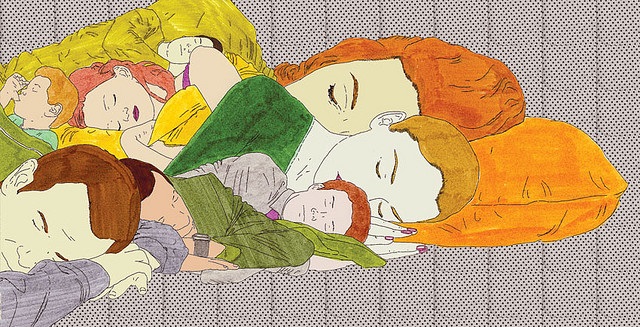
After a long hiatus, the RSA (The Royal Society for the Encouragement of Arts, Manufactures and Commerce) has returned with another one of the whiteboard animated-lectures they pioneered five years ago.
The animated reboot (above) brings to life the thoughts of another Stanford psychology professor, Carol S. Dweck. The author of Mindset: The New Psychology of Success(a book that appeared on Bill Gates’s Best of 2015 list), Dweck has looked closely at how our beliefs/mindsets strongly influence the paths we take in life. And, in this clip, she talks about how well-meaning parents, despite their best intentions, might be creating the wrong mindsets in their kids, paving the way for problems down the road. You can watch the complete, unanimated lecture here.
If you would like to support the mission of Open Culture, consider making a donation to our site. It’s hard to rely 100% on ads, and your contributions will help us continue providing the best free cultural and educational materials to learners everywhere. You can contribute through PayPal, Patreon, and Venmo (@openculture). Thanks!
At the stroke of midnight on January 1, millions of New Year’s resolutions went into effect, with the most common ones being lose weight, get fit, quit drinking and smoking, save money, and learn something new (we can help you there). Unfortunately, 33% of these resolutions will be abandoned by January’s end. And more than 80% will eventually fall by the wayside. Making resolutions stick is tricky business. But it’s possible, and Stanford psychologist Kelly McGonigal has a few scientifically-proven suggestions for you.
For years, McGonigal has taught a very popular course called The Science of Willpower in Stanford’s Continuing Studies program, where she introduces students to the idea that willpower is not an innate trait. (You can sign up for an online version of her course which starts on January 25. Get details here.) Rather it’s a “complex mind-body response that can be compromised by stress, sleep deprivation and nutrition and that can be strengthened through certain practices.” For those of you who don’t live in the San Francisco Bay Area, you can also find McGonigal’s ideas presented in a recent book, The Willpower Instinct: How Self-Control Works, Why It Matters, and What You Can Do to Get More of It. Below, we have highlighted 15 of Dr. McGonigal’s strategies for increasing your willpower reserves and making your New Year’s resolutions endure.
Will power is like a muscle. The more you work on developing it, the more you can incorporate it into your life. It helps, McGonigal says in this podcast, to start with small feats of willpower before trying to tackle more difficult feats. Ideally, find the smallest change that’s consistent with your larger goal, and start there.
Choose a goal or resolution that you really want, not a goal that someone else desires for you, or a goal that you think you should want. Choose a positive goal that truly comes from within and that contributes to something important in life.
Willpower is contagious. Find a willpower role model — someone who has accomplished what you want to do. Also try to surround yourself with family members, friends or groups who can support you. Change is often not made alone.
Know that people have more willpower when they wake up, and then willpower steadily declines throughout the day as people fatigue. So try to accomplish what you need to — for example, exercise — earlier in the day. Then watch out for the evenings, when bad habits can return.
Understand that stress and willpower are incompatible. Any time we’re under stress it’s harder to find our willpower. According to McGonigal, “the fight-or-flight response floods the body with energy to act instinctively and steals it from the areas of the brain needed for wise decision-making. Stress also encourages you to focus on immediate, short-term goals and outcomes, but self-control requires keeping the big picture in mind.” The upshot? “Learning how to better manage your stress is one of the most important things you can do to improve your willpower.” When you get stressed out, go for a walk. Even a five minute walk outside can reduce your stress levels, boost your mood, and help you replenish your willpower reserves.
Sleep deprivation (less than six hours a night) makes it so that the prefrontal cortex loses control over the regions of the brain that create cravings. Science shows that getting just one more hour of sleep each night (eight hours is ideal) helps recovering drug addicts avoid a relapse. So it can certainly help you resist a doughnut or a cigarette.
Also remember that nutrition plays a key role. “Eating a more plant-based, less-processed diet makes energy more available to the brain and can improve every aspect of willpower from overcoming procrastination to sticking to a New Year’s resolution,” McGonigal says.
Don’t think it will be different tomorrow. McGonigal notes that we have a tendency to think that we will have more willpower, energy, time, and motivation tomorrow. The problem is that “if we think we have the opportunity to make a different choice tomorrow, we almost always ‘give in’ to temptation or habit today.”
Acknowledge and understand your cravings rather than denying them. That will take you further in the end. The video above has more on that.
Imagine the things that could get in the way of achieving your goal. Understand the tendencies you have that could lead you to break your resolution. Don’t be overly optimistic and assume the road will be easy.
Know your limits, and plan for them. Says McGonigal, “People who think they have the most self-control are the most likely to fail at their resolutions; they put themselves in tempting situations, don’t get help, give up at setbacks. You need to know how you fail; how you are tempted; how you procrastinate.”
Pay attention to small choices that add up. “One study found that the average person thinks they make 14 food choices a day; they actually make over 200. When you aren’t aware that you’re making a choice, you’ll almost always default to habit/temptation.” It’s important to figure out when you have opportunities to make a choice consistent with your goals.
Be specific but flexible. It’s good to know your goal and how you’ll get there. But, she cautions, “you should leave room to revise these steps if they turn out to be unsustainable or don’t lead to the benefits you expected.”
Give yourself small, healthy rewards along the way. Research shows that the mind responds well to it. (If you’re trying to quite smoking, the reward shouldn’t be a cigarette, by the way.)
Finally, if you experience a setback, don’t be hard on yourself. Although it seems counter-intuitive, studies show that people who experience shame/guilt are much more likely to break their resolutions than ones who cut themselves some slack. In a nutshell, you should “Give up guilt.”
You decide you need some medical advice, so you take to the internet. Whoops! There’s your first mistake. Now you are bombarded with contradictory opinions from questionable sources and you begin to develop symptoms you never knew existed. It’s all downhill from there. So I’ll say this upfront: I have no medical qualifications authorizing me to dispense information about sleep disorders. The only advice I’d venture, should you have such a problem, is to go see a doctor. It might help, or not. I can certainly sympathize. I am a chronic insomniac.
The downside to this condition is obvious. I never get enough sleep. Whenever I consult the internet about this, I learn that it’s probably very dire and that I may lose my mind or die young(ish). The upside—which I learned to master after years of trying and failing to sleep like normal people—is that the nights are quiet and peaceful, and thus a fertile time creatively.
Medical issues aside, what do we know about sleep, insomnia, and creativity? Let us wade into the fray, with the proviso that we will likely reach few conclusions and may have to fall back on our own experience to guide us. In surveying this subject, I was pleased to have my experience validated by an article in Fast Company. Well, not pleased, exactly, as the author, Jane Porter, cites a study in Science that links a lack of sleep to Alzheimer’s and the accumulation of “potentially neurotoxic waste products.”
And yet, in praise of sleeplessness, Porter also recommends turning insomnia into a “productivity tool,” naming famous insomniacs like Margaret Thatcher, Bill Clinton, Charles Dickens, Marcel Proust, and Madonna (not all of whom I’d like to emulate). She then quotes psychologist Tomas Chamorro-Premuzic of University College London, who made the dubious-sounding claim in Psychology Today that “insomnia is to exceptional achievement what mental illness is to creativity.” Everything about this analogy sounds suspect to me.
But there are more substantive views on the matter. Another study, published in Creativity Research Journal, suggests insomnia may be a symptom of “notable creative potential,” though the authors only go as far as saying the two phenomenon are “associated.” The arrow of causality may point in either direction. Perhaps the most pragmatic view on the subject comes from Michael Perlis, psychology professor at the University of Pennsylvania, who says, “What is insomnia, but the gift of more time?”
Dennis Drabelle at The Washington Post, also an insomniac, refers to a recent study (as of 2007) from the University of Canterbury that suggests “insomnia and originality may go hand in hand.” He also points out that the notion of sleeplessness as productive, though “counterintuitive,” has plenty of precedent. Drabelle mentions many more famous cases, from W.C. Fields to Theodore Roosevelt to Franz Kafka. The list could go on and on.
Actor and musician Matt Berry tells The Guardian how, after years of tossing and turning, he finally harnessed his sleepless hours to write and record an album, Music for Insomniacs. “I knew that this was dead time,” says Berry, “and I could be doing something instead of sitting worrying about not being asleep.” Another musician, Dave Bayley of band Glass Animals, “owes his career in music to insomnia,” The Guardian writes, then notes a phenomenon sleep researchers call—with some skepticism—“creative insomnia.” Other musicians like Chris Martin, Moby, Tricky, and King Krule have all suffered the condition and turned it to good account.
The Guardian also notes that each of these poor souls has found “sleepless nights inspiring as well as tormenting.” Insomnia is not, in fact a gift or talent, but a painful condition that Porter and Drabelle both acknowledge can be associated with depression, addiction, and other serious medical conditions. One might make good use of the time—but perhaps only for a time. A site called Sleepdex—-which offers “resources for better sleep”—puts it this way:
Occasional insomnia appears to help some people produce new art and work, but is a detriment to others. It is perhaps true that more people find it a detriment than find it useful. Long-term insomnia and the accompanying sleep debt are almost surely negative for creativity.
This brings us to the subject of sleep—good, restful sleep—and its relationship to creativity. Sleepdex cites several research studies from Swiss and Italian universities, UC San Diego, and UC Davis. The general conclusion is that REM sleep—that period during which dreams “are the most narratively coherent of any during the night”—is also an important stimulus for creativity. There are the numerous anecdotes from artists like Salvador Dali, Paul McCartney, and countless others about famous works of art taking shape in dream states (Keith Richards says he heard the riff from “Satisfaction” in a dream).
And there are the experimental data, purportedly confirming that REM sleep enhances “creative problem solving.” European scientists have found that people were more likely to have creative insights after a long period of restful sleep, when the right brain gets a boost. Likewise, Tom Stafford at the BBC describes the “post-sleep, dreamlike mental state—known as sleep inertia or the hypnopompic state” that infuses our “waking, directed thoughts with a dusting of dreamworld magic.” It isn’t that insomniacs don’t experience this, of course, but we have less of it, as periods of REM sleep can be shorter and often interrupted by the need to scramble out of bed and get to work or get the kids to school not long after hitting the pillow.
Stafford points us toward a UC Berkeley study (apparently the University of California has some sort of monopoly on sleep research) “that helps illustrate the power of sleep to foster unusual connections, or ‘remote associates’ as psychologists call them.” Like nearly all of the scientific literature on sleep, this study expresses little doubt about the importance of sleep to memory function and problem solving. Big Think collects several more studies that confirm the findings.
On the whole, when it comes to the links between sleep—or sleeplessness—and creativity, the data and the stories point in different directions. This is hardly surprising given the slipperiness of that thing we call “creativity.” Like “love” it’s an abstract quality everyone wants and no one knows how to make in a laboratory. If it’s extra time you’re after—and very quiet time at that—I can’t recommend insomnia enough, though I wouldn’t recommend it at all as a voluntary exercise. If it’s the special creative insights only available in dream states, well, you’d best get lots of sleep. If you can, that is. Creative insomniacs—like those wandering in the confines of a dream world—know all too well they don’t have much choice in the matter.
The title of the TED talk above, “Flow, the secret to happiness,” might make you roll your eyes. It does indeed sound like self-help snake oil. But as soon as you hear the speaker, psychologist Mihaly Csikszentmihalyi, describe the rationale for his happiness study, you might pay more serious attention. After living through the Second World War in Europe (he grew up in what is now Croatia), Csikszentmihalyi says he “realized how few of the grownups I knew were able to withstand the tragedies that were visited upon them; how few of them could even resemble a normal, contented, satisfied, happy life once their job, their home, their security was destroyed by the war.”
He became interested, he says, “in understanding what contributed to a life that was worth living.” Csikszentmihalyi’s concerns are far from trivial, and his background and wealth of research lend his ideas a good deal of weight and credibility.
After chancing upon a Jungian lecture in Switzerland by a speaker who turned out to actually be Carl Jung, Csikszentmihalyi embarked on a course of study in the field now widely known as “positive psychology.” He now co-directs the Quality of Life Research Center at Claremont Graduate University and studies “human strengths such as creativity, engagement, intrinsic motivation, and responsibility.” Yes, he may present his ideas in popular self-help books and articles, but this does not make his data or conclusions any less sound than in his academic work. “Flow” is the shorthand word he uses to refer to the thesis of his book of the same name: “A person can himself [or herself] be happy, or miserable, regardless of what is actually happening ‘outside,’ just by changing the contents of consciousness.”
What does this mean? Youtuber Fight Mediocrity’s short book video book review above—which also teaches us how to pronounce Csikszentmihalyi’s name—explains the concept in brief, noting the book’s references to Stoic philosophers Epictetus and Marcus Aurelius and psychologist and Holocaust survivor Viktor Frankl to point out that the idea isn’t new but has been around for centuries: The idea being, as Csikszentmihalyi says in his TED talk, that we naturally experience the greatest happiness when fully absorbed in work we find meaningful and fulfilling. What Csikszentmihalyi calls “flow” is a meditative state we might compare to the ancient Buddhist state of ekaggata—or “one-pointed concentration”—a state meditation teacher Shaila Catherine describes as “certainty, deep stability, and clarity…. The mind is completely unified and ‘one with the experience.’”
Indeed, like the Buddhist conception, which contrasts ekaggata with a restless greed that can never be satisfied, Csikszentmihalyi contrasts “flow” with wealth, and cites research suggesting that above a certain level of basic material well-being (which far too many people do not yet have), “increases in material resources do not increase happiness.” Csikszentmihalyi partly reached his conclusions by studying the emotional states of artists, musicians, scientists, and other creative individuals, who all reported experiencing pure states of contentment and joy when so fully concentrated on their work that they forgot themselves—or, more accurately, the constellation of daily anxieties, regrets, worries, fantasies, and preoccupations that we tend to call the self. As Csikszentmihalyi strongly suggests in his books and talks, the more we can lose ourselves intensely in creative activities that bring us fulfillment, the closer we come to being in harmony with ourselves and our world.
See another talk on “flow” and happiness above, from a 2014 “Happiness & its Causes” conference in Sydney, Australia.
If you would like to support the mission of Open Culture, consider making a donation to our site. It’s hard to rely 100% on ads, and your contributions will help us continue providing the best free cultural and educational materials to learners everywhere. You can contribute through PayPal, Patreon, and Venmo (@openculture). Thanks!
In February, Oliver Sacks announced that he was suffering from terminal cancer. And, by August, he was gone — but not before showing us (if you read his op-eds in the Times) how to die with dignity and grace. All of this I was reminded of again today when I stumbled upon a recent animation inspired by Sacks’ work. Called The Lost Mariner, the short film offers an animated interpretation of a chapter in Sacks’ 1985 book The Man Who Mistook His Wife for a Hat. The chapter (also called “The Lost Mariner”) presents a curious case study of a patient known as Jimmie G. who, suffering from Korsakoff’s syndrome, loses the ability to form new memories. To see how Tess Martin made this award-winning short, you can watch the making-of video below.
In My Day, so much of the music we listened to seemed angrier, more raucous and unruly—more aggressive and plainly evil—than music today. Not that I have any hard evidence for these assertions; customarily none is required for an In My Day rant. But I submit to you this: all that musical rage, in my opinion, was a good thing.
And it seems at least in this case, I can substantiate my opinion with science. This past summer, we reported on a study done by researchers at Humboldt State, Ohio State, UC Riverside, and UT Austin showing that kids who listened to heavy metal in the 80s were “significantly happier in their youth and better adjusted currently than either middle-aged or current college-age youth comparison groups.” Despite heated debates in the 80s and 90s over objectionable lyrical content in both popular and alternative music (remember the “Cop Killer” controversy?), researchers concluded that angry rock didn’t turn people into alienated maniacs. Instead, they found, “participation in fringe style cultures may enhance identity development in troubled youth.”
Now, even more recent research into the effects of angry hardcore punk and metal on the psyches of young people seems to confirm these results and further suggest that aggressive music has a paradoxically calming effect. In a study titled “Extreme metal music and anger processing,” University of Queensland psychologists Leah Sharman and Genevieve Dingle describe how they subjected “39 extreme music listeners aged 18–34 years of age” to “anger induction,” during which time, writes Consequence of Sound, “they talked about such irritating things as relationships, money, and work.” Once the test subjects were good and stressed, Sharman and Dingle had them listen either to a “random assignment” of “extreme music from their own playlist” for ten minutes or to ten minutes of silence.
As university publication UQ News summarizes, “In contrast to previous studies linking loud and chaotic music to aggression and delinquency,” this study “showed listeners mostly became inspired and calmed” by their metal. “The music helped them explore the full gamut of emotion they felt,” says Sharman, “but also left them feeling more active and inspired.” The researchers also provide a brief history of what they call “extreme music” and define it in terms of several genres and subgenres:
Following the rise of punk and heavy metal, a range of new genres and subgenres surfaced. Hardcore, death metal, emotional/emotional-hardcore (emo), and screamo appeared throughout the 1980s, gradually becoming more a part of mainstream culture. Each of these genres and their subgenres are socio-politically charged and, as mentioned earlier, are characterized by heavy and powerful sounds with expressive vocals.
“At the forefront of [the] controversy surrounding extreme music,” they write, “is the prominence of aggressive lyrics and titles.” In additional experiments, Sharman and Dingle found that “violent lyrics” did increase “participants’ state hostility,” but the effect was fleeting. Against prevailing assumptions that angry-sounding, aggressive music causes or correlates with depression, violence, self-harm, substance abuse, or suicide, the Queensland researchers found exactly the opposite—that “extreme music” alleviated listeners’ “angst and aggression,” made them happier, calmer, and better able to cope with the anger-inducing stressors that surround us all.
These days, you don’t really hear many people making the case for pessimism. Quite the contrary, positive psychology is now en vogue. And its founder, University of Pennsylvania psychology professor Martin Seligman, has written bestsellers with titles like Learned Optimism: How to Change Your Mind and Your Life. But maybe, as Alain de Botton suggests above, there’s an argument to be made for pessimism– for having a sober, if not negative, outlook on life. And maybe there’s science that validates that point of view.
This second video, created by New York Magazine, summarizes the research of NYU professor Gabriele Oettingen, attributing to her the belief that “pessimism can be a better motivator for achieving goals than optimism,” seeing that optimism tends to lull us into complacency and slacken our desire to achieve important personal goals, like losing weight.
Couple that with this: a 2013 study released in Psychology and Aging, a journal published by the American Psychological Association (APA), concluded that “Older people who have low expectations for a satisfying future may be more likely to live longer, healthier lives than those who see brighter days ahead.” The lead author of the study Frieder R. Lang, PhD, added: “Our findings revealed that being overly optimistic in predicting a better future was associated with a greater risk of disability and death within the following decade.” “Pessimism about the future,” it seems, “may encourage people to live more carefully, taking health and safety precautions” that sunny optimists might not otherwise take.
I should add this caveat: scientists don’t necessarily find virtue in pure, unadulterated pessimism. Rather, they find benefits in what they call “defensive pessimism.” This is a strategy, as summarized by The Wall Street Journal, where people “lower their expectations and think through all the possible negatives that could happen in order to avoid them.” Frieder R. Lang, author of the Psychology & Aging study mentioned above, told WSJ, “Those who are defensively pessimistic about their future may be more likely to invest in preparatory or precautionary measures, whereas we expect that optimists will not be thinking about those things.” Similar virtues might be attributed to “defensive optimism,” but we’ll have to wait and see what the inevitable scientific studies have to say about that.
Follow Open Culture on Facebook and Twitter and share intelligent media with your friends. Or better yet, sign up for our daily email and get a daily dose of Open Culture in your inbox. And if you want to make sure that our posts definitely appear in your Facebook newsfeed, just follow these simple steps.
I’ve spent the past week on a road trip across America, and, during it, experienced perhaps my most intense case of déjà vu ever. Rolling into Memphis for the first time in my life, I walked into the lobby of the hotel at which I’d reserved a room for the night and immediately felt, in every fiber of my being, that I’d walked into that lobby before. But I then realized exactly why: it followed the same floor plan, to the last detail — the same front desk, the same business center computers, the same café with the same chalkboard asking me to “Try Our Classic Oatmeal” — of the one I’d visited the previous day in Oklahoma City.
Should we chalk this up to generic American placemaking at its most efficient, or can we find a more interesting psychological phenomenon at work? Michio Kaku, though best known for his work with physics, has some ideas of his own about what we experience when we experience déjà vu. “There is a theory,” says Kaku in the Big Think video above,“that déjà vu simply elicits fragments of memories that we have stored in our brain, memories that can be elicited by moving into an environment that resembles something that we’ve already experienced.”
But wait! “Is it ever possible on any scale,” he then tantalizingly asks, “to perhaps flip between different universes?” And does déjà vu tell us anything about our position in those universes, giving us signs of the others even as we reside in just one? Kaku quotes an analogy first made by physicist Steven Weinberg which frames the notion of a “multiverse” in terms of our vibrating atoms and the frequency of a radio’s signal: “If you’re inside your living room listening to BBC radio, that radio is tuned to one frequency. But in your living room there are all frequencies: radio Cuba, radio Moscow, the Top 40 rock stations. All these radio frequencies are vibrating inside your living room, but your radio is only tuned to one frequency.” And sometimes, for whatever reason, we hear two signals on our radio at once.
Given that, then, maybe we feel déjà vu when the atoms of which we consist “no longer vibrate in unison with these other universes,” when “we have decoupled from them, we have decohered from them.” It may relieve you to know there won’t be an exam on all this. While Kaku ultimately grants that “déjà vu is probably simply a fragment of our brain eliciting memories and fragments of previous situations,” you may get a kick out of putting his multiverse idea in context with some more traditional explanations, such as the ones written about in venues no less dependable than Scientific American and Smithsonian. But in any case, I beg you, Marriott Courtyard hotels: change up your designs once in a while.
We're hoping to rely on loyal readers, rather than erratic ads. Please click the Donate button and support Open Culture. You can use Paypal, Venmo, Patreon, even Crypto! We thank you!
Open Culture scours the web for the best educational media. We find the free courses and audio books you need, the language lessons & educational videos you want, and plenty of enlightenment in between.