Last year, we highlighted the Harvard Grant Study and The Glueck Study, two 75-year studies that have traced the lives and development of hundreds of men, trying to get answers to one big question: How can you live a long and happy life? For answers, watch Robert Waldinger above. He’s the director of what’s now called the Harvard Study of Adult Development and also an associate professor of psychiatry at Harvard Medical School.
According to the decades-long study, you won’t get health and happiness from wealth and fame (nor hard work), the mirages that many Americans chase after. Instead they come from something a little more obtainable, if you work at it—good, strong relationships with family, friends, colleagues, and folks in your community. These relationships, the study finds, protect us mentally and physically. They increase our happiness and extend our lives, whereas, conversely, loneliness and corrosive relationships put us into decline sooner than we’d like. The key takeaway here: good relationships are the foundation on which we build the good life. Start putting that into practice today.
If you would like to support the mission of Open Culture, consider making a donation to our site. It’s hard to rely 100% on ads, and your contributions will help us continue providing the best free cultural and educational materials to learners everywhere. You can contribute through PayPal, Patreon, and Venmo (@openculture). Thanks!
Is there any subject that can’t be covered in a TED Talk?
Apparently not. You can make a TED Talk about anything, even nothing, as veteran improviser and rookie Saturday Night Live writer, Will Stephen, demonstrated at a recent TEDx event in New York City.
What you shouldn’t do is deviate from TED’s established presentation tropes. Stephen may be punking us with his How to Sound Smart in Your TEDx Talk, above, but aspirant TED speakers should take notes. One can’t practice observational humor without being a keen observer. Stephen’s insights are as good a playbook as any for that unmistakeable TED-style delivery:
Use your hands.
Engage the audience by asking them a question that will result in a show of hands…
By show of hands, how many of you have been asked a question before?
Hit ‘em with an endearing, personal anecdote.
Projections will enhance your credibility.
Replay the clip with the sound down, as Stephen suggests, and it’s still obvious what he’s doing — giving a TED Talk. (The familiar camera work and editing don’t hurt either.)
Even if you’re not planning on nominating yourself to become a TED speaker in the near future, Stephen’s lesson should prove handy next time you’re called upon to do some public speaking, whether running for President or delivering the toast at your best friend’s wedding.
And nothing is certainly not the only topic of substance upon which Stephen can discourse. Witness his Tinder Strategy Powerpoint.
Hmm, maybe there are some TED-proof subjects after all…
Free will often seems like nothing more than a cruel illusion. We don’t get to choose the times, places, and circumstances of our birth, nor do we have much control over the state of our states, regions, or nations. Even the few who can design conditions such that they are always secure and comfortable find themselves unavoidably subject to what Buddhists call the “divine messengers” of sickness, aging, and death. Biology may not be destiny, but it is a force more powerful than many of our best intentions. And though most of us in the West have the privilege of living far away from war zones, millions across the world face extremities we can only imagine, and to which we are not immune by any stretch.
Among all of the psychiatrists, philosophers, and religious figures who have wrestled with these universal truths about the human condition, perhaps none has been put to the test quite like neurologist and psychotherapist Viktor Frankl, who survived Auschwitz, but lost his mother, father, brother, and first wife to the camps.
While imprisoned, he faced what he described as “an unrelenting struggle for daily bread and for life itself.” After his camp was liberated in 1945, Frankl published an extraordinary book about his experiences: Man’s Search for Meaning, “a strangely hopeful book,” writes Matthew Scully at First Things, “still a staple on the self-help shelves” though it is “inescapably a book about death.” The book has seen dozens of editions in dozens of languages and ranks 9th on a list of most influential books.
Frankl’s thesis echoes those of many sages, from Buddhists to Stoics to his 20th century Existentialist contemporaries: “Everything can be taken from a man but one thing: the last of the human freedoms—to choose one’s attitude in any given set of circumstances, to choose one’s own way.” Not only did he find hope and meaning in the midst of terrible suffering, but after his unimaginable loss, he “remarried, wrote another twenty-five books, founded a school of psychotherapy, built an institute bearing his name in Vienna,” and generally lived a long, happy life. How? The interview above will give you some idea. Frankl maintains that we always have some freedom of choice, “in spite of the worst conditions,” and therefore always have the ability to seek for meaning. “People are free,” says Frankl, no matter their level of oppression, and are responsible “for making someone or something out of themselves.”
Frankl’s primary achievement as a psychotherapist was to found the school of “logotherapy,” a successor to Freudian psychoanalysis and Adlerian individual psychology. Drawing on Existentialist philosophy (Frankl’s book was published in Germany with the alternate title From Concentration Camp to Existentialism)—but turning away from an obsession with the Absurd—his approach, writes his institute, “is based on three philosophical and psychological concepts… Freedom of Will, Will to Meaning, and Meaning in Life.”
You can hear how Frankl works these principles into his philosophy in the fascinating interview, as well as in the short clip above from an earlier lecture, in which he rails against a crude and ultimately unfulfilling form of meaning-making: the pursuit of wealth. Even us materialistic Americans, renowned for our greed, Frankl notes with good humor, respond to surveys in overwhelming numbers saying our greatest desire is to find meaning and purpose in life. Like no other secular voice, Frankl was confident that we could do so, in spite of life’s seeming chaos, through—as he explains above—a kind of idealism that brings us closer to reality.
Note: You can download Frankl’s major book, “Man’s Search for Meaning,” as a free audio book if you join Audible’s 30-Day Free Trial program. Find details on that here.
Despite our fondest intuitions and most cherished of cultural notions—manifested for decades in aspirational “Great Books” courses and reading lists—there is no “compelling evidence,” wrote University of York professor of philosophy Gregory Currie at the New York Times in 2013, “that suggests that people are morally or socially better for reading Tolstoy.” Or anything else for that matter.
Like Currie, Lee Siegel at The New Yorker casts doubt on these supposedly celebratory findings. Should we require that books prove their utility, that they make us “better” in the way that, say, dietary supplements do? Is empathy really a moral quality, or simply an ability that allows the unscrupulous to better manipulate others?
This recent tempest of social science and skepticism notwithstanding, novelists have long argued that their craft requires, and fosters, better understanding of other people—or in the famous words of Kafka, which Siegel quotes dismissively, literature is “an axe to break the frozen sea inside us.” Foremost among such artists is Leo Tolstoy, who—says Alain de Botton in his School of Life video above—“was a believer in the novel not as a source of entertainment, but as a tool for psychological education and reform. It was in his eyes the supreme medium by which we can get to know others—especially those who, from the outside, might seem unappealing—and thereby expand our humanity and tolerance.”
Were Tolstoy a lesser writer, a theory like this might have produced unreadably didactic books unlikely to find much of an audience. His great literary skill makes his books engrossingly entertaining despite these intentions. Nonetheless, De Botton shows us the ways in which novels like Anna Karenina (find it in our collection of Free eBooks and Free Audio Books) teach ethical concepts like “sympathy and forgiveness.” And whether you read Tolstoy expressly to become a better person, or find personal improvement a side-effect of reading Tolstoy, I don’t think we need social scientific arguments to read Tolstoy. Indeed, though great novels may teach us many things we did not know about human complexity, their value can reside as much in the questions they ask—and that we ask of them—as in the supposed answers they provide about humanity.
In high school, I had a history teacher who was, in his spare time, a millionaire owner of several marinas. He taught, he told us, because he loved it. Was he a good teacher? Not by the lights of most pedagogical standards, but he did intend, amidst all his lassitude and total lack of organization, to leave us all with something more important than history: the secret of his success. What was it, you ask? Naps. Each day he touted the power of power naps with a proselytizer’s relentless enthusiasm: 15 minutes a few times a day, the key to wealth and happiness.
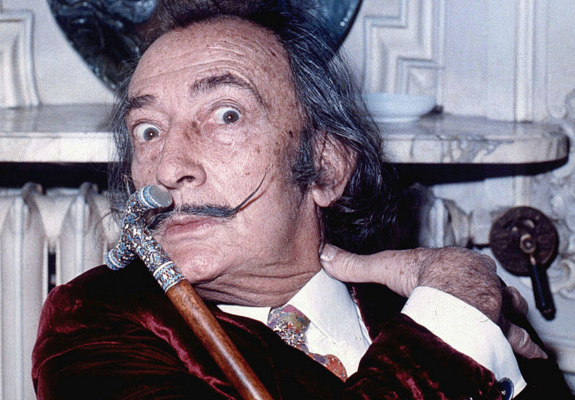
We all thought he was benignly nuts, but maybe he was on to something after all. It seems that many very wise, productive people—such as Albert Einstein, Aristotle, and Salvador Dali—have used power naps as sources of refreshment and inspiration. Except that while my history teacher recommended no less than ten minutes, at least one of these famous gents preferred less than one. Dali used a method of timing his naps that ensured his sleep would not last long. He outlined it thus, according to Lifehacker:
1. Sleep sitting upright (Dali recommends a Spanish-style bony armchair)
2. Hold a key in your hand, between your fingers (for the bohemian, use a skeleton key)
3. Relax and fall asleep (but not for too long…)
4. As you fall asleep, you’ll drop the key. Clang bang clang!
5. Wake up inspired!
Dali called it, fittingly, “Slumber with a key,” and to “accomplish this micro nap,” writes The Art of Manliness, he “placed an upside-down plate on the floor directly below the key.” As soon as he fell asleep, “the key would slip through his fingers, clang the plate, and awaken him from his nascent slumber.” He claimed to have learned this trick from Capuchin monks and recommended it to anyone who worked with ideas, claiming that the micro nap “revivified” the “physical and psychic being.”
Dali included “Slumber with a key” in his book for aspiring painters, 50 Secrets of Magic Craftsmanship, along with such nostrums as “the secret of the reason why a great draughtsman should draw while completely naked” and “the secret of the periods of carnal abstinence and indulgence to be observed by the painter.” We might be inclined to dismiss his nap technique as a surrealist practical joke. Yet The Art of Manliness goes on to explain the creative potential in the kind of nap I used to take in history class—dozing off, then jerking awake just before my head hit the desk:
The experience of this transitional state between wakefulness and sleep is called hypnagogia. You’re floating at the very threshold of consciousness; your mind is sliding into slumber, but still has threads of awareness dangling in the world…. While you’re in this state, you may see visions and hallucinations (often of shapes, patterns, and symbolic imagery), hear noises (including your own name or imagined speech), and feel almost physical sensations…. The experience can essentially be described as “dreaming while awake.”
The benefits for a surrealist painter—or any creative person in need of a jolt out of the ordinary—seem obvious. Many visionaries such as William Blake, John Keats, and Samuel Taylor Coleridge have made use of waking dream states as wellsprings of inspiration. Both Beethoven and Wagner composed while half asleep.
Scientists have found waking dream states useful as well. We’ve already mentioned Einstein. Brilliant mathematician, engineer, philosopher, and theoretical physicist Henri Poincare also found inspiration in micro naps. He pointed out that the important thing is to make ready use of any insights you glean during your few seconds of sleep by writing them down immediately (have pen and paper ready). Then, the conscious mind must take over: “It is necessary,” wrote Poincare, “to put in shape the results of this inspiration, to deduce from them the immediate consequences, to arrange them,” and so forth. He also suggests that “verification” of one’s hypnagogic insights is needed above all, but this step, while critical for the mathematician, seems superfluous for the artist.
So the micro nap comes to us with a very respectable pedigree, but does it really work or is it a psychological placebo? The author of the Almost Bohemian blog writes that he has practiced the technique for several weeks and found it “relatively successful” in restoring energy, though he has yet to harness it for inspiration. If you asked empirical sleep researchers, they might tend to agree with my history teacher: “Sleep laboratory studies show,” writes Lynne Lamberg in her book Bodyrhythms, “that a nap must last at least ten minutes to affect mood and performance.” This says nothing at all, however, about how long it takes to open a doorway to the unconscious and steal a bit of a dream to put to use in one’s waking work.
Aside from the very specific use of the micro nap, the longer power nap—anywhere from 10–40 minutes—can work wonders in improving “mood, alertness and performance,” writes the National Sleep Foundation. Short naps seem to work best as they leave one feeling refreshed but not groggy, and do not interfere with your regular sleep cycle. The Sleep Foundation cites a NASA study “on sleepy military pilots and astronauts” which found that “a 40-minute nap improved performance by 34% and alertness by 100%.” Lifehacker points to studies showing that “power naps, short 10 to 15 minute naps, improve mental efficiency and productivity,” which is why companies like Google and Apple allow their employees to doze off for a bit when drowsy.
One stress management site observes that the 10–15 minute power nap does not even require a pillow or blanket; “you don’t even need to go to sleep! You just need a comfortable place to lie on your back, put your feet up, and breathe comfortably.” Such a practice will not likely turn you into a world famous artist, poet, or scientist (or millionaire marina-owning, altruistic high school teacher). It will likely rejuvenate your mind and body so that you can make much better use of the time you spend not sleeping.
Past exploits include relieving actress Jennifer Garner of her engagement ring and basketball Hall-of-Famer Charles Barkleyof a thick bankroll. In 2001, he virtually picked former U.S. president Jimmy Carter’s Secret Service detail clean, netting badges, a watch, Carter’s itinerary, and the keys to his motorcade. (Robbins wisely steered clear of their guns.)
How does he does he do it? Practice, practice, practice… and remaining hyper vigilant as to the things commanding each individual victims’s attention, in order to momentarily redirect it at the most convenient moment.
Clearly, he’s a put lot of thought into the emotional and cognitive components. In a TED talk on the art of misdirection, above, he cites psychologist Michael Posner’s “Trinity Model” of attentional networks. He has deepened his understanding through the study of aikido, criminal history, and the psychology of persuasion. He understands that getting his victims to tap into their memories is the best way to temporarily disarm their external alarm bells. His easygoing, seemingly spontaneous banter is but one of the ways he gains marks’ trust, even as he penetrates their spheres with a predatory grace.
Watch his hands, and you won’t see much, even after he explains several tricks of his trade, such as securing an already depocketed wallet with his index finger to reassure a jacket-patting victim that it’s right where it belongs. (Half a second later, it’s dropping below the hem of that jacket into Robbins’ waiting hand.) Those paws are fast!
I do wonder how he would fare on the street. His act depends on a fair amount of chummy touching, a physical intimacy that could quickly cause your average straphanger to cry foul. I guess in such an instance, he’d limit the take to one precious item, a cell phone, say, and leave the wallet and watch to a non-theoretical “whiz mob” or street pickpocket team.
Though he himself has always been scrupulous about returning the items he liberates, Robbins does not withhold professional respect for his criminal brothers’ moves. One real-life whiz mobber so impressed him during a television interview that he drove over four hours to pick the perp’s brains in a minimum security prison, a confab New Yorker reporter Adam Green described in colorful detail as part of a lengthy profile on Robbins and his craft.
One small detail does seem to have escaped Robbins’ attention in the second demonstration video below, in which reporter Green willingly steps into the role of vic’. Perhaps Robbins doesn’t care, though his mark certainly should. The situation is less QED than XYZPDQ.
While you’re taking notice, don’t forget to remain alert to what a potential pickpocket is wearing. Such attention to detail may serve you down at the station, if not onstage.
Ayun Halliday is an author, illustrator, and Chief Primatologist of the East Village Inky zine. The sleeping bag-like insulating properties of her ankle-length faux leopard coat make her very popular with the pickpockets of New York. Follow her @AyunHalliday
Last year we told you about the importance of messy desks and walking to creativity. This year, the time has come to realize how much creativity also depends on boredom. In a sense, of course, humankind has utterly vanquished boredom, what with our modern technologies — computers, high-speed internet, smartphones — that make possible sources of rich and frequent stimulation such as, well, this very site. But what if we need a little boredom? What if boredom, that state we 21st-century first-worlders worry about avoiding more than any other, actually helps us create?
Even if we feel no boredom in our free time, surely we still endure the occasional bout of it at work. “Admitting that boredom to coworkers or managers is likely something few of us have ever done,” writes the Harvard Business Review’s David Burkus. “It turns out, however, that a certain level of boredom might actually enhance the creative quality of our work.”
He cites a well-known scientific experiment which found that volunteers did better at a creative task (like finding different uses for a pair of plastic cups) when first subjected to a boring one (like copying numbers out of the phone book) which “heightens the ‘daydreaming effect’ on creativity — the more passive the boredom, the more likely the daydreaming and the more creative you could be afterward.”
Burkus also refers to another paper documenting the performance of different subjects on word-association tests after watching different video clips, one of them deliberately boring. Who came up with the most creative associations? You guessed it: those who watched the boring video first. Boredom, the experimenters suggest, “motivates people to approach new and rewarding activities. In other words, an idle mind will seek a toy. (Anyone who has taken a long car ride with a young child has surely experienced some version of this phenomenon.)”
Writing about those same experiments, Fast Company’s Vivian Giang quotes researcher Andreas Elpidorou of the University of Louisville as claiming that “boredom helps to restore the perception that one’s activities are meaningful or significant.” He describes it as a “regulatory state that keeps one in line with one’s projects. In the absence of boredom, one would remain trapped in unfulfilling situations, and miss out on many emotionally, cognitively, and socially rewarding experiences. Boredom is both a warning that we are not doing what we want to be doing and a ‘push’ that motivates us to switch goals and projects.”
“Boredom is a fascinating emotion because it is seen as so negative yet it is such a motivating force,” says Dr. Sandi Mann of the University of Central Lancashire, one of the masterminds of the experiments with the phone book and the plastic cups, quoted by Telegraph science editor Sarah Knapton. “Being bored is not the bad thing everyone makes it out to be. It is good to be bored sometimes! I think up so many ideas when I am commuting to and from work – this would be dead time, but thanks to the boredom it induces, I come up with all sorts of projects.” (This also manifests in her parenting: “I am quite happy when my kids whine that they are bored,” she said: “Finding ways to amuse themselves is an important skill.”)
“Nearly the Weekend,” by David Feltkamp. Creative Commons image
How to make use of all this? “Taken together,” Burkus writes, “these studies suggest that the boredom so commonly felt at work could actually be leveraged to help us get our work done better,” perhaps by “spending some focused time on humdrum activities such as answering emails, making copies, or entering data,” after which “we may be better able to think up more (and more creative) possibilities to explore.” In the words of Dr. Mann herself, “Boredom at work has always been seen as something to be eliminated, but perhaps we should be embracing it in order to enhance our creativity.” And so to an even more interesting question: “Do people who are bored at work become more creative in other areas of their work – or do they go home and write novels?”
David Foster Wallace took on the relationship between boredom and creativity in an ambitious way when he started writing The Pale King, his unfinished novel (which he privately called “the Long Thing”) set in an Internal Revenue Service branch office in mid-1980s Peoria. The papers related to the project he left behind included a note about the book’s larger theme:
It turns out that bliss – a second-by-second joy + gratitude at the gift of being alive, conscious – lies on the other side of crushing, crushing boredom. Pay close attention to the most tedious thing you can find (tax returns, televised golf), and, in waves, a boredom like you’ve never known will wash over you and just about kill you. Ride these out, and it’s like stepping from black and white into color. Like water after days in the desert. Constant bliss in every atom.
This, as well as the more everyday suggestions about working more creatively by doing the boring bits first, would seem to share a basis with the ancient tradition of meditation. If indeed humanity has gone too far in its mission to alleviate the discomfort of boredom, it has produced the even more pernicious condition in which we all feel constantly and unthinkingly desperate for new distractions (which Shop Class as Soulcraft author Matthew B. Crawford memorably called “obesity of the mind”) while knowing full well that those distractions keep us from our important work, be it designing a scientific experiment, coming up with a sales strategy, or writing a novel.
Maybe we can undo some of the damage by deliberately, regularly shutting off our personal flow of interesting sensory input for a while, whether through meditation, data entry, phone-book copying, of whichever method feels right to you. (WNYC’s Manoush Zomorodi even launched a project last year called “Bored and Brilliant: The Lost Art of Spacing Out,” which challenged listeners to minimize their phone-checking and put the time gained to more creative use.) But we all need some high-quality stimulation sooner or later, so when you feel ready for another dose of it, you know where to find us.
Who really killed John F. Kennedy? Did America really land on the moon? What really brought down the Twin Towers? Few modern phenomena possess the sheer fascination quotient of conspiracy theories. If you believe in them, you’ll of course dig into them obsessively, and if you don’t believe in them, you surely feel a great curiosity about why other people do. Science writer and Skeptic magazine Editor in Chief Michael Shermer falls, needless to say, into the second group; so far into it that examining conspiracy theories and those who subscribe to them has become one of his best-known professional pursuits since at least 1997, the year of his straightforwardly titled book Why People Believe Weird Things.
On the 50th anniversary of JFK’s assassination, Shermer wrote an article in the Los AngelesTimes about the reasons that event has drawn so many avid conspiracy theorists over the past half-decade. First: their cognitive dissonance resulting from the two seemingly incompatible ideas, that of JFK “as one of the most powerful people on Earth” and JFK “killed by Lee Harvey Oswald, a lone loser, a nobody.” Second: their participation in a monological belief system, “a unitary, closed-off worldview in which beliefs come together in a mutually supportive network.” Third: their confirmation bias, or “the tendency to look for and find confirming evidence for what you already believe” — the umbrella man, the grassy knoll — “and to ignore disconfirming evidence.”
These factors all come into play with the other major American conspiracy theories as well. In the podcast clip at the top of the post, you can hear physicist Michio Kaku trying to set straight a moon landing conspiracy theorist. They argue that man has never set foot on the moon, but that the government instead hoodwinked us into believing it with an elaborate audiovisual production (directed, some theorists insist, by none other than Stanley Kubrick, who supposedly “confessed” in fake interview footage that recently made the internet rounds). Should you require further argument to the contrary, have a look at S.G. Collins’ Moon Hoax Not just above.
No higher-profile set of conspiracy-theory movement has come out of recent history than the 9/11 Truthers, who may differ on the details, but who all gather under the umbrella of believing that the events of that day happened not because of the actions of a conspiracy of foreign terrorists, but because of a conspiracy within the United States government itself. In the Q&A footage above (originally uploaded, in fact, by a believer), one such theorist stands up and asks linguist and activist Noam Chomsky to join in on the movement, pointing to a cover-up of the manner in which 7 World Trade Center collapsed — a big “smoking gun” of the larger conspiracy, in their eyes.
This prompts Chomsky to offer an explanation of how scientists and engineers actually go looking for the truth. Have they eliminated entirely their cognitive dissonance, monological belief systems, and confirmation biases? No human could ever do that perfectly — indeed, to be human is to be subject to all these distorting conditions and more — but the larger enterprise of science, at its best, frees us little by little from those very shackles. What a shame to voluntarily clap oneself back into them.
We're hoping to rely on loyal readers, rather than erratic ads. Please click the Donate button and support Open Culture. You can use Paypal, Venmo, Patreon, even Crypto! We thank you!
Open Culture scours the web for the best educational media. We find the free courses and audio books you need, the language lessons & educational videos you want, and plenty of enlightenment in between.