Swedish animator Erik Wernquist calls his short science fiction film, Wanderers, a speculative look at “humanity’s future expansion into the Solar System,” a “glimpse of the fantastic and beautiful nature that surrounds us on our neighboring worlds,” and “how it might appear to us if we were there.” The locations shown in Wanderers are all “digital recreations of actual places in the Solar System, built from real photos and map data.” And Wernquist has a big still-image gallery where he walks you through his creative work. The voice accompanying the film is none other than Carl Sagan’s, taken from an audio recording of his 1994 book Pale Blue Dot: A Vision of the Human Future in Space. Astute sci-fi fans will also notice the influences of Arthur C. Clarke, Kim Stanley Robinson and the master of space art Chesley Bonestell.
We are, it appears, in the midst of a “podcasting renaissance,” as Colin Marshall has recently pointed out. And yet, like him, I too was unaware that “podcasting had gone into a dark age.” Nevertheless, its current popularity—in an age of ubiquitous screen technology and perpetual visual spectacle—speaks to something deep within us, I think. Oral storytelling, as old as human speech, will never go out of style. Only the medium changes, and even then, seemingly not all that much.
But the differences between this golden age of podcasting and the golden age of radio are still significant. Where the podcast is often off-the-cuff, and often very intimate and personal—sometimes seen as “too personal,” as Colin writes—radio programs were almost always carefully scripted and featured professional talent. Even those programs with man-on-the street features or interviews with ordinary folks were carefully orchestrated and mediated by producers, actors, and presenters. And the business of scoring music and sound effects for radio programs was a very serious one indeed. All of these formalities—in addition to the limited frequency range of old analog recording technology—contribute to what we immediately recognize as the sound of “old time radio.” It is a quaint sound, but also one with a certain gravitas, an echo of a bygone age.
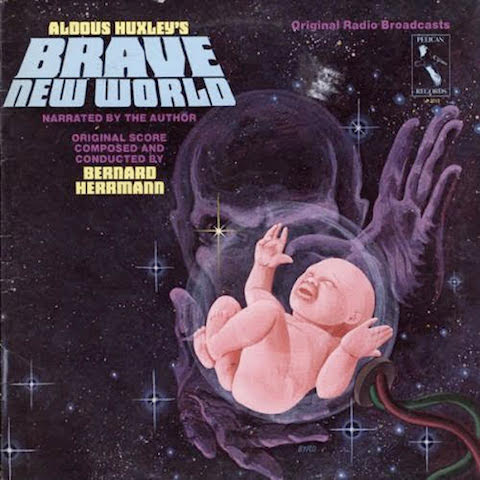
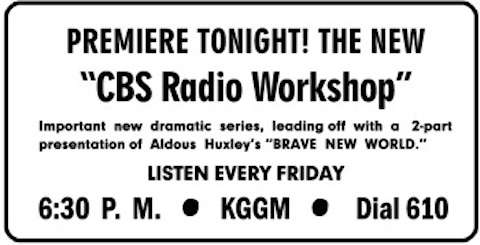
That golden age waned as television came into its own in the mid-fifties, but near its end, some broadcast companies made every effort to put together the highest quality radio programming they could in order to retain their audience. One such program, the CBS Radio Workshop, which ran from January, 1956 to September, 1957, may have been “too little too late”—as radio preservationist site Digital Deli writes—but it nonetheless was “every bit as innovative and cutting edge” as the programs that came before it. The first two episodes, right below, were dramatizations of Aldous Huxley’s Brave New World, read by the author himself. (Find it also on Spotify here.) The series’ remaining 84 programs drew from the work of Antoine de Saint-Exupéry, James Thurber, H.L. Mencken, Mark Twain, Robert Heinlein, Eugene O’Neil, Balzac, Carl Sandburg, and so many more. It also featured original comedy, drama, music, and This American Life-style profiles and storytelling.
Huxley returned in program #12, with a story called “Jacob’s Hands,” written in collaboration with and read by Christopher Isherwood. The great Ray Bradbury made an appearance, in program #4, introducing his stories “Season of Disbelief” and “Hail and Farewell,” read by John Dehner and Stacy Harris, and scored by future film and TV composer Jerry Goldsmith. Other programs, like #10, “The Exurbanites,” narrated by famous war correspondent Eric Sevareid, conducted probing investigations of modern life—in this case the growth of suburbia and its relationship to the advertising industry. The above is but a tiny sampling of the wealth of quality programming the CBS Radio Workshop produced, and you can hear all of it—all 86 episodes—courtesy of the Internet Archive.
Sample streaming episodes in the player above, or download individual programs as MP3s and enjoy them at your leisure, almost like, well, a podcast. See Digital Deli for a complete rundown of each program’s content and cast, as well as an extensive history of the series. This is the swan song of golden age radio, which, it seems, maybe never really left, given the incredible number of listening experiences we still have at our disposal. Yes, someday our podcasts will sound quaint and curious to the ears of more advanced listeners, but even then, I’d bet, people will still be telling and recording stories, and the sound of human voices will continue to captivate us as it always has.
Most people know that Mark Twain wrote about Jim and Huckleberry Finn navigating down the Mississippi. Less well known is that he occasionally dabbled in the burgeoning genre of science fiction. His 1898 short story “The Great Dark” is about a ship that sails across a drop of water on a microscope slide. His novel Connecticut Yankee in King Arthur’s Court is one of the first to explore time travel. And, in a short story called “From The ‘London Times’ in 1904,” Twain predicted the internet. In 1898. Read it here.
Set five years into the future, the story starts off as a crime mystery. Clayton, a quick-tempered army officer, is accused of murdering Szczepanik, the inventor of a new and promising device called the Telelectroscope. The tale’s unnamed narrator describes it like this:
As soon as the Paris contract released the telelectroscope, it was delivered to public use, and was soon connected with the telephonic systems of the whole world. The improved ‘limitless-distance’ telephone was presently introduced and the daily doings of the globe made visible to everybody, and audibly discussable too, by witnesses separated by any number of leagues.
That sounds a lot like social media. Mark Twain dreamed up Twitter and Youtube during the Grover Cleveland administration.
Facing the hangman’s noose, Clayton asks for, and receives, a telelectroscope for his cell. As the narrator describes Clayton’s telelectroscopic revelry, it sounds uncannily like a bored cubicle dweller surfing the web at work.
…day by day, and night by night, he called up one corner of the globe after another, and looked upon its life, and studied its strange sights, and spoke with its people, and realized that by grace of this marvelous instrument he was almost as free as the birds of the air, although a prisoner under locks and bars. He seldom spoke, and I never interrupted him when he was absorbed in this amusement. I sat in his parlor and read, and smoked, and the nights were very quiet and reposefully sociable, and I found them pleasant. Now and then I would hear him say ‘Give me Yedo;’ next, ‘Give me Hong-Kong;’ next, ‘Give me Melbourne.’ And I smoked on, and read in comfort, while he wandered about the remote underworld, where the sun was shining in the sky, and the people were at their daily work.
The story itself is an admittedly minor work by the master of American fiction. In its last third, the story abruptly turns into a surprisingly sour satire about the sad state of our legal system. As Clayton is getting marched to the gallows, the narrator spots the guy Clayton supposedly murdered on the telelectroscope screen, standing in a crowd for the coronation of the new “Czar” of China. Even though no crime took place, Clayton is still sentenced to hang.
“From The ‘London Times’ in 1904” contains two long-running themes in Twain’s work and life. One is the absurdity of the courts – see, for example “The Facts in the Great Landslide Case.”
And the other is a fascination with technology. In spite of his folksy image, he was, as they say now, an early adopter. He was the first in his neighborhood to get a telephone. He may or may not have been the first major author to use a typewriter to write a novel. He lost his shirt investing in a Victorian-era start up hawking an exceedingly complex printing press called the Paige Compositor. And he allowed himself to be filmed by Thomas Edison in 1909, a year before his death.
One wonders what he would have thought of his telelectroscope in action.
Note: The character Szczepanik mentioned above was clearly named after a Polish inventor, Jan Szczepanik, who talked about creating a “telectroscope,” in the late 19th century. However, if you read a report in The New York Times in 1898, it becomes apparent that Szczepanik’s “telectroscope” wasn’t as visionary as what Twain had in mind.
Jonathan Crow is a Los Angeles-based writer and filmmaker whose work has appeared in Yahoo!, The Hollywood Reporter, and other publications. You can follow him at @jonccrow. And check out his blog Veeptopus, featuring lots of pictures of vice presidents with octopuses on their heads. The Veeptopus store is here.
Although J.K. Rowling wrote the final book in the Harry Potter series in 2007, she continues to give Potter fans an occasional fix, publishing short works that add a little more color and detail to the Harry Potter story. Ardent fans know that Rowling wrote a short Prequel in 2008. Also, earlier this year, she began writing new stories about the 2014 Quidditch World Cup Finals for Pottermore, the website for all things Harry Potter. She later followed with a story that takes the form of an article published in The Daily Prophet (“Dumbledore’s Army Reunites at Quidditch World Cup Final”), which gives us the first glimpse of the adult Harry Potter.
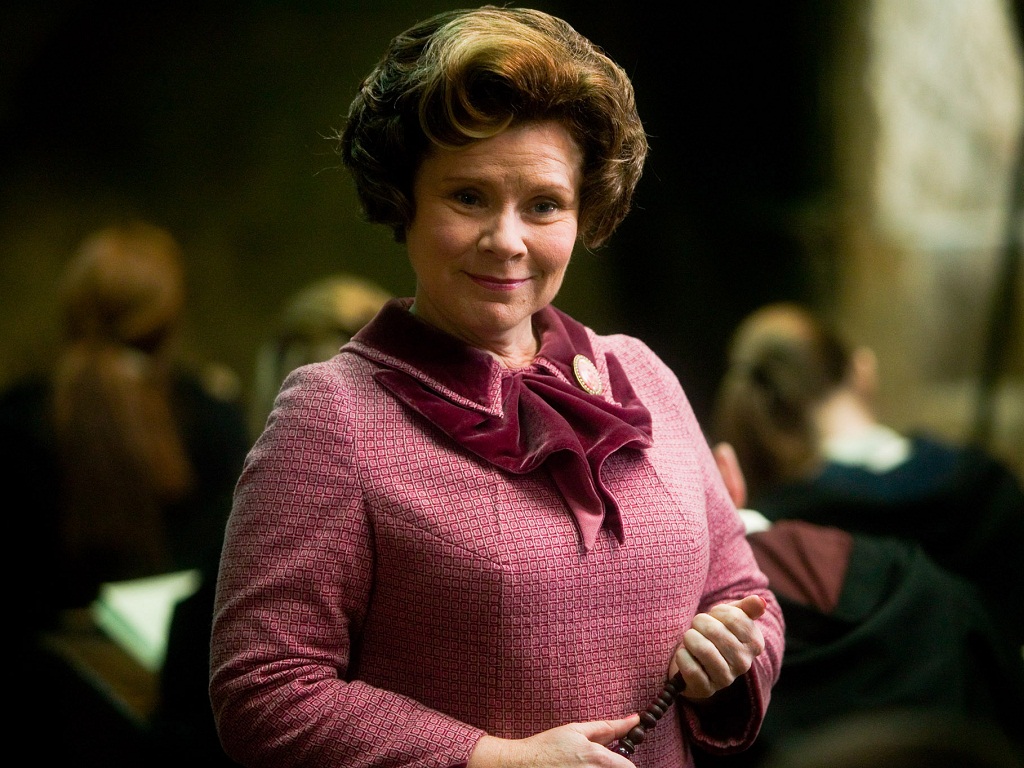
Now, on Halloween, we get “The Story of Dolores Jane Umbridge” — a short fictional essay that gives us a more complete personal portrait of the character that readers found so easy to dislike. In the essay [SPOILER ALERT], we learn that Umbridge was, gasp, a half blood, who had demonstrated a certain capacity for wickedness at a young age: “Even at seventeen, Dolores was judgemental, prejudiced and sadistic, although her conscientious attitude, her saccharine manner towards her superiors, and the ruthlessness and stealth with which she took credit for other people’s work soon gained her advancement.”
Rowling then appends some personal comments to the story, explaining the origins of the Umbridge character. She writes:
Once, long ago, I took instruction in a certain skill or subject (I am being vague as vague can be, for reasons that are about to become obvious), and in doing so, came into contact with a teacher or instructor whom I disliked intensely on sight.
The woman in question returned my antipathy with interest. Why we took against each other so instantly, heartily and (on my side, at least) irrationally, I honestly cannot say. What sticks in my mind is her pronounced taste for twee accessories. I particularly recall a tiny little plastic bow slide, pale lemon in colour that she wore in her short curly hair.… [H]er tendency to wear frills where (I felt) frills had no business to be, and to carry undersized handbags, again as though they had been borrowed from a child’s dressing-up box, jarred, I felt, with a personality that I found the reverse of sweet, innocent and ingenuous.
I rarely think back to memories from that busywork-intensive containment unit known as American elementary school, but when I do, I usually arrive at listening to a Ray Bradbury story — something about a faraway planet, something about monsoons, I can never remember which one — during read-aloud time. Even then, on some level, I understood that the author of Fahrenheit 451 and The Martian Chronicles (not that I yet had any idea at the time about books like Fahrenheit 451 and The Martian Chronicles) wrote with the human voice in mind. Not necessarily the momentarily defamiliarized voice of a teacher reading to a post-lunch classroom of ten-year-olds, and not necessarily the flawlessly pronouncing and pausing, many-takes-recorded-per-sentence voice of the professional audiobook narrator (though Bradbury’s work did provide material for a few proto-audiobooks), but, perhaps, the voice of the mind. Of all Bradbury’s tales we love to read aloud, few seem quite so effective in this way as “The Veldt.”
The story first appeared, according to the web site of public radio station WNYC, in a 1950 Saturday Evening Post “with the title ‘The World the Children Made,’ which is a good description of what goes on in this eerie tale. It imagines the ‘model home’ of the future, including a programmable nursery that becomes the site of a power struggle. [Fellow speculative writer Neil] Gaiman says that Bradbury’s tale raises complex questions: ‘Are our children our own?,’ and ‘What does technology do to them?’ ” Public Radio International commissioned no less a speaker than Colbert Report and future Late Show host Stephen Colbert — a satirist highly attuned to the ironies inherent in mankind’s visions of its own future — to read it for their “Selected Shorts” series, and you can hear the whole thing above.
Given how much progress our pursuit of total automation and virtual stimulation (and our parallel desire to escape those conditions) has made in the past 64 years, “The Veldt” has grown only more relevant. Pair it with “There Will Come Soft Rains,” Bradbury’s other famously read-aloudable story of the home of the 1950 future, for a richly funny and troubling double-feature of the mind.
Where do ideas come from? The question has always had the potential to plague anyone trying to do anything worthwhile at any time in human history. But Isaac Asimov, the massively prolific and even more massively influential writer of science fiction and science fact, had an answer. He even, in one 1959 essay, laid out a method, though we, the general public, haven’t had the chance to read it until now. The MIT Technology Review has just published his essay on creativity in full, while providing a few contextualizing remarks from the author’s friend Arthur Obermayer, a scientist who invited Asimov on board an “out of the box” missile-defense research project at an MIT spinoff called Allied Research Associates.
“He expressed his willingness and came to a few meetings,” remembers Obermayer, but “he eventually decided not to continue, because he did not want to have access to any secret classified information; it would limit his freedom of expression. Before he left, however, he wrote this essay on creativity as his single formal input.” When Obermayer found it among his old files, he “recognized that its contents are as broadly relevant today as when [Asimov] wrote it” in 1959, describing as they do “not only the creative process and the nature of creative people but also the kind of environment that promotes creativity.” Whether you write sci-fi novels or do military research, make a web series, or work on curing Ebola, you can put Asimov’s methods to use.
Asimov first investigates the origin of ideas by looking to The Origin of Species. Or rather, he looks to what you find within it, “the theory of evolution by natural selection, independently created by Charles Darwin and Alfred Wallace,” two men who “both traveled to far places, observing strange species of plants and animals and the manner in which they varied from place to place,” both “keenly interested in finding an explanation for this,” and both of whom “failed until each happened to read Malthus’s ‘Essay on Population.’ ” He finds that “what is needed is not only people with a good background in a particular field, but also people capable of making a connection between item 1 and item 2 which might not ordinarily seem connected.” Evolutionary theory seems obvious only in retrospect, he continues, as
The history of human thought would make it seem that there is difficulty in thinking of an idea even when all the facts are on the table. Making the cross-connection requires a certain daring. It must, for any cross-connection that does not require daring is performed at once by many and develops not as a “new idea,” but as a mere “corollary of an old idea.”
It is only afterward that a new idea seems reasonable. To begin with, it usually seems unreasonable. It seems the height of unreason to suppose the earth was round instead of flat, or that it moved instead of the sun, or that objects required a force to stop them when in motion, instead of a force to keep them moving, and so on.
A person willing to fly in the face of reason, authority, and common sense must be a person of considerable self-assurance. Since he occurs only rarely, he must seem eccentric (in at least that respect) to the rest of us. A person eccentric in one respect is often eccentric in others.
Consequently, the person who is most likely to get new ideas is a person of good background in the field of interest and one who is unconventional in his habits. (To be a crackpot is not, however, enough in itself.)
Once you have the people you want, the next question is: Do you want to bring them together so that they may discuss the problem mutually, or should you inform each of the problem and allow them to work in isolation?
The essay puts forth an argument for isolation (“Creation is embarrassing. For every new good idea you have, there are a hundred, ten thousand foolish ones, which you naturally do not care to display”) and a set of best practices for group idea generation, as implementable in the Allied Research Associates of the 1950s as in any organization today. If you can’t trust Asimov on this subject, I don’t know who you can trust, but consider supplementing this newfound essay with Ze Frank’s thematically related video “Brain Crack” (linguistically NSFW, though you can watch the PG version instead), which deals, in an entirely different sensibility, with the question of where ideas come from:
With more than 480 fan-made segments culled from over 1,500 submissions, The Empire Strikes Back Uncut (also known as ESB Uncut) features a stunning mash-up of styles and filmmaking techniques, including live action, animation, and stop-motion. The project launched in 2013, with fans claiming 15-second scenes to reimagine as they saw fit – resulting in sequences created with everything from action figures to cardboard props to stunning visual effects. Helmed by Casey Pugh, who oversaw 2010’s Emmy-winning Star Wars Uncut, the new film has a wonderful homemade charm, stands as an affectionate tribute to The Empire Strikes Back, and is a testament to the talent, imagination, and dedication of Star Wars fans.
ESB Uncut was just released yestery, right in time for the weekend. Below we have some more creative takes on the Star Wars films to keep you entertained.
Back in 1991, Bradley Denton published Buddy Holly is Alive and Well on Ganymede. The next year, it won the John W. Campbell Memorial Award for Best Science Fiction Novel.
Writes Cory Doctorow on BoingBoing, Buddy Holly is Alive and Well on Ganymede “is the great American comic science fiction novel, a book about the quest to exhume Buddy Holly’s corpse from Lubbock, TX to prove that he can’t possibly be broadcasting an all-powerful jamming signal from a hermetically sealed bubble on a distant, airless moon.”
Taking advantage of new innovations (new since 1991), Denton has made the novel available for free download on his website, publishing it under a Creative Commons Attribution-NonCommercial-NoDerivatives license. You can access the text in four parts here: Part 1, Part 2, Part 3, Part 4.
If you become a fan, keep an eye out for a film adaptation of the novel starring Jon Heder. It’s been in development for some time, but you can watch a trailer online.
We're hoping to rely on loyal readers, rather than erratic ads. Please click the Donate button and support Open Culture. You can use Paypal, Venmo, Patreon, even Crypto! We thank you!
Open Culture scours the web for the best educational media. We find the free courses and audio books you need, the language lessons & educational videos you want, and plenty of enlightenment in between.