Now it’s time to see whether Isaac Asimov, another sci-fi legend, possessed the same powers of prescience. Above, we’re highlighting the second part of an interview taped in 1989. It features Asimov and a younger Bill Moyers talking about education and scientific progress, and it doesn’t take long for Asimov to start describing the revolution in learning we’re seeing unfold today. Imagine a world where computers, internet connections and websites let people learn when they want, wherever they want, and how they want. Suddenly technology democratizes education and empowers people of all ages, and, before too long, “Everyone can have a teacher in the form of access to the gathered knowledge of the human species.” That’s the world we’re coming into, especially during recent months, thanks to Google, opencourseware, new-fangled MOOCs (Massive Open Online Courses), the Khan Academy, and even sites like our own. (Have you seen our lists of 450 Free Courses? 300 Free eBooks? 150 Free Textbooks? 400 Free Audio Books, etc?). Yes, 23 years ago, Asimov pretty much knew exactly where we would be today, and then some.
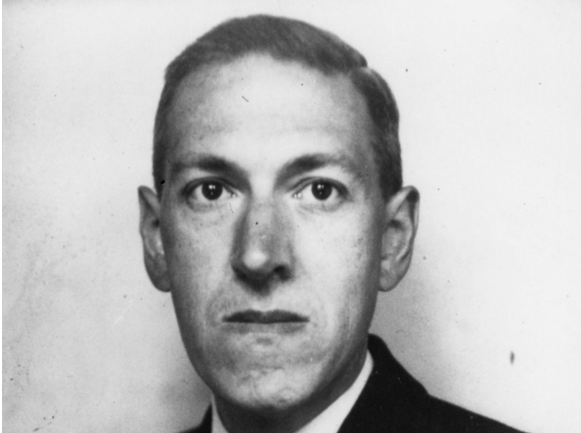
If you ask Stephen King, he’ll tell you that H.P. Lovecraft was “the twentieth century’s greatest practitioner of the classic horror tale.” And Joyce Carol Oates will readily admit that Lovecraft had “an incalculable influence on succeeding generations of writers of horror fiction.” In these modern times, you can revisit Lovecraft’s classic horror tales by downloading his works in text or audio. (See below.) Or, you can revisit his cosmic horror tales by picking up The Lovecraft Anthology, a new graphic novel series that brings Lovecraft’s writings to “vivid and malevolent life.” The video above gives you a preview of what the series has to offer. It features an animation of “The Call of Cthulhu,” Lovecraft’s famous pulp story from 1926.
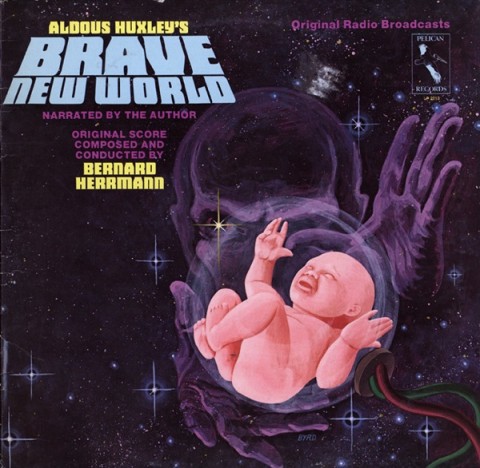
Today we’re bringing you a roundup of some of the great Science Fiction, Fantasy and Dystopian classics available on the web. And what better way to get started than with Aldous Huxley reading a dramatized recording of his 1932 novel, Brave New World. The reading aired on the CBS Radio Workshop in 1956. You can listen to Part 1 here and Part 2 here.
(FYI: You can download Huxley’s original work — as opposed to the dramatized version — in audio by signing up for a Free Trial with Audible.com, and that applies to other books mentioned here as well.)
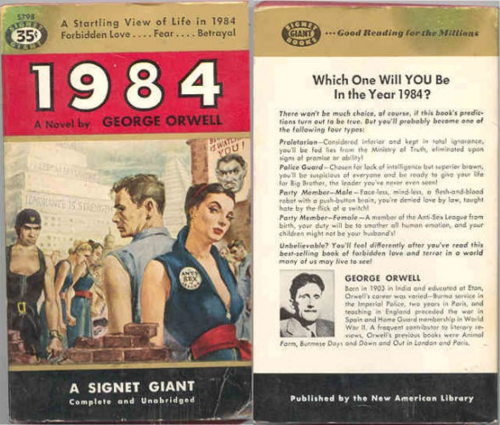
Little known fact. Aldous Huxley once gave George Orwell French lessons at Eton. And, 17 years after the release of Brave New World, Huxley’s pupil published 1984. The seminal dystopian work may be one of the most influential novels of the 20th century, and it’s almost certainly the most important political novel from that period. You can find it available on the web in three formats: Free eText — Free Audio Book – Free Movie.
In 1910, J. Searle Dawley wrote and directed Frankenstein. It took him three days to shoot the 12-minute film (when most films were actually shot in just one day). It marked the first time that Mary Shelley’s classic monster tale (text — audio) was ever adapted to film. And, somewhat notably, Thomas Edison had a hand (albeit it an indirect one) in making the film. The first Frankenstein film was shot at Edison Studios, the production company owned by the famous inventor.
Stephen King and Joyce Carol Oates — they both pay homage to H.P. Lovecraft and his great tales. And you can too by spending time with his collected works, available in etext formats here and audio formats here (Free Mp3 Zip File – Free Stream).
Philip K. Dick published 44 novels and 121 stories during his short lifetime, solidifying his position as one of America’s top sci-fi writers. If you’re not intimately familiar with his novels, then you almost certainly know major films based on Dick’s work – Blade Runner, Total Recall, A Scanner Darkly and Minority Report. To get you acquainted with PKD’s writing, we have culled together 14 short stories for your enjoyment.
Back in the late 1930s, Orson Welles launched The Mercury Theatre on the Air, a radio program dedicated to bringing dramatic, theatrical productions to the American airwaves. The show had a fairly short run, lasting from 1938 to 1941. But it made its mark. During these few years, The Mercury Theatre aired The War of the Worlds, an episode narrated by Welles that led many Americans to believe their country was under Martian attack. The legendary production, perhaps the most famous ever aired on American radio, was based on H.G. Wells’ early sci-fi novel, and you can listen to the broadcast right here.
Between 1951 and 1953, Isaac Asimov published three books that formed the now famous Foundation Trilogy. Many considered it a masterwork in science fiction, and that view became official doctrine in 1966 when the trilogy received a special Hugo Award for Best All-Time Series, notably beating out Tolkien’s The Lord of the Rings. Eventually, the BBC decided to adapt Asimov’s trilogy to the radio, dramatizing the series in eight one-hour episodes that aired between May and June 1973. Thanks to The Internet Archive you can download the full program as a zip file, or stream it online:
Part 1 |MP3| Part 2 |MP3| Part 3 |MP3| Part 4 |MP3| Part 5 |MP3| Part 6 |MP3| Part 7 |MP3| Part 8 |MP3|
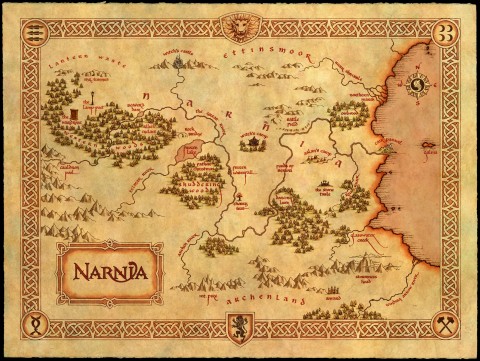
Before the days of Harry Potter, generations of young readers let their imaginations take flight with The Chronicles of Narnia, a series of seven fantasy novels written by C. S. Lewis. Like his friend J.R.R. Tolkien, Lewis served on the English faculty at Oxford University and took part in the Inklings, an Oxford literary group dedicated to fiction and fantasy. Published between 1950 and 1956, The Chronicles of Narnia has sold over 100 million copies in 47 languages, delighting younger and older readers worldwide.
Now, with the apparent blessing of the C.S. Lewis estate, the seven volume series is available in a free audio format. There are 101 audio recordings in total, each averaging 30 minutes and read by Chrissi Hart. Download the complete audio via the web or RSS Feed.
Neil Gaiman has emerged as one of today’s best fantasy writers. He has made comics respectable and published novels, including one that will be adapted by HBO. A great deal of his output, though, has been in the form of short stories, some available on the web in text format, others in audio.
The Truth Is a Cave in the Black Mountains – Read Online
Between 1982 and 2000, Rudy Rucker wrote a series of four sci-fi novels that formed The Ware Tetralogy. The first two books in the series – Software and Wetware – won the Philip K. Dick Award for best novel. And William Gibson has called Rucker “a natural-born American street surrealist” or, more simply, one sui generis dude. And now the even better part: Rucker (who happens to be the great-great-great-grandson of Hegel) has released The Ware Tetralogy under a Creative Commons license, and you can download the full text for free in PDF and RTF formats. In total, the collection runs 800+ pages.
In 2009, Brooklyn-based Web developer Casey Pugh was looking for a new way to explore the potential of crowd-sourcing when he hit upon an idea of galactic proportions. He took the original 1977 Star Wars film (later known as Episode IV: A New Hope in the chronologically ordered six-part series) and chopped it into 15-second pieces, inviting fans from around the world to choose a piece and re-create it in whatever medium they liked: live-action, puppetry, animation, you name it. Three years and one Emmy Award later, Pugh and his team have put the best pieces together and (with the blessing of Star Wars creator George Lucas) released the finished film, Star Wars Uncut: The Director’s Cut. It runs a fun two hours and five minutes. You can watch the complete movie above and learn more on the official website.
If you would like to support the mission of Open Culture, consider making a donation to our site. It’s hard to rely 100% on ads, and your contributions will help us continue providing the best free cultural and educational materials to learners everywhere. You can contribute through PayPal, Patreon, and Venmo (@openculture). Thanks!
If you’re not intimately familiar with his novels, then you assuredly know major films based on Dick’s work – Blade Runner, Total Recall, A Scanner Darklyand Minority Report. Today, we bring you another way to get acquainted with his writing. We’re presenting a selection of Dick’s stories available for free on the web. Below we have culled together 11 short stories from our collections. Some of the stories collected here have also found their way into the recently-published book, Selected Stories by Philip K. Dick, which features an introduction by Jonathan Lethem.
Let’s do the time warp today and revisit the Not-S0-Golden Age of American Television. The year was 1978. Star Wars fever still gripped America, and the Variety Show TV format wouldn’t say die. So, producing The Star Wars Holiday Special was a no-brainer. The two-hour show takes you inside the domestic world of Chewbacca and his family — his father Itchy, his wife Malla, and his son Lumpy — and features guest appearances by Jefferson Starship, Harvey Korman and Bea Arthur, plus a little stock footage of Alec Guinness. As for the production quality and special effects? They’re all textbook kitsch.
You’ve heard enough to know that this wasn’t the finest hour for the Star Wars franchise. One critic called it the “the worst two hours of television ever.” And, when he’s willing to acknowledge the existence of the TV special, George Lucas readily admits that turning Star Wars into a variety show “wasn’t the smartest thing to do.” But because the show only aired once in its entirety, the holiday special has gained something of a cult status and circulates “underground” on the web. Vanity Fair has more on this misadventure in television programming here. H/T goes to Dangerous Minds.
In 1941, director Dave Fleischer and Paramount Pictures animators Steve Muffati and George Germanetti produced Superman: The Mechanical Monsters — a big-budget animated adaptation of the popular Superman comics of that period, in which a mad scientist unleashes robots to rob banks and loot museums, and Superman, naturally, saves the day. It was one of seventeen films that raised the bar for theatrical shorts and are even considered by some to have given rise to the entire Anime genre.
More than a mere treat of vintage animation, the film captures the era’s characteristic ambivalence in reconciling the need for progress with the fear of technology in a culture on the brink of incredible technological innovation. It was the dawn of the techno-paranoia that persisted through the 1970s, famously captured in the TV series Future Shock narrated by Orson Welles, and even through today. Take for example books like Nicholas Carr’s The Shallows and Sherry Turkle’s Alone Together: Why We Expect More from Technology and Less from Each Other.
Superman: The Mechanical Monsters is available for download on The Internet Archive, and Toonami Digital Arsenal has the complete series of all seventeen films. Find more vintage animation in Open Culture’s collection of Free Movies Online.
Maria Popova is the founder and editor in chief of Brain Pickings, a curated inventory of cross-disciplinary interestingness. She writes for Wired UK, The Atlantic and DesignObserver, and spends a great deal of time on Twitter.
In 1964, Sir Arthur C. Clarke, the futurist and sci-fi writer best known for his novel 2001: A Space Odyssey, peered into the future, to the year 2000, and described what he saw. And a pretty good guess it was. Ours would be a world in which…
We could be in instant contact with each other, wherever we may be, where we can contact our friends anywhere on earth, even if we don’t know their actual physical location. It will be possible in that age, perhaps only 50 years from now, for a man to conduct his business from Tahiti or Bali just as well as he could from London.… Almost any executive skill, any administrative skill, even any physical skill, could be made independent of distance. I am perfectly serious when I suggest that one day we may have brain surgeons in Edinburgh operating on patients in New Zealand.
By 2001, California doctors were already conducting virtual surgery on patients in Rome. And, by 2005, Thomas Friedman published his bestseller, The World is Flat, which pretty much told us that us that Clarke’s imagined world had arrived — with, of course, one big exception. Cities? They’re still standing…
If you would like to support the mission of Open Culture, consider making a donation to our site. It’s hard to rely 100% on ads, and your contributions will help us continue providing the best free cultural and educational materials to learners everywhere. You can contribute through PayPal, Patreon, and Venmo (@openculture). Thanks!
We're hoping to rely on loyal readers, rather than erratic ads. Please click the Donate button and support Open Culture. You can use Paypal, Venmo, Patreon, even Crypto! We thank you!
Open Culture scours the web for the best educational media. We find the free courses and audio books you need, the language lessons & educational videos you want, and plenty of enlightenment in between.