Typing programs demand some patience on the part of the student, and David Lynch Teaches Typing is no exception.
You’ve got 90 seconds to get acclimated to the cruddy floppy disc-era graphics and the cacophonous voice of your instructor, a dead ringer for FBI Deputy Director Gordon Cole, the hard-of-hearing character director David Lynch played on his seminal early 90s series, Twin Peaks.
Things perk up about a minute and a half in, when students are instructed to place their left ring fingers in an undulating bug to the left of their keyboards.
That second “in”? Not a typo (though you’ll notice plenty of no doubt intentional boo-boos in the teacher’s pre-programmed responses…)
One of our favorites is the Apple-esque name of the program’s retro computer, and we’ll wager that frequent Lynch collaborator, actor Kyle MacLachlan, would agree.
Another reference that has thus far eluded online gaming enthusiasts in their 20s is Mavis Beacon Teaches Typing. Take a peek below at what the virtual typing tutor’s graphics looked like around the time the original Twin Peaks aired to discover the creators of David Lynch Teaches Typing’s other inspiration.
David Lynch Teaches Typing is available for free download here. If you’re anxious that doing so might open you up to a technical bug of nightmarish proportions, stick with watching the play through at the top of the page.
From HBO comes the latest teaser trailer for a new adaptation of Ray Bradbury’s 1953 dystopian novel, Fahrenheit 451. Scheduled to debut in May 2018, the new film will feature Michael B. Jordan and Michael Shannon.
Ostensibly Fahrenheit 451 is a story about government censorship. And some have considered it a response to McCarthyism. But, when asked what the story is really about, Ray Bradbury said this: It’s about people “being turned into morons by TV.” As a medium, television “gives you the dates of Napoleon, but not who he was,” spreading “factoids” instead of knowledge. “They stuff you with so much useless information, you feel full.” Just something to keep in mind before and after the new HBO film hits your TV sets this spring.
If you would like to support the mission of Open Culture, consider making a donation to our site. It’s hard to rely 100% on ads, and your contributions will help us continue providing the best free cultural and educational materials to learners everywhere. You can contribute through PayPal, Patreon, and Venmo (@openculture). Thanks!
The more things change, the more the talking points stay the same. Just swap teachers for airplane passengers, and watch a silly sitcom punchline morph into actual GOP policy.
When it came out in 1995, Mamoru Oshii’s Ghost in the Shell showed the world what the art of Japanese animation could do with the kind of gritty, tech-saturated, globalized cyberpunk visions popularized in the previous decade by William Gibson and other writers. The film’s particularly successful release in the United Kingdom got some culturally savvy marketers in Ireland thinking: why not use this sort of thing to sell beer?
But rather than ripping it off and watering it down — all too par for the course in advertising — they hired animators straight from Production I.G., Ghost in the Shell’s studio, to create a whole new animated cyberpunk reality, the one in which Last Orders, the minute-long spot above, takes place. The 1997 commercial tells the story of six samurai rushing through a cityscape that has everything we’ve now come to expect from this genre: forests of high-rises, bustling streets, mysterious women, artificial humanoids, the technological everywhere merged with the organic, and neon signs aplenty.
The samurai converge on their destination, a tavern, just in time to silently but firmly signal their demand for their drink of choice: Murphy’s Irish Stout, a Heineken-distributed brew offered as a lighter, less bitter alternative to the market-dominating Guinness. But no matter of the steely determination of the samurai in Last Orders, the first anime-style commercial ever to air in the UK and Ireland, it seems that one challenges such an iconic brand at one’s peril: Murphy’s currently has only a five-percent share of the Irish stout market, and that mostly thanks to a 28-percent share in its native Cork.
The Japanese animators who worked on the commercial have fared rather better, going on to, among many other respected projects, Blood: The Last Vampire and Jin-Roh: The Wolf Brigade. Though I’ve never encountered Murphy’s on any tap, I’d gladly watch a movie or even an entire series set in its world. The stout market, the mighty Guinness included, may have been on the decline in recent years, but cyberpunk, in our own ever more globalized and tech-saturated reality, seems about due for a comeback.
Based in Seoul, Colin Marshall writes and broadcasts on cities and culture. His projects include the book The Stateless City: a Walk through 21st-Century Los Angeles and the video series The City in Cinema. Follow him on Twitter at @colinmarshall or on Facebook.
Do I like Philip K. Dick? Do androids dream of electric sheep? Honestly, I don’t think we’ll ever be able to answer such questions about the subjective experience of artificial beings. But I know for certain that I like Philip K. Dick. Deeply admire, respect, fear, even… there are many words I could use to describe the way I feel about his imagination and vision. And I could say much the same about the film adaptations of Dick’s work, up to and including Blade Runner 2049, which wasn’t as visually overwhelming on the small screen after its release on streaming video but still as emotionally captivating in its narrative, pacing, score, and director Denis Villeneuve’s fidelity to, and expansion of, the original film’s use of color and monumental, future-brutalist architecture to tell a story.
Though he very much wanted to break out of science fiction and achieve the status of a “literary” writer—the distinctions in his day being much harder and faster—Dick’s fiction has provided the ultimate source for the cinematic sci-fi epic for several decades now, and shows little sign of falling out of favor. The commercial and creative question seems to be not whether Dick’s stories still resonate, but whether they translate to television as brilliantly as they do to film. Critical opinion can sharply divide on Amazon’s adaptation of Dick’s alternative history novel The Man in the High Castle (about a world in which the Axis powers triumphed), which might be “ponderous,” “boring,” and—in its second season—“the worst TV show of the year,” or “the second best show Amazon has ever made.”
How much this latter judgment conveys depends upon how highly, on the whole, one rates the quality of programming from that corporate mega-juggernaut threatening to overtake nearly every aspect of consumer culture. To say that I find it ironic that such an entity possesses not only one Philip K. Dick property, but now two, with its latest Dick-inspired anthology show Philip K. Dick’s Electric Dreams, would be to grossly understate the case. The author who imagined an intrusive internet of things and a dystopian world where advertisements appear in our minds might also find this situation somewhat… Dick-ian (Dick-like? Dick-ish?). But such is the world we live in. Putting these ironies aside, let’s revisit the question: do Dick’s stories work as well on TV as they do on film?
Find out for yourself. The first season of Philip K. Dick’sElectric Dreams is now streaming on Amazon (see the trailer above), and you can either purchase it by episode, or binge-stream the whole thing gratis with a 30-day free trialof Amazon Prime. Given that the series, which adapts stories from a collection of the same title, is not the product of one singular vision but a different creative team each time, you may agree with Evan Narcisse at Gizmodo, who writes that the episodes “don’t just vary in aesthetics; they vary widely in quality.” It has a star-studded cast—including Anna Paquin, Janelle Monae, Terrance Howard, Steve Buscemi, and Bryan Cranston (who co-produced)—and some impressive production values.
But Electric Dreams also has a significant challenge set before it: “to show both new viewers and conversant fans why Dick’s oeuvre matters, which is hard in a world where we’re eerily close to some of his fictional realities.” Indeed—as we ponder whether we might be characters in a simulated reality, our thoughts and beliefs manipulated by powerful companies like those in Dick’s unsettling Ubik—watching the show might add yet another layer of bewilderment to the already very strange experience of everyday life these days. But then again, “if you feel weirded out while watching, that just means the show is doing its job.”
FYI. Carl Sagan’s 13-episode series Cosmos originally aired in 1980 and became one of the most widely watched series in the history of American public TV. The show also won two Emmys and a Peabody Award.
Right now, you can watch the original Cosmos episodes over on Twitch.TV. From time to time, Twitch airs marathon sessions of old programs. They did Julia Child’s “The French Chef” back in 2016. Now it’s Sagan’s turn.
Twitch.TV originally aired the Cosmos series last spring as part of a Science Week celebration. Read their press release for more information.
If you would like to support the mission of Open Culture, consider making a donation to our site. It’s hard to rely 100% on ads, and your contributions will help us continue providing the best free cultural and educational materials to learners everywhere. You can contribute through PayPal, Patreon, and Venmo (@openculture). Thanks!
For a good long while, or at least a few decades, the best things on TV in the U.S. happened outside the major broadcast and national cable networks. And like a great many other cultural happenings of the previous century, you would have to live in New York to experience them. I mean, of course, the weird, wonderful world of Manhattan public access cable TV. Here you could watch, for example, Glenn O’Brien’s TV Party, created by the titular host as “a drug-fueled re-interpretation of Hugh Hefner’s Playboy After Dark”—as we noted in a recent post—and featuring the most cutting-edge artists and musicians of the day.
Around the same time, Andy Warhol conducted his version of a celebrity interview show on local cable, and as the banal infotainment of daytime talk show and 24-hour-cable news developed on mainstream TV, a dozen bizarre, hilarious, raunchy, and ridiculous interview and call-in shows took hold on New York cable access in the years to follow (some of them still exist).
I happened to catch the tail end of this golden era, which tapered off in the nineties as the internet took over for the communities these shows served. But oh, what it must have been like to watch the thriving downtown scene document itself on TV from week-to-week, alongside the legendarily flamboyant Manhattan subcultures that found their voices on cable access?
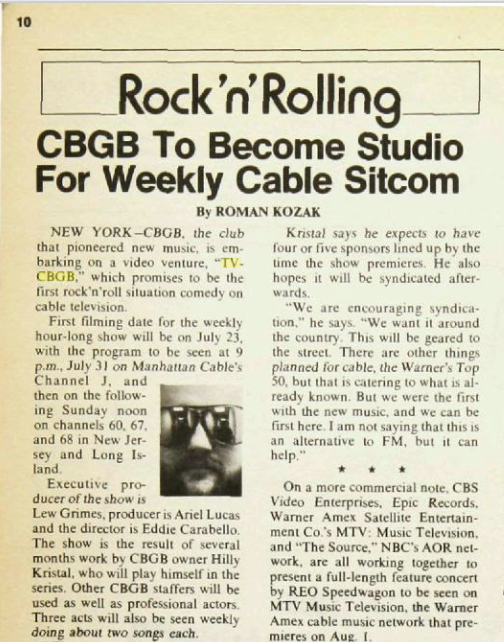
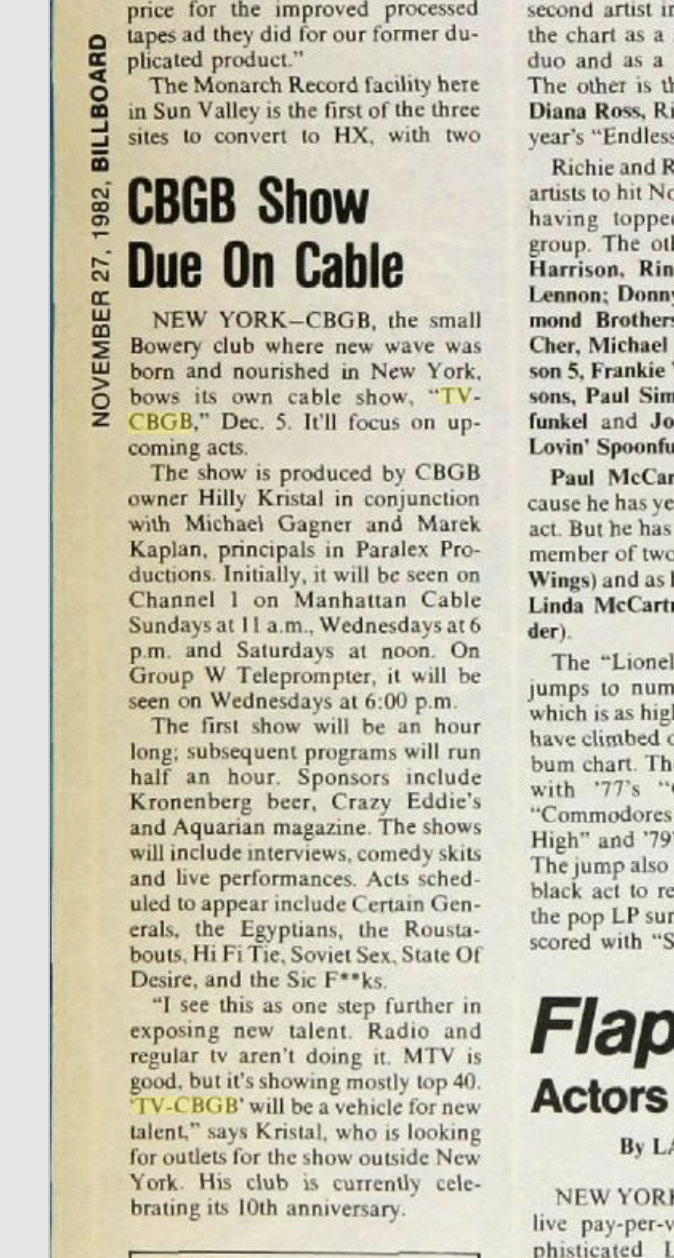
Quite a few people remember it well, and were thrilled when the video at the top emerged from obscurity: an episode of TV-CBGB shot in 1981, “an odd glimpse,” writes Martin Schneider at Dangerous Minds, “of a CBGB identity that never took shape, as a cable access mainstay.” It is unclear how many episodes of the show were shot, or aired, or still exist in some form, but what we do have above seems representative, according to two Billboard articles describing the show. The first, from July 11, 1981, called the project “the first rock’n’roll situation comedy on cable television.”
Created by CBGBs owner, Hilly Kristal, the show aimed to give viewers slices of life from the Bowery institution, which was already famous, according to Billboard, as “the club that pioneered new music.” Kristal told the trade magazine, “There will always be a plot, though a simple plot. It will be about what happens in the club, or what could happen.” He then goes on to describe a series of plot ideas which, thankfully, didn’t dominate the show—or at least what we see of it above. The episode is “90% performance,” though “not true concert footage,” Schneider writes.
After an odd opening intro, we’re thrown into a song from Idiot Savant. Other acts include The Roustabouts, The Hard, Jo Marshall, Shrapnel, and Sic Fucks. While not among the best or most well-known to play at the club, these bands put on some excellent performances. By November of the following year, it seems the first episode had still not yet aired. Billboard quotes Kristal as calling TV-CBGB “one step further in exposing new talent. Radio and regular tv aren’t doing it. MTV is good, but it’s showing mostly top 40.”
Had the show migrated to MTV, Schneider speculates, it might have become a “national TV icon,” fulfilling Kristal’s vision for a new means of bringing obscure downtown New York musicians to the world at large. It might have worked. Though the sketches are lackluster, notable as historical curiosities, the music is what makes it worthwhile, and there’s some really fun stuff here—vital and dramatic. While these bands may not have had the mass appeal of, say, Blondie or the Ramones, they were stalwarts of the early 80s CBGB scene.
The awkward, strangely earnest, and often downright goofy skits portraying the goings-on in the lives of club regulars and employees are both somehow touching and tedious, but with a little polish and better direction, the whole thing might have played like a punk rock version of Fame—which maybe no one needed. As it stands, given the enthusiasm of several YouTube commenters who claim to have watched it at the time or been in the club themselves, the episode constitutes a strange and rare document of what was, if not what could have been.
Whether your New Year’s resolution involves taking up painting, managing stress, cultivating a more positive outlook, or building a business empire, the late television artist Bob Ross can help you stick it out.
Like Fred Rogers’ Mr Rogers’ Neighborhood, Ross’ long-running PBS show, The Joy of Painting, did not disappear from view following its creator’s demise. For over twenty years, new fans have continued to seek out the half-hour long instructional videos, along with its mesmerizingly mellow, easily spoofed host.
It’s said that 90% of the regular viewers tuning in to watch Ross crank out his signature “wet-on-wet” landscapes never took up a brush, despite his belief that, with a bit of encouragement, anyone can paint.
Perhaps they preferred sad clowns or big-eyed children to scenic landscapes of the sort that would not have looked out of place in a 1970’s motel.… Or perhaps Ross, himself, was the big draw.
Like Mister Rogers, Ross spoke softly, using direct address to create an impression of intimacy between himself and the viewer. Twenty years in the military had soured him on barked-out, rigid instructions. Instead, Ross reassured less experienced painters that the 16th-century ”Alla Prima” technique he brought to the masses could never result in mistakes, only “happy accidents.” He was patient and kind and he didn’t take his own abilities too seriously, though he seemed like he would certainly have taken pleasure in yours.
His devotees may be content just seeing “happy little trees” and “pretty little mountains” bloom on canvas, but in an interview with NPR, Ross’ business partner, Annette Kowalski, suggests that he would not have been.
The gentle, forest-and-cloud-loving host was also an ambitious and highly focused businessman, who used TV as the medium for his success. Every folksy comment was rehearsed before filming and he stuck with the permed hairdo he loathed, rather than scrapping what had become a highly visual brand identifier.
Ayun Halliday is an author, illustrator, theater maker and Chief Primatologist of the East Village Inky zine. Her resolution is to spend less time online, but you can still follow her @AyunHalliday.
We're hoping to rely on loyal readers, rather than erratic ads. Please click the Donate button and support Open Culture. You can use Paypal, Venmo, Patreon, even Crypto! We thank you!
Open Culture scours the web for the best educational media. We find the free courses and audio books you need, the language lessons & educational videos you want, and plenty of enlightenment in between.