Some of us are using this period of self-isolation to make sourdough.
Others are learning to play an instrument or initiating a daily yoga practice.
For those considering taking up painting, David Dunlop’s Emmy-Award winning PBS series Landscapes Through Time offers an excellent alternative (or supplement) to the well-established joys of cult figure Bob Ross, the eternal king of television art instruction.
Like Ross, Dunlop has a mellow onscreen temperament that pairs beautifully with the enchanting setting of Claude Monet’s famous water garden, above.
(Those who’ve visited Monet’s house and garden at Giverny will envy him his tourist-free access to the site. Even those with no intention of picking up a brush should find it restorative to spend time gazing at the same lovely view that Dunlop, like Monet before him, looks at through a deliberately Impressionistic squint.)
He packs a lot of art appreciation into 14 easily digested minutes, touching on art history, brush technique, composition, use of light, and, in particular, color theory.
When the museums reopen, you may find this crash course has enhanced your enjoyment, especially as pertains to canvases by Monet and his fellow Impressionists.
For those pursuing the hands-on oil painting experience, Dunlop provides a supply list of colors, all readily available:
Cobalt Blue
Cadmium Yellow
Alizarin Crimson
Ultramarine
Brilliant Rose
Emerald Green
Hooker’s Green
Titanium White
His brushes and paper appear to be garden variety, and his approach, like Ross’, is fast and loose.
Those who favor a less brazen approach may feel more at home with his watercolor painting demonstration in Cezanne’s Mont Sainte-Victoire in Provence, France, below.
There are more excerpts and instruction on Dunlop’s YouTube channel. For those wishing to take it to the next level, Dunlop is teaching a series of interactive studio demonstration classes via Zoom. Register here.
The lack of human presence in majorly polluted cities these past couple months has had some people seeing utopias as the skies begin to clear. But empty cities seem a little more dystopian to me. Dystopias are “a kind of surrealism,” writes Kim Stanley Robinson. They unearth the dreamlike dread beneath the veneer of the normal. No matter when they’re set, dystopias don’t depict the future so much as “the feeling of the present… heightened by exaggeration to a kind of dream or nightmare.” The events in dystopian fiction approach the truth of someone’s situation somewhere in the world and make visible what has been hidden.
We know ghost cities exist as ancient disasters like Pompeii and Herculaneum and modern ones like Pripyat, Ukraine, outside Chernobyl. But there are more of them than many of us know. Gleaming cities like Ashgabat, Turkmenistan, which broke ground in 1991 and contains the largest number of marble buildings in the world.
The 4.5 million square meter metropolis has almost no inhabitants, an enormous government folly. Towns and cities around the world have been abandoned for for all sorts of reasons, and they continue to as sea levels rise. Which is what makes viewing live camera footage of some of the world’s most iconic streets—almost completely emptied by the pandemic at the height of tourist season—so… surreal.
It’s true that people haven’t fled these cities, but made cozy bunkers of their apartments. Yet seeing the vacant streets live on camera, in Venice, London, New York, and elsewhere in the world, I get the uncanny feeling of looking at proto-surrealist painter Giorgio de Chirico’s The Enigma of a Day, a depiction of a shadowy, uninhabited street through which we expect the Italian version of a tumbleweed to roll. Surveillance technology has inadvertently become a medium of modernist art.
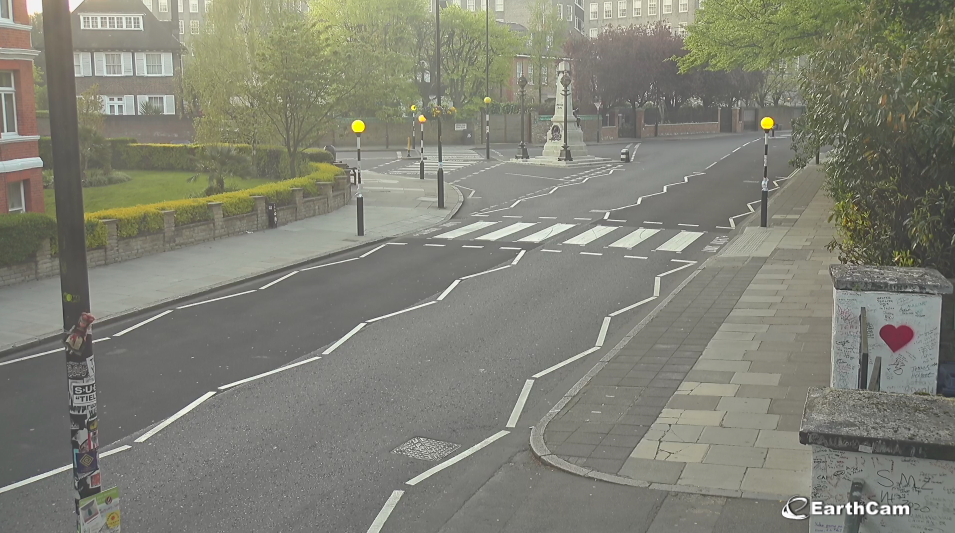
There is so much beauty in the live view at the top of the Ponte delle Guglie in Venice from the Hotel Filù Venezia, and there is also such lonely melancholy, depending on the time of day and where the shadows fall. See a live view of Times Square, above, and another Times Square view at EarthCam, where you can also catch a feed of a mostly empty Abbey Road (some times of day emptier than others, as in the early-morning screenshot below). Skyline Webcams hosts even more live camera views of Venice, including feeds from the Rialto Bridge and the Piazza San Marco, as well as live feeds from several sites in Padua and other places in Italy.
These real-time visions are transporting in their strangeness. Are we living in the present or the future? In a dystopian world, there isn’t any difference. All futures are foreclosed by catastrophe, “all distances in time and space are shrinking,” wrote Martin Heidegger, a thinker who understood disaster, and who fell in line behind it. In that same essay, “The Thing” (as translated by Albert Hofstader), the German philosopher made his famous comment, “the terrible has already happened.”
The terrible that has happened to us is not only a deadly pandemic. The virus is not likely to disappear on its own; who knows how long this will go on? But not far behind the current crisis are more climate events that threaten to empty streets. If we empty cities not only as indicative of temporarily social distancing, but as images of the possible near-future, maybe we’ll be far less inclined to come out of this surreal experience and get right back to business-as-usual.
The Paris Catacombs is “one of those places,” wrote photographer Félix Nadar, “that everyone wants to see and no one wants to see again.” If anyone would know, Nadar would. He spent three months in and out of the underground city of death, with its macabre piles of skulls and crossbones, taking photographs (see here) that would help turn it into an internationally famous tourist attraction. In these days of quarantine, no one can see it; the site is closed until further notice. But if you’re the type of person who enjoys touring necropolises, you can still get your fix with a virtual visit.
Why would anyone want to do this, especially during a global outbreak? The Catacombs have attracted seekers after morbid curiosities and spiritual and philosophical truths for over two hundred years, through revolutions, massacres, and plagues.
A stark, haunting reminder of what Nadar called “the egalitarian confusion of death,” they witness mutely, without euphemism, to the future we are all assured, no matter our rank or position. They began as a disordered pile of bones in the late 18th century, transferred from overcrowded cemeteries and became a place where “a Merovingian king remains in eternal silence next to those massacred in September ‘92” during the French Revolution.
Contemplations of death, especially in times of war, plague, famine, and other shocks and crises, have been an integral part of many cultural coping mechanisms, and often involve meditations on corpses and graveyards. The Catacombs are no different, a sprawling memento mori named after the Roman catacombs, “which had fascinated the public since their discovery,” as the official site notes. Expanded, renovated, and rebuilt during the time of Napoleon and later during the extensive renovations of Paris in the mid-19th century, the site was first “consecrated as the ‘Paris Municipal Ossuary’ on April 7, 1786” and opened to the public in 1809.
It is a place that reminds us how all conflicts end. To the “litany of royal and impoverished dead from French history,” writes Allison Meier at the Public Domain Review, Nadar added in his essay on the Catacombs “the names of revolutionary victims and perpetrators like Maximilien Robespierre and Jean-Paul Marat.” Ruminations on the universal nature of death may be an odd diversion for some, and for others an urgent reminder to find out what matters to them in life. Learn more about the fascinating history of the Paris Catacombs here and begin your virtual visithere.
It’s not like we’re maestros…it’s a moment of joy in this moment of anxiety. —Emma Santachiara, Rome
As reported by The New York Times, Ms. Sanachiara, age 73, has joined the vast choir of ordinary Italians taking to their balconies and windows to participate in socially distant neighborhood singalongs as coronavirus rages through their country.
The Internet has been exploding with messages of support and admiration for the quarantined citizens’ musical displays, which have a festive New Year’s Eve feel, especially when they accompany themselves on pot lids.
Three days ago, Rome’s first female mayor, Virginia Raggi, called upon residents to fling open their windows or appear on their balconies for nightly 6pm community sings.
A woman in Turin reported that the pop up musicales have forged friendly bonds between neighbors who in pre-quarantine days, never acknowledged each other’s existence.
Naturally, there are some soloists.
Tenor Maurizio Marchini serenaded Florentines to “Nessun Dorma,” the famous aria from Puccini’s opera Turandot, repeating the high B along with a final Vincerò!, which earns him a clap from his young son.
In Rome, Giuliano Sangiorgi, frontman for Negramaro, hit his balcony, guitar in hand, to entertain neighbors with Pino Daniele’s 1980 hit “Quanno Chiove” and his own band’s “Meraviglioso.”
Earlier in the year, the 11 million residents of Wuhan, China, the deadly epicenter of the coronavirus outbreak, also used music to boost morale, singing the national anthem and other patriotic songs from their individual residences. Jiāyóu, or “add oil,” was a frequent exhortation, reminding those in isolation to stay strong and keep going.
Readers, are you singing with your neighbors from a safe distance? Are they serenading you? Let us know in the comments.
Ayun Halliday is an author, illustrator, theater maker and Chief Primatologist of the East Village Inky zine. Like most of us in this crazy, historic period, all of her events have been cancelled. Follow her @AyunHalliday.
Many claim Los Angeles was “built for the car,” a half-truth at best. When the city — or rather, the city and the vast region of southern California surrounding it — first boomed in the late 19th and early 20th century, it grew according to the spread of its electric railway networks. But for early adopters of the automobile (as well as the many aspirants close behind), its sheer size, easily navigable terrain, and still-low population density made greater Los Angeles an ideal place to drive.
After the Second World War, the days of the Pacific Electric and Los Angeles Railroad, once among the finest urban rail systems in the world, were clearly numbered. Both went out of service by the early 1960s, and for the next few decades the car was indeed king. One theory holds, though with imperfect evidence, that Los Angeles lost its trains because of an automakers’ conspiracy.
Whatever the cause, the long heyday of the automobile and its attendant “car culture” changed mid-20th-century Los Angeles. It left its boldest mark in the city’s architecture, a category that must surely include the swooping concrete of the freeways, but more obviously includes the buildings designed to catch the eye of a human being behind the wheel cruising at speed. We notice at a different scale in a car than we do on foot, and so the structures along Los Angeles’ main roads — especially boulevards like Wilshire, Hollywood, and Sunset — grew more legible to the motorist in the second half of the twentieth century.
That means Los Angeles’ architecture grew ever bigger, bolder, more eye-catching — or, depending on your perspective, ever more garish, ungainly, and impersonal. You can see this transformation captured in action from the car window in the three videos featured here. At the top of the post is a six-minute drive through the downtown Los Angeles of the 1940s, which begins on Bunker Hill, an area originally built up with stately Victorian houses in the late 19th century.
By the time of this film those houses had been subdivided into cheap apartments, and films noirs (such as Robert Aldrich’s Kiss Me Deadly) were using it as a typical “bad neighborhood.” That atmosphere also made it a target for a 50-year “urban renewal” project that, starting in the late 50s onward, scraped the houses off Bunker Hill and rebuilt it with corporate towers and prestige cultural venues.
A through-the-windshield view of Los Angeles in the 50s appears in the video second from the top, a 1957 drive down Hollywood Boulevard. That street and that year stand at the intersection of pre-war and post-war Los Angeles, and the built environment reflects as much the sensibility of the turn of the 20th century as it does what we know think of as “mid-century modern.”
Below that we have a drive through the city so many think of when they think of Los Angeles: the Los Angeles of the 1960s, a seemingly limitless realm of palm trees, brightly colored billboards, and Space Age-influenced towers that pop out even more from their low-slung surroundings when seen from the freeway — in other words, the Los Angeles Quentin Tarantino recreates in Once Upon a Time… in Hollywood.
To get a sense of the greater sweep of change in Los Angeles, have a look at the New Yorker video above (previously featured here on Open Culture) that puts the downtown drive from the 1940s alongside the same drive replicated in the 2010s. Popular culture may associate Los Angeles with the willful erasure of history as much as it associates Los Angeles with the automobile, but traces are there for those — in a car, on foot, on a bike, or going by any form of transportation besides — who know how to see them.
Based in Seoul, Colin Marshall writes and broadcasts on cities, language, and culture. His projects include the book The Stateless City: a Walk through 21st-Century Los Angeles and the video series The City in Cinema. Follow him on Twitter at @colinmarshall or on Facebook.
Sometimes the miraculous time-saving conveniences we’ve come to depend on can have the opposite effect, as artist Simon Wickert recently demonstrated, ambling about the streets of Berlin at a Huck Finn-ish pace, towing a squeaky-wheeled red wagon loaded with 99 secondhand smartphones.
Each phone had a SIM card, and all were running the Google Maps app.
The result?
A near-instantaneous “virtual traffic jam” on Google Maps, even though bicyclists seem to vastly outnumber motorists along Wickert’s route.
As a Google spokesperson told 9to5 Google’s Ben Schoon shortly after news of Wickert’s stunt began to spread:
Traffic data in Google Maps is refreshed continuously thanks to information from a variety of sources, including aggregated anonymized data from people who have location services turned on and contributions from the Google Maps community.
In other words, had you checked your phone before heading out to the Baumhaus an der Mauer(Treehouse on the Wall), the Urban Art Clash Gallery, OMA’s Café, or some other spot close to Wickert’s little red wagon’s trail of terror—like Google’s Berlin office—you might have thought twice about your intended path, or even going at all, seeing bridges and streets change from a free and easy green to an ostensibly gridlocked red.
As long as Wickert kept moving, he was able to continue fooling the algorithm into thinking 99 humans were all using their phone’s Maps app for navigational purposes in a small, congested area.
Obviously, a couple of buses could easily be responsible for carrying 99 smartphones in active use, but it’s unlikely those phones owners would be consulting the map app in the passenger seats, when they could be scrolling through Instagram or playing Candy Crush.
Wickert also discovered that his virtual traffic jam disappeared whenever a car passed his wagonload.
The spokesperson who engaged with Schoon put a good-natured face on Google’s response to Wickert’s hack, saying, “We’ve launched the ability to distinguish between cars and motorcycles in several countries including India, Indonesia and Egypt, though we haven’t quite cracked traveling by wagon. We appreciate seeing creative uses of Google Maps like this as it helps us make maps work better over time.”
Meanwhile, the artist’s puckish stunt, which he describes as a “performance and installation,” seems anchored by sincere philosophical questions, as evidenced by the inclusion on his website of the below excerpt from “The Power of Virtual Maps,” urban researcher Moritz Ahlert’s recent essay in theHamburger Journal für Kulturanthropologie, :
The advent of Google’s Geo Tools began in 2005 with Maps and Earth, followed by Street View in 2007. They have since become enormously more technologically advanced. Google’s virtual maps have little in common with classical analog maps. The most significant difference is that Google’s maps are interactive – scrollable, searchable and zoomable. Google’s map service has fundamentally changed our understanding of what a map is, how we interact with maps, their technological limitations, and how they look aesthetically.
In this fashion, Google Maps makes virtual changes to the real city. Applications such as Airbnb and Carsharing have an immense impact on cities: on their housing market and mobility culture, for instance. There is also a major impact on how we find a romantic partner, thanks to dating platforms such as Tinder, and on our self-quantifying behavior, thanks to the nike jogging app. Or map-based food delivery apps like deliveroo or foodora. All of these apps function via interfaces with Google Maps and create new forms of digital capitalism and commodification. Without these maps, car sharing systems, new taxi apps, bike rental systems and online transport agency services such as Uber would be unthinkable. An additional mapping market is provided by self-driving cars; again, Google has already established a position for itself.
With its Geo Tools, Google has created a platform that allows users and businesses to interact with maps in a novel way. This means that questions relating to power in the discourse of cartography have to be reformulated. But what is the relationship between the art of enabling and techniques of supervision, control and regulation in Google’s maps? Do these maps function as dispositive nets that determine the behavior, opinions and images of living beings, exercising power and controlling knowledge? Maps, which themselves are the product of a combination of states of knowledge and states of power, have an inscribed power dispositive. Google’s simulation-based map and world models determine the actuality and perception of physical spaces and the development of action models.
Depending on how you feel about cats, the feline situation on the island of Cyprus is either the stuff of a delightful children’s story or a horror film to be avoided at all cost.
Despite being surrounded on all sides by water, the cat population—an estimated 1.5 million—currently outnumbers human residents. The overwhelming majority are feral, though as we learn in the above episode of PBS’ EONS, they, too, can be considered domesticated. Like the other 600,000,000-some living members of Felis Catus on planet Earth—which is to say the type of beast we associate with litterboxes, laser pointers, and Tender Vittles—they are descended from a single subspecies of African wildcat, Felis Silvestris Lybica.
While there’s no single narrative explaining how cats came to dominate Cyprus, the story of their global domestication is not an uncommon one:
An ancient efficiency expert realized that herding cats was a much better use of time than hunting them, and the idea quickly spread to neighboring communities.
Kidding. There’s no such thing as herding cats (though there is a Chicago-based cat circus, whose founder motivates her skateboard-riding, barrel-rolling, high-wire-walking stars with positive reinforcement…)
Instead, cats took a commensal path to domestication, lured by their bellies and celebrated curiosity.
Ol’ Felis (Felix!) Silvestris (Sufferin’ Succotash!) Lybica couldn’t help noticing how human settlements boasted generous supplies of food, including large numbers of tasty mice and other rodents attracted by the grain stores.
Her inadvertent human hosts grew to value her pest control capabilities, and cultivated the relationship… or at the very least, refrained from devouring every cat that wandered into camp.
Eventually, things got to the point where one 5600-year-old specimen from northwestern China was revealed to have died with more millet than mouse meat in its system—a pet in both name and popular sentiment.
Chow chow chow.
Interestingly, while today’s house cats’ gene pool leads back to that one sub-species of wild mackerel-tabby, it’s impossible to isolate domestication to a single time and place.
Both archeological evidence and genome analysis support the idea that cats were domesticated both 10,000 years ago in Southwest Asia… and then again in Egypt 6500 years later.
At some point, a human and cat traveled together to Cyprus and the rest is history, an Internet sensation and an if you can’t beat em, join em tourist attraction.
Such high end island hotels as Pissouri’s Columbia Beach Resort and TUI Sensatori Resort Atlantica Aphrodite Hills in Paphos have started catering to the ever-swelling numbers of uninvited, four-legged locals with a robust regimen of healthcare, shelter, and food, served in feline-specific tavernas.
An island charity known as Cat P.A.W.S. (Protecting Animals Without Shelter) appeals to visitors for donations to defray the cost of neutering the massive feral population.
For every Nets fan cheering their team on in Brooklyn’s Barclays Center and every tourist gamboling about the post-punk, upscale East Village, there are dozens of local residents who remember what—and who—was displaced to pave the way for this progress.
It’s no great leap to assume that something had to be plowed under to make way for the city’s myriad gleaming skyscrapers, but harder to conceive of Central Park, the 840-acre oasis in the middle of Manhattan, as a symbol of ruthless gentrification.
Plans for a peaceful green expanse to rival the great parks of Great Britain and Europe began taking shape in the 1850s, driven by well-to-do white merchants, bankers, and landowners looking for temporary escape from the urban pressures of densely populated Lower Manhattan.
It took 20,000 workers—none black, none female—over three years to realize architects Frederick Law Olmsted and Calvert Vaux’s sweeping pastoral design.
A hundred and fifty years later, Central Park is still a vital part of daily life for visitors and residents alike.
But what of the vibrant neighborhood that was doomed by the park’s construction?
The best established of these was Seneca Village, which ran from approximately 82nd to 89th Street, along what is known today as Central Park West. 260-some residents were evicted under eminent domain and their homes, churches, and school were razed.
This physical erasure quickly translated to mass public amnesia, abetted, no doubt, by the way Seneca Village was framed in the press, not as a community of predominantly African-American middle class and working class homeowners, but rather a squalid shantytown inhabited by squatters.
As Brent Staples recalls in a New York Times op-ed, in the summer of 1871, when park workers dislodged two coffins in the vicinity of the West 85th Street entrance, The New York Herald treated the discovery as a baffling mystery, despite the presence of an engraved plate on one of the coffins identifying its occupant, an Irish teenager, who’d been a parishioner of Seneca Village’s All Angels Episcopal Church.
Copeland and her colleagues kept Alexander’s work in mind when they began excavating Seneca Village in 2011, focusing on the households of two African-American residents, Nancy Moore and William G. Wilson, a father of eight who served as sexton at All Angels and lived in a three-story wood-frame house. The dig yielded 250 bags of material, including a piece of a bone-handled toothbrush, an iron tea kettle, and fragments of clay pipes and blue-and-white Chinese porcelain:
Archaeologists have begun to consider the lives of middle class African Americans, focusing on the ways their consumption of material culture expressed class and racial identities. Historian Leslie Alexander believes that Seneca Village not only provided a respite from discrimination in the city, but also embodied ideas about African pride and racial consciousness.
Owning a home in Seneca Village also bestowed voting rights on African American male heads of household.
Two years before it was torn down, the community was home to 20 percent of the city’s African American property owners and 15 percent of its African American voters.
Thanks to the efforts of historians like Copeland and Alexander, Seneca Village is once again on the public’s radar, though unlike Pigtown, a smaller, predominantly agricultural community toward the southern end of the park, the origins of its name remain mysterious.
Was the village named in tribute to the Seneca people of Western New York or might it, as Alexander suggests, have been a nod to the Roman philosopher, whose thoughts on individual liberty would have been taught as part of Seneca Village’s African Free Schools’ curriculum?
We're hoping to rely on loyal readers, rather than erratic ads. Please click the Donate button and support Open Culture. You can use Paypal, Venmo, Patreon, even Crypto! We thank you!
Open Culture scours the web for the best educational media. We find the free courses and audio books you need, the language lessons & educational videos you want, and plenty of enlightenment in between.