It looks like America will get to see The Interview on Christmas Day after all — heck, even before. After Sony announced yesterday that the Seth Rogen-James Franco film will be shown in select US cinemas on Christmas, the announcement came this morning that Americans can exercise their freedom and watch the film online too — right now.
Every student of history surely feels impressed by one achievement or another of the ancient Greeks, whether in the field of engineering, art, or the convergence of the two. Even a bored college undergrad in a thousand-seat lecture hall has to admire ancient Greek vases when they pop up in the lecturer’s Powerpoint slides. That much-studied culture’s penchant for stylizing images of their society on their pottery has allowed us to see their world as, in some sense, a living, breathing one — or to see it through the eyes of the artisans who lived to see it themselves. But for all their mastery of the art of the vase, they never actually got their images to live nor breathe. For that, we must turn to 21st-century technology, specifically as applied by Panoply, a project animator of Steve K. Simons and ancient Greece scholar Sonya Nevin, which was designed to bring these vases to life.
“Panoply covers a lot of aspects of culture as method tying the artifacts to information about Greek life,” writes io9’s Katharine Trendacosta. “There are ones on myths, sport, and warfare,” the last of which, “Hoplites!,” you can watch at the top of the post. Simons and Nevin made this seven-minute battle scene out of the foot soldiers actually depicted on a vase dating to about 550 BCE currently held by the Ure Museum of Greek Archaeology at the University of Reading.
Just above, we have “The Cheat,” a short and humorous scene from the ancient Olympics that plays out on the surface of a shard. The animation below features a figure of Greek myth that even the most inattentive student will know: a certain Pandora, and far be it from her to resist the temptation to open a certain box. (Actually it was a vase/pithos.) You can watch more on Panoply’s Youtube channel. As unconventional means of visualizing ancient Greece go, it’s got to beat 300 for accuracy.
We like to bring this chestnut back from time to time. Watch it, and you’ll know why.
In 1977, just a short month before Bing Crosby died of a heart attack, the 40s crooner hosted David Bowie, the glam rocker, on his Christmas show. The awkwardness of the meeting is palpable. An older, crusty Crosby had no real familiarity with the younger, androgynous Bowie, and Bowie wasn’t crazy about singing The Little Drummer Boy.
So, shortly before the show’s taping, a team of writers had to frantically retool the song, blending the traditional Christmas song with a newly-written tune called Peace on Earth. (You can watch the writers tell the story, years later, below.) After one hour of rehearsal, the two singers recorded The Little Drummer Boy/Peace on Earth and made a little classic. The Washington Post has the backstory on the strange Bing-Bowie meeting. Also find a Will Ferrell parody of the meeting here. We hope you enjoy revisiting this clip with us. Happy holidays to you all.
If you would like to support the mission of Open Culture, consider making a donation to our site. It’s hard to rely 100% on ads, and your contributions will help us continue providing the best free cultural and educational materials to learners everywhere. You can contribute through PayPal, Patreon, and Venmo (@openculture). Thanks!
Season 5 of Downton Abbey will begin (in the US) on January 4th. But before the main course, we get a little appetizer, which comes in the form of a nine-minute parody starring George Clooney, Jeremy Piven and the cast of Downton Abbey. Borrowing from It’s a Wonderful Life, the fun film asks us to imagine daily life at the Abbey without Lord Grantham in the picture. That’s when we get to see Lady Grantham cavorting with George Clooney, the Marquis of Hollywood (who kind of resembles Gomez from the Addams Family). And then the rest of the family and staff letting their hair loose.
The parody was made for Text Santa, an initiative that supports UK charities during the Christmas period. You can learn how to donate here.
Thanks Kim L. for the tip!
If you would like to support the mission of Open Culture, consider making a donation to our site. It’s hard to rely 100% on ads, and your contributions will help us continue providing the best free cultural and educational materials to learners everywhere. You can contribute through PayPal, Patreon, and Venmo (@openculture). Thanks!
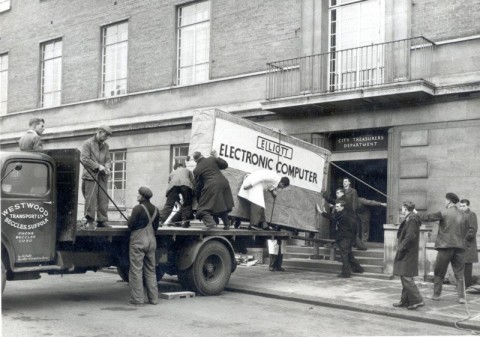
Norwich City Council’s first computer, being delivered to the City Treasurer’s Department in Bethel Street, Norwich in 1957. The City of Norwich, and its forward-thinking Treasurer, Mr A.J. Barnard, were pioneers in the application of computer technology to the work of UK local authorities and businesses. In 1953–4, Mr Barnard and his team began looking for an electronic system to handle its rates and payroll. They began discussions with Elliott Brothers of London in 1955, and the City Council ordered the first Elliott 405 computer from them in January 1956. It was delivered to City Hall in February 1957 and became operational in April 1957. The event was celebrated by a demonstration of the machine in front of the Lord Mayor of Norwich and the press on 3 April 1957.
For more vintage moments in computing, please enjoy some of the “relateds” below.
How does Martin Scorsese deliver dramatic moments with such impact? Why do Jackie Chan’s kicks and punches, even those performed in service of jokes, land with such impact? And why do Michael Bay movies, despite their near-fetishistic inclusion of things crashing into other things, seem to lack any kind of impact at all (apart from that on audience adrenaline and box office numbers)? Questions like these keep cinephiles, filmmakers, and cinephilic filmmakers up at night, and they also apparently drive editor and video essayist Tony Zhou to make his series Every Frame a Painting. At the top of the post, you can watch his analysis of Scorsese’s use of silence; below, of how Jackie Chan does action comedy; and at the bottom, how Michael Bay crafts his unique brand of cinematic “Bayhem.”
Michael Bay, you might incredulously ask — the guy who directed the Transformers movies? Indeed. But as Zhou puts it, “Even if you dislike him (as I do), Bay has something valuable to teach us about visual perception.” His video essays aim to learn from all films, drawing lessons from those that succeed at every level (as some say several of Scorsese’s do) to those that exemplify a kind of highly specialized mastery (as Jackie Chan’s best surely do), to those that fail at even their own aims (as Jackie Chan’s American productions tend to do), to those that aggressively and successfully pursue questionable aesthetic ends (as, well… perhaps you can guess).
Having watched these threevideos and thus come to understand what situations bring on a Scorsesean silence, why Hong Kong money allows Jackie Chan to perfectly kick a bad guy down a staircase, and which traditions Michael Bay exaggerates to achieve his brand of visual maximalism, you’ll want to move on to Zhou’s other analyses, which break down the techniques of directors like Edgar Wright, David Fincher, and Steven Spielberg. Evidently a fan of both East Asian cinema and animation, he also looks hard at what working outside live reality allows Japanese director Satoshi Kon to do, and what superstar Korean filmmaker Bong Joon-ho gets out of telephoto profile shots in Mother. “There’s actually a lot of great videos on the internet analyzing movie content or themes,” he says in the latter essay, “but I think we’re missing stuff about the actual form — you know, the pictures and the sound.” Every Frame a Painting shows us exactly what we’re missing.
The towering giants of 80s comedy—Harold Ramis, Catherine O’Hara, Martin Short, John Candy, Rick Moranis, Gilda Radner, Dan Aykroyd, Bill Murray—seem to have emerged as fully-formed geniuses on the soundstages of Saturday Night Live and in major comedy films and TV shows. Likewise more recent names like Bob Odenkirk, Tina Fey, Steve Carrell, Amy Sedaris, and Stephen Colbert. But the fact is, like most artists, these stars got their start on humbler stages—those of the Second City improv theater, the longest running troupe of its kind in the U.S. and Canada. Operating in Chicago, L.A., and Toronto, Second City began with a small group of University of Chicago actors, including the late Mike Nichols and his comedy partner Elaine May. The first theater opened in 1959, and during the sixties Second City nurtured actors and comics like Alan Arkin, Del Close, Joan Rivers, and Peter Boyle.
Among the mind-boggling wealth of talent Second City produced, one comedian stands out both because of his legendary physical comedy and his untimely and tragic death. And though these descriptions apply equally to Second City alum Chris Farley, today we’re focusing in on John Belushi, who joined Second City in 1971, four years before the debut of Saturday Night Live and his subsequent turns in The Blues Brothers and Animal House. In the clip at the top, see Belushi play “the humiliated son of a father who died a less-than-respectable death.” Joining him onstage are Joe Flaherty—best known for his work on Second City’s SCTV—and Harold Ramis, Jim Fisher, Judy Morgan, and Eugenie Ross-Leming. Just above, the same cast surrounds Belushi as he does his Truman Capote impression.
Both performances date from 1972, and though the video and audio quality leave much to be desired, they’re well worth watching, especially Belushi’s Capote. Remembered more perhaps for his bizarre comedic violence, it’s easy to forget the over two-dozen characters Belushi impersonated while on SNL, including Henry Kissinger, Tip O’Neil, Elizabeth Taylor, John Lennon, and William Shatner. Particularly poignant now, as we look back on the career of Joe Cocker, who died yesterday, is Belushi’s famous impression of the spirited British singer, above. When Cocker saw it, he “became hysterical,” saying, “You can’t not laugh at this.” It’s a fitting tribute to Belushi, a true fan of Cocker’s art, and to Cocker, who had the humility and good humor to appreciate a good joke at his expense.
You can watch a longer video of old Second City performances on this page. It runs about 40 minutes.
One’s never too old to be read a story. There’s no shame in stealing a couple of minutes from your busy, stress-filled day to let actress Susan Sarandon read you one, above.
Goodnight Moonwas never a part of my childhood, but it came into heavy rotation when my own kids were little. It wasn’t a title they clamored for—in my experience, the intended demographic favors the junky and cringe-inducing over classics of children’s literature, but no matter.
All day, I indulged their hankering for tales of preschool-aged dinosaurs who had to be taught how to share, giant silly cookies, and a certain television character who reacted poorly to being passed over as flower girl. In return, I ruled the night.
I treasured Goodnight Moon not so much because it made them fall asleep—there are shelves upon shelves of dependable choices in that department—but rather for its simplicity. There were no moral lessons. Nothing sparkly or magic or forced. Nothing that catered to their supposed whims. Author Margaret Wise Brown’s stated aim with regard to the child reader was “to jog him with the unexpected and comfort him with the familiar.”
I approve. But there’s not a lot of jogging in Goodnight Moon. Just that comb and that brush and that bowlful of mush. What a blessed relief.
As one approaches the end, Goodnight Moon begins to rival Charlotte’s Web as children’s literature’s great meditation on death. The catalogue of all those things we’re saying goodnight to harkens to the final scene in Our Town, when the newly dead Emily, revisiting her childhood home, cries, “All that was going on in life and we never noticed.”
Every time my small crew made it to “goodnight stars, goodnight air, goodnight noises everywhere,” I was croaking. (Not figuratively, though a little research reveals I am not the only one to think this lovely phrase would make a great epitaph.)
This emotional collapse was equal parts cathartic and embarrassing. What can I say? My cup ranneth over. I was glad to learn that E. B. White’s voice betrayed him, too, recording Charlotte’s Web’s most poignant scene.
Narrating the lightly animated story for 1999’sGoodnight Moon & Other Sleepytime Tales, Sarandon exhibits astonishing self control. It’s probably a good thing for children everywhere to see that there’s at least one adult out there with the steel to soldier through. Her youngest child was still little when she went into the recording booth. If she’d wanted, she could’ve milked it for every last drop of pathos, but I’m glad she played it straight, because most of us can’t.
(And few of us can write a book so elegant on a topic so profound. Sarandon’s would-be publishers rejected her children’s book about a “very funny raccoon” who dies.”)
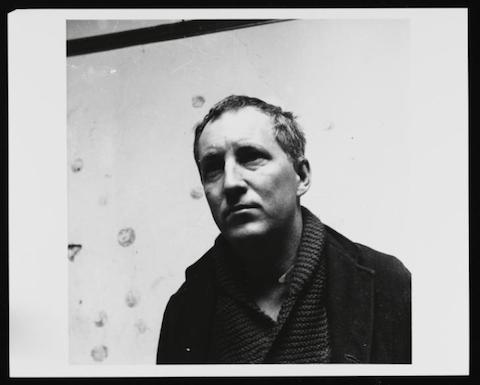
Photograph of Nigel Henderson via Nigel Henderson Estate
If you’re like me, one of the first items on your itinerary when you hit a new city is the art museums. Of course one, two, even three or four visits to the world’s major collections can’t begin to exhaust the wealth of painting, sculpture, photography, and more contained within. Rotating and special exhibits make taking it all in even less feasible. That’s why we’re so grateful for the digital archives that institutions like the Getty, LA County Museum of Art, the Metropolitan Museum of Art, the National Gallery, and the British Library make available free online. Now another museum, Britain’s Tate Modern, gets into the digital archive arena with around 70,000 digitized works of art in their online gallery.
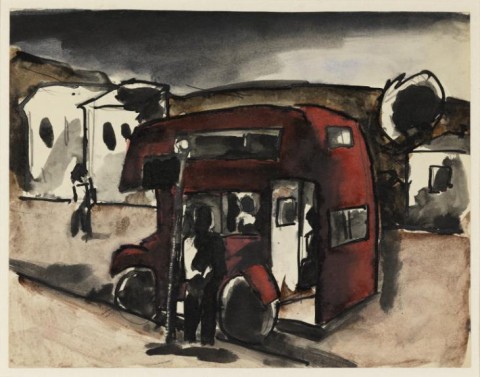
“Sketch of the bus stop” from the estate of Josef Herman
But wait, there’s more. Much more. A separate digital archive—the Tate’s Archives & Access project—offers up a trove of materials you’re unlikely to encounter much, if at all, in their physical spaces. That’s because this collection digitizes little-seen “artists’ materials, including photographs, sketchbooks, diaries, letters and objects, documenting the lives and working processes of British born and émigré artists, from 1900 to the present.” These include, writes The Guardian, “the love letters of painter Paul Nash, the detailed sculpture records of Barbra Hepworth, and 3,000 photographs by Nigel Henderson, providing a behind-the-scenes backstage look at London’s 1950s jazz scene.” Thus far, the Tate has uploaded about 6,000 items, “including 52 collections relating to 79 artists.” At the Tate archive, you’ll find photographs like that of painter and photographer Nigel Henderson (see top of the post) and also paintings by the highly regarded Polish-British realist, Josef Herman (right above).
“Squared-up drawings of soldiers” via The estate of David Jones
You’ll find preliminary sketches like the 1920–21 Squared-up drawings of soldiers by painter and poet David Jones, above, one of 109 sketches and two sketchbooks available by the same artist. You’ll find letters like that below, written by sculptor Kenneth Armitage to his wife Joan Moore in 1951—one of hundreds. These are but the tiniest sampling of what is now “but a drop in the ocean,” The Guardian writes, “given the more than 1 million items in the [physical] archive.” Archive head Adrian Glew calls the collection “a national archival treasure” that is also “for the enrichment of the whole world.”
Letter from Kenneth Armitage to Joan Moore via the The Kenneth Armitage Foundation
The remainder of the digitized Archives & Access collection—52, 000 items in total—should be available by the summer of 2015. While viewing art and artifacts online is certainly no substitute for seeing them in person, it’s better than never seeing them at all. In any case, millions of pieces are only viewable by curators and specialists and never make their way to gallery floors. But with the appearance and expansion of free online archives like the Tate’s, that situation will shift dramatically, opening up national treasures to independent scholars and ordinary art lovers the world over.
How does a movie become a “classic”? Explanations, never less than utterly subjective, will vary from cinephile to cinephile, but I would submit that classic-film status, as traditionally understood, requires that all elements of the production work in at least near-perfect harmony: the cinematography, the casting, the editing, the design, the setting, the score. Outside first-year film studies seminars and deliberately contrarian culture columns, the label of classic, once attained, goes practically undisputed. Even those who actively dislike Stanley Kubrick’s 2001: A Space Odyssey, for instance, would surely agree that its every last audiovisual nuance serves its distinctive, bold vision — especially that opening use of “Thus Spake Zarathustra.”
But Kubrick didn’t always intend to use that piece, nor the other orchestral works we’ve come to closely associate with mankind’s ventures into realms beyond Earth and struggles with intelligence of its own invention. According to Jason Kottke, Kubrick had commissioned an original score from A Streetcar Named Desire, Spartacus, Cleopatra, and Who’s Afraid of Virginia Woolf composer Alex North.
At the top of the post, you can see 2001’s opening with North’s music, and below you can hear 38 minutes of his score on Spotify. As to the question of why Kubrick stuck instead with the temporary score of Strauss, Ligeti, and Khatchaturian he’d used in editing, Kottke quotes from Michel Ciment’s interview with the filmmaker:
However good our best film composers may be, they are not a Beethoven, a Mozart or a Brahms. Why use music which is less good when there is such a multitude of great orchestral music available from the past and from our own time? [ … ] Although [North] and I went over the picture very carefully, and he listened to these temporary tracks and agreed that they worked fine and would serve as a guide to the musical objectives of each sequence he, nevertheless, wrote and recorded a score which could not have been more alien to the music we had listened to, and much more serious than that, a score which, in my opinion, was completely inadequate for the film.
North didn’t find out about Kubrick’s choice until 2001’s New York City premiere. Not an enviable situation, certainly, but not the worst thing that ever happened to a collaborator who failed to rise to the director’s expectations.
If you would like to support the mission of Open Culture, consider making a donation to our site. It’s hard to rely 100% on ads, and your contributions will help us continue providing the best free cultural and educational materials to learners everywhere. You can contribute through PayPal, Patreon, and Venmo (@openculture). Thanks!
Today as we say goodbye to British singer Joe Cocker, who died at 70 after a struggle with lung cancer, we’ll remember him most for that 1969 Woodstock performance of The Beatles’ “With a Little Help From My Friends.” It was without a doubt a career-defining moment. He never stopped performing the song in his inimitably gruff style, his raspy voice partly a product of too many cigarettes and some pretty hard living over the decades. Known also for his air guitar proficiency, Cocker successfully covered other famous bands like Traffic and The Box Tops, and made many songs—like Billy Preston’s “You Are So Beautiful to Me”—uniquely his.
But yes, it’s that 1969 debut album, also titled With a Little Help from My Friends, with its mix of originals and big-name covers from The Beatles and Bob Dylan, that first brought us the Joe Cocker we fondly pay tribute to this holiday week. I overheard someone describe Cocker as the only person who could do The Beatles better than they could, which is going a bit too far. But he may be the only artist whose covers of the band are as well-known and well-loved as their originals. Paul McCartney, who will lead memorials this week with Ringo Starr, said of Cocker’s “A Little Help,” “it was just mind-blowing, [he] totally turned the song into a soul anthem and I was forever grateful to him for doing that.” Indeed. At the top of the post, see Cocker and band above play “With a Little Help” in Cologne, Germany in 2013, and just above, watch again that gripping Woodstock performance.
We're hoping to rely on loyal readers, rather than erratic ads. Please click the Donate button and support Open Culture. You can use Paypal, Venmo, Patreon, even Crypto! We thank you!
Open Culture scours the web for the best educational media. We find the free courses and audio books you need, the language lessons & educational videos you want, and plenty of enlightenment in between.

![Letter from Kenneth Armitage to Joan Moore [1951] by Kenneth Armitage 1916-2002](https://cdn8.openculture.com/wp-content/uploads/2014/12/Kenneth-Armitage-Letter.jpg)



