Ah, the ancient art of rhetoric. There’s no escaping it. Variously defined as “the art of argumentation and discourse” or, by Aristotle in his fragmented treatise, as “the means of persuasion [that] could be found in the matter itself; and then stylistic arrangement,” rhetoric is complicated. Aristotle’s definition further breaks down into three distinct types, and he illustrates each with literary examples. And if you’ve ever picked up a rhetorical guide—ancient, medieval, or modern—you’ll be familiar with the lists of hundreds of unpronounceable Greek or Latin terms, each one corresponding to some quirky figure of speech.
Well, as usual, the internet provides us with an easier way in the form of the video above of 10 figures of speech “as illustrated by Monty Python’s Flying Circus,” one of the most literate of popular artifacts to ever appear on television. There’s “paradiastole,” the fancy term for euphemism, demonstrated by John Cleese’s overly decorous newscaster. There’s “epanorthosis,” or “immediate and emphatic self-correction, often following a slip of the tongue,” which Eric Idle overdoes in splendid fashion. Every possible poetic figure or grammatical tic seems to have been named and catalogued by those philosophically resourceful Greeks and Romans. And it’s likely that the Pythons have utilized them all. I await a follow-up video in lieu of reading any more rhetorical textbooks.
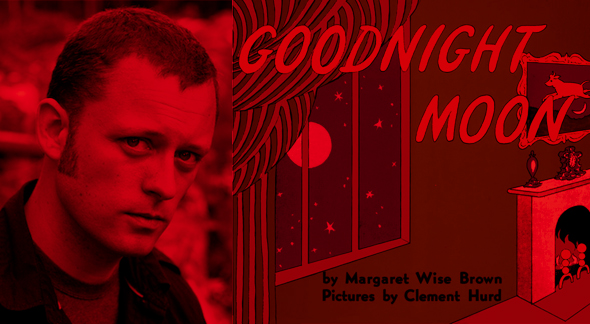
Is this wrong? Benjamin Percy (author of the werewolf thriller Red Moon) takes the sweet children’s bedtime story, Goodnight Moonby Margaret Wise Brown, and turns it into a story that will keep kids (and maybe adults) awake for days on end — perhaps leaving parents no choice but to have the real Werner Herzog read Go the F**k to Sleep. This recording comes courtesy ofGraywolf Press, and don’t forget to look under your bed.
American movie stars have long found work across the pacific in Japanese television commercials: Nicolas Cage, Paul Newman, Dennis Hopper, Harrison Ford, Jodie Foster — the list goes on. If their spots aired stateside, we’d probably buy what they sell too, but celebrities in their image-protective league have thus far shown a reluctance to endorse products in their own country. Japan’s ad industry hasn’t only sought the participation of America’s big-name actors, though; it’s also gone after the directors. At the top, you’ll see one featuring a filmmaker never afraid of exposure: Pulp Fiction auteur Quentin Tarantino taking a turn in local costume (and alongside a talking dog) in a commercial for Japanese cell phone service provider Softbank. Just below, we have Orson Welles, he of Citizen Kane and British frozen-peas narration alike, in a spot for G&G Whisky.
“I direct films and act in them,” Welles says by way of introduction. “What we’re always trying for is perfection, but of course, that’s only a hope. But with G&G, you can rely on it.” It may put you in the mind of Sofia Coppola’s Lost in Translation, wherein Bill Murray’s character famously turns up in Japan to shoot a whisky commercial of his own. Makers of that beverage have shown quite an interest in the imprimatur of cinema’s luminaries, Eastern as well as Western.
We’ve previously featured a Suntory commercial including not just The Gofather and Apocalypse Now director Francis Ford Coppola, but Akira Kurosawa, the maker of Rashomon and Seven Samurai, known in his homeland as “the Emperor.” It makes you wonder: do we in America know our directors well enough that they could sell us things? Then again, the Japanese did enjoy all those old Woody Allen Seibu spots when most of them still hadn’t a clue about the beloved filmmaker’s identity.
I am of the rather uncontroversial opinion that any marriage is what any two people make of it themselves. I’m also of the opinion that no matter how many people may publicly disagree with that idea, in private, people make their own rules. Nonetheless, the less outspoken among us often respond to moralists and scolds in our lives with the live-and-let live attitude expressed by a character in E.M. Forster’s Where Angels Fear to Tread: “Let Philip say what he likes, and he will let us do what we like.”
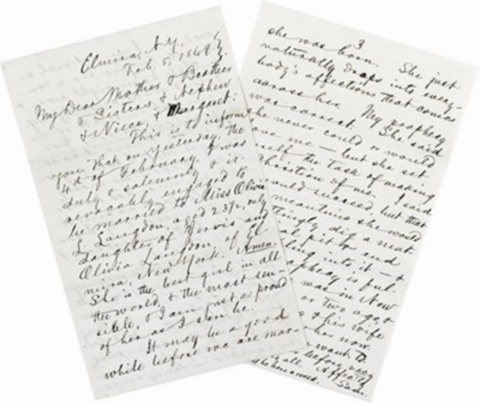
Such passive-aggressive arrangements can be alienating, an opinion Mark Twain seemed to hold when he announced to his family the upcoming nuptials to his future wife of 34 years, Olivia Langdon. In a display of what Booktryst calls “the sort of sentiment deeply appreciated by a prospective spouse,” Twain wrote his family in 1869 to tell them the news, and he tried to win them over. His announcement is a “gushing, self-deprecating declaration of intent.” One, moreover, that presumes his audience’s contrariness. The then 34-year-old Twain anticipates and addresses what seems his family’s primary objection to his marriage in general: he details his financial plans and expresses his intention to proceed “unaided.”
Twain then mounts his best persuasive case to sway his readers—Mother & Brother & Sisters & Nephew & Niece, & Margaret—in Langdon’s favor. He says that everyone who knows her “naturally” loves her. He also goes so far as to say that Langdon “set herself the task of making a Christian of me” and that “she would succeed.” Anyone who knows Twain’s attitudes toward religion, and Christianity in particular, may see some hyperbole, or even disingenuousness, here, but perhaps it’s a sincere expression of how far he was willing to go for the woman who stood by his side as he lost his fortune and hers in scheme after failed get-rich-quick scheme. As Booktryst nicely puts it, “Aside from pen & paper, the only investment that ever paid off for him was his effort to win the heart of Olivia Langdon.”
This is to inform you that on yesterday, the 4th of February, I was duly & solemnly & irrevocably engaged to be married to Miss Olivia L. Langdon, of Elmira, New York. Amen. She is the best girl in all the world, & the most sensible, & I am just as proud of her as I can be.
It may be a good while before we are married, for I am not rich enough to give her a comfortable home right away, & I don’t want anybody’s help. I can get an eighth of the Cleveland Herald for $25,000, & have it so arranged that I can pay for it as I earn the money with my unaided hands. I shall look around a little more, & if I can do no better elsewhere, I shall take it.
I am not worrying about whether you will love my future wife or not—if you know her twenty-four hours & then don’t love her, you will accomplish what nobody else has ever succeeded in doing since she was born. She just naturally drops into everybody’s affections that comes across her. My prophecy was correct. She said she never could or would love me—but she set herself the task of making a Christian of me. I said she would succeed, but that in the meantime she would unwittingly dig a matrimonial pit & end up tumbling into it—& lo! the prophecy is fulfilled. She was in New York a day or two ago, & George Wiley & his wife Clara know her now. Pump them, if you want to. You shall see her before very long.
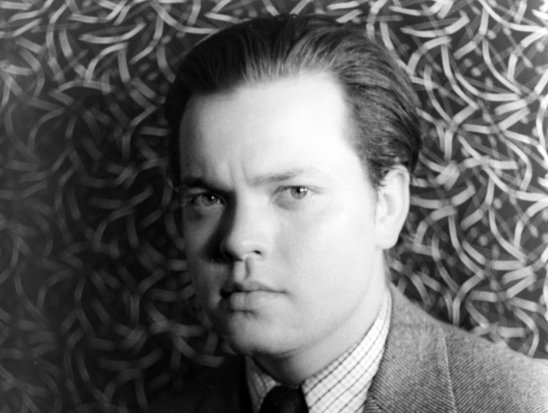
One night in October of 1938, listeners tuned into CBS radio to hear a piece of radio theater (listen below) so frightening and, for its time, realistic, that people across New England and eastern Canada fled their homes to escape danger. Or so the legend goes. With Orson Welles reading the part of an astronaut and professor, the Mercury Theatre on the Air’s broadcast of War of the Worlds hit a frayed nerve in the American public.
The show aired during the tense years leading up to World War II, when fascism was on the rise in Europe. Many took the “news” of an alien invasion for truth. It would have been easy to be fooled: the story, adapted from H.G. Wells’ early sci-fi novel, was written as a simulated news broadcast. It opened with an introduction from the novel and a note that the adaptation was set a year ahead (1939). For those who missed that disclaimer, the remainder of the show was unsettling to say the least.
A reporter read a weather report. Then came dance music played by a fictitious band (“Ramon Raquello and his Orchestra”) that was interrupted by news of bizarre explosions on the surface of Mars. Soon Orson Welles made his appearance, interviewed as an expert who denied the possibility of any life on the red planet. But then came the news of a cylindrical meteorite landing in northern New Jersey. A crowd gathered and a “reporter” came on the scene to watch the cylinder unscrew itself and reveal a rocketship inside.
Chaos ensued, followed by a Martian invasion of New York City, where people ran into the East River “like rats.”
Welles offered another disclaimer at the end of the story (when the aliens succumbed to Earth’s pathogens) to remind listeners that the broadcast was fiction.
Too little, too late? Or just great theater?
The next day, Welles held a brilliant news conference where he apologized for putting a fright into listeners. (It’s another great piece of theater.) Meanwhile the broadcast established the Mercury Theatre on the Air—already an acclaimed stage production company—as one of America’s top-rated radio programs. Until then the show had languished in relative obscurity. After sending thousands of people into a panic, the show earned advertising sponsorship from Campbell’s Soup.
Kate Rix writes about digital media and education. Follow her on Twitter.
Note: If you’re having difficulties getting this software running in your browser give Firefox a try. It seems to work the best.
Movies, commercials, radio shows, even books: we’ve enjoyed the ability to effortlessly pull up things we remember from our childhood on the internet just long enough that it feels strange and uncomfortable when we can’t. Up until now, though, we haven’t had an easy way to re-experience the computer software we remember using in decades past. In my case, of course — and likely in a fair few of yours as well — I spent most of my computer time in decades past playing games and not, say, building balance sheets. But whichever you did, the Internet Archive’s newly opened Historical Software Archive makes it easy to re-live those old days at the keyboard without having to buy a vintage computer on eBay, track down its software, remember all its required commands and keystrokes, and hope the floppy discs — or, heaven help us, cassette tapes — boot up correctly. They’ve made these wealth of games, applications, and oddities freely available with the development of JMESS, a Javascript-powered version of the Multi Emulator Super System, “a mature and breathtakingly flexible computer and console emulator that has been in development for over a decade and a half by hundreds of volunteers.”
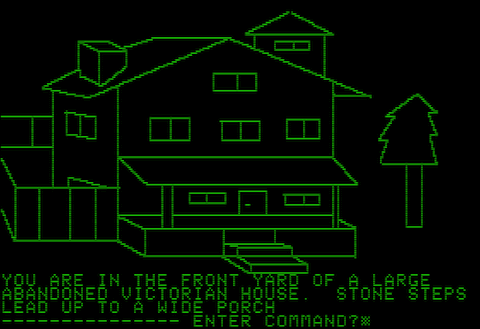
They say a bit more about the technology behind all this on the Internet Archive Blog, and the Historical Software Archive’s front page offers recommendations for which “ground-breaking and historically important software products” to try first, including 1.) Jordan Mechner’s Karateka (top), a hot game in 1980 and the most popular item in the archive today; 2) Sierra On-Line’s Mystery House (above), which gave rise more or less by itself to a vast genre of graphic adventures; 3) three adaptations of Namco’s Pac-Man (one for the Atari 2600, one remade for that same console, one lawsuit-inducing knockoff for the lesser-known Odyssey2); 4) E.T. the Extra-Terrestrial, a “1982 adventure video game developed and published by Atari, Inc. for the Atari 2600 video game console;” and 5) Dan Bricklin and Bob Frankston’s Visi-Calc (below), the granddaddy of all spreadsheet programs, and arguably the single application that turned computing from hobby into necessity. Or how about 6) WordStar, the early word processing program? Just click on the “Run an in-browser emulation of the program” link to fire up any of these and, if you’re under about 30, experience just what computer users of the late seventies and early eighties had to deal with — and how much fun they had.
In a post earlier this year, we showcased one of the few known sound films of Charlie Parker performing live. Above, we have another very rare clip, from 1950, with Parker, young upstart alto, trading lines with veteran tenor Coleman Hawkins. Buddy Rich plays drums, and Hank Jones and Ray Brown play piano and bass.
Parker looks characteristically cool between the distinguished poise of Hawkins and the boyish exuberance of natural bandleader Buddy Rich who, in the second tune, exudes much goofy enthusiasm as he destroys the snare drum. This take may be hard bop at its hardest, which makes Parker’s understated contest with Hawkins all the more vital, propelled by some of the most frenetic rhythms in jazz history.
There is much more after the first two takes, as a voiceover segment announces. The rhythm section gets a little time, then they’re joined by Bill Harris and Lester Young. And then, at 12:18, the already all-star cast gets rounded out by a scatting Ella Fitzgerald off stage left, leaned over Hank Jones’ piano. This is a hell of a fun performance to watch, whether you’re a student of bop, have a music-historical bent, or just love seeing live jazz at the top of its game.
Shakespeare sells: counterintuitive, but seemingly true. The film industry, which pumps out Shakespeare adaptations (of varying levels of creativity) on the regular, has known this ever since it could hardly have had much awareness of itself as a film industry. At the top, we have the only surviving scene from 1899’s King John, where Shakespeare on screen all started.
“The next three decades would see varied approaches to the challenge of filming Shakespeare in a medium denied the spoken word,” writes the British Film Institute’s Michael Brooke, “from the imaginative tableaux-style mime of Percy Stow’s The Tempest (1908) to truncated productions of the major tragedies (Richard III, 1911; Hamlet, 1913).” Excerpts from one of these last, F.R. Benson’s Richard III, you can watch just below:
Early Shakespeare adapters like Benson tended to make less Shakespeare films than, as Brooke puts it, “compilations of memorable moments” from the plays. Then again, every genre of movie attempted simple things back then, and Shakespearean productions would grow far richer in the sound era, which 1929’s The Taming of the Shrew ushered in for the Bard, and with no less a silver-screen legend than Mary Pickford in the role of Kate.
Seven years later, the not-yet-Sir Laurence Olivier, “cinema’s first great Shakespearean artist,” would make his Shakespeare debut as Orlando in Paul Czinner’s As You Like It(1936), which you can watch below. He’d almost made this debut as the lead in George Cukor’s Romeo & Juliet, but ultimately turned it down.
Xiangjun Shi, otherwise known as Shixie, studied animation at RISD and physics at Brown. Then, she harnessed her training in both disciplines to create an animation explaining the virtue of studying physics. Pretty quickly, it gets to the crux of the matter: Studying physics will change how you see the world and how you understand your place in it, all while letting you wrap your mind around some pretty electrifying concepts. I think I’m sold!
In a year that marks some significant pop culture 20th anniversaries—Wired magazine, Nirvana’s In Utero, The X‑Files–one in particular may get somewhat less press. This coming December will be twenty years since Frank Zappa died of prostate cancer at age 52, after achieving infamy, notoriety, and finally, actual, run-of-the-mill fame. The latter he didn’t seem to cherish as much, and certainly not during his sickness. Nevertheless, Zappa sat for a Today Show interview, one of his last, and discussed his current work and failing health. A young chipper Katie Couric gives Zappa an ambivalent intro as the “bizarre performer with a penchant for lascivious lyrics.” “What few know,” she goes on to say, “is that he’s also a serious and respected classical composer.” Zappa’s bona fides as a “serious” artist seem to grant him a pass, at least for a bit, from interviewer Jamie Gangel, who begins asking about the successful performances of his work in Europe, where he “sells out concert halls.”
Zappa responds respectfully, but is obviously quite bored and in pain. He’s subdued, downbeat, guarded. Then the inevitable grilling begins. “How much do you think you did for the sound and how much for the humor?” asks Gangel. “Both,” answers Zappa, “The goal here is entertainment.” Zappa pronounces himself “totally unrepentant” for his life. In answer to the question “is there anything you’ve done that you felt sorry for?” he simply says, “No.”
And why should he confess on national television? There are many more interesting things to discuss, such as Zappa’s stand against Tipper Gore’s Parents Music Resource Center (PMRC) during the legendary 1985 Senate Hearings (along with Dee Snider and, of all people, John Denver). When the conversation turns to that history, Zappa learns a fun fact about Gore that genuinely catches him off-guard. The interview goes to some very sad places, and while Zappa hangs in there, it’s not particularly entertaining to see him staunchly refuse to view his condition through Gangel’s lenses. He clearly doesn’t see his illness as theater and won’t play penitent or victim.
A much more lively interview, by a much better informed interviewer, six months before Zappa’s death, is with Ben Watson for Mojo. In both of these moments, however, Zappa insists on the only label he ever applied to himself: he’s an entertainer, nothing more. Whether touted as a “classical composer” (a phrase he doesn’t use) or thought of as an artist, Zappa to the very end dodged any hint of serious moral intentions in his music, which perhaps makes him one of the most honest musicians in all of pop culture history. He saved the serious intentions for an arena much more in need of them. His PMRC hearing testimony contains an eloquent statement of his ethos: “Bad facts make bad laws. And people who write bad laws are, in my opinion, more dangerous that songwriters who celebrate sexuality.”
In 1965, Woody Allen took time out from his first film What’s New Pussycatto tape a half-hour of stand up in front of a live television audience in the UK.
Exuberant and horny in an adorable, puppyish way, the 30-year-old comic seemed to relish this return to his nightclub act. The comedy is situational, observational, autobiographical — imagine Louis CK with a PG vocabulary, no kids, a necktie and a twinkle in his eye. Already ensconced on the Upper East Side, he paints a decidedly downtown vision of a New York populated by artists’ models, swinging Bennington girls, and women with pierced ears. Like Louis—or the young Brooklyn hipsters on Girls—he’s itching to score.
It does a body good to see him at this “childlike” stage of his career.
“…comics are childlike and they are suing for the approval of the adults. Something goes on in a theater when you’re fourteen years old and you want to get up onstage and make the audience laugh. You’re always the supplicant, wanting to please and to get warm laughs. Then what happens to comics — they make it and they become a thousand times more wealthy than their audience, more famous, more idolized, more traveled, more cultivated, more experienced, more sophisticated, and they’re no longer the supplicant. They can buy and sell their audience, they know so much more than their audience, they have lived and traveled around the world a hundred times, they’ve dined at Buckingham Palace and the White House, they have chauffeured cars and they’re rich and they’ve made love to the world’s most beautiful women — and suddenly it becomes difficult to play that loser character, because they don’t feel it. Being a supplicant has become much harder to sell. If you’re not careful, you can easily become less amusing, less funny. Many become pompous… A strange thing occurs: You go from court jester to king.”
We're hoping to rely on loyal readers, rather than erratic ads. Please click the Donate button and support Open Culture. You can use Paypal, Venmo, Patreon, even Crypto! We thank you!
Open Culture scours the web for the best educational media. We find the free courses and audio books you need, the language lessons & educational videos you want, and plenty of enlightenment in between.