Watch Frank Zappa Play Michael Nesmith (RIP) on The Monkees–and Vice Versa (1967)
In December 1967, The Monkees blew their audience’s minds by hosting Frank Zappa, “participant in and perhaps even leader of” the Mothers Of Invention.
Or did they?
The tidal wave of affection that comprises twenty-first century Monkees mania makes us forget that children were the primary audience for The Monkees’ titular sitcom. (One might also say that The Monkees were the sitcom’s titular band.)
But even if the kids at home weren’t sufficiently conversant in the musical underground to identify the special guest star of the episode, “The Monkees Blow Their Minds,” we are.
It’s a joy to see Zappa and The Monkees’ supremely laid back Michael Nesmith (RIP) impersonating each other.
Zappa’s idea, apparently. He’s in complete control of the gimmick from the get go, whereas Nesmith struggles to keep their names straight and his prosthetic nose in place before getting up to speed.
It’s important to remember that it’s not Frank, but Nesmith playing Frank who accuses The Monkees’ music of being banal and insipid.
Zappa himself was a great supporter of The Monkees. “When people hated us more than anything, he said kind things about us,” Nesmith recalled in Barry Miles’ Zappa biography. Zappa attempted to teach Nesmith how to play lead guitar, and offered drummer Micky Dolenz a post-Monkees gig with The Mothers of Invention.
Their mutual warmth makes lines like “You’re the popular musician! I’m dirty gross and ugly” palatable. It put me in mind of comedian Zach Galifianakis’ Between Two Ferns, and countless other loosely rehearsed web series.
After a couple of minutes, Nesmith gets his hat back to conduct as Zappa smashes up a car to the tune of the Mother’s Of Invention’s “Mother People.”
Related Content:
A Young Frank Zappa Turns the Bicycle into a Musical Instrument on The Steve Allen Show (1963)
Ayun Halliday is an author, homeschooler, and Chief Primatologist of the East Village Inky zine. Follow her @AyunHalliday
Read More...
Punks, Goths, and Mods on TV (1983)
The Rivethead preoccupation with fashion is inescapably related to their anxiety over being confused for subcultures they profess to hate: Goths, Punks, Metalheads, Death Rockers… The fact that so many subcultures claim black as their color of choice contributes to the confusion.
There are two points upon which theorists of post-industrial British subcultures generally agree: 1) No matter the music or the fashion, the boundaries between one subculture and another were rigorously, even violently, enforced (hence the wars between the mods and rockers), and; 2) The music and fashions of every subculture were subject to cooptation by the machinery of capitalism, to be mass produced, packaged, and sold as off-the-rack commodity, a phenomenon that occurred almost as soon as punks, mods, rockers, goths, teddy boys, skinheads, New Romantics, etc. began appearing on television — as in the post-Grundy Irish TV appearance of four young individuals above from 1983.
The interviewer introduces these punks, goths, and mods by referring first to their employment — or lack of employment — status, and then to the number of children in their family. Comments dripping with class disdain sit alongside a characterization of various subcultures as “gangs” — the Hell’s Angels thrown in among them just to drive the point home. Of course, there’s more to say about the denizens of early-80s UK subcultural street corners — more than these four representatives have to say themselves. It is communicated through performance rather than verbal exposition, through the affiliations of clothing, music, and pose — as in the mini-historical slideshow of late-20th century British subcultures below, from the 50s to the 80s.
In 1979, British theorist Dick Hebdige published what many considered the definitive analysis of these working-class scenes, which frequently centered around forms of racial and cultural exchange — as with mods who loved jazz or punks who loved ska and dub reggae; or racial and cultural exclusion — as with fascist skinheads and chauvinist teddy boys who glorified the past, while other subcultural ideologies looked to the future (or, as the case may be, no future).
Hebdige’s Subculture: the Meaning of Style begins with a story about French writer Jean Genet, humiliated in prison by homophobic guards over his possession of a tube of Vaseline:
Like Genet, we are interested in subculture – in the expressive forms and rituals of those subordinate groups – the teddy boys and mods and rockers, the skinheads and the punks – who are alternately dismissed, denounced and canonized; treated at different times as threats to public order and as harmless buffoons.
The irony of subcultures is that they identify with social outsiders, while re-enforcing boundaries that create exclusivity (cf. the quote at the top, from Hebdige-inspired Subcultures List). When the novelty and shock recedes, they become ripe fodder for commercial cooptation, even luxury branding.
What we usually don’t get from tame retrospectives, or from patronizing mass media of the time, are deviant outsiders like Genet who cannot be reabsorbed into the system because their very existence poses a threat to the social order as so construed. So much of the fashion and music of post-war Britain was directly created or inspired by West Indian migrants of the Windrush generation, for example. In too many popular representations of postwar British subcultures, that essential part of the working class UK subculture story has been entirely left out.
Related Content:
A History of Punk from 1976–78: A Free Online Course from the University of Reading
The History of Punk Rock in 300 Tracks: A 13-Hour Playlist Takes You From 1965 to Present
Josh Jones is a writer and musician based in Durham, NC. Follow him at @jdmagness
Read More...How Well Can You Move in Medieval Armor?: Medievalist Daniel Jaquet Gives It a Try in Real Life
If you’ve ever run a marathon in costume, or for that matter, boarded public transportation with a large musical instrument or a bulky bag of athletic equipment, you know that gear can be a burden best shed.
But what if that gear is your first, nay, best line of defense against a fellow knight fixing to smite you in the name of their liege?
Such gear is non-optional.
Curious about the degree to which 15th-century knights were encumbered by their protective plating, medievalist Daniel Jaquet commissioned a top armor specialist from the Czech Republic to make a suit specific to his own personal measurements. The result is based on a 15th century specimen in Vienna that has been studied by the Wallace Collection’s archaeometallurgist Alan Williams. As Jaquet recalled in Sciences et Avenir:
We had to make compromises in the copying process, of course, because what interested me above all was to be able to do a behavioral study, to see how one moved with this equipment on the back rather than attaching myself to the number of exact rivets…we knew the composition and the hardness of the parts that we could compare to our replica.
The accomplished martial artist tested his mobility in the suit with a variety of highly public, modern activities: reaching for items on the highest supermarket shelves, jogging in the park, scaling a wall at a climbing gym, taking the Metro …
It may look like showboating, but these movements helped him assess how he’d perform in combat, as well as lower stress activities involving sitting down or standing up.
Out of his metal suit, Jaquet has been known to amuse himself by analyzing the verisimilitude of Game of Thrones’ combat scenes. (Conclusion: some liberties were taken, armor-wise, in that gruesome face off between the Mountain and the Viper.)
An invitation to travel to New York City to present at the Metropolitan Museum of Art offered an unexpected testing opportunity, compliments of the airline’s baggage restrictions:
For reasons of weight, space and cost, the solution to wear the armor over me was considered the best.
(The TSA officers at Newark were not amused...)

His armored experience sheds light on those of early 15th-century knight Jean le Maingre, aka Boucicaut, whose impressive career was cut short in 1415, when he was captured by the English at the Battle of Agincourt.
Boucicaut kept himself in tip top physical condition with a regular armored fitness regimen. His chivalric biography details gearing up for exercises that include running, chopping wood, vaulting onto a horse, and working his way up a ladder from the underside, without using his feet.
Jaquet duplicates them all in the above video.
(Reminder to those who would try this at home, make sure you’re capable of performing these exercises in lightweight shorts and t‑shirt before attempting to do them in armor.)
Like Boucicault’s, Jaquet’s armor is bespoke. Those who’ve struggled to lift their arms in an off-the-rack jacket will appreciate the trade off. It’s worth spending more to ensure sufficient range of movement.
In Boucicault’s day, ready-made pieces of lesser quality could be procured at markets, trading fairs, and shops in populous areas. You could also try your luck after battle, by stripping the captive and the dead of theirs. Size was always an issue. Too small and your movement would be restricted. Too big, and you’d be hauling around unnecessary weight.
Jaquet describes his load as being on par with the weight 21st-century soldiers are required to carry. Body armor is a lifesaver, according to a 2018 study by the Center for a New American Security, but it also reduces mobility, increases fatigue, and reduces mission performance.
Gizmodo’s Jennifer Ouellette finds that medieval knights faced similar challenges:
The legs alone were carrying an extra 15 to 18 pounds, so the muscles had to work that much harder to overcome inertia to set the legs in motion. There is also evidence that the thin slits in the face mask, and tight chest plate, restricted oxygen flow even further.
Read a detailed, scholarly account of Jaquet’s armor experiment in Historical Methods: A Journal of Quantitative and Interdisciplinary History.
For those looking for a lighter read, here is Jaquet’s account of taking a commercial flight in armor (and some best practice tips for those attempting the same.)
- Ayun Halliday is the Chief Primatologist of the East Village Inky zine and author, most recently, of Creative, Not Famous: The Small Potato Manifesto. Follow her @AyunHalliday.
Related Content
What It’s Like to Actually Fight in Medieval Armor
How to Make and Wear Medieval Armor: An In-Depth Primer
Read More...When the Colosseum in Rome Became the Home of Hundreds of Exotic Plant Species

The Colosseum is one of the most popular tourist attractions in Italy, and thus one of the most popular tourist attractions in all of Europe. But the nature of its appeal to its many visitors has changed over the centuries. In the Atlantic, novelist and podcaster Paul Cooper notes that, “the belief that Christian martyrs had once been fed to the lions in the arena,” for example, once made it a renowned site of religious pilgrimage. (This “despite little evidence that Christians were ever actually killed in the arena.”) But in that same era, the Colosseum was also a site of botanic pilgrimage: amid its ruins grew “420 species of plant,” including some rare examples “found nowhere else in Europe.”
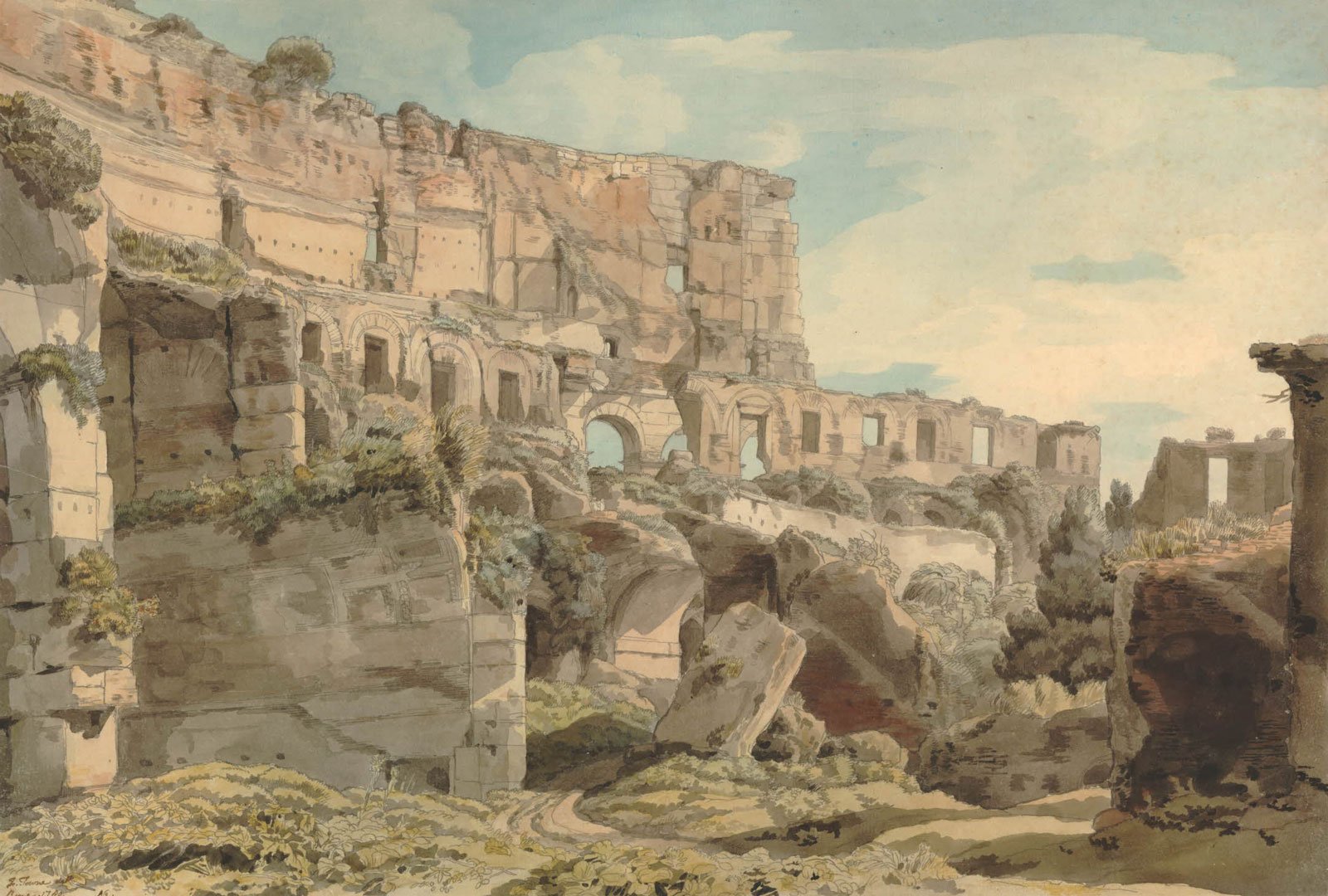
Notable tourists who took note of the Colosseum’s rich plant life include Charles Dickens, who beheld its “walls and arches overgrown with green,” and Percy Bysshe Shelley, who wrote of how “the copsewood overshadows you as you wander through its labyrinths, and the wild weeds of this climate of flowers bloom under your feet.”
Cooper quotes from these writings in his Atlantic piece, and in an associated Twitter thread also includes plenty of renderings of the Colosseum as it then looked during the 18th and 19th centuries. He even selected images from Flora of the Colosseum of Rome, or, Illustrations and descriptions of four hundred and twenty plants growing spontaneously upon the ruins of the Colosseum of Rome (readable free online at the Internet Archive), the 1855 work of a less well-known Englishman named Richard Deakin.
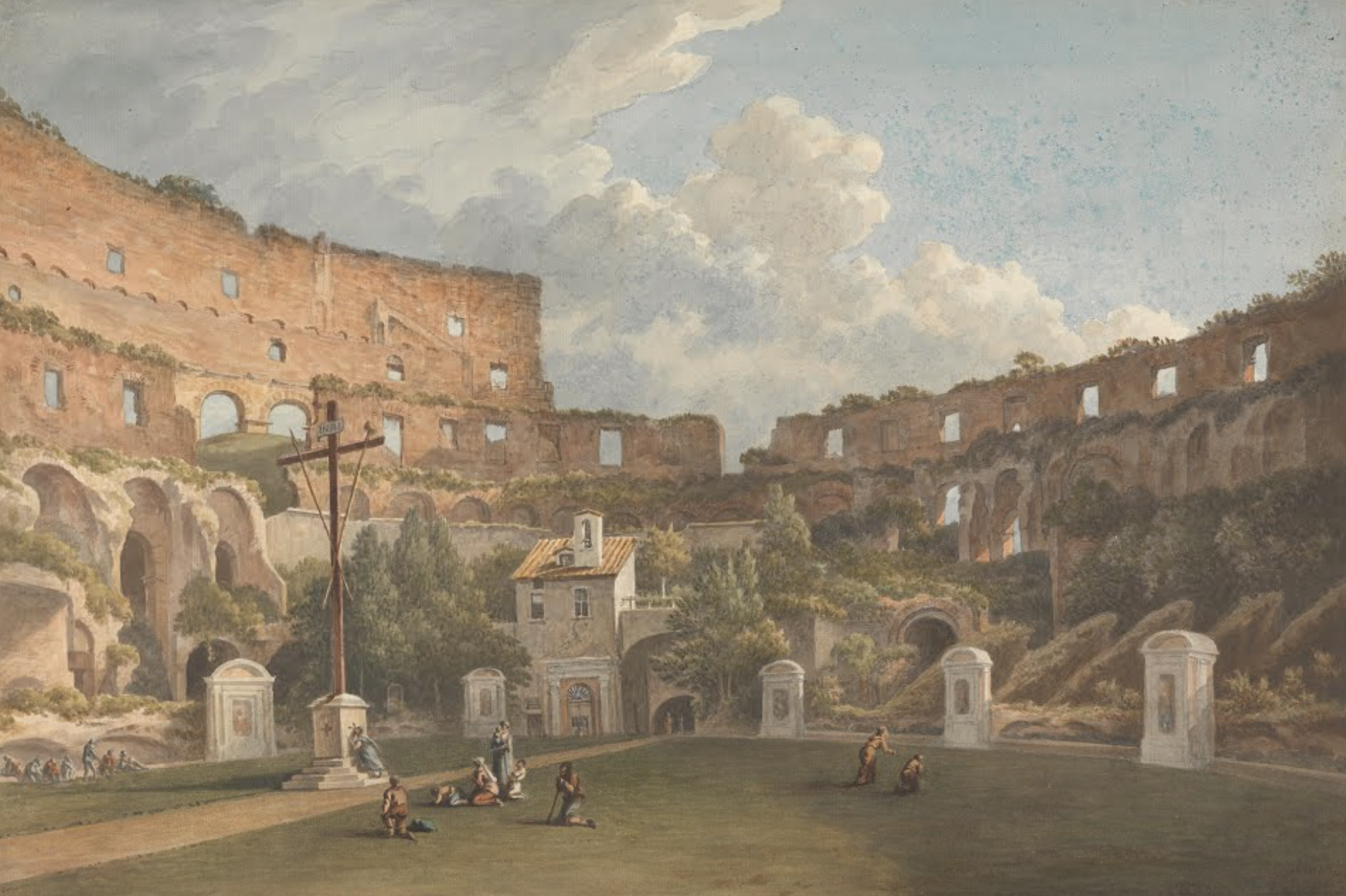
A botanist, Deakin did the hard work of cataloging those hundreds of plant species growing in the Colosseum back in the 1850s. The intervening 170 or so years have taken their toll on this biodiversity: as Nature reported it, only 242 of these species were still present in the early 2000s, due in part to “a shift towards species that prefer a warmer, drier climate” and the growth of the surrounding city. In its heyday in the first centuries of the last millennium, the arena lay on the outskirts of Rome, whereas it feels central today. Pay it a visit, and you both will and will not see the Colosseum that Dickens and Shelley did; but then, they never knew it as, say, Titus or Domitian did. In recent years there have been moves to restore and even improve ancient features like the retractable floor; why not double down on the exotic flora while we’re at it?
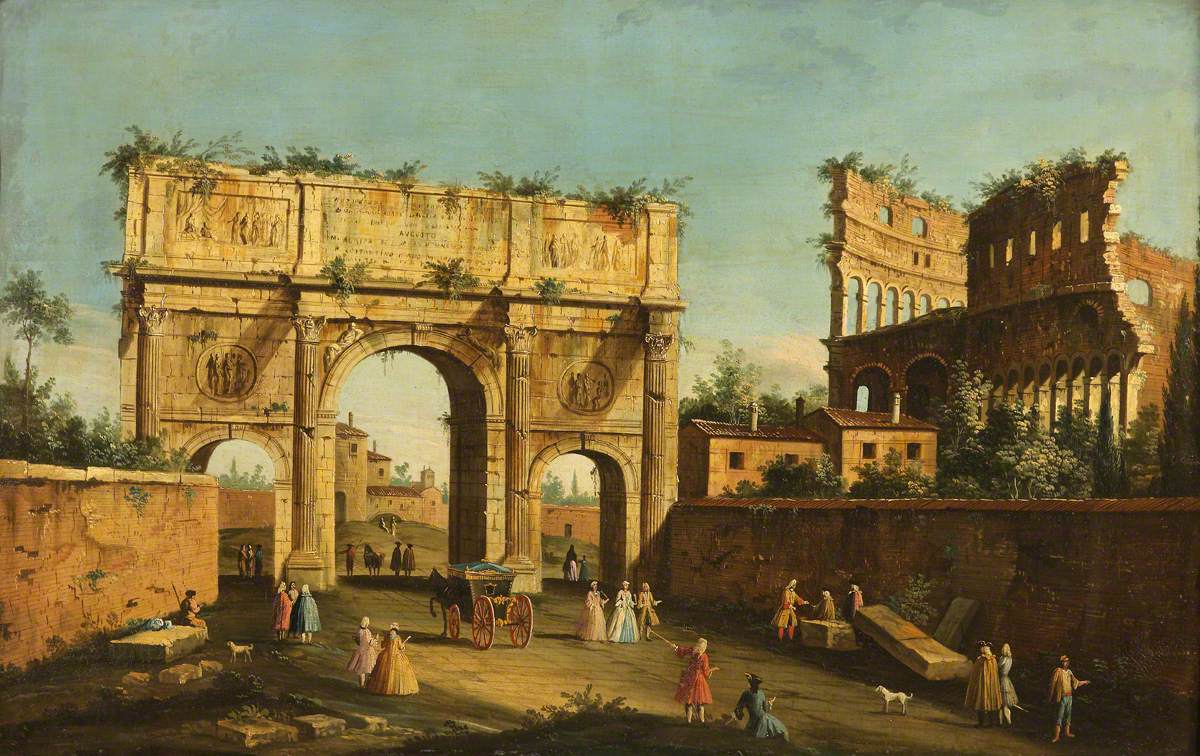
via The Atlantic
Related content:
Rome’s Colosseum Will Get a New Retractable Floor by 2023 — Just as It Had in Ancient Times
Building The Colosseum: The Icon of Rome
With 9,036 Pieces, the Roman Colosseum Is the Largest Lego Set Ever
Based in Seoul, Colin Marshall writes and broadcasts on cities and culture. His projects include the book The Stateless City: a Walk through 21st-Century Los Angeles and the video series The City in Cinema. Follow him on Twitter at @colinmarshall or on Facebook.
Read More...How Peter Jackson Used Artificial Intelligence to Restore the Video & Audio Featured in The Beatles: Get Back
Much has been made in recent years of the “de-aging” processes that allow actors to credibly play characters far younger than themselves. But it has also become possible to de-age film itself, as demonstrated by Peter Jackson’s celebrated new docu-series The Beatles: Get Back. The vast majority of the material that comprises its nearly eight-hour runtime was originally shot in 1969, under the direction of Michael Lindsay-Hogg for the documentary that became Let It Be.
Those who have seen both Linday-Hogg’s and Jackson’s documentaries will notice how much sharper, smoother, and more vivid the very same footage looks in the latter, despite the sixteen-millimeter film having languished for half a century. The kind of visual restoration and enhancement seen in Get Back was made possible by technologies that have only emerged in the past few decades — and previously seen in Jackson’s They Shall Not Grow Old, a documentary acclaimed for its restoration of century-old World War I footage to a time-travel-like degree of verisimilitude.
“You can’t actually just do it with off-the-shelf software,” Jackson explained in an interview about the restoration processes involved in They Shall Not Grow Old. This necessitated marshaling, at his New Zealand company Park Road Post Production, “a department of code writers who write computer code in software.” In other words, a sufficiently ambitious project of visual revitalization — making media from bygone times even more lifelike than it was to begin with — becomes as much a job of traditional film-restoration or visual-effects as of computer programming.
This also goes for the less obvious but no-less-impressive treatment given by Jackson and his team to the audio that came with the Let It Be footage. Recorded in large part monaurally, these tapes presented a formidable production challenge. John, Paul, George, and Ringo’s instruments share a single track with their voices — and not just their singing voices, but their speaking ones as well. On first listen, this renders many of their conversations inaudible, and probably by design: “If they were in a conversation,” said Jackson, they would turn their amps up loud and they’d strum the guitar.”
This means of keeping their words from Lindsay-Hogg and his crew worked well enough in the wholly analog late 1960s, but it has proven no match for the artificial intelligence/machine learning of the 2020s. “We devised a technology that is called demixing,” said Jackson. “You teach the computer what a guitar sounds like, you teach them what a human voice sounds like, you teach it what a drum sounds like, you teach it what a bass sounds like.” Supplied with enough sonic data, the system eventually learned to distinguish from one another not just the sounds of the Beatles’ instruments but of their voices as well.
Hence, in addition to Get Back’s revelatory musical moments, its many once-private but now crisply audible exchanges between the Fab Four. “Oh, you’re recording our conversation?” George Harrison at one point asks Lindsay-Hogg in a characteristic tone of faux surprise. But if he could hear the recordings today, his surprise would surely be real.
Related Content:
Watch Paul McCartney Compose The Beatles Classic “Get Back” Out of Thin Air (1969)
Artificial Intelligence Program Tries to Write a Beatles Song: Listen to “Daddy’s Car”
Based in Seoul, Colin Marshall writes and broadcasts on cities and culture. His projects include the book The Stateless City: a Walk through 21st-Century Los Angeles and the video series The City in Cinema. Follow him on Twitter at @colinmarshall or on Facebook.
Read More...The Drugs Used by the Ancient Greeks and Romans
Many of us living in the parts of the world where marijuana has recently been legalized may regard ourselves as partaking of a highly modern pleasure. And given the ever-increasing sophistication of the growing and processing techniques that underlie what has become a formidable cannabis industry, perhaps, on some level, we are. But as intellectually avid enthusiasts of psychoactive substances won’t hesitate to tell you, their use stretches farther back in time than history itself. “For as long as there has been civilization, there have been mind-altering drugs,” writes Science’s Andrew Lawler. But was anyone using them in the predecessors to western civilization as we know it today?
For quite some time, scholars believed that unlike, say, Mesoamerica or north Africa, “the ancient Near East had seemed curiously drug-free.” But now, “new techniques for analyzing residues in excavated jars and identifying tiny amounts of plant material suggest that ancient Near Easterners indulged in a range of psychoactive substances.”
The latest evidence suggests that, already three millennia ago, “drugs like cannabis had arrived in Mesopotamia, while people from Turkey to Egypt experimented with local substances such as blue water lily.” That these habits seem to have continued in ancient Greece and Rome is suggested by archaeological evidence summarized in the video above.
In 2019, archaeologists unearthed a few precious artifacts from a fourth-century Scythian burial mound near Stavropol in Russia. There were “golden armbands, golden cups, a heavy gold ring, and the greatest treasure of all, two spectacular golden vessels,” says narrator Garrett Ryan, who earned a PhD in Greek and Roman History from the University of Michigan. The interiors of those last “were coated with a sticky black residue,” confirmed in the lab to be opium with traces of marijuana. “The Scythians, in other words, got high” — as did “their Greek and Roman neighbors.” Ryan, author of Naked Statues, Fat Gladiators, and War Elephants: Frequently Asked Questions about the Ancient Greeks and Romans, goes on to make intriguing connections between scattered but relevant pieces of archaeological and textual evidence. We know that some of our civilizational forebears got high; how many, and how high, are questions for future scholastic inquiry.
Related Content:
Algerian Cave Paintings Suggest Humans Did Magic Mushrooms 9,000 Years Ago
Discover the Oldest Beer Recipe in History From Ancient Sumeria, 1800 B.C.
1,000-Year-Old Illustrated Guide to the Medicinal Use of Plants Now Digitized & Put Online
Beer Archaeology: Yes, It’s a Thing
Based in Seoul, Colin Marshall writes and broadcasts on cities and culture. His projects include the book The Stateless City: a Walk through 21st-Century Los Angeles and the video series The City in Cinema. Follow him on Twitter at @colinmarshall or on Facebook.
Read More...The Secrets of Beethoven’s Fifth, the World’s Most Famous Symphony
Revered by music lovers of temperaments as varied as Peanuts’ Schroeder and A Clockwork Orange’s Alex, Ludwig van Beethoven is one of the most celebrated composers in the Western classical music canon.
Symphony No. 5 in C minor is surely one of his most recognized, and frequently performed works, thanks in large part to its dramatic opening motif –
dun-dun-dun-DAH!
Music educator Hanako Sawada’s entertaining TED-Ed lesson, animated by Yael Reisfeld above, delves into the story behind this symphony, “one of the most explosive pieces of music ever composed.”
Middle and high school music teachers will be glad to know the creators lean into the heightened emotions of the piece, depicting the composer as a tortured genius whose piercing gaze is bluer than Game of Thrones’ Night King.
Beethoven was already enjoying a successful reputation at the time of the symphony’s 1808 premiere, but not because he toiled in the service of religion or wealthy patrons like his peers.
Instead, he was an early-19th century bad ass, prioritizing self-expression and pouring his emotions into compositions he then sold to various music publishers.
With the Fifth, he really shook off the rigid structures of prevailing classical norms, embracing Romanticism in all its glorious turmoil.
The famous opening motif is repeated to the point of obsession:
Throughout the piece, the motif is passed around the orchestra like a whisper, gradually reaching more and more instruments until it becomes a roar.
Besotted teenagers, well acquainted with this feeling, are equipped with the internal trombones, piccolos, and contrabassoons of the sort that make the piece even more urgent in feel.
Just wait until they get hold of Beethoven’s Immortal Beloved letters, written a few years after the symphony, when the hearing loss he was wrestling with had progressed to near total deafness.
Whether or not it was the composer (and not his biographer) who characterized the central motif as the sound of “Fate knocking at the door,” it’s an apt, and riveting notion.
Take a quiz, participate in a guided discussion, and customize Hanako Sawada’s lesson, “The Secrets of the World’s Most Famous Symphony,” here.
Listen to the symphony in its entirety below.
Related Content:
Ayun Halliday is the Chief Primatologist of the East Village Inky zine and author, most recently, of Creative, Not Famous: The Small Potato Manifesto. Follow her @AyunHalliday.
Read More...Violinist Breaks a String While Performing Tchaikovsky in Concert, and Gracefully Recovers
Having evolved over centuries — indeed, millennia — the formal elegance and sonic beauty of stringed instruments continue to inspire their players toward ever-greater heights of virtuosity. But of course, the attainment of virtuosity itself doesn’t come easy, and whatever altitude you reach, you’ll still be dogged by some of the same problems you were as a novice. What violinist, for instance, could ever fully put out of their mind the possibility of a string’s breaking as they play, whether at home or in Carnegie Hall? Not celebrity player Ray Chen, surely, given that it’s happened to him at least twice in the past five years.
Being a Youtuber as well, Chen has turned these onstage misfortunes to his advantage. Just last week he put up “Violinist string BREAKS during Tchaikovsky,” a video that captures his latest such experience while playing with the Seattle Symphony Orchestra. Far from grinding to a halt, the performance continues with only a minor hitch.
After making a valiant attempt to soldier on short an E string, Chen switches to what appears to be the backup plan. Without the option of singing the blues while changing the string himself, as B.B. King did at Farm Aid, he swaps his instrument with that of the concertmaster, who passes it down the line. Unfazed, Chen continues playing right where he left off.
Chen followed a similar procedure after a string break in 2017, while playing in Brussels with the Taiwan Philharmonic. Then, as now, he uploaded the footage to his Youtube channel, where it has racked up more than 1.6 million views. The brief clip also captures his final toss onto the floor of the spare pack of strings he’d had the good sense to place in his pocket beforehand. The accolades posted in the comments below bring to mind the story of 19th-century violinist Carl Herman Unthan. Born without arms, Unthan became a virtuoso by playing instead with his feet — which he also used to change a string that broke on him in concert. This proved astonishing enough that he’s said later to have deliberately weakened strings in order to repeat the spectacle for other audiences. Just imagine if he’d had Youtube.
via Laughing Squid
Related Content:
B.B. King Changes Broken Guitar String Mid-Song at Farm Aid, 1985 and Doesn’t Miss a Beat
Why Violins Have F‑Holes: The Science & History of a Remarkable Renaissance Design
The Art and Science of Violin Making
A Gigantic Violin Floats Down Venice’s Grand Canal with a String Quartet on Top
Based in Seoul, Colin Marshall writes and broadcasts on cities, language, and culture. His projects include the Substack newsletter Books on Cities, the book The Stateless City: a Walk through 21st-Century Los Angeles and the video series The City in Cinema. Follow him on Twitter at @colinmarshall or on Facebook.
Read More...What Makes the Mona Lisa a Great Painting: A Deep Dive
This past summer we featured a short video introduction to the Mona Lisa here on Open Culture. You’d think that if any painting didn’t need an introduction, that would be the one. But the video’s creator James Payne showed many of us just how much we still have to learn about Leonardo’s most famous work of art — and indeed, perhaps the most famous work by any artist. On his Youtube channel Great Art Explained, Payne offers clear and powerful analyses of paintings from van Gogh’s The Starry Night and Hopper’s Nighthawks to Warhol’s Marilyn Diptych and Picasso’s Guernica. But there are some images to which a fifteen-minute video essay can’t hope to do justice.
In those cases, Payne has been known to follow up with a deluxe expanded edition. Taking on Hieronymus Bosch’s The Garden of Earthly Delights, he followed up three individual fifteen-minute videos — for a triptych, a neat union of form and substance — with a full-length treatment of the whole work.
Payne’s full-length version of his Mona Lisa video more than doubles the length of the original. “This is the more comprehensive version I always wanted to do,” he notes, adding that it “uses some of the information from the first film (but in higher resolution with better sound and with clearer graphics), as well as answering the hundreds of questions: Why doesn’t she have eyebrows? Is it a self-portrait? Is she only famous because she was stolen? How do we know what he was thinking?”
This time around, Payne has more to say about how Leonardo created such a compelling portrait on a technical level, but also why he came to paint it in the first place. On top of that, the expanded format gives him time to examine the much more conventional portraits Leonardo’s contemporaries were painting at the time, as well as what’s known as the Prado Mona Lisa. A depiction of the same sitter that may even have been painted simultaneously by one of Leonardo’s students, it makes for an illuminating object of comparison. Payne also gets into the 1911 theft and recovery that ultimately did a great deal for the painting’s reputation, as well as its 1963 exhibition in America that, thanks to television, turned it into a mass-media icon. By now we’ve all had more glimpses of the Mona Lisa more times than we can remember, but it takes enthusiasm like Payne’s to remind us of all the ways we can truly see it.
Related Content:
What Makes Leonardo’s Mona Lisa a Great Painting?: An Explanation in 15 Minutes
Why Leonardo da Vinci’s Greatest Painting is Not the Mona Lisa
Original Portrait of the Mona Lisa Found Beneath the Paint Layers of da Vinci’s Masterpiece
Based in Seoul, Colin Marshall writes and broadcasts on cities, language, and culture. His projects include the Substack newsletter Books on Cities, the book The Stateless City: a Walk through 21st-Century Los Angeles and the video series The City in Cinema. Follow him on Twitter at @colinmarshall or on Facebook.
Read More...Why Leonardo da Vinci’s Greatest Painting is Not the Mona Lisa
Despite creating two of the most famous paintings in the history of Western art, The Last Supper and the Mona Lisa, Leonardo da Vinci did not particularly think of himself as a painter. Sigmund Freud may have devoted several hundred words to showing that the Renaissance man par excellence rarely finished an artwork because of infantile psychosexual conflicts, but it seems more fitting to look at Leonardo’s approach to painting as of a piece with his approach to everything: He was simply far more interested in process than product. Even when the product was a masterpiece-in-the-making, and Leonardo’s patrons awaited, the artist’s restless mind was ready to move on before he finished a commission.
Such was the case with the Mona Lisa, which Leonardo never delivered to his client and instead brought with him to France. This painting, in all its unfinished mystery, may be Leonardo’s best-known work, but it is not — as Evan Puschak, a.k.a. The Nerdwriter, argues above — his best.
That honor should be reserved for a painting Leonardo began in the same year as the Mona Lisa, 1503: The Virgin and Child with St. Anne, which he worked on for seven years, never delivered to his client (most likely the King of France), and left unfinished at the time of his death in 1519.
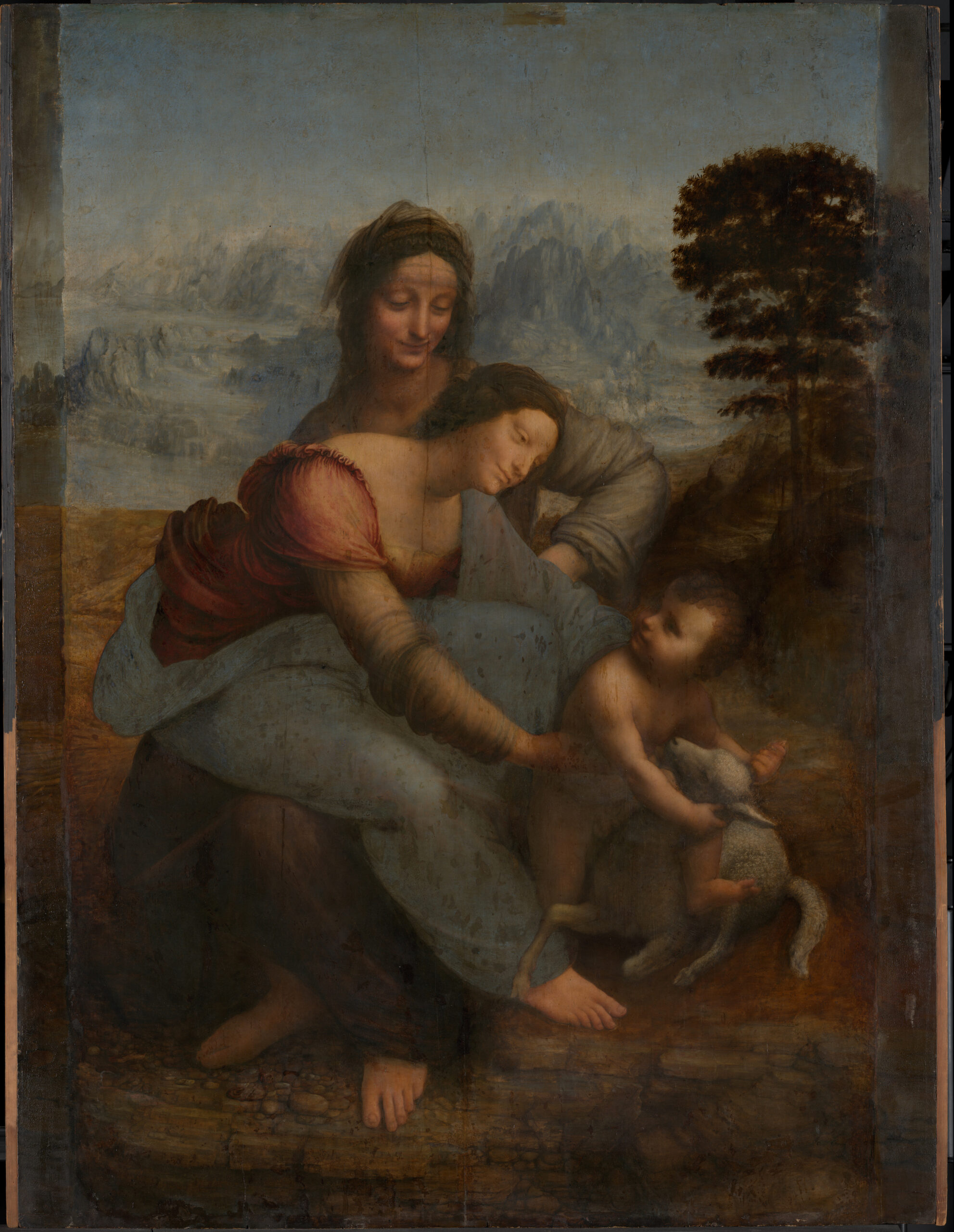
The painting depicts a grouping of three figures: the infant Christ, wrestling a lamb, his mother, attempting to pull him away, and her mother, the apocryphal St. Anne, forming the stable base and apex of the triad. Behind her head towers a dense mountain range, a symbol of deep ecological time, says Puschak, just as the lamb in the foreground symbolizes the Passion to come. This transition from a pre-historic past (one far more ancient than the Biblical stories) to a redeemed future does not terminate with the lamb, says Puschak, but with us, the viewer.
The pyramidal composition recalls Leonardo’s The Virgin of the Rocks from 1483. Such groupings were common in early Renaissance paintings, but The Virgin and Child with St. Anne represented a masterful refinement of the composition and of Leonardo’s famed sfumato technique. As Artdaily notes:
In Florence, where it was conceived, the Saint Anne quickly drew considerable attention and can be seen as a watershed moment in the evolution of artistic language, inspiring many disciples and colleagues who sought to emulate Leonardo’s style and technique in this work. Florentines were fascinated by the various cartoons executed by Leonardo and by the painted work, even in its rough outlines.
One preparatory work, the so-called “Burlington House Cartoon” (below), shows “the full expression of Leonardo’s first vision of the Saint Anne theme upon being awarded the commission.”
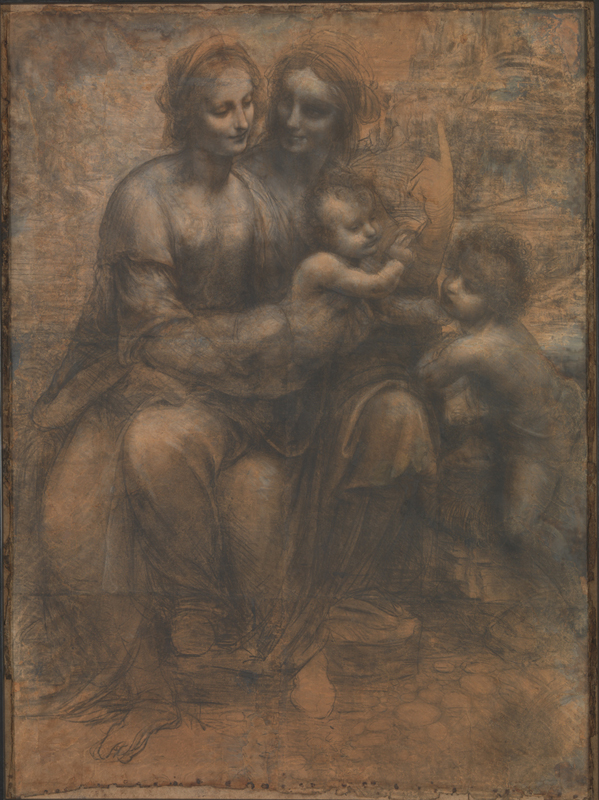
Image via the National Gallery
The work also shows the continued development of a theme that absorbed the artist throughout his life, expressed in earlier works such as The Virgin and Child with Cat and The Virgin of the Rocks. “These Virgin and Child compositions testify to Leonardo’s question to render in the most compelling manner the tenderness of the relationship between Jesus and the Virgin Mary,” and thus, between mother and son. Most of Freud’s observations in his Leonardo essay are nonsense, based on a mistranslation into German of the word “vulture” for a word that actually means “kite” (an error he later found particularly embarrassing). But his discussion of Leonardo’s childhood and his best, unfinished painting may strike us with particular poignancy.
[T]he smile which is playing on the lips of both women, although unmistakably the same as in the picture of Mona Lisa, has lost its sinister and mysterious character; it expresses a calm blissfulness.… Leonardo’s childhood was precisely as remarkable as this picture. He has had two mothers, the first his true mother, Caterina, from whom he was torn away between the age of three and five years, and a young tender step-mother, Donna Albiera, his father’s wife. By connecting this fact of his childhood… and condensing them into a uniform fusion, the composition of Saint Anne, Mary and the Child, formed itself in him.
Perhaps Freud was right, and The Virgin and Child with St. Anne was truly Leonardo’s most personal work, the apotheosis of a quest to integrate his personality through art. Whatever the case, we can say, along the psychoanalyst, that “on becoming somewhat engrossed in this picture it suddenly dawns upon the spectator that only Leonardo could have painted this picture.”
On a side note, Nerdwriter, the creator of the video above, has a new book coming out, Escape into Meaning: Essays on Superman, Public Benches, and Other Obsessions. You can pre-order it now.
Related Content:
Leonardo Da Vinci’s To-Do List from 1490: The Plan of a Renaissance Man
Josh Jones is a writer and musician based in Durham, NC. Follow him at @jdmagness
Read More...Support Us
We're hoping to rely on loyal readers, rather than erratic ads. Please click the Donate button and support Open Culture. You can use Paypal, Venmo, Patreon, even Crypto! We thank you!

About Us

Open Culture scours the web for the best educational media. We find the free courses and audio books you need, the language lessons & educational videos you want, and plenty of enlightenment in between.
Advertise With Us
FREE UPDATES!
GET OUR DAILY EMAIL
Get the best cultural and educational resources on the web curated for you in a daily email. We never spam. Unsubscribe at any time.
FOLLOW ON SOCIAL MEDIA
Open Culture editor Dan Colman scours the web for the best educational media. He finds the free courses and audio books you need, the language lessons & movies you want, and plenty of enlightenment in between.
Advertise With Us

