The Nine Greatest Films You’ve Never Seen
Whether we know it or not, we have all absorbed a cinematic vocabulary and set of film historical references through the film and television we’ve watched throughout our lives. We can leave it to the filmmakers, critics, and cinephiles to memorize glossaries of techniques. It’s enough that we understand what’s happening on screen because hundreds of visual narratives have been constructed in more or less the same way. This language did not come out of a primordial soup but took shape over the last 120 years or so: from the Lumière Brothers and Georges Méliès to Wes Anderson and Denis Villeneuve and so on — each stage along the way absorbing influences and ideas from the most innovative films.
Take, for example, My Dinner with Andre, an intensely philosophical film that consists of only two main characters, one setting, and no real plot to speak of. Instead, the film exploits the techniques of shot/reverse shot to their fullest, creating extraordinary intimacy between two characters, and the viewer, with the camera. Louis Malle’s 1981 film became a standard for filmed existential conversations. Yet behind it stands an even more iconic conversation, one literally concerned with life and Death. Ingmar Bergman’s The Seventh Seal is a cinematic reference for countless movies, and a film that undoubtedly expanded the ways filmmakers could tell stories.
But there is another film we should see, says the Cinematic Cartography above, if we want to know where else the philosophical conversation in film might go: Hungarian director Zoltán Fábri’s 1976 The Fifth Seal, a grim morality play set in Nazi-occupied Hungary in which four friends in a bar propose a thought experiment that becomes terrifyingly real. The film cuts between the conversation on screen and scenes of Hieronymus Bosch’s The Garden of Earthly Delights. “All through the film,” one critic writes, “an intelligent viewer will note the characters in the film constantly reassess their philosophical stance or points of view, according to circumstances.”
The entire movement of the film turns on a single question, a stark restatement of the Hegelian master/slave dialectic. Rather than a philosophical conversation between two stable points of view, The Fifth Seal shows us perspectives that shift according to the characters’ self-perceptions, our perceptions of them, and the influence of Bosch on what we see, adding layers of dramatic irony and extra-diegetic tension. Influential in its own way, if The Fifth Seal had been as widely seen as The Seventh Seal, we might have seen cinema take a different turn in the last few decades. Such is the case with all nine films discussed. See them listed below, learn about them in brief in “The Greatest Films You Don’t Know,” above, and imagine the directions cinema might go if it took more cues from these undervalued classics.
0:00 Introduction (Ashes and Snow, A Time to Live A Time to Die, Strangers In Good Company, Borom Sarat, Dead Man’s Letter’s, Killer of Sheep, Napoleon, Still Life)
1:50 The Fifth Seal — Az ötödik pecsét (Dir: Zoltán Fábri)
7:29 The House Is Black — خانه سیاه است (Dir: Forough Farrokhzad)
9:57 Tie Xi Qu: West of The Tracks — 铁西区 (Dir: Wang Bing)
14:12 As I Was Moving Ahead Occasionally I Saw Brief Glimpses of Beauty (Dir: Jonas Mekas)
18:37 The Enclosed Valley — La vallée close (Dir: Jean-Claude Rousseau)
19:37 Pastoral: To Die in the Country — 田園に死す (Dir: Shūji Terayama)
23:44 Punishment Park (Dir: Peter Watkins)
28:03 The Cremator — Spalovač mrtvol (Dir: Juraj Herz) 30:28 O Pagador de Promessas (Dir: Anselmo Duarte)
31:39 Conclusion (Lucifer Rising, An Elephant Sitting Still, Marketa Lazarova, White Noise, Platform, The Burmese Harp)
If you would like to support the mission of Open Culture, consider making a donation to our site. It’s hard to rely 100% on ads, and your contributions will help us continue providing the best free cultural and educational materials to learners everywhere. You can contribute through PayPal, Patreon, and Venmo (@openculture). Thanks!
Related Content:
Martin Scorsese Creates a List of 39 Essential Foreign Films for a Young Filmmaker
Josh Jones is a writer and musician based in Durham, NC. Follow him at @jdmagness
Read More...Watch the New Trailer for a Kurt Vonnegut Documentary 40 Years In the Making
When Kurt Vonnegut first arrived in Dresden, a city as yet untouched by war, crammed into a boxcar with dozens of other POWs, the city looked to him like “Oz,” he wrote in his semi-autobiographical sixth novel Slaughterhouse-Five. After all, he says, “The only other city I’d ever seen was Indianapolis, Indiana.” When Vonnegut and his fellow GIs emerged from the bowels of the pork plant in which they’d waited out the Allied bombing of the city, they witnessed the aftermath of Dresden’s destruction. The city formerly known as “the Florence of the Elbe” was “like the moon,” as Vonnegut’s “unstuck” protagonist Billy Pilgrim says in the novel: cratered, pitted, leveled…. But the smoking ruins were the least of it.
Vonnegut and his fellow prisoners spent the next few days removing and incinerating thousands of bodies, an experience that would forever shape the writer and his stories. Whether mentioned explicitly or not, Dresden became a “death card,” writes Philip Beidler, that Vonnegut planted throughout his work. Death recurs with banal regularity, the phrase “So it goes,” peppered (106 times) throughout Slaughterhouse-Five, which Vonnegut credited to the French novelist Celine, whose cynicism tipped over into hatred. Vonnegut may have gone as far as generalized misanthropy, but his dry, wisecracking humor and his humanism stayed intact, even if it had picked up a passenger: the horror of mass death that haunted his imagination.
Vonnegut, like Billy Pilgrim, became “unstuck in time,” a condition we might see now as analogous to PTSD, his daughter Nanette says. “He was writing to save his own life,” as news from Vietnam came in and Vonnegut, a pacifist, found himself “losing his temper” at the television. “He saw the numbers, how many dead,” she adds, “that these kids were being conned, and sent to their deaths. And I think it probably set a fire under him to have his say.” A new documentary on the writer titled Unstuck in Time shows how much impact his “say” had on the country’s readers. Vonnegut wrote unbridled satire, science fiction, and social commentary, in thin books with irreverent doodles in the margins. As director Robert Weide says in the trailer above, holding a copy of Breakfast of Champions, “what high school kid isn’t gonna gobble this up?”
Weide, like most lovers of Vonnegut, discovered him as a teenager. At 23, the budding filmmaker contacted his literary hero about making a documentary. Over the course of the next twenty-five years, Weide– best known for his work with Larry David on Curb Your Enthusiasm (and as a meme) — filmed and taped conversations with Vonnegut until the author’s death in 2007. The resulting documentary promises a comprehensive portrait of the writer’s life, LitHub writes, from his “childhood in Indianapolis to his experience as a prisoner of war to his rise to literary stardom to the fans left in the wake of his death, all through the lens of Vonnegut and Weide’s close friendship.”
As the relationship between filmmaker and subject became part of the film itself, co-director Don Argott joined the project “to document the meta element of this story,” says Weide, “as I continued to focus on Vonnegut’s biography.” Forty years in the making, Unstuck in Time, evolved from a “fairly conventional author documentary” to what may stand as the most intimate portrait of the author put on film. Perhaps someday we’ll also see the publication of an 84-page scrapbook recently sold at auction, a collection of Vonnegut’s wartime letters, news clippings, and photographs of the ruined German city that he never fully left behind.
Related Content:
Why Should We Read Kurt Vonnegut? An Animated Video Makes the Case
Watch a Sweet Film Adaptation of Kurt Vonnegut’s Story, “Long Walk to Forever”
Josh Jones is a writer and musician based in Durham, NC. Follow him at @jdmagness
Read More...Become a Project Manager Without a College Degree with Google’s Project Management Certificate
As we first mentioned last year, Google has launched a series of Career Certificate programs that allow students to gain expertise in a field, ideally enough to start working without a 4‑year college degree. This initiative now includes a Certificate in Project Management, which consists of six courses.
- Foundations of Project Management
- Project Initiation: Starting a Successful Project
- Project Planning: Putting It All Together
- Project Execution: Running the Project
- Agile Project Management
- Capstone: Applying Project Management in the Real World
Above, a Program Manager talks about “her path from dropping out of high school and earning a GED, joining the military, and working as a coder, to learning about program management and switching into that career track.” An introduction to the Project Management certificate appears below.
The Project Management program takes about six months to complete, and should cost about $250 in total. Students get charged $39 per month until they complete the program.
You can explore the Project Management certificate here. And find other Google career certificates in other fields–e.g. UX Design and Data Analytics–over on this page. All Google career courses are hosted on the Coursera platform.
Note: Open Culture has a partnership with Coursera. If readers enroll in certain Coursera courses and programs, it helps support Open Culture.
Related Content
150 Free Online Business Courses
Read More...Nick Cave’s Online Store: Pencils Adorned with Lyrics, Mugs, Polaroids & More
I’m sitting on the balcony
Reading Flannery O’Connor
With a pencil and a plan- Nick Cave, Carnage
Access to technology has transformed the creative process, and many artists who’ve come to depend on it have long ceased to marvel at the labor and time saved, seething with resentment when devices and digital access fails.
Musician Nick Cave, founder and frontman of The Bad Seeds, is one who hasn’t abandoned his analog ways, whether he’s in the act of generating new songs, or seeking respite from the same.
“There has always been a strong, even obsessive, visual component to the (songwriting) process,” he writes, “a compulsive rendering of the lyric as a thing to be seen, to be touched, to be examined:”
I have always done this—basically drawn my songs—for as long as I’ve been writing them…when the pressure of song writing gets too much, well, I draw a cute animal or a naked woman or a religious icon or a mythological creature or something. Or I take a Polaroid or make something out of clay. I do a collage, or write a child’s poem and date stamp and sticker it, or do some granny-art with a set of watercolour paints.
Last year, these extra creative labors became fruits in their own right, with the opening of Cave Things, an online shop well stocked with quirky objects “conceived, sourced, shaped, and designed” by the musician.
These include such longtime fascinations as prayer cards, picture discs, and Polaroids, and a series of enameled charms and ceramic figures that evoke Victorian Staffordshire “flatbacks.”
T‑shirts, guitar picks and egg cups may come graced with doodles of frequent collaborator Warren Ellis’ bearded mug, or the aforementioned naked women, which Cage describes to Interview’s Ben Barna as “a compulsive habit I have had since my school days”:
They have no artistic merit. Rather, they are evidence of a kind of ritualistic and habitual thinking, not dissimilar to the act of writing itself, actually.
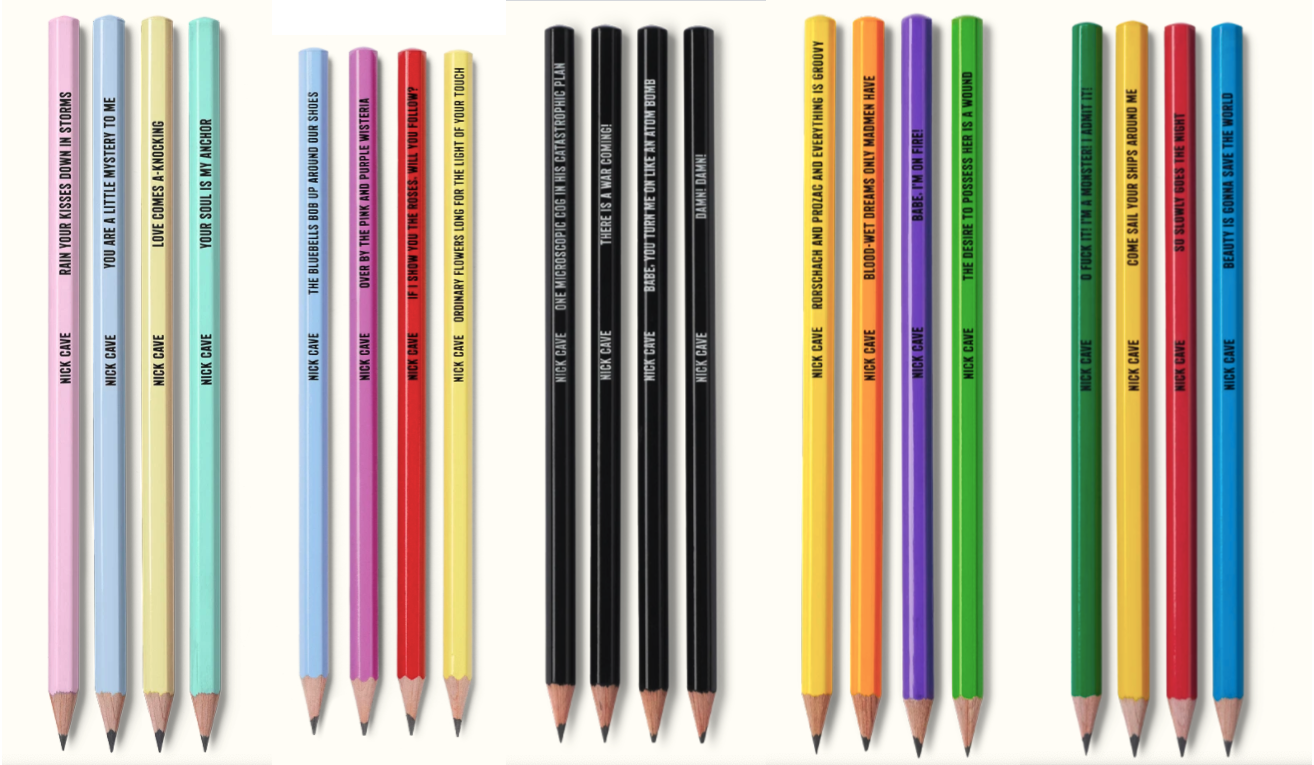
Of all of Cave’s Cave Things, the ones with the broadest appeal may be the pencil sets personalized with thematic snippets of his lyrics.
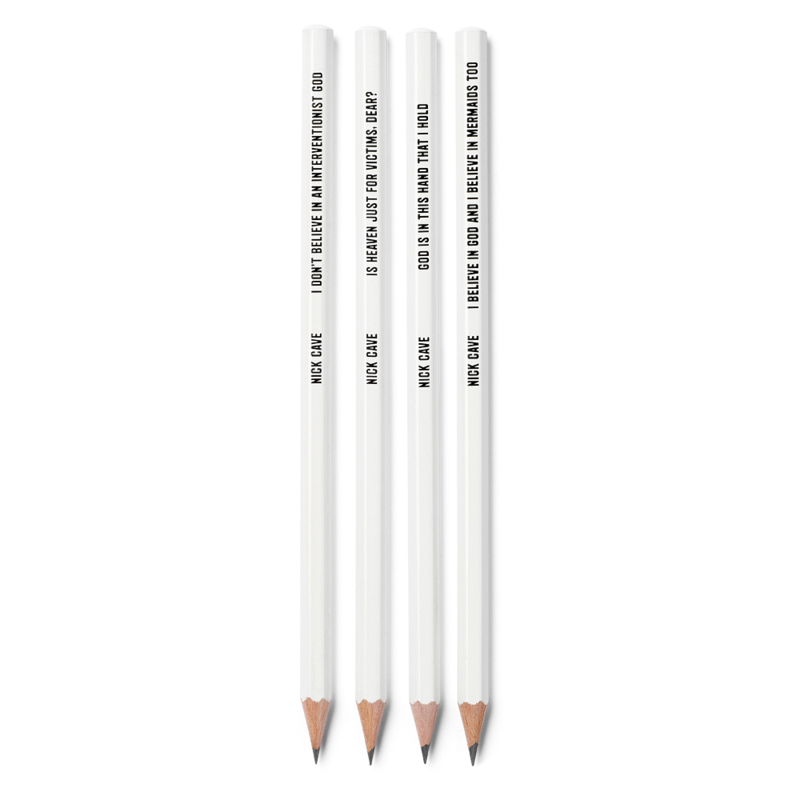
White god pencils quote from “Into My Arms,” “Idiot Prayer,” “Mermaids,” and “Hand of God.”
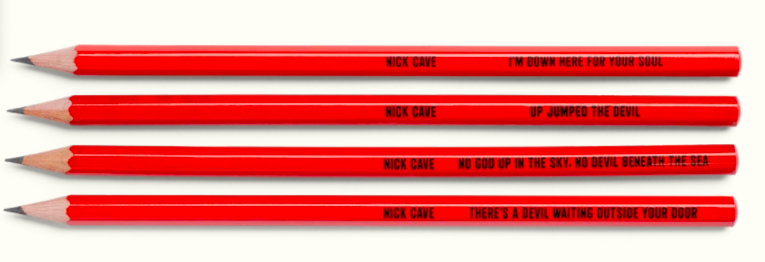
A red devil pencil bearing lines from “Brompton Oratory” slips a bit of god into the mix, as well as a reference to the sea, a frequent Cave motif.
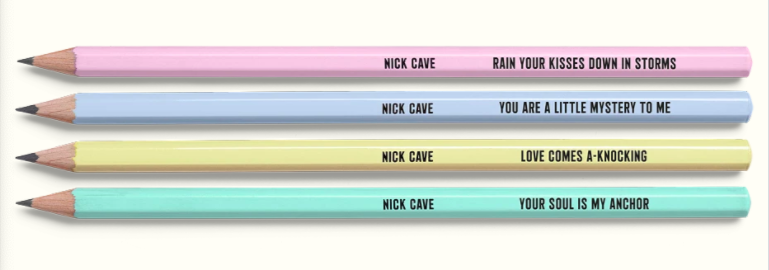

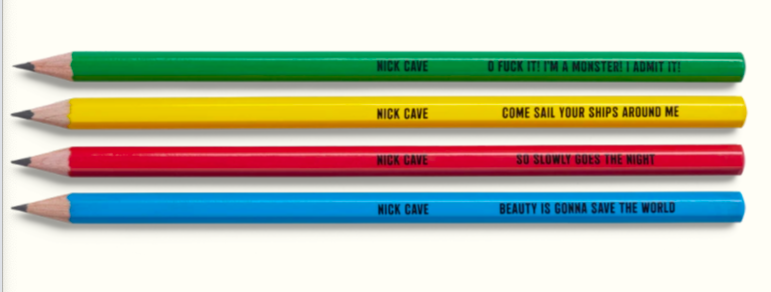
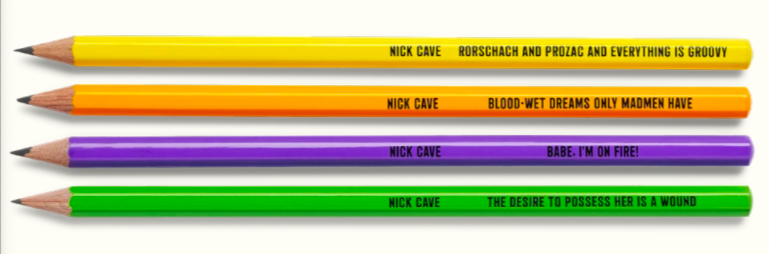
Madness and war pencils are counterbalanced by pencils celebrating love and flowers.
The pencils are Vikings, a classic Danish brand well known to pencil nerds, hard and black on the graphite scale.
Put them all in a cup and draw one out at random, or let your mood or feelings about what said pencil will be writing or drawing determine your pick.
Meanwhile Cave’s implements of choice may surprise you. As he told NME’s Will Richards last December:
My process of lyric writing is as follows: For months, I write down ideas in a notebook with a Bic medium ballpoint pen in black. At some point, the songs begin to reveal themselves, to take some kind of form, which is when I type the new lyrics into my laptop. Here, I begin the long process of working on the words, adding verses, taking them away, and refining the language, until the song arrives at its destination. At this stage, I take one of the yellowing back pages I have cut from old second-hand books, and, on my Olympia typewriter, type out the lyrics. I then glue it into my bespoke notebook, number it, date-stamp it, and sticker it. The song is then ‘officially’ completed.
Hmm. No pencils, though there’s a reference to a blind pencil seller in Cave’s contribution to the soundtrack of Wim Wenders’ science fiction epic Until the End of the World.
Two more lyrics about pencils and he’ll have enough to put a Pencil Pencils set up on Cave Things!
Follow Cave Things on Instagram to keep tabs on new pencil drops.
Related Content:
Listen to Nick Cave’s Lecture on the Art of Writing Sublime Love Songs (1999)
Ayun Halliday is an author, illustrator, theater maker and Chief Primatologist of the East Village Inky zine. Follow her @AyunHalliday.
Read More...Gustav Klimt’s Masterpieces Destroyed During World War II Get Recreated with Artificial Intelligence
A century after the death of Gustav Klimt, his art continues to enrapture its viewers. Maybe it has enraptured you, but no matter how deep you’ve gone into Klimt’s oeuvre, there are three paintings you’ve only ever seen in black and white. That’s not because he painted them in that way; rich and brilliant colors originally figured into all his work, the most notable usage being the real gold layered onto his best-known painting, 1908’s The Kiss. In the year before The Kiss, he completed an even more ambitious work: a series of paintings commissioned for the University of Vienna’s Great Hall, meant to represent the fields after which they were titled: Philosophy, Medicine, and Jurisprudence.
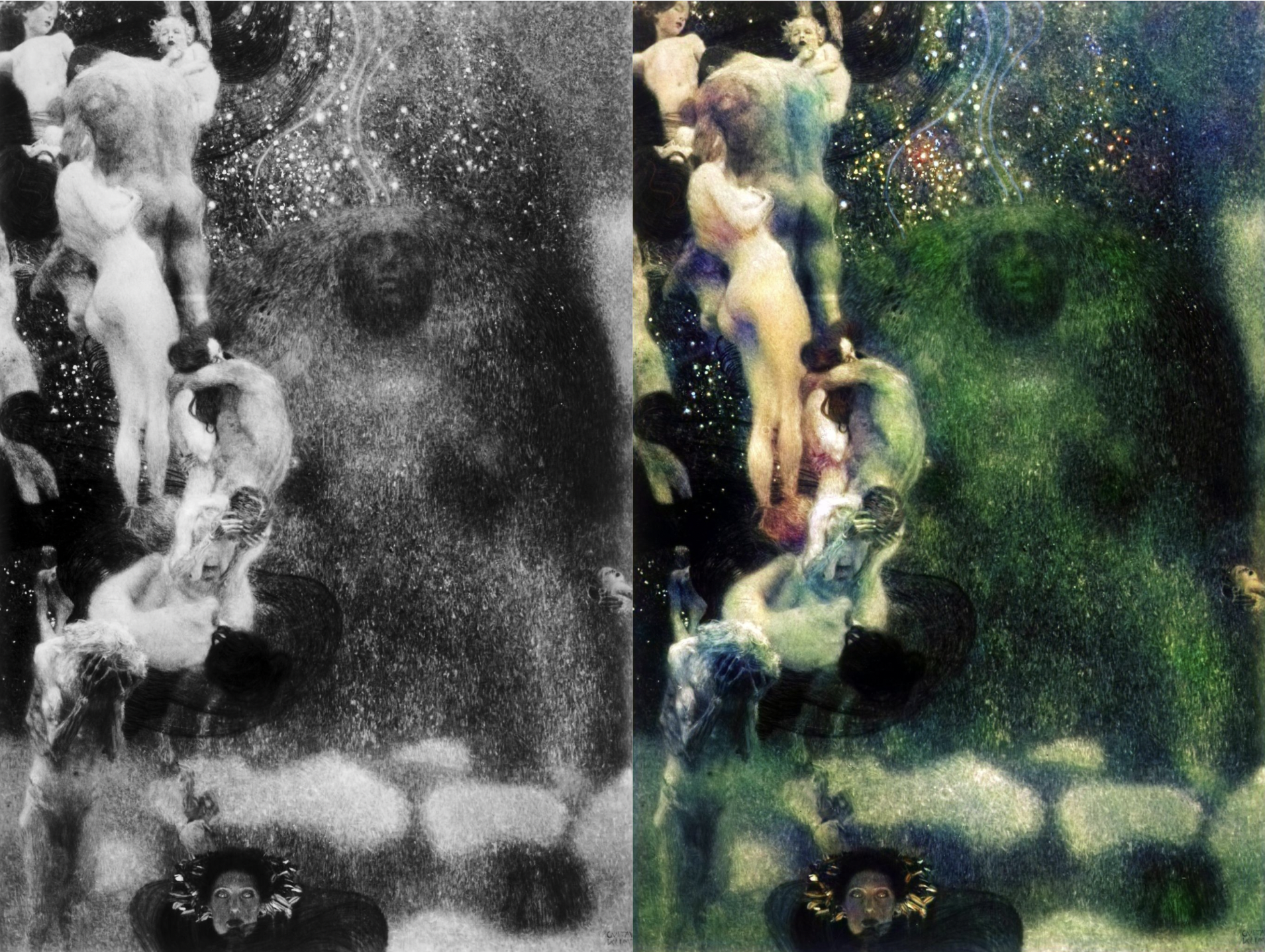
Klimt’s “Faculty Paintings,” as they’re now known, struck critics at the time as pieces of “perverted excess.” Such charges must have been nothing new to Klimt, for whom unabashed eroticism and subjective views of reality — neither particularly in fashion in the institutions of early 20th-century Vienna — constituted basic artistic principles.
Ultimately, Klimt himself bought Philosophy, Medicine, and Jurisprudence back, and by the end of the Second World War all three had found their way into the hands of the Nazis. With defeat looming, they chose to burn down rather than surrender the Austrian castle in which they’d been storing the Faculty Paintings and other works of art.
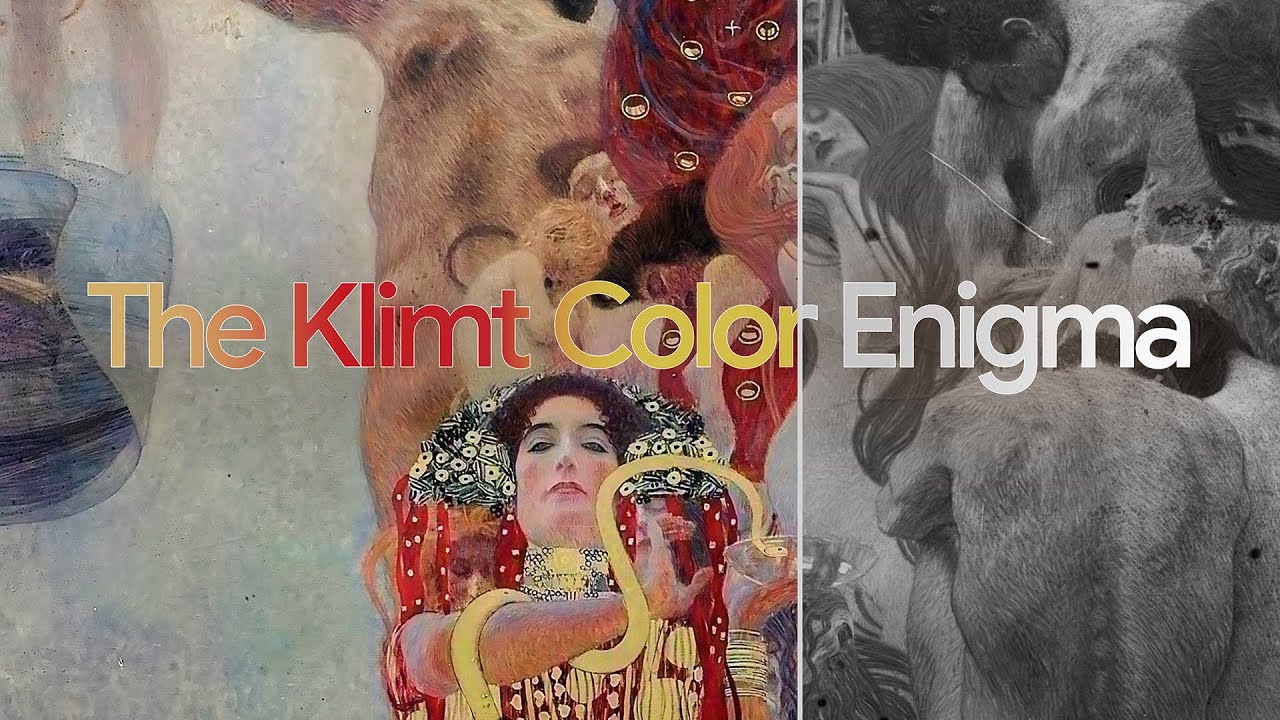
With the Faculty Paintings surviving only in black-and-white photographs and scanty descriptions, generations of Klimt enthusiasts have had to imagine how they really looked. Now, Google Arts & Culture and Vienna’s Belvedere Museum have joined forces to figure out to a greater degree of certainty than ever, using artificial intelligence to determine what colors Klimt would have applied to Philosophy, Medicine, and Jurisprudence based on in-depth analyses of the rest of his work. You can get an overview of the process from the short video at the top of the post, and you can read about it in more detail at Google Arts & Culture.
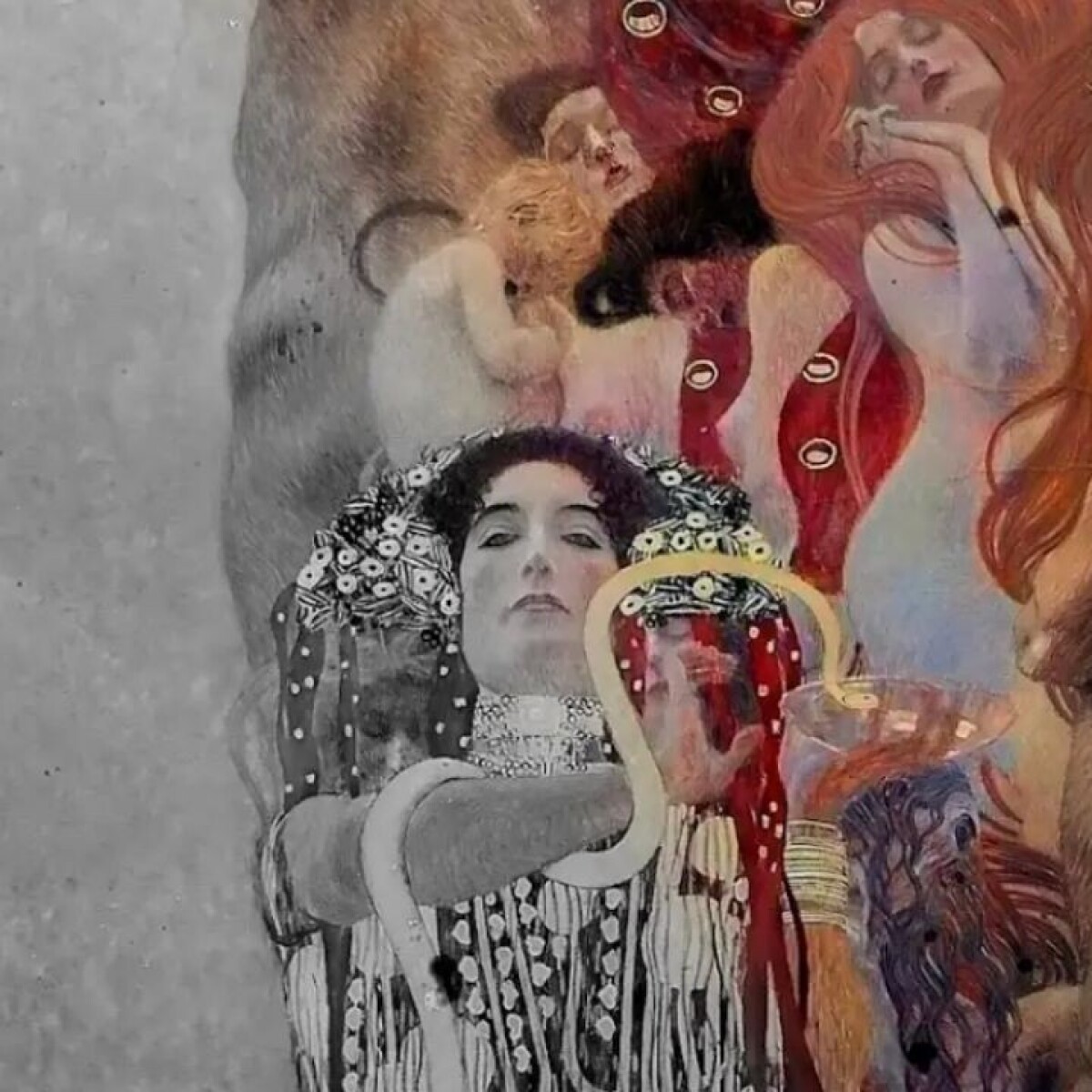
“Klimt’s three Faculty Paintings were among the largest artworks Klimt ever created and in the field of Symbolist painting they represent Klimt’s masterpieces,” says Belvedere curator Dr. Franz Smola in a Google Arts & Culture blog post. “The colors were essential for the overwhelming effect of these paintings, and they caused quite a stir among Klimt’s contemporaries. Therefore the reconstruction of the colors is synonymous with recognizing the true value and significance of these outstanding artworks.” The project comes as just one part of Klimt vs. Klimt: The Man of Contradictions, an online retrospective featuring more than 120 of the artist’s works available to view in augmented reality, as well as an ultra-high-resolution scan of The Kiss. Klimt’s paintings may no longer shock us, but they still have much to show us.
Related Content:
The Long-Lost Pieces of Rembrandt’s Night Watch Get Reconstructed with Artificial Intelligence
AI & X‑Rays Recover Lost Artworks Underneath Paintings by Picasso & Modigliani
Based in Seoul, Colin Marshall writes and broadcasts on cities, language, and culture. His projects include the Substack newsletter Books on Cities, the book The Stateless City: a Walk through 21st-Century Los Angeles and the video series The City in Cinema. Follow him on Twitter at @colinmarshall or on Facebook.
Read More...Why Scientists Can’t Recreate the Sound of Stradivarius Violins: The Mystery of Their Inimitable Sound
In his influential 1936 essay, “The Work of Art in the Age of Mechanical Reproduction,” critic Walter Benjamin used the word “aura” to describe an artwork’s “presence in time and space” — an explanation of the thrill, or chill, we get from standing before a Jackson Pollock, say, or a Michelangelo, rather than a photograph of the same. Writing in the age of radio, photography, and newspapers, Benjamin believed that aura could not be transmitted or copied: “Even the most perfect reproduction of a work of art is lacking in one element” — that rare thing that makes art worth preserving and reproducing in the first place.
Let’s grant, for the sake of argument, that musical instruments have aura — that the very sounds they make are its manifestation, and that, no matter how sophisticated our technology, we may never reproduce those sounds perfectly. As Hank Green explains in the SciShow video above: “For centuries, musicians, instrument makers, engineers, and scientists have been trying to understand and reproduce the ‘Stradivarius’ sound. They’ve investigated everything from the materials their maker used to how he crafted the violins. But the mystique is still there.” Can science solve the mystery?
At heart, the question seems to be whether the aural qualities of a Stradivari instrument can be plucked from their time and place of origin and made fungible, so to speak, across the centuries. Antonio Stradivari (his name is often Latinized to “Stradivarius”) began making violins in the 1600s and continued, with his sons Francesco and Omobono, until his death in 1737, producing around 1000 instruments, most of which were violins. About 650 of those instruments survive today, and approximately 500 of those are violins, ranging in value from tens of millions to priceless.
Green surveys the techniques, materials, physics, and chemical composition of Stradivari violins “to understand why Stradivarius violins have been so hard to recreate.” Their sound has been described as “silvery,” says Green, a word that sounds pretty but has little technical meaning. Rather than rely on adjectives, researchers from diverse fields have tried to work from the objects themselves — analyzing and attempting to recreate the violins’ shape, construction, materials, etc. They’ve learned that time and place matter more than they supposed.
The wood of a Stradivari violin “really is different,” Green says, “but because Stradivari never wrote down his process, researchers can’t quite tell why.” That wood itself grew in a process over which Stradivari had no control. The alpine spruce he used came from trees harvested “at the edge of Europe’s Little Ice Age, a 70-year period of unseasonably cold weather … that slowed tree growth and made for even more consistent wood.” We begin to see the difficulties. One researcher, Joseph Nagyvary, a professor emeritus of biochemistry at Texas A&M University, recently made another discovery. As Texas A&M Today notes:
[Stradivari and fellow maker Guarneri] soaked their instruments in chemicals such as borax and brine to protect them from a worm infestation that was sweeping through Italy in the 1700s. By pure accident the chemicals used to protect the wood had the unintended result of producing the unique sounds that have been almost impossible to duplicate in the past 400 years.
Perhaps we cannot duplicate the sound because none of us is Antonio Stradivari, working with his sons in the early 18th century in Cremona, Italy, building violins with a unique crop of alpine spruce while fighting unseasonably cold weather and worms.
Related Content:
Why Stradivarius Violins Are Worth Millions
Josh Jones is a writer and musician based in Durham, NC. Follow him at @jdmagness
Read More...Quentin Tarantino Reviews Movies: From Dunkirk and King of New York, to Soul Brothers of Kung Fu & More
Some of the most influential directors of the French New Wave, like Jean-Luc Godard, François Truffaut, and Éric Rohmer, first stepped into the world of film as critics. They found their voices by publishing in the Paris cinephile institution of Cahiers du cinéma; a few decades later, Quentin Tarantino found his own by working at the Manhattan Beach cinephile institution of Video Archives. Stories of all the myriad ways in which he would express his enthusiasm for and expertise on cinema there have passed into legend. But just like the critics Godard, Truffaut, and Rohmer, the video-store clerk Tarantino ultimately seems to have signed on to the old proposition that the best response to a work of art is another work of art.
Tarantino’s endorsements of and introductions to the work of other directors (for example, the one he recorded for Wong Kar-wai’s Chungking Express) have given us a sense of his cinematic taste. So, in an even more telling manner, do the elements he steals — by his own admission — from other movies.
A look at the dance scene in Pulp Fiction, for example, reveals a filmmaker well acquainted with the French New Wave, and even more so with the work of Italia master Federico Fellini that came out in the same era. And even if you think you could go head-to-head with Tarantino on midcentury European auteurs, could you match his understanding of A Man Called Tiger, Fatal Needles vs. Fatal Fists, or Soul Brothers of Kung Fu?
Those are just three of the films Tarantino has reviewed at the web site of the New Beverly Cinema, the theater he owns in Los Angeles. Published in a low-profile manner, these short essays on the kind of 1970s Hong Kong martial-arts pictures that rightfully belong on downtown triple-bills (and that Tarantino surely first saw on downtown triple-bills) exude the kind of fan-critic energy that brings to mind bygone days of the internet.
Not that Tarantino eschews more recent movies and movie media. In late 2019 and early 2010, he appeared three times on The Ringer’s The Rewatchables podcast to share his thoughts on three pictures worth seeing again: Christopher Nolan’s Dunkirk from 2017, Tony Scott’s Unstoppable from 2010, and Abel Ferrara’s King of New York from 1990. Listen and you may just feel like a Video Archive customer in the 1980s, getting recommendations from an oddly persuasive clerk.
Related Content:
Quentin Tarantino Picks the 12 Best Films of All Time; Watch Two of His Favorites Free Online
Quentin Tarantino’s Handwritten List of the 11 “Greatest Movies”
An Analysis of Quentin Tarantino’s Films Narrated (Mostly) by Quentin Tarantino
Based in Seoul, Colin Marshall writes and broadcasts on cities, language, and culture. His projects include the Substack newsletter Books on Cities, the book The Stateless City: a Walk through 21st-Century Los Angeles and the video series The City in Cinema. Follow him on Twitter at @colinmarshall or on Facebook.
Read More...Good with Words: A Series of Writing & Editing Courses from the University of Michigan
We’ve all used words just about as long as we’ve been alive. This obvious truth, alas, has led too many of us into the delusion that we’re good with words: that we’re good speakers and, even more commonly and less justifiably, that we’re good writers. Yet anyone who’s seen or heard much of how words are used in the realms of business and academia — to say nothing of personal correspondence — does understand, on some level, the true rarity of these skills. Now, those of us who recognize the need to shore up our own skills can do so through Good with Words, a specialization in writing and editing now offered by the University of Michigan through online education platform Coursera.
Good with Words comprises individual courses on word choice and word order, structure and organization, drafting, and revising. Here to teach them is Michigan Law School Clinical Assistant Professor of Law Patrick Barry, of whose lecturing style you can get a taste in this Youtube playlist collecting clips of a writing workshop held for Michigan Law students in 2014.
In the clip above, he takes on the common problem of verbal clutter, working from the definition originally laid out by On Writing Well author William Zinsser (whose ten writing tips we previously featured here on Open Culture). In other brief views, Barry touches on everything from the power of description and sentence flow to facts versus truths and zombie nouns.
In one workshop clip, Barry reminds his students that, in order to write good sentences, they must read good sentences. This point bears repeating, and indeed Barry repeats it in his Coursera course, the relevant excerpt of which you can view here. “A young writer must read,” he quotes Colum McCann declaring in the book Letters to a Young Writer. “She must read and read and read. Adventurously. Promiscuously. Unfailingly.” But taking a course as well couldn’t hurt, especially when, as with Good with Words, it can be audited for free. (Coursera also offers a paid option for students who would like to receive a certificate upon completing the specialization.) Barry offers plenty of example sentences, good and less so, but the true writers among us will never stop looking for their own, even after Good with Words’ suggested four-month duration is over.
Related Content:
Free Online Writing & Journalism Courses
10 Writing Tips from Legendary Writing Teacher William Zinsser
Martin Amis Explains His Method for Writing Great Sentences
Jane Austen Used Pins to Edit Her Manuscripts: Before the Word Processor & White-Out
Based in Seoul, Colin Marshall writes and broadcasts on cities, language, and culture. His projects include the Substack newsletter Books on Cities, the book The Stateless City: a Walk through 21st-Century Los Angeles and the video series The City in Cinema. Follow him on Twitter at @colinmarshall or on Facebook.
Read More...The Evolution of Kandinsky’s Painting: A Journey from Realism to Vibrant Abstraction Over 46 Years
Like most renowned abstract painters, Wassily Kandinsky could also paint realistically. Unlike most renowned abstract painters, he only took up art in earnest after studying economics and law at the University of Moscow. He then found early success teaching those subjects, which seem to have proven too worldly for his sensibilities: at age 30 he enrolled in the Munich Academy to continue the study of art that he’d left off while growing up in Odessa. The surviving paintings he produced at the end of the 19th century and the beginning of the 20th, displayed on Wikipedia’s list of his works, include a variety of landscapes, most presenting German and Russian (or today Ukrainian) landscapes undisturbed by a single human figure.
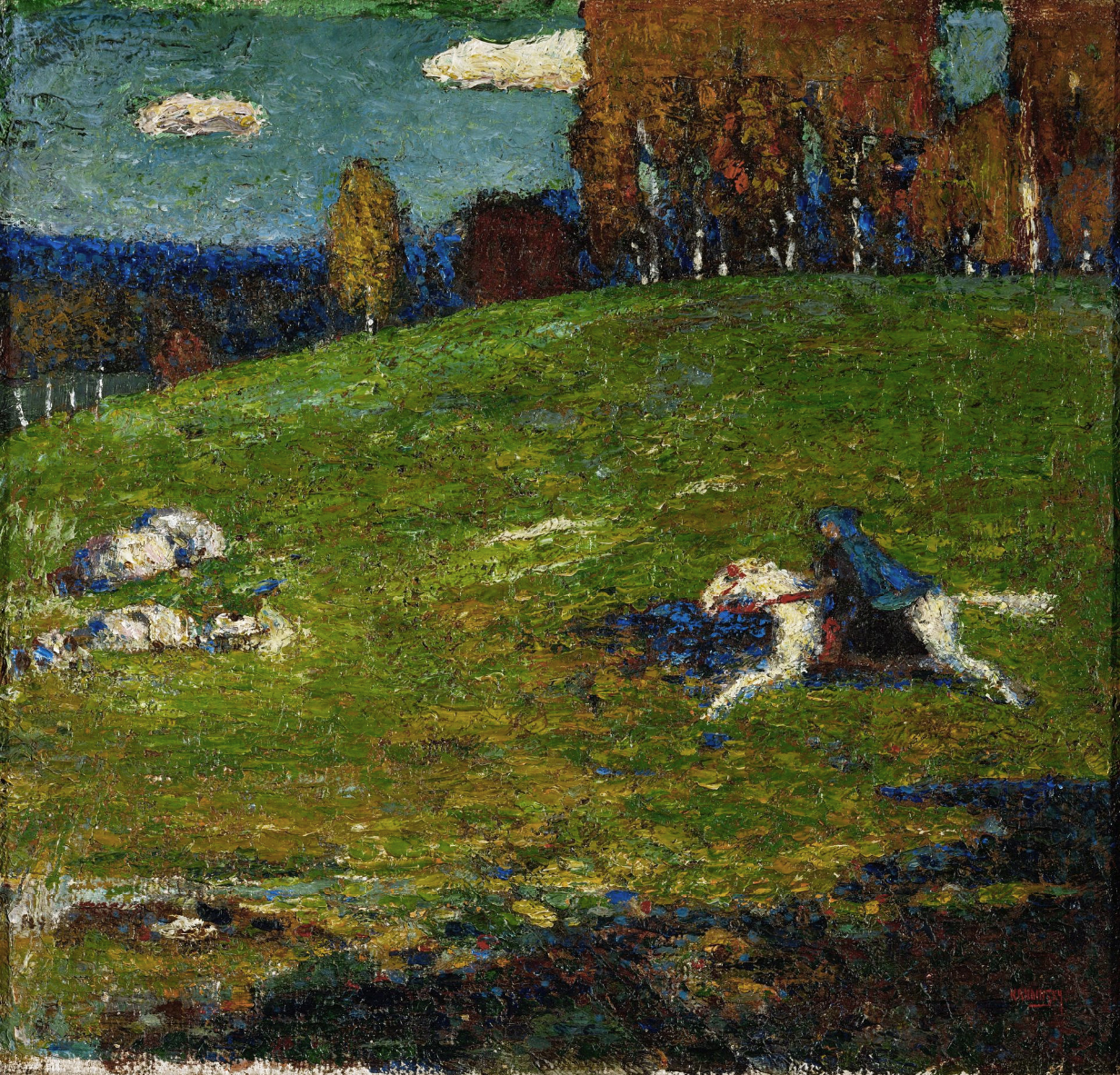
Kandinsky made dramatic change come with 1903’s The Blue Rider (above). The presence of the titular figure made for an obvious difference from so many of the images he’d created over the previous half-decade; a shift in its very perception of reality made for a less obvious one.
This is not the world as we normally see it, and Kandinsky’s track record of highly representative paintings tells us that he must deliberately have chosen to paint it it that way. With fellow artists like August Macke, Franz Marc, Albert Bloch, and Gabriele Münter, he went on to form the Blue Rider Group, whose publications argued for abstract art’s capability to attain great spiritual heights, especially through color.
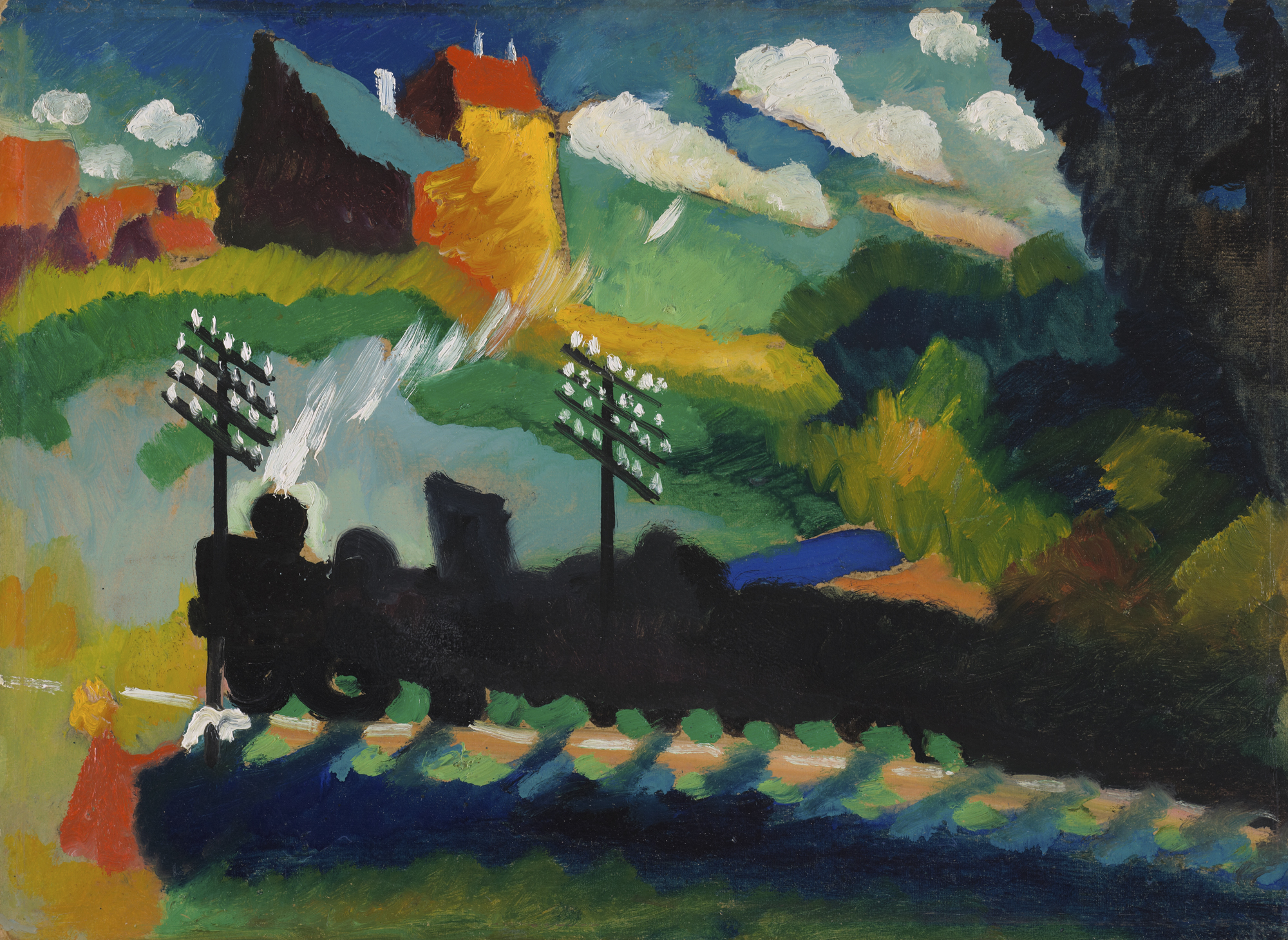
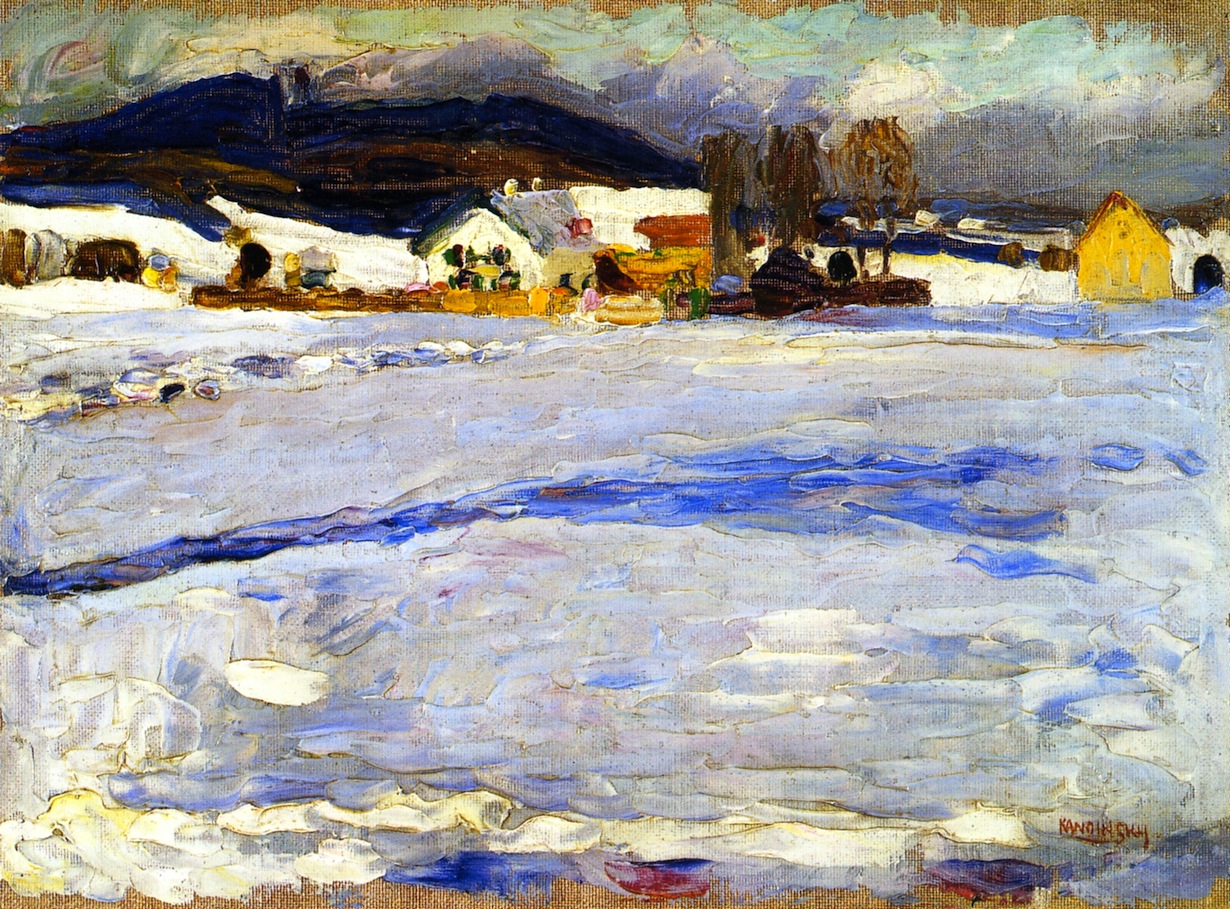
“Gradually Kandinsky makes departures from the external ‘world as a model’ into the world of ‘paint as a thing in itself,’ ” writes painter Markus Ray. “Still depicting ‘worldly scenes,’ these paintings start to take on purer colors and shapes. He reduces volumes into simple shapes, and colors into bright and vibrant hues. One can still make out the scene, but the shapes and colors begin to take on a life of their own.” This is especially true of the scenes Kandinsky painted in Bavaria, such as 1909’s Railway near Murnau above. The outbreak of World War I five years later sent him back to Russia, where he continued his pioneering journey toward a visual art equal in expressive power to music, which he called his “ultimate teacher.” But by the early 1920s it had become clear that his increasingly individualistic and non-representative tendencies wouldn’t sit well with the Soviet cultural powers that be.
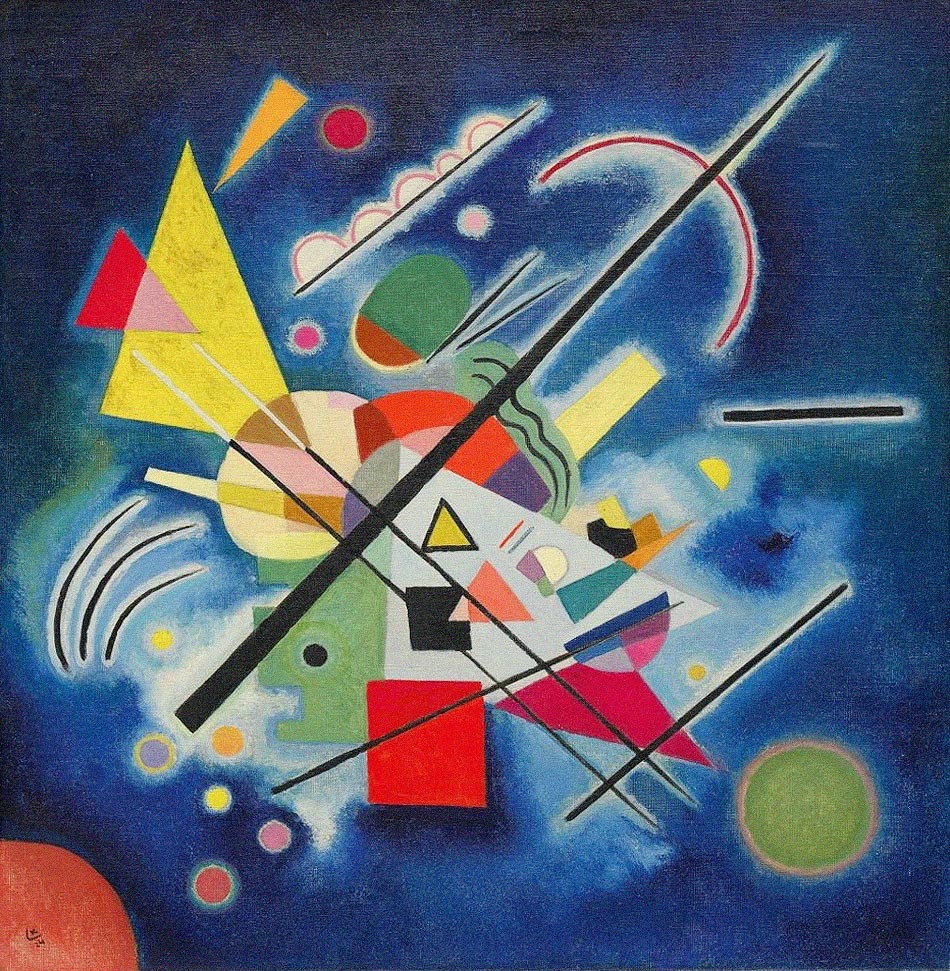
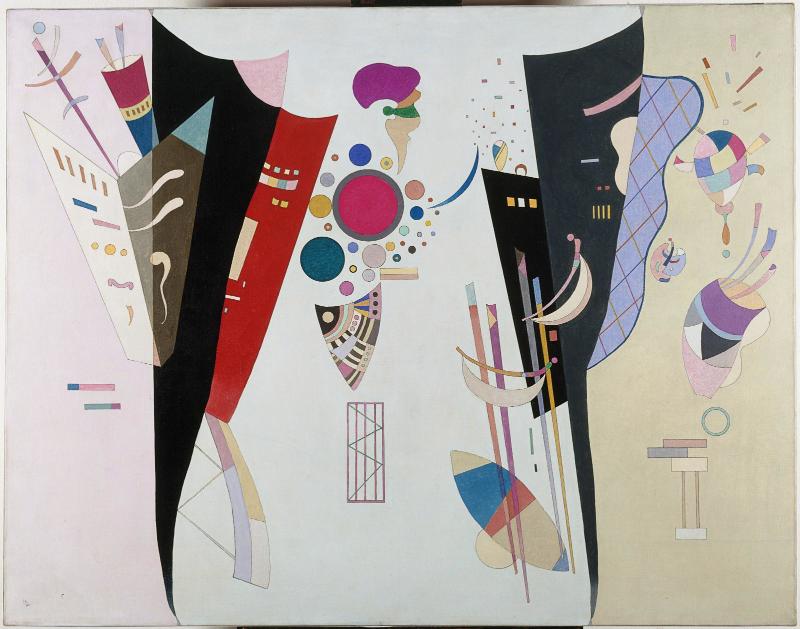
A return to Germany was in order. “In 1921, at the age of 55, Kandinsky moved to Weimar to teach mural painting and introductory analytical drawing at the newly founded Bauhaus school,” says Christie’s. “There he worked alongside the likes of Paul Klee, László Moholy-Nagy and Josef Albers,” and also expanded on Goethe’s theories of color. A true believer in the Bauhaus’ “philosophy of social improvement through art,” Kandinsky also wound up among the artists whose work was exhibited in the Nazi Party’s “Degenerate Art Exhibition” of 1937. By that time the Bauhaus was dissolved and Kandinsky had resettled in Paris, where until his death in 1944 (as evidenced by Wikipedia’s list of his paintings) he kept pushing further into abstraction, seeking ever-purer expressions of the human soul until the very end.
Related Content:
Time Travel Back to 1926 and Watch Wassily Kandinsky Make Art in Some Rare Vintage Video
An Interactive Social Network of Abstract Artists: Kandinsky, Picasso, Brancusi & Many More
How to Paint Like Kandinsky, Picasso, Warhol & More: A Video Series from the Tate
The Guggenheim Puts Online 1700 Great Works of Modern Art from 625 Artists
Based in Seoul, Colin Marshall writes and broadcasts on cities, language, and culture. His projects include the Substack newsletter Books on Cities, the book The Stateless City: a Walk through 21st-Century Los Angeles and the video series The City in Cinema. Follow him on Twitter at @colinmarshall or on Facebook.
Read More...A 10-Course Introduction to Data Science from Johns Hopkins
Data is now everywhere. And those who can harness data effectively stand poised to innovate and make impactful decisions. This holds true in business, medicine, healthcare, education and other spheres of life.
Enter the 10-course Introduction to Data Science from Johns Hopkins. Offered on the Coursera platform, this course sequence covers “the concepts and tools you’ll need throughout the entire data science pipeline, from asking the right kinds of questions to making inferences and publishing results.” The program includes courses covering The Data Scientist’s Toolbox, R Programming, Getting and Cleaning Data, Developing Data Products and more. There’s also a Capstone Project where students can build a data product using real-world data.
Students can formally enroll in the Introduction to Data Science specialization and receive a certificate for each course they complete–a certificate they can share with prospective employers and their professional networks. They’ll also leave with a portfolio demonstrating mastery of the material covered in the sequence. Hopkins estimates that most learners can complete the sequence in 3–7 months, during which time students will be charged $49 per month.
Alternatively, students can audit individual courses for free. When you enroll in a course, look carefully for the Audit option. Note: Auditors cannot receive a certificate for each completed course.
If would like to formally enroll in the Introduction to Data Science sequence, you can start a 7‑Day Free Trial and size things up here.
Open Culture has a partnership with Coursera. If readers enroll in certain Coursera courses and programs, it helps support Open Culture.
Related Content:
Read More...Support Us
We're hoping to rely on loyal readers, rather than erratic ads. Please click the Donate button and support Open Culture. You can use Paypal, Venmo, Patreon, even Crypto! We thank you!

About Us

Open Culture scours the web for the best educational media. We find the free courses and audio books you need, the language lessons & educational videos you want, and plenty of enlightenment in between.
Advertise With Us
FREE UPDATES!
GET OUR DAILY EMAIL
Get the best cultural and educational resources on the web curated for you in a daily email. We never spam. Unsubscribe at any time.
FOLLOW ON SOCIAL MEDIA
Open Culture editor Dan Colman scours the web for the best educational media. He finds the free courses and audio books you need, the language lessons & movies you want, and plenty of enlightenment in between.
Advertise With Us

