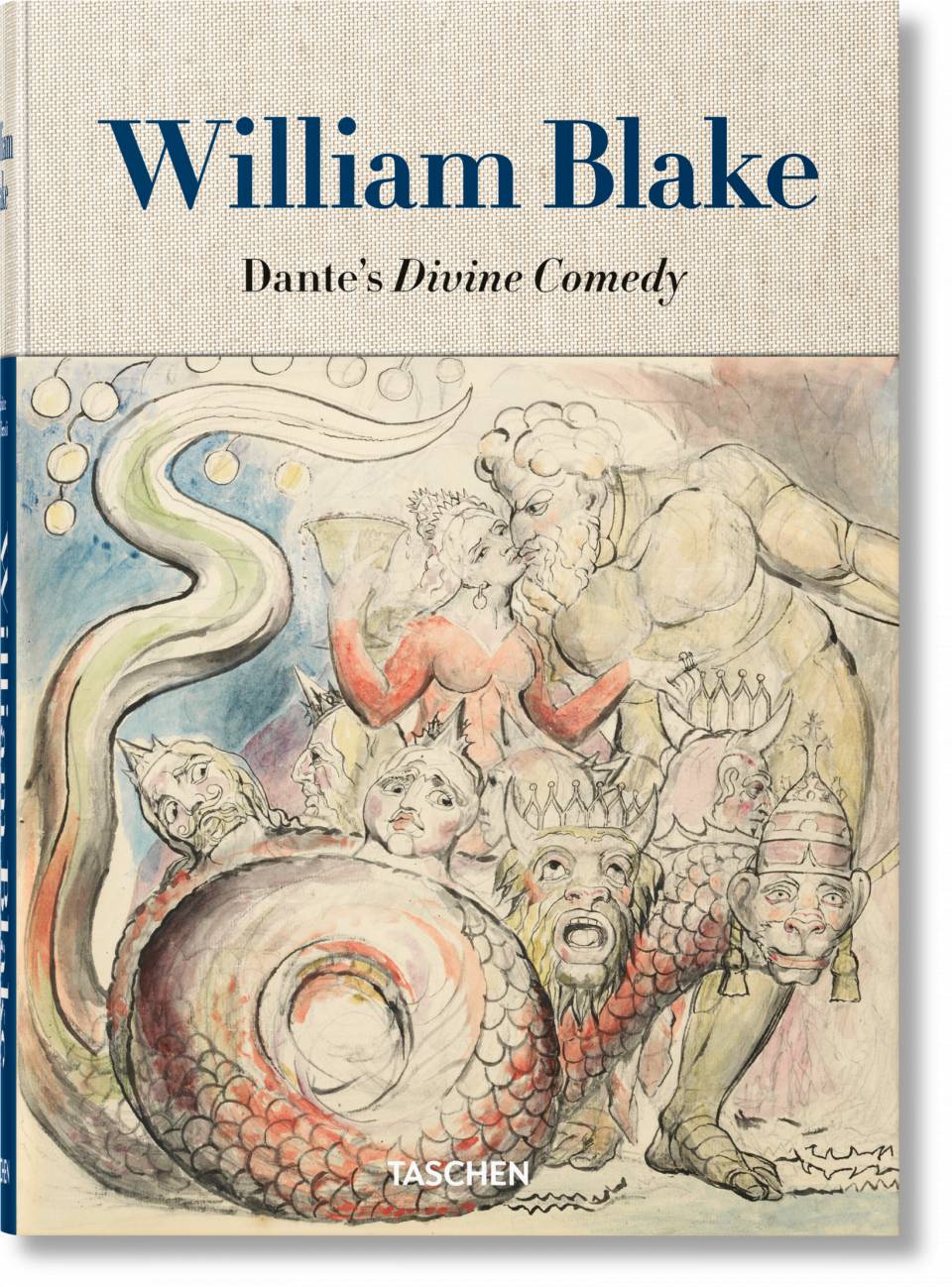
William Blake’s 102 Illustrations of The Divine Comedy Collected in a Beautiful Book from Taschen
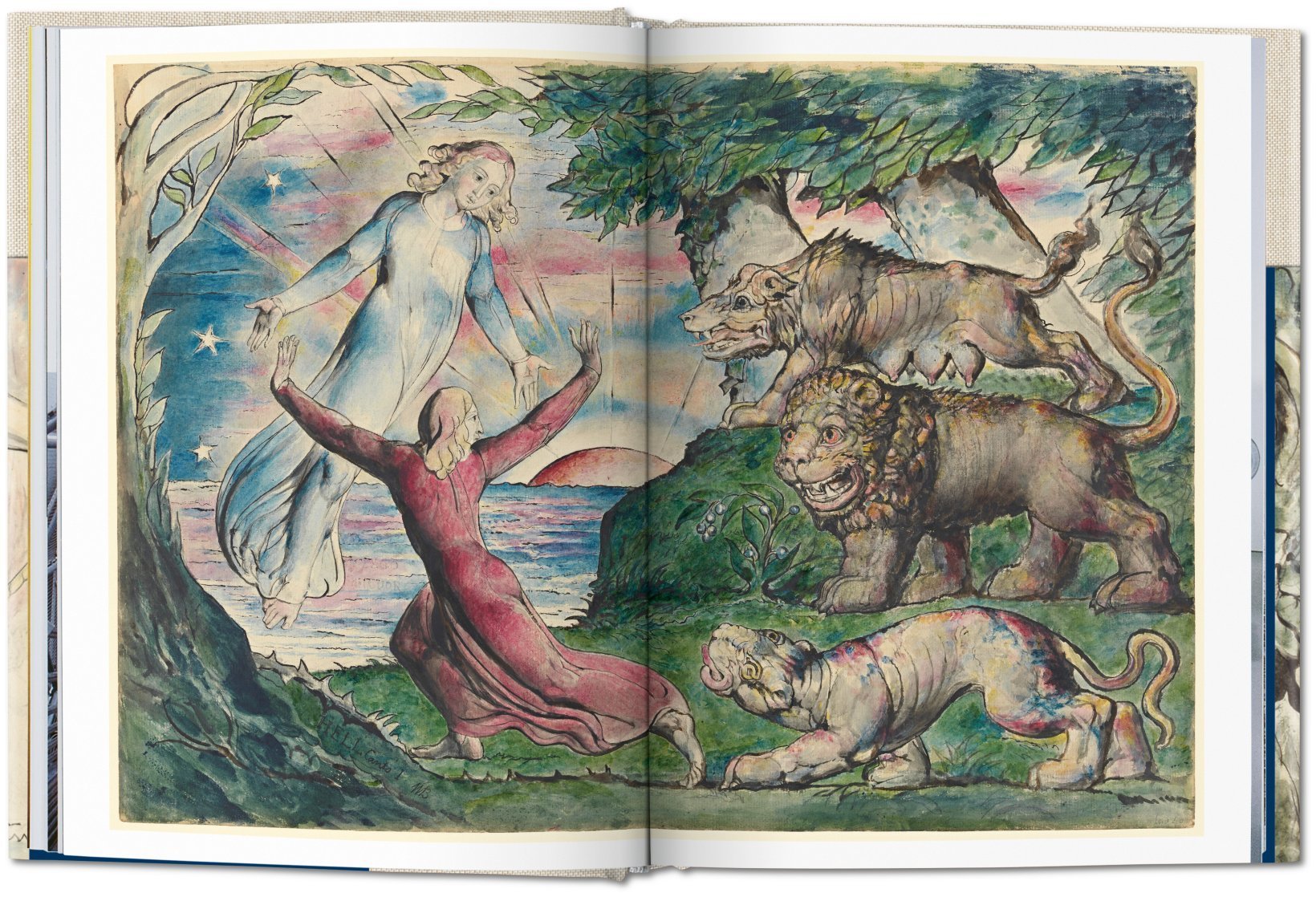
In his book on the Tarot, Alejandro Jodorowsky describes the Hermit card as representing mid-life, a “positive crisis,” a middle point in time; “between life and death, in a continual crisis, I hold up my lit lamp — my consciousness,” says the Hermit, while confronting the unknown. The figure recalls the image of Dante in the opening lines of the Divine Comedy. In Mandelbaum’s translation at Columbia’s Digital Dante, we see evident similarities:
When I had journeyed half of our life’s way,
I found myself within a shadowed forest,
for I had lost the path that does not stray.Ah, it is hard to speak of what it was,
that savage forest, dense and difficult,
which even in recall renews my fear:so bitter—death is hardly more severe!
This is not to say the literary Dante and occult Hermeticism are historically related; only they emerged from the same matrix, a medieval Catholic Europe steeped in mysterious symbols. The Hermit is a portent, messenger, and guide, an aspect represented by the poet Virgil, whom William Blake — in 102 watercolor illustrations made between 1824 and 1827 — dressed in blue to represent spirit, while Dante wears his usual red — the color, in Blake’s system, of experience.
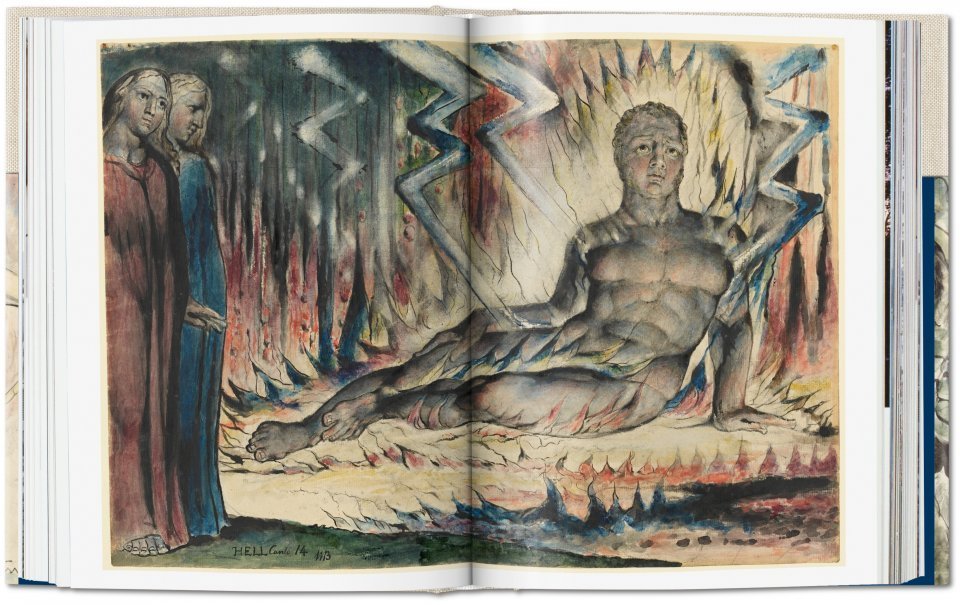
Blake did not read the Divine Comedy as a medieval Catholic believer but as a visionary 18th and 19th century English artist and poet who invented his own religion. He “taught himself Italian in order to be able to read the original” and had a “ complex relationship” with the text, writes Dante scholar Silvia De Santis.
His interpretation drew from a “widespread ‘selective use’” of the poet,” dating from 16th century English Protestant readings which saw Dante’s satirical skewering of corrupt individuals as indictments of the institutions they represent — the church and state for which Blake had no love.
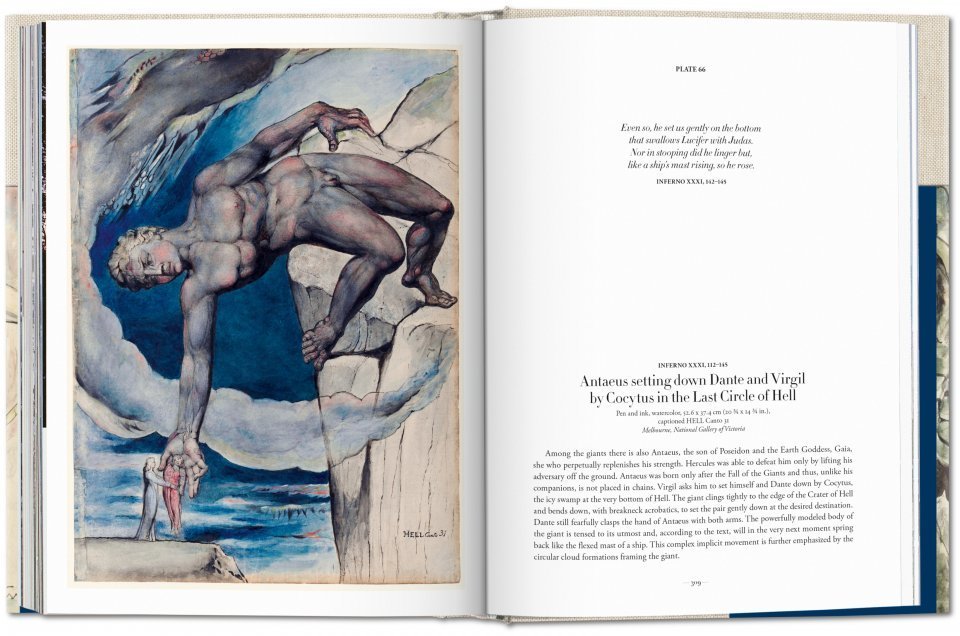
Approaching the project at the end of his life, not the middle, Blake drew primarily on themes that Dante scholar Robin Kilpatrick describes as a “searching analysis of all of the political and economic factors that had destroyed Florence .… Hell is a diagnosis of what, in so many ways, can prove to be divisive in human nature. Sin, for Dante, is not transgression of an ordinary kind … against some law… it’s a transgression against love.”
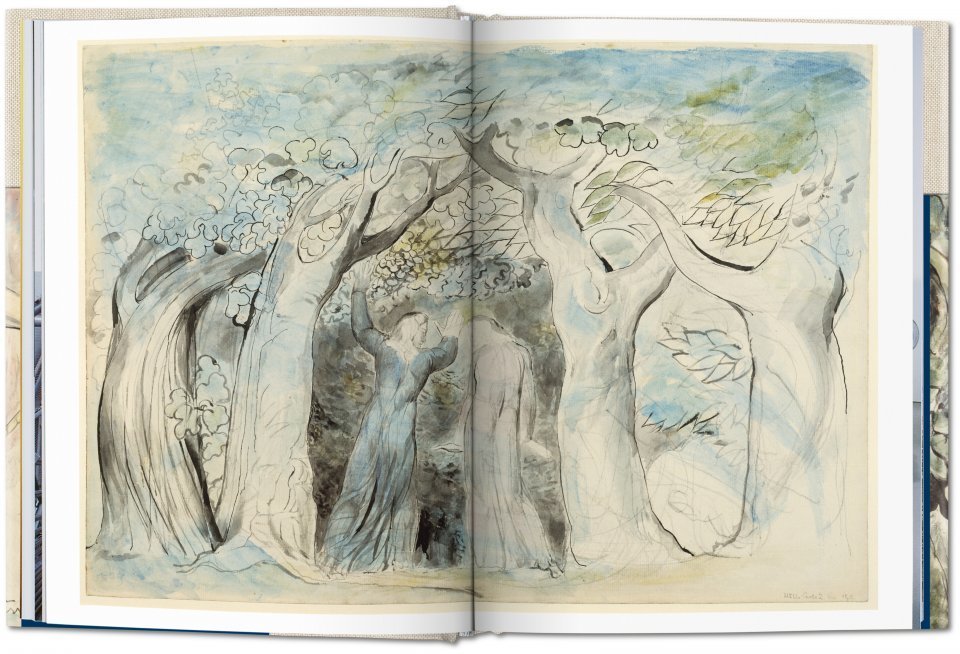
Blake died before he could finish the series, commissioned by his friend John Linnell in 1824. He had intended to engrave all 102 illustrations, conceived, he wrote, “during a fortnight’s illness in bed.” You can see all of his stunning watercolors online here and find them lovingly reproduced in a new book published by Taschen with essays by Blake and Dante experts, helping contextualize two poets who found a common language across a span of 500 years. The book, originally priced at $150, now sells for $40. A beautiful XL edition sells at a higher price.
Related Content:
A Digital Archive of the Earliest Illustrated Editions of Dante’s Divine Comedy (1487–1568)
Josh Jones is a writer and musician based in Durham, NC. Follow him at @jdmagness.
Read More...The First Air Raid Happened When Austria Dropped Bombs on Venice from Pilotless Hot-Air Balloons (1849)
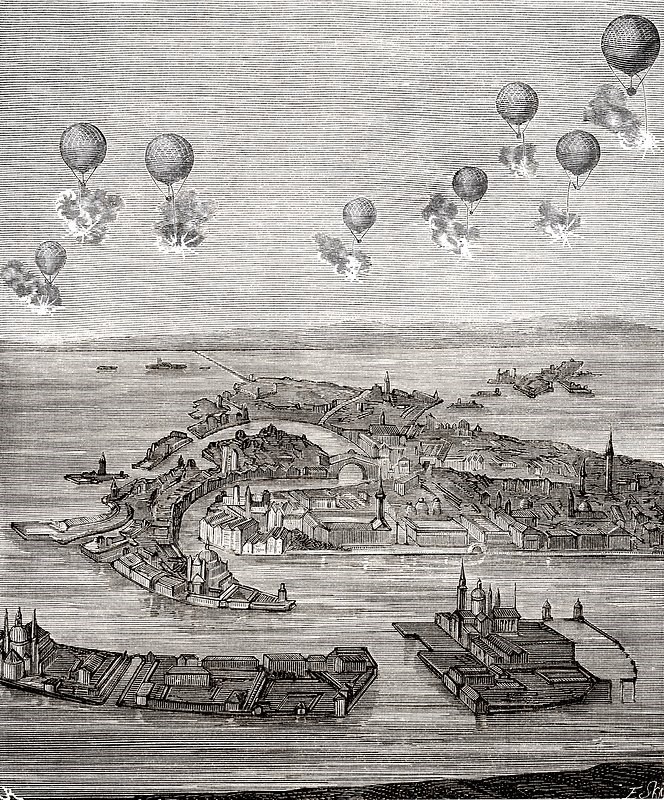
We surround the phrase “ahead of its time” with a mystical aura. But just because an idea shows up earlier than we expect does not mean it was ever a good idea for human progress. Take, for example, the idea to rain incendiary devices on the heads of civilian populations in wartime. Recent iterations of this technology — unmanned drones surgically bombing weddings and funerals — may be an improvement over Hiroshima or napalm-happy helicopter pilots like Apocalypse Now’s Bill Kilgore. But drones have not, thereby, rendered the nuclear option or trigger-happy death from above obsolete, or made mass civilian casualties less tragic and unnecessary, comparisons of raw numbers aside.
Drone bombing is one of those ideas that showed up ahead of its time — at the very first use of aerial bombing of any kind. Unmanned Aerial Vehicles (UAVs) were launched in the service of a military operation 30 years before Edison harnessed electricity for home use.
In 1849, remote piloting was hardly possible. But it was possible to launch a fleet of hot air balloons loaded with explosives from a ship and send them in the general direction of a target. That’s what the Austrian army did — twice — over Venice, in a campaign to recapture the city when its citizens rebelled against imperial rule and built their own republic. Luckily for Venice, the first use of naval air power was also the least effective.
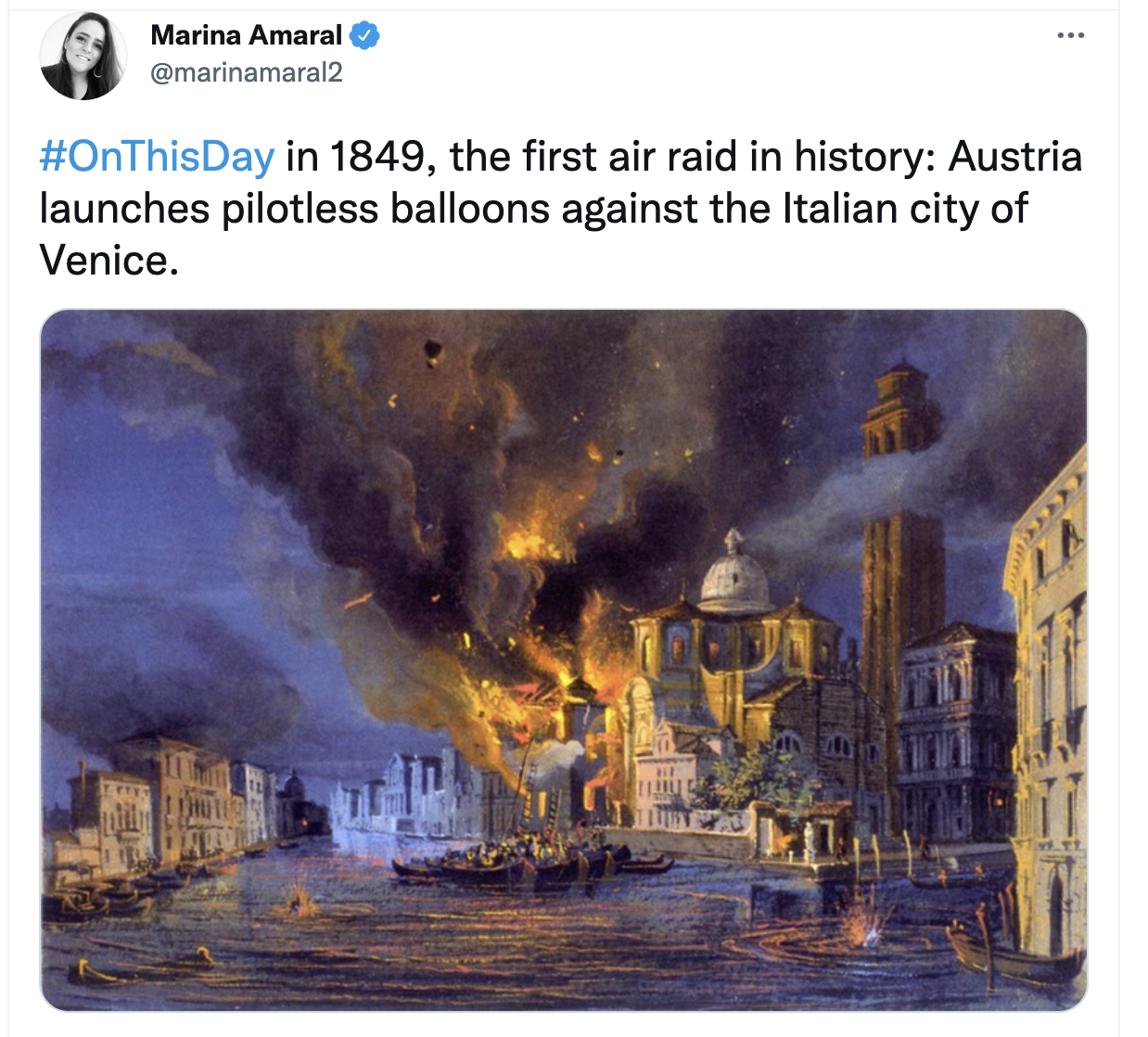
The balloons “carried 33 pounds of explosives,” writes Monash University professor Russell Naughton, “set with a half-hour time fuse, and troops scurried around with them to launch them into the proper wind currents.” The idea for the bombardment came from an Austrian artillery lieutenant named Franz von Uchatius and was initially carried out on July 12, 1849. This attempt “failed because the wind was not in Austria’s favor,” writes Weapons and Warfare, quoting from a contemporary account in Time magazine:
The balloons appeared to rise to about 4,500 ft. Then they exploded in midair or fell into the water, or, blown by a sudden southeast wind, sped over the city and dropped on the besiegers. Venetians, abandoning their homes, crowded into the streets and squares to enjoy the strange spectacle. … When a cloud of smoke appeared in the air to make an explosion, all clapped and shouted. Applause was greatest when the balloons blew over the Austrian forces and exploded, and in such cases the Venetians added cries of ‘Bravo!’ and ‘Good appetite!’
More spectacle than threat, the balloon bombs might have been abandoned as a failed experiment, but the Austrians were persistent; they had besieged the city, determined to subdue it. Another attack on August 22 seems to have also done more damage to the Austrians than their targets. Although the balloons could not be piloted, the detonation of their charges was controlled, Scientific American wrote that year, “by electro magnetism by means of a long isolated copper wire with a large galvanic battery placed on the shore. The bomb falls perpendicularly, and explodes on reaching the ground” … theoretically.
It is not clear from the sources how many bombs were launched. Numbers range from 2 to 200. In any case, the bombing would have little effect on ending the siege, which went on for five more months afterward, and they received little notice in the press. They did, however, have the effect after their second appearance of producing “extreme terror,” the British Morning Chronicle reported, documenting the first appearance of “shock and awe.” And terror was “clearly what was intended,” Brett Holman writes at Airminded, rather than a strategic offensive. “The bombs used were filled with shrapnel, which isn’t much use for anything but killing and maiming people. So there were few qualms on the part of the Austrians about targeting and killing civilians.” They were simply killed more efficiently with conventional artillery and starvation.

The example of the Austrians was not followed by other armies, who weren’t eager to have explosive balloons blow back on their own lines. The idea of bombing cities from the air, writes Holman, “had to be invented all over again. Which it was, of course, and Venice’s next air raid was on 24 May 1915.”
Just last year, the entire city shut down — “even planes were barred from flying to and from Venice’s Marco Polo Airport,” DW reported — as authorities led an effort to “remove and defuse a World War II-era bomb” on what local media dubbed “Bomba Day.”
via Marina Amaral
Related Content:
Watch Venice’s New $7 Billion Flood Defense System in Action
How Venice Works: 124 Islands, 183 Canals & 438 Bridges
A Drone’s Eye View of the Ruins of Pompeii
Josh Jones is a writer and musician based in Durham, NC. Follow him at @jdmagness
Read More...Hear Charlie Watts Inimitable Isolated Drum Tracks on “Gimme Shelter,” “Beast of Burden,” and “Honky Tonk”
When I was a kid in New Jersey, if you were looking for work, there’d be ads for musicians. In the mid-60s and 70s, they would invariably say: “Wanted: Charlie Watts type drummer” — Max Weinberg
Since Charlie Watts passed away last month, tribute upon tribute has poured in to celebrate his style, his austere simplicity, his role as the calm, steady eye of the Rolling Stones’ roiling storm. “Drumming is often ugly,” Amanda Petrusich wrote at The New Yorker, “but Watts looked so beautiful when he played … His posture alone suggested a preternatural elegance … there is always poetry in restraint.”
This is the way Watts’ playing looks to non-musicians, and most Rolling Stones fans are not musicians, and do not listen to rock drumming alone. “It’s possible to find Watts’s isolated drum tracks online,” Petrusich writes, “If you’re into that sort of thing. They’re not always perfect in the technical sense, but they are deeply perfect in other, less quantifiable ways.” Watts himself described his drumming as non-technical and decried his lack of training. It was all about the band, he said repeatedly.
But ask other drummers to quantify Watts’ perfection and they’ll do so happily. Watts taught himself to play by listening to his favorite jazz drummers, writes Max Weinberg, “among them the great English jazz drummer Phil Seamen, and Dave Tough, an American drummer who even looked like Charlie: a fastidious dresser, apparently with the most incredible groove and sound.” Weinberg, who incorporated Watts’ influence on Springsteen songs like “Born to Run,” elaborates further.
One way Watts commanded a room, he says, was as a proponent “of a style of rock drumming popularized by the late, great Al Jackson, the famous Stax drummer, where you deliberately play behind the direct backbeat. The way you do that — which is a little technical — is not by focusing on the two and the four beat, but the one and the three. Another example is James Brown’s music, which is heavily focused on landing on the one. It takes a long time to be able to do that.” He developed the skill as a blues and jazz drummer even before Mick and Keith seduced him to the Stones.
Another drum celebrity admirer, Stewart Copeland, writes about Watts’ unique dynamics. As a rock drummer trained on jazz, he “went for groove, and derived power from relaxation. Most rock drummers are trying to kill something; they’re chopping wood. Jazz drummers instead tend to be very loose to get that jazz feel, and he had that quality.” While Mick strutted and dripped across the stage, Charlie “hardly broke a sweat.” From this, Copeland learned that “you can actually get a better sound out of your drums, and a better groove, if you relax.”
In the classic drum tracks here, listen for some of Watts’ distinctive, subtle moves, and read more about his technique in Copeland and Weinberg’s reminisces here. It’s fair to say that every rock drummer who came after Charlie Watts learned something from Charlie Watts, whether they knew it or not. But while “you can analyze Charlie Watts,” Copeland writes, “that still won’t get you to his feel and his distinct personality. It’s an X‑factor, it’s a charisma, it’s an undefinable gift of God.” Petrusich concludes her tribute with a similar expression of non-technical awe: “Watching Watts play is still one of the best ways I know to check in with the riddle and thrill of art — to witness something miraculous but not to understand it.”
Related Content:
Saying Goodbye to Charlie Watts (RIP), the Engine of the Rolling Stones for Half a Century
Josh Jones is a writer and musician based in Durham, NC. Follow him at @jdmagness
Read More...The Brilliant 19th-Century Astronomical Drawings of Étienne Léopold Trouvelot
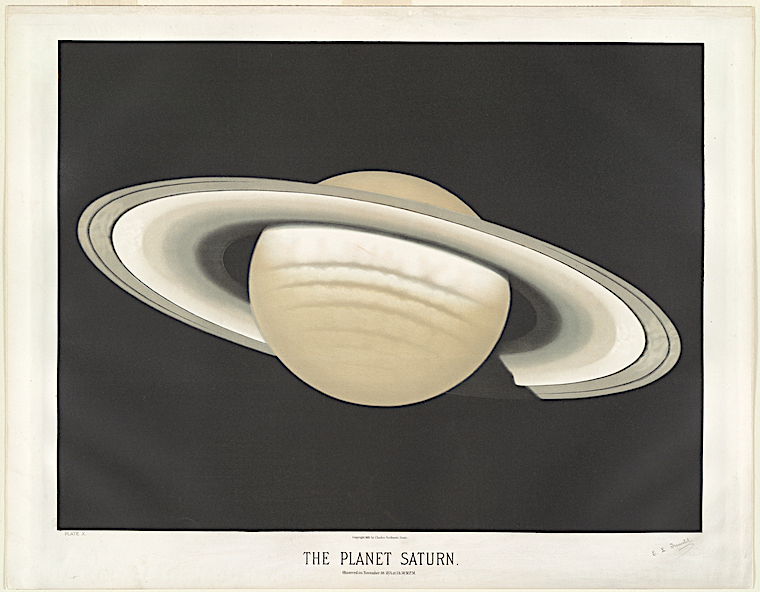
The first photo of the moon was taken in 1850 by Louis Daguerre, from whom the daguerrotype gets its name. We have no idea what that first image looked like as it was lost in a studio fire. But the need to catalog the heavens with modern tools had started, and was both fascinating as it was lacking. Into this evolution of science and art stepped Étienne Léopold Trouvelot, the French immigrant, living in the States, an amateur scientist and an illustrator. He would dismiss photography of the heavens as “so blurred and indistinct that no details of any great value can be secured.” And by illustrating instead by he saw through telescopes, he secured a place in art *and* science history.
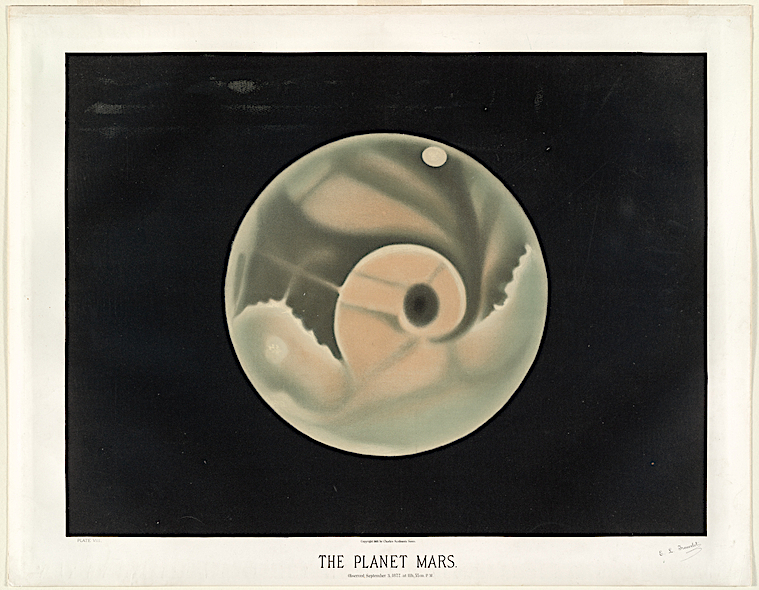
Trouvelot might have thought his scientific papers would be his legacy. He wrote fifty in his lifetime. Instead it is his roughly 7,000 illustrations of planets, comets, and other phenomena that still please us to this day. The New York Public Library has put 15 of his best up on their site, and over at this page, you can compare what Trouvelot saw—-the great astronomer Emma Converse called Trouvelot the “prince of observers”—-to photos from NASA’s archive.
Even if his Mars is a bit fanciful, looking translucent like a fish egg, his understanding of the planet echoes in the following century of sci-fi paranoia. Something strange must be there, he suggests.

Harvard hired him to sketch at their college’s observatory, and he used pastels to bring the planets to life. Engraving or ink would not have worked as well as these soft shapes and determined lines. His rendering of the moon surface is accurate but also fanciful, like whipped cream. And his sun spots might not be accurate, but they replicated the god-like forces at work on its tumultuous surface. His Saturn is the most realistic of them all. Even the NASA image doesn’t look too different to Trouvelot’s art.

These images also help rehabilitate Trouvelot’s other legacy—-the dreaded Gypsy Moth. Before his stint as amateur scientist, he was also an amateur entomologist, and while researching silkworms and silk production, accidentally let European gypsy moths into North America, where they wreaked havoc on the forests of North America. Saturn’s rings may look the same back then as they do now, but so does the damage of the gypsy moth, which according to Wikipedia is up to $868 million in damages per year.

Related Content:
A 9th Century Manuscript Teaches Astronomy by Making Sublime Pictures Out of Words
Jocelyn Bell Burnell Changed Astronomy Forever; Her Ph.D. Advisor Won the Nobel Prize for It
Ted Mills is a freelance writer on the arts who currently hosts the Notes from the Shed podcast and is the producer of KCRW’s Curious Coast. You can also follow him on Twitter at @tedmills, and/or watch his films here.
Read More...Philosophy vs. Improv: A New Podcast from The Partially Examined Life and Chicago Improv Studio
The Partially Examined Life Philosophy Podcast has been sharing reading-group discussions on classic philosophy texts for well over a decade, with over 40 million downloads to date.
However, interactive conversations about texts you probably haven’t read can be difficult to follow no matter how much we try to make them accessible, and a decade of history means that many names that might be dropped that those newly checking in may or may not be familiar with.
I’m one of the hosts of that podcast, and while I’m very happy with the format and thrilled to have reached so many people with it, I also appreciate the dynamic of a one-on-one tutoring interchange, and I stand firmly behind one of the original rules of The Partially Examined Life: No name-dropping.
As we read more complicated texts, our interest becomes figuring out what the philosopher meant, and only secondarily whether that meaning actually relates to something in people’s actual lives. Yes, we are critical (some say too critical) of the subject-matter, but we’re also big fans; we could bask in the literary glow of Hegel or Plato or Simone de Beauvoir or Hannah Arendt all day, and have often done so.
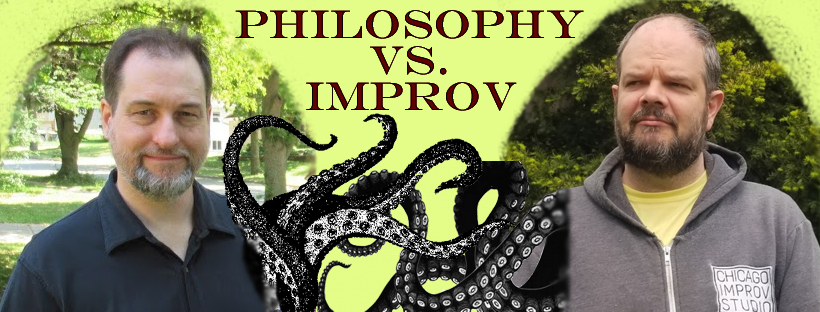
My newest podcast, Philosophy vs. Improv, is reciprocal tutoring realized as comedy (or at least performance art?). As someone who studied philosophy for many years in school and has then been hosting The Partially Examined Life for so long, I’m in a good position to come up with particular philosophical points worth teaching to a new learner.
My Philosophy vs. Improv co-host is Bill Arnett, founder of the Chicago Improv Studio, author of The Complete Improviser, and the former training director at Chicago’s famed iO Theater. He has appeared repeatedly on the Hello From the Magic Tavern improv comedy podcast as a character named Metamore who leads the show’s hosts (who are all fantasy characters a la Tolkein or Narnia) in a table-top role-playing game called Offices and Bosses. This and other shows ignited in me an urge to learn the fundamentals of improv comedy, and so each Philosophy vs. Improv episode, Bill comes up with some trick of the trade to try to teach me.
There are two rules of engagement: First, we can’t just state up front what the lesson is. We can ask each other questions, go through exercises, and otherwise discuss the material, but the lesson should emerge naturally. Second, we don’t take turns in trying to teach each other. As he’s making me act out scenes, I’m trying to set up those scenes or have my character react in such a way to exemplify my philosophical point. As we’re discussing philosophy, Bill is relating it to comparable points about improv. Of course, we’re both interested in learning as well as teaching, so the “vs.” in the show’s title is not so much competition between us as between which lesson ends up more nearly producing its intended effect in the other person.
It is surprising how smoothly these dueling lessons often fit together, as lessens about ethics in particular, about the art of living, are very much relevant to the improvisational skills of being present, presenting yourself, discovering the reality of a situation, and exploring truths of character. Fiction is often a very effective vehicle for addressing philosophy, whether the characters themselves are talking philosophically (even if they’re animals, cave men, or otherwise in a non-typical situation for discussion), or perhaps we’re embodying some political situation or thought experiment that we’re subjecting to philosophical analysis.
Likewise, back to the days of Plato, a dose of irony in discussing philosophy can be useful, and this format allows us to not just be ourselves on a podcast discussing philosophy, but at any point to launch into some comedy bit, and in this way show the absurdity of views we’re arguing against or just play with the ideas in a manner that I think enhances mental flexibility, which is essential both for improvisation and for philosophical creativity.
Listen to the latest episode (#7), entitled “Meritocracy Now!”
Start listening with Philosophy vs. Improv episode 1.
For more information, see philosophyimprov.com.
Mark Linsenmayer is the host of four podcasts: Pretty Much Pop: A Culture Podcast, Nakedly Examined Music, The Partially Examined Life, and Philosophy vs. Improv.
Read More...Become a Project Manager Without a College Degree with Google’s Project Management Certificate
As we first mentioned last year, Google has launched a series of Career Certificate programs that allow students to gain expertise in a field, ideally enough to start working without a 4‑year college degree. This initiative now includes a Certificate in Project Management, which consists of six courses.
- Foundations of Project Management
- Project Initiation: Starting a Successful Project
- Project Planning: Putting It All Together
- Project Execution: Running the Project
- Agile Project Management
- Capstone: Applying Project Management in the Real World
Above, a Program Manager talks about “her path from dropping out of high school and earning a GED, joining the military, and working as a coder, to learning about program management and switching into that career track.” An introduction to the Project Management certificate appears below.
The Project Management program takes about six months to complete, and should cost about $250 in total. Students get charged $39 per month until they complete the program.
You can explore the Project Management certificate here. And find other Google career certificates in other fields–e.g. UX Design and Data Analytics–over on this page. All Google career courses are hosted on the Coursera platform.
Note: Open Culture has a partnership with Coursera. If readers enroll in certain Coursera courses and programs, it helps support Open Culture.
Related Content
Read More...How Doctor Who First Started as a Family Educational TV Program (1963)
Those who grew up with the BBC sci-fi series Doctor Who watched from “behind the sofa,” a popular phrase associated with the show for the rubbery, bug-eyed monsters it held in store each week for loyal viewers. Although it may be hard for those who didn’t experience it in their formative years to understand, Doctor Who has frequently been voted the scariest TV show of all time, over grislier, big-budget series like The Walking Dead, and has done so without losing its sense of humor, a testament to the conceit of “regeneration” keeping things fresh by updating the Doctor and his companions every few years.
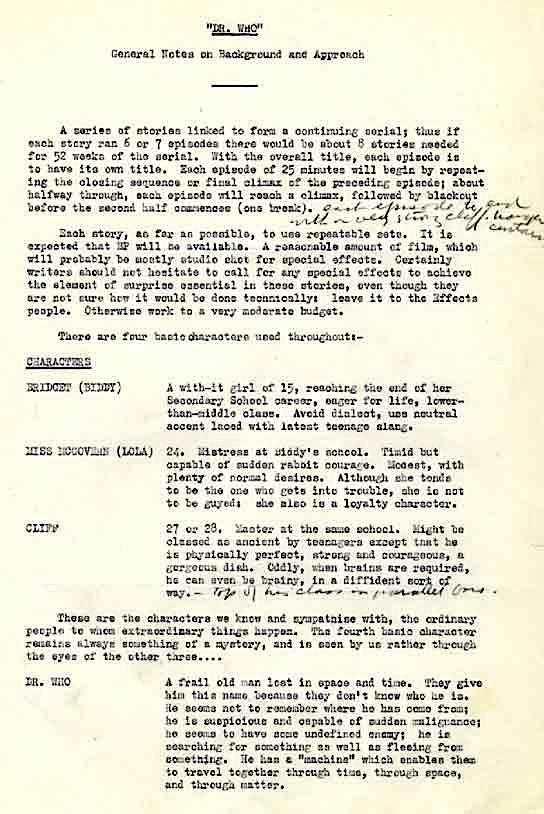
Space monsters, Daleks, Cybermen, and a revolving cast, however, were not part of Doctor Who’s original remit. The show began as an educational program on the BBC, and this explains many of its integral parts, which have remained throughout its first run from 1963 to 1989 and its revival from 2005 to the present. These elements include the TARDIS, companions of various ages, the Coal Hill School, and the Doctor himself, a Time Lord from the planet Gallifrey with interstellar technology and a dodgy memory.
We find the core premise in the show’s pilot episode and original 4‑part series, An Unearthly Child, which introduced William Hartnell as the Doctor, Carole Ann Ford as his granddaughter, Susan Foreman (originally named Barbara, or “Biddy”), and Jaqueline Hill and William Russell as school teachers Barbara Wright and Ian Chesterton. BBC drama head Sydney Newman had tasked writers with creating a family educational show to meet the network’s public service mandate, and came up with the idea of a science fiction show as a way to have characters visit historical periods and talk about science in an entertaining way.
“Doctor Who’s early historical stories emphasize education by downplaying the programme’s fantasy with minimal science-fiction elements,” writes Tom Steward at Deletion. The idea of a time machine bigger on the inside than the outside came from Newman. Writer Anthony Coburn turned it into a police box after a note from Newman asking for a “tangible” symbol. Newman “instructed writers to ‘get across the basis of teaching of educational experience.’ ” When they came back with a story about Daleks, he balked: “No bug-eyed monsters,” he wrote, no alien baddies, no actors in rubber suits. This was to be a serious show about serious educational subjects. Script changes and technical challenges meant months of setback and delays.
It was difficult for some critics to take the resulting four episode arc particularly seriously. The first episode showed Barbara and Ian discovering the TARDIS in a London junkyard. Then they are all transported to the prehistoric past, where they observe (and escape) a power struggle among prehistoric cave people. (Guardian critic Mary Crozier lamented that the “wigs and furry pelts and clubs were all ludicrous.”) The show’s debut was also inauspicious: November 23, 1963, the day after John F. Kennedy’s assassination. The BBC reran the first episode the next week and picked up another 2 million viewers.
Still, it had become clear after the first series that in order to survive, Doctor Who would have “to give the public what they wanted,” Steward writes, “rather than what was good for them.” Thus, the Daleks debuted in the second season, and by the mid-60s, historical stories were replaced with “fantasies in historical costume featuring anachronistic villains or monsters.” The show became a weekly creature feature and introduced terrifying villains like Davros, the Daleks’ creator, a cross between a Strangelove-like Nazi scientist and Star Wars’ clone-happy Emperor Palpatine (Davros came first).
The costumes may look silly in hindsight, but as childhood Who fan Charlie Jane Anders writes at io9, “those of us who are adults now didn’t have huge screen HD televisions when we were kids.” (And those of us who remember it, remember being terrified by equally goofy costuming in The Land of the Lost.) Look past the low-budget effects and Doctor Who becomes pure horror, exploring very dark territory with only a sonic screwdriver, a few friends, and a quirky sense of humor — or 13 quirky senses of humor, including Jodie Whittaker’s as the current Doctor and first woman to fill the role.
As you can see from the clips of the first episode above, Doctor Who established its weird air of existential dread from the start with Delia Derbyshire’s otherworldly theme and some avant-garde camera effects in lieu of bigger-budget spectacles. The show did not retain much from its educational beginnings aside from the key characters and the look and feel of the TARDIS. It was “seen to have failed as pedagogy,” writes Steward, but as a body of science fiction lore that continues to stay relevant, it has all sorts of lessons to teach about courage, companionship, and the value of the right tool for the right job.
Related Content:
30 Hours of Doctor Who Audio Dramas Now Free to Stream Online
The Fascinating Story of How Delia Derbyshire Created the Original Doctor Who Theme
A Detailed, Track-by-Track Analysis of the Doctor Who Theme Music
Josh Jones is a writer and musician based in Durham, NC. Follow him at @jdmagness
Read More...Watch Venice’s New $7 Billion Flood Defense System in Action
There are capitals unlikely to be much afflicted by rising sea levels — Indianapolis, say, or La Paz — but Venice looks set for a much more dire fate. Still, there is hope for the Floating City, a hope held out by large-scale engineering projects like the one profiled in the Tomorrow’s Build video above. Called MOSE (an acronym standing for MOdulo Sperimentale Elettromeccanico), the system consists of “78 gates, each 20 meters wide, that rise up out of the water when flooding is imminent.” This sounds like just the ticket for a city that, “built in the middle of a lagoon,” has “been susceptible to a natural phenomenon known as acqua alta, or ‘high water,’ since its founding in the fifth century.”
MOSE is now “finally up and running, eighteen years after construction began” — and a decade after its original completion deadline. This was too late, unfortunately, to spare Venice from the 2019 flood that ranked as its worst in 50 years, leaving 80 percent of the city underwater.
“The good news is, it passed the first major test,” successfully protecting the city in October of last year “from a 1.3‑meter high tide, and it’s performed multiple times since. But this doesn’t mean that flooding’s been stopped entirely. In December, it was unable to prevent an unexpectedly high tide from sweeping in and drenching the city once again.” Technically, that incident wasn’t MOSE’s fault: “Weather forecasters underestimated how high the water would get, so authorities kind of didn’t think to switch it on.”
This speaks to the difficulty of not just designing and installing a complex mechanical defense mechanism, but also of getting it to work in concert with the other systems already performing functions of their own (and at various levels of reliability). At a cost of over €6 billion (or $7 billion), MOSE has become “far more expensive than first predicted,” and thus faces that much higher a burden of self-justification, especially given the cloud of “corruption, environmental opposition, and questions about its long-term effectiveness” hanging over it. Seen in action, MOSE remains an unquestionably impressive work of engineering, but its associated headaches have surely converted some to the position on Venice once advanced by no less a scholar and lover of that storied city than Jan Morris: “Let her sink.”
Related Content:
How Venice Works: 124 Islands, 183 Canals & 438 Bridges
Watch City Out of Time, a Short Tribute to Venice, Narrated by William Shatner in 1959
Venice in a Day: From Daybreak to Sunset in Timelapse
Based in Seoul, Colin Marshall writes and broadcasts on cities, language, and culture. His projects include the Substack newsletter Books on Cities, the book The Stateless City: a Walk through 21st-Century Los Angeles and the video series The City in Cinema. Follow him on Twitter at @colinmarshall or on Facebook.
Read More...Take an Intellectual Odyssey with a Free MIT Course on Douglas Hofstadter’s Pulitzer Prize-Winning Book Gödel, Escher, Bach: An Eternal Golden Braid
In 1979, mathematician Kurt Gödel, artist M.C. Escher, and composer J.S. Bach walked into a book title, and you may well know the rest. Douglas R. Hofstadter won a Pulitzer Prize for Gödel, Escher, Bach: an Eternal Golden Braid, his first book, thenceforth (and henceforth) known as GEB. The extraordinary work is not a treatise on mathematics, art, or music, but an essay on cognition through an exploration of all three — and of formal systems, recursion, self-reference, artificial intelligence, etc. Its publisher settled on the pithy description, “a metaphorical fugue on minds and machines in the spirit of Lewis Carroll.”
GEB attempted to reveal the mind at work; the minds of extraordinary individuals, for sure, but also all human minds, which behave in similarly unfathomable ways. One might also describe the book as operating in the spirit — and the practice — of Herman Hesse’s Glass Bead Game, a novel Hesse wrote in response to the data-driven machinations of fascism and their threat to an intellectual tradition he held particularly dear. An alternate title (and key phrase in the book) Magister Ludi, puns on both “game” and “school,” and alludes to the importance of play and free association in the life of the mind.
Hesse’s esoteric game, writes his biographer Ralph Freedman, consists of “contemplation, the secrets of the Chinese I Ching and Western mathematics and music” and seems similar enough to Hofstadter’s approach and that of the instructors of MIT’s open course, Gödel, Escher, Bach: A Mental Space Odyssey. Offered through the High School Studies Program as a non-credit enrichment course, it promises “an intellectual vacation” through “Zen Buddhism, Logic, Metamathematics, Computer Science, Artificial Intelligence, Recursion, Complex Systems, Consciousness, Music and Art.”
Students will not study directly the work of Gödel, Escher, and Bach but rather “find their spirits aboard our mental ship,” the course description notes, through contemplations of canons, fugues, strange loops, and tangled hierarchies. How do meaning and form arise in systems like math and music? What is the relationship of figure to ground in art? “Can recursion explain creativity,” as one of the course notes asks. Hofstadter himself has pursued the question beyond the entrenchment of AI research in big data and brute force machine learning. For all his daunting erudition and challenging syntheses, we must remember that he is playing a highly intellectual game, one that replicates his own experience of thinking.
Hofstadter suggests that before we can understand intelligence, we must first understand creativity. It may reveal its secrets in comparative analyses of the highest forms of intellectual play, where we see the clever formal rules that govern the mind’s operations; the blind alleys that explain its failures and limitations; and the possibility of ever actually reproducing workings in a machine. Watch the lectures above, grab a copy of Hofstadter’s book, and find course notes, readings, and other resources for the fascinating course Gödel, Escher, Bach: A Mental Space Odyssey archived here. The course will be added to our list, 1,700 Free Online Courses from Top Universities.
Related Content:
How a Bach Canon Works. Brilliant.
Mathematics Made Visible: The Extraordinary Mathematical Art of M.C. Escher
Josh Jones is a writer and musician based in Durham, NC. Follow him at @jdmagness
Read More...757 Episodes of the Classic TV Game Show What’s My Line?: Watch Eleanor Roosevelt, Louis Armstrong, Salvador Dali & More
What would the host and panelists of the classic primetime television game show What’s My Line? have made of The Masked Singer, a more recent offering in which panelists attempt to identify celebrity contestants who are concealed by elaborate head-to-toe costumes and electronically altered voiceovers.
One expects such shenanigans might have struck them as a bit uncouth.
Host John Charles Daly was willing to keep the ball up in the air by answering the panel’s initial questions for a Mystery Guest with a widely recognizable voice, but it’s hard to imagine anyone stuffing former First Lady Eleanor Roosevelt into the full body steampunk bee suit the (SPOILER) Empress of Soul wore on The Masked Singer’s first season.
Mrs. Roosevelt’s Oct 18, 1953 appearance is a delight, especially her pantomimed disgust at the 17:29 mark, above, when blindfolded panelist Arlene Francis asks if she’s associated with politics, and Daly jumps in to reply yes on her behalf.
Later on, you get a sense of what playing a jolly parlor game with Mrs. Roosevelt would have been like. She’s not above fudging her answers a bit, and very nearly wriggles with anticipation as another panelist, journalist Dorothy Kilgallen, begins to home in on the truth.
While the roster of Mystery Guests over the show’s original 17-year broadcast is impressive — Cab Calloway, Judy Garland, and Edward R. Murrow to name a few — every episode also boasted two or three civilians hoping to stump the sophisticated panel with their profession.
Mrs. Roosevelt was preceded by a bathtub salesman and a fellow involved in the manufacture of Bloodhound Chewing Tobacco, after which there was just enough time for a woman who wrote television commercials.
Non-celebrity guests stood to earn up to $50 (over $500 today) by prolonging the revelation of their professions, as compared to the Mystery Guests who received an appearance fee of ten times that, win or lose. (Presumably, Mrs. Roosevelt was one of those to donate her honorarium.)
The regular panelists were paid “scandalous amounts of money” as per publisher Bennett Cerf, whose “reputation as a nimble-witted gentleman-about-town was reinforced by his tenure on What’s My Line?”, according to Columbia University’s Oral History Research Office.
The unscripted urbane banter kept viewers tuning in. Broadway actor Francis recalled: “I got so much pleasure out of ‘What’s My Line?’ There were no rehearsals. You’d just sit there and be yourself and do the best you could.”
Panelist Steve Allen is credited with spontaneously alighting on a breadbox as a unit of comparative measurement while questioning a manhole cover salesman in an episode that featured June Havoc, legend of stage and screen as the Mystery Guest (at at 23:57, below).
“Want to show us your breadbox, Steve?” one of the female panelists fires back off-camera.
The phrase “is it bigger than a breadbox” went on to become a running joke, further contributing to the illusion that viewers had been invited to a fashionable cocktail party where glamorous New York scenemakers dressed up to play 21 Professional Questions with ordinary mortals and a celebrity guest.
Jazz great Louis Armstrong appeared on the show twice, in 1954 and then again in 1964, when he employed a successful technique of light monosyllabic responses to trick the same panelists who had identified him quickly on his initial outing.
“Are you related to anybody that has anything to do with What’s My Line?” Cerf asks, causing Armstrong, host Daly, and the studio audience to dissolve with laughter.
“What happened?” Arlene Francis cries from under her pearl-trimmed mask, not wanting to miss the joke.
Television — and America itself — was a long way off from acknowledging the existence of interracial families.
“It’s not Van Clyburn, is it?” Francis ventures a couple of minutes later.…
Expect the usual gender-based assumptions of the period, but also appearances by Mary G. Ross, a Cherokee aerospace engineer, and physicist Helen P. Mann, a data analyst at Cape Canaveral.
If you find the convivial atmosphere of this seminal Goodson-Todman game show absorbing, there are 757 episodes available for viewing on What’s My Line?’s YouTube channel.
Allow us to kick things off on a Surreal Note with Mystery Guest Salvador Dali, after which you can browse chronological playlists as you see fit:
Related Content:
How American Bandstand Changed American Culture: Revisit Scenes from the Iconic Music Show
Ayun Halliday is an author, illustrator, theater maker and Chief Primatologist of the East Village Inky zine. Follow her @AyunHalliday.
Read More...Support Us
We're hoping to rely on loyal readers, rather than erratic ads. Please click the Donate button and support Open Culture. You can use Paypal, Venmo, Patreon, even Crypto! We thank you!

About Us

Open Culture scours the web for the best educational media. We find the free courses and audio books you need, the language lessons & educational videos you want, and plenty of enlightenment in between.
Advertise With Us
FREE UPDATES!
GET OUR DAILY EMAIL
Get the best cultural and educational resources on the web curated for you in a daily email. We never spam. Unsubscribe at any time.
FOLLOW ON SOCIAL MEDIA
Open Culture editor Dan Colman scours the web for the best educational media. He finds the free courses and audio books you need, the language lessons & movies you want, and plenty of enlightenment in between.
Advertise With Us

