Epidemics in Western Society Since 1600: A Free Online Course from Yale University
From Yale University comes an unfortunately timely course, Epidemics in Western Society Since 1600. Recorded before the outbreak of COVID-19, the 25 lecture course, presented by historian Frank Snowden, covers the following ground:
This course consists of an international analysis of the impact of epidemic diseases on western society and culture from the bubonic plague to HIV/AIDS and the recent experience of SARS and swine flu. Leading themes include: infectious disease and its impact on society; the development of public health measures; the role of medical ethics; the genre of plague literature; the social reactions of mass hysteria and violence; the rise of the germ theory of disease; the development of tropical medicine; a comparison of the social, cultural, and historical impact of major infectious diseases; and the issue of emerging and re-emerging diseases.
You can watch the lectures on YouTube above, or on iTunes (Video — Audio). You can also read Snowden’s related book: Epidemics and Society: From the Black Death to the Present.
If you want to hear what Snowden has to say about COVID-19, we have two interviews below.
Coronavirus (COVID-19) Update: Epidemics in History
How Will COVID-19 Change the World? Historian Frank Snowden on Epidemics From the Black Death to Now
Epidemics in Western Society Since 1600 will be added to our list of Free Online History courses, a subset of our metacollection, 1,700 Free Online Courses from Top Universities.
If you would like to support the mission of Open Culture, consider making a donation to our site. It’s hard to rely 100% on ads, and your contributions will help us continue providing the best free cultural and educational materials to learners everywhere. You can contribute through PayPal, Patreon, and Venmo (@openculture). Thanks!
Related Content:
The History of the Plague: Every Major Epidemic in an Animated Map
Read More...The Meaning of Hieronymus Bosch’s Spellbinding Triptych, The Garden of Earthly Delights
Hieronymus Bosch was born Jheronimus van Aken. We know precious little else about him, not even the year of his birth, which scholar Nicholas Baum guesses must have been right in the middle of the fifteenth century. But we do know that the artist was born in the Dutch town of ‘s‑Hertogenbosch, better known as Den Bosch, to which his assumed name pays tribute. It is thus to Den Bosch that Baum travels in the The Mysteries of Hieronymus Bosch, the 1983 BBC TV movie above, in search of clues to an interpretation of Bosch’s mysterious, grotesque, and sometimes hilarious paintings. What manner of place could produce an artistic mind capable of The Garden of Earthly Delights?
“My first reaction was disappointment,” Baum says of Den Bosch. “I wasn’t expecting such a very ordinary, very commercial, very provincial little town. I couldn’t for the life of me fit anybody as extraordinary as Bosch into a sleepy little place like this.” A hardworking everyday Dutchman might laugh at Baum’s English imagination having got away with him; perhaps he’d even quote his country’s well-worn proverb about normal human behavior being crazy enough.
Nevertheless, fueled by a near-lifelong fascination with Bosch’s fantastical and forbidding art, Baum goes deeper: quite literally deeper, in one case, descending to the dank cellar beneath the house where the artist grew up in order to take in “the authentic smell and feel of Bosch’s own day.”
Further insights come when Baum investigates Bosch’s membership in the Catholic fraternity of the Common Life. A few decades later, that same order would also educate northern Renaissance philosopher Erasmus, whose religiosity is well known. Bosch must have been no less pious, but for centuries that didn’t figure as thoroughly into the interpretation of his paintings as it might have. Focused on the vivid images of bacchanalia Bosch incorporated into his work, some speculated on his involvement in orgy-oriented secret societies. But Baum’s journey convinces him that Bosch was “a fierce and pious Christian” who painted with the goal of turning a gluttonous, wealth- and pleasure-obsessed humanity back toward the teachings of the Bible. And half a millennium later, it is his wildly imaginative renderings of sin that continue to compel us — as well as hold out the promise of further secrets yet unexplained.
For anyone interested, Taschen now publishes an Bosch: The Complete Works, a beautiful and exhaustive exploration of the painter’s work. It includes a special chapter on The Garden of Earthly Delights.
Related Content:
The Meaning of Hieronymus Bosch’s The Garden of Earthly Delights Explained
Based in Seoul, Colin Marshall writes and broadcasts on cities, language, and culture. His projects include the Substack newsletter Books on Cities, the book The Stateless City: a Walk through 21st-Century Los Angeles and the video series The City in Cinema. Follow him on Twitter at @colinmarshall or on Facebook.
Read More...When Rage Against the Machine Interviewed Noam Chomsky (1999)
“The first great [economic] experiment was a ‘bad idea’ for the subjects, but not for the designers and local elites associated with them. This pattern continues until the present: placing profit over people.” — Noam Chomsky, Profit Over People
“A global decomposition is taking place. We call it the Fourth World War: neoliberalism’s globalization attempt to eliminate that multitude of people who are not useful to the powerful — the groups called ‘minorities’ in the mathematics of power, but who happen to be the majority population in the world.” — Subcomandante Marcos
Whether we think of global neoliberalism — to the extent that we think about it — as the inertia of centuries-old economic theory or as deliberate genocide, the effects are the same. The majority of the world’s population suffers under massive inequality, including, now, vaccine inequality, leading to raging COVID epidemics in some parts of the world as other places emerge from lockdowns and resume “normal” operations. The “Capitalist Hydra,” as Zapatista leader Subcomandante Marcos once called it, always seems to grow more heads.
Indeed, most plans to alleviate global poverty and disease seem to further enrich the architects and immiserate the targets of their purported care. Noam Chomsky has pointed out repeatedly that neoliberal economic rules are only applied to subject populations, since the wealthy ignore the strict conditions they impose by force and coercion on others, calling the outcomes a natural sorting of “winners and losers.” Ongoing global economic practices have accelerated a climate crisis that impacts the majority of the world’s (poor) population, sending millions on a collision course with brutality at the borders as they flee to other parts of the world for bare survival.
The multiple crises we now face were clearly evident at the turn of the millennium, when Rage Against the Machine played Mexico City for the first time in 1999. They released the concert footage in a video titled The Battle of Mexico City in 2001, the same year the indigenous guerrilla force EZLN — popularly known as the Zapatistas — marched on Mexico City. (Concert audio was released on vinyl this past June.) The video release included interviews with Chomsky and then-EZLN military leader Marcos, and you can see them both here.
At the top, Chomsky responds to a question about NAFTA, a “free-trade” agreement that proved his point about how such policies do the opposite of what they propose, benefitting the very few instead of the many. Chomsky, who analyzed the ways that the government and corporate media manufactured consent for their policies during the Vietnam War, wasn’t taken in by the hype. The agreement never had anything to do with free trade, he says, but with locking Mexico into programs of “structural adjustment” that kept people in poverty and the country dependent on economic terms dictated from outside its borders.
From the perspective of the indigenous people in Mexico fighting for an autonomous region in Chiapas, the struggle is not only against the Mexican government, but also an international economic order that imposes its will on the country and its citizens, who then turn on the poorest and most dispossessed among them in conditions of manufactured scarcity. Indigenous Mexicans, like other internally subjected people around the world, are deemed expendable, figured as a “problem” to be solved or eliminated. What is so striking about these perspectives, twenty years after the release of The Battle of Mexico City, is just how prescient, even prophetic, they sound today.
Related Content:
An Animated Introduction to Noam Chomsky’s Groundbreaking Linguistic Theories
Josh Jones is a writer and musician based in Durham, NC. Follow him at @jdmagness
Read More...The Life & Art of Hilma Af Klint: A Short Art History Lesson on the Pioneering Abstract Artist
Like many artists whose abstractions cemented their legacy, Hilma af Klint was trained to paint portraits, botanicals, and landscapes.
The naturalist works of her early adulthood depict bourgeois, late-19th century Swedish life, and, by association, the sort of subject matter and approach that were deemed most fitting for a female artist, even in a society where women were allowed to work alongside men.
But something else was afoot with Hilma, as artist and educator Paul Priestley points out in the above episode from his Art History School series.
Her 10-year-old sister’s death from the flu may have caused her to lean into an existing interest in spiritualism, but as Iris Müller-Westermann, director of Moderna Museet Malmö told The Guardian’s Kate Kellaway, the “mathematical, scientific, musical, curious” teen was likely motivated by her own thirst for knowledge as by this family tragedy:
You have to understand this was the age when natural sciences went beyond the visible: Heinrich Hertz discovered electromagnetic waves [1886], Wilhelm Röntgen invented the x‑ray [1895]…Hilma is like Leonardo – she wanted to understand who we are as human beings in the cosmos.
Her interest in the occult did not make her an outsider. Spiritualism was considered a respectable intellectual preoccupation. Abstract painters Vasily Kandinsky, Piet Mondrian, Kasimir Malevich and Frantisek Kupka were also using their art to try and get at that which the eye could not see.
All but Hilma were hailed as pioneers.
The New York Times review of Los Angeles County Museum of Art’s 1986 exhibit The Spiritual in Art: Abstract Painting 1890–1985, mentions some of their spiritual bona fides:
They were generated by such ventures into mysticism as Theosophy, Anthroposophy, Rosicrucianism, Eastern philosophy, and various Eastern and Western religions. Spiritual ideas were not peripheral to these artists’ lives, not something that happened to pop into their minds as they stood by their canvas. Kupka participated in seances and was a practicing medium. Kandinsky attended private fetes involved with magic, black masses and pagan rituals. Mondrian was a member of the Dutch Theosophical Society and lived briefly in the quarters of the French Theosophical Society in Paris. He said once that he ”got everything from the Secret Doctrine” of Theosophy, which was an attempt by its founder Helena Petrovna Blavatsky to do nothing less than read, digest and synthesize all religions. It has been known for some time how much of Mondrian’s symbolism — including the ubiquitous vertical and horizontal lines — and how much of his utopianism, was shaped by Theosophical doctrine.
Reviewer Michael Brenson devotes one sentence to Hilma, “a previously unknown Swedish artist whose somewhat mechanical abstract paintings and drawings of organic, geometrical forms were marked by Theosophy and Anthroposophy.”
Thirty-five years later, she’s receiving much more credit. As Priestley says in his video biography, Hilma, and not Kandinsky, is now hailed as the first painter to experiment with abstraction.
Would Hilma have welcomed such a distinction?
She maintained that she was but a receiving instrument for Amaliel, a “high master” from another dimension, who made contact during the séances she participated in regularly with four friends who met weekly to practice automatic drawing and writing.
Amaliel charged her with creating the artwork for the interior of a temple that was part of the high masters’ vision. The Guggenheim’s classroom materials for The Paintings for the Temple note that her friends warned Hilma against accepting this otherworldly commission, “that the intensity of this kind of spiritual engagement could drive her into madness.”
But Hilma threw herself into the assignment, producing 111 paintings during a one-and-a-half year period, claiming:
The pictures were painted directly through me, without any preliminary drawings and with great force. I had no idea what the paintings were supposed to depict; nevertheless, I worked swiftly and surely, without changing a single brushstroke.
For whatever reason, the paintings proved too much for Rudolph Steiner, the founder of the Anthroposophical Society, whom she had invited to view them, paying his travel expenses in hope that he would provide a detailed analysis and interpretation of the images. Instead, he counseled her that no one would understand them, and that the only course of action would be to keep the paintings out of sight and out of mind for fifty years. To do otherwise might endanger her health.
A disappointing response that ultimately led to the paintings being socked away for an even longer period.
Good news for Kandinsky… and possibly for Steiner.
At any rate, the competition was coerced into eliminating herself, inadvertently planting the seeds for some major, if delayed art world excitement. Hilma, who died more than forty years before the L.A. County Museum show, was not able to bask in the attention on any earthly plane.
For those curious in a take that is not entirely rooted in the art world, Lightforms Art Center in Hudson, New York hosted a recent Hilma Af Klint exhibit. Their strong ties to the Anthroposophical community make for some interesting exhibit commentary.
Related Content:
New Hilma af Klint Documentary Explores the Life & Art of the Trailblazing Abstract Artist
Discover Hilma af Klint: Pioneering Mystical Painter and Perhaps the First Abstract Artist
Ayun Halliday is an author, illustrator, theater maker and Chief Primatologist of the East Village Inky zine. Follow her @AyunHalliday.
Read More...Watch Artisans Make Hand-Carved Championship Chess Sets: Each Knight Takes Two Hours
Whether because of the popularity of Netflix’s The Queen’s Gambit or because of how much time indoors the past year and a half has entailed, chess has boomed lately. Luckily for those would-be chessmasters who’ve had their interest piqued, everything they need to learn the game is available free online. But the deeper one gets into any given pursuit, the greater one’s desire for concrete representations of that interest. In the case of chess players, how many, at any level, have transcended the desire for a nice board and pieces? And how many have never dreamed of owning one of the finest chess sets money can buy?
Such a set appears in the Business Insider video above. “You can pick up a plastic set for $20 dollars, but a wooden set certified for the World Chess Championship costs $500,” says its narrator. “Much of the value of a high-quality of the set comes down to how well just one piece is made: the knight.”
Properly carved by a master artisan, each knight — with its horse’s head, the only realistic piece in chess — takes about two hours. Very few are qualified for the job, and one knight carver appears in an interview to explain that it took him five or six years to learn it, as against the four or five months required to master carving the other pieces.
The workshop introduced in this video is located in Amritsar (also home to the Golden Temple and its enormous free kitchen, previously featured here in Open Culture). To those just starting to learn about chess, India may seem an unlikely place, but in fact no country has a longer history with the game. “Chess has been played for over 1,000 years, with some form of the game first appearing in India around the sixth century,” says the video’s narrator. “Over the past two centuries, high-level competitions have drawn international interest.” For most of that period, fluctuations in public enthusiasm for chess have resulted in proportionate fluctuations in the demand for chess sets, much of which is satisfied by large-scale industrial production. But the most experienced players presumably feel satisfaction only when handling a knight carved to artisanal perfection.
Related Content:
Learn How to Play Chess Online: Free Chess Lessons for Beginners, Intermediate Players & Beyond
A Brief History of Chess: An Animated Introduction to the 1,500-Year-Old Game
Man Ray Designs a Supremely Elegant, Geometric Chess Set in 1920–and It Now Gets Re-Issued
The Bauhaus Chess Set Where the Form of the Pieces Artfully Show Their Function (1922)
A Beautiful Short Documentary Takes You Inside New York City’s Last Great Chess Store
Based in Seoul, Colin Marshall writes and broadcasts on cities, language, and culture. His projects include the Substack newsletter Books on Cities, the book The Stateless City: a Walk through 21st-Century Los Angeles and the video series The City in Cinema. Follow him on Twitter at @colinmarshall or on Facebook.
Read More...Storytelling and Race in Captain America — Pretty Much Pop: A Culture Podcast #98
What is it for a super-hero to represent America? Though the character created by Joe Simon and Jack Kirby in 1941 may have been a way to capitalize on WWII patriotism, it has since been used to ask questions about what it really means to be patriotic and how America’s ideals and its reality may conflict. We’re of course talking about race, a theme explored by Sam Wilson, formerly Cap’s side-kick, picking up the shield in the comics and now on TV (and in the forthcoming film).
Your Pretty Much Pop hosts Mark Linsenmayer, Erica, and Brian are joined by comic super-fan Anthony LeBlanc (returning from our ep. 56 on black nerds) to discuss the recent comic runs by Ta-Nehishi Coates and Nick Spencer and especially Truth: Red, White and Black, Marvel’s 2003 comics mini-series by Robert Morales and Kyle Baker that tells the story of American super-soldier experiments on unknowing black men (reminiscent of the real-life Tuskegee Syphilis Study). This was the source of the “first black Captain America” character Isaiah Bradley featured in The Falcon and the Winter Soldier Disney+ show, which we also discuss.
Here are a few articles that fed into our discussion:
- “The Power of a Skeptical Captain America” by Sophie Gilbert
- “‘The Falcon and the Winter Soldier’ Never Took Its Protagonist Seriously” by Justin Charity
- “‘The Falcon and the Winter Soldier’ Was Riddled With Contradictions” by Alison Herman
- “When Sam Wilson Became Captain America” by Brittany Matter
- “Why I’m Writing Captain America, and Why It Scares the Hell out of Me” by Ta-Nehishi Coates
- “My Secret History With Secret Empire: Looking Back At Nick Spencer’s Captain America” by Vishal Gullapalli
- “Secret Empire Creators Preview Captain America’s Assault on the Marvel Universe” by Christian Holub
- “Captain America Goes to War With Jordan Peterson” by Matthew Gault
- “Black Panther Writer Criticizes Marvel’s Treatment of Comic Creators” by Robert Wood
The final issue of Ta-Nehisi Coates’ Captain America is coming July 7.
We recommend the Captain America Comic Book Fans podcast for more information. Their recent interview with longtime editor Tom Brevoort was illuminating, and they spent eps. 33 and 34 walking through Truth: Red, White & Black.
Hear more of this podcast at prettymuchpop.com. This episode includes bonus discussion that you can access by supporting the podcast at patreon.com/prettymuchpop. This podcast is part of the Partially Examined Life podcast network.
Pretty Much Pop: A Culture Podcast is the first podcast curated by Open Culture. Browse all Pretty Much Pop posts.
Read More...Quentin Tarantino Releases His First Novel: A Pulpy Novelization of Once Upon a Time in Hollywood
There’s no business like show business. Or maybe — as Bart Simpson once wrote on the blackboard — “there are plenty of businesses like show business.”
Quentin Tarantino’s ninth film, 2019’s Once Upon a Time in Hollywood, follows aging TV star, Rick Dalton, being pushed into playing villainous character roles. Drunk and depressed, Dalton and his sidekick/hanger-on/stunt double Cliff Booth watch reruns of his show and get into a series of increasingly serious scrapes as the actor searches for a role that will redeem him. The film’s outline–shorn of historical references that made critics lionize it as “a love letter to old Hollywood”–sounds suspiciously like another media property in the middle of its final season that summer.
Called a Mad Men replacement, Netflix’s satirical adult cartoon series Bojack Horseman also follows an aging former TV star and his sidekicks/hanger(s)-on through their misadventures in Hollywood (“Hollywoo”). Along the way they confront issues that fall under the rubric of “toxic masculinity,” such as workplace harassment, emotional immaturity, and the abuse of power in an industry with wildly unequal power dynamics. The show makes clear that neither old, nor new, Hollywood deserves a love letter — no more than other industries that allow such behavior. (It also features a caricature of Tarantino.)
Once Upon a Time in Hollywood, by contrast, celebrates the old star system and its privileges — or so Richard Brody argues at The New Yorker — in an “obscenely regressive vision of the 60s” that scrubs the decade of its protests and brutal crackdowns. The premise underlying Tarantino’s alternate-history dramedy seems to be: “If only the old-line Hollywood people of the fifties and sixties had maintained their pride of place—if only the times hadn’t changed, if only the keys to the kingdom hadn’t been handed over to the freethinkers and decadents of the sixties—then both Hollywood and the world would be a better, safer, happier place.”
Tarantino sets up “hippies,” a favorite pejorative of his characters, as fall guys for the Manson Family murders, rather than Manson’s own white supremacist beliefs. As many critics noted at the time, “the only substantial character of color, Bruce Lee (Mike Moh), is played… as a haughty parody” who gets “dramatically humiliated” by Pitt’s swashbuckling stuntman — who is rumored to have murdered his wife and who dispatches the film’s female Manson cult villains with the sadistic glee of a true psychopath, a scene, Brody writes, “that only hammers [Tarantino’s] doctrine home.”
Celebration there may be in the film, but there is also mourning. Christopher Hooten at Little White Lies scoffs at the “love letter” idea and sees the film instead as a lament for the end of cinema’s “freethinkers”:
This is Tarantino’s passion project – potentially his last film – and it comes across as him trying to sneak out a movie with a ’70s sensibility and tone before it’s no longer possible. Once the likes of Tarantino and Martin Scorsese have bowed out, that might well be it for auteur-driven filmmaking on a blockbuster scale. We’ve reached a polarisation in the industry where a director either works as a hired (and frequently fired) gun for a Disney or a Warner Bros, or else goes cap in hand in the hope of scraping together a few million dollars to make something more personal and unique.
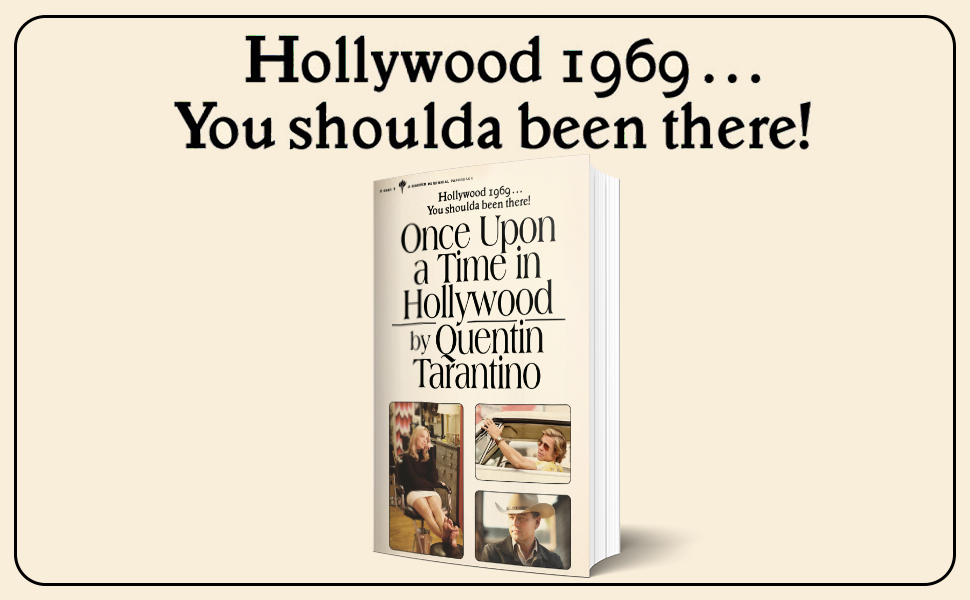
The Tarantinos of the world might be a dying breed, but Tarantino isn’t leaving his art behind so much as turning his hand to “more personal and unique” projects – in this case a novel, and more specifically, “the pulpiest of pulp fiction — the novelization,” writes Peter Bradshaw at The Guardian. Once Upon a Time in Hollywood: A Novel finds him “cranking up the backstories, mulching up reality and alt.reality pastiche, ladling in new episodes,” and flexing his formidable strengths as a writer of crackling dialogue and action. The book also promises an ending viewers of the film won’t see coming.
The novel explores the inner lives of its female characters, including, of course, Sharon Tate “and the fictional child actor Trudi Fraser,” and adds an even darker edge to Cliff Booth, who is said to admire a certain character despite or because he is “unconsciously racist, consciously misogynistic.” This is Tarantino, after all, none of whose characters are ever shining examples of virtue. But in the post-auteur, post-Weinstein future, he seems to suggest, maybe old-Hollywood anti-heroes like Cliff Booth and Leonardo DiCaprio’s washed-up star Rick Dalton will only shine on streaming TV shows and in the pages of throwback pulp novels, “packaged like those New English Library paperbacks that used to be on carousel displays in supermarkets and drugstores.” You can pick up a copy of Once Upon a Time in Hollywood: A Novel here.
Related Content:
Quentin Tarantino Explains How to Write & Direct Movies
An Analysis of Quentin Tarantino’s Films Narrated (Mostly) by Quentin Tarantino
Josh Jones is a writer and musician based in Durham, NC. Follow him at @jdmagness
Read More...The Conspiracy Behind the Iconic Statue, the Venus de Milo
The Venus de Milo is one of art’s most widely recognized female forms.
The Mona Lisa may be the first stop on many Louvre visitors’ agendas, but Venus, by virtue of being unclothed, sculptural, and prominently displayed, lends herself beautifully to all manner of souvenirs, both respectful and profane.
Delacroix, Magritte, Dali, and The Simpsons have all paid tribute, ensuring her continued renown.
Renoir is that rare bird who was impervious to her 6’7” charms, describing her as the “big gendarme.” His own Venus, sculpted with the help of an assistant nearly 100 years after the Venus de Milo joined the Louvre’s collection, appears much meatier throughout the hip and thigh region. Her celebrity cannot hold a candle to that of her armless sister.
In the Vox Almanac episode above, host Phil Edwards delves into the Venus de Milo’s appeal, taking a less delirious approach than sculptor Auguste Rodin, who rhapsodized:
…thou, thou art alive, and thy thoughts are the thoughts of a woman, not of some strange, superior being, artificial and imaginary. Thou art made of truth alone, outside of which there is neither strength nor beauty. It is thy sincerity to nature which makes thee all powerful, because nature appeals to all men. Thou art the familiar companion, the woman that each believes he knows, but that no man has ever understood, the wisest not more than the simple. Who understands the trees? Who can comprehend the light?
Edwards opts instead for a Sharpie and a tiny 3‑D printed model, which he marks up like a plastic surgeon, drawing viewers’ attention to the missing bits.
The arms, we know.
Also her earlobes, most likely removed by looters eager to make off with her jewelry.
One of her massive marble feet (a man’s size 15) is missing.
And so is a portion of the plinth on which she once stood.
Interestingly, the plinth was among the items discovered by accident on the Greek island of Milos in 1820, along with two pillars topped with busts of Hercules and Hermes, the bisected Venus, and assorted marble fragments, including — maybe — an upper arm and hand holding a round object (a golden apple, mayhaps?)
Edwards doesn’t delve into the conflicting accounts surrounding the wheres and whys of this discovery. Nor does he go into the complications of the sculpture’s acquisition, and how it very nearly wound up on a ship bound for Constantinople.
What he’s most interested in is that plinth, which would have given the lie to the long-standing assertion that the Venus de Milo was created in the Classical era.
This incorrect designation made the Louvre’s newest resident a most welcome replacement for the loot France had been compelled to return to the Vatican in the wake of Napoleon’s first abdication.
The plinth may have been “lost” under mysterious circumstances, but its inscription was preserved in a sketch by A. Debay, whose father had been a student of Jacques-Louis David, Napoleon’s now-banished First Painter, a Neo-Classicist.
(David’s final painting, Mars Disarmed by Venus and the Three Graces, completed a couple of years after Venus de Milo was installed in the Louvre, was considered a bust.)
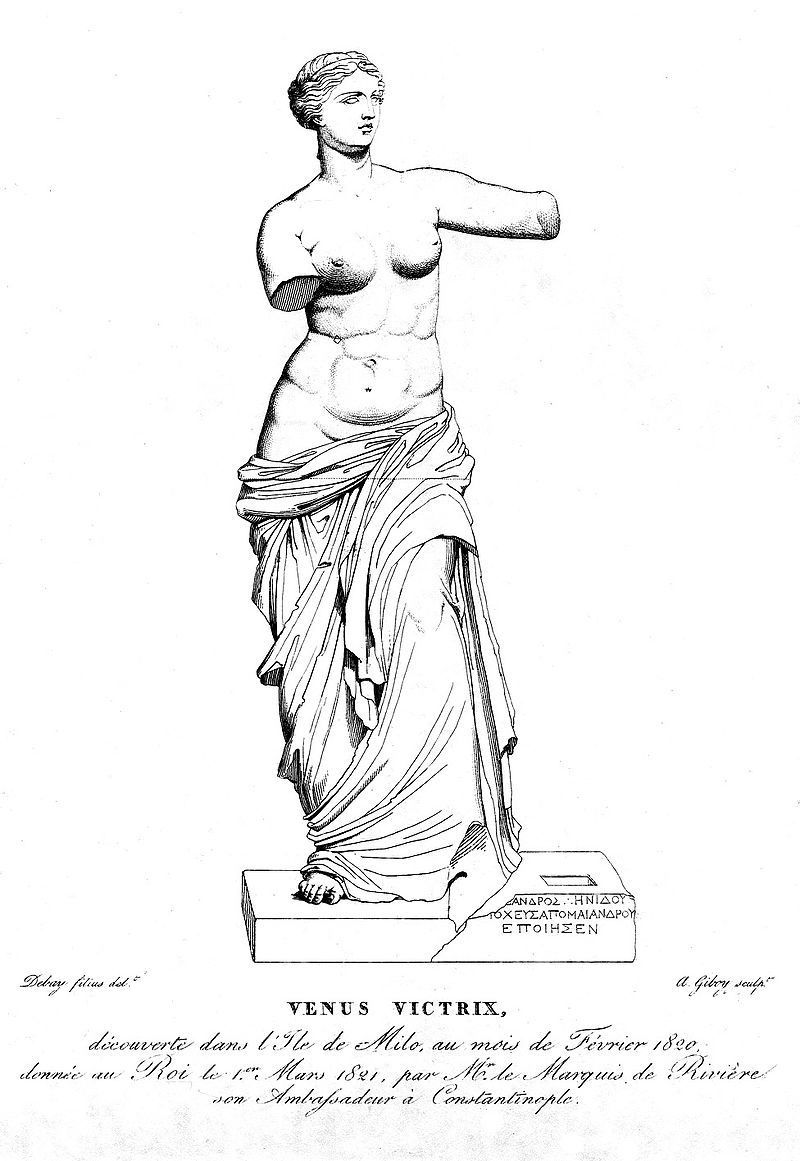
Debay’s faithful recreation of the plinth’s inscription as part of his study of the Venus de Milo offers clues as to her creator — “ …andros son of …enides citizen of …ioch at Meander made.”
It also dates her creation to 150–50 BCE, corroborating notes French naval officer Jules d’Urville had made in Greece weeks after the discovery.
The birth of this Venus should have been attributed to the Hellenistic, not Classical period.
This would have been problematic for both France and the Louvre, as art historian Jane Ursula Harris writes in The Believer:
Had her true author been known, she likely would’ve been locked away in the museum’s archive, if not sold off. Hellenistic art had by then been denigrated by Renaissance scholars who re-conceived it in anti-classical terms, finding in its expressive, experimental form and emotional content a provocative realism that defied everything their era stood for: modesty, intellect, and equanimity…It helped that the Venus de Milo possessed several classical attributes. Her strong profile, short upper lip, and smooth features, for example, were in keeping with Classical figural conventions, as was the continuous line connecting her nose and forehead. The partially-draped figure with its attenuated silhouette – which the Regency fashion of the day imitated with its empire bust-line – also recalled classical sculptures of Aphrodite, and her Roman counterpart, Venus. Yet despite all these classical identifiers, the Venus de Milo flaunted a definitive Hellenistic influence in her provocatively low-slung drapery, high waist line, and curve-enhancing contrapposto—far more sensual and exaggerated than classical ideals allowed.
It took the Louvre over a hundred years to come clean as to its star sculpture’s true provenance.
What happened to the plinth remains anyone’s guess.
The only mystery the museum’s website seems concerned with is one of identity — is she Aphrodite, goddess of beauty, or Poseidon’s wife, Amphitrite, the sea goddess worshipped on the island on which she was discovered?
For a deeper dive into the Venus de Milo’s complicated journey to the Louvre, we recommend Rachel Kousser’s article, “Creating the Past: The Venus de Milo and the Hellenistic Reception of Classical Greece,” which can be downloaded free here. Or do as Vox’s Edwards suggests and 3‑D print a tiny Venus de Milo in a decidedly non-Classical color using MyMiniFactory’s free pattern.
Related Content:
The Making of a Marble Sculpture: See Every Stage of the Process, from the Quarry to the Studio
Ayun Halliday is an author, illustrator, theater maker and Chief Primatologist of the East Village Inky zine. Follow her @AyunHalliday.
Read More...Considering Mare of Easttown — Pretty Much Pop: A Culture Podcast #97
Insofar as something is a TV hit at all these days, the small-town Pennsylvania murder mystery starring Kate Winslet seems to qualify, but what distinguishes it from the many many other crime dramas on TV? Your Pretty Much Pop hosts Mark Linsenmayer, Erica Spyres, and Brian Hirt discuss the plot structure, casting, and other creative choices and try to figure out how the show relates to Broadchurch, The Undoing, etc. Should there be a season two?
Here are a few of the articles that fed the discussion:
- “‘Mare of Easttown’ Was Not a Show About Murder” by Alison Herman
- “Does It Take a Murder to Make an HBO Show About Women a Hit?” by Anna Nordberg
- “‘Mare of Easttown’ Ended with a Shocking Twist. But That’s Not the Only Reason the Show Was a Hit.” by Emily Yahr
- “Kate Winslet Shows There’s More to Middle Age Than a Saggy Belly” by Gaby Hinsliff
- “Why Most Actors Won’t Even Attempt a Philadelphia Accent” by Sam Adams
- “Mare of Easttown Season 2 Could Happen — but It Shouldn’t” by Marc McLaren
- “ ‘Murdur Durdur’: Inside SNL’s Killer Mare of Easttown Parody” by Hillary Busis
Hear more of this podcast at prettymuchpop.com. This episode includes bonus discussion that you can access by supporting the podcast at patreon.com/prettymuchpop. This podcast is part of the Partially Examined Life podcast network.
Pretty Much Pop: A Culture Podcast is the first podcast curated by Open Culture. Browse all Pretty Much Pop posts.
Read More...This Is “The End”: A Video Exploration of The Doors’ Existential Epic
If you had broken up with your college boyfriend and he told you that he written an 11-minute song about you while on enough LSD to kill a horse, would you want to hear it? Or would you block his number on your phone?
Or maybe because said boyfriend is Jim Morrison and the band is the Doors and the song is “The End,” we’ll let it slide, because whether or not you think Jim’s lyrics are super deep or supercilious, the groove is undeniable, four small furry musicians gathered together in a studio and grooving on a raga, conjuring up Eastern mysticism with Western instruments.
In Polyphonic’s explainer video on “The End,” he pulls apart The Doors’ magnum opus, the closer to its 1967 debut album, analyzing the song in real time as it unspools. (There’s a few moments where Polyphonic and Morrison are vocalizing at the same time—we recommend turning on captions).
The girlfriend in question was Mary Werbelow, Morrison’s steady in the early ‘60s before he chose the path of putting his poetry to music. The Werbelow/Morrison couple had to die for the Doors to be born, in a sense, and Morrison started the lyrics as a goodbye song, a standard pop trope at the time. (There’s a very touching, rare interview with Werbelow here). But Morrison took it in another direction, we could say.
“The End” might be the first musical example of the Psychotronic Breakup genre. Defined by Noah Segan and Adam Egypt Mortimer when talking about film, the Psychotronic Breakup genre “uses dream imagery, paranormal ideas, or the horror genre to express the emotional drama of heartbreak.” Segan and Mortimer’s definition deals only with film, but Morrison does the same thing with song, a little over ten years before the films they discuss. “The End” is a breakup song that breaks down the psyche like LSD, sending the injured party back to basics, and into a universe of archetypes. Things are dying. Things are being reborn. There’s a blue bus which is calling us, and that is either a reference to the Solar Boat in Egyptian mythology or a reference to the Santa Monica bus system (according to one wag in the comments). Or hey, maybe it is both, because Morrison is tapping into something here, much like James Joyce created layers of myth within the quotidian. (Morrison achieves this by walking backwards into it, however.)
Polyphonic gets into the song’s Oedipal Cliff Notes section, describing how it all came fluming out of Morrison on stage, the band having dragged him to a gig at the Whiskey a Go-Go after he consumed “10,000 mikes” (i.e. 10,000 micrograms, about ten full doses) of LSD. A few days later the “kill your teachers, kill your parents” riff was committed to tape, this time also on LSD.
For all its pretense the song still works. And though Morrison never did reconcile with his girlfriend, the song did find its soul mate when Francis Ford Coppola used “The End” as the opening to Apocalypse Now, another work of art that drained the life force from its creator. There are no real cover versions of “The End,” and there are no films past Coppola’s that can use it without irony. It exists like a totem, to be found and puzzled over.
(But because this is late capitalism and everything is terrible, Polyphonic’s segue into a sponsor ad at 11:46 is something wondrous to behold in its perverse beauty. Be warned, my only friend.)
Related Content:
“The Lost Paris Tapes” Preserves Jim Morrison’s Final Poetry Recordings from 1971
A Young, Clean Cut Jim Morrison Appears in a 1962 Florida State University Promo Film
Ted Mills is a freelance writer on the arts who currently hosts the Notes from the Shed podcast and is the producer of KCRW’s Curious Coast. You can also follow him on Twitter at @tedmills, and/or watch his films here.
Read More...Support Us
We're hoping to rely on loyal readers, rather than erratic ads. Please click the Donate button and support Open Culture. You can use Paypal, Venmo, Patreon, even Crypto! We thank you!

About Us

Open Culture scours the web for the best educational media. We find the free courses and audio books you need, the language lessons & educational videos you want, and plenty of enlightenment in between.
Advertise With Us
FREE UPDATES!
GET OUR DAILY EMAIL
Get the best cultural and educational resources on the web curated for you in a daily email. We never spam. Unsubscribe at any time.
FOLLOW ON SOCIAL MEDIA
Open Culture editor Dan Colman scours the web for the best educational media. He finds the free courses and audio books you need, the language lessons & movies you want, and plenty of enlightenment in between.
Advertise With Us

