The Artistic & Mystical World of Tarot: See Decks by Salvador Dalí, Aleister Crowley, H.R. Giger & More
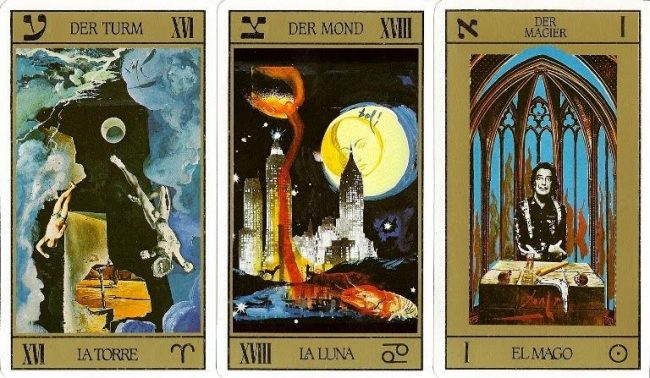
The tarot goes back to Italy of the late Middle Ages. Every day here in the 21st century, I see undeniable signs of its cultural and temporal transcendence: specifically, the tarot shops doing business here and there along the streets of Seoul, where I live. The tarot began as a deck for play, but these aren’t dealers in card-gaming supplies; rather, their proprietors use tarot decks to provide customers suggestions about their destiny and advice on what to do in the future. Over the past five or six centuries, the purpose of the tarot many have changed, but its original artistic sensibility — dramatic, symbol-laden, and highly subject to counterintuitive interpretation — has remained intact.
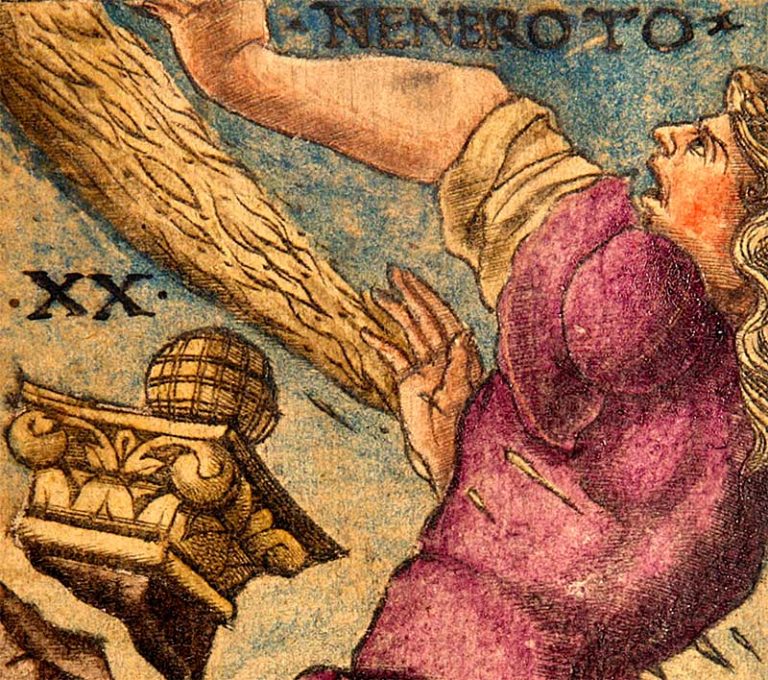
You can get an idea of that original artistic sensibility by taking a look at the the Sola-Busca, the oldest known complete deck of tarot cards. Dating from the 1490s, it holds obvious historical interest, but it’s hardly the only tarot deck we’ve featured here on Open Culture.
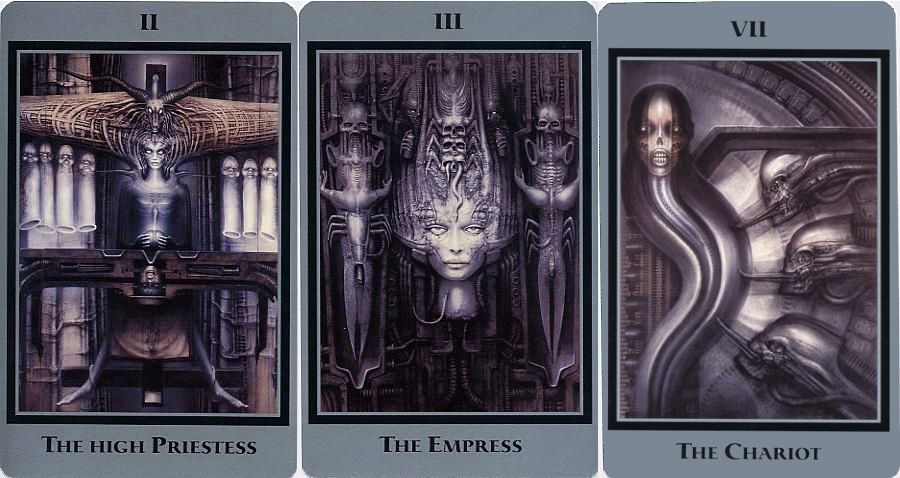
Artists of subsequent eras, up to and including our own, have created special decks in accordance with their distinctive visions. The unstoppable surrealist Salvador Dalí designed his own, a project embarked upon at the behest of James Bond film producer Albert Broccoli. Later, the master of biomechanism H.R. Giger received a tarot commission as well; though his deck uses previously unpublished rather than custom-made art, it all looks surprisingly, sometimes chillingly fitting.
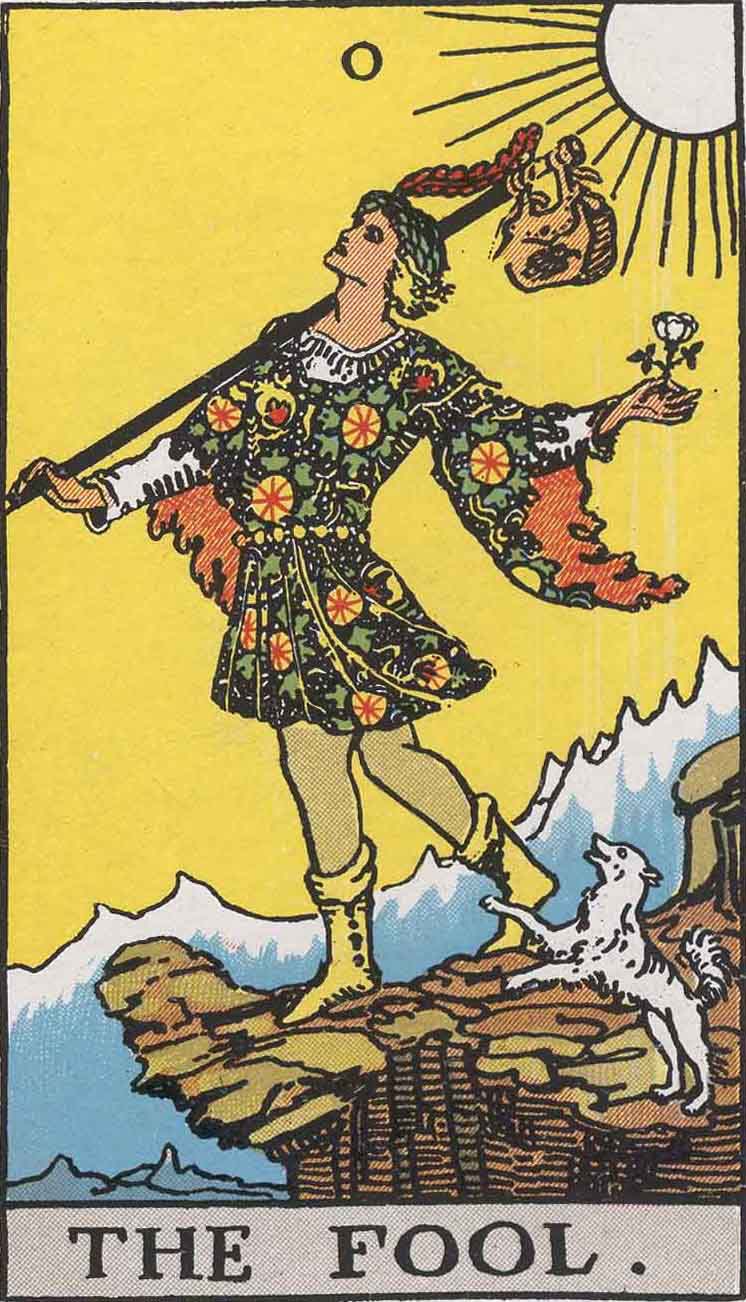
The world’s most popular tarot deck was designed not by a famous artist, but by an illustrator named Pamela Coleman-Smith. Many more have used and appreciated her work than even, say, the Thoth deck, designed by no less renowned an occultist than Aleister Crowley, “the wickedest man in the world.” If you won’t take his word for it, perhaps the founder of analytical psychology can sell you on the merits of tarot: for Carl Jung, the deck held out the possibility of the “intuitive method” he sought for “understanding the flow of life, possibly even predicting future events, at all events lending itself to the reading of the conditions of the present moment.” (See his deck here.) Even if you’re not in search of such a method, few other artifacts weave together so many threads of art, philosophy, history, and symbolism. Of course, no few modern enthusiasts find in it the same appeal as did those early tarot players of the 15th century: it’s fun.
Related Content:
Meet the Forgotten Female Artist Behind the World’s Most Popular Tarot Deck (1909)
The Thoth Tarot Deck Designed by Famed Occultist Aleister Crowley
Behold the Sola-Busca Tarot Deck, the Earliest Complete Set of Tarot Cards (1490)
Based in Seoul, Colin Marshall writes and broadcasts on cities, language, and culture. His projects include the Substack newsletter Books on Cities, the book The Stateless City: a Walk through 21st-Century Los Angeles and the video series The City in Cinema. Follow him on Twitter at @colinmarshall or on Facebook.
Read More...The Story of the MiniDisc, Sony’s 1990s Audio Format That’s Gone But Not Forgotten
“If I had asked people what they wanted, they would have said faster horses.” Whether or not pioneering carmaker Henry Ford actually uttered that quip, it has long held near-Biblical status in the realm of American business. On the other side of the Pacific, Sony founder Akio Morita put it less memorably but more generally: “If you ask the public what they think they’ll need, you’ll always be behind in this world. You’ll never catch up unless you think one to ten years in advance, and create a market for the items you think the public will accept at that time.” And had Sony, creator of the Walkman and co-creator of the Compact Disc, asked its customers what they wanted in the late 1980s, they may well have said digital cassette tapes.
In fact Philips, Sony’s partner in the development of the Compact Disc, did want to make a digital cassette tape. But Sony saw the future differently, imagining optical discs that were even more compact, and rewritable to boot. The result was MiniDisc, which within a few years of its launch in 1992 managed to see off the Digital Compact Cassette, the competing format Philips ended up developing with Matsushita. But then the story gets even more interesting, and you can see it told in detail by the half-hour This Does Not Compute documentary above. Though the MiniDisc wasn’t a straightforward success, it turns out neither to have been the sort of Betamax-style failure many Americans seem to remember today.
As a consumer audio format, MiniDisc actually became a massive phenomenon, at least back in Sony’s homeland of Japan. The peculiar economics of the Japanese music market, especially back in the 1990s, made CDs about twice as expensive there as they were in the United States. Enter the music-rental shop, where customers could check out a dozen albums for the cost of buying a single one of them, then go home and copy them all to their MiniDiscs. Veritably printing money, Sony and other MiniDisc hardware manufacturers came to the defense of music-rental chains when the displeased Japanese record industry took them to court. By the time the issue was settled, MiniDisc had already entrenched itself in the Japanese market to the point that its devices surpassed CD players in sales.
Confused by the sudden preponderance of options, most of them pricey and of uncertain value, American music consumers of the early 1990s stuck with what they knew: the high-quality CD for home listening, and the “good-enough” analog cassette tape elsewhere. In the world of professional audio, and especially among radio producers, the flexibility, reliability, convenience, and clarity of MiniDisc proved undeniable. But never cheap or widespread enough for the average listener, nor quite high-fidelity enough for the exacting audiophile, it spent most of its life in the West as a niche product. Today, a decade after its discontinuation, the history of technology has come to recognize MiniDisc as the evolutionary link between the Walkman and the iPod, each of which revolutionized the way we listen to music. And what with the newly retro appeal of 1990s technology, its aesthetic stock has never been higher.
Related Content:
The Story of How Beethoven Helped Make It So That CDs Could Play 74 Minutes of Music
All Praise Lou Ottens: The Inventor of the Cassette Tape Dies at Age 94
A Celebration of Retro Media: Vinyl, Cassettes, VHS, and Polaroid Too
Based in Seoul, Colin Marshall writes and broadcasts on cities, language, and culture. His projects include the Substack newsletter Books on Cities, the book The Stateless City: a Walk through 21st-Century Los Angeles and the video series The City in Cinema. Follow him on Twitter at @colinmarshall or on Facebook.
Read More...David Bowie on Why It’s Crazy to Make Art–and We Do It Anyway (1998)
Art is useless, Oscar Wilde declared. Yet faced with, say, a painting by Kandinsky, film by Malick, or great work by David Bowie, we may feel it “impossible to escape the impression,” as Sigmund Freud wrote, “that people commonly use false standards of measurement — that they seek power, success and wealth for themselves and admire them in others, and that they underestimate what is of true value in life.” However ambiguously, art can move us beyond the selfish boundaries of the ego to connect with intangibles beyond ideas of use and uselessness.
That experience of connectedness, what Freud called the “oceanic,” stimulated by a work of art can mirror the sublime feelings awakened by nature. “A work of art is useless as a flower is useless,” Wilde clarified in a letter to a perplexed reader. “A flower blooms for its own joy. We gain a moment of joy by looking at it. That is all that is to be said about our relations to flowers.” It’s an imperfect analogy. The flower serves quite another purpose for the bee, and for the plant. “All of this is I fear very obscure,” Wilde admits.
The point being, from the point of view of bare survival, art makes no sense. “It’s a loony kind of thing to want to do,” says Bowie himself, in the interview clip above from a 1998 appearance on The Charlie Rose Show. “I think the saner and rational approach to life is to survive steadfastly and create a protective home and create a warm loving environment for one’s family and get food for them. That’s about it. Anything else is extra. All culture is extra…. It’s unnecessary and it’s a sign of the irrational part of man. We should just be content with picking nuts.”
My fav Bowie clip ever is him talking about how the Art establishment co-opts particular voices out of a fertile art movement to kill off that movement by creating singular voices to perpetuate the idea of Art as rare commodity by geniuses rather than something within all people pic.twitter.com/CXBzYBN6cR
— RAMZEE (@RamzeeRawkz) February 28, 2021
Why are we not content with picking nuts? Perhaps most of us are. Perhaps “being an artist,” Bowie wonders “is a sign of a certain kind of dysfunction, of social dysfunctionalism anyway. It’s an extraordinary thing to do, to express yourself in such… in such rarified terms.” It’s a Wildean observation, but one Bowie does not make to stigmatize individuals. As Rose remarks, he has “always resisted the idea that this creativity that you have comes from any form of dysfunction or… madness.” Perhaps instead it is the market that is dysfunctional, Bowie suggests in a 1996 interview, just above, with Rose and Julian Schnabel.
Art may serve no practical purpose in an ordinary sense, but it is not only the provenance of singular geniuses. “Once it falls into the hands of the proletariat,” says Bowie, “that the ability to make art is inherent in all of us, that demolishes the idea of art and commerce, and that’s no good for business.” Wilde also saw art and commerce in fundamental tension. “Of course man may sell the flower, and so make it useful to him,” he wrote. “But this has nothing to do with the flower. It is not part of its essence. It is accidental. It is a misuse,” an artificial elevation and enclosure, says Bowie, of expressions that belong to everyone.
Related Content:
Bowie’s Bookshelf: A New Essay Collection on The 100 Books That Changed David Bowie’s Life
When David Bowie Launched His Own Internet Service Provider: The Rise and Fall of BowieNet (1998)
Josh Jones is a writer and musician based in Durham, NC. Follow him at @jdmagness
Read More...AI & X‑Rays Recover Lost Artworks Underneath Paintings by Picasso & Modigliani
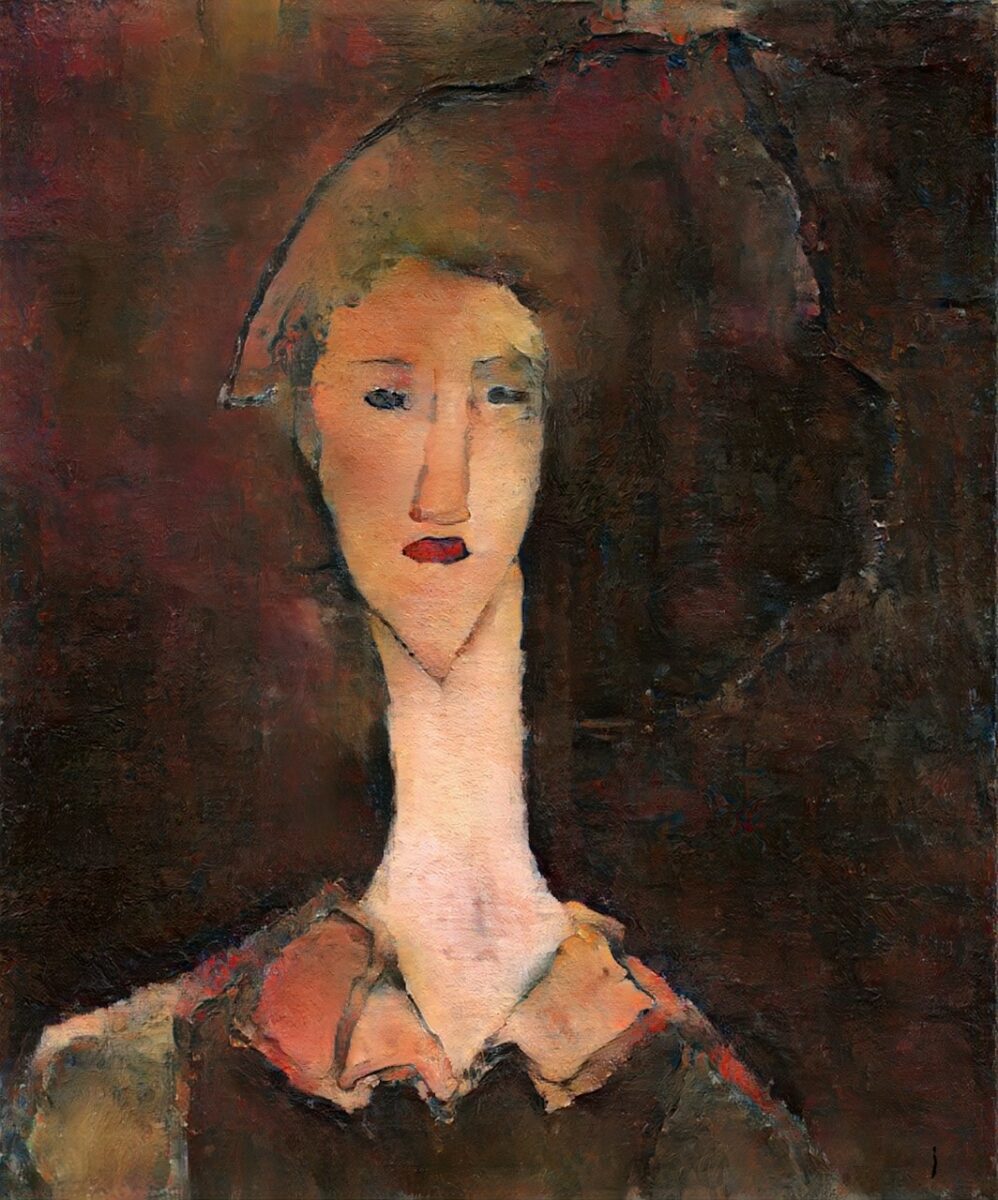
You see above a painting by Amedeo Modigliani, a portrait of the artist’s lover Beatrice Hastings, unseen by the public until its rediscovery just this year. Or at any rate, some see that: in another sense, the image is a new or almost-new artistic creation, based on X‑rays of Modigliani’s Portrait of a Girl. Underneath the paint that makes up that celebrated work lie traces enough to establish the presence of a different, earlier one beneath. But only now, after the employment of neural networks fed with enough of the artist’s acknowledged work to recognize and replicate his signature style, do we have a sense of what it could have looked like.
“Anthony Bourached and George Cann, both PhD candidates, are heading the ‘NeoMasters’ project through a company called Oxia Palus,” writes The Guardian’s Dalya Alberge. “They have ambitious plans to rediscover further hidden paintings on canvases that were reused by artists, who were perhaps too impoverished to buy supplies or dissatisfied with initial compositions.”
Modigliani was certainly impecunious enough to have done so more than once, and his relationship with Hastings — a long affair that was volatile even by the standards of the early 20th-century Parisian bohemia they inhabited — did provide material for other portraits.
Specialists, respectively, in neuroscience and the surface of Mars (their company’s name refers to a region of that planet), Bourached and Cann have proven enterprising in this art-oriented endeavor. “A 3D-printed physical rendering of their creation, complete with computer-simulated ‘brushstrokes’ and texture, will soon go on display at London’s Lebenson Gallery as part of the duo’s ‘NeoMasters’ project,” writes Nora McGreevy at Smithsonian.com. Earlier this year, McGreevy also covered Oxia Palus’ digitally assisted recovery of a Barcelona landscape possibly painted by the Spanish poet, playwright, and artist Santiago Rusiñol — before it was painted over by Pablo Picasso.
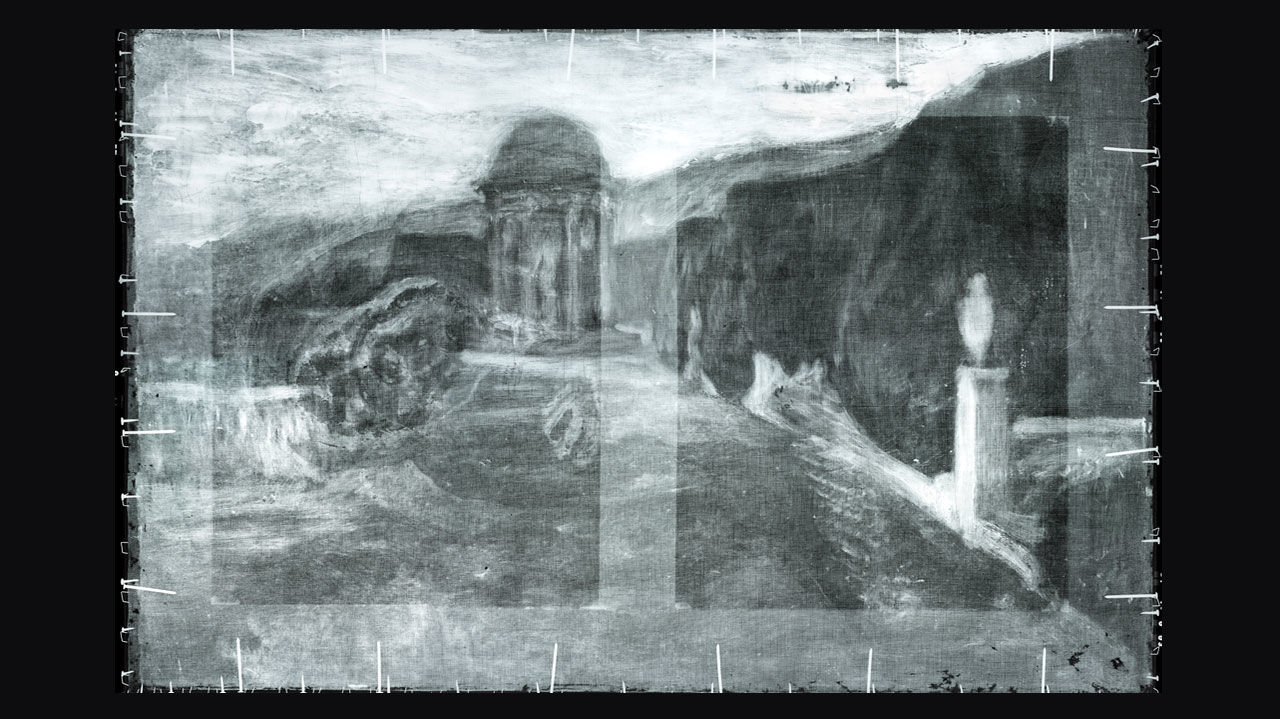
This discovery actually goes back to 1992, when conservators first determined the existence of another image beneath Picasso’s little-known La Miséreuse accroupie, or The Crouching Beggar. “Researchers suspect that Picasso used the mountains in Rusiñol’s landscape to shape the contours of his female subject’s back,” writes McGreevy. “A 2018 X‑ray of that lesser-known work by the Art Gallery of Toronto provided Oxia Palus what they needed to start work on their A.I.-assisted recreation. Not only did Bourached and Cann 3D print 100 physical copies of the final product, they linked each one to a unique non-fungible token (NFT), the new kind of digital artifact that has become something of a craze in the art world — surely an unimaginable afterlife for these images Modigliani and Picasso must have assumed they’d obliterated for good.
Related Content:
Original Portrait of the Mona Lisa Found Beneath the Paint Layers of da Vinci’s Masterpiece
Short Film Takes You Inside the Recovery of Andy Warhol’s Lost Computer Art
A 10 Billion Pixel Scan of Vermeer’s Masterpiece Girl with a Pearl Earring: Explore It Online
Based in Seoul, Colin Marshall writes and broadcasts on cities, language, and culture. His projects include the Substack newsletter Books on Cities, the book The Stateless City: a Walk through 21st-Century Los Angeles and the video series The City in Cinema. Follow him on Twitter at @colinmarshall or on Facebook.
Read More...Umberto Eco’s 36 Rules for Writing Well (in English or Italian)

Creative Commons image by Rob Bogaerts, via the National Archives in Holland
Umberto Eco knew a great many things. Indeed too many things, at least according to his critics: “Eco knows everything there is to know and spews it in your face in the most blasé manner,” declared Pier Paolo Pasolini, “as if you were listening to a robot.” That line appears quoted in Tim Parks’ review of Pape Satàn Aleppe, a posthumous collection of essays from La Bustina di Minerva, the magazine column Eco had written since 1985. “This phrase means ‘Minerva’s Matchbook,’ ” Parks explains. “Minerva is a brand of matches, and, being a pipe smoker, Eco used to jot down notes on the inside flap of their packaging. His columns were to be equally extemporaneous, compulsive and incisive, each as illuminating and explosive as a struck match.”
At the same time, “the reference to the Roman goddess Minerva is important; it warns us that in the modern world we may struggle to distinguish between divinities and bric-a-brac.” This was as true, and remains as true, in the realm of letters as in any other. And of all the things Eco knew, he surely knew best how to use words; hence his La Bustina di Minerva column laying out 40 rules for speaking and writing.
This meant, of course, speaking and writing in Italian, his native tongue and the language of which he spent his career demonstrating complete mastery. But as translator Gio Clairval shows in her English rendition of Eco’s rules, most of them apply just as well to this language.
“I’ve found online a series of instructions on how to write well,” says Eco’s introduction to the list. “I adopt them with a few variations because I think they could be useful to writers, particularly those who attend creative writing classes.” A few examples will suffice to give a sense of his guidance:
- Avoid alliterations, even if they’re manna for morons.
- Avoid clichés: they’re like death warmed over.
- Never generalize.
- Hold those quotes. Emerson aptly said, “I hate quotes. Tell me only what you know.”
- Don’t write one-word sentences. Ever.
- Recognize the difference between the semicolon and the colon: even if it’s hard.
- Do you really need rhetorical questions?
- Be concise; try expressing your thoughts with the least possible number of words, avoiding long sentences– or sentences interrupted by incidental phrases that always confuse the casual reader– in order to avoid contributing to the general pollution of information, which is surely (particularly when it is uselessly ripe with unnecessary explanations, or at least non indispensable specifications) one of the tragedies of our media-dominated time.
- Don’t be emphatic! Be careful with exclamation marks!
- No need to tell you how cloying preteritions are.
Not only does each of Eco’s points offer a useful piece of writing advice, it elegantly demonstrates just how your writing will come off if you fail to follow it. In the event that “you can’t find the appropriate expression,” he writes, “refrain from using colloquial/dialectal expressions.” To this he appends, of course, a colloquial expression, Peso el tacòn del buso: “The patch is worse than the hole.” However clichéd it sounds in Italian, all of us would do well to bear it in mind no matter the language in which we write. (And if you write in Italian, be sure to read Eco’s original column, which contains additional rules applying only to that language: Non usare metafore incongruenti anche se ti paiono “cantare,” for instance. Sono come un cigno che deraglia.)
You can read all 36 of Eco’s English-relevant writing rules at Clairval’s site. If you’d like to hear more of his writing advice, watch the Louisiana Channel interview clip we featured after his death in 2016. And elsewhere in our archives, you can compare and contrast Eco’s list of rules for writing with those drawn up by the likes of Walter Benjamin, Steven Pinker, Stephen King, V.S. Naipaul, Friedrich Nietzsche, Elmore Leonard, and George Orwell. Though Eco could, in his writing, assume what Parks calls an “immeasurably superior” persona, he surely would have agreed with the final, thoroughly English point on Orwell’s list: “Break any of these rules sooner than say anything outright barbarous.”
Related content:
Umberto Eco Dies at 84; Leaves Behind Advice to Aspiring Writers
Umberto Eco Explains Why We Make Lists
Watch Umberto Eco Walk Through His Immense Private Library: It Goes On, and On, and On!
Based in Seoul, Colin Marshall writes and broadcasts on cities, language, and culture. His projects include the Substack newsletter Books on Cities, the book The Stateless City: a Walk through 21st-Century Los Angeles and the video series The City in Cinema. Follow him on Twitter at @colinmarshall or on Facebook.
Read More...The Horrors of Bull Island, “the Worst Music Festival of All Time” (1972)
It’s maybe a little unfair to compare 1972’s “Bull Island” Festival to Fyre Fest, the music festival scam so egregious it warranted dueling documentaries on Hulu and Netflix. But “Bull Island” — or what was originally called the Erie Canal Soda Pop Festival — was an epic catastrophe, maybe the worst in music festival history, and well deserving of its own media franchise. Still, its organizers had every intention of following through on the event. What happened wasn’t entirely their fault, but partly the result of a campaign to route thousands of hippies out of the state of Indiana.
Promoters Tom Duncan and Bob Alexander had previously staged a successful festival, the Bosse Field Freedom Fest, in Evansville, an event featuring Tina Turner, Edgar Winter, Dr. John, Howlin’ Wolf, and John Lee Hooker. Eager to top themselves and bring a “bigger-than-Woodstock”-sized happening to the Midwest, they booked “a blockbuster collection of artists” for their next event, writes Patrick Chamberlain at Everfest, “including Black Sabbath, The Allman Brothers, Fleetwood Mac, Ravi Shankar, The Eagles, and even Cheech and Chong.”
Before securing all the permits, they placed ads and started selling tickets. The two eager 20-something organizers both suffered from the tragic flaw of youthful overconfidence, which blinded them to the fact that there was no way their next festival was going to happen in Evansville, or anywhere in Indiana, for that matter. The error led to what may be, as Bandsplaining explains above, the worst music festival of all time. “The lack of preparedness, the lawlessness, the desperation of the crowd; it’s like the bad-acid trip version of Woodstock where [spoiler] everything burns down. [/spoiler].”

Although reports from locals mostly characterized the duo’s previous outdoor festival at Bosse Field as peaceful, Evansville Mayor Russell Lloyd vowed it would never happen again. Yet Duncan and Alexander plowed ahead with planning the Eerie Canal Soda Pop Festival, as Sean Mcdevitt writes at the Courier & Press:
Contracts were signed, helicopters were rented, and holes were being dug for some 500 portable toilets. More than 30 rock groups were booked, and tickets went on sale in several cities around the country.
Oblivious to their fate, the organizers sold almost 9,000 tickets. “Just eight days after its announcement, a restraining order was issued against the event,” followed by a string of similar ordinances in neighboring counties as other locales got wind of the projected 50,000 to 60,000 attendees expected to show up. Soon, those numbers swelled to the hundreds of thousands. Alexander and Duncan went on TV and begged authorities to let the show proceed to prevent mass civil unrest.
Forced to move the festival out of state, they settled on a place called Bull Island, “not in fact an island, but rather a collection of swampy fields,” Chamberlain notes, “under the legal jurisdiction of the town of Carmi, Illinois, but only accessible through Indiana.” When 200,000 hippies arrived on Labor Day weekend, it caused a traffic jam 30 miles long, and they were forced to abandon their cars and hike for miles on foot, resembling “a defeated army,” NBC Nightly News reporter Edwin Newman put it.
Some of the acts — including Ravi Shankar, Ted Nugent’s Amboy Dukes, and Black Oak Arkansas — did make it, choppering in to play a set, then swiftly leaving. “Cheech and Chong were helicoptered in, performed for fifteen minutes in a deluge of rain, cut their set short,” and got out, surely sensing bad vibes everywhere, caused by strychnine-laced acid. Big acts like Rod Stewart and Black Sabbath had already canceled, leaving long stretches of silence between sets.
For most festival attendees, the open-air drug markets stood out most in their memories. “The dope district looked like double rows of fish stands at the county fair!” one remembers. “It was easier to buy drugs than it was to buy water,” recalled another attendee. The police, vastly outnumbered, left well enough alone and stayed outside the fence. Jemayel Khawaja at Ozy paints the scene:
Inside, chaos was already in full swing. The stage was half constructed, and the campgrounds — crammed with over four times as many people as expected — were lined with open drug markets. Hawkers set up stalls selling marijuana, mescaline, LSD and heroin. “I never saw so many drugs in my life,” attendee Ray Kessler recalled to local newspaper The Mount Vernon Democrat. With only six outhouses and half-dug wells to serve as sanitation, thousands instead took to relieving themselves en masse in what became known as “The Turd Fields” and bathing in the Wabash River.
What happened was surely inevitable. Price gouging caused attendees, rabid with hunger and thirst, to attack vendors. Some caught pneumonia in the torrential rains on the third day. One attendee drowned in the Wabash, another was run over by a truck but survived, many were beaten and robbed, one overdosed, one gave birth. By that evening, “the crowd had endured enough,” Chamberlain writes. “The lasting image many have of the festival is the crowd setting the stage on fire. It was a fitting ending. By this point, the populous turned to mass exodus, during which common themes were intoxication, breakdowns, theft, long drives, and comedowns.”
Related Content:
Listen Online to Every Minute of the Original Woodstock Festival
Josh Jones is a writer and musician based in Durham, NC. Follow him at @jdmagness
Read More...Watch a Never-Aired TV Profile of James Baldwin (1979)
In 1979, just a couple of months into his stint with 20/20, ABC’s fledgling television news magazine, producer and documentarian Joseph Lovett was “beyond thrilled” to be assigned an interview with author James Baldwin, whose work he had discovered as a teen.
Knowing that Baldwin liked to break out the bourbon in the afternoon, Lovett arranged for his crew to arrive early in the morning to set up lighting and have breakfast waiting before Baldwin awakened:
He hadn’t had a drop to drink and he was brilliant, utterly brilliant. We couldn’t have been happier.
Pioneering journalist Sylvia Chase conducted the interview. The segment also included stops at Lincoln Center for a rehearsal of Baldwin’s play, The Amen Corner, and the Police Athletic League’s Harlem Center where Baldwin (and perhaps the camera) seems to unnerve a teen reporter, cupping his chin at length while answering his question about a Black writer’s chances:
There never was a chance for a Black writer. Listen, a writer, Black or white, doesn’t have much of a chance. Right? Nobody wants a writer until he’s dead. But to answer your question, there’s a greater chance for a Black writer today than there ever has been.
In the Manhattan building Baldwin bought to house a number of his close-knit family, Chase corners his mother in the kitchen to ask if she’d had any inkling her son would become such a success.
“No, I didn’t think that,” Mrs. Baldwin cuts her off. “But I knew he had to write.”
Baldwin speaks frankly about outing himself to the general public with his 1956 novel Giovanni’s Room and about what it means to live as a Black man in a nation that has always favored its white citizens:
The American sense of reality is dictated by what Americans are trying to avoid. And if you’re trying to avoid reality, how can you face it?
Nearly 35 years before Black Lives Matter’s formation, he tackles the issue of white fragility by telling Chase, “Look, I don’t mean it to you personally. I don’t even know you. I have nothing against you. I don’t know you personally, but I know you historically. You can’t have it both ways. You can’t swear to the freedom of all mankind and put me in chains.”
The finished piece is a superb, 60 Minutes-style profile that covers a lot of ground, and yet, 20/20 chose not to air it.
After the show ran Chase’s interview with Michael Jackson, producer Lovett inquired as to the delay and was told that no one would be interested in a “queer, Black has-been”:
I was stunned, I was absolutely stunned, because in my mind James Baldwin was no has-been. He was a classic American writer, translated into every language in the world, and would live on forever, and indeed he has. His courage and his eloquence continue to inspire us today.
On June 24, Joseph Lovett will moderate James Baldwin: Race, Media, and Psychoanalysis, a free virtual panel discussion centering on his 20/20 profile of James Baldwin, with psychoanalysts Victor P. Bonfilio and Annie Lee Jones, and Baldwin’s niece, author Aisha Karefa-Smart. Register here.
H/T to author Sarah Schulman
Related Content:
Watch the Famous James Baldwin-William F. Buckley Debate in Full, With Restored Audio (1965)
Listen to James Baldwin’s Record Collection in a 478-track, 32-Hour Spotify Playlist
Ayun Halliday is an author, illustrator, theater maker and Chief Primatologist of the East Village Inky zine. Follow her @AyunHalliday.
Read More...Watch an Accurate Reconstruction of the World’s Oldest Computer, the 2,200 Year-Old Antikythera Mechanism, from Start to Finish
There’s nothing like an ancient mystery, especially one as seemingly insoluble as the origins of “the world’s first computer,” the Antikythera mechanism. Discovered off the coast of the Greek island of Antikythera in 1901, the corroded collection of gears and dials seemed fake to scientists at first because of its ingeniousness. It has since been dated to 100 to 150 BC and has inspired decades of research and speculative reconstruction. Yet, no one knows who made it, and more importantly, no one knows how it was made.
“The distance between this device’s complexity and others made at the same time is infinite,” says Adam Wojcik, a materials scientist at the University College of London. “Frankly, there is nothing like it that has ever been found. It’s out of this world.”
The expression should not make us think of ancient aliens — the Antikythera mechanism contains more than enough evidence of human limitation, showing a geocentric model of the cosmos with the only five planets its maker would have known.
The 2,000-plus year-old device continues to reveal its secrets, including hidden inscriptions found during CT scans of the object, as Smithsonian reported in 2015. The mechanism is “similar in size to a mantel clock, and bits of wood found on the fragments suggest it was housed in a wooden case. Like a clock, the case would’ve had a large circular face with rotating hands. There was a knob or handle on the side, for winding the mechanism forward or backward. And as the knob turned, trains of interlocking gearwheels drove at least seven hands at various speeds. Instead of hours and minutes, the hands displayed celestial time.”
If the Antikythera mechanism is a “celestial clock,” who better to design and build its reconstruction than a clockmaker? That is exactly what we see in the videos above, created for the clockmaking YouTube channel Clickspring. Using the best scientific model of the mechanism to date — published this year by Dr. Tony Freeth and colleagues of the Antikythera Mechanism Research Project — Clickspring shows how the device might have fit together and makes educated guesses about the right placement of its dozens of small parts.
You can see a preview of the Antikythera reconstruction project at the top, watch the full project above, and see individual episodes showcasing different phases of construction on YouTube. The model “conforms to all the physical evidence,” Freeth writes, “and matches the descriptions in the scientific inscriptions engraved on the mechanism itself.” What no one can figure out, however, is just how the ancient Greek artisans who made it shaped precision metal parts without lathes and other modern tools of the machine-makers trade. Researchers, and clockmakers, may have pieced together the Antikythera puzzle, but the mystery of how it came into existence at all remains unsolved.
Related Content:
Modern Artists Show How the Ancient Greeks & Romans Made Coins, Vases & Artisanal Glass
Josh Jones is a writer and musician based in Durham, NC. Follow him at @jdmagness
Read More...Søren Kierkegaard – Subjectivity, Irony and the Crisis of Modernity: A Free Online Course from the University of Copenhagen

The University of Copenhagen and Jon Stewart, PhD present Søren Kierkegaard – Subjectivity, Irony and the Crisis of Modernity, a course exploring the work of Denmark’s great philosopher. The course description reads as follows:
It is often claimed that relativism, subjectivism and nihilism are typically modern philosophical problems that emerge with the breakdown of traditional values, customs and ways of life. The result is the absence of meaning, the lapse of religious faith, and feeling of alienation that is so widespread in modernity.
The Danish thinker Søren Kierkegaard (1813–55) gave one of the most penetrating analyses of this complex phenomenon of modernity. But somewhat surprisingly he seeks insight into it not in any modern thinker but rather in an ancient one, the Greek philosopher Socrates.
In this course created by former associate professor at the Søren Kierkegaard Research Centre, Jon Stewart, we will explore how Kierkegaard deals with the problems associated with relativism, the lack of meaning and the undermining of religious faith that are typical of modern life. His penetrating analyses are still highly relevant today and have been seen as insightful for the leading figures of Existentialism, Post-Structuralism and Post-Modernism.
You can take Søren Kierkegaard for free by selecting the audit option upon enrolling. If you want to take the course for a certificate, you will need to pay a fee.
Søren Kierkegaard has been added to our list of Free Philosophy Courses, a subset of our collection, 1,700 Free Online Courses from Top Universities.
Related Content
Existential Philosophy of Kierkegaard, Sartre, Camus Explained with 8‑Bit Video Games
Read More...The Bob Ross Virtual Art Gallery: A New Site Presents 403 Paintings from The Joy of Painting Series
“We don’t make mistakes. We have happy accidents,” the late Bob Ross soothed fans painting along at home, while brushing an alarming amount of black onto one of his signature nature scenes.
His mellow on-camera demeanor and flowing, wet-on-wet oil painting style were perfectly calibrated to help tightly-wound viewers relax into a right-brained groove.
The creators of the Bob Ross Virtual Art Gallery take a more left brained approach.

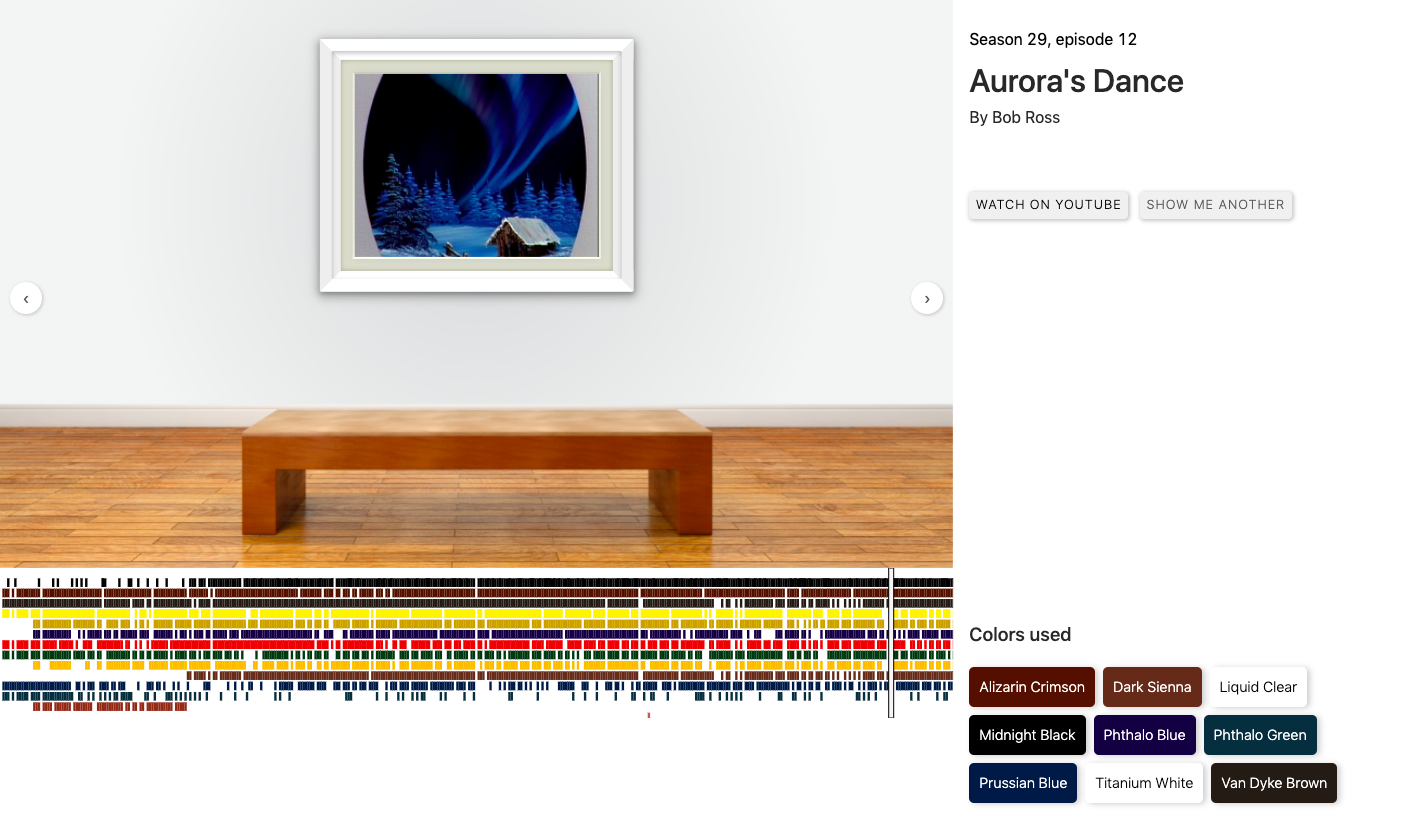
Having collected data on Ross’ evergreen series, The Joy of Painting, they analyzed it for frequency of color use over the show’s 403 episodes, as well as the number of colors applied to each canvas.
For those keeping score, after black and white, alizarin crimson was the color Ross favored most, and 1/4 of the paintings made on air boast 12 colors.
The data could be slightly skewed by the contributions of occasional guest artists such as Ross’ former instructor, John Thamm, who once counseled Ross to “paint bushes and trees and leave portrait painting to someone else.” Thamm availed himself of a single color — Van Dyke Brown — to demonstrate the wipe out technique. His contribution is one of the few human likenesses that got painted over the show’s 11-year public television run.
The Bob Ross Virtual Art Gallery has several options for viewing the data.
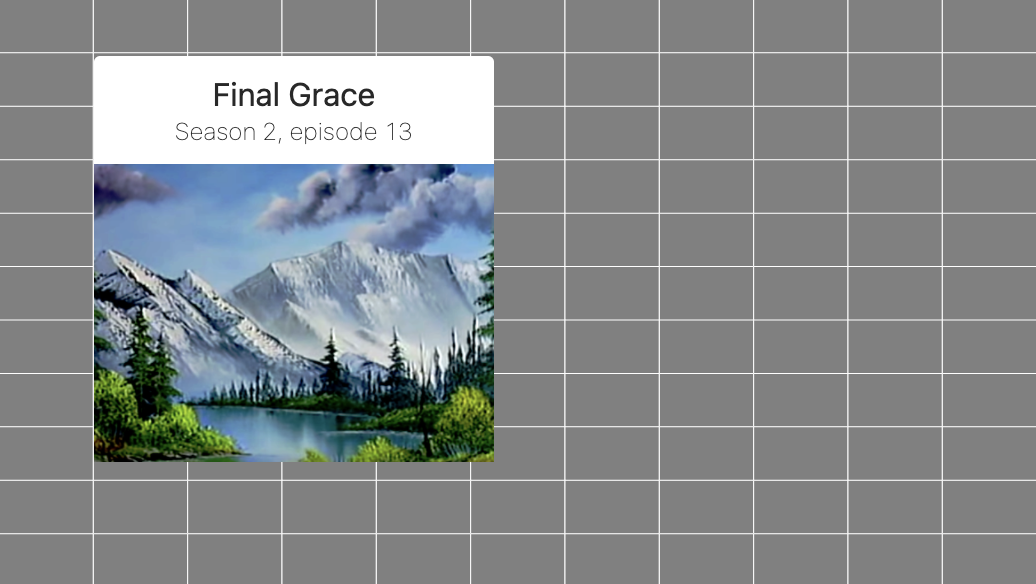
Mouse over a grid of grey rectangles to see the 403 artworks presented in chronological order, along with titles and episode numbers.
(This has all the makings of a thumping good memory game, à la Concentration… flip all the rectangles, study them, then see if you can navigate back to all the cabins or meadows.)
A bar graph, similarly composed of rectangles, reveals the colors that went into each painting.
Another chart analyzes Ross’ use of color over time, as he moved away from Burnt Umber and eased up on Pfthalo Green.

Indian Red was accorded but a single use, in season 22’s first episode, “Autumn Images.” (“Let’s sparkle this up. We’re gonna have fall colors. Let’s get crazy.”)
For art lovers craving a more traditional gallery experience, site creator Connor Rothschild has installed a virtual bench facing a frame capable of displaying all the paintings in random or chronological order, with digital swatches representing the paints that went into them and YouTube links to the episodes that produced them.
And for those who’d rather gaze at data science, the code is available on GitHub.
Explore the Bob Ross Virtual Art Gallery here. Scroll down to take advantage of all the options.
Related Content:
Experience the Bob Ross Experience: A New Museum Open in the TV Painter’s Former Studio Home
Bob Ross’ Christmas Special: Celebrate, Relax, Nod Off
Ayun Halliday is an author, illustrator, theater maker and Chief Primatologist of the East Village Inky zine. Join her Necromancers of the Public Domain: The Periodical Cicada, a free virtual variety show honoring the 17-Year Cicadas of Brood X. Follow her @AyunHalliday.
Read More...Support Us
We're hoping to rely on loyal readers, rather than erratic ads. Please click the Donate button and support Open Culture. You can use Paypal, Venmo, Patreon, even Crypto! We thank you!

About Us

Open Culture scours the web for the best educational media. We find the free courses and audio books you need, the language lessons & educational videos you want, and plenty of enlightenment in between.
Advertise With Us
FREE UPDATES!
GET OUR DAILY EMAIL
Get the best cultural and educational resources on the web curated for you in a daily email. We never spam. Unsubscribe at any time.
FOLLOW ON SOCIAL MEDIA
Open Culture editor Dan Colman scours the web for the best educational media. He finds the free courses and audio books you need, the language lessons & movies you want, and plenty of enlightenment in between.
Advertise With Us

