How Bob Dylan Created a Musical & Literary World All His Own: Four Video Essays
More than two decades ago, New Yorker music critic Alex Ross published a piece on Bob Dylan in what many would then have considered his “late” period. “In the verbal jungle of rock criticism, Dylan is seldom talked about in musical terms,” Ross writes. “His work is analyzed instead as poetry, punditry, or mystification.” Despite having long possessed exalted cultural status, and been subject to the attendant intensity of scrutiny and exegesis that comes along with it, “Dylan himself declines the highbrow treatment — though you get the sense that he wouldn’t mind picking up a Nobel Prize.” As it happened, he picked one up seventeen years later, in a clear institutional affirmation of his work’s being, indeed, literature. But what (as many have asked about the work itself) does that mean?
In the video essay at the top of the post, Evan Puschak, better known as the Nerdwriter, examines Dylan’s literary powers through the microcosm of one song. “All Along the Watchtower” first appeared on the austere 1967 album John Wesley Harding, a seeming repudiation of both the increasingly psychedelic pop-cultural zeitgeist and his own persona as a prophetic folk singer-turned-rocker. “Dylan spent much of his early career fighting off the label of prophet,” says Puschak, “but here he seems to accept the role, laying down an apprehensive, apocalyptic scenario, as if to say, ‘You want a prophecy? Okay, I’ll give you a prophecy, but it comes at a price: the price is mystery and entrapment, a prophecy the meaning of which is forever out of reach.”
A short folk ballad, “All Along the Watchtower” is told “as a conversation that aims to convey a message. But the fingerprints of the blues are everywhere on this song: namely, of one of Dylan’s heroes, Robert Johnson, who, the legend has it, sold his sold to the Devil for musical genius.” In addition to dealing with longer musical traditions, the song also finds Dylan employing timeless archetypes like the joker and the thief, drawing as well from the Bible (to which John Wesley Harding contains some 70 references) as he tells their story. These sound like the qualities of a literary enterprise, but as PBS Idea Channel host Mike Rugnetta argues in the video above, “When we label something literature, we’re not making a simple factual statement about the characteristics of a work of art. We’re communicating about what we consider worthwhile.”
In considering whether Dylan’s work is “really literature,” Rugnetta cites literary theorist Terry Eagleton’s essay “What Is Literature?” In it Eagleton writes that “literature transforms and intensifies ordinary language, deviates systematically from everyday speech” — but also that “one can think of literature less as some inherent quality or set of qualities displayed by certain kinds of writing, all the way from Beowulf to Virginia Woolf, than as a number of ways in which people relate themselves to writing.” Participated in by critics, academics, and amateurs, the ever-growing industry of “Dylanology” attests to a particularly intimate and long-lasting relationship between Dylan’s music and its listeners. The adjective literary, here, seems to imply the existence of ambition, complexity, ambiguity, and extended cultural centrality.
Nothing evidences cultural centrality like parody, and as the Polyphonic video above shows, Dylan has inspired more than a few astute send-ups over the decades. “With so much conversation around him and such a distinct style,” says its narrator, “it’s perhaps unsurprising that he’s been a frequent target of satire.” That includes songs by other famous and well-regarded musicians. In “A Simple Desultory Philippic (or How I Was Robert McNamara’d into Submission),” Paul Simon “mocks Dylan’s lyrical habits and proclivity for referencing historical and fictional figures in his music.” In addition to its “nasal folk-rock style,” Stealers Wheel’s “Stuck in the Middle with You” uses “the archetypal figures of the clown and the joker,” much like “All Along the Watchtower.” (To say nothing of Weird Al’s palindromic “Bob.”)
Like many a literary master, Dylan has dished it out as well as taken it. But his best-known acts of mockery seem to have been directed not toward his peers but the press, whose ravenousness in the 20th century of ever-more-mass media did so much to both build him up and cramp his style. “In his early days, Dylan used the media as a tool for self-mythmaking,” says Polyphonic’s narrator in the video above. But “soon enough, be became the icon for a growing counterculture,” and the title of “voice of a generation” began to weigh heavily. Throwing it off required getting adversarial, not least through songs like “Ballad of a Thin Man,” a j’accuse against an unspecified “Mr. Jones,” representative — so it’s been proposed — of the legions of badgering squares sent by newspapers, television, and so on.
Dylan could also have intended Mr. Jones to stand more broadly for “people out of touch with him and his movement, people who pestered him for his beliefs without truly understanding where they came from,” members of “old society, trying to pass blanket moralistic judgments on his culture and lifestyle.” Like a character out of F. Scott Fitzgerald, “inauthentic on all levels,” Mr. Jones is “faking his way through intellectual circles while fetishizing the counterculture.” 57 years after “Ballad of a Thin Man,” the now-octogenarian Dylan continues to record and perform, and to engage with the media when and how he sees fit. He’s somehow avoided joining the establishment, let alone becoming a Mr. Jones; he remains the joker who, asked in a 1960s press conference whether he considered himself a songwriter or a poet, replied, “Oh, I consider myself more of a song and dance man.”
Related Content:
“Tangled Up in Blue”: Deciphering a Bob Dylan Masterpiece
Bob Dylan Reads From T.S. Eliot’s Great Modernist Poem The Waste Land
Hear Bob Dylan’s Newly Released Nobel Lecture: A Meditation on Music, Literature & Lyrics
Bob Dylan’s Famous Televised Press Conference After He Went Electric (1965)
Kurt Vonnegut on Bob Dylan: He “Is the Worst Poet Alive”
Based in Seoul, Colin Marshall writes and broadcasts on cities and culture. His projects include the book The Stateless City: a Walk through 21st-Century Los Angeles and the video series The City in Cinema. Follow him on Twitter at @colinmarshall or on Facebook.
Read More...New Study Finds That Humans Are 33,000 Years Older Than We Thought

photo by Céline Vidal
“Where’re you from?” one character asks another on the Firesign Theatre’s classic 1969 album How Can You Be in Two Places at Once When You’re Not Anywhere at All. “Nairobi, ma’am,” the other replies. “Isn’t everybody?” Like most of the countless multi-layered gags on their albums, this one makes a cultural reference, presumably to the discoveries made by famed paleoanthropologists Louis and Mary Leakey over the previous 20 years. Their discovery of fossils in Kenya and elsewhere did much to advance the thesis that humankind evolved in Africa, and that the process was happening more than 1.75 million years before.
Like all scientific breakthroughs, the Leakeys’ work only prompted more questions — or rather, created more opportunities for refining and adding detail to the relevant body of knowledge. Subsequent digs all over Africa have produced further evidence of how far our species and its predecessors go back, and where exactly the evolutionary progress happened.
Just this month, Nature published a new paper on the “age of the oldest known Homo sapiens from eastern Africa.” These new findings about known fossils, originally discovered in southwestern Ethiopia in 1967, suggest that the time has come for another revision of the long pre-history of humanity.

photo by Céline Vidal
The paper’s authors, writes Reuters’ Will Dunham, “used the geochemical fingerprints of a thick layer of ash found above the sediments containing the fossils to ascertain that it resulted from an eruption that spewed volcanic fallout over a wide swathe of Ethiopia roughly 233,000 years ago.” These fossils “include a rather complete cranial vault and lower jaw, some vertebrae and parts of the arms and legs.” After their initial discovery by the late Richard Leakey, son of Louis and Mary (and a man genuinely from Nairobi, born and raised), the fossils buried by this prehistoric Vesuvius were previously believed to be “no more than about 200,000 years old.”
Dunham quotes the paper’s lead author, University of Cambridge volcanologist Celine Vidal, as saying this discovery aligns with “the most recent scientific models of human evolution placing the emergence of Homo sapiens sometime between 350,000 to 200,000 years ago.” Though Vidal and her team’s analysis of the ash’s geochemical composition has determined the minimum age of Omo I, as these fossils are known, the maximum age remains an open question. Or at least, it awaits the efforts of researchers to date the “ash layer below the sediment containing the fossils” and render a more precise estimate. And when that’s established, it will then, ideally, become material for the next big absurdist comedy troupe.
via Hyperallergic
Related Content:
Where Did Human Beings Come From? 7 Million Years of Human Evolution Visualized in Six Minutes
Richard Dawkins Explains Why There Was Never a First Human Being
How Humans Migrated Across The Globe Over 200,000 Years: An Animated Look
The Life & Discoveries of Mary Leakey Celebrated in an Endearing Cutout Animation
Based in Seoul, Colin Marshall writes and broadcasts on cities and culture. His projects include the book The Stateless City: a Walk through 21st-Century Los Angeles and the video series The City in Cinema. Follow him on Twitter at @colinmarshall or on Facebook.
Read More...1,100 Delicate Drawings of Root Systems Reveals the Hidden World of Plants

We know that plants can inspire art. If you, personally, still require convincing on that point, just have a look at Elizabeth Twining’s Illustrations of the Natural Orders of Plants, the drawings of Ernst Heinrich Haeckel, Elizabeth Blackwell’s A Curious Herbal, and Nancy Anne Kingsbury Wollstonecraft’s Specimens of the Plants and Fruits of the Island of Cuba — not to mention the paintings of Georgia O’ Keeffe — all previously featured here on Open Culture. But those works concern themselves only with plant life as it exists above ground.
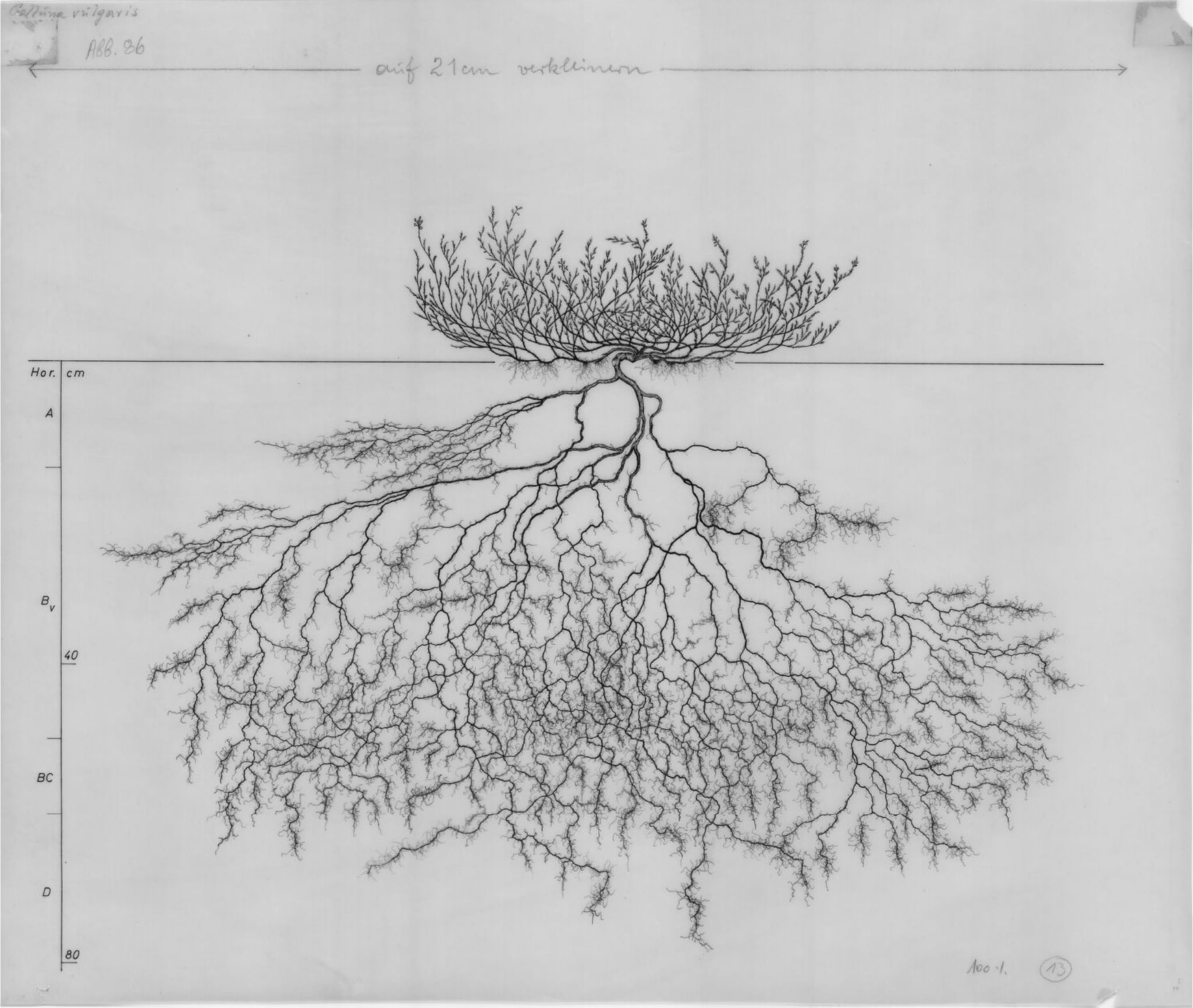
What goes on down below, underneath the soil? That you can see for yourself — and without having to pull up one of our fine flowering (or non-flowering) friends to do so — at Wageningen University’s online archive of root system drawings. “The outcome of 40 years of root system excavations in Europe,” says that site, the collection contains 1,180 diagrams of species from Abies alba (best known today as a kind of Christmas tree) to Zygophyllum xanthoxylon (a faintly scrubby-looking native of the arid and semi-arid regions of continents like Africa and Australia).

The site explains that “the drawings, their analysis and description were done by Univ. Prof. Dr. Erwin Lichtenegger (1928–2004) and Univ. Prof. Dr. Lore Kutschera (1917–2008), leader of Pflanzensoziologisches Institut, Klagenfurt, (now in Bad Goisern, Austria).”
Over the course of 40 years, writes The Washington Post’s Erin Blakemore, Lichtenegger and Kustchera “collaborated on an enormous ‘root atlas’ that maps the underground trajectories of common European plants.” Created through “a laborious system of digging up and documenting the intricate systems,” these drawings are “also art in their own right, honoring the beauty of a part of plants most never give that much thought.”

Even the least botanically aware among us knows that plants have roots, but how many of us are aware of the scale and complexity those roots can attain? “Root systems allow plants to gather the water and minerals they use to grow,” writes Blakemore. “As the root system grows, it creates more and more pathways that allow water to get into the deep subsoil, and fostering the growth of microbes that benefit other life. Strong root systems can prevent erosion, protecting the land on which they grow. And the structures allow the soil to capture carbon.” Thus root systems, never a particular locus of coolness, have the distinction of doing their part to fight climate change. And thanks to Lichtenegger and Kustchera’s drawings, they underscore the capacity of art to reveal worlds hidden to most of us. View all of the images here.

via Colossal
Related Content:
Two Million Wondrous Nature Illustrations Put Online by The Biodiversity Heritage Library
Based in Seoul, Colin Marshall writes and broadcasts on cities and culture. His projects include the book The Stateless City: a Walk through 21st-Century Los Angeles and the video series The City in Cinema. Follow him on Twitter at @colinmarshall or on Facebook.
Read More...The Philosophy of Games: C. Thi Nguyen on the Philosophy vs. Improv Podcast
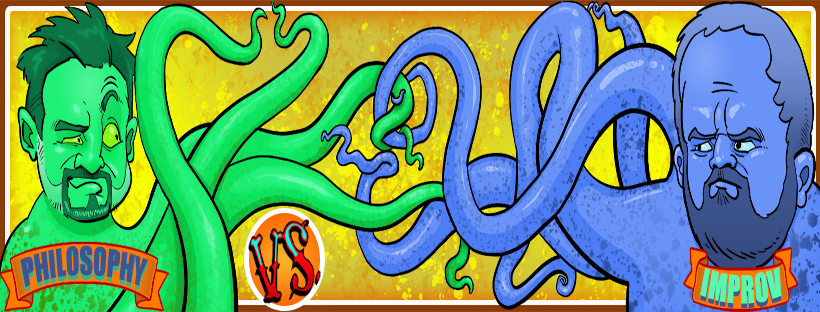
Thi Nguyen (pronounced “TEE NWEEN”) teaches at the University of Utah, and his first book, 2020’s Games: Agency as Art, makes a case for games being treated as a serious object of study for philosophy. Thi sees game analysis as not just a sub-division in the philosophy of art (aesthetics), but in the philosophy of action. How do games relate to other human activities with constraints, like customs, language, and more specifically performative acts within language (like saying “I do” during a marriage ceremony, where you’re not just describing that you do something, but actually taking action)?
On this recording (episode 24 of the podcast), Thi joins philosophy podcaster Mark Linsenmayer of The Partially Examined Life and improvisational comedy coach Bill Arnett of the Chicago Improv Studio to talk about games and improv, and to engage in a couple of improv scenes that explore the connection between the two.

This is the third philosophy guest for the Philosophy vs. Improv podcast, which alternates between guests from the improv world, guests from the philosophy world, and no guest at all. The overall format involves a lesson from each host, which they teach to each other (and the guest) simultaneously. This often results in unexpected synchronicity given the connections between two disciplines that stress the analysis of language, living deliberately, and quick thinking.
For another philosophically rich episode, see episode #20 in which St. Lawrence University’s Jennifer L. Hansen appeared to discuss the many aspects of the concept of “The Other” in philosophy.
Philosophy vs. Improv is a podcast hosted by Mark Linsenmayer, who also hosts The Partially Examined Life Philosophy Podcast, Pretty Much Pop: A Culture Podcast, and Nakedly Examined Music.
Read More...How to Decode NASA’s Message to Aliens
When NASA spent close to a billion dollars on the Voyager program, launching a pair of probes from Cape Canaveral in 1977, its primary purpose was not to find intelligent extra-terrestrial life. The program grew out of ambitions for a “Grand Tour”: four robotic probes that would visit all the planets in the outer solar system, taking advantage of a 175-year alignment of Jupiter and Saturn. A downsized version produced Voyager 1 and 2, each craft “a miniature marvel,” writes the Attic. “Weighing less than a Volkswagen, each had 65,000 parts. Six thrusters powered by plutonium. Three gyroscopes. Assorted instruments to measure gravity, radiation, magnetic fields, and more. Design and assembly took years.”
Since reaching Jupiter in 1979, the two probes have sent back astonishing images from the great gas giants and the very edges of the solar system. “By 2030, Voyager 1 and 2 will cease communications for good,” says Cory Zapatka in the Verge Science video above, “and while they won’t be able to beam information back to Earth, they’re going to continue sailing through space at almost 60,000 kilometers per hour,” reaching interstellar unknowns their makers will never see. Voyager 1 was only supposed to last 10 years. In 2012, it left the solar system, to drift, along with its twin, “endlessly among the stars of our galaxy,” Timothy Ferris writes in The New Yorker, “unless someone or something encounters them someday.”
As deep space detritus, the probes will make excellent carriers for an interstellar message in a bottle, the Voyager team reasoned. The idea prompted the creation of the Golden Record, an LP fitted to each probe containing a message from humanity to the cosmos. “Etched in copper, plated with gold, and sealed in aluminum cases, the records are expected to remain intelligible for more than a billion years, making them the longest-lasting objects ever crafted by human hands.” Produced by Ferris and overseen by Carl Sagan and a team including his future wife, Ann Druyan, the Golden Record includes the work of Mozart, Chuck Berry, folk music from around the world, the sounds of waves and whales, and one of the most universal of human sounds, laughter (likely that of Sagan himself).
The Golden Record also includes 115 images, etched into its very surface. No, they are not digital files. “There are no jpegs or tifs included on it,” says Zapatka. After all, “The Voyager’s computer systems were only 69 kilobytes large, barely enough for one image, let alone 115.” These are analog still photographs and diagrams that must be reconstructed with mathematical formulae extracted from electronic tones. The process starts with the diagrams on the record’s cover — simple icons that contain an incredible density of information. We begin with two circles joined by a line. They are hydrogen atoms, the most plentiful gas in the universe, undergoing a change that occurs spontaneously once every 10 million years.
During this rare occurrence, the hydrogen atoms emit energy at wavelengths of 21 centimeters. This measurement is used as “a constant for all the other symbols on the record.” That’s an awful lot of background knowledge required to decipher what look to the scientifically untrained eye like a pair of tiny eyes behind a pair of odd eyeglasses. But for spacefaring aliens, “how hard could that be?” says Bill Nye above in an abridged description of how to decode the Golden Record. We may never, in a billion years, know if any extra-terrestrial species ever finds the record and makes the attempt. But the Golden Record has become as much an object of fascination for humans as it is a greeting from Earth to the galaxy. Learn more from NASA here about the images encoded on the Golden Record and order your own reproduction (on LP or CD) here.
Related Content:
NASA Lets You Download Free Posters Celebrating the 40th Anniversary of the Voyager Missions
Carl Sagan Warns Congress about Climate Change (1985)
Josh Jones is a writer and musician based in Durham, NC. Follow him at @jdmagness
Read More...How to Ride a Pterosaur, According to Science
From the BBC: “During the Late Cretaceous, winged prehistoric creatures called pterosaurs dominated the air. They were the first vertebrates to master flight. They were not dinosaurs but closely related. Some were tiny, but some were the biggest creatures ever to have flown. We ask a question you’ve all been wondering, could we ride one, and if so, how?” In the animation above, science producer Pierangelo Pirak explores some ideas Dr. Liz Martin-Silverstone, a palaeontologist with a keen interest in biomechanics. She runs the Palaeobiology Laboratories, including the XTM Imaging Facility for microCT scanning and imaging analysis, at the University of Bristol.
If you would like to support the mission of Open Culture, consider making a donation to our site. It’s hard to rely 100% on ads, and your contributions will help us continue providing the best free cultural and educational materials to learners everywhere. You can contribute through PayPal, Patreon, and Venmo (@openculture). Thanks!
Related Content
Gertie the Dinosaur: The Mother of all Cartoon Characters (1914)
40,000-Year-Old Symbols Found in Caves Worldwide May Be the Earliest Written Language
Read More...Animals Laugh Too: UCLA Study Finds Laughter in 65 Species, from Rats to Cows
Every pet owner knows that animals love to play, but laughter seems reserved for humans, a few apes, and maybe a few birds good at mimicking humans and apes. As it turns out, according to a new article published in the journal Bioacoustics, laughter has been “documented in at least 65 species,” Jessica Wolf writes at UCLA Newsroom. “That list includes a variety of primates, domestic cows and dogs, foxes, seals, and mongooses, as well as three bird species, including parakeets and Australian magpies.” This is a far cry from just a few years ago when apes and rats were the “only known animals to get the giggles,” as Liz Langley wrote at National Geographic in 2015.
Yes, rats laugh. How do scientists know this? They tickle them, of course, as you can see in the video just above. (Rat tickling, it turns out, is good for the animals’ well being.) The purpose of this experiment was to better understand human touch — and tickling, says study author Michael Brecht, “is one of the most poorly understood forms of touch.”
Laughter, on the other hand, seems somewhat better understood, even among species separated from us by tens of millions of years of evolution. In their recent article, UCLA primatologist Sasha Winkler and UCLA professor of communication Greg Bryant describe how “play vocalizations” signal non-aggression during roughhousing. As Winkler puts it:
When we laugh, we are often providing information to others that we are having fun and also inviting others to join. Some scholars have suggested that this kind of vocal behavior is shared across many animals who play, and as such, laughter is our human version of an evolutionarily old vocal play signal.
Generally, humans are unlikely to recognize animal laughter as such or even perceive it at all. “Our review indicates that vocal play signals are usually inconspicuous,” the authors write. Rats, for example, make “ultrasonic vocalizations” beyond the range of human hearing. The play vocalizations of chimpanzees, on the other hand, are much more similar to human laughter, “although there are some differences,” Winkler notes in an interview. “Like, they vocalize in both the in-breath and out breath.”
Why study animal laughter? Beyond the inherent interest of the topic — an especially joyful one for scientific researchers — there’s the serious business of understanding how “human social complexity allowed laughter to evolve from a play-specific vocalization into a sophisticated pragmatic signal,” as Winkler and Bryant write. We use laughter to signal all kinds of intentions, not all of them playful. But no matter how many uses humans find for the vocal signal, we can see in this new review article how deeply non-aggressive play is embedded throughout the animal world and in our evolutionary history. Read “Play vocalisations and human laughter: a comparative review” here.
Related Content:
Eye of the Pangolin: The Search for an Animal on the Edge
Download Animals and Ethics 101: Thinking Critically About Animal Rights (Free)
Josh Jones is a writer and musician based in Durham, NC. Follow him at @jdmagness
Read More...The Famous Downfall Scene Explained: What Really Happened in Hitler’s Bunker at the End?
Before his role as Hitler in the 2004 German film Downfall turned Swiss actor Bruno Ganz into a viral internet star, he was best known for playing an angel who comforts the dying in Wim Wenders’ 1987 Wings of Desire. “People really seemed to think of me as a guardian angel,” he told The Irish Times in 2005. “People would bring their children before me for a blessing or something.” Seventeen years later, the self-described introvert transformed his gentle, comforting face into the Nazi screen monster: “Nothing prepared me for what must be the most convincing screen Hitler yet,” wrote The Guardian’s Rob Mackie. “An old, bent, sick dictator with the shaking hands of someone with Parkinson’s, alternating between rage and despair in his last days in the bunker.”
This portrayal has never been surpassed, and perhaps it never will be. How many fictionalized film treatments of these events do we need? Especially since this one lives forever in meme form: Ganz endlessly spitting and gesticulating, while captions subtitle him ranting about “his pizza arriving late” – Gael Fashingbaeur Cooper writes at cnet – or “the Red Wedding scene on Game of Thrones, or finding out he wasn’t accepted into Harry Potter’s Hogwarts.” As Virginia Heffernan wrote at The New York Times in 2008 – maybe the height of the meme’s virality – “It seems that late-life Hitler can be made to speak for almost anyone in the midst of a crisis…. Something in the spectacle of an autocrat falling to pieces evidently has widespread appeal.”
Given the widespread preference for memes over facts, the ubiquity of the Downfall clip as viral spectacle, and the renewed relevance of murderous autocracy in the West, we might find ourselves wondering about the historical accuracy of Downfall’s portrayal. Did the dictator really lose it in the end? And why do we find this idea so satisfying? To begin to answer the first question, we might turn to the video above, “That Downfall Scene Explained,” from the makers of The Great War, billed as the “biggest ever crowdfunded history documentary.” Despite taking as their subject the First World War, the filmmakers also cover some of the events of WWII for fans.
First, we must remember that Downfall is an “artistic interpretation.” It condenses weeks into days, days into hours, and takes other such dramatic liberties with accounts gathered from eyewitnesses. So, “what is Hitler freaking out about” in the famous scene?, the subtitle asks. It is April 1945. The Red Army is 40 kilometers from Nazi headquarters in Berlin. The dictator’s Chief of the Army General Staff Hans Krebs explains the situation. Hitler remains in control, drawing possible lines of attack on the map, believing that SS commander Felix Steiner’s Panzer divisions will repel the Soviets.
Little does he know that Steiner’s divisions exist only on paper. In reality, the SS leader has refused to take to the field, convinced the battle cannot be won. Another General, Alfred Jodel, steps in and delivers the news. Hitler then clears the room of all but Jodl, Krebs, and two other high-ranking generals. Joseph Goebbels and Martin Bormann stay behind as well. Then (as played by Ganz, that is) Hitler has that famous screen meltdown. The outburst “shows just how he had centralized the chain of command,” and how it failed him.
This may have been so. Downfall presents us with a convincing, if highly condensed, portrait of the major personalities involved. But “the scene that spawned a thousand YouTube parodies,” writes Alex Ross at The New Yorker, “is based, in part, on problematic sources.” One of these, the so-called Hitler Book, was compiled from “testimony of two Hitler adjutants, Otto Günsche and Heinz Linge, who had been captured by the Red Army and interrogated at length…. The most curious thing about The Hitler Book is that it was intended for a single reader: Joseph Stalin.” The Soviet dictator wanted, and got, “a lavishly detailed chronicle of Hitler’s psychological implosion.” Other sources “convey a more complex picture.”
According to other accounts, Hitler was “generally composed” when learning about the Red Army attack on Berlin, even as he decided to give up and die in the bunker. According to Nazi stenographer, Gerhard Herrgesell, it was the generals who “violently opposed” surrender and spoke harshly to Hitler to persuade him to defend the city – a speech that had some effect during an April 22nd meeting. It did not, of course, prevent Hitler and his new bride Eva Braun’s eventual April 30 suicide. For Ross, however, this more complex historical picture shows “how cults of personality feed as much upon the aspirations of their members as upon the ambitions of their leaders.” The members of Hitler’s inner circle were as committed to the ideology as the leader himself.
There is more to the film’s title in German, Untergang, than its translation suggests, Ross writes: “It carries connotations of decline, dissolution, or destruction.” When we fix the end of Nazism to the suicidal death of one delusional, drug-addled madman, we lose sight of this wider meaning. In the viral spread of the Hitler meme, we see a kind of comically banal triumph. It is “the outcome,” Heffernan argues, that “Hitler, the historical figure sought….” A situation in which he becomes “not the author of the Holocaust” but “the brute voice of the everyman unconscious,” a proliferating grievance machine. From another perspective, imagining Hitler’s end may offer “comforting moral closure to a story of limitless horror,” writes Ross. But it has helped feed the myth that it could only happen there and then: “Now German historians are ending their books on Nazism with thinly veiled references to an American Untergang.”
Related Content:
Josh Jones is a writer and musician based in Durham, NC. Follow him at @jdmagness
Read More...When Maurice Sendak Created a Dark Nutcracker Ballet
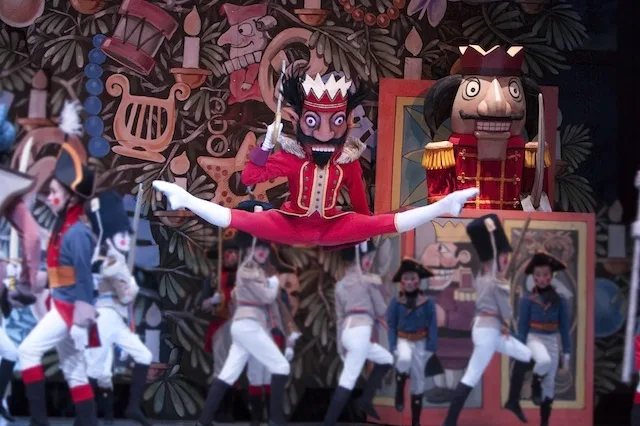
Children are the perfect audience for The Nutcracker.
(Well, children and the grandmothers who can’t wait for the toddler to start sitting still long enough to make the holiday-themed ballet an annual tradition…)
Maurice Sendak, the celebrated children’s book author and illustrator, agreed, but found the standard George Balanchine-choreographed version so treacly as to be unworthy of children, dubbing it the “most bland and banal of ballets.”
The 1983 production he collaborated on with Pacific Northwest Ballet artistic directors Kent Stowell and Francia Russell did away with the notion that children should be “coddled and sweetened and sugarplummed and kept away from the dark aspects of life when there is no way of doing that.”
Tchaikovsky’s famous score remained in place, but Sendak and Stowell ducked the source material for, well, more source material. As per the New York City Ballet’s website, the Russian Imperial Ballet’s chief ballet master, Marius Petipa, commissioned Tchaikovsky to write music for an adaptation of Alexander Dumas’ child-friendly story The Nutcracker of Nuremberg. But The Nutcracker of Nuremberg was inspired by the much darker E.T.A. Hoffman tale, 1816’s “The Nutcracker and the Mouse King.”
The “weird, dark qualities” of the original were much more in keeping with Sendak’s self proclaimed “obsessive theme”: “Children surviving childhood.”
Sendak wanted the ballet to focus more intently on Clara, the young girl who receives the Nutcracker as a Christmas present in Act I:
It’s about her victory over her fear and her growing feelings for the prince… She is overwhelmed with growing up and has no knowledge of what this means. I think the ballet is all about a strong emotional sense of something happening to her, which is bewildering.
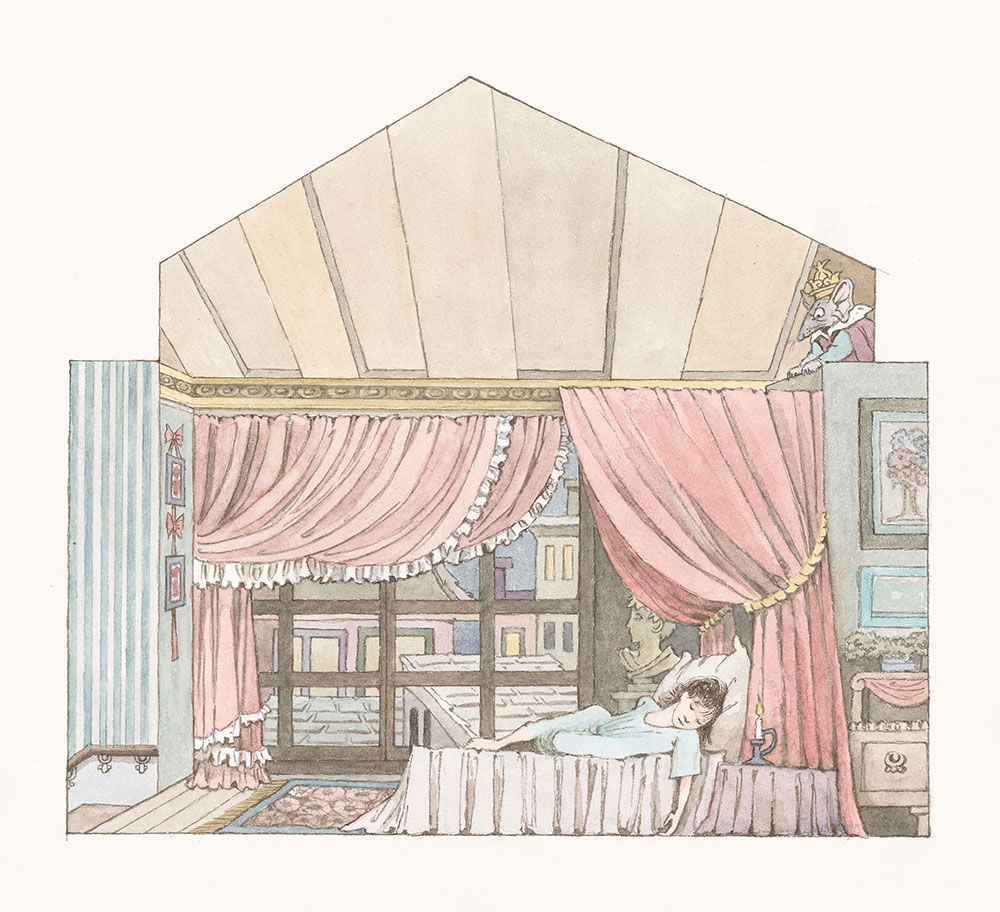
Balanchine must have felt differently. He benched Clara in Act II, letting the adult Sugarplum Fairy take centerstage, to guide the children through a passive tour of the Land of Sweets.
As Sendak scoffed to the Dallas Morning News:
It’s all very, very pretty and very, very beautiful… I always hated the Sugarplum Fairy. I always wanted to whack her.
“Like what kids really want is a candy kingdom. That shortchanges children’s feelings about life,” echoes Stowell, who revived the Sendak commission, featuring the illustrator’s sets and costumes every winter for 3 decades.
In lieu of the Sugar Plum Fairy, Sendak and Stowell introduced a dazzling caged peacock — a fan favorite played by the same dancer who plays Clara’s mother in Act I.
The threats, in the form of eccentric uncle Drosselmeier, a ferocious tiger, and a massive rat puppet with an impressive, pulsing tail, have a Freudian edge.

The painted backdrops, growing Christmas tree, and Nutcracker toy look as if they emerged from one of Sendak’s books. (He followed up the ballet by illustrating a new translation of the Hoffman original.)
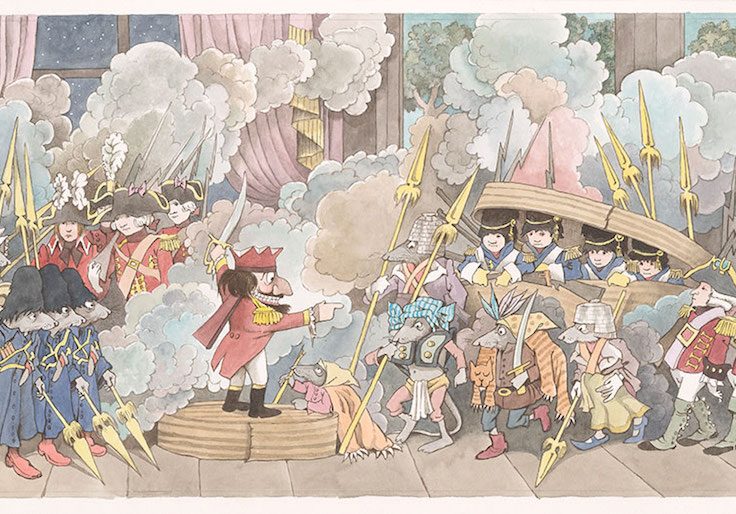
The Sendak-designed costumes are more understated, thought Pacific Northwest Ballet costumer Mark Zappone, who described working with Sendak as “an incredible joy and pleasure” and recalled the funny ongoing battle with the Act II Moors costumes to Seattle Met:
Maurice’s design had the women in quite billowy pants. So we ripped them out of the box, threw them on the girls upstairs in the studios, and Kent started rehearsing the Moors. And one by one, the girls got their legs stuck in those pants and—boom—hit the floor, all six of them. It was like, “Oh my God, what are we going to do about that one?” They ended up, for years, twisting the legs in their costumes and making a little tuck here and there. It was a rite of passage; if you were going to do the Moors, don’t forget to twist your pants around so you won’t get stuck in them.
Rent a filmed version of Maurice Sendak’s The Nutcracker on Amazon Prime. (Look for a Wild Thing cameo in the boating scene with Clara and her Prince.)
Related Content:
The Only Drawing from Maurice Sendak’s Short-Lived Attempt to Illustrate The Hobbit
Maurice Sendak Sent Beautifully Illustrated Letters to Fans — So Beautiful a Kid Ate One
Maurice Sendak Illustrates Tolstoy in 1963 (with a Little Help from His Editor)
Ayun Halliday is the Chief Primaologist of the East Village Inky zine and author, most recently, of Creative, Not Famous: The Small Potato Manifesto. Follow her @AyunHalliday.
Read More...What Does It Take to Be a Great Artist?: An Aging Painter Reflects on His Creative Process & Why He Will Never Be a Picasso
What does it take to be an artist? In the short film above by Jakub Blank, artist Bill Blaine meditates on the question as he strolls around his home and studio and talks about his work. Blaine has aged into the realization that making art is what fulfills him, even though it probably won’t bring him immortal fame. “I’ve thought about this,” he says. “I would probably be a happier person if I were painting all the time.” Bloated egos belong to the young, and Blaine is glad to put the “absurd” ambitions of youth behind him. “In the old days,” he muses, “your ego was so big, that you wanted to be better than everybody else, you wanted to be on the cutting edge of things… at least with old age, you don’t have a lot of that.”
And yet, though he seems to have everything an artist could want in the material sense – a palatial estate with its own well-appointed studio – a melancholy feeling of defeat hangs over the artist. Sadness remains in his ready smile as he gently interrogates himself, “So then, why the hell aren’t you painting all the time?” Blaine chuckles as he contemplates seeing a therapist, an idea he doesn’t seem to take particularly seriously. Aside from a few outliers, maybe the psychiatric profession hasn’t taken the creative impulse particularly seriously either. One psychoanalyst who did, Otto Rank, wrote in Art and Artist of the importance of creativity to all human development and activity.
“The human urge to create,” Rank argued, “does not find expression in works of art alone. It also produces religion and mythology and the social institutions corresponding to these. In a word, it produces the whole culture.” Everything we do, from baking bread to writing symphonies, is a creative act, in that we take raw materials and make things that didn’t exist before. In Western culture, however, the role of the artist has been distorted. Artists are elevated to the status of genius, or relegated to mediocrities, at best, disposable deadbeats, at worst. Blaine surely deserves his lot of happiness from his work. Has he been undermined by self-doubt?
His vulnerability and the sharp candor of his observations leave us with a portrait of a man almost in agony over the knowledge, he says – again using the accusatory second person – that “you’re not going to be the next Picasso or the next Frank Stella or whatever else.” There’s more to the negative comparisons than wounded vanity. He should feel free to do what he likes, but he lacks what made these artists great, he says:
You have to be obsessive, you really do. Compulsive. And I’m not enough, unfortunately. Had a certain amount of talent, just didn’t have the obsession apparently. I think that’s what great artists have. They can’t let it go. And eventually, whatever they do, that’s their art, that’s who they are.
Blaine contrasts greatness with the work of unserious “dilettantes” who may approximate abstract expressionist or other styles, but whose work fails to manifest the personality of the artist. “You can see through it,” says Blaine, wincing. Shot in his “home and studio in Mount Dora, Florida,” notes Aeon, the film is “full of his original paintings and photographs. Blaine offers his unguarded thoughts on a range of topics related to the generative process.”
Artists are rarely their own best critics, and Blaine’s assessments of his work can seem withering when voiced over Blank’s slideshow presentations. But as he opens up about his creative process, and his perception of himself as “too bourgeois” to really make it, he may reveal much more about the struggles that all artists — or all creative people — face than he realizes.
Related Content:
Josh Jones is a writer and musician based in Durham, NC. Follow him at @jdmagness
Read More...Support Us
We're hoping to rely on loyal readers, rather than erratic ads. Please click the Donate button and support Open Culture. You can use Paypal, Venmo, Patreon, even Crypto! We thank you!

About Us

Open Culture scours the web for the best educational media. We find the free courses and audio books you need, the language lessons & educational videos you want, and plenty of enlightenment in between.
Advertise With Us
FREE UPDATES!
GET OUR DAILY EMAIL
Get the best cultural and educational resources on the web curated for you in a daily email. We never spam. Unsubscribe at any time.
FOLLOW ON SOCIAL MEDIA
Open Culture editor Dan Colman scours the web for the best educational media. He finds the free courses and audio books you need, the language lessons & movies you want, and plenty of enlightenment in between.
Advertise With Us

