Francis Ford Coppola Breaks Down His Most Iconic Films: The Godfather, Apocalypse Now & More
Fifty years after its theatrical release, The Godfather remains a subject of lively cinephile conversation. What, as any of us might ask after a fresh semi-centennial viewing of Francis Ford Coppola’s mafia masterpiece, is this movie about? We need only ask Coppola himself, who has our answer in one word: succession. In the recent GQ interview above, he also explains the themes of other major works with similar succinctness: Apocalypse Now is about morality; The Conversation is about privacy. Such clean and simple encapsulations belie the nature of the film production process, and especially that of Coppola’s nineteen-seventies pictures, with their large scale, seriousness of purpose, and proneness to severe difficulty.
“What we consider real art is a movie that does not have a safety net,” Coppola says, and that applies without a doubt to movies like The Godfather and Apocalypse Now. Much as Orson Welles once said of his own experience making Citizen Kane, the young Coppola went into The Godfather ignorant of more or less everything involved in its content but life in an Italian-American family. But he had, in theater school, learned the techniques of “outwitting the faculty,” and dealing with the higher-ups at Hollywood studios turned out to require that same skill set. He thus found a way to include every element ruled insistently out by the executives, from New York locations and a period setting to performers like the then-unknown Al Pacino and then-washed-up Marlon Brando.
Brando didn’t take part in The Godfather Part II, but he did show up at the end of Apocalypse Now for a vividly memorable turn as the power-mad Colonel Kurtz. As Coppola remembers it, “when Brando arrived, he looked at me — he’s so smart — and he said, ‘You painted yourself in a corner, didn’t you?” The actor meant that the surreal qualities of the film had reached such an intensity that no conventional form of resolution could possibly suffice. This was the result of the fact that, as Coppola puts it, “one of the things that make a movie is the movie: it contributes to making itself.” In other words, as Coppola and his collaborators shot each scene (a process that famously resulted in over one million feet of footage), the very film taking shape before them suggested its own direction — in the case of Apocalypse Now, toward the ever darker and stranger.
Always candid about his professional struggles, Coppola has also been generous with technical and artistic explanations of just how his pictures have come together. Godfather fans will delight in his director’s-commentary tracks on the first and second parts of that trilogy; as for The Godfather Part III, Coppola released a new edit (in the manner of Apocalypse Now’s Redux and Final Cut) called The Godfather Coda: The Death of Michael Corleone in 2020. He discusses that project in the GQ interview, and also his work-in-progress Megalopolis. Having described The Godfather as essentially a Shakespearean tale, he’s now reaching further back in time: “Wouldn’t it be interesting if you made a Roman epic but didn’t set it in ancient Rome — set it in modern New York?” He also lets us in on Megalopolis’ surprising key word: not megalomania, nor ambition, nor power, but sincerity.
Related content:
A Behind-the-Scenes Look at the Casting of The Godfather with Coppola, Pacino, De Niro & Caan
Francis Ford Coppola’s Handwritten Casting Notes for The Godfather
Orson Welles Explains Why Ignorance Was His Major “Gift” to Citizen Kane
Based in Seoul, Colin Marshall writes and broadcasts on cities, language, and culture. His projects include the Substack newsletter Books on Cities, the book The Stateless City: a Walk through 21st-Century Los Angeles and the video series The City in Cinema. Follow him on Twitter at @colinmarshall or on Facebook.
Read More...When Movies Came on Vinyl: The Early-80s Engineering Marvel and Marketing Disaster That Was RCA’s SelectaVision
Anyone over 30 remembers a time when it was impossible to imagine home video without physical media. But anyone over 50 remembers a time when it was difficult to choose which kind of media to bet on. Just as the “computer zoo” of the early 1980s forced home-computing enthusiasts to choose between Apple, IBM, Commodore, Texas Instruments, and a host of other brands, each with its own technological specifications, the market for home-video hardware presented several different alternatives. You’ve heard of Sony’s Betamax, for example, which has been a punchline ever since it lost out to JVC’s VHS. But that was just the realm of video tape; have you ever watched a movie on a vinyl record?
Four decades ago, it was difficult for most consumers to imagine home video at all. “Get records that let you have John Travolta dancing on your floor, Gene Hackman driving though your living room, the Godfather staying at your house,” booms the narrator of the television commercial above.
How, you ask? By purchasing a SelectaVision player and compatible video discs, which allow you to “see the entertainment you really want, when you want, uninterrupted.” In our age of streaming-on-demand this sounds like a laughably pedestrian claim, but at the time it represented the culmination of seventeen years and $600 million of intensive research and development at the Radio Company of America, better known as RCA.
Radio, and even more so its successor television, made RCA an enormous (and enormously profitable) conglomerate in the first half of the twentieth century. By the 1960s, it commanded the resources to work seriously on such projects as a vinyl record that could contain not just music, but full motion pictures in color and stereo. This turned out to be even harder than it sounded: after numerous delays, RCA could only bring SelectaVision to market in the spring of 1981, four years after the internal target. By that time, after the company had been commissioning content for the better part of a decade (D. A. Pennebaker shot David Bowie’s final Ziggy Stardust concert in 1973 on commission from RCA, who’d intended to make a SelectaVision disc out of it), the format faced competition from not just VHS and Betamax but the cutting-edge LaserDisc as well.
Nevertheless, the SelectaVision’s ultra-densely encoded vinyl video discs — officially known as capacitance electronic discs, or CEDs — were, in their way, marvels of engineering. You can take a deep dive into exactly what makes the system so impressive, which involves not just a breakdown of its components but a complete retelling of the history of RCA, though the five-part Technology Connections miniseries at the top of the post. True completists can also watch RCA’s video tour of its SelectaVision production facilities, as well as its live dealer-introduction broadcast hosted by Tom Brokaw and featuring a Broadway-style musical number. SelectaVision was also rolled out in the United Kingdom in 1983, thus qualifying for a hands-on examination by British retro-tech Youtuber Techmoan.
SelectaVision lasted just three years. Its failure was perhaps overdetermined, and not just by the bad timing resulting from its troubled development. In the early 1980s, the idea of buying pre-recorded video media lacked the immediate appeal of “time-shifting” television, which had become possible only with video tape. Nor did RCA, whose marketing centered on the possibility of building a permanent home-video library in the manner of one’s music library, foresee the possibility of rental. And though CEDs were ultimately made functional, they remained cumbersome, able to hold just one hour of video per side and notoriously subject to jitters even on the first play. Yet as RCA’s ad campaigns emphasized, there really was a “magic” in being able to watch the movies you wanted at home, whenever you wanted to. In that sense, at least, we now live in a magical world indeed.
Related content:
The Story of the MiniDisc, Sony’s 1990s Audio Format That’s Gone But Not Forgotten
A Celebration of Retro Media: Vinyl, Cassettes, VHS, and Polaroid Too
Based in Seoul, Colin Marshall writes and broadcasts on cities, language, and culture. His projects include the Substack newsletter Books on Cities, the book The Stateless City: a Walk through 21st-Century Los Angeles and the video series The City in Cinema. Follow him on Twitter at @colinmarshall or on Facebook.
Read More...A Digital Archive of Hieronymus Bosch’s Complete Works: Zoom In & Explore His Surreal Art
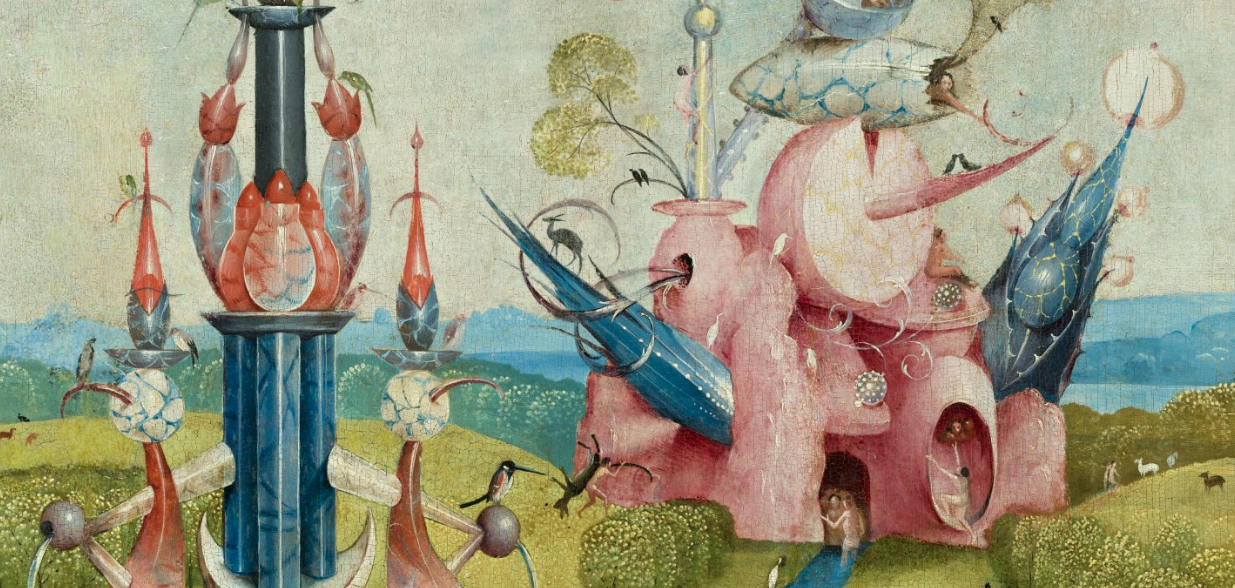
Very little is known about the Dutch painter Hieronymus Bosch. And I am going to suggest that is a good thing. Would it help to know that this man who created truly inspired, endlessly fascinating views of heaven and hell, of creature-filled gardens of debauchery, had a particular point of view on humanity? Or that he thought there was a “correct” way to understand his paintings? Perhaps it’s the mystery of the man that brings us closer to these works, to study them in detail, and to delight in their playful horror. And for those who really want detail, the Bosch Project is the place to find it.
The Bosch Project (aka the Bosch Research and Conservation Project) began in 2010 as a way to bring together the artist’s 45 paintings “spread across 2 continents, 10 countries, 18 cities, and 20 collections” for in-depth research, available to everyone.
The year 2016 marked the 500th anniversary of Bosch’s death, with celebrations in the artist’s birthplace of Hertogenbosch and a revolutionary exhibition in Noordbrabants, which stirred controversy when it disputed the authenticity of several major works in the Prado Museum in Spain, added two new attributions, and restored nine works.
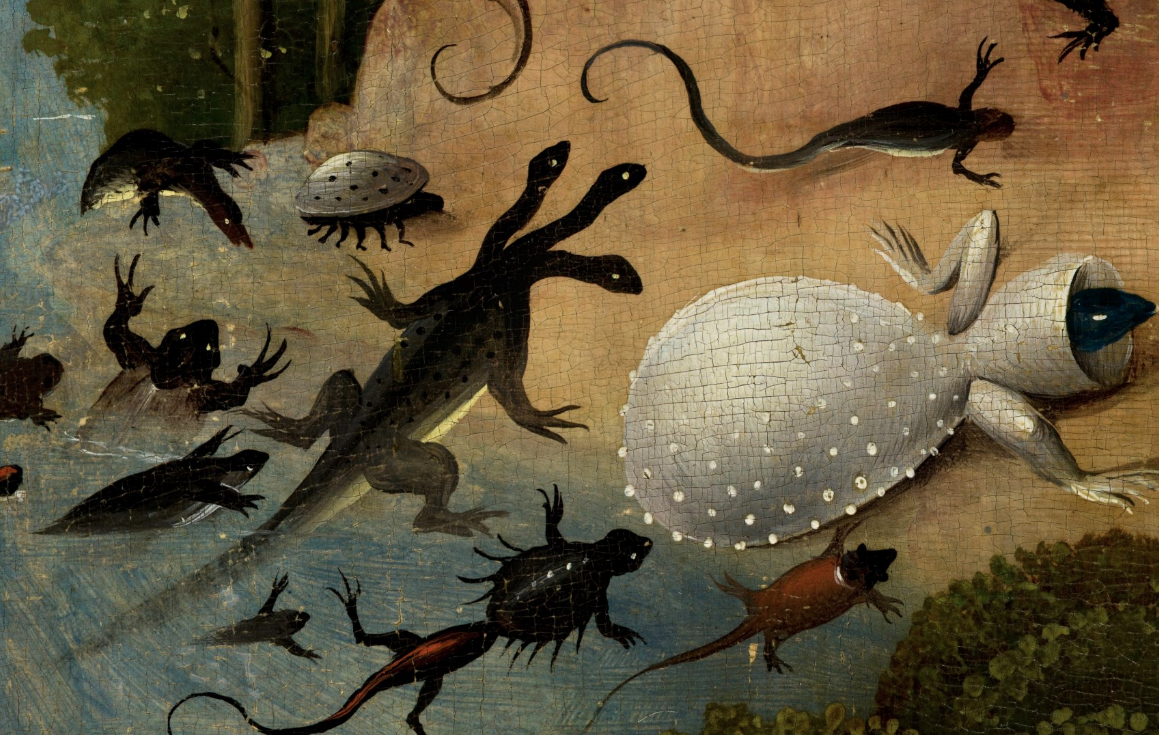
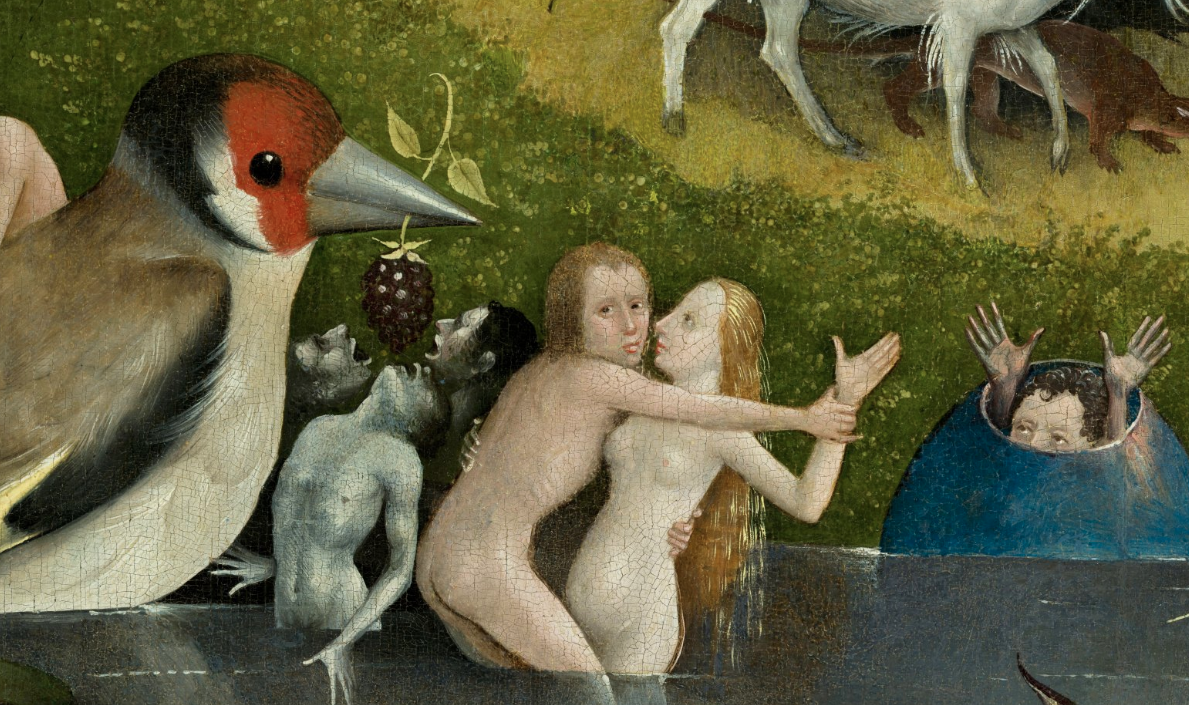
Here is where the Bosch Project website shines. The “synchronized image viewers” allow us to zoom in to the smallest brushstroke to examine Bosch’s detailed worlds and characters. And in a nod to his use of triptychs, the other two sides of the painting zoom in as well. It makes for some interesting, but not essential, juxtapositions. It’s also easy to move around in the work with just the scrollwheel of the mouse. Other paintings allow the viewer to examine the infrared reflectogram of the painting’s layers, exposing Bosch’s corrections and deletions. Closer examination of his grand panels reveals Bosch’s cartoonish brushwork, his caricature, and his immense humor. For sure, the artist wanted us to meditate on greater matters like our own salvation, but there’s so much fun in the way he paints animals, or in the bacchanalia of The Garden of Earthly Delights, you can be forgiven for thinking he’d want to party as well. Grab that scroll wheel and check out the Garden—there’s plenty of room. Enter the Bosch Project website here.
Related Content:
The Meaning of Hieronymus Bosch’s The Garden of Earthly Delights Explained
Ted Mills is a freelance writer on the arts who currently hosts the Notes from the Shed podcast and is the producer of KCRW’s Curious Coast. You can also follow him on Twitter at @tedmills, and/or watch his films here.
Read More...Hannah Arendt Explains How Propaganda Uses Lies to Erode All Truth & Morality: Insights from The Origins of Totalitarianism

Image by Bernd Schwabe, via Wikimedia Commons
At least when I was in grade school, we learned the very basics of how the Third Reich came to power in the early 1930s. Paramilitary gangs terrorizing the opposition, the incompetence and opportunism of German conservatives, the Reichstag Fire. And we learned about the critical importance of propaganda, the deliberate misinforming of the public in order to sway opinions en masse and achieve popular support (or at least the appearance of it). While Minister of Propaganda Joseph Goebbels purged Jewish and leftist artists and writers, he built a massive media infrastructure that played, writes PBS, “probably the most important role in creating an atmosphere in Germany that made it possible for the Nazis to commit terrible atrocities against Jews, homosexuals, and other minorities.”
How did the minority party of Hitler and Goebbels take over and break the will of the German people so thoroughly that they would allow and participate in mass murder? Post-war scholars of totalitarianism like Theodor Adorno and Hannah Arendt asked that question over and over, for several decades afterward. Their earliest studies on the subject looked at two sides of the equation. Adorno contributed to a massive volume of social psychology called The Authoritarian Personality, which studied individuals predisposed to the appeals of totalitarianism. He invented what he called the F‑Scale (“F” for “fascism”), one of several measures he used to theorize the Authoritarian Personality Type.
Arendt, on the other hand, looked closely at the regimes of Hitler and Stalin and their functionaries, at the ideology of scientific racism, and at the mechanism of propaganda in fostering “a curiously varying mixture of gullibility and cynicism with which each member… is expected to react to the changing lying statements of the leaders.” So she wrote in her 1951 Origins of Totalitarianism, going on to elaborate that this “mixture of gullibility and cynicism… is prevalent in all ranks of totalitarian movements”:
In an ever-changing, incomprehensible world the masses had reached the point where they would, at the same time, believe everything and nothing, think that everything was possible and nothing was true… The totalitarian mass leaders based their propaganda on the correct psychological assumption that, under such conditions, one could make people believe the most fantastic statements one day, and trust that if the next day they were given irrefutable proof of their falsehood, they would take refuge in cynicism; instead of deserting the leaders who had lied to them, they would protest that they had known all along that the statement was a lie and would admire the leaders for their superior tactical cleverness.
Why the constant, often blatant lying? For one thing, it functioned as a means of fully dominating subordinates, who would have to cast aside all their integrity to repeat outrageous falsehoods and would then be bound to the leader by shame and complicity. “The great analysts of truth and language in politics”—writes McGill University political philosophy professor Jacob T. Levy—including “George Orwell, Hannah Arendt, Vaclav Havel—can help us recognize this kind of lie for what it is.… Saying something obviously untrue, and making your subordinates repeat it with a straight face in their own voice, is a particularly startling display of power over them. It’s something that was endemic to totalitarianism.”
Arendt and others recognized, writes Levy, that “being made to repeat an obvious lie makes it clear that you’re powerless.” She also recognized the function of an avalanche of lies to render a populace powerless to resist, the phenomenon we now refer to as “gaslighting”:
The result of a consistent and total substitution of lies for factual truth is not that the lie will now be accepted as truth and truth be defamed as a lie, but that the sense by which we take our bearings in the real world—and the category of truth versus falsehood is among the mental means to this end—is being destroyed.
The epistemological ground thus pulled out from under them, most would depend on whatever the leader said, no matter its relation to truth. “The essential conviction shared by all ranks,” Arendt concluded, “from fellow traveler to leader, is that politics is a game of cheating and that the ‘first commandment’ of the movement: ‘The Fuehrer is always right,’ is as necessary for the purposes of world politics, i.e., world-wide cheating, as the rules of military discipline are for the purposes of war.”
“We too,” writes Jeffrey Isaacs at The Washington Post, “live in dark times”—an allusion to another of Arendt’s sobering analyses—“even if they are different and perhaps less dark.” Arendt wrote Origins of Totalitarianism from research and observations gathered during the 1940s, a very specific historical period. Nonetheless the book, Isaacs remarks, “raises a set of fundamental questions about how tyranny can arise and the dangerous forms of inhumanity to which it can lead.” Arendt’s analysis of propaganda and the function of lies seems particularly relevant at this moment. The kinds of blatant lies she wrote of might become so commonplace as to become banal. We might begin to think they are an irrelevant sideshow. This, she suggests, would be a mistake.
Note: An earlier version of this post appeared on our site in 2017.
Related Content:
The Origins of the Word “Gaslighting”: Scenes from the 1944 Film Gaslight
Hannah Arendt’s Original Articles on “the Banality of Evil” in the New Yorker Archive
Hannah Arendt Discusses Philosophy, Politics & Eichmann in Rare 1964 TV Interview
Josh Jones is a writer and musician based in Durham, NC. Follow him at @jdmagness
Read More...Howard Zinn’s Recommended Reading List for Activists Who Want to Change the World
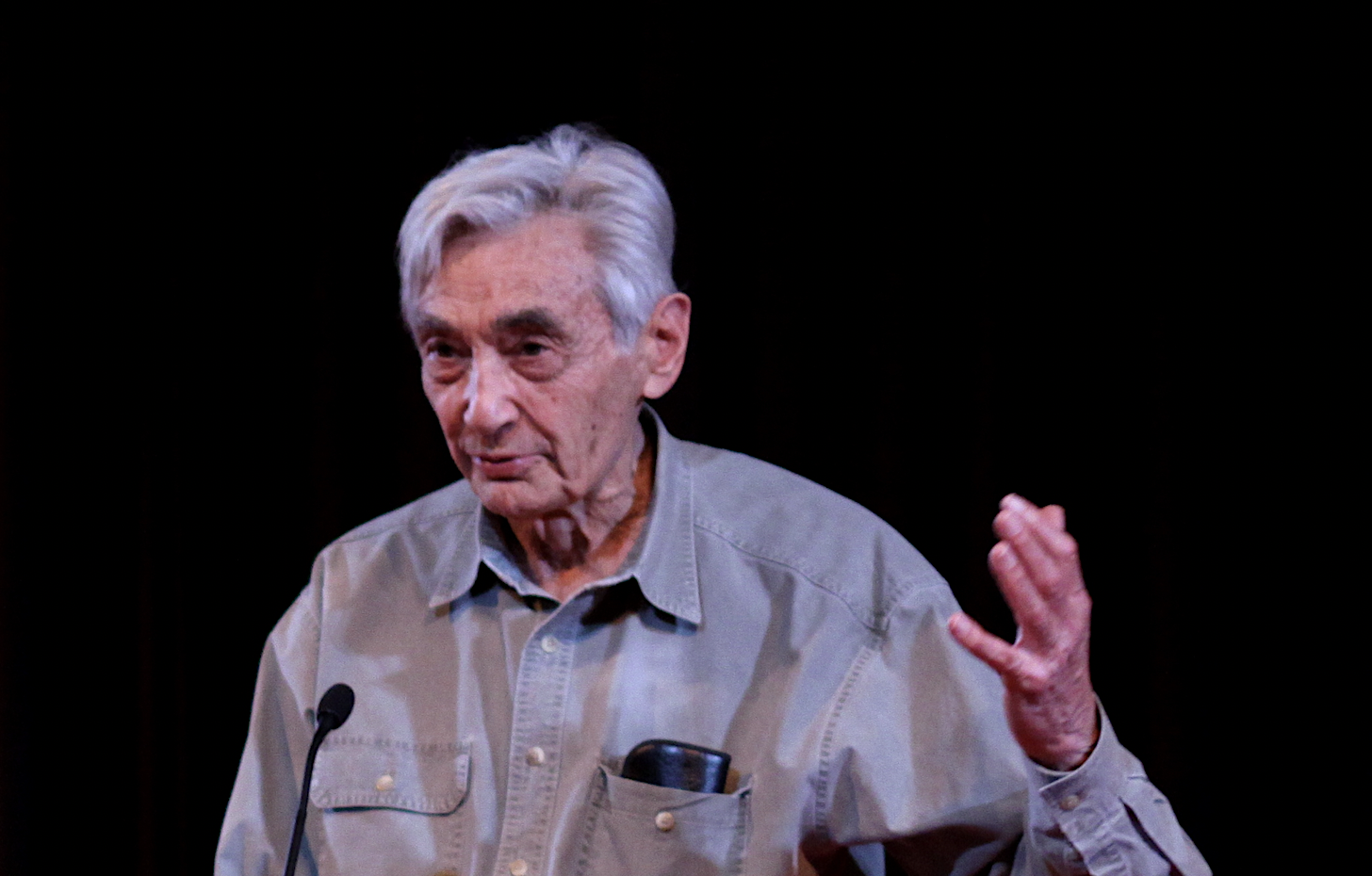
Image by via Wikimedia Commons
Back in college, I spotted A People’s History of the United States in the bags and on the bookshelves of many a fellow undergraduate. By that time, Howard Zinn’s alternative telling of the American story had been popular reading material for a couple of decades, just as it presumably remains a couple more decades on. Even now, a dozen years after Zinn’s death, his ideas about how to approach U.S. history through non-standard points of view remain widely influential. Just last month, Radical Reads featured the reading list he originally drew up for the Socialist Worker, pitched at “activists interested in making their own history.”
Zinn’s recommendations naturally include the work of other historians, from Gary Nash’s Red, White and Black: The Peoples of Early America (“a pioneering work of ‘multiculturalism’ dealing with racial interactions in the colonial period”) to Vincent Harding’s There Is a River: The Black Struggle for Freedom in America (an “excellent start on Black history”) to Samuel Yellen’s American Labor Struggles (which “brings to life the great labor conflicts of American history”).
His suggested books cover not just the 20th century but eras like the Civil War, and even, extensively, the time of Christopher Columbus. For those who take their analyses of the past in comically illustrated form, Zinn also highlights Larry Gonick’s The Cartoon History of the United States as “funny and remarkably rich in its content.”
Certain Zinn picks stand out as being of special interest to Open Culture readers. These include Noam Chomsky’s Year 501, in which “the nation’s most distinguished intellectual rebel gives us huge amounts of information about recent American foreign policy”; Richard Hofstadter’s The American Political Tradition, with its “iconoclastic view of American political leaders, including Jefferson, Jackson, Lincoln, Wilson and the two Roosevelts, suggesting more consensus than difference at the top of the political hierarchy”; and W.E.B. DuBois’ Black Reconstruction, “a direct counter to the traditional racist accounts of Reconstruction, presenting the narrative from the Black point of view.” Zinn also praises The Sixties, “a vivid history, well-written, thoughtful, by one of the activists of that era”: Todd Gitlin, who died earlier this month.
Despite its understandable inclination toward nonfiction, Zinn’s list also has room for several classic American novels like John Steinbeck’s The Grapes of Wrath, Richard Wright’s Black Boy, and Zora Neale Hurston’s Their Eyes Were Watching God. You may remember some of these books from your own high-school and university days, but whatever you got out of them back then, you’ll experience them more richly by revisiting them now, deeper into your own intellectual journey. As Zinn’s own life and work demonstrated, you can always find more angles from which to view the political, social, and cultural history of your county — the farther removed from those you were shown in school, the better.
via Radical Reads
Related content:
African-American History: Modern Freedom Struggle (A Free Course from Stanford)
American Literature, From the Beginnings to the Civil War: A Free Online Course from NYU
Noam Chomsky Defines What It Means to Be a Truly Educated Person
Adorn Your Garden with Howard the Zinn Monk
Based in Seoul, Colin Marshall writes and broadcasts on cities, language, and culture. His projects include the Substack newsletter Books on Cities, the book The Stateless City: a Walk through 21st-Century Los Angeles and the video series The City in Cinema. Follow him on Twitter at @colinmarshall or on Facebook.
Read More...Google App Uses Machine Learning to Discover Your Pet’s Look Alike in 10,000 Classic Works of Art
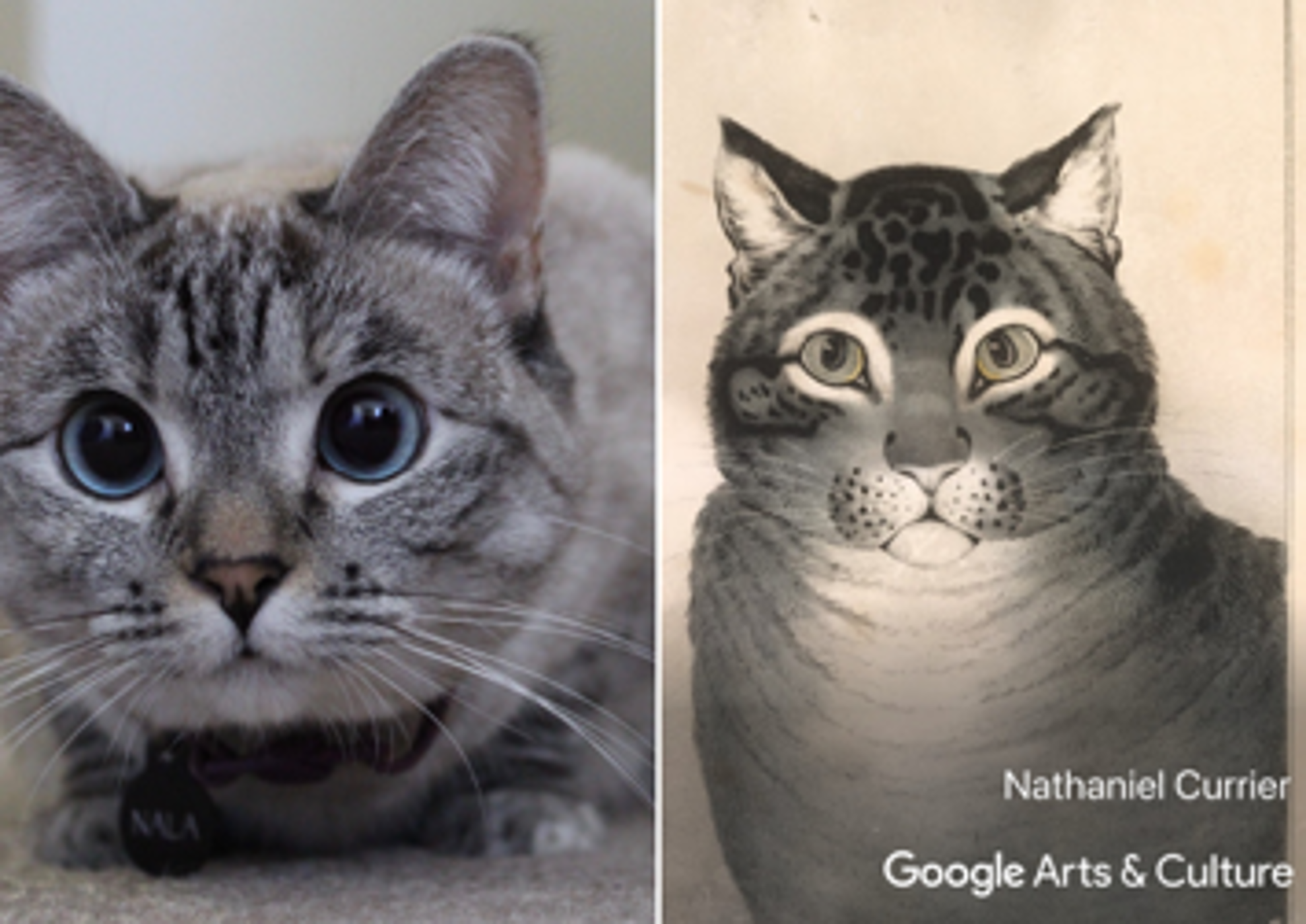
Does your cat fancy herself a 21st-century incarnation of Bastet, the Egyptian Goddess of the Rising Sun, protector of the household, aka The Lady of Slaughter?
If so, you should definitely permit her to download the Google Arts & Culture app on your phone to take a selfie using the Pet Portraits feature.
Remember all the fun you had back in 2018 when the Art Selfie feature mistook you for William II, Prince of Orange or the woman in “Jacob Cornelisz. van Oostsanen Painting a Portrait of His Wife”?
Surely your pet will be just as excited to let a machine-learning algorithm trawl tens of thousands of artworks from Google Arts & Culture’s partnering museums’ collections, looking for doppelgängers.
Or maybe it’ll just view it as one more example of human folly, if a far lesser evil than our predilection for pet costumes.
Should your pet wish to know more about the artworks it resembles, you can tap the results to explore them in depth.
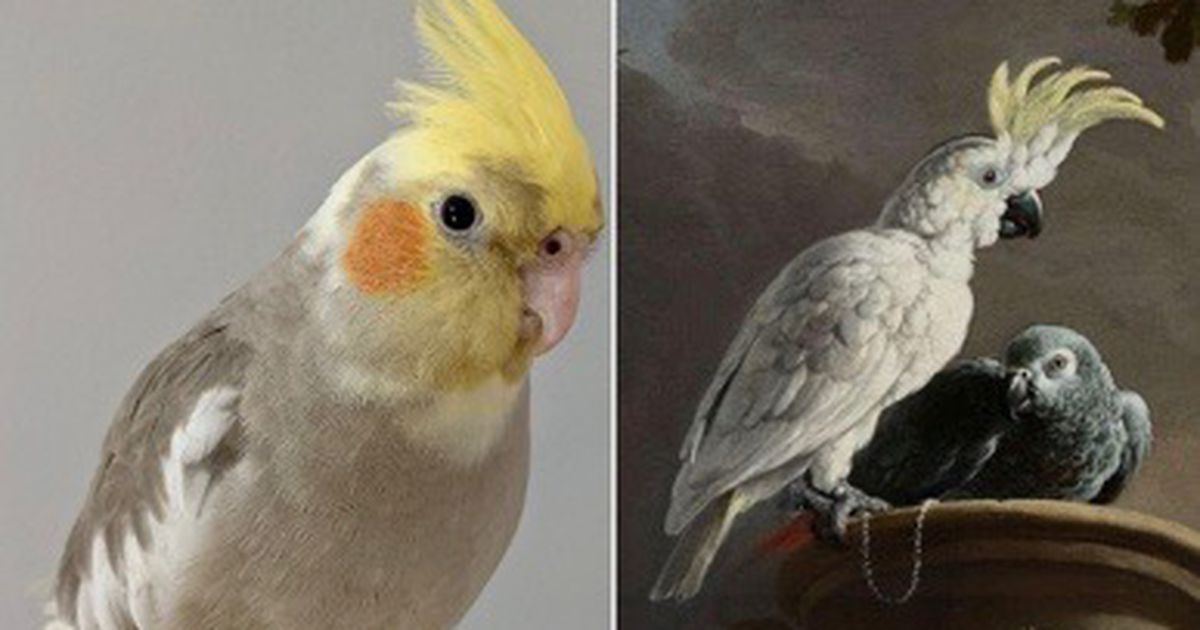
Dogs, fish, birds, reptiles, horses, and rabbits can play along too, though anyone hailing from the rodent family will find themselves shut out.
Mashable reports that “uploading a stock image of a mouse returned drawings of wolves.”
We can’t blame your pet snake for fuming.
Ditto your Vietnamese Pot-bellied pig.
Though your pet ferret probably doesn’t need an app (or a crystal ball) to know what its result would be. Better than an ermine collar, anyway…

If your pet is game and falls within Pet Portraits approved species parameters, here are the steps to follow:
- Launch the Google Arts & Culture app and select the Camera button. Scroll to the Pet Portraits option.
- Have your pet take a selfie. (Or alternatively, upload a saved image.)
- Give the app a few seconds (or minutes) to return multiple results with similarity percentages.
Download the Google Arts & Culture app here.
- Ayun Halliday is the Chief Primatologist of the East Village Inky zine and author, most recently, of Creative, Not Famous: The Small Potato Manifesto. Follow her @AyunHalliday.
Related Content:
Google’s Free App Analyzes Your Selfie and Then Finds Your Doppelganger in Museum Portraits
Construct Your Own Bayeux Tapestry with This Free Online App
Read More...Nietzsche’s 10 Rules for Writing with Style
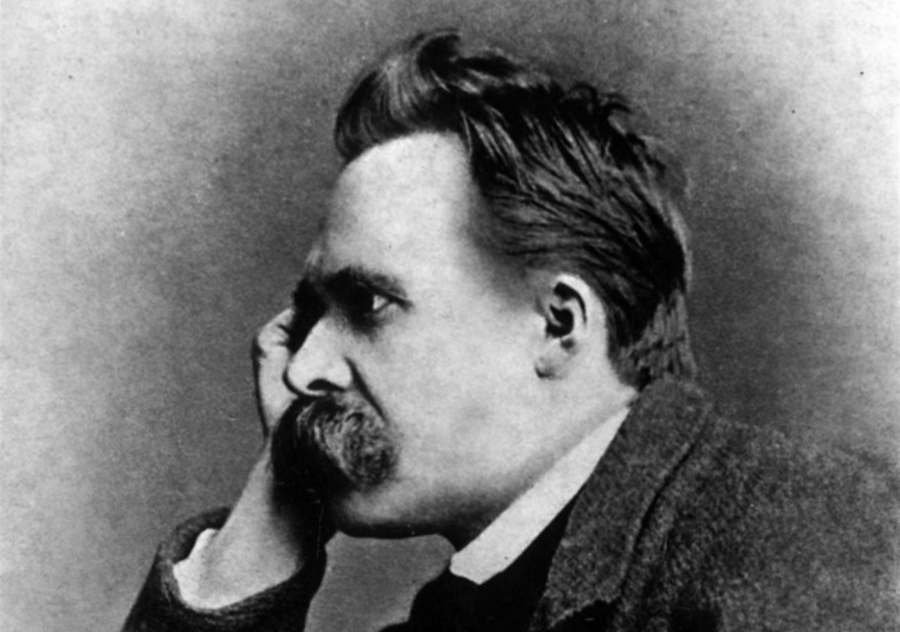
The life of Russian-born poet, novelist, critic, and first female psychologist Lou Andreas-Salomé has provided fodder for both salacious speculation and intellectual drama in film and on the page for the amount of romantic attention she attracted from European intellectuals like philosopher Paul Rée, poet Ranier Maria Rilke, and Friedrich Nietzsche. Emotionally intense Nietzsche became infatuated with Salomé, proposed marriage, and, when she declined, broke off their relationship in abrupt Nietzschean fashion.
For her part, Salomé so valued these friendships she made a proposal of her own: that she, Nietzsche and Rée, writes D.A. Barry at 3:AM Magazine, “live together in a celibate household where they might discuss philosophy, literature and art.” The idea scandalized Nietzsche’s sister and his social circle and may have contributed to the “passionate criticism” Salomé’s 1894 biographical study, Friedrich Nietzsche: The Man and His Works, received. The “much maligned” work deserves a reappraisal, Barry argues, as “a psychological portrait.”
In Nietzsche, Salomé wrote, we see “sorrowful ailing and triumphal recovery, incandescent intoxication and cool consciousness. One senses here the close entwining of mutual contradictions; one senses the overflowing and voluntary plunge of over-stimulated and tensed energies into chaos, darkness and terror, and then an ascending urge toward the light and most tender moments.” We might see this passage as charged by the remembrance of a friend, with whom she once “climbed Monte Sacro,” she claimed, in 1882, “where he told her of the concept of the Eternal Recurrence ‘in a quiet voice with all the signs of deepest horror.’”
We should also, perhaps primarily, see Salomé’s impressions as an effect of Nietzsche’s turbulent prose, reaching its apotheosis in his experimentally philosophical novel, Thus Spake Zarathustra. As a theorist of the embodiment of ideas, of their inextricable relation to the physical and the social, Nietzsche had some very specific ideas about literary style, which he communicated to Salomé in an 1882 note titled “Toward the Teaching of Style.” Well before writers began issuing “similar sets of commandments,” writes Maria Popova at Brain Pickings, Nietzsche “set down ten stylistic rules of writing,” which you can find, in their original list form, below.
1. Of prime necessity is life: a style should live.
2. Style should be suited to the specific person with whom you wish to communicate. (The law of mutual relation.)
3. First, one must determine precisely “what-and-what do I wish to say and present,” before you may write. Writing must be mimicry.
4. Since the writer lacks many of the speaker’s means, he must in general have for his model a very expressive kind of presentation of necessity, the written copy will appear much paler.
5. The richness of life reveals itself through a richness of gestures. One must learn to feel everything — the length and retarding of sentences, interpunctuations, the choice of words, the pausing, the sequence of arguments — like gestures.
6. Be careful with periods! Only those people who also have long duration of breath while speaking are entitled to periods. With most people, the period is a matter of affectation.
7. Style ought to prove that one believes in an idea; not only that one thinks it but also feels it.
8. The more abstract a truth which one wishes to teach, the more one must first entice the senses.
9. Strategy on the part of the good writer of prose consists of choosing his means for stepping close to poetry but never stepping into it.
10. It is not good manners or clever to deprive one’s reader of the most obvious objections. It is very good manners and very clever to leave it to one’s reader alone to pronounce the ultimate quintessence of our wisdom.
As with all such prescriptions, we are free to take or leave these rules as we see fit. But we should not ignore them. While Nietzsche’s perspectivism has been (mis)interpreted as wanton subjectivity, his veneration for antiquity places a high value on formal constraints. His prose, we might say, resides in that tension between Dionysian abandon and Apollonian cool, and his rules address what liberal arts professors once called the Trivium: grammar, rhetoric, and logic: the three supports of moving, expressive, persuasive writing.
Salomé was so impressed with these aphoristic rules that she included them in her biography, remarking, “to examine Nietzsche’s style for causes and conditions means far more than examining the mere form in which his ideas are expressed; rather, it means that we can listen to his inner soundings.” Isn’t this what great writing should feel like?
Salomé wrote in her study that “Nietzsche not only mastered language but also transcended its inadequacies.” (As Nietzsche himself commented in 1886, notes Hugo Drochon, he needed to invent “a language of my very own.”) Nietzsche’s bold-yet-disciplined writing found a complement in Salomé’s boldly keen analysis. From her we can also perhaps glean another principle: “No matter how calumnious the public attacks on her,” writes Barry, “particularly from [his sister] Elisabeth Förster-Nietzsche during the Nazi period in Germany, Salomé did not respond to them.”
Note: An earlier version of this post appeared on our site in December 2016.
If you would like to support the mission of Open Culture, consider making a donation to our site. It’s hard to rely 100% on ads, and your contributions will help us continue providing the best free cultural and educational materials to learners everywhere. You can contribute through PayPal, Patreon, and Venmo (@openculture). Thanks!
Related Content:
The Daily Habits of Highly Productive Philosophers: Nietzsche, Marx & Immanuel Kant
Walter Kaufmann’s Classic Lectures on Nietzsche, Kierkegaard and Sartre (1960)
Writing Tips by Henry Miller, Elmore Leonard, Margaret Atwood, Neil Gaiman & George Orwell
Josh Jones is a writer and musician based in Durham, NC. Follow him at @jdmagness
Read More...Nikola Tesla’s Predictions for the 21st Century: The Rise of Smart Phones & Wireless, The Demise of Coffee & More (1926/35)
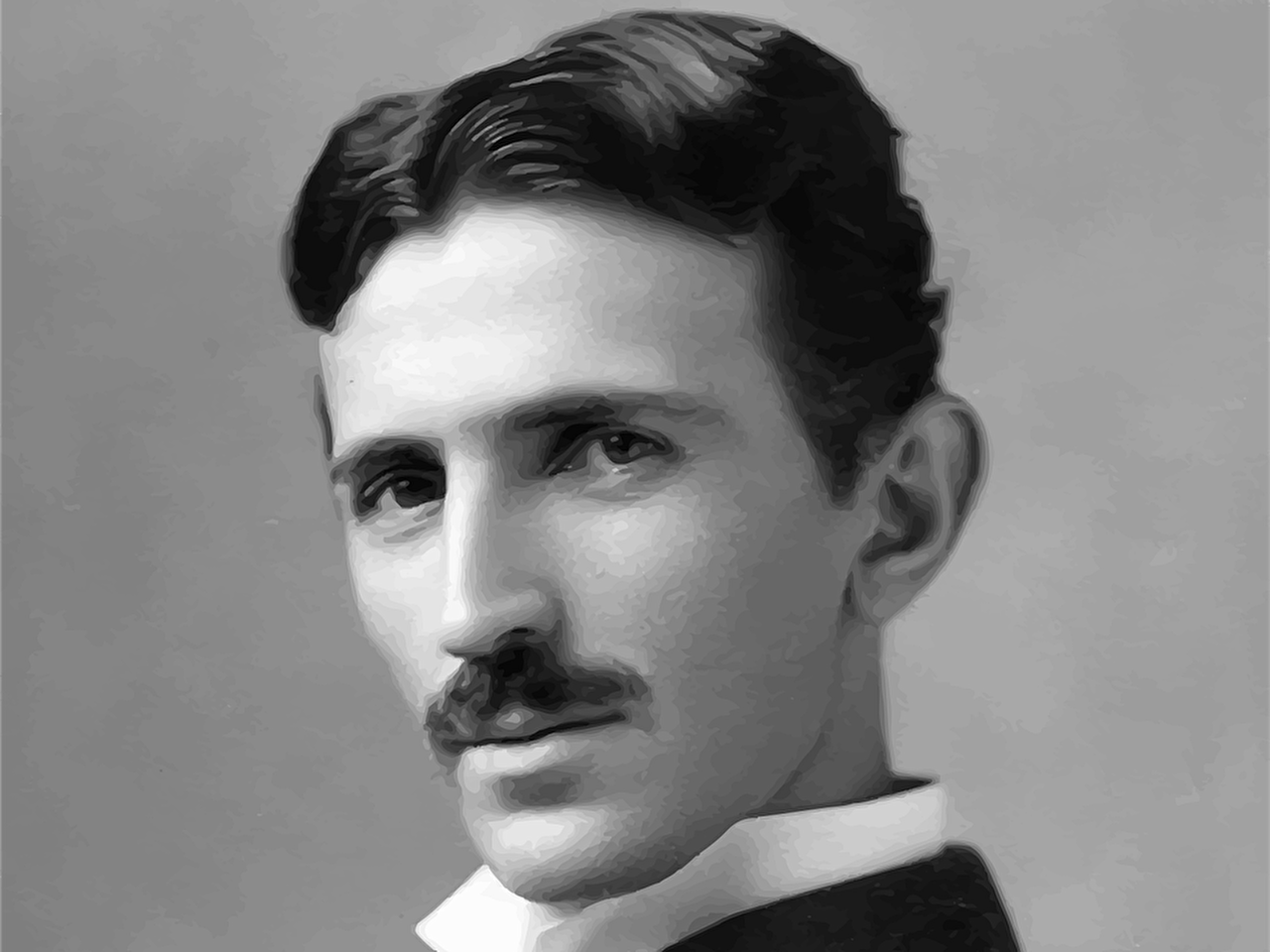
The fate of the visionary is to be forever outside of his or her time. Such was the life of Nikola Tesla, who dreamed the future while his opportunistic rival Thomas Edison seized the moment. Even now the name Tesla conjures seemingly wildly impractical ventures, too advanced, too expensive, or far too elegant in design for mass production and consumption. No one better than David Bowie, the pop artist of possibility, could embody Tesla’s air of magisterial high seriousness on the screen. And few were better suited than Tesla himself, perhaps, to extrapolate from his time to ours and see the technological future clearly.
Of course, this image of Tesla as a lone, heroic, and even somewhat tragic figure who fell victim to Edison’s designs is a bit of a romantic exaggeration. As even the editor of a 1935 feature interview piece in the now-defunct Liberty magazine wrote, Tesla and Edison may have been rivals in the “battle between alternating and direct current…. Otherwise the two men were merely opposites. Edison had a genius for practical inventions immediately applicable. Tesla, whose inventions were far ahead of the time, aroused antagonisms which delayed the fruition of his ideas for years.” One can in some respects see why Tesla “aroused antagonisms.” He may have been a genius, but he was not a people person, and some of his views, though maybe characteristic of the times, are downright unsettling.
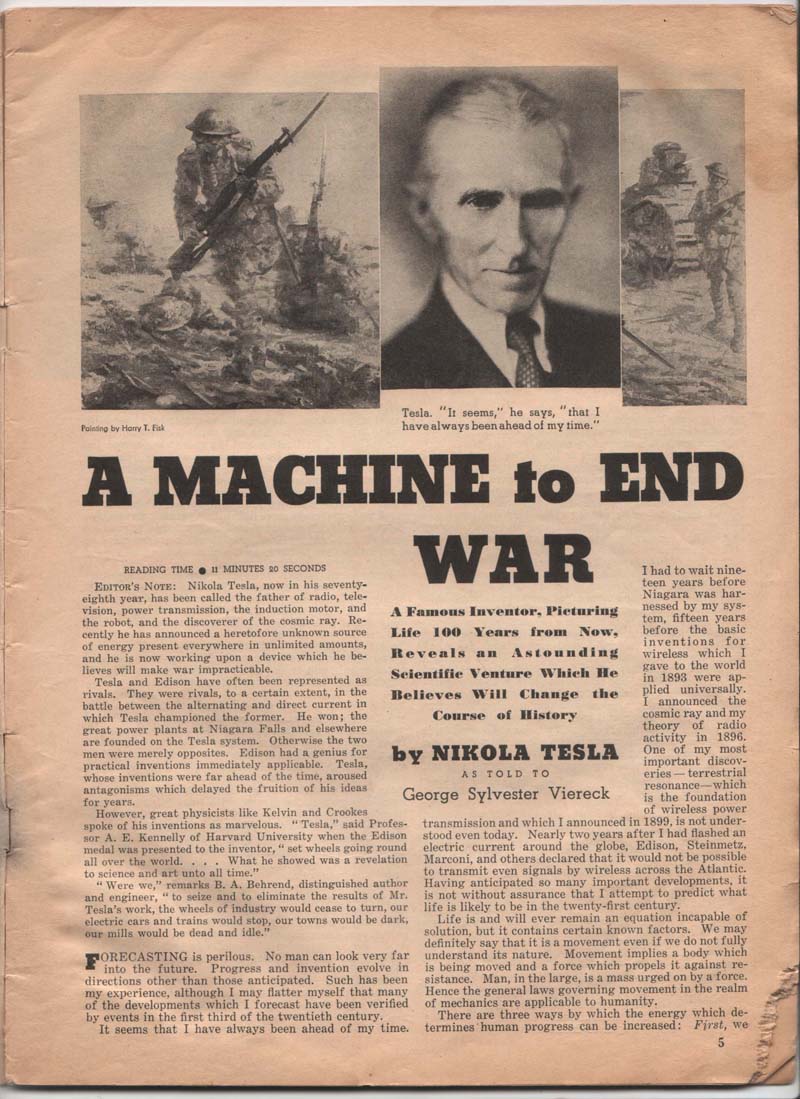
In the lengthy Liberty essay, “as told to George Sylvester Viereck” (a poet and Nazi sympathizer who also interviewed Hitler), Tesla himself makes the pronouncement, “It seems that I have always been ahead of my time.” He then goes on to enumerate some of the ways he has been proven right, and confidently lists the characteristics of the future as he sees it. No one likes a know-it-all, but Tesla refused to compromise or ingratiate himself, though he suffered for it professionally. And he was, in many cases, right. Many of his 1935 predictions in Liberty are still too far off to measure, and some of them will seem outlandish, or criminal, to us today. But some still seem plausible, and a few advisable if we are to make it another 100 years as a species. Tesla’s predictions include the following, which he introduces with the disclaimer that “forecasting is perilous. No man can look very far into the future.”
- “Buddhism and Christianity… will be the religion of the human race in the twenty-first century.”
- “The year 2100 will see eugenics universally established.” Tesla went on to comment, “no one who is not a desirable parent should be permitted to produce progeny. A century from now it will no more occur to a normal person to mate with a person eugenically unfit than to marry a habitual criminal.”
- “Hygiene, physical culture will be recognized branches of education and government. The Secretary of Hygiene or Physical Culture will be far more important in the cabinet of the President of the United States who holds office in the year 2025 than the Secretary of War.” Along with personal hygiene, Tesla included “pollution” as a social ill in need of regulation.
- “I am convinced that within a century coffee, tea, and tobacco will be no longer in vogue. Alcohol, however, will still be used. It is not a stimulant but a veritable elixir of life.”
- “There will be enough wheat and wheat products to feed the entire world, including the teeming millions of China and India.” (Tesla did not foresee the anti-gluten mania of the 21st century.)
- “Long before the next century dawns, systematic reforestation and the scientific management of natural resources will have made an end of all devastating droughts, forest fires, and floods. The universal utilization of water power and its long-distance transmission will supply every household with cheap power.” Along with this optimistic prediction, Tesla foresaw that “the struggle for existence being lessened, there should be development along ideal rather than material lines.”
Tesla goes on to predict the elimination of war, “by making every nation, weak or strong, able to defend itself,” after which war chests would be diverted to funding education and research. He then describes—in rather fantastical-sounding terms—an apparatus that “projects particles” and transmits energy, enabling not only a revolution in defense technology, but “undreamed of results in television.” Tesla diagnoses his time as one in which “we suffer from the derangement of our civilization because we have not yet completely adjusted ourselves to the machine age.” The solution, he asserts—along with most futurists, then and now—“does not lie in destroying but in mastering the machine.” As an example of such mastery, Tesla describes the future of “automatons” taking over human labor and the creation of “a thinking machine.”
Matt Novak at the Smithsonian has analyzed many of Tesla’s claims, interpreting his predictions about “hygiene and physical culture” as a foreshadowing of the EPA and discussing Tesla’s work in robotics (“Today,” Tesla proclaimed, “the robot is an accepted fact”). The Liberty article was not the first time Tesla had made large-scale, public predictions about the century to come and beyond. In 1926, Tesla gave an interview to Collier’s magazine in which he more or less accurately foresaw smartphones and wireless telephony and computing:
When wireless is perfectly applied the whole earth will be converted into a huge brain, which in fact it is…. We shall be able to communicate with one another instantly, irrespective of distance. Not only this, but through television and telephony we shall see and hear one another as perfectly as though were face to face, despite intervening distances of thousands of miles; and the instruments through which we shall be able to do this will be amazingly simple compared with our present telephone. A man will be able to carry one in his vest pocket.
Telsa also made some odd predictions about fuel-less passenger flying machines “free from any limitations of the present airplanes and dirigibles” and spouted more of the scary stuff about eugenics that had come to obsess him late in life. Additionally, Tesla saw changing gender relations as the precursor of a coming matriarchy. This was not a development he characterized in positive terms. For Tesla, feminism would “end in a new sex order, with the female as superior.” (As Novak notes, Tesla’s misgivings about feminism have made him a hero to the so-called “men’s rights” movement.) While he fully granted that women could and would match and surpass men in every field, he warned that “the acquisition of new fields of endeavor by women, their gradual usurpation of leadership, will dull and finally dissipate feminine sensibilities, will choke the maternal instinct, so that marriage and motherhood may become abhorrent and human civilization draw closer and closer to the perfect civilization of the bee.”
It seems to me that a “bee civilization” would appeal to a eugenicist, except, I suppose, Tesla feared becoming a drone. Although he saw the development as inevitable, he still sounds to me like any number of current politicians who argue that society should continue to suppress and discriminate against women for their own good and the good of “civilization.” Tesla may be an outsider hero for geek culture everywhere, but his social attitudes give me the creeps. While I’ve personally always liked the vision of a world in which robots do most the work and we spend most of our money on education, when it comes to the elimination of war, I’m less sanguine about particle rays and more sympathetic to the words of Ivor Cutler.
Note: An earlier version of this post appeared on our site in 2015.
via Smithsonian/Paleofuture
Related Content:
In 1900, Ladies’ Home Journal Publishes 28 Predictions for the Year 2000
Josh Jones is a writer and musician based in Durham, NC. Follow him at @jdmagness
Read More...Tate Kids Presents Introductions to Art Movements: Cubism, Impressionism, Surrealism & More
Tate Kids has a solid grasp on the sort of hands on art-related content that appeals to children — Make a mud painting! Make a spaghetti sculpture! Photo filter challenge!
Children of all ages, grown ups who skipped out on art history included, will benefit from their breakneck overviews of entire art movements.
Take cubism.
The Tate Kids’ animation, above, provides a solid if speedy overview, zipping through eight canvases, six artists, and explanations of the movement’s two phases — analytical and synthetic. (Three phases if you count Orphism, the abstract, cubist influenced painting style married artists Robert and Sonia Delaunay hatched around 1912.)
Given the intended audience, the fond friendship between the fathers of cubism, Georges Braque and Pablo Picasso looms large, with nary a peep about Picasso’s narcissism and misogyny. And it must be said that the narrator’s tone grates a bit — a bit too loud, a bit too wowed.
The Impressionists come off as the real cool kids, with a different narrator, and nifty collage animations that find Camille Pissarro throwing horns and a Mohawked Alfred Sisley as they reject the Salon’s insistence on “myths, battles and paintings of important people.”
Their defiant spirit is supported by criticism that most definitely has not stood the test of time:
Pure evil!
Wallpaper!
Like a monkey has got hold of a box of paints!
Kid presenters seize the controls for an introduction to the mid-century Japanese avant-garde movement, Gutai.
Their conclusion?
Smashing things up is fun!
As are manifestos:
Let’s bid farewell to the hoaxes piled up on the altars and in the palaces, the drawing rooms and the antique shops…Lock up these corpses in the graveyard!
Yay!
Those who are poorly equipped to stomach the narrators’ whizbang enthusiasm should take a restorative minutes to visit the museum oranges in hand, with 12-year-old Jaeda and 9‑year-old Fatimatu. Their calm willingness to engage with conceptual art is a tonic:
When I started art, I though art was just about making it perfect, but you don’t have to care what other people say. That could still mean an art to you.
Watch a Tate Kids Art Movements playlist on YouTube. Supplement what you’ve learned with a host of Tate Kids activities, coloring pages, games, quizzes, artist bios and a gallery of crowdsourced kid art.
Related Content
The Tate Digitizes 70,000 Works of Art: Photos, Sketchbooks, Letters & More
A 110-Year-Old Book Illustrated with Photos of Kittens & Cats Taught Kids How to Read
- Ayun Halliday is the Chief Primatologist of the East Village Inky zine and author, most recently, of Creative, Not Famous: The Small Potato Manifesto. Follow her @AyunHalliday.
Read More...Great Art Cities: Visit the Fascinating, Lesser-Known Museums of London & Paris
Gallerists James Payne and Joanne Shurvell understand that institutional big gorillas like the Louvre, the Musee d’Orsay, Tate Britain, and London’s National Gallery require no introduction. Their new art and travel series, Great Art Cities Explained, concentrates instead on the wonderful, smaller museums the biggies often overshadow.
First time visitors to London and Paris may be left scrambling to rearrange their itineraries.
The first two episodes have us persuaded that Sir John Soane’s Museum, Kenwood House, the Wallace Collection, Le Musée National Eugène Delacroix, Le Musée de Montmartre à Paris, and Atelier Brancusi are the true “don’t miss” attractions if time is tight.
Credit Payne, whose flair for dishy, far ranging, highly accessible narration made his other web series, Great Art Explained in Fifteen Minutes, an instant hit.
The three British institutions featured above were once grand private homes, whose owners decided to donate them and the magnificent art collections they contained to the public good.
Whatever motivated these wealthy men’s generosity — vanity, the quest for immortality, or, in one case, the desire to cut off a churlish and morally lax son whom Payne compares to the central figure in William Hogarth’s A Rake’s Progress, a Sir John Soane’s Museum favorite — Payne holds them in higher regard than today’s investment-obsessed art collectors:
The world needs more men like (William) Murray, (Sir John) Soane, and (Sir Richard) Wallace, men who saw that art can transcend social class. They understood that art should enrich the soul, not the bank balance.
His peeks into their circumstances are every bit as fascinating as the tidbits he drops about the artists whose work he includes.
Rather than giving a sweeping overview of each collection, he focuses on a few key works, sharing his curatorial perspective on their history, acquisition, subject matter, creation, and reception:
Rembrandt’s Self Portrait with Two Circles (1669)
Vermeer’s The Guitar Player (1672)
Hogarth’s A Rake’s Progress (1732)
Canaletto’s Venice: the Bacino di San Marco from San Giorgio Maggiore and Venice: the Bacino di San Marco from the Canale della Giudecca (c. 1735 — 1744)
Fragonard’s The Swing (1767)
Frans Hal’s Laughing Cavalier (1624)
Payne’s rollicking approach means each episode is crammed with plenty of artwork residing outside of the featured museums, too, as he compares, contrasts, and contextualizes.
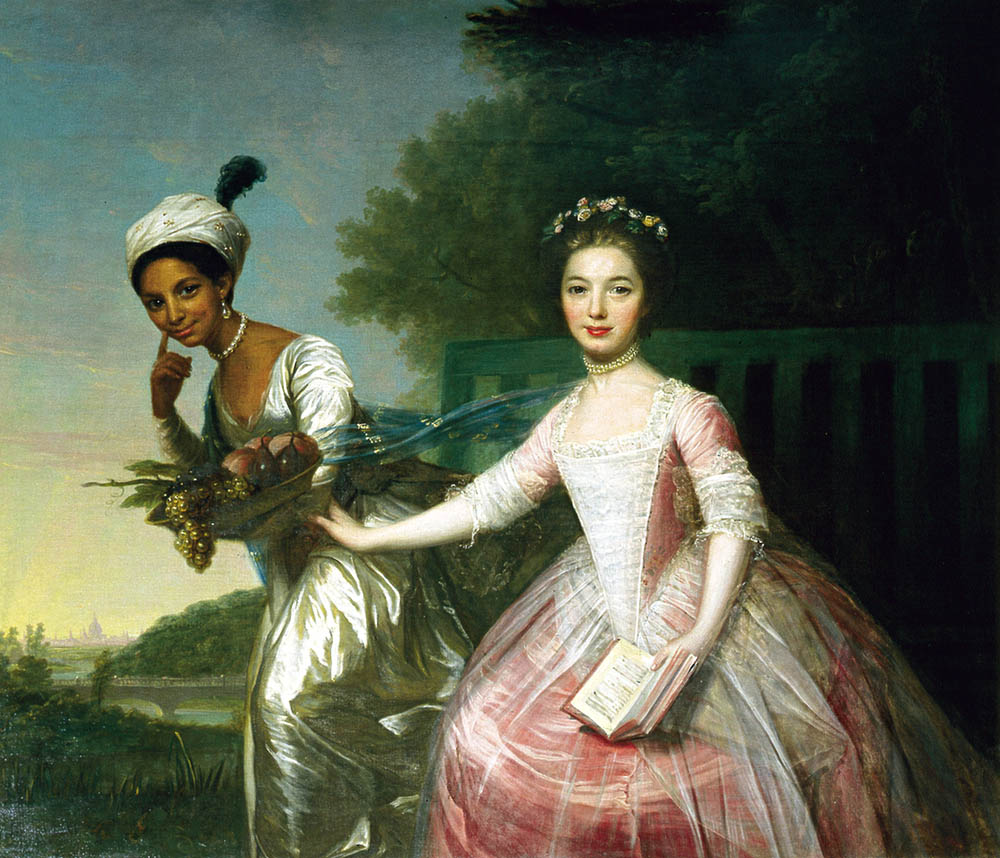
One of his most interesting tales in the London episode concerns an 18th-century portrait of William Murray’s great-nieces, Dido Belle and Elizabeth Murray, raised by their abolitionist great-uncle at Kenwood House:
Dido Belle was the illegitimate daughter of a Black slave and William Murray’s nephew and was raised by Murray as part of the aristocracy. By all accounts, Dido and her cousin were raised as equals and this portrait of the two was seen as an image of sisterhood, reflecting their equal status. But looking at it with modern eyes, we can see it more in the vein of traditional servant and master portraits of the time. Belle’s exotic clothing is designed to differentiate her from her cousin and the painting reflects the conservative views of the time.
Artist David Martin places the cousins on a bench outside the Hampstead Heath mansion, with St. Paul’s Cathedral in the background. For years, it was the only known portrait of Belle.
It hangs, not in Kenwood House, but in Scone Palace’s Ambassador’s Room.
Meanwhile, one of Kenwood House’s latest acquisitions is a 2021 portrait of Belle by young Jamaican artist Mikéla Henry-Lowe, on display in the library.
Next up on Great Art Cities Explained: New York. Look for it on this playlist on Great Art Explained’s YouTube channel.
Related Content:
Mark Rothko’s Seagram Murals: What Makes Them Great Art
Ayun Halliday is the Chief Primatologist of the East Village Inky zine and author, most recently, of Creative, Not Famous: The Small Potato Manifesto. Follow her @AyunHalliday.
Read More...Support Us
We're hoping to rely on loyal readers, rather than erratic ads. Please click the Donate button and support Open Culture. You can use Paypal, Venmo, Patreon, even Crypto! We thank you!

About Us

Open Culture scours the web for the best educational media. We find the free courses and audio books you need, the language lessons & educational videos you want, and plenty of enlightenment in between.
Advertise With Us
FREE UPDATES!
GET OUR DAILY EMAIL
Get the best cultural and educational resources on the web curated for you in a daily email. We never spam. Unsubscribe at any time.
FOLLOW ON SOCIAL MEDIA
Open Culture editor Dan Colman scours the web for the best educational media. He finds the free courses and audio books you need, the language lessons & movies you want, and plenty of enlightenment in between.
Advertise With Us



