The Last Video Store: A Short Documentary on How the World’s Oldest Video Store Still Survives Today
When was the last time you went to a video store? Perhaps your habit died with the major rental outlets like Blockbuster Video, all of whose locations closed by early 2014. Or rather, almost all of them: as fans of retro video culture know, the sole Blockbuster store on this Earth rents on in Bend, Oregon. But for all the nostalgic appeal of its blue-and-yellow brand livery, the “last Blockbuster” is at its heart the local operation it had been before the once-mighty international chain assimilated it in 2000. Back then, recall, we cinephiles saw Blockbuster and its like as remorseless corporate predators ready to swallow every independent video store, hardly sparing the ones at which we’d received our own film education.
My own teenage induction into cinephilia happened at Scarecrow Video, which continues to serve Seattle’s film obsessives today. Indeed, of all video stores that have ever existed, only the eccentric independents still stand. This holds true on both sides of the pond: though London now has no video stores at all, Bristol boasts the oldest video store in the world, one with the experientially apt name of 20th Century Flicks. You can have a look at this tenacious operation in Arthur Cauty’s documentary short “The Last Video Store,” which in the words of the shop’s owners and staff explains just how Flicks (as they refer to it) has managed to carve out an economic and cultural space in the 21st century.
“Flicks, because it’s got this very strange, idiosyncratic collection of trash to extreme high-brow movies, we just had this niche that we managed to survive in,” says co-owner David Taylor. Since its founding in 1982 (and through a few moves in that time), the store has amassed “the biggest collection in the U.K. by quite a long way. It’s over 20,000 movies,” which by Taylor’s reckoning is “about five times more than Netflix.” This gets at an unexpected but now common complaint about the streaming-media future in which we now live: despite their technical capacity to offer film libraries of Borgesian vastness, liberated as they are from the increasingly constrained spaces of traditional video stores, even the most successful streaming platforms maintain disappointingly limited selections.
“There’s some good stuff as well, admittedly, but it’s hidden behind all of the trash,” Flicks clerk Daisy Steinhardt says of Netflix, referring to a very different kind of “trash” than that proudly stocked by her store. “If you come here, then you can talk to someone who knows about or at least likes film, and then actually have a conversation rather than just trusting an algorithm.” It is this sense of community — which Blockbuster-style chains failed to offer, and which internet-based services can hardly hope to replicate — on which surviving video stores have capitalized. 20th Century Video have even built a pair of small theaters in the store, which customers can book to view anything in its far-reaching collection. Should a bold investor come along, co-owner David White envisions “a bar, a little restaurant, a retro arcade,” even an entire “emporium for an old-school type of experience.” And who among us wouldn’t enjoy the occasional night out in the 20th century?
Related Content:
A Beautiful Short Documentary Takes You Inside New York City’s Last Great Chess Store
The Last Bookstore: A Short Documentary on Perseverance & the Love of Books
An Interactive Map of Every Record Shop in the World
Based in Seoul, Colin Marshall writes and broadcasts on cities, language, and culture. His projects include the Substack newsletter Books on Cities, the book The Stateless City: a Walk through 21st-Century Los Angeles and the video series The City in Cinema. Follow him on Twitter at @colinmarshall, on Facebook, or on Instagram.
Read More...The Cinematography That Changed Cinema: Exploring Akira Kurosawa, Stanley Kubrick, Peter Greenaway & Other Auteurs
One type of argument made against “auteur theory,” which posits a film’s director as its “author,” holds that certain non-directorial collaborators contribute just as many — or, as Pauline Kael argued about Citizen Kane, more — of a work of cinema’s defining qualities. Surely a video essayist like Lewis Bond, co-creator with Luiza Liz Bond of Youtube channel The Cinema Cartography, subscribes to auteur theory: just look at the increasingly in-depth analyses he’s created on Stanley Kubrick, Andrei Tarkovsky, and David Lynch — all, of course, directors. But the recent Cinema Cartography essay “The Cinematography That Changed Cinema” sees him turning away from the figure of the director, exploring instead the auteur-like contributions of those masters of the camera.
Any competent cinematographer can make shots pretty; few can make them truly cinematic. Here we use “cinematic” in the sense that Peter Greenaway would, referring to the vast capabilities of the medium to go beyond photographically illustrating essentially verbal stories — capabilities that, alas, have so far gone mostly unused. It should come as no surprise this essay uses Greenaway’s The Cook, the Thief, His Wife, and Her Lover to establish its perspective on the power of cinematography.
Ironically, the movie’s inventiveness in that respect and all others produces “a film so removed from cinema that it rarely feels as though it was even intended to be a film.” Shot by Sacha Vierny (best known for Alain Resnais’ Hiroshima mon amour), its ultra-artificial images resemble those of no other movies, much less anything in real life, and for that reason they sweep us along.
Drawing examples from dozens of films over half an hour, the Bonds show how cinematographers have not just represented or enhanced reality, but created it anew. This happens in such pictures famous for their visual lushness as Michael Powell’s The Red Shoes (cinematographer: Jack Cardiff), Kubrick’s Barry Lyndon (John Alcott), Terrence Malick’s Days of Heaven (Néstor Almendros), and Akira Kurosawa’s Ran (Asakazu Nakai, Takao Saitô, and Shôji Ueda). But it also happens in less likely cinematic realms: 1970s Italian horror, documentary, and even productions stripped nearly bare of money and equipment, whether by choice (as under the rigors of the Dogme 95 manifesto) or by necessity (as in Mikhail Kalatozov’s still aesthetically exhilarating I Am Cuba). You could call each of these films beautiful, but as every cinephile has felt, film doesn’t exist to achieve beauty: it exists to go beyond it.
Related Content:
The 100 Most Memorable Shots in Cinema Over the Past 100 Years
A Mesmerizing Supercut of the First and Final Frames of 55 Movies, Played Side by Side
The Greatest Cut in Film History: Watch the “Match Cut” Immortalized by Lawrence of Arabia
The History of the Movie Camera in Four Minutes: From the Lumiere Brothers to Google Glass
Based in Seoul, Colin Marshall writes and broadcasts on cities, language, and culture. His projects include the Substack newsletter Books on Cities, the book The Stateless City: a Walk through 21st-Century Los Angeles and the video series The City in Cinema. Follow him on Twitter at @colinmarshall, on Facebook, or on Instagram.
Read More...A Dictionary of Symbols: Juan Eduardo Cirlot’s Classic Study of Symbols Gets Republished in a Beautiful, Expanded Edition
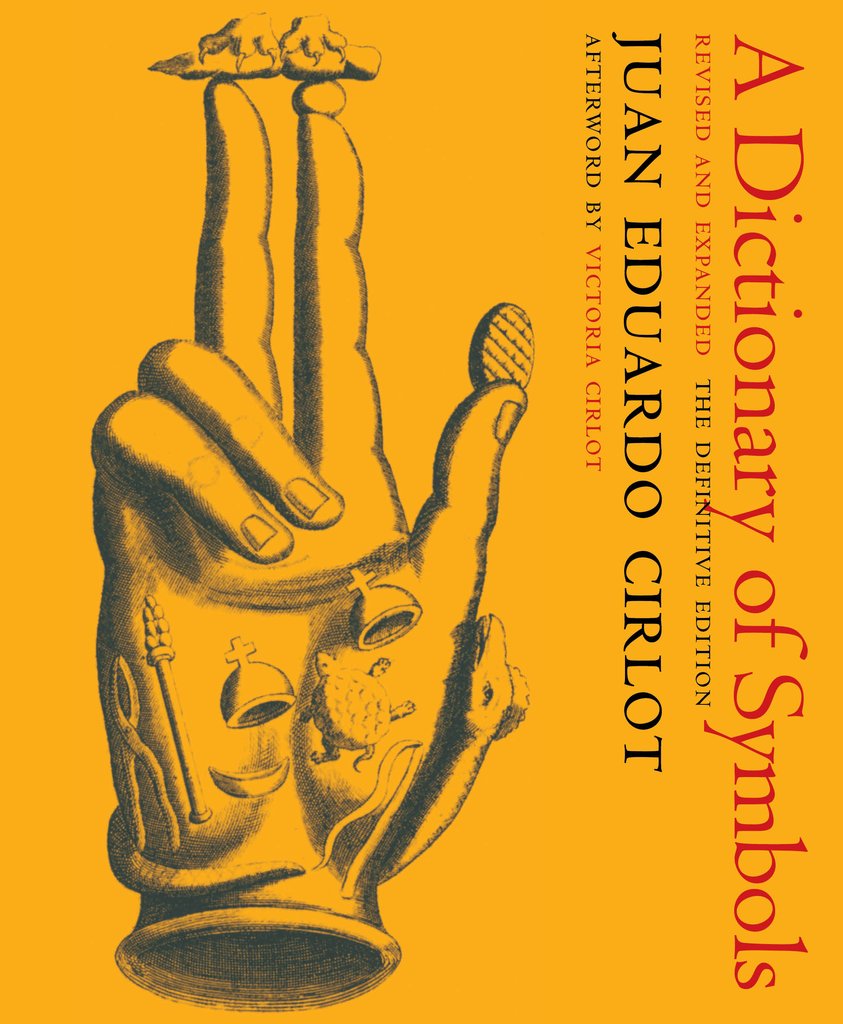
How, exactly, does one go about making a global dictionary of symbols? It is a Herculean task, one few scholars would take on today, not only because of its scope but because the philological approach that gathers and compares artifacts from every culture underwent a correction: No one person can have the expertise to cover everything. Yet the attempts to do so have had tremendous creative value. Such explorations bring us closer to what makes humans the same the world over: our productive imaginations and the archetypal wellspring of images that guide us through the unknown.
When Spanish poet, critic, translator, and musicologist Juan Eduardo Cirlot began his 1958 Dictionary of Symbols, he did so with Carl Jung in mind, writing against a current of positivism that devalued the symbolic.
Cirlot quotes Jung in his introduction: “For the modern mind, analogies… are nothing but self-evident absurdities. This worthy judgement does not, however, in any way alter the fact that such affinities of thought do exist and that they have been playing an important role for centuries.” Like it or not, we interact through the symbolic realm all the time. Those interactions are freighted with historical and cultural meaning we would do well to understand if we are to understand ourselves.
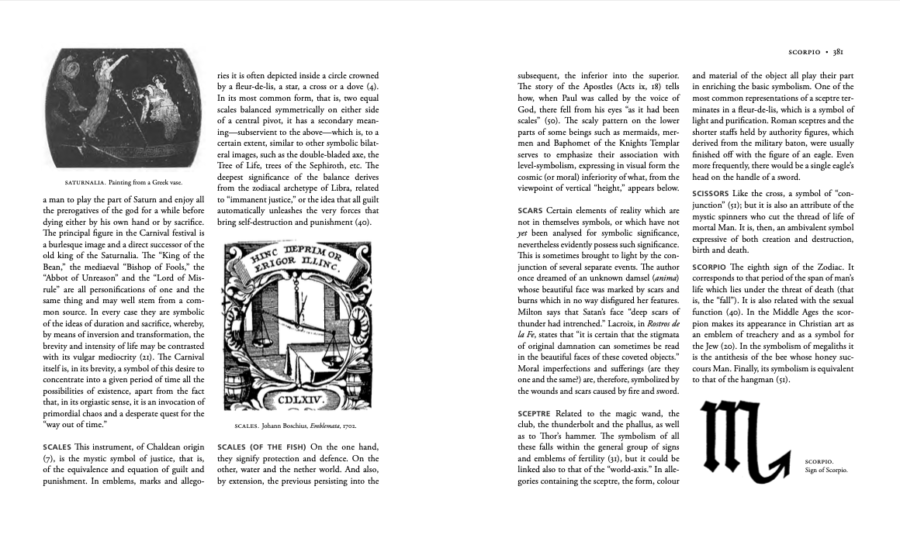
In his method, Cirlot writes in a Preface:
I wanted to embrace the broadest possible range of objects and cultures, to compare the symbols of the post-Roman West with symbols from India, the Far East, Chaldea, Egypt, Israel and Greece. Images, essential myths, allegories, for my purposes, all these needed to be consulted, not, self-evidently, with the intention of making an exhaustive reckoning, but rather to comb out patterns in meaning, in what counts as essential, in fields both near and far.
Cirlot draws his inspiration from Dada and Surrealism and the comparative method in religious studies popularized by scholars like Mircea Eliade, who influenced prominent students of myth like Joseph Campbell (and through Campbell, the popular culture of film, television, and the internet). “Thus I drew near the luminous labyrinth of symbols,” Cirlot writes, “concerned less with interpretation than with comprehension and concerned most of all, really, with the contemplation of how symbols dwell across time and culture.” And “dwell” they do, as we know, in elemental figures like dragons and serpents, destructive gods and evil eyes. (In 1954, Cirlot published The Eye in Mythology, a precursor to A Dictionary of Symbols.)
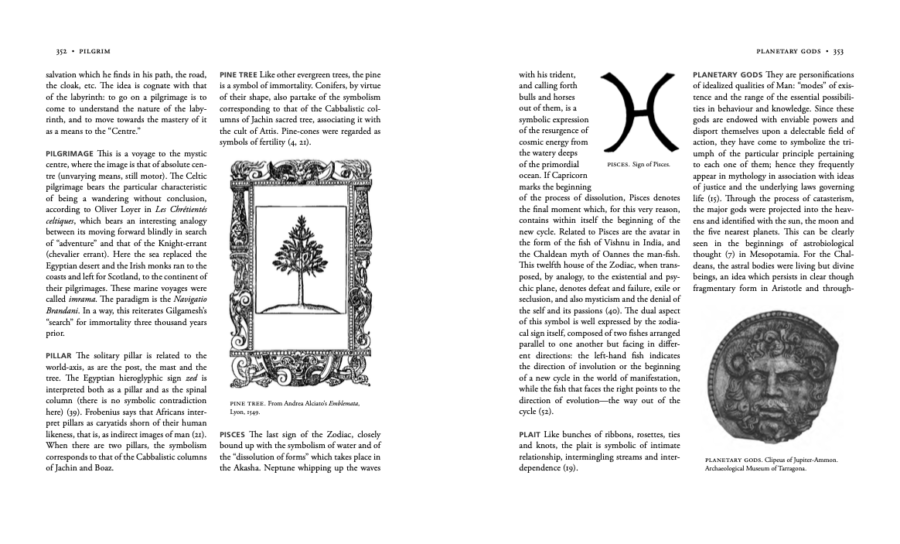
In times of trouble and uncertainty like ours, symbols become important ways of organizing chaos in our collective imagination, and are integral to what Sinding Bentzen, professor of economics at the University of Copenhagen, calls “religious coping” in the face of COVID-19. Ripped from their historic context, as happened with the swastika, symbols can be used to intentionally manipulate and mislead, to turn collective anxiety into acquiescence to tyranny and totalitarianism. Cirlot was acutely aware of this as an artist working under the rule of Francisco Franco. As a leading member of a group of painters and poets who called themselves Dau al Set (“the seven-spotted dice”), Cirlot and his contemporaries “championed creative liberty and resistance to the dominant Fascist regime.”
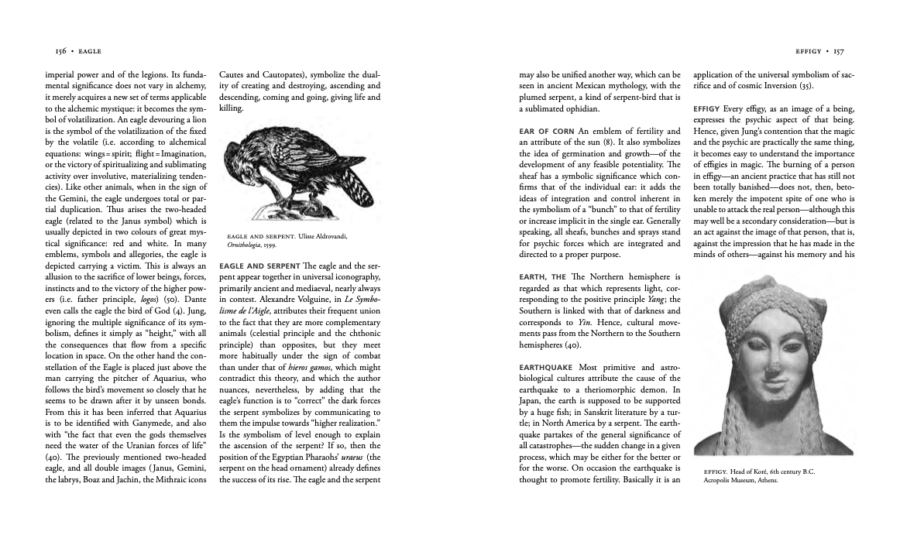
In the 21st century, we can just as well read Cirlot’s dictionary with this same mission. It is not an artifact of another time but as an ever-relevant, erudite, and fascinating resource for our own. Through the study of symbols we learn to see, Cirlot wrote, that “nothing is meaningless or neutral: everything is significant,” every idea connected to others across time and space. “It is only by reading through the volume steadily that one can become aware of the intricate interrelations of symbolic meanings,” wrote Catherine Rau in a 1962 review of the book. We can “develop such awareness by starting off with any random entry,” Angelica Frey observes at Hyperallergic.
Do so in the “original, significantly enlarged” new edition of the Cirlot’s Dictionary of Symbols, just published by the New York Review of Books in an English translation by Valerie Miles. We can read the book for reference or for pleasure, Herbert Read writes in an introduction to the new edition, “but in general the greatest use of the volume will be for the elucidation of those many symbols which we encounter in the arts and in the history of ideas. Man, it has been said, is a symbolizing animal; it is evident that at no stage in the development of civilization has man been able to dispense with symbols.”
via Hyperallergic
Related Content:
40,000-Year-Old Symbols Found in Caves Worldwide May Be the Earliest Written Language
18 Classic Myths Explained with Animation: Pandora’s Box, Sisyphus & More
48 Hours of Joseph Campbell Lectures Free Online: The Power of Myth & Storytelling
Josh Jones is a writer and musician based in Washington, DC. Follow him @jdmagness
Read More...Three Days in Twin Peaks: An In-Depth Journey Through the Evocative Locations of David Lynch’s TV Series
After a time of great personal loss, a friend of mine set off on a road trip around the United States. When I later asked what part of the country had made the deepest impression on him, he named a few towns about thirty miles east of Seattle: the shooting locations, he hardly needed tell a fellow David Lynch fan, of Twin Peaks. Raised in Spokane, Washington, among a variety of other modest American cities, Lynch saw clearly the look and feel of the titular setting by the time he co-created the show with writer Mark Frost. He eventually found it in the Washingtonian towns of Snoqualmie, North Bend and Fall City, which even today offer a friendly reception to the occasional Twin Peaks pilgrim — at least according to my friend.
This was more recently corroborated by Jeremiah Beaver, creator of Youtube “Twin Peaks theory and analysis show” Take the Ring. Thirty years after the premiere of the famously cryptic yet transfixing original series, the Indianapolis-based Beaver made the trip to Washington to visit its every remaining location — as well as those used in the 1992 prequel film Twin Peaks: Fire Walk with Me, 2017’s Twin Peaks: The Return, and even these productions’ deleted scenes.
Into the half-hour-long “Three Days in Twin Peaks” Beaver fits a great deal of information related to Twin Peaks’ production and mythos as well as the real-life history of the relevant places. “It was at times hard to distinguish the Twin Peaks that lived in my imagination versus the ground beneath my feet,” he admits.
Beaver makes his way to locations both major and minor, from the Twin Peaks Sheriff’s Department (now the DirtFish Rally Racing School) and the Double R diner (Twede’s Cafe, “one of the few spots in Washington state that really owns its Peakness”) to the shack of the Book House biker club and the bench in E.J. Roberts Park once sat upon by the late Harry Dean Stanton’s Carl Robb. Some real buildings played dual roles: both Twin Peaks’ Blue Pine Lodge and Great Northern Hotel are in reality different parts of Poulsbo’s Kiana Lodge, and the Mt. Si Motel appears as “two different motels with elements of the supernatural,” first in Fire Walk with Me, then even more seedily in The Return. “That fresh mountain air and smell of trees is no joke,” says Beaver, words to heed if you plan on making your own Twin Peaks pilgrimage — and if you do, you can surely guess how he describes the coffee and cherry pie at Twede’s.
Related Content:
David Lynch Draws a Map of Twin Peaks (to Help Pitch the Show to ABC)
Watch an Epic, 4‑Hour Video Essay on the Making & Mythology of David Lynch’s Twin Peaks
Twin Peaks Actually Explained: A Four-Hour Video Essay Demystifies It All
Play the Twin Peaks Video Game: Retro Fun for David Lynch Fans
Based in Seoul, Colin Marshall writes and broadcasts on cities, language, and culture. His projects include the Substack newsletter Books on Cities, the book The Stateless City: a Walk through 21st-Century Los Angeles and the video series The City in Cinema. Follow him on Twitter at @colinmarshall, on Facebook, or on Instagram.
Read More...Sean Connery (RIP) Reads C.P. Cavafy’s Epic Poem “Ithaca,” Set to the Music of Vangelis
This video combines three things that make me happy: the voice of Sean Connery (who passed away today), the music of Vangelis (Blade Runner, Chariots of Fire), and the poetry of C.P. Cavafy. Put them all together and you get a blissful soundscape of rolling synth lines, rolling Scottish R’s, and a succession of Homeric images and anaphoric lines. And the video’s quite nice as well.
Anyway, it seems rude to say much more and drown the poem in commentary. So, follow along with Sean Connery.
Find the text of the poem after the jump. (more…)
Read More...The Gruesome Dollhouse Death Scenes That Reinvented Murder Investigations
Who can resist miniatures?
Wee food, painstakingly rendered in felted wool…
Matchbook-sized books you can actually read…
Classic record albums shrunk down for mice…
The late Frances Glessner Lee (1878–1962) definitely loved miniatures, and excelled at their creation, knitting socks on pins, hand rolling real tobacco into tiny cigarettes, and making sure the victims in her realistic murder scene dioramas exhibited the proper degree of rigor mortis and lividity.
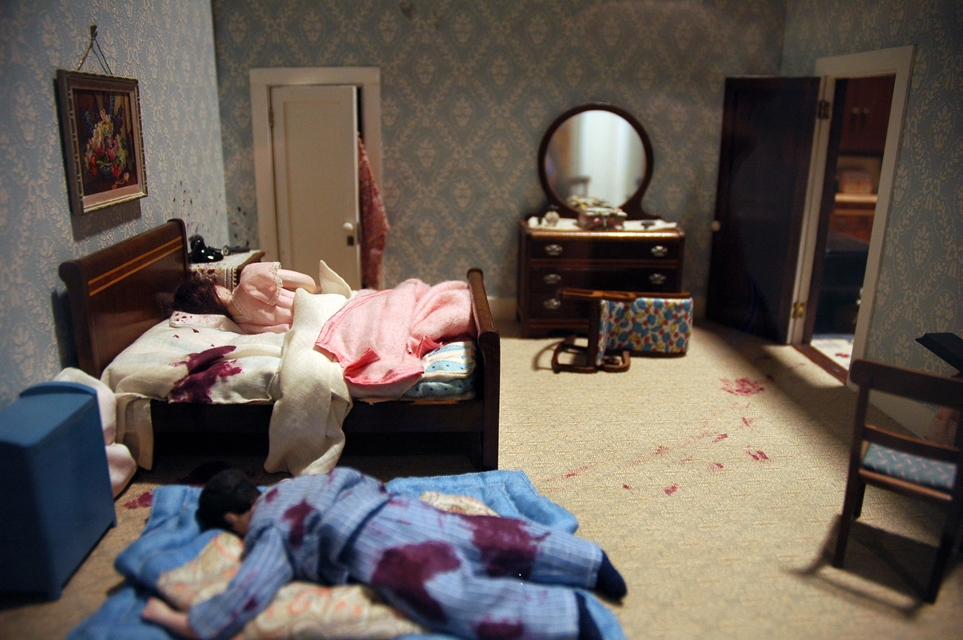
Lee began work on her Nutshell Studies of Unexplained Death at the age of 65, as part of a lifelong interest in homicide investigation.
Her preoccupation began with the Sherlock Holmes stories she read as a girl.
In the 1930s, the wealthy divorcee used part of a sizable inheritance to endow Harvard University with enough money for the creation of its Department of Legal Medicine.
Its first chairman was her friend, George Burgess Magrath, a medical examiner who had shared his distress that criminals were literally getting away with murder because coroners and police investigators lacked appropriate training for forensic analysis.
The library to which Lee donated a thousand books on the topic was named in his honor.
The homemade dioramas offered a more vivid experience than could be found in any book.
Each Nutshell Study required almost half a year’s work, and cost about the same as a house would have at the time. ($6000 in the 1940s.)
“Luckily, I was born with a silver spoon in my mouth,” Lee remarked. “It gives me the time and money to follow my hobby of scientific crime detection.”
Although Lee had been brought up in a luxurious 13 bedroom home (8 were for servants’ use), the domestic settings of the Nutshell Studies are more modest, reflective of the victims’ circumstances.
She drew inspiration from actual crimes, but had no interest in replicating their actual scenes. The crimes she authored for her little rooms were composites of the ones she had studied, with invented victims and in rooms decorated according to her imagination.
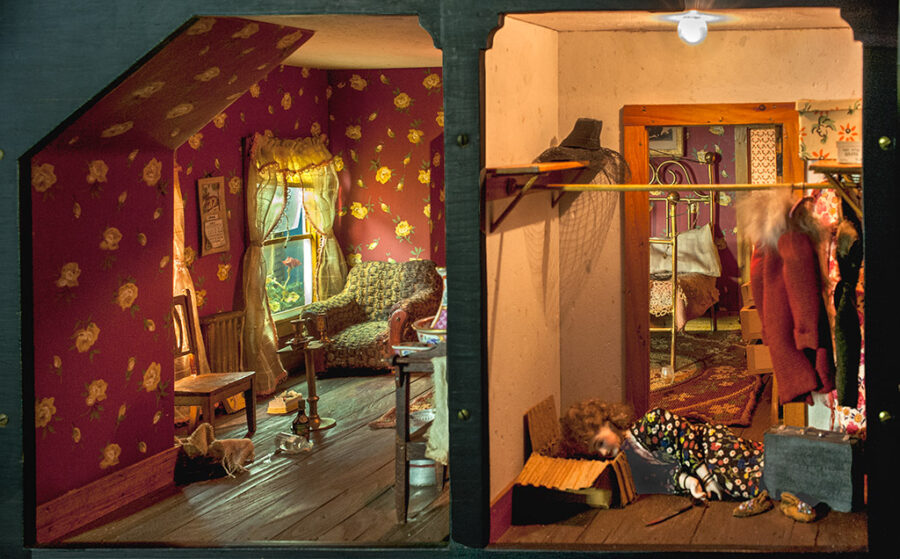
Her intent was to provide investigators with virgin crime scenes to meticulously examine, culling indirect evidence from the painstakingly detailed props she was a stickler for getting right.
Students were provided with a flashlight, a magnifying glass, and witness statements. Her attention to detail ensured that they would use the full ninety minutes they had been allotted analyzing the scene. Their goal was not to crack the case but to carefully document observations on which a case could be built.
The flawlessness of her 1:12 scale renderings also speaks to her determination to be taken seriously in what was then an exclusively male world. (Women now dominate the field of forensic science.)
Nothing was overlooked.
As she wrote to Dr. Alan Moritz, the Department of Legal Medicine’s second chair, in a letter reviewing proposed changes to some early scenes:
I found myself constantly tempted to add more clues and details and am afraid I may get them “gadgety” in the process. I hope you will watch over this and stop me when I go too far. Since you and I have perpetrated these crimes ourselves we are in the unique position of being able to give complete descriptions of them even if there were no witnesses—very much in the manner of the novelist who is able to tell the inmost thoughts of his characters.
It’s no accident that many of the Nutshell Studies’ little corpses are female.
Lee did not want officers to treat victims dismissively because of gender-related assumptions, whether the scenario involved a prostitute whose throat has been cut, or a housewife dead on the floor of her kitchen, the burners of her stove all switched to the on position.
Would you like to test your powers of observation?
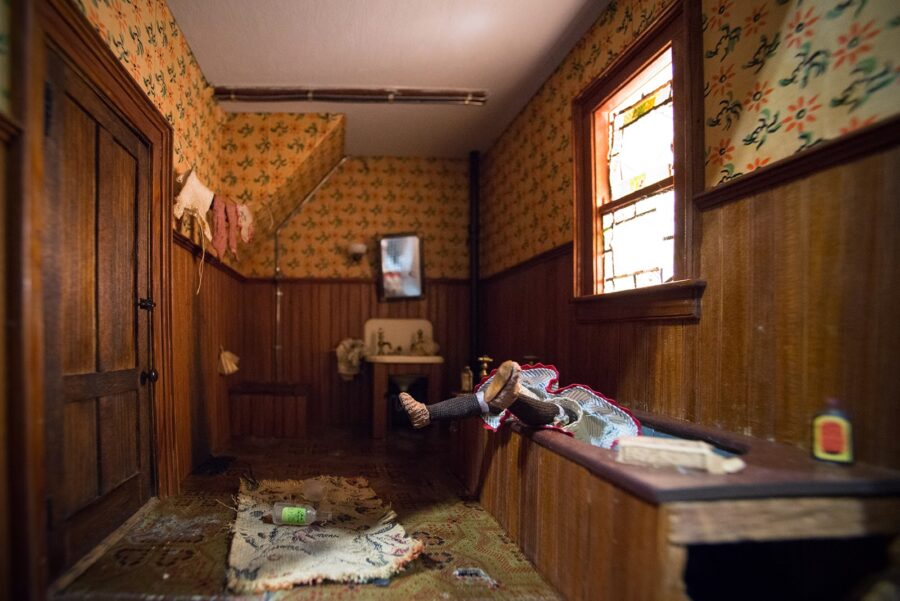
Above are the remains of Maggie Wilson, discovered in the Dark Bathroom’s tub by a fellow boarder, Lizzie Miller, who gave the following statement:
I roomed in the same house as Maggie Wilson, but knew her only from we met in the hall. I think she had ‘fits’ [seizures]. A couple of male friends came to see her fairly regularly. On Sunday night, the men were there and there was a lot of drinking going on. Some time after the men left, I heard the water running in the bathroom. I opened the door and found her as you see her.
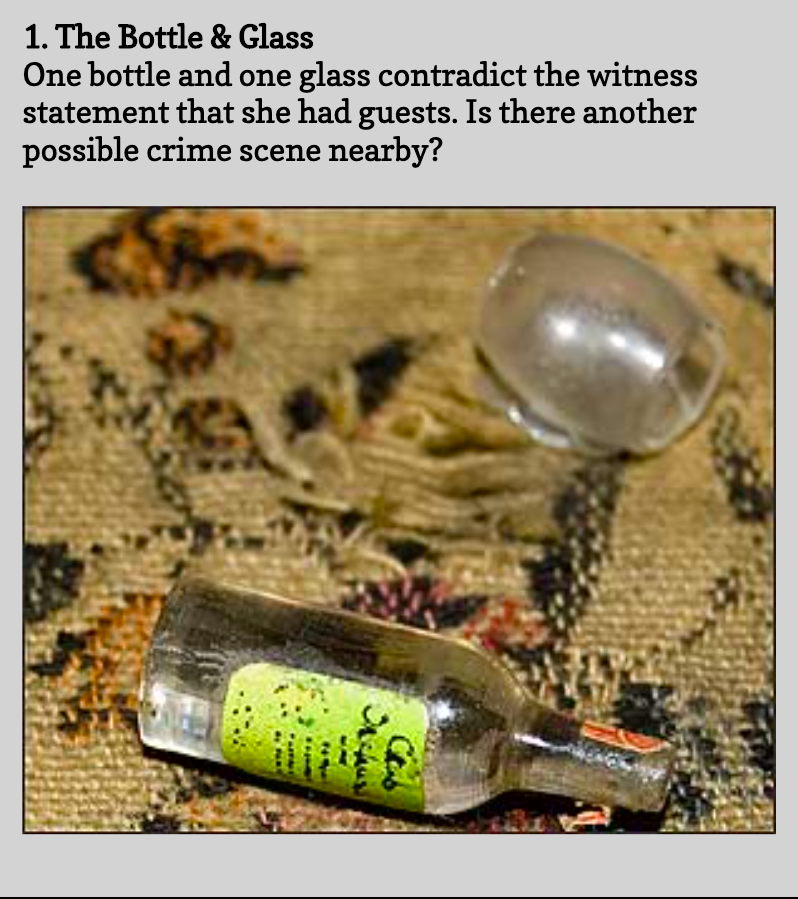

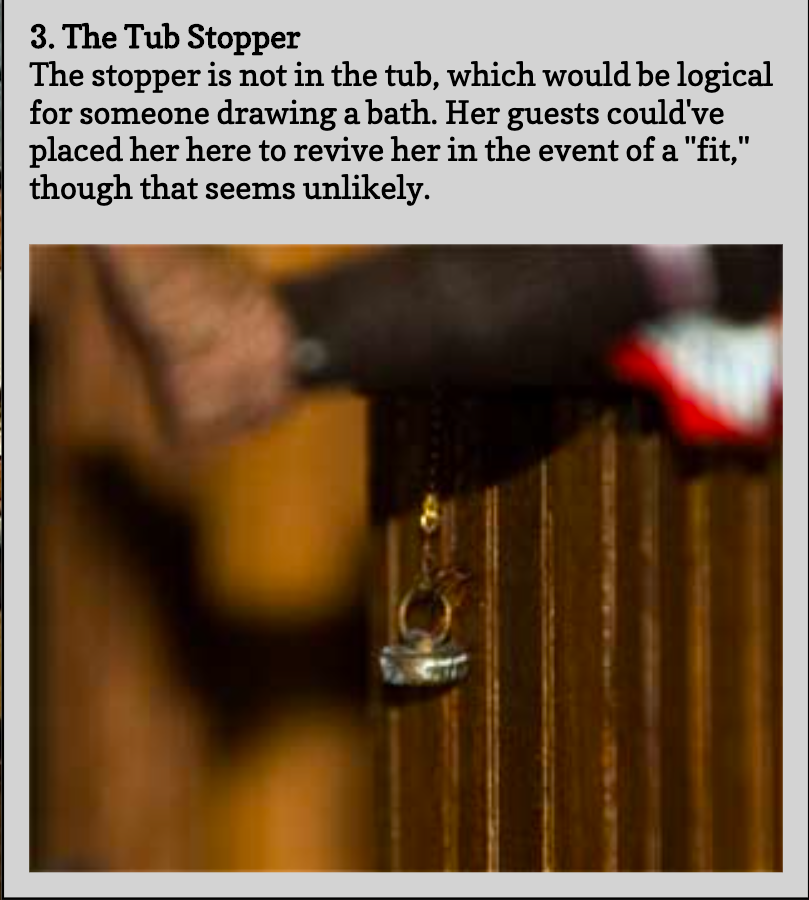
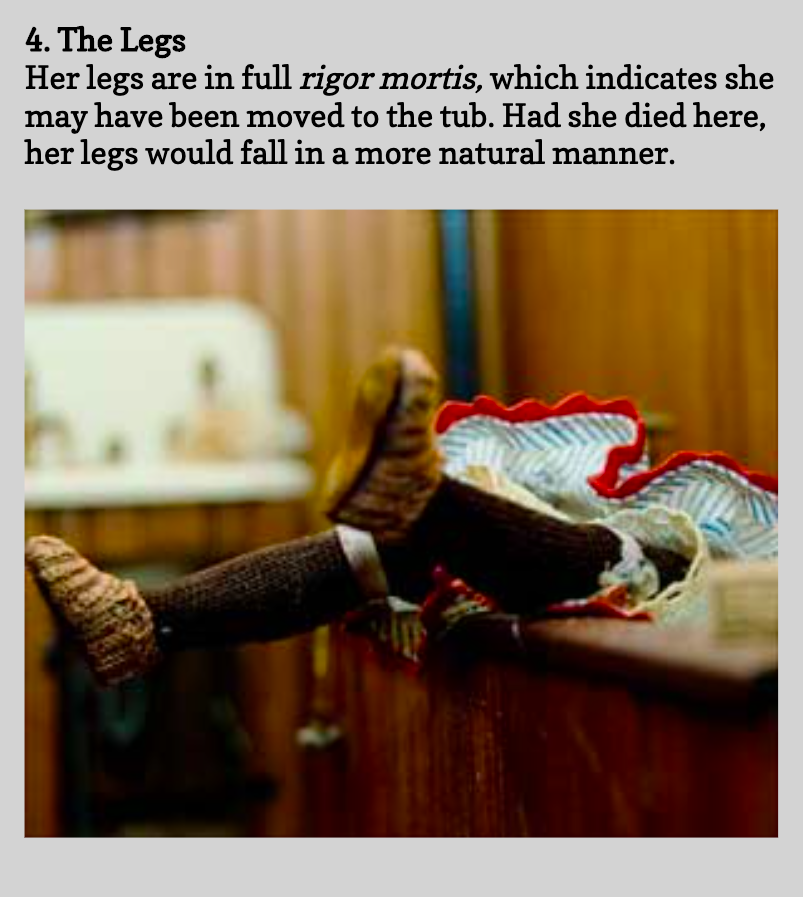
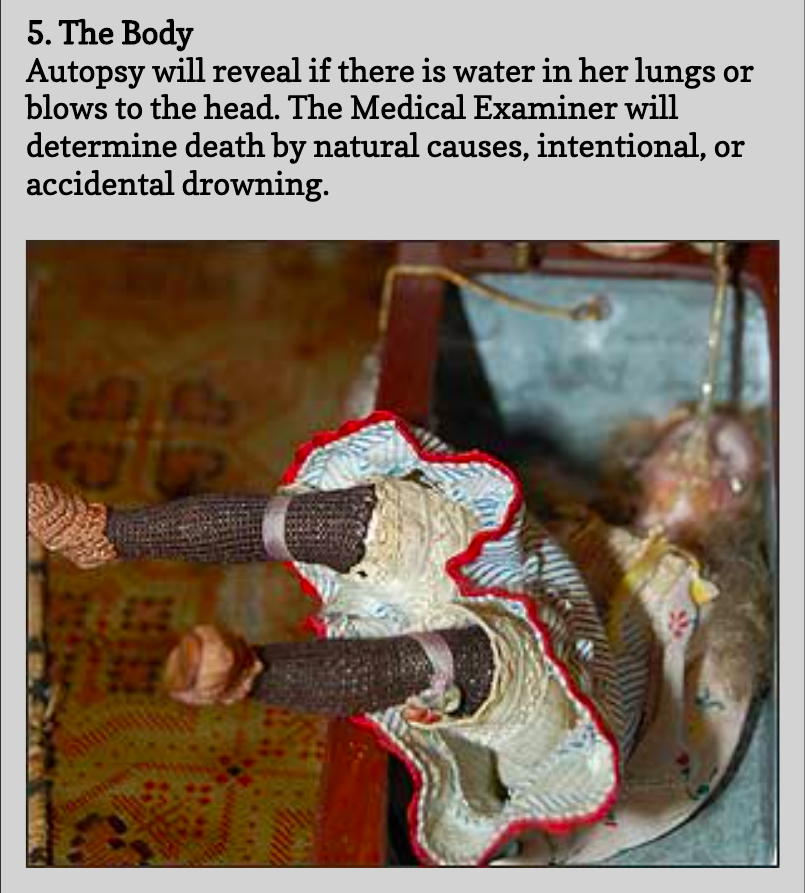
Grim, eh?
Not nearly as grim as what you’ll find in the Parsonage or the Three-Room Dwelling belonging to shoe factory foreman Robert Judson, his wife, Kate, and their baby, Linda Mae.
The period-accurate mini furnishings and fashions may create a false impression that the Mother of Forensic Science’s Nutshell Studies should be relegated to a museum.
In truth, their abundance of detail remains so effective that the Office of the Chief Medical Examiner in Baltimore continues to use 18 of them in training seminars to help homicide investigators “convict the guilty, clear the innocent, and find the truth in a nutshell.”
Explore 5 Nutshell Studies—Woodman’s Shack, Attic, Living Room, Garage, and Parsonage Parlor—in 360º compliments of The Smithsonian American Art Museum Renwick Gallery’s exhibit Murder Is Her Hobby: Frances Glessner Lee and The Nutshell Studies of Unexplained Death.
Related Content:
Lucy Lawless Joins Pretty Much Pop: A Culture Podcast #5 on True Crime
Ayun Halliday is an author, illustrator, theater maker and Chief Primatologist of the East Village Inky zine. Follow her @AyunHalliday.
Read More...The Secret to High Performance and Fulfilment: Psychologist Daniel Goleman Explains the Power of Focus
“Concentration is one of the happiest things in my life,” says novelist Haruki Murakami in a 2011 New York Times Magazine profile. “If you cannot concentrate, you are not so happy.” In this, the author of A Wild Sheep Chase surely has the agreement of the author of Emotional Intelligence, the psychologist and writer Daniel Goleman. But Goleman expresses it a bit differently, as you can hear — in detail and at length — in “Focus: The Secret to High Performance and Fulfillment,” an Intelligence Squared talk based on the book he published eighteen years after the bestselling Emotional Intelligence, Focus: The Hidden Driver of Excellence.
Attention, Goleman tells us, is under siege, not least by devices “devised to interrupt us, to seduce us, to draw our attention from this to that.” He quotes the famed economist, political scientist, and cognitive psychologist Herbert Simon’s observation that “information consumes attention. Hence a wealth of information creates a poverty of attention” — but he doesn’t mention that Simon made it nearly fifty years ago, long before the invention of most of what besieges our attention today. (Then again, even medieval monks complained of constant distraction.) Most of us can feel, on some level, that to the extent we have trouble focusing, we also have trouble performing at the level we’d like to in our professional and social life.
What can we do about it? After offering psychological explanations of what’s going on with our ability to focus (or lack thereof), Goleman suggests strategies we can use to master our “emotional distractors” and work out the “mental muscle” that is our attention. (This analogy with physical exercise would get no argument from Murakami, who runs as rigorously as he writes.) Though “mind-wandering is absolutely essential for creative insight,” as we’ve previously discussed here on Open Culture, the critical skill is to bring our mind back from its wandering at will. This we can practice through Buddhist-style breathing meditation, a subject to which Goleman has since devoted a good deal of research, and just one of the practices that can help us live our lives to the fullest by allowing us to see, hear, consider, and engage with what’s right in front of us.
As Goleman lays out a suite of attention-building techniques and their benefits, he touches on theories and findings from cognitive psychology that have by now been popularized into familiarity: the Stanford “marshmallow test,” for example, which appears to show that children who can delay gratification have better life outcomes than those who cannot. Such outcomes can be ours as well, he argues, if we make a habit of “lengthening the gap between impulse and action” in our own habits. “I’m not a fast thinker, but once I am interested in something, I am doing it for many years,” as Murakami says. “I’m kind of a big kettle. It takes time to get boiled, but then I’m always hot.” As for the rest of us, couldn’t we all stand to become bigger kettles than we are?
Related Content:
How to Focus: Five Talks Reveal the Secrets of Concentration
How Information Overload Robs Us of Our Creativity: What the Scientific Research Shows
How to Take Advantage of Boredom, the Secret Ingredient of Creativity
How Meditation Can Change Your Brain: The Neuroscience of Buddhist Practice
Medieval Monks Complained About Constant Distractions: Learn How They Worked to Overcome Them
Based in Seoul, Colin Marshall writes and broadcasts on cities, language, and culture. His projects include the Substack newsletter Books on Cities, the book The Stateless City: a Walk through 21st-Century Los Angeles and the video series The City in Cinema. Follow him on Twitter at @colinmarshall, on Facebook, or on Instagram.
Read More...How to Speak: Watch the Lecture on Effective Communication That Became an MIT Tradition for Over 40 Years
In his legendary MIT lecture “How to Speak,” professor Patrick Winston opens with a story about seeing Olympic gymnast Mary Lou Retton at a Celebrity Ski Weekend. It was immediately clear to him that he was the better skier, but not because he had more innate athletic ability than an Olympic gold medalist, but because he had more knowledge and practice. These, Winston says, are the key qualities we need to become better communicators. Inherent talent helps, he says, but “notice that the T is very small. What really matters is what you know.”
What some of us know about communicating effectively could fill a greeting card, but it’s hardly our fault, says Winston. Schools that send students into the world without the ability to speak and write well are as criminally liable as officers who send soldiers into battle without weapons. For over 40 years, Winston has been trying to remedy the situation with his “How to Speak” lecture, offered every January,” notes MIT, “usually to overflow crowds.” It became “so popular, in fact, that the annual talk had to be limited to the first 300 participants.”
Now it’s available online, in both video and transcript form, in the talk’s final form from 2018 (it evolved quite a bit over the decades). Professor Winston passed away last year, but his wisdom lives on. Rather than present us with a dry theory of rhetoric and composition, the onetime director of the MIT’s Artificial Intelligence Laboratory offers “a few heuristic rules” distilled from “praxis in communication approaches that incorporate Neurolinguistics, Linguistics, Paleoanthropology, Cognitive Science and Computer Science,” writes Minnie Kasyoka.
Winston’s research on “creating machines with the same thought patterns as humans” led him to the following conclusions about effective speaking and writing—observations that have borne themselves out in the careers of thousands of public speakers, job seekers, and professionals of every kind. Many of his heuristics contradict decades of folk opinion on public speaking, as well as contemporary technological trends. For one thing, he says, avoid opening with a joke.
People still settling into their seats will be too distracted to pay attention and you won’t get the laugh. Instead, open with an analogy or a story, like his Mary Lou Retton gambit, then tell people, directly, what they’re going to get from your talk. Then tell them again. And again. “It’s a good idea to cycle on the subject,” says Winston. “Go around it. Go round it again. Go round it again.” It’s not that we should assume our audience is unintelligent, but rather that “at any given moment, about 20%” of them “will be fogged out no matter what the lecture is.” It’s just how the human mind works, shifting attention all over the place.
Like all great works on effective communication, Winston’s talk illustrates his methods as it explains them: he fills the lecture with memorable images—like “building a fence” around his idea to distinguish it from other similar ideas. He continues to use interesting little stories to make things concrete, like an anecdote about a Serbian nun who was offended by him putting his hands behind his back. This is offered in service of his lengthy defense of the blackboard, contra PowerPoint, as the ultimate visual aid. “Now, you have something to do with your hands.”
The talk is relaxed, humorous, and informative, and not a step-by-step method. As Winston says, you can dip in and out of the copious advice he presents, taking rules you think might work best for your particular style of communication and your communication needs. We should all, he emphasizes, hone our own way of speaking and writing. But, “while he never explicitly stresses the ultimate need for rhetorical devices,” Kasyoka points out, he demonstrates that they are imperative.
Professor Winston masterfully uses persuasive techniques to hammer on this point. For example, the use of anadiplosis, that is the repetition of a clause in a sentence for emphasis, is very manifest in this snippet from his talk: “Your careers will be determined largely by how well you speak, by how well you write, and by the quality of your ideas… in that order.”
How do we learn to use rhetoric as effectively as Winston? We listen to and read effective rhetoric like his. Do so in the video lecture at the top and on the “How to Speak” course page, which has transcripts for download and additional resources for further study.
Related Content:
Literary Theorist Stanley Fish Offers a Free Course on Rhetoric, or the Power of Arguments
The Shape of A Story: Writing Tips from Kurt Vonnegut
Josh Jones is a writer and musician based in Durham, NC. Follow him at @jdmagness
Read More...Watch Cornel West’s Free Online Course on W.E.B. Du Bois, the Great 20th Century Public Intellectual
A giant of 20th century scholarship, W.E.B. Du Bois’ career spanned six decades, two World Wars, and several waves of civil rights and decolonial movements; he saw the twentieth century with more clarity than perhaps anyone of his generation through the lens of “double consciousness”; he wrote presciently about geopolitics, political economy, institutional racism, imperialism, and the culture and history of both black and white Americans; we find in nearly all of his work piercing observations that seem to look directly at our present conditions, while analyzing the conditions of his time with radical rigor.
“An activist and a journalist, a historian and a sociologist, a novelist, a critic, and a philosopher,” notes the Stanford Encyclopedia of Philosophy, Du Bois “examined the race problem in its many aspects more profoundly, extensively, and subtly” than “anyone, at any time.” And there is no one more fluent in the vernaculars, literatures, and philosophies Du Bois mastered than Cornel West, who lays out for us what this means:
Du Bois, like Plato, like Shakespeare, like Toni Morrison, like Thomas Pynchon, like Virginia Woolf…. What do they do? They push you against a wall: heart, mind, soul. Structures and institutions, vicious forms of subordination, but also joyful and heroic forms of critique and resistance.
West begins his course on Du Bois—delivered in the summer of 2017 at Dartmouth—with this description (things get going in the first lecture at 3:15 after the course intro), which gestures toward the comparative, “call and response,” discussion to come. All nine lectures from “The Historical Philosophy of W.E.B. Du Bois” (plus an additional public talk West delivered at the university) are available at Dartmouth’s Department of English and Creative Writing site, as well as this YouTube playlist.
The course follows the movement of Du Bois’ complex historical philosophy and pioneering use of scholarly autobiography—(what West calls the “cultivation” of a “critical self”)—through a number of themes, from “Du Bois and the Catastrophic 20th Century” to, in the final lecture, “Revolution, Race, and American Empire.” It begins with 1903’s The Souls of Black Folk, in which Du Bois first wrote of double consciousness and penned the famous line, “The problem of the twentieth century is the problem of the color-line.”
West puts close readings of that seminal work next to “subsequent essays in [Du Bois’] magisterial corpus, especially his classic autobiography Dusk of Dawn (1940),” the course description reads. The latter text is not only a Bildung, a “spiritual autobiography,” Du Bois called it, but also a critical analysis of science and empire, whiteness, propaganda, world war, revolution, and a conceptualization of race that sees the idea’s arbitrary illogic, in the “continuous change in the proofs and arguments advanced.” These ideas became formative for anti-colonial, anti-imperial, and Pan-African movements.
Du Bois first formed his “radical cosmopolitanism,” as Gunter Lenz writes in The Journal of Transnational American Studies, during his studies in Germany, where he arrived in 1892 and found himself, he wrote, “on the outside of the American world, looking in.” He returned to Germany over the decades and, in a 1936 visit, was one of the few public intellectuals who predicted a “world war on Jews” and “all non-Nordic races.” But Du Bois not only confronted the genocidal wars and helped lead the liberatory movements of the 20th century; he also, with uncanny perspicacity, both anticipated and shaped the struggles of the 21st. Access West’s full lecture course here.
West’s course, “The Historical Philosophy of W.E.B. Du Bois,” will be added to our collection, 1,700 Free Online Courses from Top Universities.
Related Content:
Free Online History Courses
W.E.B. Du Bois Devastates Apologists for Confederate Monuments and Robert E. Lee (1931)
Daniel Dennett and Cornel West Decode the Philosophy of The Matrix
Josh Jones is a writer and musician based in Durham, NC. Follow him at @jdmagness
Read More...How Some of the World’s Most Famous Cheeses Are Made: Camembert, Brie, Gorgonzola & More
Attention cheese lovers!
Do you salivate at the thought of a Cheese Channel?
Careful what you wish for.
Food photographers employ all manner of disgusting tricks to make junky pancakes and fast food burgers look irresistibly mouthwatering.
Food Insiders’ Regional Eats tour of the Italian Gorgonzola-making process inside a venerable, family-owned Italian creamery is the inverse of that.
The finished product is worthy of a still life, but look out!
Despite the deliberately gentle motion of the custom-made machinery into which the milk is poured, getting there is a stomach churning prospect.
Personally, we don’t find the smell of that venerable, veined cheese offensive. The pungent aroma is practically music to our nose, stimulating the cilia at the tips of our sensory cells, alerting our tongue that a rare and favorite flavor is in range.
Nor is it a mold issue.
Marco Invernizzi, managing director of Trecate’s hundred-year-old Caseificio Si Invernizzi, exudes such deep respect for Penicillium roqueforti and the other particulars of Gorgonzola’s pedigree, it would surely be our honor to sample one of the 400 wheels his creamery produces every day.
Just give us a sec for the visuals of that grizzly birth video to fade from our memory.
With the exception of a close up on a faucet gushing milk into a bucket, the peek inside the Camembert-making process is a bit easier to stomach.
There are curds, but they’re contained.
The cheese at Le 5 Frères, a family farm in the village of Bermonville, is made by old fashioned means, ladling micro-organism-rich milk to which rennet has been added into perforated forms, that are topped off a total of five times in an hour.
The steamy temperatures inside the artisanal brie molding room at Seine-et-Marne’s 30 Arpents causes Food Insiders’ camera lens to fog, making for an impressionistic view, swagged in white.
Nearly 20 years ago, Mad Cow disease came close to wiping this operation out.
The current herd of friendly Holsteins were all born on 30 Arpents’ land. Each produces about 30 liters of milk (or slightly more than one daily wheel of brie de Meaux) per day.
Get the scoop on Swiss Emmentaler, Italy’s largest buffalo mozzarella balls, and other world cheese MVPs on Food Insider’s 87-video Cheese Insider playlist.
Related Content:
An Animated History of Cheese: 10,000 Years in Under Six Minutes
How to Break Open a Big Wheel of Parmesan Cheese: A Delightful, 15-Minute Primer
Ayun Halliday is an author, illustrator, theater maker and Chief Primatologist of the East Village Inky zine. Follow her @AyunHalliday.
Read More...Support Us
We're hoping to rely on loyal readers, rather than erratic ads. Please click the Donate button and support Open Culture. You can use Paypal, Venmo, Patreon, even Crypto! We thank you!

About Us

Open Culture scours the web for the best educational media. We find the free courses and audio books you need, the language lessons & educational videos you want, and plenty of enlightenment in between.
Advertise With Us
FREE UPDATES!
GET OUR DAILY EMAIL
Get the best cultural and educational resources on the web curated for you in a daily email. We never spam. Unsubscribe at any time.
FOLLOW ON SOCIAL MEDIA
Open Culture editor Dan Colman scours the web for the best educational media. He finds the free courses and audio books you need, the language lessons & movies you want, and plenty of enlightenment in between.
Advertise With Us

