A Brief History of Talking Heads: How the Band Went from Scrappy CBGB’s Punks to New Wave Superstars
We could split hairs all day. Are Talking Heads punk? Are they New Wave? Are they “art rock”? Why not all of the above. Consider their cred. Two art students, David Byrne and Chris Frantz, move to New York in the late 70 with their three-chord, two-piece band The Artistics. With minimal musical ability and no experience in the music business, they thought, said Byrne, “we’d have a serious try at a band.” Unable to recruit new members in the city, they asked Frantz’s girlfriend, fellow art student Tina Weymouth, who did not play bass, to be their bassist. Soon enough, they’re playing their first show as Talking Heads at CBGB’s in 1975, opening for the Ramones and Television.
What could be more of a prototypically punk origin story? But then there’s the evolution of Talking Heads from jangly, nervous art rockers to confident re-interpreters of funk, disco, and polyrhythmic Afrobeat in their 80s New Wave epics. Their ability to absorb so many influences from outside of punk’s narrow repertoire made them one of the best live bands of the decade, and Frantz and Weymouth one of the most formidable rhythm sections in modern rock. Their experiments with Brian Eno, Adrian Belew, and Robert Fripp lent them a progressive edge that made Remain in Light an unlikely New Wave classic among Phish fans; they made one of the most beloved concert films of all time with Jonathan Demme in 1984….
How did all this come about? You’ll get a very good explanation in “A Brief History of Talking Heads,” above. Suffice to say they were an instant hit, arriving in “the right place at the right time,” a still-astonished Byrne remembers years later in an interview clip. After their first gig, they appeared on the cover of The Village Voice, in a 1975 article by James Wolcott calling punk “a conservative impulse in the New Rock Underground.”
Seeing them for the first time is transfixing: Frantz is so far back on drums that it sounds as if he’s playing in the next room; Weymouth, who could pass as Suzy Quatro’s sorority sister, stands rooted to the floor, her head doing an oscillating-fan swivel; the object of her swivel is David Byrne, who has a little-boy-lost-at-the-zoo voice and the demeanor of someone who’s spent the last half hour whirling around in a spin dryer. When his eyes start Ping-Ponging in his head, he looks like a cartoon of a chipmunk from Mars. The song titles aren’t tethered to conventionality either: “Psycho Killer” (which goes “Psycho Killer, qu’est-ce c’est? Fa-fa-fa-fa-fa-fa-fa-fa-fa”), “The Girls Want to Be With the Girls,” “Love is Like a Building on Fire,” plus a cover version of that schlock classic by ? and the Mysterians, “96 Tears.”
Wolcott would go on to identify all of the qualities that made them “such a central ‘70s band,” including Weymouth’s bass playing providing “hook as well as bottom” and the “banal facade under which run ripples of violence and squalls of frustration.” As for what they should have been called, Byrne is matter of fact, as always. “I don’t think anyone liked being called ‘punk rockers,’” he says, “even though being lumped together and having this kind of handle made it easier for us all to be thought of as a movement.”
It was a movement of bands all deciding to do their own thing in their own way, but to do it together, restoring what Wolcott called the “efficacious beauty” of rock as a “communal activity.” The critic wondered at the time whether “any of the bands who play [CBGB’s] will ever amount to anything more than a cheap evening of rock and roll?” Learn above how one of the “most intriguingly off-the-wall bands in New York” in the mid-70s exceeded the expectations of even the most devoted of early punk connoisseurs.
Related Content:
Talking Heads Live in Rome, 1980: The Concert Film You Haven’t Seen
Watch Phish Play the Entirety of the Talking Heads’ Remain in Light (1996)
Josh Jones is a writer and musician based in Durham, NC. Follow him at @jdmagness
Read More...The Map of Doom: A Data-Driven Visualization of the Biggest Threats to Humanity, Ranked from Likely to Unlikely
Surely you’ve learned, as I have, to filter out the constant threats of doom. It’s impossible to function on high alert all of the time. But one must stay at least minimally informed. To check the news even once a day is to encounter headline after headline announcing DOOM IS COMING! Say that we’re all desensitized, and rather than react, we evaluate: In what way will doom arrive? How bad will the doom be? There are many competing theories of doom. Which one is most likely, and how can we understand them in relation to each other?
For this level of analysis, we might turn to Dominic Walliman, physicist and proprietor of Domain of Science, the YouTube channel and website that has brought us entertaining and comprehensive maps of several scientific fields, such as biology, chemistry, mathematics, computer science, and quantum physics. Is ranking apocalypses a scientific field of study, you might wonder? Yes, when it is a data-driven threat assessment. Walliman surveyed and analyzed, as he says in his introduction, “all of the different threats to humanity that exist.”

When the pandemic hit last winter, “we as a society were completely unprepared for it,” despite the fact that experts had been warning us for decades that exactly such a threat was high on the scale of likelihood. Are we focusing on the wrong kinds of doom, to the exclusion of more pressing threats? Instead of panicking when the coronavirus hit, Walliman cooly wondered what else might be lurking around the corner. “Crikey,” says the New Zealander upon the first reveal of his Map of Doom, “there’s quite a lot aren’t there?”
Not content to just collect disasters (and draw them as if they were all happening at the same time), Walliman also wanted to find out which ones pose the biggest threat, “using some real data.” After the Map of Doom comes the Chart of Doom, an XY grid plotting the likelihood and severity of various crises. These include ancient stalwarts like super volcanoes; far more recent threats like nuclear war and catastrophic climate change; cosmic threats like asteroids and collapsing stars; terrestrial threats like widespread societal collapse and extra-terrestrial threats like hostile aliens….

At the top of the graph, at the limit of “high likelihood,” there lies the “already happening zone,” including, of course, COVID-19, climate change, and volatile extreme weather events like hurricanes and tsunamis. At the bottom, in the “impossible to calculate” zone, we find sci-fi events like rogue AI, rogue black holes, rogue nano-bots, hostile aliens, and the collapse of the vacuum of space. All theoretically possible, but in Walliman’s analysis mostly unlikely to occur. As in all of his maps, he cites his sources on the video’s YouTube page.
If you’re not feeling quite up to a data presentation on mass casualty events just now, you can download the Map and Chart of Doom here and peruse them at your leisure. Pick up a Map of Doom for the wall at Walliman’s site, and while you’re there, why not buy an “I survived 2020” sticker. Maybe it’s premature, and maybe in poor taste. And maybe in times of doom we need someone to face the facts of doom squarely, turn them into cartoon infographics of doom, and claim victories like living through another calendar year.
Related Content:
M.I.T. Computer Program Alarmingly Predicts in 1973 That Civilization Will End by 2040
In 1704, Isaac Newton Predicts the World Will End in 2060
Josh Jones is a writer and musician based in Durham, NC. Follow him at @jdmagness
Read More...Quentin Tarantino’s Copycat Cinema: How the Postmodern Filmmaker Perfected the Art of the Steal
You can call Quentin Tarantino a thief. Call him unoriginal, a copycat, whatever, he doesn’t care. But if you really want to get him going, call him a tribute artist. This, he insists, is the last thing he has ever been: great directors, Tarantino declares, “don’t do homages.” They outright steal, from anyone, anywhere, without regard to intellectual property or hurt feelings.
But great directors don’t plagiarize in the Tarantino school of filmmaking. (Pay attention students, this is important.) They don’t take verbatim from a single source, or even two or three. They steal everything. “I steal from every single movie ever made,” says Tarantino, and if you don’t believe him, you’ll probably have to spend a few years watching his films shot by shot to prove him wrong, if that’s possible.
But, of course, he’s overstating things. He’s never gone the way of blockbuster CGI epics. On the contrary, Tarantino’s last film was an homage (sorry) to an older Hollywood, one on the cusp of great change but still beholden to things like actors, costumes, and sets. Maybe a paraphrase of his claim might read: he steals from every movie ever made worth stealing from, and if you’re Quentin Tarantino, there are a lot of those most people haven’t even heard of.
The Cinema Cartography video essay above, “The Copycat Cinema of Quentin Tarantino,” begins with a reference not to a classic work of cinema, but to a classic album made two years before the time of Once Upon a Time in Hollywood. The cover of the Beatles’ Sgt. Pepper’s Lonely Hearts Club Band is “a signifier of the artist’s status as an icon within a social milieu… this image more than anything explores the social ambiance in which someone lives in pop culture before becoming pop culture themselves.”
To suggest that the Beatles weren’t already pop culture icons in 1967 seems silly, but the visual point stands. On the cover of Sgt. Pepper’s they eclipse even their earlier boy band image and freshly insert themselves into the center of 20th century cultural history up to their present. “Understanding this idea,” says narrator Lewis Michael Bond, “is fundamental to understanding the cinema of Quentin Tarantino.” How so?
“All artists, consciously or unconsciously, take from their influences, “but it’s the degree of self-awareness and internal referencing that would inevitably bring us to the concept of postmodernism.” Tarantino is nothing if not a postmodern artist—rejecting ideas about truth, capital T, authenticity, and the uniqueness of the individual artist. All art is made from other art. There is no original and no originality, only more or less clever and skillful remixes and restatements of what has come before.
Tarantino, of course, knows that even his postmodern approach to cinema isn’t original. He stole it from Godard, and named his first production company A Band Apart, after Godard’s 1964 New Wave film Band of Outsiders, which is, Pauline Kael wrote, “like a reverie of a gangster movie as students in an espresso bar might remember it or plan it.” Tarantino’s films, especially his early films, are genre exercises made the way an adrenaline-fueled video store clerk would make them—stuffing in everything on the shelves in artful pastiches that revel in their dense allusions and in-jokes.
In this school of filmmaking, the question of whether or not a filmmaker is “original” has little meaning. Are they good at ripping off the past or not? When it comes to exquisite, bloody mash ups of exploitation flicks and the revered high classics of cinema, no one is better than Tarantino.
Related Content:
Quentin Tarantino Picks the 12 Best Films of All Time; Watch Two of His Favorites Free Online
An Analysis of Quentin Tarantino’s Films Narrated (Mostly) by Quentin Tarantino
Quentin Tarantino Explains How to Write & Direct Movies
Josh Jones is a writer and musician based in Durham, NC. Follow him at @jdmagness
Read More...The Uncanny Children’s Book Illustrations of Sigmund’s Freud’s Niece, Tom Seidmann-Freud
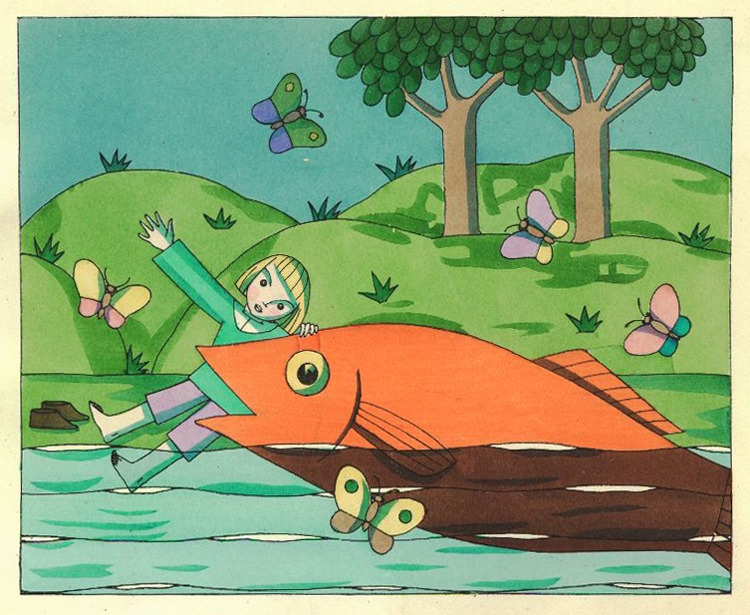
In 1919, Sigmund Freud published “The ‘Uncanny,’” his rare attempt as a psychoanalyst “to investigate the subject of aesthetics.” The essay arrived in the midst of a modernist revolution Freud himself unwittingly inspired in the work of Surrealists like Salvador Dali, Andre Breton, and many others. He also had an influence on another artist of the period: his niece Martha-Gertrud Freud, who started going by the name “Tom” after the age of 15, and who became known as children’s book author and illustrator Tom Seidmann-Freud after she married Jakob Seidmann and the two established their own publishing house in 1921.
Seidmann-Freud’s work cannot help but remind students of her uncle’s work of the unheimlich—that which is both frightening and familiar at once. Uncanniness is a feeling of traumatic dislocation: something is where it does not belong and yet it seems to have always been there. Perhaps it’s no coincidence that the Seidmann-Freud’s named their publishing company Peregrin, which comes from “the Latin, Peregrinos,” notes an exhibition catalogue, “meaning ‘foreigner,’ or ‘from abroad’—a title used during the Roman Empire to identify individuals who were not Roman citizens.”
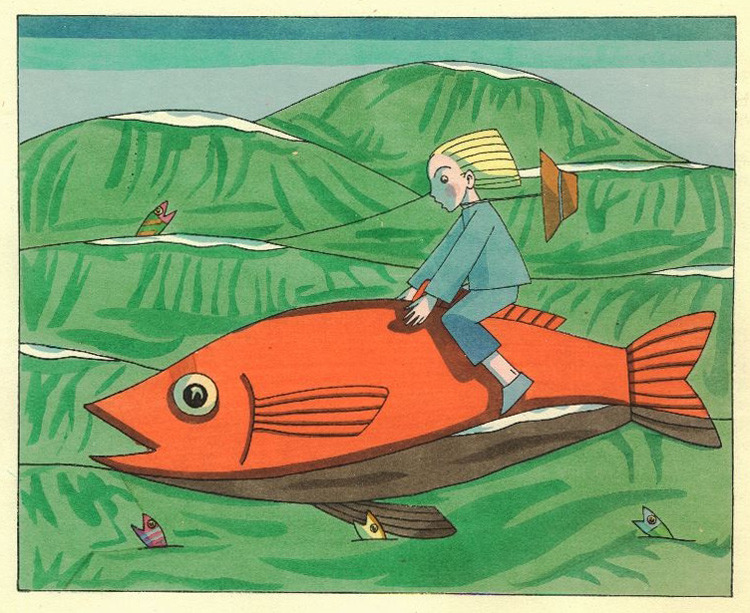
Uncanny dislocation was a theme explored by many an artist—many of them Jewish—who would later be labeled “decadent” by the Nazis and killed or forced into exile. Seidmann-Freud herself had migrated often in her young life, from Vienna to London, where she studied art, then to Munich to finish her studies, and finally to Berlin with her husband. She became familiar with the Jewish philosopher and mystic Gershom Scholem, who interested her in illustrating a Hebrew alphabet book. The project fell through, but she continued to write and publish her own children’s books in Hebrew.
In Berlin, the couple established themselves in the Charlottenburg neighborhood, the center of the Hebrew publishing industry. Seidmann-Freud’s books were part of a larger effort to establish a specifically Jewish modernism. Tom “was a typical example of the busy dawn of the 1920s,” Christine Brinck writes at Der Tagesspiegel. Scholem called the chain-smoking artist an “authentic Bohèmienne” and an “illustrator… bordering on genius.” Her work shows evidence of a “close familiarity with the world of dreams and the subconscious,” writes Hadar Ben-Yehuda, and a fascination with the fear and wonder of childhood.
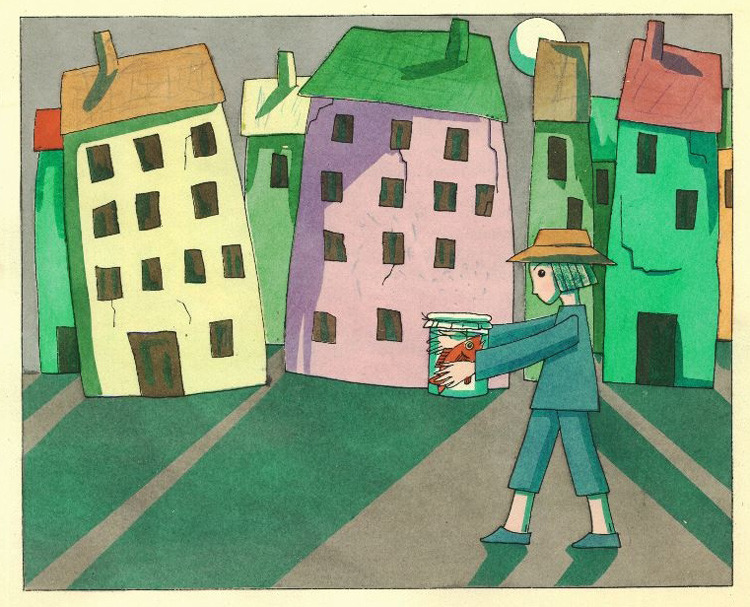
In her 1923 The Fish’s Journey, Seidmann-Freud draws on a personal trauma, “the first real tragedy to have struck her young life when her beloved brother Theodor died by drowning.” Other works illustrate texts—chosen by Jakob and the couple’s business partner, poet Hayim Nahman Bialik—by Hans Christian Andersen and the Brothers Grimm, “with drawings adapted to the landscapes of a Mediterranean community,” “a Jewish, socialist notion… added to the texts,” “and the difference between boys and girls made indecipherable,” the Seidmann-Freud exhibition catalogue points out.
These books were part of a larger mission to “introduce Hebrew-speaking children to world literature, as part of establishing a modern Hebrew society in Palestine.” Tragically, the publishing venture failed, and Jakob hung himself, the event that precipitated Tom’s own tragic end, as Ben-Yehuda tells it:
The delicate, sensitive illustrator never recovered from her husband’s death. She fell into depression and stopped eating. She was hospitalized, but no one from her family and friends, not even her uncle Sigmund Freud who came to visit and to care for her was able to lift her spirits. After a few months, she died of anorexia at the age of thirty-eight.
Seidmann-Freud passed away in 1930, “the same year that the liberal democracy in Germany, the Weimar Republic, started it frenzied downward descent,” a biography written by her family points out. Her work was burned by the Nazis, but copies of her books survived in the hands of the couple’s only daughter, Angela, who changed her name to Aviva and “emigrated to Israel just before the outbreak of World War II.”
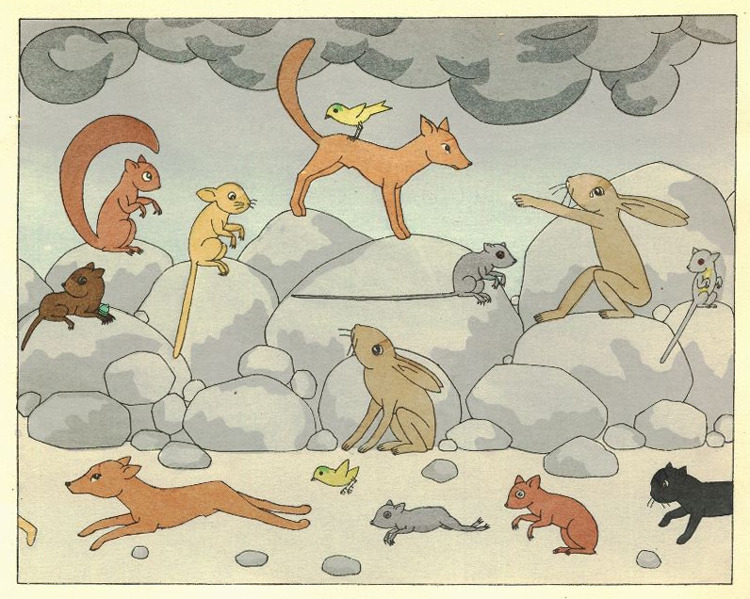
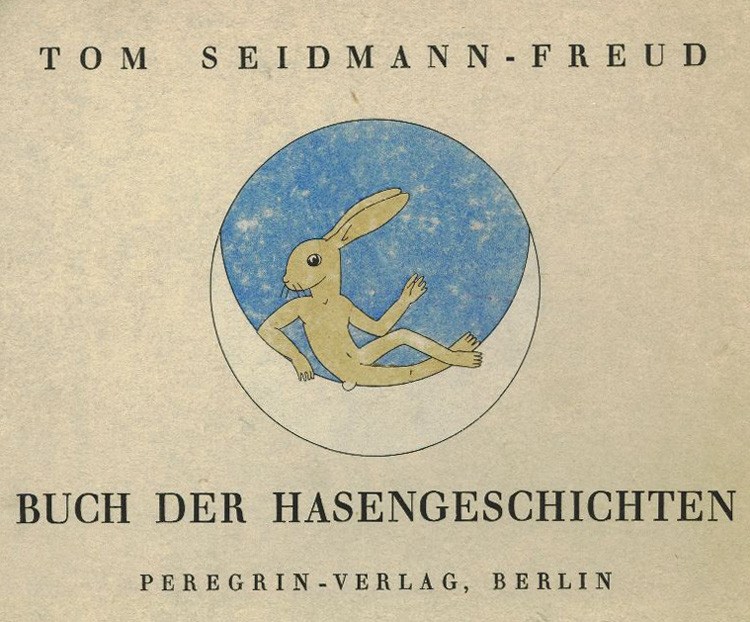
The “whimsically apocalyptic” illustrations in books like Buch Der Hasengeschichten, or The Book of Rabbit Stories from 1924, may seem more ominous in hindsight. But we can also say that Tom, like her uncle and like so many contemporary avant-garde artists, drew from a general sense of uncanniness that permeated the 1920s and often seemed to anticipate more full-blown horror. See more Seidmann-Freud illustrations at 50 Watts, the Freud Museum London, KulturPort, and at her family-maintained site, where you can also purchase prints of her many weird and wonderful scenes.
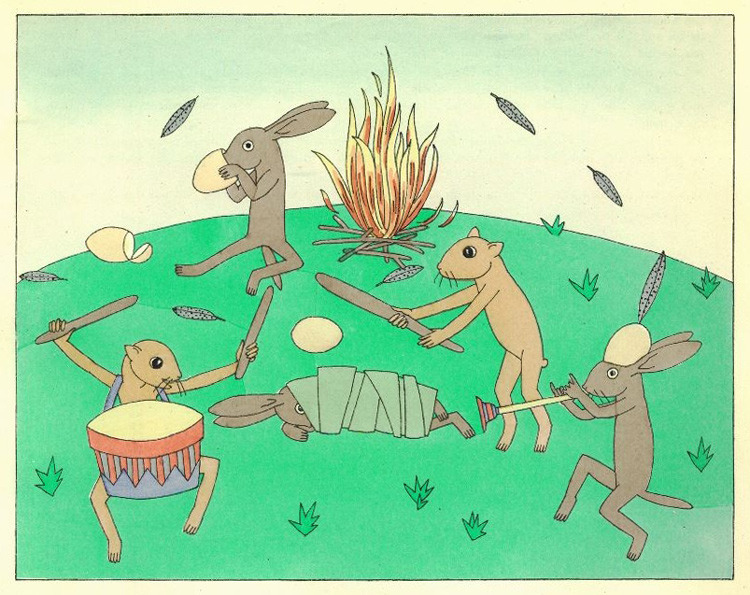
via 50 Watts
Related Content:
Sigmund Freud Speaks: Hear the Only Known Recording of His Voice, 1938
Enter an Archive of 6,000 Historical Children’s Books, All Digitized and Free to Read Online
Josh Jones is a writer and musician based in Durham, NC. Follow him at @jdmagness
Read More...Hear Legendary BBC Composer Delia Derbyshire’s Electronic Version of Bach’s “Air on a G String”
When the warm, warbly, slightly-out-of-tune sounds of the early Moog synthesizer met the delicate figures of Bach’s concertos, suites, preludes, fugues, and airs in Wendy Carlos’ 1968 Switched-on Bach, the result reinvigorated popular interest in classical music and helped launch the careers of seventies Moog synthesists like composer of instrumental hit “Popcorn,” Gershon Kingsley; occultist and composer of TV themes and jingles, Mort Garson; and pioneering disco producer Giorgio Moroder. These were not the kind of musicians, nor the kind of music, of which Carlos approved. She was mortified to have her album marketed as a novelty record or, later, as instrumental pop.
The reclusive Carlos’ interpretations of Beethoven and moody originals defined the sound of Stanley Kubrick’s A Clockwork Orange and The Shining. This soundtrack work may be one of the few things Carlos has in common with legendary BBC Radiophonic Workshop composer and creator of the eerie Doctor Who theme, Delia Derbyshire. But where Carlos’ film scores evoke an ominous, otherworldly grandeur, Derbyshire’s soundtracks, made for radio and television, use more primitive electronic techniques to conjure weirder, and in some ways creepier, atmospheres.
The 1971 compilation album BBC Radiophonic Music, for example, contains music from three of the Workshop’s most prominent composers—Derbyshire, John Baker, and David Cain—and features one of her most famous themes, “Ziwzih Ziwzih Oo-Oo-Oo,” which critic Robin Carmody described as “her most terrifying moment, tumbling into a nightmare, the sound of childhood at its most chilling.” The work she did for the Radiophonic Workshop was not intended to be particularly musical at all. Workshop employees were instead expected to be technicians of sound, employing new audio technologies for purely dramatic effect.
“The only way into the workshop was to be a trainee studio manager,” Derbyshire remarked in a 2000 interview. “This is because the workshop was purely a service department for drama. The BBC made it quite clear that they didn’t employ composers and we weren’t supposed to be doing music.” Nonetheless, she applied her tape loops, oscillators, and other musique concrete techniques to at least one classical piece, Bach’s “Air on a G String.” The resulting interpretation sounds entirely different from Carlos’ electric Bach. It is, Carmody writes, “an ice-cold nocturnal rewrite… the stuff of a seven-year-old child’s most unforgettable nightmares.” The piece does not seem to have been made for a BBC production. Derbyshire herself dismissed the recording as “rubbish,” though she admitted “it has a fair number of admirers.”
Soon after its release, in a 1:44 snippet on the compilation album, Derbyshire left the Workshop to pursue her own musical direction. She composed music for the stage and screen, then became disillusioned with the music industry altogether. The availability of the analog synthesizers popularized by Carlos’ record had rendered her way of making music obsolete. But as the many recent tributes to Derbyshire’s legacy testify, her work has been as influential as that of the early analog synth composers, on everyone from the Beatles to contemporary experimental artists. Derbyshire’s playful weirdness has been oft-imitated over the decades, but no one has ever interpreted Bach quite like this before or since.
Related Content:
Two Documentaries Introduce Delia Derbyshire, the Pioneer in Electronic Music
The Fascinating Story of How Delia Derbyshire Created the Original Doctor Who Theme
Josh Jones is a writer and musician based in Durham, NC. Follow him at @jdmagness
Read More...Discover the Cyanometer, the Device Invented in 1789 Just to Measure the Blueness of the Sky
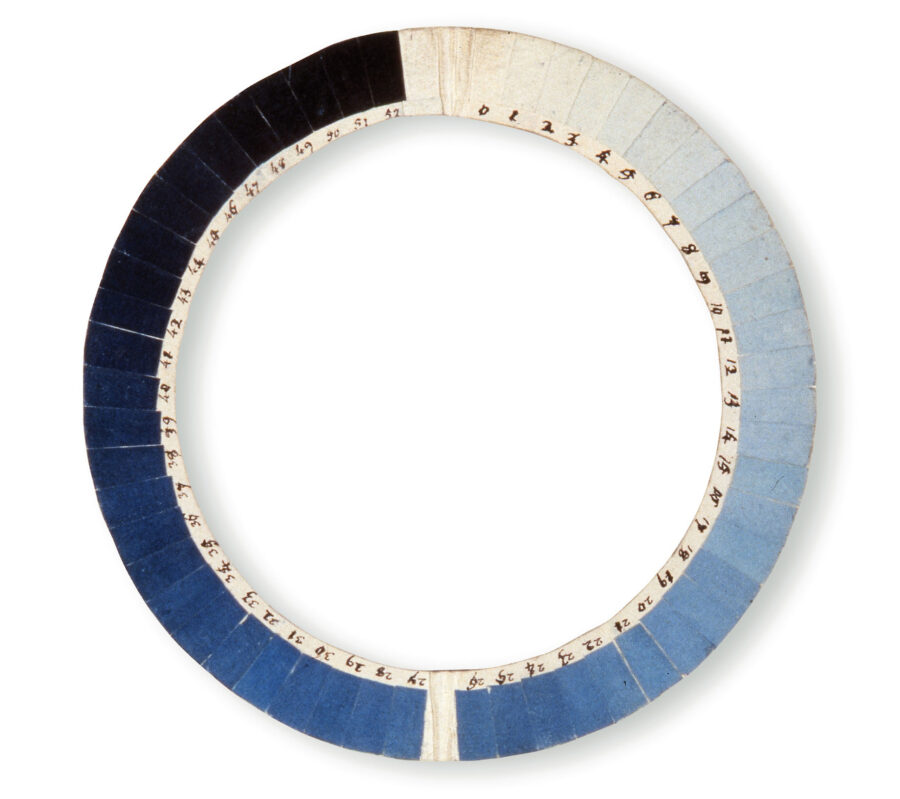
English astronomer and physicist James Jeans’ 1931 essay “Why the Sky is Blue” has become a classic of concise expository writing since it was first published in a series of talks. In only four paragraphs and one strikingly detailed, yet simple analogy, Jeans gave millions of students a grasp of celestial blueness in prose that does not substitute nature’s poetry for scientific jargon and diagrams.
Over a hundred years earlier, another scientist created a similarly poetic device; in this case, one which attempted to depict how the sky is blue. Swiss physicist Horace Bénédict de Saussure’s 1789 Cyanometer, “a circle of paper swatches dyed in increasingly deep blues, shading from white to black,” Sarah Laskow writes at Atlas Obscura, “included 52 blues… in its most advanced iteration,” intended to show “how the color of the sky changed with elevation.”
Saussure’s fascination with the blueness of the sky began when he was a young student and traveled to the base of Mont Blanc. Overawed by the summit, he dreamt of climbing it, but instead used his family’s wealth to offer a reward to the first person who could. Twenty-seven years later, Saussure himself would ascend to the top, in 1786, carrying with him “pieces of paper colored different shades of blue, to hold up against the sky and match its color.”
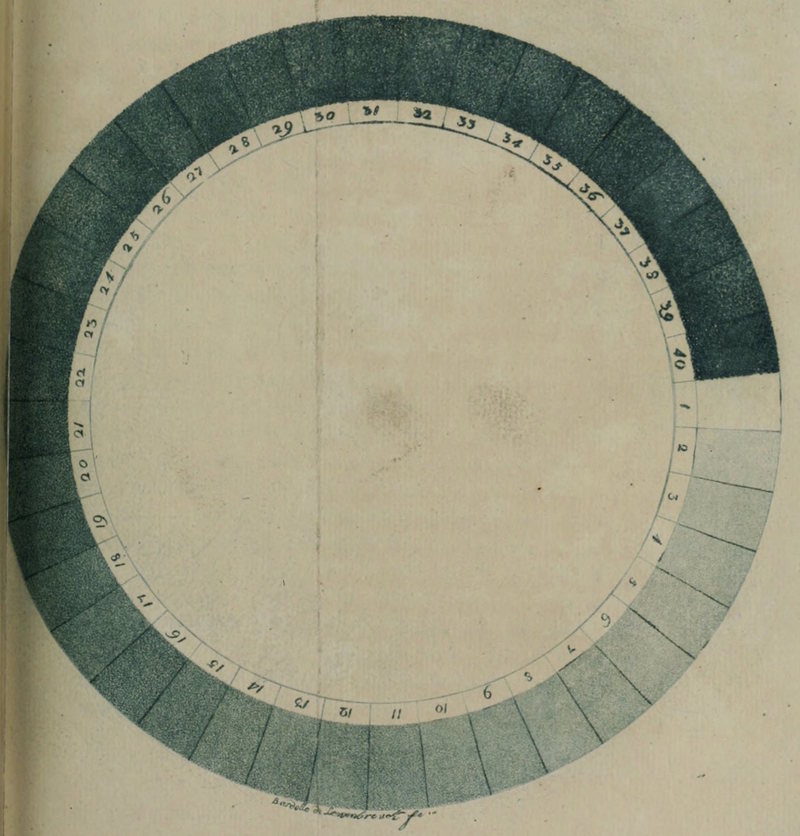
Saussure was taken with a phenomenon reported by mountaineers: as one climbs higher, the sky turns a deeper shade of blue. He began to formulate a hypothesis, the Royal Society of Chemistry Explains:
Armed with his tools and a small chemistry set, he trekked round the valleys and beyond. As his trips carried him ever higher, he puzzled about the colour of the sky. Local legend had it that if one climbed high enough it turned black and one would see, or even fall into, the void — such terrors kept ordinary men away from the peaks. But to Saussure, the blue colour was an optical effect. And because on some days the blue of the sky faded imperceptibly into the white of the clouds, Saussure concluded that the colour must indicate its moisture content.
At the top of Mont Blanc, the physicist measured what he deemed “a blue of the 39th degree.” The number meant little to anyone but him. “Upon its invention, the cyanometer rather quickly fell into disuse,” as Maria Gonzalez de Leon points out. “After all, very little scientific information was given.”
The tool did, however, accompany the famed geographer Alexander von Humboldt across the Atlantic, “to the Caribbean, the Canary Islands, and South America,” writes Laskow, where Humboldt “set a new record, at the 46th degree of blue, for the darkest sky ever measured” on the summit of the Andean mountain Chimborazo. This would be one of the only notable uses of the poetic device. “When the true cause of the sky’s blueness, the scattering of light, was discovered decades later, in the 1860s, Saussure’s circle of blue had already fallen into obscurity.”
via MessyNessy/Colossal
Related Content:
A 900-Page Pre-Pantone Guide to Color from 1692: A Complete Digital Scan
The Vibrant Color Wheels Designed by Goethe, Newton & Other Theorists of Color (1665–1810)
Josh Jones is a writer and musician based in Durham, NC. Follow him at @jdmagness
Read More...Pop Songs with Narrative: Pretty Much Pop (#69) Discusses Tunes Ranging from Bob Dylan’s “Hurricane” to “The Pina Colada Song” with Songwriter/Author Rod Picott
Plenty of songs purport to tell stories, and the narrative ballad of course has a long enough history that the two forms certainly aren’t alien. But how do our listening practices conditioned by pop music jibe with recognizing and understanding narrative?
Singer/songwriter and short story author Rod Picott joins your hosts Mark Linsenmayer, Erica Spyres, and Brian Hirt to talk about classics by writers like Bob Dylan and Johnny Cash, formative nightmares like “Leader of the Pack” and “Escape (The Pina Colada Song), borderline cases like “Bohemian Rhapsody,” and more. We also consider how this form relates to musical theater, music videos, soundtracks, and commercials.
We tried to stick to popular songs, but most of us are pretty old. You can listen and read the lyrics if you’re not following:
- “Mack the Knife” by Bobby Darin
- “The Long Black Veil” by Johnny Cash
- “Coward of the Country” by Kenny Rogers
- “Leader of the Pack” by The Shangri-Las
- “Bohemian Rhapsody” by Queen
- “Hurricane” by Bob Dylan
- “Scenes from an Italian Restaurant” by Billy Joel
- “Escape (The Pina Colada Song)” by Rupert Holmes (Watch him on Burt Sugarman’s Midnight Special. Yes, there was a Taco Bell commercial that used this song.)
- “Paradise by the Dashboard Light” by Meat Loaf (written by Jim Steinman). Read Tim Quirk’s extensive analysis of this disturbing song.
- “Famous Blue Raincoat” by Leonard Cohen
- “Jack and Diane” by John Cougar Mellencamp
- “Glory Days” by Bruce Springsteen
- “Fortunate Son” by Creedence Clearwater Revival
- “Tiger Tom Dixon’s Blues” by Rod Picott
Why these songs? Well, we found a few lists online:
- “Inventory: 26 Songs That are Just as Good as Short Stories” from the AV Club
- “15 Songs That Tell Better Stories Than Your Favorite Novel” by Josue Brocca
- “168 Favorite Pop, Rock, and Country Songs That Tell a Story” from FlourishAnyway
Hear Mark interview Rod on Nakedly Examined Music. Learn more at rodpicott.com.
Hear more of this podcast at prettymuchpop.com. This episode includes bonus discussion you can access by supporting the podcast at patreon.com/prettymuchpop. This time, an update on Rod’s music plus political discussion and more.
This podcast is part of the Partially Examined Life podcast network.
Pretty Much Pop: A Culture Podcast is the first podcast curated by Open Culture. Browse all Pretty Much Pop posts.
Read More...Rubens’ Cupid Escapes His Painting & Flies Around Brussels Airport, Thanks to Projection Mapping Technology
Peter Paul Rubens’ zaftig beauties and plump little angels burst with health. His “powerful and exuberant style,” notes one analysis of his technique, “came to characterize the Baroque art of northern Europe.” Rubens’ name became synonymous with figures who were “realistic, fleshy and indeed corpulent… set in dynamic compositions that echo the grand organizations of the Renaissance masters.”
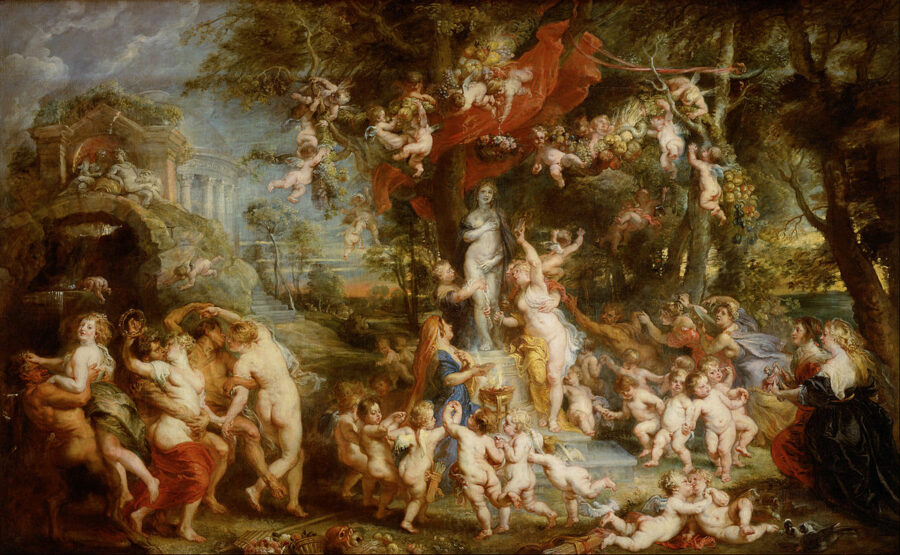
An excellent example of such a composition is The Feast of Venus (1636), painted in the “ecstatic intensity” of Rubens’ own style, writes the Kunsthistorisches Museum Wien, after a “description in antiquity of a Greek painting in which a cult image of Aphrodite is decorated by nymphs, with winged cupids dancing around it.” Venus may be at the center of the huge piece, but the cupids’ roly-poly arms and legs upstage her.
Rubens’ cupids already look like they’re going to pop off the canvas. In the video at the top, one of them does—breaks right through the frame, scampers across the top and takes flight around the gallery over the heads of awed onlookers. Cupid retrieves a bow and arrows and begins firing love darts around the room. The scene is Brussels Airport, where a selection of Rubens’ paintings recently hung in an art-themed lounge.
The spectators are passengers waiting for their flights, and the escaped cupid is a trick of projection mapping, created by the Belgian company SkullMapping and commissioned by the tourist agency VisitFlanders. The cupid flew until April of last year, when the paintings were replaced by work from Brueghel as part of a larger project to promote Flemish art and culture in places where people are most likely to encounter it.
Would such small-scale projection maps, “mini-mapping,” as it’s called, ever be employed in an actual gallery, to the work of revered old masters? Might this be something of an art world heresy? Or might we see in the near future huge, detailed canvases of painters like Rubens and his role model, Titian, suddenly burst into three dimensions, their subjects given life, of some kind, and invited to walk or fly around the halls?
Do these gimmicks trivialize great art or renew appreciation for it? I’d wager that, if he were alive, Rubens might thrill to see his well-fed cupids and angels in motion, and he might just take to building projection maps himself. We have some small idea, at least, of what they might look like, above.
Related Content:
Batman & Other Super Friends Sit for 17th Century Flemish Style Portraits
Artist Nina Katchadourian Creates Flemish Style Self-Portraits in Airplane Lavatory
Josh Jones is a writer and musician based in Durham, NC. Follow him at @jdmagness
Read More...Eno: A 1973 Mini-Doc Shows Brian Eno at the Beginning of His Solo Career

Image via Wikimedia Commons
We’ve seen bits and pieces of the 1973 mini-doc Eno over the years, as it is such a rare and wonderful glimpse into the very beginnings of Brian Eno’s career, and being the go-to footage for any doc about the man. Over the course of the film, we see Eno assembling/recording “The Paw-Paw Negro Blowtorch”, the second track on his debut album Here Come the Warm Jets. Right from the beginning, we see that Eno was true to his word and using the recording studio as an instrument. With Derek Chandler by his side engineering, we see Eno layering one sound after another, removing others, much like a painter. If you know the track, you notice it take form and shape, but there are things that would later be “painted over,” like a sitar solo (!) where the wigged out oscillator solo now sits. The film opens with Eno playing an arpeggiated bass line on a piano that also doesn’t make it into the song. (The bass instead is supplied by Busta Jones, seen playing a two note riff with a lot of feeling.) Chris Spedding stops by to play “something purely Duane Eddy” on his guitar, asking Eno “you’ll treat it later?” “Probably,” says Eno. (More like definitely).
“I have attempted to replace the element of skill considered necessary in music with the element of judgement,” Eno says early in the film, and a listen to the finished track reveals that judgement. And what do you know–the sitar *is* there, as are the piano lines, like a space in the canvas where the original sketch can be seen.
We also get an amazing, extended glimpse at Eno’s notebooks, which have popped up in various books on Eno, including More Dark Than Shark and Visual Music. From the profane to the profound, from drawings of genitals to detailed analog system diagrams, it’s all here, and as far as we know the notebooks, which he started at 14, continue to this day.
The film also makes the case for a later Eno theory, that of the “scenius,” which he once described thus: “‘Scenius stands for the intelligence and the intuition of a whole cultural scene. It is the communal form of the concept of the genius.’”
For Eno in 1973, the scenius is the Portobello Road area where he can browse thrift stores, run into friends, and check in on designer/girlfriend Carol McNicoll, who made all Eno’s glam outfits. And he also talks about how Robert Fripp just stopped by on his way home one night and recorded side one of their team-up album No Pussyfooting.
All in all a terrific look into the beginning of an artistic legacy, and a film that desperately needs a pristine new transfer. (And no, you will never convince me that the Portsmouth Sinfonia is any good.)
Related Content:
Brian Eno Reveals His Favorite Film Soundtracks
Brian Eno Explains the Loss of Humanity in Modern Music
Ted Mills is a freelance writer on the arts who currently hosts the Notes from the Shed podcast and is the producer of KCRW’s Curious Coast. You can also follow him on Twitter at @tedmills, and/or watch his films here.
Read More...How the Beach Boys Created Their Pop Masterpieces: “Good Vibrations,” Pet Sounds, and More
If you ever decide to listen through the Beach Boys’ entire studio discography, one album per week, it will take about six months. I know because I just finished doing it myself, beginning with their simple celebration/exploitation of early-60s youth beach-and-car culture Surfin’ Safari and ending, six months yet half a century later, with the lushly elegiac That’s Why God Made the Radio. Between those points, of course, came the songs everyone knows, the hits that made the Beach Boys “America’s Band.” But as many times as we happen to have heard them, how well do we really know, say, “Good Vibrations” or “God Only Knows” — let alone the definitive artistic statement of an album that is Pet Sounds?
We can get to know them better through the work of the music-oriented video essayists of Youtube, who in recent years have turned their attention to the Beach Boys catalog. Not that true pop-music obsessives ever really turned away from it: surely, at some point in your life, you’ve met the kind of exegete intent on convincing you of the artistic glories of the miniature symphonies to teenage longing composed by the band’s mastermind Brian Wilson. But today they can incorporate visuals into their argument, as well as passages from and elements of the music itself, to more clearly reveal the formidable inspiration and craftsmanship that went into these ostensibly straightforward odes to love and good times.
Whether in 1966 or today, even an inattentive listener can sense the scale of ambition present in a song like “Good Vibrations.” As noted in Polyphonic’s analysis, its production cost between $50,000 and $75,000 ($370,000-$550,000 today), making it the most expensive single recording to date. But in its three minutes and 39 seconds, “Brian Wilson managed to put together a song dense enough that you could teach an entire course on it, all while maintaining a devotion to radio-friendly, ear-catching hooks.” The motivation to do this, so the legend has it, came from the Beatles, who earlier that year had redefined the very form of the album with Revolver — a response in part to Pet Sounds, itself fired by the earlier innovations of the Beatles’ Rubber Soul.
This friendly (if high-stakes) competition constitutes the background of the normally Beatles-oriented channel The HollyHobs’ video essay on “God Only Knows,” a song so glorious that even Paul McCartney names it among the best of all time. And it counts as but one of the highlights on Pet Sounds, an overview of which you can hear in this Pitchfork “Liner Notes” video. That video emphasizes Wilson’s central role in the production, something that would be difficult to over-emphasize: when former Beatles publicist Derek Taylor signed on with with Beach Boys, he based his whole campaign on the claim that “Brian Wilson is a genius.”
What makes that true is the subject of the video above by music-and-film Youtuber Jeffrey Stillwell (He’s also created another video looking at the “lost years,” when a psychologically struggling Wilson began to withdraw from the band, but kept on making music.) Only those who listen to the the entire Beach Boys discography can fully appreciate what Wilson brought to the band, and perhaps more importantly, how his work was enriched by the contributions of the other members. These include, among others, the original core of Wilson’s brothers Carl and Dennis, Al Jardine, and even the oft-vilified yet ultimately indispensable Mike Love — not that “Kokomo” is going to inspire a video essay any time soon.
Related Content:
John Belushi and Dan Aykroyd Get Brian Wilson Out of Bed and Force Him to Go Surfing, 1976
The Story of “Wipe Out,” the Classic Surf Rock Instrumental
How “Strawberry Fields Forever” Contains “the Craziest Edit” in Beatles History
Based in Seoul, Colin Marshall writes and broadcasts on cities, language, and culture. His projects include the Substack newsletter Books on Cities, the book The Stateless City: a Walk through 21st-Century Los Angeles and the video series The City in Cinema. Follow him on Twitter at @colinmarshall, on Facebook, or on Instagram.
Read More...Support Us
We're hoping to rely on loyal readers, rather than erratic ads. Please click the Donate button and support Open Culture. You can use Paypal, Venmo, Patreon, even Crypto! We thank you!

About Us

Open Culture scours the web for the best educational media. We find the free courses and audio books you need, the language lessons & educational videos you want, and plenty of enlightenment in between.
Advertise With Us
FREE UPDATES!
GET OUR DAILY EMAIL
Get the best cultural and educational resources on the web curated for you in a daily email. We never spam. Unsubscribe at any time.
FOLLOW ON SOCIAL MEDIA
Open Culture editor Dan Colman scours the web for the best educational media. He finds the free courses and audio books you need, the language lessons & movies you want, and plenty of enlightenment in between.
Advertise With Us


