20 Lessons from the 20th Century About How to Defend Democracy from Authoritarianism: A Timely List from Yale Historian Timothy Snyder
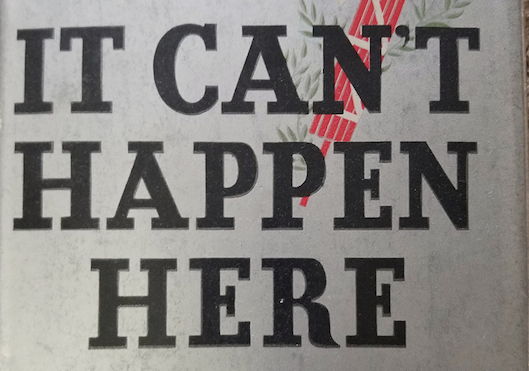
Image by Rob Kall, via Flickr Commons
Timothy Snyder, Housum Professor of History at Yale University, is one of the foremost scholars in the U.S. and Europe on the rise and fall of totalitarianism during the 1930s and 40s. Among his long list of appointments and publications, he has won multiple awards for his recent international bestsellers Bloodlands: Europe between Hitler and Stalin and last year’s Black Earth: The Holocaust as History and Warning. That book in part makes the argument that Nazism wasn’t only a German nationalist movement but had global colonialist origins—in Russia, Africa, and in the U.S., the nation that pioneered so many methods of human extermination, racist dehumanization, and ideologically-justified land grabs.
The hyper-capitalism portrayed in the U.S.—even during the Depression—Snyder writes, fueled Hitler’s imagination, such that he promised Germans “a life comparable to that of the American people,” whose “racially pure and uncorrupted” German population he described as “world class.” Snyder describes Hitler’s ideology as a myth of racialist struggle in which “there are really no values in the world except for the stark reality that we are born in order to take things from other people.” Or as we often hear these days, that acting in accordance with this principle is the “smart” thing to do. Like many far right figures before and after, Hitler aimed to restore a state of nature that for him was a perpetual state of race war for imperial dominance.
After the November 2016 election, Snyder wrote a profile of Hitler, a short piece that made no direct comparisons to any contemporary figure. But reading the facts of the historical case alarmed most readers. A few days later, the historian appeared on a Slate podcast to discuss the article, saying that after he submitted it, “I realized there was more.… there are an awful lot of echoes.” Snyder admits that history doesn’t actually repeat itself. But we’re far too quick, he says, to dismiss that idea as a cliché “and not think about history at all. History shows a range of possibilities.” Similar events occur across time under similar kinds of conditions. And it is, of course, possible to learn from the past.
If you’ve heard other informed analysis but haven’t read Snyder’s New York Review of Books columns on fascism in Putin’s Russia or the former Yanukovich’s Ukraine, or his long article “Hitler’s World May Not Be So Far Away,” you may have seen his widely-shared Facebook post making the rounds. As he argued in The Guardian last September, today we may be “too certain we are ethically superior to the Europeans of the 1940s.” On November, 15, 2016 Snyder wrote on Facebook that “Americans are no wiser than the Europeans who saw democracy yield to fascism, Nazism, or communism.” Snyder has been criticized for conflating these regimes, and rising “into the top rungs of punditdom,” but when it comes to body counts and levels of suppressive malignancy, it’s hard to argue that Stalinist Russia, any more than Tsarist Russia, was anyone’s idea of a democracy.
Rather than making a historical case for viewing the U.S. as exactly like one of the totalitarian regimes of WWII Europe, Snyder presents 20 lessons we might learn from those times and use creatively in our own where they apply. In my view, following his suggestions would make us wiser, more self-aware, proactive, responsible citizens, whatever lies ahead. Read Snyder’s lessons from his Facebook post below and consider ordering his latest book On Tyranny: Twenty Lessons from the Twentieth Century:
1. Do not obey in advance. Much of the power of authoritarianism is freely given. In times like these, individuals think ahead about what a more repressive government will want, and then start to do it without being asked. You’ve already done this, haven’t you? Stop. Anticipatory obedience teaches authorities what is possible and accelerates unfreedom.
2. Defend an institution. Follow the courts or the media, or a court or a newspaper. Do not speak of “our institutions” unless you are making them yours by acting on their behalf. Institutions don’t protect themselves. They go down like dominoes unless each is defended from the beginning.
3. Recall professional ethics. When the leaders of state set a negative example, professional commitments to just practice become much more important. It is hard to break a rule-of-law state without lawyers, and it is hard to have show trials without judges.
4. When listening to politicians, distinguish certain words. Look out for the expansive use of “terrorism” and “extremism.” Be alive to the fatal notions of “exception” and “emergency.” Be angry about the treacherous use of patriotic vocabulary.
5. Be calm when the unthinkable arrives. When the terrorist attack comes, remember that all authoritarians at all times either await or plan such events in order to consolidate power. Think of the Reichstag fire. The sudden disaster that requires the end of the balance of power, the end of opposition parties, and so on, is the oldest trick in the Hitlerian book. Don’t fall for it.
6. Be kind to our language. Avoid pronouncing the phrases everyone else does. Think up your own way of speaking, even if only to convey that thing you think everyone is saying. (Don’t use the internet before bed. Charge your gadgets away from your bedroom, and read.) What to read? Perhaps “The Power of the Powerless” by Václav Havel, 1984 by George Orwell, The Captive Mind by Czesław Milosz, The Rebel by Albert Camus, The Origins of Totalitarianism by Hannah Arendt, or Nothing is True and Everything is Possible by Peter Pomerantsev.
7. Stand out. Someone has to. It is easy, in words and deeds, to follow along. It can feel strange to do or say something different. But without that unease, there is no freedom. And the moment you set an example, the spell of the status quo is broken, and others will follow.
8. Believe in truth. To abandon facts is to abandon freedom. If nothing is true, then no one can criticize power, because there is no basis upon which to do so. If nothing is true, then all is spectacle. The biggest wallet pays for the most blinding lights.
9. Investigate. Figure things out for yourself. Spend more time with long articles. Subsidize investigative journalism by subscribing to print media. Realize that some of what is on your screen is there to harm you. Learn about sites that investigate foreign propaganda pushes.
10. Practice corporeal politics. Power wants your body softening in your chair and your emotions dissipating on the screen. Get outside. Put your body in unfamiliar places with unfamiliar people. Make new friends and march with them.
11. Make eye contact and small talk. This is not just polite. It is a way to stay in touch with your surroundings, break down unnecessary social barriers, and come to understand whom you should and should not trust. If we enter a culture of denunciation, you will want to know the psychological landscape of your daily life.
12. Take responsibility for the face of the world. Notice the swastikas and the other signs of hate. Do not look away and do not get used to them. Remove them yourself and set an example for others to do so.
13. Hinder the one-party state. The parties that took over states were once something else. They exploited a historical moment to make political life impossible for their rivals. Vote in local and state elections while you can.
14. Give regularly to good causes, if you can. Pick a charity and set up autopay. Then you will know that you have made a free choice that is supporting civil society helping others doing something good.
15. Establish a private life. Nastier rulers will use what they know about you to push you around. Scrub your computer of malware. Remember that email is skywriting. Consider using alternative forms of the internet, or simply using it less. Have personal exchanges in person. For the same reason, resolve any legal trouble. Authoritarianism works as a blackmail state, looking for the hook on which to hang you. Try not to have too many hooks.
16. Learn from others in other countries. Keep up your friendships abroad, or make new friends abroad. The present difficulties here are an element of a general trend. And no country is going to find a solution by itself. Make sure you and your family have passports.
17. Watch out for the paramilitaries. When the men with guns who have always claimed to be against the system start wearing uniforms and marching around with torches and pictures of a Leader, the end is nigh. When the pro-Leader paramilitary and the official police and military intermingle, the game is over.
18. Be reflective if you must be armed. If you carry a weapon in public service, God bless you and keep you. But know that evils of the past involved policemen and soldiers finding themselves, one day, doing irregular things. Be ready to say no. (If you do not know what this means, contact the United States Holocaust Memorial Museum and ask about training in professional ethics.)
19. Be as courageous as you can. If none of us is prepared to die for freedom, then all of us will die in unfreedom.
20. Be a patriot. The incoming president [Trump] is not. Set a good example of what America means for the generations to come. They will need it.
Note: This post originally appeared on our site in January 2017.
Related Content:
Umberto Eco Makes a List of the 14 Common Features of Fascism
George Orwell’s Final Warning: Don’t Let This Nightmare Situation Happen. It Depends on You!
Josh Jones is a writer and musician based in Durham, NC. Follow him at @jdmagness
Read More...Behold an Interactive Online Edition of Elizabeth Twining’s Illustrations of the Natural Orders of Plants (1868)
Of all the varied objects of creation there is, probably, no portion that affords so much gratification and delight to mankind as plants. —Elizabeth Twining
“Who owned nature in the eighteenth century?” asks Londa Schiebinger in Plants and Empire, a study of what the Stanford historian of science calls “colonial bioprospecting in the Atlantic World.” The question was largely decided at the time by “heroic voyaging botanists” and “biopirates” who claimed the world’s natural resources as their own. The matter was settled in the next couple centuries by merchants like Thomas Twining and his descendants, proprietors of Twinings tea. Founded as Britain’s first known tea shop in 1706, the company went on to become one of the largest purveyors of teas grown in the British colonies.
One of Twining’s descendants, Elizabeth Twining, carried on the legacy as what Schiebinger calls one of many “armchair naturalists, who coordinated and synthesized collecting from sinecures in Europe,” a role often taken on by women who could not travel the world. Twining aimed, however, not to create taxonomies of the world’s plants but those of her own country in a comparative analysis.
Her 1868 Illustrations of the Natural Orders of Plants, she wrote in her introduction, was “the first work which has thus done due honour to our British plants by connecting with others, and placing them whenever possible at the head of the Order to be illustrated.”

Twining’s revaluation of local British plants was in keeping with the reformist spirit of the age, and she herself was such a reformer. “Apart from her artistic endeavors,” writes Nicholas Rougeaux, Twining “was a notable philanthropist,” establishing almshouses and temperance halls, founding “mother’s meetings” in London, and helping to found the Bedford College for Women. She was inspired by Curtis’s The Botanical Magazine and “she practiced by making sketches from works in the Dulwich Picture Gallery, and toured famous museums thanks to her father’s patronage.”

Twining authored and illustrated several botanical books, “most notably,” Rougeux writes, “the two volume Illustrations of the Natural Orders of Plants, which included a total of 160 hand-colored lithographs, royal folio, reportedly based on observation at the Royal Botanical Gardens in Kew and at Lexden Park in Colchester.” Rougeux has done for her work what the designer previously did for other illustrated classics of science and math (see the related links below): digitizing the illustrations and transliterating the text into a digital format, with hyperlinks and sharing features.
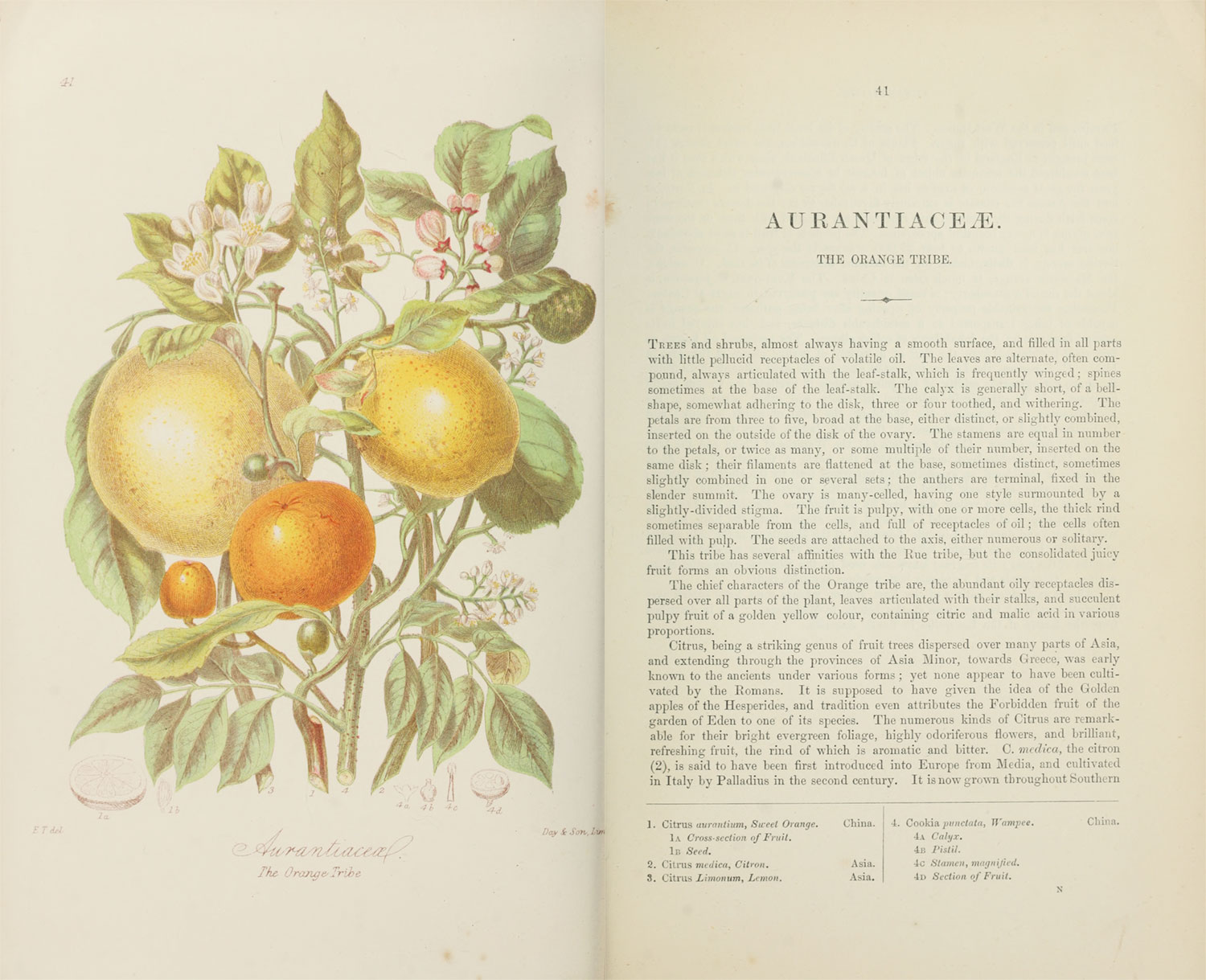
Rougeux’s Illustrations of the Natural Orders of Plants offers itself as “a complete reproduction and restoration… enhanced with interactive illustrations, descriptions, and posters featuring the illustrations.” The first two volumes of the original book were published in 1849 and 1855. Rougeux’s online version of the text is based on the 1868 second edition “with re-drawn illustrations based on her originals.” (See pages from the text above and below.) Rougeux’s digitized text is thus two steps removed from Twining’s original illustrations, but we can see the care and attention she put into classifying the flora of her native country.
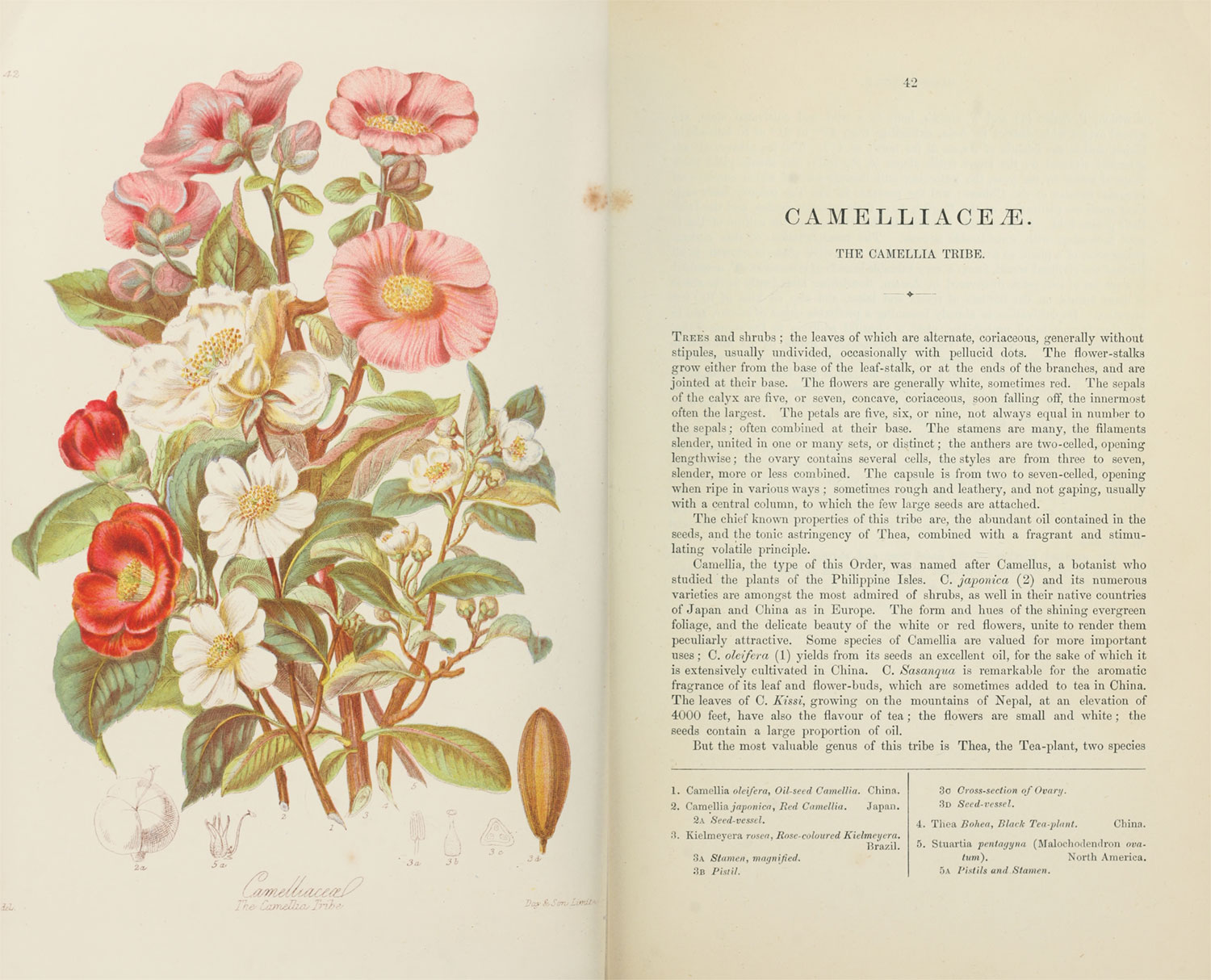
“Twining chose to illustrate plants using the classification system created by Augustin-Pyrame de Candolle based on multiple characteristics of plants—rather than the more widely used system by Carl Linnaeus which was focused on plants’ reproductive characteristics,” notes Rougeux, “because the De Candolle system was newer and she wanted her readers to be up to date as classification systems were evolving.”

Although biological taxonomies have changed considerably since her time, Twining’s Illustrations of the Natural Orders of Plants remains an intriguing “snapshot in time” that depicts not only the latest ideas about plant classification in the mid-19th century but also the attitudes a prominent member of the British ruling class adopted toward nature as a whole. See Rougeux’s online edition of Twining’s text here.

Related Content:
Josh Jones is a writer and musician based in Durham, NC. Follow him at @jdmagness
Read More...Fonts in Use: Enter a Giant Archive of Typography, Featuring 12,618 Typefaces
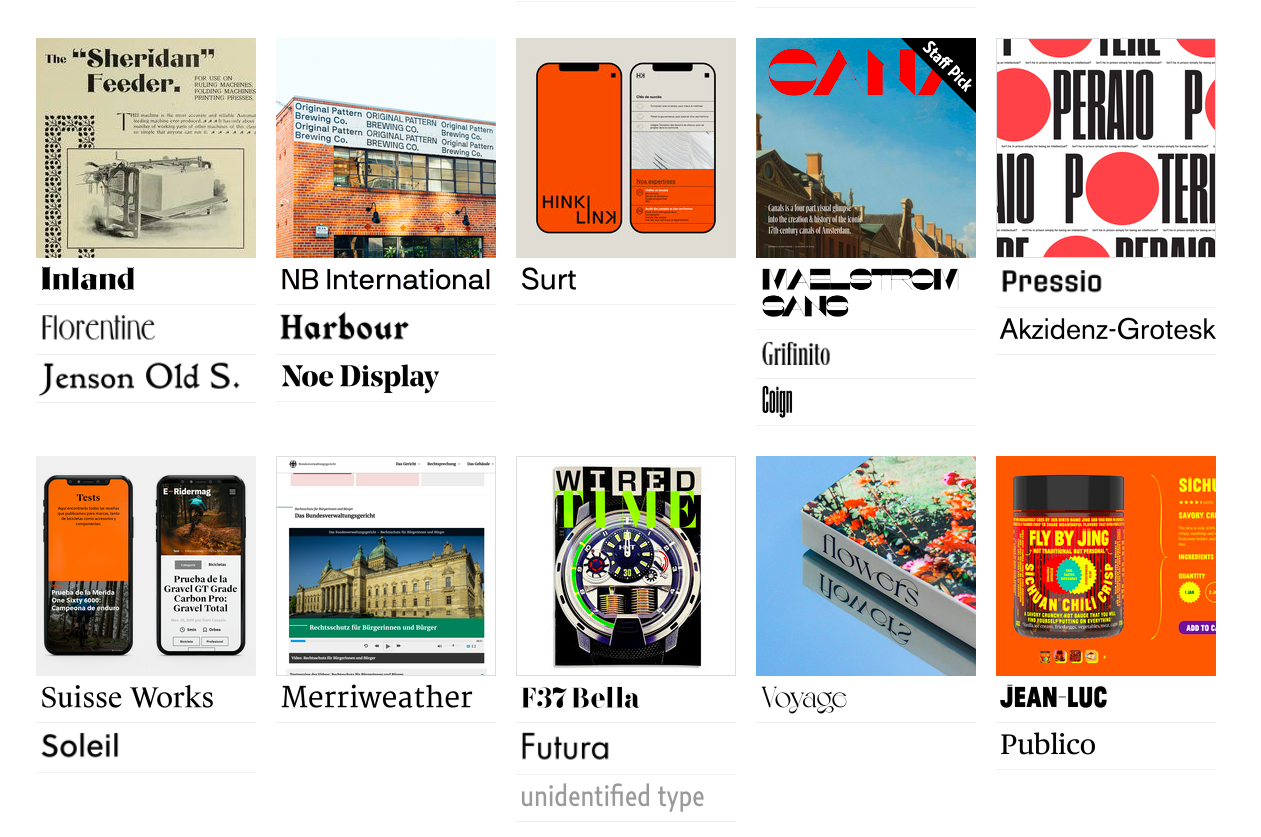
Type selection is an intensive process that requires intimate knowledge of a brand’s values, audience, competition, voice, and goals.
Fonts in Use is a typography nerd’s dream come true.
The 10-year-old independent archive of typography has collected over 17,000 designs, each using at least one of over 12,000 typeface families from more than 3,500 type companies. Each font is contextualized with images depicting them in the wild, on everything from wine labels and storefronts to book covers, record albums, movie posters and of course, advertising of all shapes and sizes.
Fonts can create unlikely bedfellows.

The Ramones’ iconic seal achieved its presidential look thanks to ITC Tiffany.
Other memorable appearances include the first edition cover of Italo Calvino’s experimental novel If On a Winter’s Night a Traveler and the titles for Hammer Film’s 1980 anthology TV series, Hammer House of Horror.
Fonts in Use’s managing editor, Florian Hardwig, describes ITC Tiffany as “Ed Benguiat’s 1974 revisitation and interpretation of 19th-century faces like West Old Style or Old Style Title,” noting such “Victorian details” as “large angled serifs and sharply terminated diagonals.”
The principal cast of Law & Order underwent several changes over the show’s 20-year run, but Friz Quadrata remained a constant, supplying titles and such necessary details as location, time, and date.
Friz Quadrata should be equally familiar to Dungeons & Dragons players of a certain age and fans of Garden Wafers, the packaged cookies from Hong Kong that are a staple of stateside Asian markets.
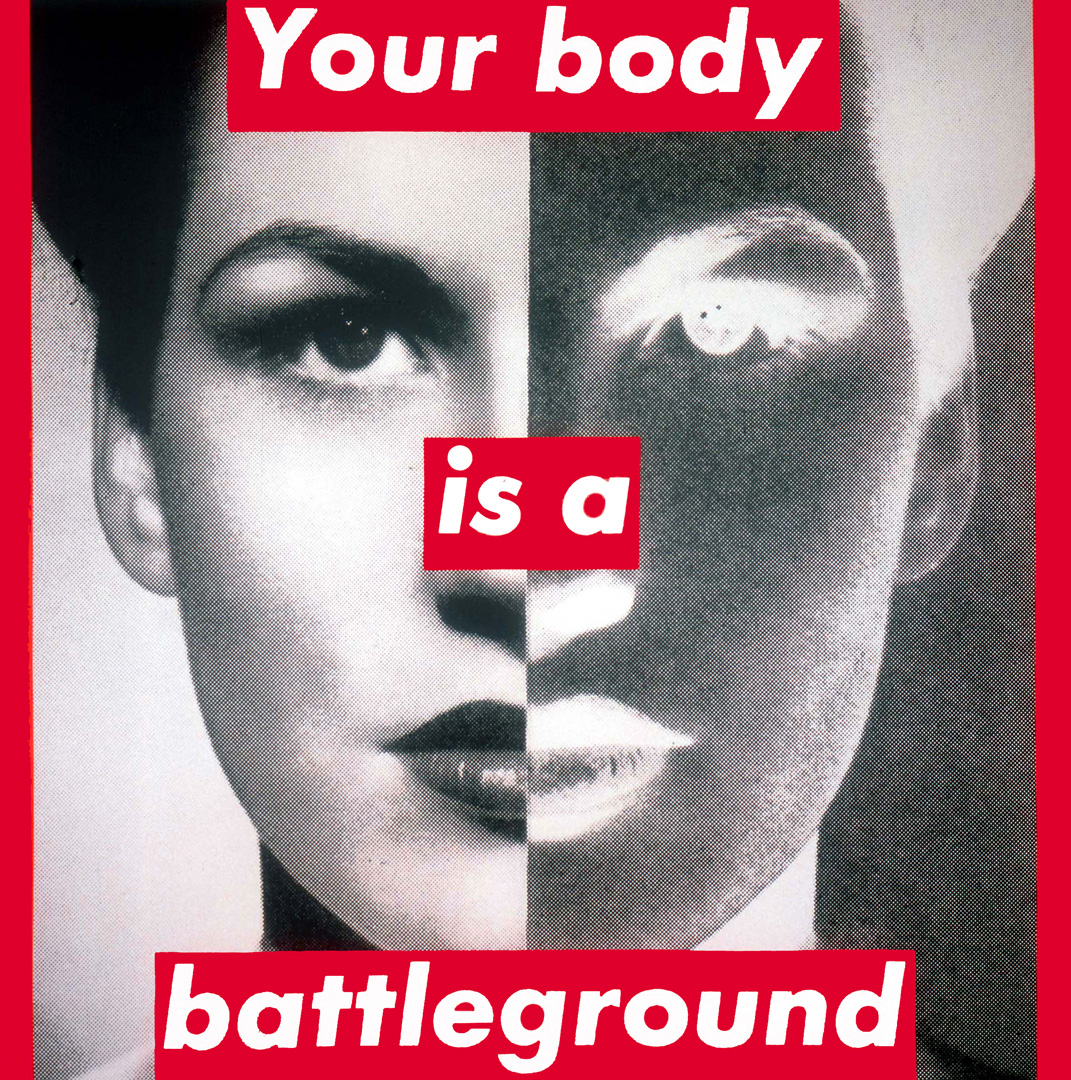
Artist Barbara Kruger’s distinctive text-based work places overt commentary in white italicized Futura on red bands on top of black and white images.
Futura was also the face of a tourist map to Berlin during the 1936 summer Olympics and author David Rees’ tongue-in-cheek guide How to Sharpen Pencils: A Practical & Theoretical Treatise on the Artisanal Craft of Pencil Sharpening for Writers, Artists, Contractors, Flange Turners, Anglesmiths, & Civil Servants.
Comic Sans may not get much love out in the real world, but it’s well represented in the archive’s user submissions.
You’ll find growing numbers of fonts in Cyrillic, as well as fonts familiar to readers of Chinese, Japanese, Korean, Arabic, Greek and Hebrew…
Newbie Netflix Sans keeps company with 19th-century sans Bureau Grot, a favorite of Vice President-Elect Kamala Harris…
Fat Albert, Tintoretto, Benguiat Caslon, Scorpio, Hoopla and Saphir are your ticket back to a far groovier period in the history of graphic art.
Spend an hour or two rummaging through the collection and we guarantee you’ll feel an urgent need to upload typographic examples pulled from your shelves and cabinets.
Fonts in Use welcomes such submissions, as long as type is clearly visible in your uploaded image and is—or was—in use (as opposed to an example of lettering for lettering’s sake). They will also consider custom typefaces which are historically significant or otherwise outstanding, and those that are available to the general public. Please include a short description in your commentary, and whenever possible, credit any designers, photographers, or sources of your image.
Typography nerds are standing by to help.
Begin your explorations of Fonts in Use here. If you’re feeling overwhelmed, the Staff Picks are a great place to start.
Related Content:
The History of Typography Told in Five Animated Minutes
Why This Font Is Everywhere: How Cooper Black Became Pop Culture’s Favorite Font
Ayun Halliday is an author, illustrator, theater maker and Chief Primatologist of the East Village Inky zine. She most recently appeared as a French Canadian bear who travels to New York City in search of food and meaning in Greg Kotis’ short film, L’Ourse. Follow her @AyunHalliday.
Read More...Animation Pioneer Lotte Reiniger Adapts Mozart’s The Magic Flute into an All-Silhouette Short Film (1935)
When Lotte Reiniger began making animation in the late 1910s, her work looked like nothing that had ever been shot on film. In fact, it also resembles nothing else achieved in the realm of cinema in the century since. Even the enormously budgeted and staffed productions of major studios have yet to replicate the stark, quavering charm of her silhouette animations. Those studios do know full well, however, what Reiniger realized long before: that no other medium can more vividly realize the visions of fairy tales. To believe that, one needs only watch her 1922 Cinderella or 1955 Hansel and Gretel, previously featured here on Open Culture.
It was between those productions that Reiniger made the work for which she’s now best remembered: the 1926 One Thousand and One Nights pastiche The Adventures of Prince Achmed, the very first feature in animation history. Nine years later, she turned to source material closer at hand, culturally speaking, and adapted a section of Wolfgang Amadeus Mozart’s opera The Magic Flute.
You can watch the result, the ten-minute Papageno, at the top of the post. A bird-catcher, the title character finds one day that all the avians around him have become tiny human females. Though none of them stick around, an ostrich later delivers him a full-size maiden, only for a giant snake to drive her away. Will Papageno defeat the serpent and reclaim his beloved, or submit to despair?
“The magic of the fairy tale has always been her greatest fascination, yet her own interpretations attain a unique quality,” says the narrator of the 1970 documentary short just above, in which Reiniger re-enacts the thoroughly analog and highly labor-intensive making of Papageno. “The figures she cuts out and constructs were originally inspired by the puppets used in traditional Eastern shadow theaters, of which the silhouette form is the logical conclusion.” This hybridization of venerable narrative material from Western lands like Germany with an even more venerable aesthetic from Eastern lands like Indonesia has assured only part of her work’s enduring appeal. “Ms. Reiniger will continue to have a strange affection for each of her figures,” the narrator notes. This is “an understandable affection, for in their flexibility they have almost human characteristics of movement.” It’s an affection anyone with an interest in animation, fairy tales, or Mozart will share.
Related Content:
The First Animated Feature Film: The Adventures of Prince Achmed by Lotte Reiniger (1926)
Mozart’s Diary Where He Composed His Final Masterpieces Is Now Digitized and Available Online
Hear All of Mozart in a Free 127-Hour Playlist
Based in Seoul, Colin Marshall writes and broadcasts on cities, language, and culture. His projects include the Substack newsletter Books on Cities, the book The Stateless City: a Walk through 21st-Century Los Angeles and the video series The City in Cinema. Follow him on Twitter at @colinmarshall, on Facebook, or on Instagram.
Read More...When Iggy Pop Published an Essay, “Caesar Lives,” in an Academic Journal about His Love for Edward Gibbon’s The Decline and Fall of the Roman Empire (1995)
Purveyors of the shocking, primal idiocy of pure rock and roll can in many cases be some of the most intelligent people in pop. Or at least that’s the case with the king of shocking, primal idiocy, Iggy Pop. He has interpreted Whitman’s “barbaric yawp” and delivered the John Peel Lecture for BBC Music, becoming “a visiting professor from the School of Punk Rock Hard Knocks,” writes Rolling Stone and bringing an elder statesman’s perspective informed not only by his years in the bowels of the music industry but also by his avocation as a scholar of the Roman Empire….
Yes, that’s right, Iggy Pop is not only an adroit stylist of some of the most brilliantly stupid garage rock ever made, but he’s also a serious reader and thinker who once published a brief reflection on his relationship with Edward Gibbon’s The Decline and Fall of the Roman Empire in the academic journal Ireland Classics.
“Iggy Pop, like Bob Dylan,” writes E.J. Hutchinson, “has an avid interest in Roman antiquity and its genetic connection to contemporary life.” He may also be the sharpest, wiliest embodiment of post-industrial American decline—his entire musical personality a punch in the collective face of the nation’s delusions.
In 1982, horrified by the meanness, tedium and depravity of my existence as I toured the American South playing rock and roll music and going crazy in public, I purchased an abridged copy of The Decline and Fall of the Roman Empire (Dero Saunders, Penguin).
The grandeur of the subject appealed to me, as did the cameo illustration of Edward Gibbon, the author, on the front cover. He looked like a heavy dude.
Hutchinson gives us a finely wrought analysis of Pop’s “tour de force of classical Gibbonian English prose, a scrap of Ciceronian periodicity.” (Gibbon did, indeed, look like a heavy dude.) Pop’s reading of Gibbon, “with pleasure around 4 am, with my drugs and whisky in cheap motels,” absorbed him in its “clash of beliefs, personalities and values,” he writes, “played out on antiquity’s stage by crowds of the vulgar, led by huge archetypal characters.” All of this appealed to him, he writes, given his own role in “a political business… the music business, which is not about music at all, but is a kind of religion-rental.”
Gibbon’s massive saga, a monumental example of sweeping Enlightenment historiography, so captivated Pop that a decade later, it inspired “an extemporaneous soliloquy” he called “Caesar,” the closing track on 1993’s “overlooked masterpiece” American Caesar. The spoken word piece “made me laugh my ass off,” he writes, “because it was so true. America is Rome. Of course, why shouldn’t it be? All of Western life and institutions today are traceable to the Romans and their world. We are all Roman children for better or worse.”
But there was much more to Pop’s reading of Gibbon—which he eventually enjoyed in a “beautiful edition in three volumes of the magnificent original unabridged”—than a possibly facile comparison between one failing empire and another. Much more, indeed. Reading Gibbon, he writes (sounding very much like another proponent of the classics, Italo Calvino), taught him how to think about the present, and how to think, humbly, about himself. He ends his essay with a numbered list of “just some of the ways I benefit”:
- I feel a great comfort and relief knowing that there were others who lived and died and thought and fought so long ago; I feel less tyrannized by the present day.
- I learn much about the way our society really works, because the system-origins — military, religious, political, colonial, agricultural, financial — are all there to be scrutinized in their infancy. I have gained perspective.
- The language in which the book is written is rich and complete, as the language of today is not.
- I find out how little I know.
- I am inspired by the will and erudition which enabled Gibbon to complete a work of twenty-odd years. The guy stuck with things. I urge anyone who wants life on earth to really come alive for them to enjoy the beautiful ancestral ancient world.
Read Pop’s full 1995 Ireland Classics essay on Jstor or Medium.
Related Content:
The Splendid Book Design of the 1946 Edition of Gibbon’s Decline and Fall of the Roman Empire
Iggy Pop Reads Edgar Allan Poe’s Classic Horror Story, “The Tell-Tale Heart”
Stream Iggy Pop’s Two-Hour Radio Tribute to David Bowie
Josh Jones is a writer and musician based in Durham, NC. Follow him at @jdmagness
Read More...Did Beethoven Use a Broken Metronome When Composing His String Quartets? Scientists & Musicians Try to Solve the Centuries-Old Mystery
When it comes to classical composers, Beethoven was pretty metal. But was he writing some kind of classical thrash? Hardcore orchestrations too fast for the average musician to play? 66 out of 135 of Beethoven’s tempo markings made with his new metronome in the early 1800s seem “absurdly fast and thus possibly wrong,” researchers write in a recent American Mathematical Society article titled “Was Something Wrong with Beethoven’s Metronome?” Indeed, the authors go on, “many if not most of Beethoven’s markings have been ignored by latter day conductors and recording artists” because of their incredible speed.
Since the late 19th century and into the age of recorded music, conductors have slowed Beethoven’s quartets down, so that we have all internalized them at a slower pace than he presumably meant them to be played. “These pieces have throughout the years entered the subconscious of professional musicians, amateurs and audiences, and the tradition,” writes the Beethoven Project, “handed down by the great quartets of yesteryear.” Slower tempos have “become a norm against which all subsequent performances are judged.”
Eybler Quartet violist Patrick Jordan found out just how deeply musicians and audiences have internalized slower tempi when he became interested in playing and recording at Beethoven’s indicated speeds in the mid-80s. “Finding a group of people who were prepared to actually take [Beethoven’s metronome marks] seriously—that was a 30-year wait,” he tells CBC. “A huge amount of our labour required that we un-learn those things; that we get notions of what we’ve heard recorded and played in concerts many times out of our heads and try to put in what Beethoven, at least at some point in his life, believed and thought highly enough to make a note of and publish.”
But did he? The subject of Beethoven’s metronome has been a source of controversy for some time. A few historians have theorized that the inventor of the metronome, Johann Nepomuk Mälzel, “something of a mechanical wizard,” Smithsonian writes, and also something of a disreputable character, sabotaged the device he presented to the composer in 1815 as a peace offering after he sued Beethoven for the rights to a composition. (Mälzel actually stole the metronome’s design from a Dutch mechanic named Dietrich Winkel.) But most musicologists and historians have dismissed the theory of deliberate trickery.
Still, the problem of too-fast tempi persists. “The literature on the subject is enormous,” admit the authors of the American Mathematical Society study. Their research suggests that Beethoven’s metronome was simply broken and he didn’t notice. Likewise data scientists at the Universidad Carlos III de Madrid have theorized that the composer, one of the very first to use the device, misread the machine, a case of musical misprision in his reaction against what he called in 1817 “these nonsensical terms allegro, andante, adagio, presto….”
Theorists may find the tempi hard to believe, but the Toronto-based Eybler Quartet was undeterred by their skepticism. “I don’t think there’s any evidence to suggest that the mechanism itself was [faulty],” says Jordan, “and we know from [Beethoven’s] correspondence and contemporaneous accounts that he was very concerned that his metronome stay in good working order and he had it recalibrated frequently so it was accurate.” Jordan instead credits the punishing speeds to Romanticism’s passionate individualism, and to the fact that “Beethoven was not always so very nice.” Maybe, instead of soothing his audiences, he wanted to shock them and set their hearts racing.
Who are we to believe? Questions of tempo can be fraught in classical circles (witness the reactions to Glenn Gould’s absurdly slow versions of Bach.) The metronome was supposed to solve problems of rhythmic imprecision. Instead, at least in Beethoven’s case, it reinscribed them in compositions that boldly challenge ideas of what a classical quartet is supposed to sound like, which makes me think he knew exactly what he was doing.
Related Content:
How Did Beethoven Compose His 9th Symphony After He Went Completely Deaf?
Stream the Complete Works of Bach & Beethoven: 250 Free Hours of Music
Josh Jones is a writer and musician based in Durham, NC. Follow him at @jdmagness
Read More...The Power of Pulp Fiction’s Dance Scene, Explained by Choreographers and Even John Travolta Himself
All the great movies have a few memorable scenes; Pulp Fiction is made of nothing but. More than a quarter-century ago, that film’s release turned a young video-store clerk-turned-auteur called Quentin Tarantino into a household name. Cinephiles today still argue about which is the most memorable among its scenes, and only the most contrarian could fail to consider the dance. It comes early in the film, when the hitman Vincent Vega takes his boss’ wife out to dinner, the absent kingpin having ordered him to do so. The two eat at an elaborately 1950s-themed diner and on a whim enter its twist contest. They walk off the dance floor with a trophy — as well as a couple decades’ influence on popular culture.
“The twist was made famous in the 60s,” explains choreographer Lauren Yalango-Grant in the Vanity Fair video just above. “There were a lot of variations that came out of the twist that we do see in this scene,” such as “the monkey,” “the swim,” and “the Batman,” better known as “the Batusi.”
As busted by John Tavolta and Uma Thurman, all these moves come out in an improvisational fashion, each in response to the last: “If John starts to do the Batman, then Uma’s going to ‘yes-and’ it with not only a Batman but an open palm, her own version of this move,” adds choreographer Christopher Grant. Their movements give the scene a great deal of its impact, but so does those movements’ incongruity with their expressions, which Yalango-Grant calls “the juxtaposition of their seriousness and the lack of play on their faces versus the play in their bodies.”
Though now cinematically iconic in its own right, Pulp Fiction’s dance scene pays homage to a host of older films. The most obvious is Jean-Luc Godard’s Bande à part, with what Yalango-Grant calls its “amazing dance sequence in a cafe. It’s totally out of context, of nowhere.” Never shy to admit his acts of artistic “theft,” Tarantino once complained that too few picked up this one: “Everybody thinks that I wrote this scene just to have John Travolta dancing. But the scene existed before John Travolta was cast.” The director’s intention, rather, was to pay tribute to his favorite musical sequences, which “have always been in Godard, because they just come out of nowhere. It’s so infectious, so friendly. And the fact that it’s not a musical, but he’s stopping the movie to have a musical sequence, makes it all the more sweet.”
The casting of Travolta (Tarantino’s “strong, strong, strong second choice” for Vincent Vega) proved fortuitous. The very image of the man dancing made for yet another chapter of pop culture from which the film could draw, but without his real-life dancing skills and instincts, the scene wouldn’t have been as memorable as it is. “Quentin was dead-set on both of us doing the twist, which is a very fun dance, but it’s limited in how long one wants to watch someone do the twist,” Travolta remembers on a recent appearance on The Late Late Show with James Corden. So he told the director, “When I was growing up, there were novelty dances. There were dances like the swim and the Batman and the hitchhiker and the tighten up. Maybe we should widen the spectrum on this.” Tarantino’s unwillingness to compromise his ambitions and obsessions has made him perhaps the most acclaimed filmmaker of his generation, but so has knowing when to defer to the star of Saturday Night Fever.
Related Content:
Quentin Tarantino Gives Sneak Peek of Pulp Fiction to Jon Stewart in 1994
Quentin Tarantino’s Original Wish List for the Cast of Pulp Fiction
The Music in Quentin Tarantino’s Films: Hear a 5‑Hour, 100-Song Playlist
An Analysis of Quentin Tarantino’s Films Narrated (Mostly) by Quentin Tarantino
How Anna Karina (RIP) Became the Mesmerizing Face of the French New Wave
Based in Seoul, Colin Marshall writes and broadcasts on cities, language, and culture. His projects include the Substack newsletter Books on Cities, the book The Stateless City: a Walk through 21st-Century Los Angeles and the video series The City in Cinema. Follow him on Twitter at @colinmarshall, on Facebook, or on Instagram.
Read More...Revisit Kate Bush’s Peculiar Christmas Special, Featuring Peter Gabriel (1979)
It’s been hard out there for Kate Bush fans. Since the genius “Queen of British Pop” retired from touring in 1979, public appearances have been few and far-between. She found the machinery of pop-stardom a hindrance to her process, and she’s been busy with other things, she says. “Every time I finish an album, I go into visual projects…. So I started to veer away from the thing of being a live performing artist, to one of being a recording artist with attached visuals.”
Fans are not entitled to her presence, but Kate Bush was sorely missed in the 35 years between her first tour and her 2014 “Before the Dawn” residency at London’’s Hammersmith Apollo. Before returning to the stage, she kept herself in the public eye with elaborately costumed music videos, a format perfectly suited to her theatrical and cinematic ambitions. (Asked by an interviewer in 1980 what she wanted to do next, she answered, “Everything.”)
But then there’s the Kate Bush Christmas Special, “titled simply Kate on-screen,” writes Christine Pallon. The program, which “aired on the BBC on December 28th, 1979,” followed on the heels of the Tour of Life, the whirlwind debut concert series that promised, but did not deliver, so many more. “The Christmas special’s choreography borrows heavily from that tour. But where she sang live on the Tour of Life, she lip-syncs to pre-recorded tracks here and incorporates pre-recorded video segments. As a result, the Christmas special plays out more like a crazy, longform music video than a traditional stage show.”
Does Kate Bush sing Christmas songs? Does she sit on Santa’s lap? Does she mime, arms akimbo, before the yule log?
Does she lounge on a piano next to a Golden Age crooner?
C’mon…
Okay, she sings one Christmas song, “December Will Be Magic Again,” an original released as a UK single that year. The song pays earnest homage to traditional Christmas figures like Bing Crosby, Saint Nick, and Oscar Wilde before Kate turns into some kind of strange Santa-like being who drops down on “the white city” in a parachute to “cover the lovers.”
Otherwise, the Christmas Special draws on Bush’s first three albums. In addition to her entourage of dancers and backup lip-syncers, she also invites a special guest—Peter Gabriel, of course (who might just as well be called the male Kate Bush)—to sing his “Here Comes the Flood” and duet with her on the extremely downbeat “Another Day.”
Christmas spirit? Who needs it? This is Kate, answering the age-old question, Pallon writes, “what would happen if the BBC gave a Christmas special to an incredibly ambitious 21-year-old art rocker who also smokes a ton of weed?” See the full tracklist, with timestamps, just below. Enjoy, and Happy Kate Bush Christmas Special Day!
Kate Bush — Christmas Special Tracklist:
(Intro) 00:00
Violin 00:29
(Gymnopédie No.1 — composed by Erik Satie) 03:44
Symphony In Blue 04:44
Them Heavy People 08:20
(Intro for Peter Gabriel) 12:52
Here Comes The Flood (Peter Gabriel) 13:22
Ran Tan Waltz 17:02
December Will Be Magic Again 19:43
The Wedding List 23:35
Another Day (with Peter Gabriel) 28:05
Egypt 31:41
The Man With The Child In His Eyes 36:21
Don’t Push Your Foot On The Heartbreak 39:24
Related Content:
300 Kate Bush Impersonators Pay Tribute to Kate Bush’s Iconic “Wuthering Heights” Video
2009 Kate Bush Documentary Dubs Her “Queen of British Pop”
Josh Jones is a writer and musician based in Durham, NC. Follow him at @jdmagness
Read More...The UN’s World Happiness Report Ranks “Socialist Friendly” Countries like Finland, Norway, Denmark, Iceland & Sweden as Among the Happiest in the World
One of the most pernicious, “dangerous, anti-human and soul-crushing” myths in the business world, writes Liz Ryan at Forbes, is the “idiotic nostrum” that has also crept into government and charitable work: “If you can’t measure it, you can’t manage it.” The received wisdom is sometimes phrased more cynically as “if you can’t measure it, it didn’t happen,” or more positively as “if you can’t measure it, you can’t improve it.”
But “the important stuff can’t be measured,” says Ryan. Don’t we all want to believe that? “Can’t Buy Me Love” and so forth. Maybe it’s not that simple, either. Take happiness, for example. We might say we disagree about its relative importance, but we all go about the business of trying to buy happiness anyway. In our hearts of hearts, it’s a more or less an unquestionable good. So why does it seem so scarce and seem to cost so much? Maybe the problem is not that happiness can’t be measured but that it can’t be commodified.
Buddhist economies like Bhutan, for example, run on a GHI (Gross National Happiness) index instead of GDP, and pose the question of whether the issue of national happiness is one of priorities. In other words, “you get what you measure.” In March, Laura Begley Bloom cited the 20 happiest countries in the world at Forbes, using the UN’s 2020 World Happiness Report, “a landmark survey of the state of global happiness,” as the report’s website describes it, “that ranks 156 countries by how happy their citizens perceive themselves to be.”

Happiness is measured across urban and rural environments and according to environmental quality and sustainable development metrics. The report uses six rubrics to assess happiness—levels of GDP, life expectancy, generosity, social support, freedom and corruption, and income. Their assessment relied on self-reporting, to give “a direct voice to the population as opposed the more top-down approach of deciding ex-ante what ought to matter.” The last chapter attempts to account for the so-called “Nordic Exception,” or the puzzling fact that “Nordic countries are constantly among the happiest in the world.”
Maybe this fact is only puzzling if you begin with the assumption that wealthy capitalist economies promote happiness. But the top ten happiest countries are wealthy “socialist friendly” mixed economies, as Bill Maher jokes in the clip at the top, saying that in the U.S. “the right has a hard time understanding we don’t want long lines for bread socialism, we want that you don’t have to win the lotto to afford brain surgery socialism.” This is comedy, not trenchant geo-political analysis, but it alludes to another significant fact.
Most of the world’s unhappiest countries and cities are formerly colonized places whose economies, infrastructures, and supply chains have been destabilized by sanctions (which cause long bread lines), bombed out of existence by wealthier countries, and destroyed by climate catastrophes. The report does not fully explore the meaning of this data, focusing, understandably, on what makes populations happy. But an underlying theme is the suggestion that happiness is something we achieve in real, measurable economic relation with each other, not solely in the pursuit of individualist ideals.
Related Content:
How Much Money Do You Need to Be Happy? A New Study Gives Us Some Exact Figures
Josh Jones is a writer and musician based in Durham, NC. Follow him at @jdmagness
Read More...Three Amateur Cryptographers Finally Decrypted the Zodiac Killer’s Letters: A Look Inside How They Solved a Half Century-Old Mystery
If we envision serial killers as figures who taunt law enforcement with cryptic messages sent to the media, we do so in large part because of the Zodiac Killer, who terrorized northern California in the late 1960s and early 70s. Though he seems to have stopped killing more than half a century ago, he remains an object of great fascination (and even became the subject of David Fincher’s acclaimed film Zodiac in 2007). As thoroughly as the case has been investigated, much remains unknown — not least what he actually said in some of his coded letters. But just this month, a team of three cryptography enthusiasts managed to break one of the Zodiac’s ciphers, finally revealing the contents of a 51-year old letter.
The Zodiac wrote this particular communiqué in a transposition cipher, which, as Ars Technica’s Dan Goodin writes, uses “rules to rearrange the characters or groups of characters in the message.” In the case of the 340, named for the number of symbols, the content “was probably rearranged by manipulating triangular sections cut from messages written into rectangles.” For the past half-century, nobody could successfully return the text to its original arrangement, but in 2020, there’s an app for that. Or rather, a software engineer named David Oranchak, a mathematician named Sam Blake, and a programmer named Jarl Van Eycke made an app for that. Goodin quotes Oranchak as saying the three had been “working on and off on solving the 340 since 2006.”
You can see Oranchak explain how he and his collaborators finally cracked the 340’s cipher in the video at the top of the post, the final episode of his five-part series Let’s Crack the Zodiac. This wasn’t a matter of simply whipping up the right piece of artificial intelligence and letting it rip: they had to generate hundreds of thousands of permutations of the message as well as attempts at decryptions of those messages. And even when recognizable words and phrases began to emerge in the results — “TRYING TO CATCH ME,” “THE GAS CHAMBER” — quite a bit of trial, error, and thought, remained to be done. It helped that Oranchak knew his Zodiac history, such as that someone claiming to be the killer mentioned not wanting to be sent to the gas chamber when he called in to a local television show on October 20, 1969, two weeks before the 340 was received.
Was it really him? The 340, when finally decoded — a process complicated by the mistakes the Zodiac made, not just in spelling but in executing his laborious, fully analog encryption process — seems to provide the answer:
I HOPE YOU ARE HAVING LOTS OF FUN IN TRYING TO CATCH ME
THAT WASNT ME ON THE TV SHOW
WHICH BRINGS UP A POINT ABOUT ME
I AM NOT AFRAID OF THE GAS CHAMBER
BECAUSE IT WILL SEND ME TO PARADICE ALL THE SOONER
BECAUSE I NOW HAVE ENOUGH SLAVES TO WORK FOR ME
WHERE EVERYONE ELSE HAS NOTHING WHEN THEY REACH PARADICE
SO THEY ARE AFRAID OF DEATH
I AM NOT AFRAID BECAUSE I KNOW THAT MY NEW LIFE IS
LIFE WILL BE AN EASY ONE IN PARADICE DEATH
“The message doesn’t really say a whole lot,” admits Oranchak. “It’s more of the same attention-seeking junk from Zodiac. We were disappointed that he didn’t put any personally identifying information in the message, but we didn’t expect him to.” The Zodiac Killer remains unidentified, and indeed remains one of recent history’s more compelling villains, not just to those with an interest in true crime, but to those with an interest in cryptography as well. For two more messages still remain to be decoded, and in one of them he offers a short cipher that, he writes, contains his name — but then, if there’s any correspondent we shouldn’t rush to take at his word, it’s this one.
Related Content:
The Enigma Machine: How Alan Turing Helped Break the Unbreakable Nazi Code
How British Codebreakers Built the First Electronic Computer
The Serial Killer Who Loved Jazz: The Infamous Story of the Axeman of New Orleans (1919)
The Gruesome Dollhouse Death Scenes That Reinvented Murder Investigations
Based in Seoul, Colin Marshall writes and broadcasts on cities, language, and culture. His projects include the Substack newsletter Books on Cities, the book The Stateless City: a Walk through 21st-Century Los Angeles and the video series The City in Cinema. Follow him on Twitter at @colinmarshall, on Facebook, or on Instagram.
Read More...Support Us
We're hoping to rely on loyal readers, rather than erratic ads. Please click the Donate button and support Open Culture. You can use Paypal, Venmo, Patreon, even Crypto! We thank you!

About Us

Open Culture scours the web for the best educational media. We find the free courses and audio books you need, the language lessons & educational videos you want, and plenty of enlightenment in between.
Advertise With Us
FREE UPDATES!
GET OUR DAILY EMAIL
Get the best cultural and educational resources on the web curated for you in a daily email. We never spam. Unsubscribe at any time.
FOLLOW ON SOCIAL MEDIA
Open Culture editor Dan Colman scours the web for the best educational media. He finds the free courses and audio books you need, the language lessons & movies you want, and plenty of enlightenment in between.
Advertise With Us


