The Oldest Known Globe to Depict the New World Was Engraved on an Ostrich Egg, Maybe by Leonardo da Vinci (1504)
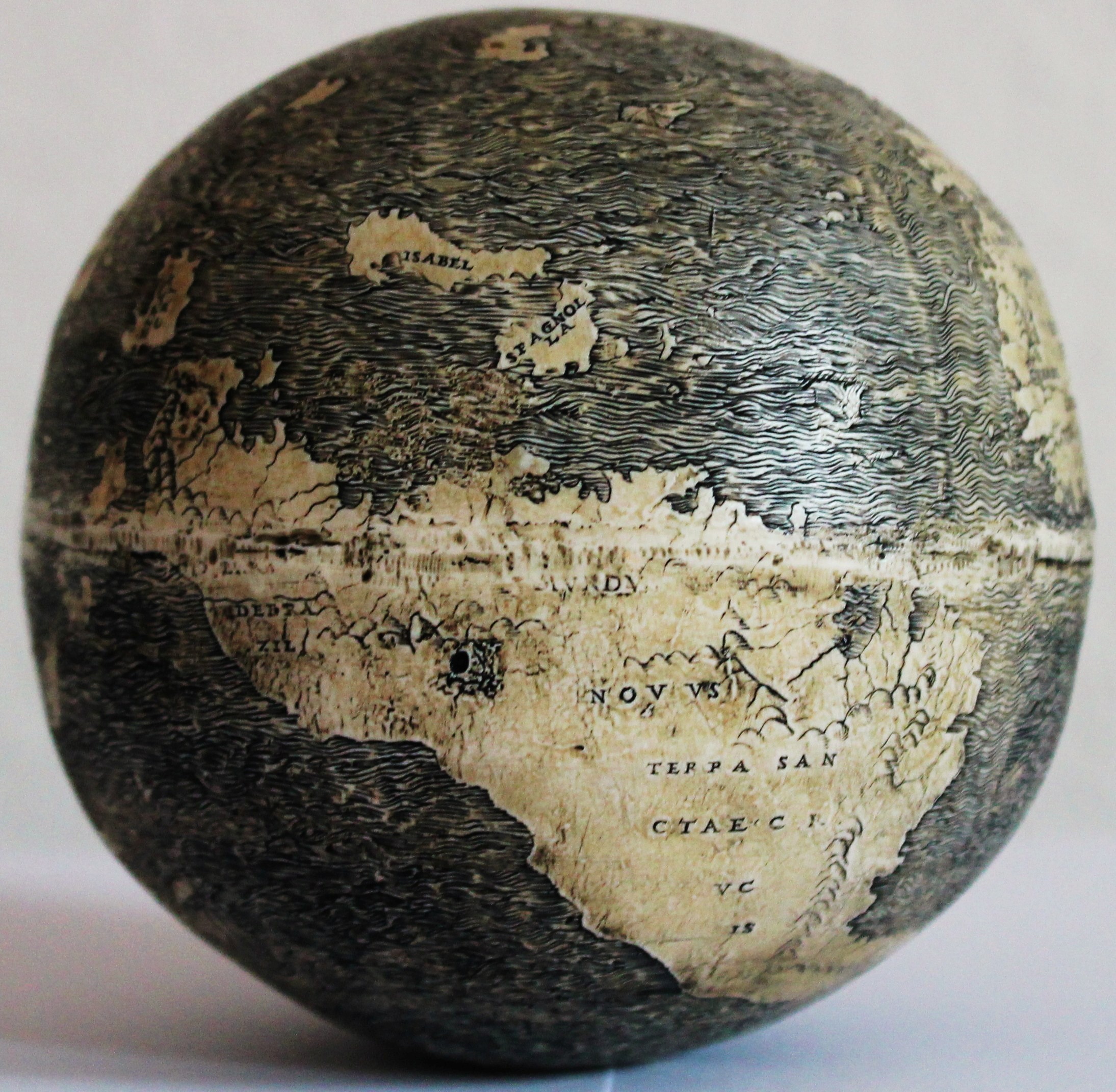
Image by Davidguam via Wikimedia Commons
Every time you think you’ve got a handle on Leonardo da Vinci’s genius (which is to say, you think you’ve heard about the most important things he painted, wrote, and invented), yet more evidence comes to light of the many ways he meets the standard for the adjective “genius”.… Recently, Leonardo re-appeared not only as an inventor of futuristic military technology or discoverer of complex human anatomy, but also as the first European to depict the “New World” on a globe–proving he knew about Columbus’ voyages when the globe was made in 1504.
The discovery “marks the first time ever that the names of countries such as Brazil, Germania, Arabia and Judea have appeared on a globe,” notes Cambridge Scholars Publishing, who released a book by the globe’s discoverer and primary researcher, Stefaan Missinne. The artifact attributed to Leonardo is engraved, “with immaculate detail,” writes Meeri Kim at The Washington Post, “on two conjoined halves of ostrich eggs.” And it features a single sentence, in Latin, above Southeast Asia: Hic Sunt Dracones–“Here be dragons.”
We’ll notice other unique features of the engraved egg Missinne calls, simply, “the Da Vinci Globe,” such as the fact that in place of Central and North America are the islands of Columbus’ “discovery,” surrounded by a vast ocean in which Pacific and Atlantic join. Why ostrich eggs? Humans have used them for decorative purposes for millennia. Also, “in that time period,” says Thomas Sander, editor of the Washington Map Society’s journal, Portolan, “the ostrich was quite the animal, and it was a big thing for the noble people to have ostriches in their back gardens.”
Missinne, a real estate developer, collector, and globe expert originally from Belgium, discovered the globe in 2012 at the London Map Fair. It was purchased “from a dealer who said it had been part of an important European collection for decades,” and its buyer and owner remain anonymous. After the globe appeared, Missinne “consulted more than 100 scholars and experts in his year-long analysis,” putting “about five years of research into one year,” says Sander, calling the research “an incredible detective story.”
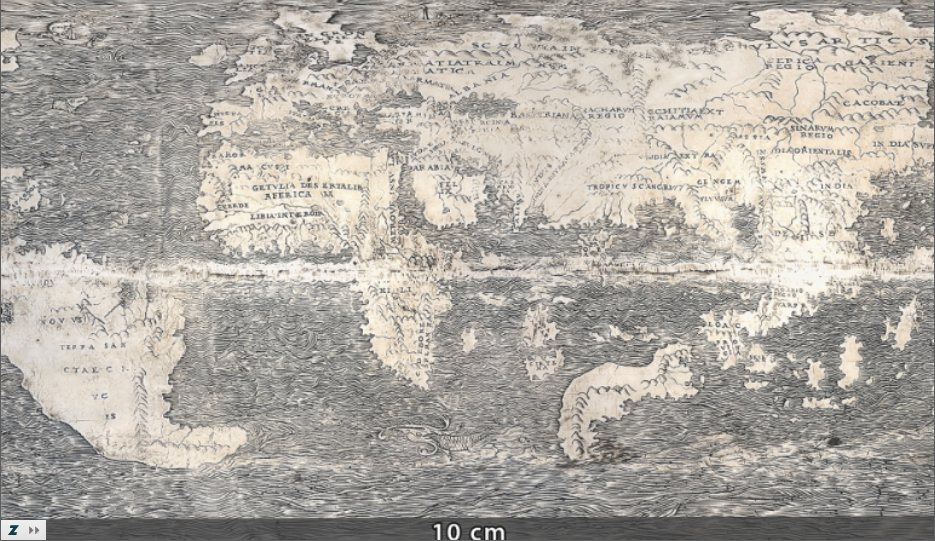
Missinne’s investigation seems to substantiate his claims that the globe was made by Leonardo or his workshop. The evidence, some of which you can find on the Cambridge Scholars Publishing site, includes a 1503 preparatory map in da Vinci’s papers; the presence of arsenic, which only Leonardo was known to use at the time in copper to keep it from losing its lustre; “The use of chiaroscuro, pentienti, triangular shapes, the mathematics of the scale reflecting Leonardo’s written dimension of planet earth”; and a 1504 letter from Leonardo himself stating, “my world globe I want returned back from my friend Giovanni Benci.”
Missinne and Geert Verhoeven, of the Ludwig Boltzmann Institute for Archaeological Prospection & Virtual Archeology, have published a paper on the “unfolding” of Leonardo’s globe into the two-dimensional image above (see an interactive version here). “This miniature egg globe is not only the oldest extant engraved globe,” the authors write, “but it is also the oldest post-Columbian globe of the world and the first ever to depict Newfoundland and many other territories.” Previously, the Hunt-Lenox Globe, a small copper globe, was thought to be the oldest known such artifact. Dated to around 1510, this globe, Missinne discovered, is actually a copy made from a cast of the older, original ostrich-egg globe.
Missinne’s findings have their detractors, including John W. Hessler of the Library of Congress, who claims Missinne himself is the anonymous owner of the globe, which raises issues of conflict of interest. “Where this thing comes from needs to be clarified,” says Renaissance cartography expert Chet Van Duzer of the John Carter Brown Library in Providence, R.I., though he adds, “It is an exciting discovery, no question.” Missinne’s claims for the egg’s provenance are more modest than his marketing. He “speculates,” writes Kim, “ the egg could have loose connections to the workshop of Leonardo da Vinci.” Hessler’s view is less equivocal: “The Leonardo connection is pure nonsense.”
A layperson like Missinne, whatever his personal investment, might be inclined to overinterpret evidence or make tenuous connections a trained scholar would avoid. The many scholars he cites in support of his claims for the globe are also vulnerable to these charges, however, though to a lesser degree. What do we make of French Mona Lisa expert Pascal Cotte’s testimonial, “I hereby confirm the evidence of the left-handedness of the engravings on the Ostrich Egg Globe. As Leonardo was the only left-handed artist in his workshop, I hereby endorse the hypothesis of Leonardo da Vinci’s authorship”? As in all such academic debates, “Here be dragons.” Weigh the case in full in Missinne’s 2018 book, The Da Vinci Globe.
Related Content:
Leonardo da Vinci’s Elegant Studies of the Human Heart Were 500 Years Ahead of Their Time
Leonardo da Vinci Draws Designs of Future War Machines: Tanks, Machine Guns & More
Josh Jones is a writer and musician based in Durham, NC. Follow him at @jdmagness
Read More...Travel from Rotterdam to Amsterdam in 10 Minutes by Boat: A 4k Timelapse
In 2013, a boat traveled from Rotterdam to Amsterdam, with a timelapse camera installed 30 meters high. The resulting film “gives a unique and stunning view of the old Dutch waterways, in 4K.” And lots of bridges along the way.
All images were shot with a Canon 550d at an interval of 3 seconds. 30,000 pictures were taken in total. Initially, “the film couldn’t be published due to restrictions. After a few years it was forgotten.” But now it has been resurrected, and it’s online.
If you would like to support the mission of Open Culture, consider making a donation to our site. It’s hard to rely 100% on ads, and your contributions will help us continue providing the best free cultural and educational materials to learners everywhere. You can contribute through PayPal, Patreon, and Venmo (@openculture). Thanks!
Related Content:
16th-Century Amsterdam Stunningly Visualized with 3D Animation
How Venice Works: 124 Islands, 183 Canals & 438 Bridges
Read More...Alan Watts Reads “One of the Greatest Things Carl Jung Ever Wrote”
Carl Jung founded the field of analytical psychology more than a century ago, and many reference his insights into the human mind and condition still today. Alan Watts certainly did his bit to keep the Jungian flame alive, whatever the outward differences between a Swiss psychiatrist and an English interpreter of Taoism, Hinduism, and Buddhism, especially of the Zen variety. Both men believed in casting a wide spiritual net, all the better to expose the common core elements of seemingly disparate ancient traditions. And in so doing they could hardly afford to ignore the religious underpinnings of the European civilization, broadly speaking, from which they emerged. In fact, Watts became an ordained Episcopal priest at the age of 30 — though, owing to the complexities of his beliefs as well as his personal life, he resigned the ministry by age 35.
But Watts’ investment in certain tenets of Christianity endured, and he named as one of Jung’s greatest writings a lecture delivered to a Swiss clergy group. “People forget that even doctors have moral scruples and that certain patient’s confessions are hard even for a doctor to swallow,” begins the speech as Watts reads it aloud in the video above. “Yet the patient does not feel himself accepted unless the very worst in him is accepted too. No one can bring this about by mere words. It comes only through reflection and through the doctor’s attitude towards himself and his own dark side.” To help another person, in other words, one must first accept that person as he is; but to accept another person as he is first requires taking oneself straight, less-than-admirable qualities and all.
According to Watts, Jung himself demonstrated this rare self-awareness. “He knew and recognized what I sometimes call the element of irreducible rascality in himself,” says Watts in a talk of his own previously featured here on Open Culture. “He knew it so strongly and so clearly, and in a way so lovingly, that he would not condemn the same thing in others, and would therefore not be led into those thoughts, feelings, and acts of violence towards others which are always characteristic of the people who project the devil in themselves upon the outside, upon somebody else, upon the scapegoat.” As Jung puts it to his clerical audience, “In the sphere of social or national relations, the state of suffering may be civil war, and this state is to be cured by the Christian virtue of forgiveness and love of one’s enemies.”
What Christianity holds as true of the outer world goes just as well, Jung argues, for the inner one. “This is why modern man has heard enough about guilt and sin. He is sorely beset by his own bad conscience and wants, rather, to know how he is to reconcile himself with his own nature, how he is to love the enemy in his own heart and call the wolf his brother.” He “does not want to know in what way he can imitate Christ, but in what way he can live his own individual life, however meagre and uninteresting it may be.” Only by being allowed to follow this “egoism” to its conclusion of “complete isolation” can he “get to know himself and learn what an invaluable treasure is the love of his fellow beings”; it is only “in the state of complete abandonment and loneliness that we experience the helpful powers of our own natures.” Without knowing our own natures, we can hardly expect even the most time-tested belief systems to put an end to the civil wars inside us.
Related Content:
Zen Master Alan Watts Explains What Made Carl Jung Such an Influential Thinker
Carl Jung Explains His Groundbreaking Theories About Psychology in a Rare Interview (1957)
Alan Watts On Why Our Minds And Technology Can’t Grasp Reality
Face to Face with Carl Jung: ‘Man Cannot Stand a Meaningless Life’ (1959)
The Wisdom of Alan Watts in Four Thought-Provoking Animations
Based in Seoul, Colin Marshall writes and broadcasts on cities, language, and culture. His projects include the Substack newsletter Books on Cities, the book The Stateless City: a Walk through 21st-Century Los Angeles and the video series The City in Cinema. Follow him on Twitter at @colinmarshall or on Facebook.
Read More...Watch a Korean Master Craftsman Make a Kimchi Pot by Hand, All According to Ancient Tradition
The South Korean capital of Seoul, where I live, has in the 21st century astonished visiting Westerners with its technology, its infrastructure, and its sheer urban vitality. It strikes many of those Westerners (and I include myself among them) as considerably more developed than anywhere in the countries they came from. But however much Seoul may feel like the future, nowhere in Korea has the past wholly vanished. Take the bulbous earthenware jars still visible on more than a few of the country’s terraces and rooftops, meant to hold condiments like soybean and red pepper paste as well as that world-famous symbol of not just Korean cuisine but Korean culture itself, the fermented cabbage known as kimchi.
Commonly called hangari, or more traditionally onggi, these jars essential to the fermentation of kimchi and other Korean foods are today produced in large numbers with industrial methods. But there are also Korean potters who’ve stuck to the old ways — and in a select few cases, the very old ways indeed. Take Jin-Gyu, the subject of the video above, a short documentary from Eater’s “Handmade” series.
“I’m the youngest of the intangible cultural assets in Korea,” he says, referring to the official list of Important Intangible Cultural Properties introduced to protect long-standing traditions in music, dance, and craft just as the country began its unprecedented surge into modernity. The making of onggi itself, a process Jin-Gyu demonstrates from start to finish in the video, is Important Intangible Cultural Property No. 96.
After pounding his clay into shape while describing how its soil first flows down from the mountains, Jin-gyu places it onto his wheel and gives it the distinctive shape recognizable from all those terraces and rooftops. This requires constant use of his hands, occasional use of his feet, and even the application of traditional tools that he also made himself. The contrast with traditional Japanese pottery, its emphasis on small-scale elegance and near-existentialist attitude toward the final product, is instructive: the Korean variety, as Jin-gyu practices it, has a different energy, more of an emotional and physical rusticity. “This makes me so happy,” he says after removing finished jar from the kiln originally built by his onggi-potter father. “After 300 years, it’ll return to the soil.” But there are plenty of hearty meals to be had in the meantime, none of them without kimchi.
Related Content:
How Soy Sauce Has Been Made in Japan for Over 220 Years: An Inside View
Modern Artists Show How the Ancient Greeks & Romans Made Coins, Vases & Artisanal Glass
Based in Seoul, Colin Marshall writes and broadcasts on cities, language, and culture. His projects include the Substack newsletter Books on Cities, the book The Stateless City: a Walk through 21st-Century Los Angeles and the video series The City in Cinema. Follow him on Twitter at @colinmarshall or on Facebook.
Read More...How Quentin Tarantino Shoots a Film at 3 Different Budget Levels: Reservoir Dogs ($1 Million), Pulp Fiction ($8 Million), and Once Upon a Time in Hollywood ($95 Million)
Quentin Tarantino has never shied away from talking, at length and at a rapid clip, about his process. “In another life,” Colin Marshall writes in a previous post on the subject, he might have become a “foremost practitioner” of the video essay on cinema. His meticulous analyses of not only his own films but also the hundreds he references–or outright steals from–can be dizzying, the ravings of an overactive creative mind that seems impossible to rein in.
Tarantino has also given us significant insight into his screenwriting process, saying “I was put on Earth to face the blank page” and claiming that he watches the entire film in his mind’s eye before putting pen to paper. He wrote Pulp Fiction “off and on,” Mark Seal notes at Vanity Fair, “in a one-room apartment with no phone or fax” in Amsterdam. Then he sought out veteran Hollywood typist Linda Chen, who agreed to type, and edit, the manuscript for free.
“His handwriting is atrocious,” says Chen. “He’s a functional illiterate. I was averaging about 9,000 grammatical errors per page. After I would correct them, he would try to put back the errors, because he liked them.”
As a writer, Tarantino’s quirks don’t actually seem out of place. As a director, his process would not seem to lend itself to the most disciplined production. The final product of that error-ridden script, however, became what Roger Ebert called “the most influential” movie of the 90s, “so well written in a scruffy, fanzine way that you want to rub noses in it—the noses of those zombie writers who take ‘screenwriting’ classes that teach them the formulas for ‘hit films.’” Of course, great writing is an indispensable part of making a great film, but so too is great filmmaking.…
How did Tarantino go from feverishly hand-scribbled script to a “most influential” film as a director? He has worked within strict limitations, as on his directorial debut, Reservoir Dogs, with larger budgets and better sets, as on Pulp Fiction, and on his most recent film, the $95 million Once Upon a Time in Hollywood. But he has always maintained a consistent visual style easily recognizable across all nine of his films.
In the video essay above from In Depth Cine, you can learn more of the story of how Tarantino accomplished his directorial visions, and how that style followed him from film to film. The video gets into technical details like the choice of 35mm cameras and the lighting placement. It also tells the story of how three films—Reservoir Dogs, Pulp Fiction, and Once Upon a Time in Hollywood—used their vastly different budget levels, while all remaining true to each other and to their writer and director’s intentions.
Related Content:
An Analysis of Quentin Tarantino’s Films Narrated (Mostly) by Quentin Tarantino
Quentin Tarantino Explains How to Write & Direct Movies
Josh Jones is a writer and musician based in Durham, NC. Follow him at @jdmagness
Read More...Brâncuși Captures His Sculpture & Life on Film: Watch Rare Footage Shot Between 1923–1939
Here in the early 21st century, even the non-artists among us carry digital video cameras in our pockets. Back in the early 20th century, the ability to film your own life and work, or that of your coterie, wasn’t so close at hand — unless, of course, you ran with the avant-garde. Constantin Brâncuși did, having been brought into the artistic and intellectual scene of the Paris of the 1910s, to which he’d made his way from his native Romania. He eventually counted among his friends the likes of Pablo Picasso, Ezra Pound, Marcel Duchamp, Guillaume Apollinaire, Tristan Tzara, and Man Ray, who got the innovative, hardworking and famously low-tech sculptor practicing cinema.
“In the early 1920s, Man Ray, who had previously taught Constantin Brâncuși how to handle a still camera, introduced him to the movie camera,” says Ubuweb in a description of “fifty minutes of film, shot between 1923 and 1939,” that represents “the sum total of all the images ever filmed by Brâncuși.”
The artist “makes use of framing, shadows, incidental light and refraction in order to activate the plastic properties of his sculptures, and opens up this visual analysis to movement and to time.” Pieces such as Leda and the scandalous Princess X become the subjects of their own sequences; later, we witness “Brancusi’s journey to Romania and the construction of the Endless Column in Târgu Jiu.”
These Endless Column passages, as art critic Blake Gopnik sees them, show “Brâncuși obsessed with how his soaring sculpture comes to life in the open air.” From all this footage Gopnik gets the sense that Brâncuși was “less interested in making fancy museum objects than in putting new kinds of almost-living things into the world,” and indeed drawing inspiration from the living things of the world: “In one of the clips, Brâncuși turns his camera on a pacing hawk, which comes across as a close, natural analog to the many ‘birds’ he created as sculptures.” Another “shows one of his stone pedestals, which meant as much to him as the sculptures set on them, supporting a live flapper doing an ecstatic dance” — captivating evidence of his interest in forms of life beyond the avian.
Related Content:
Rare Film of Sculptor Auguste Rodin Working at His Studio in Paris (1915)
Man Ray’s Portraits of Ernest Hemingway, Ezra Pound, Marcel Duchamp & Many Other 1920s Icons
Based in Seoul, Colin Marshall writes and broadcasts on cities, language, and culture. His projects include the Substack newsletterBooks on Cities, the book The Stateless City: a Walk through 21st-Century Los Angeles and the video series The City in Cinema. Follow him on Twitter at @colinmarshall, on Facebook, or on Instagram.
Read More...Wilhelm Reich’s Orgone Energy Accumulator Was Beloved by William S. Burroughs and Banned by the FDA: Find Plans to Build the Controversial Device Online
Was Austrian Marxist psychoanalyst Wilhelm Reich a trenchant socio-political thinker or a total crank? A fraud or a prophet? Maybe a little from each column, at different times during the course of his bizarre career. An enthusiastic student of Sigmund Freud, Reich applied his teacher’s theories of repressed libido to the frightening political theater of the 1930s, writing against the spread of Nazism in his prescient 1933 book The Mass Psychology of Fascism. Here, Reich brought Marx and Freud together to argue that sexual inhibition and fear led to arrested development and submission to authoritarianism.
Reich was “a sexual evangelist,” Christoper Turner writes at The Guardian, “who held that satisfactory orgasm made the difference between sickness and health.” His work was banned and burned by the Nazis, and he fled to a succession of Scandinavian countries, then to the U.S. in 1939, “by which time his former psychoanalytic colleagues were questioning his sanity.” The primary reason for their suspicion: Reich’s devotion to what he called “orgone,” an all-pervasive sexual energy that permeates the universe… according to Reich. Orgone and related concepts appear in his early work, but by the end of the 1930s, they came to entirely dominate his thinking.
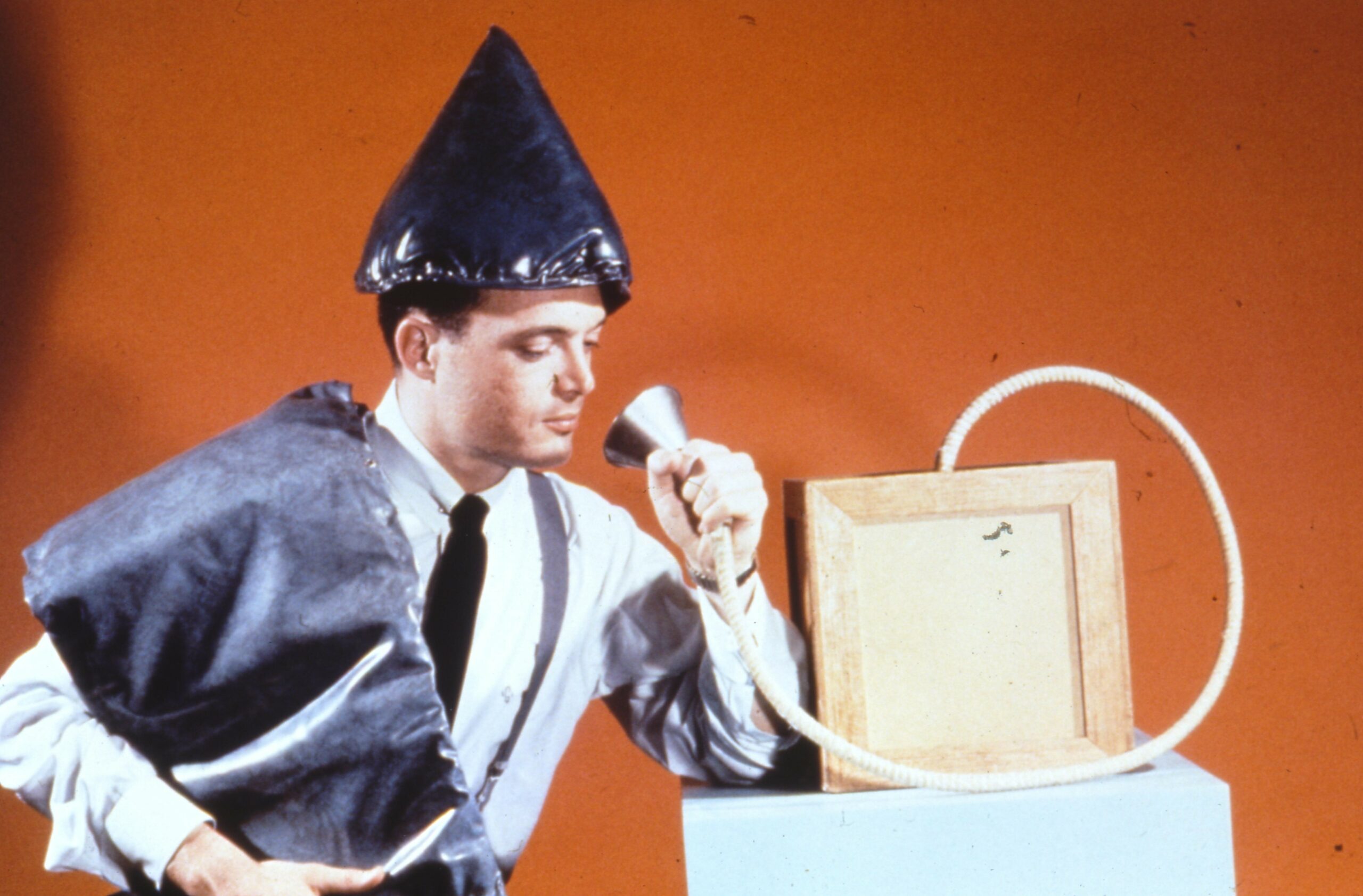
“In the strange and colorful history of pseudoscience, Wilhelm Reich’s ‘discovery’ of orgone—a substance that’s not only a life force, but indeed makes up the very fabric of space—must surely be a watershed,” writes Matt Simon at Wired. Reich intensified his belief in the glowing blue energy of orgone with the invention of the Orgone Energy Accumulator, an isolation box that supposedly charged those who sat inside it with the power of orgone. The device went through a few iterations (see the use of the “orgone blanket, above), until its final form of a metal-lined box roughly the size of a wardrobe or telephone booth.
Reich’s influence on 20th century culture goes far beyond the creation of this weird device. He might be said to have predicted and precipitated what he himself called the “sexual revolution.” (“No power on earth will stop it,” Reich wrote in the 30s.) Critics dismissed his belief in the liberating potential of free love as a “genitial utopia.” Their scorn mattered little to the countercultural figures who picked up and disseminated his work. “Almost a century” after Reich’s invention of orgone, writes Simon, “his bonkers ideas live on,” including the notion that nearly every health condition can be traced to an imbalance of orgone energy.
The Orgone Accumulator was popularized by William S. Burroughs, a true believer—as he was in many things, from Scientology to Shamanism—and an enthusiastic promoter of “life in orgone boxes.” (Jack Kerouac called Burroughs’ accumulator a “mystical outhouse” in On the Road.) Burroughs swore by the accumulator and wrote a 1977 article for Oui magazine in which he defended Reich’s claims that time spent in the sealed box might cure cancer—a claim that prompted the FDA to file an injunction against Reich in 1954 to stop use of the device and literature pertaining to it.
“Reich continued profiting from the accumulators,” writes Simon, “and the court found him in contempt of the injunction. He was sentenced to federal prison, where he died in 1957.” Devotees of his work have defended him ever since. (“Who is the FDA,” wrote Burroughs indignantly, “to deprive cancer patients of any treatment that could be efficacious?”). James DeMeo, Ph.D., director of the Orgone Biophysical Research Laboratory in Ashland Oregon, has recently released the 3rd, revised and expanded, edition of his Orgone Accumulator Handbook, a thorough reference guide, “with construction plans.”
Should you have the desire to build your own “mystical outhouse,” DeMeo’s text would seem to be a definitive reference. Proceed at your own risk. Wilhelm Reich’s orgone therapy remains squarely on a list of treatments unapproved by the FDA. The FBI, on the other hand, who “have a whole section on their website dedicated to Wilhelm Reich,” notes Mary Bellis, found no cause to prosecute the Austrian psychologist. “In 1947,” they note, “a security investigation concluded that neither the Orgone Project nor any of its staff were engaged in subversive activities.” But what could have been more subversive to the post-war U.S. establishment than maintaining the world’s ills could be cured by really good sex? Download a free copy of DeMeo’s book here.
Related Content:
A Look Inside William S. Burroughs’ Bunker
The Famous Break Up of Sigmund Freud & Carl Jung Explained in a New Animated Video
Josh Jones is a writer and musician based in Durham, NC. Follow him at @jdmagness
Read More...Take a New Virtual Reality Tour of the Metropolitan Museum of Art
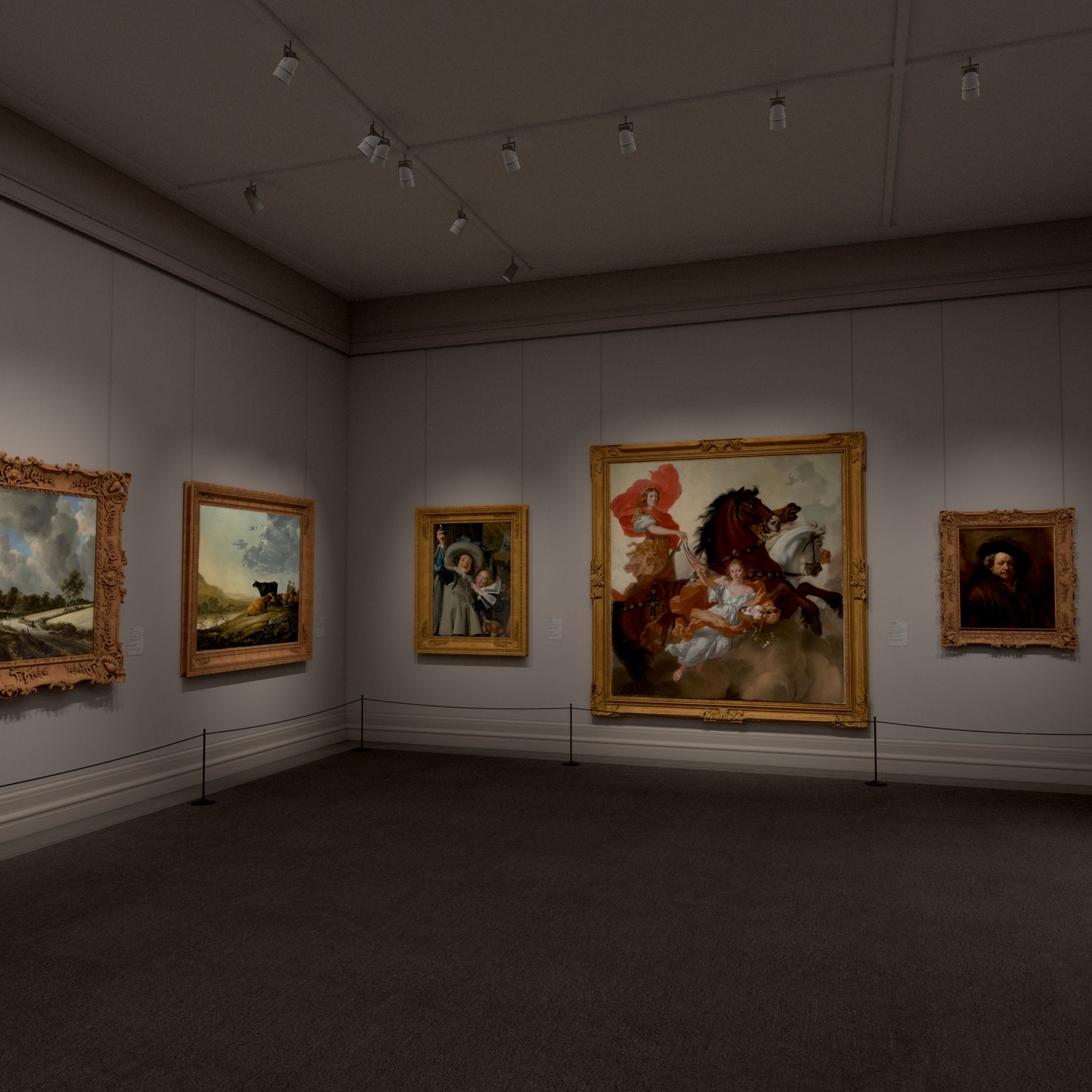
You can go to the Metropolitan Museum of Art today, and in real life at that. This isn’t true of all the world’s great art institutions, still shut down as many are by measures in response to the past year’s coronavirus pandemic. But then, none of them have offered a digital visiting experience quite like The Met Unframed, recently launched in partnership with cellphone service provider Verizon. For a period of five weeks, anyone can join and freely roam a virtual reconstruction, or rather reimagining, of the Met and its galleries. There they’ll encounter paintings by Pollock, Van Gogh, and Rembrandt, as well as work by current artists and majestic artifacts from antiquity.
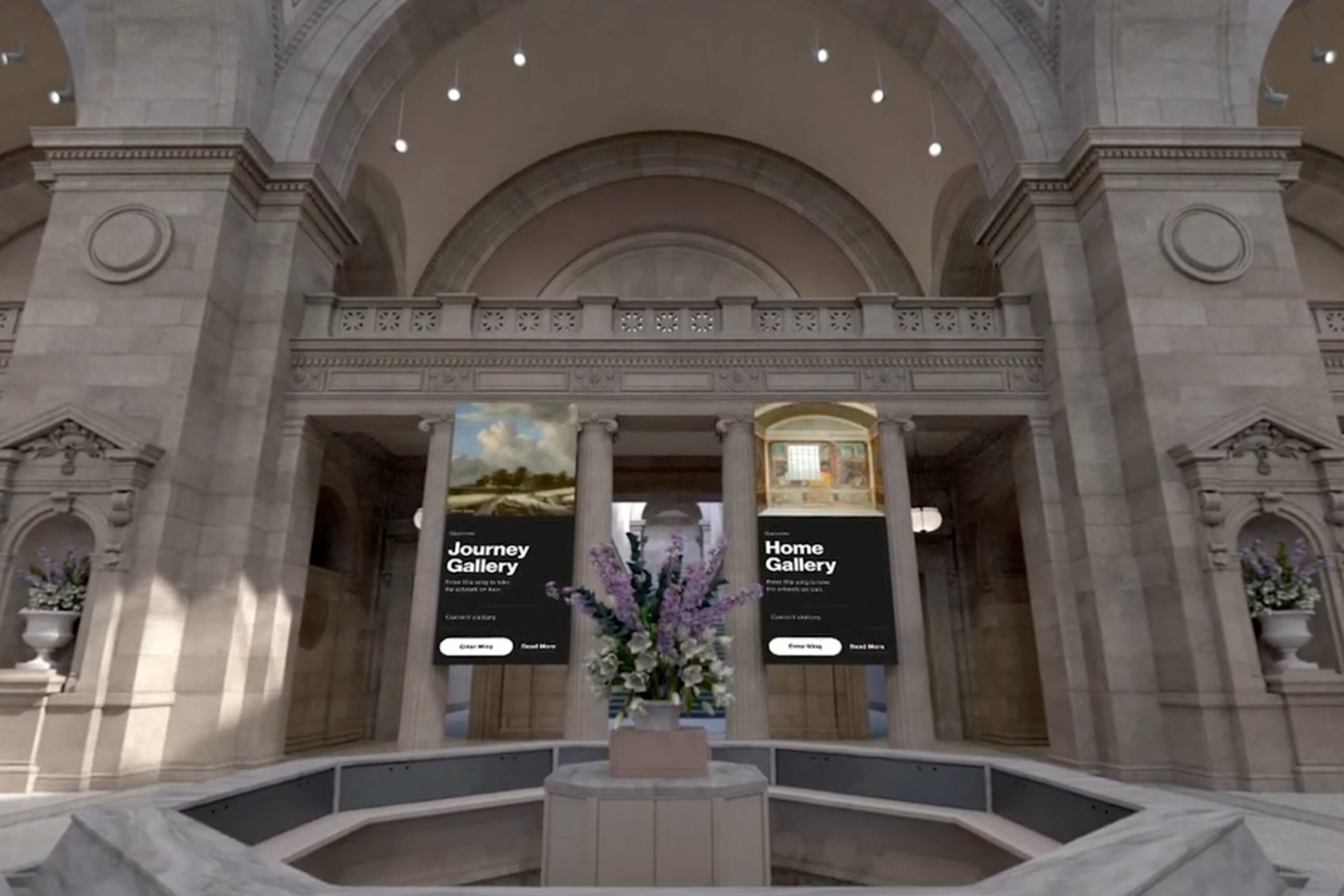
“Upon entering the website, visitors are welcomed to the museum’s Great Hall with a view of Kent Monkman’s diptych mistikôsiwak: Wooden Boat People (2019),” writes Hyperallergic’s Hakim Bishara. “From there, banners offer broad thematic concepts — Power, Home, Nature, and Journey — through which visitors can explore the galleries.”
Embedded in certain pieces of art, you’ll find not just historical details and audio-tour explanations but mini-games, which “include trivia questions and riddles that encourage close observation of the artworks and labels. A game called ‘Analysis’ uses the Met’s infrared and X‑ray conservation scans of paintings to reveal underdrawings and other hidden details of well-known paintings.”
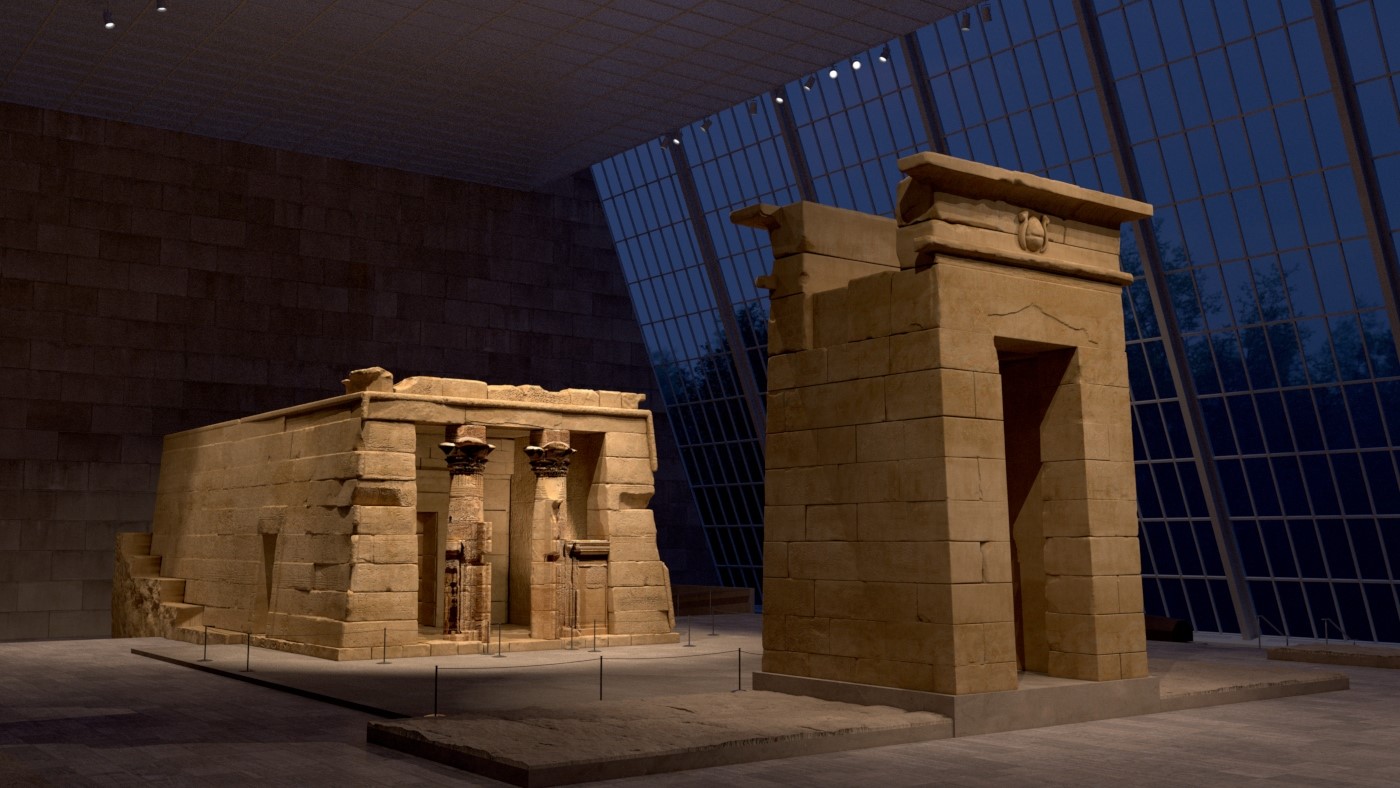
Win enough such games, and you’ll get the chance to “borrow” the artwork you’ve clicked to display, through augmented reality, in your space of choice — for fifteen minutes, at least. At Artnet, critic Ben Davis writes of placing here and there around his apartment Frederic Edwin Church’s Heart of the Andes, Jacob Lawrence’s The Photographer, and a Baby Yoda-scaled version of Rembrandt’s Self-Portrait. He even makes a serious if ultimately frustrated effort to win digital borrowing rights to the ancient Egyptian Temple of Dendur, one of the Met’s pièces de résistance since the late 1970s.
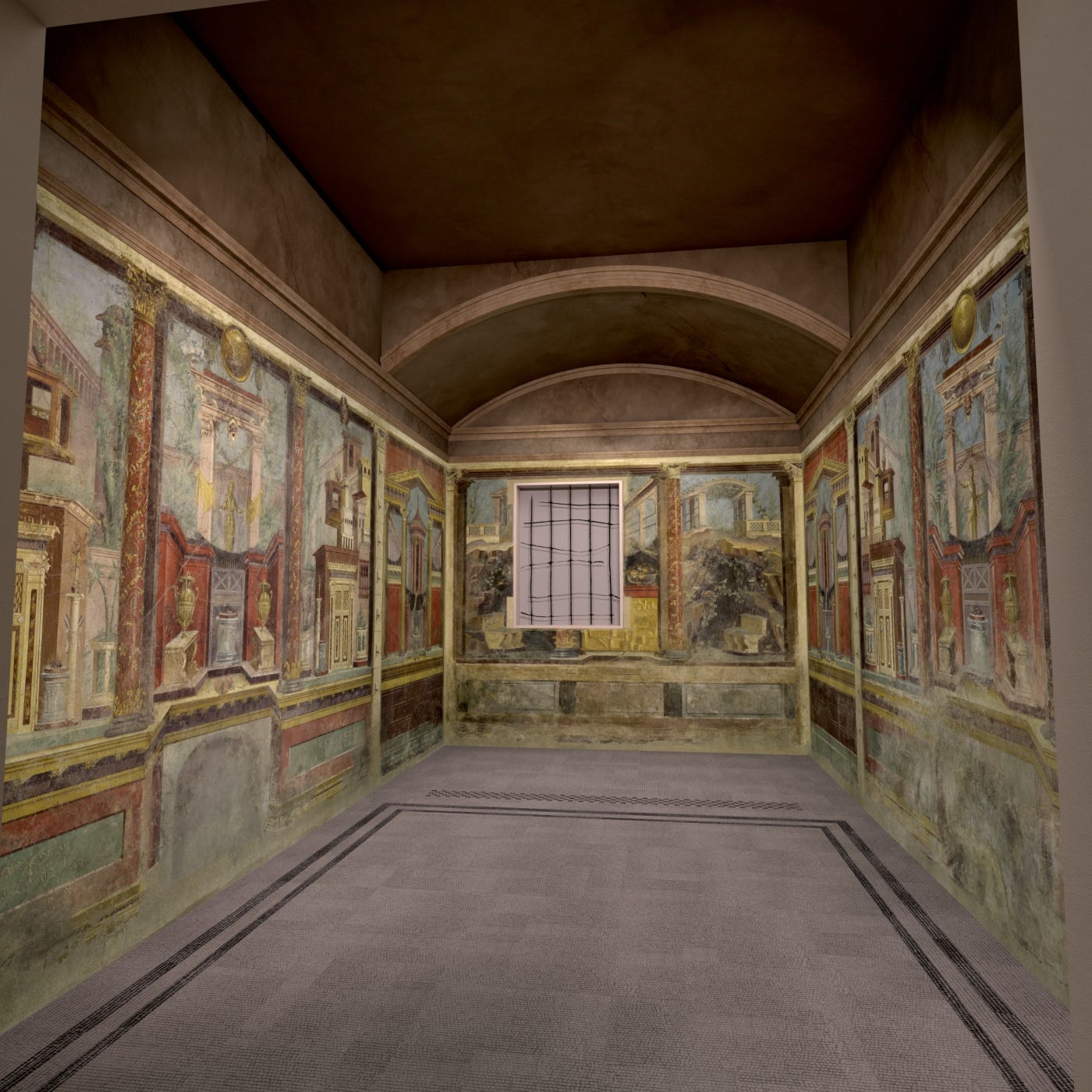
To experience The Met Unframed for yourself, just head over to its web site and use your phone to scan the QR code that comes up (if you’re not browsing on your phone in the first place). You’ll then be taken straight to the virtual Great Hall, which you can navigate by swiping in any direction — or physically moving your phone around, if you’ve enabled gyroscope mode — and tapping the icons glowing along the ground or on the walls. The combination of high technology, historical reference, depopulated but elegantly designed settings, puzzle challenges, and a score in which synthesizers meet ambient noise will remind visitors of a certain age of nothing so much as the adventure games of the early 1990s, especially Myst and its clones. But then, what does a museum do if not unite the past and the present?
Related Content:
Download 584 Free Art Books from The Metropolitan Museum of Art
The Metropolitan Museum of Art Puts 400,000 High-Res Images Online & Makes Them Free to Use
Take a Virtual Tour of 30 World-Class Museums & Safely Visit 2 Million Works of Fine Art
Based in Seoul, Colin Marshall writes and broadcasts on cities, language, and culture. His projects include the Substack newsletterBooks on Cities, the book The Stateless City: a Walk through 21st-Century Los Angeles and the video series The City in Cinema. Follow him on Twitter at @colinmarshall, on Facebook, or on Instagram.
Read More...A Look Inside William S. Burroughs’ Bunker
When everybody had one or two vodkas and smoked a few joints, it was always the time for the blowgun. —John Giorno
From 1974 to 1982, writer William S. Burroughs lived in a former locker room of a 19th-century former-YMCA on New York City’s Lower East Side.
When he moved on, his stuff, including his worn out shoes, his gun mags, the typewriter on which he wrote Cities of the Red Night, and half of The Place of Dead Roads, a well-worn copy of The Medical Implications of Karate Blows, and a lamp made from a working Civil war-era rifle, remained.
His friend, neighbor, tourmate, and occasional lover, poet John Giorno preserved “The Bunker” largely as Burroughs had left it, and seems to delight in rehashing old times during a 2017 tour for the Louisiana Channel, above.
It’s hard to believe that Burroughs found Giorno to be “pathologically silent” in the early days of their acquaintance:
He just wouldn’t say anything. You could be there with him the whole evening, he wouldn’t say a word. It was not the shyness of youth, it was much more than that, it was a very deep lack of ability to communicate. Then he had cancer and after the operation that was completely reversed and now he is at times a compulsive talker, when he gets going there is no stopping him.
According to Burroughs’ companion, editor and literary executor, James Grauerholz, during this period in Burroughs’ life, “John was the person who contributed most to William’s care and upkeep and friendship and loved him.”
Giorno also prepared Burroughs’ favorite dish—bacon wrapped chicken—and joined him for target practice with the blowgun and a BB gun whose projectiles were forceful enough to penetrate a phonebook.
Proximity meant Giorno was well acquainted with the schedules that governed Burroughs’ life, from waking and writing, to his daily dose of methadone and first vodka-and-Coke of the day.
He was present for many dinner parties with famous friends including Andy Warhol, Lou Reed, Frank Zappa, Allen Ginsberg, Debbie Harry, Keith Haring, Jean-Michel Basquiat, and Patti Smith, who recalled visiting the Bunker in her National Book Award-winning memoir, Just Kids:
It was the street of winos and they would often have five cylindrical trash cans to keep warm, to cook, or light their cigarettes. You could look down the Bowery and see these fires glowing right to William’s door… he camped in the Bunker with his typewriter, his shotgun and his overcoat.
All Giorno had to do was walk upstairs to enjoy Burroughs’ company, but all other visitors were subjected to stringent security measures, as described by Victor Bockris in With William Burroughs: A Report from the Bunker:
To get into the Bunker one had to pass through three locked gates and a gray bulletproof metal door. To get through the gates you had to telephone from a nearby phone booth, at which point someone would come down and laboriously unlock, then relock three gates before leading you up the single flight of gray stone stairs to the ominous front door of William S. Burroughs’ headquarters.
Although Burroughs lived simply, he did make some modifications to his $250/month rental. He repainted the battleship gray floor white to counteract the lack of natural light. It’s pretty impregnable.
He also installed an Orgone Accumulator, the invention of psychoanalyst William Reich, who believed that spending time in the cabinet would improve the sitter’s mental, physical, and creative wellbeing by exposing them to a mysterious universal life force he dubbed orgone energy.
(“How could you get up in the morning with a hangover and go sit in one of these things?” Giorno chuckles. “The hangover is enough!”)
Included in the tour are excerpts of Giorno’s 1997 poem “The Death of William Burroughs.” Take it with a bit of salt, or an openness to the idea of astral body travel.
As per biographer Barry Miles, Burroughs died in the Lawrence Memorial Hospital ICU in Kansas, a day after suffering a heart attack. His only visitors were James Grauerholz, his assistant Tom Peschio, and Dean Ripa, a friend who’d been expected for dinner the night he fell ill.
Poetic license aside, the poem provides extra insight into the men’s friendship, and Burroughs’ time in the Bunker:
The Death of William Burroughs
by John Giorno
William died on August 2, 1997, Saturday at 6:01 in the
afternoon from complications from a massive heart attack
he’d had the day before. He was 83 years old. I was with
William Burroughs when he died, and it was one of the best
times I ever had with him.Doing Tibetan Nyingma Buddhist meditation practices, I
absorbed William’s consciousness into my heart. It seemed as
a bright white light, blinding but muted, empty. I was the
vehicle, his consciousness passing through me. A gentle
shooting star came in my heart and up the central channel,
and out the top of my head to a pure field of great clarity
and bliss. It was very powerful—William Burroughs resting
in great equanimity, and the vast empty expanse of
primordial wisdom mind.I was staying in William’s house, doing my meditation
practices for him, trying to maintain good conditions and
dissolve any obstacles that might be arising for him at that
very moment in the bardo. I was confident that William had
a high degree of realization, but he was not a completely
enlightened being. Lazy, alcoholic, junkie William. I didn’t
allow doubt to arise in my mind, even for an instant,
because it would allow doubt to arise in William’s mind.Now, I had to do it for him.
What went into William Burroughs’ coffin with his dead body:
About ten in the morning on Tuesday, August 6, 1997,
James Grauerholz and Ira Silverberg came to William’s
house to pick out the clothes for the funeral director to put
on William’s corpse. His clothes were in a closet in my
room. And we picked the things to go into William’s coffin
and grave, accompanying him on his journey in the
underworld.His most favorite gun, a 38 special snub-nose, fully loaded
with five shots. He called it, “The Snubby.” The gun was my
idea. “This is very important!” William always said you can
never be too well armed in any situation. Of his more than
80 world-class guns, it was his favorite. He often wore it on
his belt during the day, and slept with it, fully loaded, on
his right side, under the bed sheet, every night for fifteen
years.Grey fedora. He always wore a hat when he went out. We
wanted his consciousness to feel perfectly at ease, dead.His favorite cane, a sword cane made of hickory with a
light rosewood finish.Sport jacket, black with a dark green tint. We rummaged
through the closet and it was the best of his shabby clothes,
and smelling sweet of him.Blue jeans, the least worn ones were the only ones clean.
Red bandana. He always kept one in his back pocket.
Jockey underwear and socks.
Black shoes. The ones he wore when he performed. I
thought the old brown ones, that he wore all the time,
because they were comfortable. James Grauerholz insisted,
“There’s an old CIA slang that says getting a new
assignment is getting new shoes.”White shirt. We had bought it in a men’s shop in Beverly
Hills in 1981 on The Red Night Tour. It was his best shirt,
all the others were a bit ragged, and even though it had
become tight, he’d lost a lot of weight, and we thought it
would fit. James said,” Don’t they slit it down the back
anyway.”Necktie, blue, hand painted by William.
Moroccan vest, green velvet with gold brocade trim, given
him by Brion Gysin, twenty-five years before.In his lapel button hole, the rosette of the French
government’s Commandeur des Arts et Lettres, and the
rosette of the American Academy of Arts and Letters,
honors which William very much appreciated.A gold coin in his pants pocket. A gold 19th Century Indian
head five dollar piece, symbolizing all wealth. William
would have enough money to buy his way in the
underworld.His eyeglasses in his outside breast pocket.
A ball point pen, the kind he always used. “He was a
writer!”, and sometimes wrote long hand.A joint of really good grass.
Heroin. Before the funeral service, Grant Hart slipped a
small white paper packet into William’s pocket. “Nobody’s
going to bust him.” said Grant. William, bejeweled with all
his adornments, was traveling in the underworld.I kissed him. An early LP album of us together, 1975, was
called Biting Off The Tongue Of A Corpse. I kissed him on
the lips, but I didn’t do it . . . and I should have.
Related Content:
How William S. Burroughs Influenced Rock and Roll, from the 1960s to Today
William S. Burroughs’ Class on Writing Sources (1976)
Ayun Halliday is an author, illustrator, theater maker and Chief Primatologist of the East Village Inky zine. She most recently appeared as a French Canadian bear who travels to New York City in search of food and meaning in Greg Kotis’ short film, L’Ourse. Follow her @AyunHalliday
Read More...How Lava Lamps Help Secure the Internet
Try not to think too hard about the concept of randomness — and especially about the question of how, exactly, one generates a random number. Most of us, of course, simply ask a computer to do it. But how can a computer, which by its very nature follows unambiguous directions in a predictable manner, come up with a truly random number, in the literal sense of the word? As far as the everyday purposes for which we might need “random” numbers — setting the combination on a lock, for instance — merely unpredictable numbers suffice. But where, exactly, can we draw the line between unpredictability and randomness?
Albert Einstein famously pronounced that “God does not play dice with the universe,” drawing on a metaphor still central to humanity’s conception of randomness. Dice provide “random” numbers in that, when thrown, they’re subject to too many physical factors — an area of some interest for Einstein — for us to reliably guess which way they’ll land. And so we find ourselves again delivered back from randomness into unpredictability. But achieving ever-greater unpredictability, which has proven invaluable to fields like cryptography, has necessitated combining computers with analog physical phenomena essentially similar to the rolling of dice.
Using a somewhat less ancient technology, internet security provider Cloudflare has taken a step closer to genuine randomness. “Every time you log in to any website, you’re assigned a unique identification number,” explains Wired’s Ellen Airhart. “It should be random, because if hackers can predict the number, they’ll impersonate you.” But who could predict “the goopy mesmeric swirlings of oil, water, and wax” within a lava lamp, let alone an entire wall covered with them? “Cloudflare films the lamps 24/7 and uses the ever-changing arrangement of pixels to help create a superpowered cryptographic key.”
Theoretically, Airhart acknowledges, “bad guys could sneak their own camera into Cloudflare’s lobby to capture the same scene,” but the company also “films the movements of a pendulum in its London office and records the measurements of a Geiger counter in Singapore to add more chaos to the equation. Crack that, Russians.” Constant vigilance against a threat from Russia aided by psychedelic bedroom light fixtures? You’d be forgiven for feeling unstuck in time, partially transported to the reality of half a century ago. But then, Cloudflare is headquartered in San Francisco — a city where the groundbreaking and the groovy haven’t parted ways just yet.
Related Content:
Stephen Fry Explains Cloud Computing in a Short Animated Video
“The Bay Lights,” The World’s Largest LED Light Sculpture, Debuts in San Francisco
How Art Nouveau Inspired the Psychedelic Designs of the 1960s
Visualizing WiFi Signals with Light
Based in Seoul, Colin Marshall writes and broadcasts on cities, language, and culture. His projects include the Substack newsletter Books on Cities, the book The Stateless City: a Walk through 21st-Century Los Angeles and the video series The City in Cinema. Follow him on Twitter at @colinmarshall, on Facebook, or on Instagram.
Read More...Support Us
We're hoping to rely on loyal readers, rather than erratic ads. Please click the Donate button and support Open Culture. You can use Paypal, Venmo, Patreon, even Crypto! We thank you!

About Us

Open Culture scours the web for the best educational media. We find the free courses and audio books you need, the language lessons & educational videos you want, and plenty of enlightenment in between.
Advertise With Us
FREE UPDATES!
GET OUR DAILY EMAIL
Get the best cultural and educational resources on the web curated for you in a daily email. We never spam. Unsubscribe at any time.
FOLLOW ON SOCIAL MEDIA
Open Culture editor Dan Colman scours the web for the best educational media. He finds the free courses and audio books you need, the language lessons & movies you want, and plenty of enlightenment in between.
Advertise With Us



