The Curious Death of Vincent van Gogh
The story of Vincent van Gogh’s suicide, like the removal of his ear, has been integral to his mythos for a long time, immortalized by Kirk Douglas in the final scene of Vincente Minnelli’s film Lust for Life and in the 1934 biographical novel of the same name by Irving Stone. We’ve all accepted this as brute historical fact, but, apparently, “it’s all bunk,” Gregory White Smith and Steven Naifeh wrote in a 2014 Vanity Fair article based on a decade of research for a new biography (Van Gogh: The Life).
“Though eagerly embraced by a public in love with a handful of memorable images and spellbound by the thought of an artist who would cut off his own ear,” the authors argue, “Stone’s suicide yarn was based on bad history, bad psychology, and, as a definitive new expert analysis makes clear, bad forensics.” An expert analysis, you say? Yes. the world’s biggest posthumous art star has become an unsolved mystery, the subject of a Buzzfeed video above, part a series that also includes Edgar Allan Poe, JFK, Jimmy Hoffa, and Natalie Wood.
Van Gogh’s suicide seems accepted as a fact by the Van Gogh Museum, at least according to their website, evidenced by the morbid gloom of his late letters to his brother. But Van Gogh wrote “not a word about his final days,” Smith and Naifeh point out, and he left behind no suicide note, “odd for a man who churned out letters so profligately.” A piece of writing found on him turned out to be an early draft of his last letter to Theo, which was “upbeat—even ebullient—about the future.” He had every reason to be, given the glowing success of his first show. “He had placed a large order for more paints only a few days before a bullet put a hole in his abdomen.”
The story of how the hole got there involves a then-16-year-old Paris pharmacist named René Secrétan, who cruelly bullied Van Gogh during his 1890 summer in Auvers. (He also sat for some paintings and a drawing.) His involvement explains the “studied silence” the community maintained after Van Gogh’s death. No one mentioned suicide, but no one would say much of anything else either. Secrétan became a wealthy banker and lived to see Kirk Douglas portray the eccentric artist he mocked as “Toto.” He later admitted to owning the gun that killed Van Gogh, but denied firing the shot.
The new evidence surrounding Van Gogh’s possible murder has been in the public eye for several years now, but it hasn’t made much of a dent in the Van Gogh suicide legend. Still, we must admit, that story has always made little sense. Even scholars at the Van Gogh museum privately admitted to the artist’s biographers that they had serious doubts about it. These were dismissed, they claimed, as being “too controversial.” Now that Van Gogh has become a YouTube true crime unsolved mystery, there’s no shutting the door on speculation about his untimely and tragic demise.
Related Content:
Vincent Van Gogh’s Self Portraits: Explore & Download a Collection of 17 Paintings Free Online
Vincent Van Gogh’s Favorite Books
Josh Jones is a writer and musician based in Durham, NC. Follow him at @jdmagness
Read More...Google Introduces 6‑Month Career Certificates, Threatening to Disrupt Higher Education with “the Equivalent of a Four-Year Degree”

Update: You can find the first of the Google Career Certificates here. They’re also added to our collection 200 Online Certificate & Microcredential Programs from Leading Universities & Companies.
I used to make a point of asking every college-applying teenager I encountered why they wanted to go to college in the first place. Few had a ready answer; most, after a deer-in-the-headlights moment, said they wanted to be able to get a job — and in a tone implying it was too obvious to require articulation. But if one’s goal is simply employment, doesn’t it seem a bit excessive to move across the state, country, or world, spend four years taking tests and writing papers on a grab-bag of subjects, and spend (or borrow) a large and ever-inflating amount of money to do so? This, in any case, is one idea behind Google’s Career Certificates, all of which can be completed from home in about six months. Find the first ones here.
Any such remote educational process looks more viable than ever at the moment due to the ongoing coronavirus pandemic, a condition that also has today’s college-applying teenagers wondering whether they’ll ever see a campus at all. Nor is the broader economic harm lost on Google, whose Senior Vice President for Global Affairs Kent Walker frames their Career Certificates as part of a “digital jobs program to help America’s economic recovery.” He writes that “people need good jobs, and the broader economy needs their energy and skills to support our future growth.” At the same time, “college degrees are out of reach for many Americans, and you shouldn’t need a college diploma to have economic security.”
Hence Google’s new Career Certificates in “the high-paying, high-growth career fields of Data Analytics, Project Management, and User Experience (UX) Design,” which join their existing IT Support and IT Automation in Python Certificates.
- Google UX Design Professional Certificate
- Google Data Analytics Professional Certificate
- Google Project Management Professional Certificate
- Google IT Support Professional Certificate
- Google IT Automation Professional Certificate
Hosted on the online education platform Coursera, these programs (which run about $300-$400) are developed in-house and taught by Google employees and require no previous experience. To help cover their cost Google will also fund 100,000 “need-based scholarships” and offer students “hundreds of apprenticeship opportunities” at the company “to provide real on-the-job training.” None of this guarantees any given student a job at Google, of course, but as Walker emphasizes, “we will consider our new career certificates as the equivalent of a four-year degree.”
Biggest tech & higher ed story of the last 2 weeks — #Google entering higher ed, offering BA-equivalent degrees@YahooFinance pic.twitter.com/bsGgwHsnRn
— Scott Galloway (@profgalloway) August 30, 2020
Technology-and-education pundit Scott Galloway calls that bachelor’s-degree equivalence the biggest story in his field of recent weeks. It’s perhaps the beginning of a trend where tech companies disrupt higher education, creating affordable and scalable educational programs that will train the workforce for 21st century jobs. This could conceivably mean that universities lose their monopoly on the training and vetting of students, or at least find that they’ll increasingly share that responsibility with big tech.
This past spring Galloway gave an interview to New York magazine predicting that “ultimately, universities are going to partner with companies to help them expand.” He adds: “I think that partnership will look something like MIT and Google partnering. Microsoft and Berkeley. Big-tech companies are about to enter education and health care in a big way, not because they want to but because they have to.” Whether such university partnerships will emerge as falling enrollments put the strain on certain segments of the university system remains to be seen, but so far Google seems confident about going it alone. And where Google goes, as we’ve all seen before, other institutions often follow.
Note: You can listen to Galloway elaborate on how Google may lead to the unbundling of higher ed here. Listen to the episode “State of Play: The Sharing Economy” from his Prof G podcast:
Related Content:
200 Online Certificate & Microcredential Programs from Leading Universities & Companies.
Based in Seoul, Colin Marshall writes and broadcasts on cities, language, and culture. His projects include the book The Stateless City: a Walk through 21st-Century Los Angeles and the video series The City in Cinema. Follow him on Twitter at @colinmarshall, on Facebook, or on Instagram.
Read More...Watch Bob Dylan Perform “Only A Pawn In Their Game,” His Damning Song About the Murder of Medgar Evers, at the 1963 March on Washington
Trauma is repetition, and the United States seems to inflict and suffer from the same deep wounds, repeatedly, unable to stop, like one of the ancient Biblical curses of which Bob Dylan was so fond. The Dylan of the early 1960s adopted the voice of a prophet, in various registers, to tell stories of judgment and generational curses, symbolic and historical, that have beset the country from its beginnings.
The verses of “Blowin’ in the Wind,” from 1963’s The Freewheelin’ Bob Dylan, enact this repetition, both traumatic and hypnotic. In its dual refrains—“how many times…?” and “the answer is blowin’ in the wind” (ephemeral, impossible to grasp)—the song cycles between earnest Lamentations and the acute, world-weary resignation of Ecclesiastes. “This ambiguity is one reason for the song’s broad appeal,” as Peter Dreier writes at Dissent.
Just three months after its release, when Dylan performed at the March on Washington for Jobs and Freedom on August 28, 1963, “Blowin’ in the Wind” had become a massive civil rights anthem. But he had already ceded the song to Peter, Paul & Mary, who played their version that day. Dylan ignored his sophomore album entirely to play songs from the upcoming The Times They Are a‑Changing—songs that stand out for their indictments of the U.S. in some very specific terms.
Dylan played three songs from the new album: “When the Ship Comes In” with Joan Baez, “Only a Pawn in Their Game,” and “With God on Our Side.” (He also played the popular folk song “Keep Your Eyes on the Prize.”) In contrast to his vaguely allusive popular anthems, “Only a Pawn in Their Game”—about the murder of Medgar Evers—isn’t coy about the culprits and their crimes. We might say the song offers an astute analysis of institutional racism, white supremacy, and stochastic terrorism.
A bullet from the back of a bush
Took Medgar Evers’ blood
A finger fired the trigger to his name
A handle hid out in the dark
A hand set the spark
Two eyes took the aim
Behind a man’s brain
But he can’t be blamed
He’s only a pawn in their gameA South politician preaches to the poor white man
“You got more than the blacks, don’t complain
You’re better than them, you been born with white skin, ” they explain
And the Negro’s name
Is used, it is plain
For the politician’s gain
As he rises to fame
And the poor white remains
On the caboose of the train
But it ain’t him to blame
He’s only a pawn in their gameThe deputy sheriffs, the soldiers, the governors get paid
And the marshals and cops get the same
But the poor white man’s used in the hands of them all like a tool
He’s taught in his school
From the start by the rule
That the laws are with him
To protect his white skin
To keep up his hate
So he never thinks straight
‘Bout the shape that he’s in
But it ain’t him to blame
He’s only a pawn in their gameFrom the poverty shacks, he looks from the cracks to the tracks
And the hoofbeats pound in his brain
And he’s taught how to walk in a pack
Shoot in the back
With his fist in a clinch
To hang and to lynch
To hide ‘neath the hood
To kill with no pain
Like a dog on a chain
He ain’t got no name
But it ain’t him to blame
He’s only a pawn in their gameToday, Medgar Evers was buried from the bullet he caught
They lowered him down as a king
But when the shadowy sun sets on the one
That fired the gun
He’ll see by his grave
On the stone that remains
Carved next to his name
His epitaph plain
Only a pawn in their game
These lyrics have far too much relevance to current events, and they’re indicative of the changing tone of Dylan’s muse. His refrains drip with irony. The killer of Medgar Evers “can’t be blamed”—an evasion of responsibility that becomes a powerful force all its own.
Dylan revisits the themes of generational trauma and murder in “With God on Our Side” (hear him sing it with Baez at Newport, above). The song is a sharp satire of his historical education, with its inevitable repetitions of war and slaughter. Here, Dylan presents the exponentially gross, existentially dreadful, consequences of a national abdication of blame for historical violence.
Oh my name it ain’t nothin’
My age it means less
The country I come from
Is called the Midwest
I was taught and brought up there
The laws to abide
And that land that I live in
Has God on its sideOh, the history books tell it
They tell it so well
The cavalries charged
The Indians fell
The cavalries charged
The Indians died
Oh, the country was young
With God on its sideThe Spanish-American
War had its day
And the Civil War, too
Was soon laid away
And the names of the heroes
I was made to memorize
With guns in their hands
And God on their sideThe First World War, boys
It came and it went
The reason for fighting
I never did get
But I learned to accept it
Accept it with pride
For you don’t count the dead
When God’s on your sideThe Second World War
Came to an end
We forgave the Germans
And then we were friends
Though they murdered six million
In the ovens they fried
The Germans now, too
Have God on their sideI’ve learned to hate the Russians
All through my whole life
If another war comes
It’s them we must fight
To hate them and fear them
To run and to hide
And accept it all bravely
With God on my sideBut now we got weapons
Of chemical dust
If fire them, we’re forced to
Then fire, them we must
One push of the button
And a shot the world wide
And you never ask questions
When God’s on your sideThrough many a dark hour
I’ve been thinkin’ about this
That Jesus Christ was
Betrayed by a kiss
But I can’t think for you
You’ll have to decide
Whether Judas Iscariot
Had God on his side.So now as I’m leavin’
I’m weary as Hell
The confusion I’m feelin’
Ain’t no tongue can tell
The words fill my head
And fall to the floor
That if God’s on our side
He’ll stop the next war
Dylan’s race/class analysis in “Only a Pawn in the Game” and his succinct People’s History of Christian Nationalism in “With God on Our Side” stand out as interesting choices for the March for several reasons. For one thing, it’s as though he had written these songs expressly to take the political, economic, and religious mechanisms and mythologies of racism apart. This was radical speech in an event that was policed by its organizers to tone down inflammatory rhetoric for the cameras.
23-year-old John Lewis, for example, was forced to temper his speech, in which he meant to say, “We will march through the South, through the heart of Dixie, the way Sherman did. We shall pursue our own scorched earth policy and burn Jim Crow to the ground — nonviolently.… the revolution is at hand, and we must free ourselves of the chains of political and economic slavery.” As a popular white artist, rather than a potentially seditious Black organizer, Dylan had far more license and could “use his privilege,” as they say, to describe the systems of political and economic oppression Lewis had wanted to name.
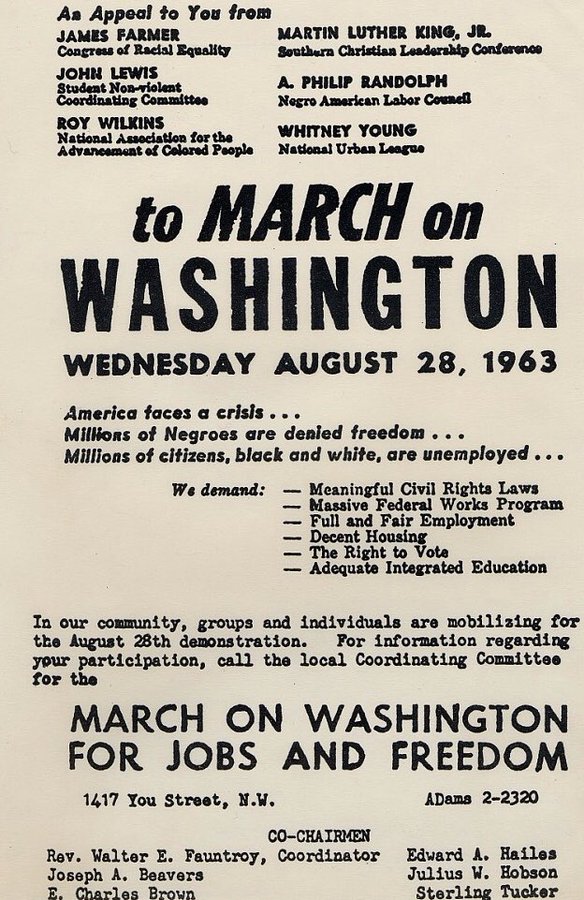
Dylan’s performance was one of a handful of memorable musical appearances. Most of the singers made a far bigger impression, like Mahalia Jackson, Marian Anderson, and Baez herself, whose “We Shall Overcome” created a legendary moment of harmony. No one sang along to Dylan’s new songs—they wouldn’t have known the words. But Dylan was never careless. He chose these words for the moment, hoping to have some impact in the only way he could.
The 1963 March’s purpose has been overshadowed by a few passages in Martin Luther King, Jr.‘s powerful “I Have a Dream” speech, co-opted by everyone and reduced to meme-able quotes. But the protest “remains one of the most successful mobilizations ever created by the American Left,” historian William P. Jones writes. “Organized by a coalition of trade unionists, civil rights activists, and feminists–most of them African American and nearly all of them socialists.”
Dylan sang stories of how the country got to where it was, through a history of violence still playing out before the marchers’ eyes. Whatever political tensions there were among the various organizers and speakers did not distract them from pushing through the 1964 Civil Rights Act and the Fair Employment Practices clause banning discrimination on the basis of race, religion, national origin, or sex—protections that have been broadened since that time, and also challenged, threatened, and stripped away.
Fifty-seven years later, as the RNC convention ends and another March on Washington happens, we might reflect on Dylan’s small but prescient contributions in 1963, in which he aptly characterized the traumatic repetitions we’re still convulsively experiencing over half a century later.
Related Content:
A Massive 55-Hour Chronological Playlist of Bob Dylan Songs: Stream 763 Tracks
Josh Jones is a writer and musician based in Durham, NC. Follow him at @jdmagness
Read More...A New Interactive Map Shows All Four Million Buildings That Existed in New York City from 1939 to 1941
New Yorkers have borne witness to a noticeable uptick in the number of shiny, new buildings going up in the city over the last few years, crowding the waterfront, rising from the ashes of community gardens and older, infinitely more modest structures.
Their developers have taken care to top load them with luxury amenities—rooftop cabanas, 24-hour fitness clubs, marble countertops, screening rooms.
But one thing they can’t provide is the sense of lived history that imbues every old building with a true sense of character, mystique, and oft-grubby charm.
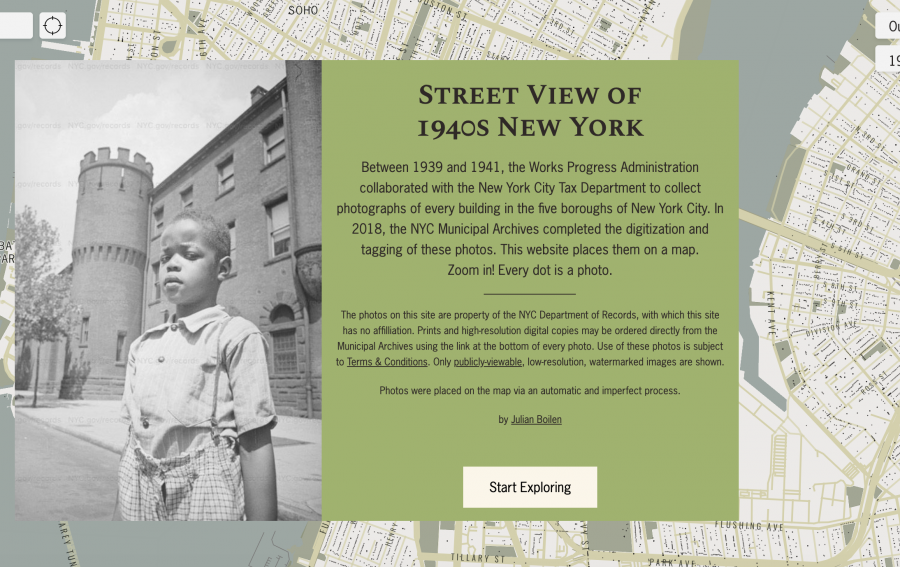
I fear that the occupants of these newer buildings won’t have nearly as much fun as the rest of us searching for our current addresses on the NYC Municipal Archives’ interactive map, above.
Every dot represents a Works Progress Administration photograph of a New York City building, snapped between 1939 and 1941 as a means of standardizing the way in which property values were assessed and recorded.
There are 4,282,000 dots, spread out between five boroughs.
Does that sound densely packed?
You should see it today… there’s been a lot of vertical build.

This unassuming fuel oil plant near Brooklyn’s Gowanus Canal has given way to a 430-unit building boasting a yoga room, spin studios, and valet services for those in need of dry-cleaning, laundry, apartment cleaning, or dog walking…though sadly, no on-premises motor oil. We find that omission somewhat surprising for such a full-service residential development on the banks of a Superfund site, whose clean up is estimated to tip the scales at $500 million.


We also wonder what the occupants of the above buildings would have made of the glassy 25-story complex that opened on their coordinates earlier this year. Is it just us, or does it seem a bit disingenuous of its developers to trumpet that its location is “the epitome of New York City’s authenticity, with over a century of rich history, where the world’s sartorial and culinary trends are born”?

(You can find us a few blocks away muttering into our chopped liver at Russ and Daughters, a venerable food shop that looks much the same today as it did in 1940, though you’ll have to confirm with a bit of research on your own if you don’t want to take our word for it, the WPA “dot” revealing little more than a man with a stick and several moving vehicles.)

Our final stop is one of many architectural ghosts to haunt the Hudson Yards colossus, the self-described “epicenter of Manhattan’s New West Side… a beacon for creative professionals, a hub for fashion, design, communications and art.” In addition to a much reviled $200 million shawarma-shaped “3‑dimensional public space” and state of the art wine fridges, amenities now include diagnostic and antibody testing “performed by top medical professionals.”
It’s telling that in the summer of 2020, prospective tenants were offered incentives including two months’ free rent and a $2,000 gift card.
Proof, perhaps, that New York will continue as it always has—a city in constant flux. The prevalence of modern high rise buildings in dystopian fiction gives us pause.…
Explore the Street View of 1940s New York here.
Related Content:
New York Public Library Puts 20,000 Hi-Res Maps Online & Makes Them Free to Download and Use
Ayun Halliday is an author, illustrator, theater maker and Chief Primatologist of the East Village Inky zine. Follow her @AyunHalliday.
Read More...Back to the Arena: Battling the Hunger Games Prequel with Pretty Much Pop: A Culture Podcast (#57)
Remember when The Hunger Games was everywhere? Its author Suzanne Collins has decided that young people could benefit from more exploration of Just War Theory through the world of Panem, and so has published The Ballad of Songbirds and Snakes, a prequel covering the early years of future president Coriolanus Snow during the 10th Hunger Games.
Pretty Much Pop hosts Mark Linsenmayer, Erica Spyres, and Brian Hirt give their spoiler-free reviews of the new book and look back on the original book trilogy and its adaptation into four films (and do spoil those, in case you want to go watch them). We talk about what makes these novels “YA,” the function of adapting them to film, and the limits of the franchise’s premise and world-building. Does the work critique yet glorify violence at the same time? Will the film version of the new novel be our next Phantom Menace?
Some articles we looked at included:
- “A ‘Hunger Games’ Prequel Focuses on an Unlikely Character” by Sarah Lyall
- “ ‘The Ballad Of Songbirds And Snakes’ Is A Lackluster Prequel To ‘The Hunger Games’ ” by Annalisa Quinn
- “Why the ‘Hunger Games’ Prequel Book is So Controversial” by Lauren Sarner
- Stephen King’s original 2008 Entertainment Weekly review of The Hunger Games
- “Hunger Games: 25 Things Wrong With Katniss Everyone Chooses To Ignore” by Stephanie Marceau
- “How Bad Is Katniss’ PTSD in The Hunger Games? We Asked the Experts” by Vasilis Pozios and Praveen Kambam
- “How does The Hunger Games Criticise American Society?” By Megan Burbage
- “Suzanne Collins Talks About ‘The Hunger Games,’ the Books and the Movies” (Q&A with David Levitan)
- “Why the Message of the Hunger Games Films is Dangerous” by Peter Bloom
- “10 Years Later, is The Hunger Games Still Shocking?” by Constance Grady et al at Vox
- “Hunger Games Prequel Movie The Ballad of Songbirds and Snakes Officially Set by Lionsgate” by Joseph Baxter
Learn more at prettymuchpop.com. This episode includes bonus discussion that you can only hear by supporting the podcast at patreon.com/prettymuchpop. This podcast is part of the Partially Examined Life podcast network.
Pretty Much Pop: A Culture Podcast is the first podcast curated by Open Culture. Browse all Pretty Much Pop posts.
Read More...When Salvador Dalí Met Alice Cooper & Turned Him into a Hologram: The Meeting of Two Kings of Camp (1973)
Kings of camp Alice Cooper and Salvador Dalí made a natural pair when they met in New York City in April of 1973. “A mind-melding of sorts took place,” writes Super Rad Now. “Over the course of about two weeks” Cooper and Dalí “ate together, drank together, and basked in the glow of each other’s exceptional uniqueness.” Then Dalí decided to turn Cooper into a hologram, the First Cylindric Chromo-Hologram Portrait of Alice Cooper’s Brain.
How did this come about? It was only a matter of time before Dalí sought out the “godfather of shock rock.” The Surrealist prankster “knew how to promote himself and others,” notes historian and writer Sophia Deboick in a fantastic understatement. Dalí had been shocking audiences decades before Vincent Furnier, lead singer of the band Alice Cooper—who took the name for himself in 1975—was born, making transgressive films like Un Chien Andalou and getting tossed out of the Surrealists for possible fascist sympathies and unabashedly commercial aspirations.
Dalí used his connections to the world of pop music to meet “figures such as Brian Jones, Bryan Ferry and David Bowie” in the late 60s and early 70s. He came calling at Cooper’s door after the 1972 “rapier-waving performance of ‘School’s Out’ on Top of the Pops [drew] the opprobrium of Mary Whitehouse… and a truck carrying a billboard image of Alice wearing only a snake… mysteriously ‘broke down’ on Oxford Circus the same summer, causing chaos.”
Cooper’s schtick was catnip to Dalí, but as usual, the artist had something more sophisticated in mind when he staged what looked like a typically bizarre publicity stunt. Cooper was invited to Dalí’s studio to pose with “an ant-covered plaster brain topped with a chocolate éclair.” This Dalí placed behind Cooper’s head on a red velvet cushion as Alice “sat on a rotating turntable wearing over a million dollars-worth of diamonds from the famous Harry Winston jewelers on Fifth Avenue (Cooper remembers it in the short video clip at the top as 4 million dollars worth), holding a fragmented Venus de Milo as a microphone.”

For Cooper and the band, the collaboration helped bring their own particular artistic vision to fruition, lending them the imprimatur of the most popular shock artist of the century. “Five of the original band members were art majors,” he later recalled, “and we worshipped Dalí: we thought of ourselves as surrealists.” (He also named one of his boa constrictors Dalí.)
For Dalí, the resulting holographic image fulfilled a longstanding exploration of new ideas and a new medium—as well as a deliberate movement away from his devotion to Freudian psychoanalysis.
Throughout the 1970s Dalí worked with optical illusions and stereoscopic images… but his interest in working in the third and fourth dimensions dated back further. His 1958 Anti-Matter Manifesto proclaimed his intent to abandon his exploration of the interior world for a focus on “the exterior world and that of physics [which] has transcended the one of psychology,” saying he had swapped Freud for Heisenberg. The tesseract cross of his Crucifixion (Corpus Hypercubus) (1954) was inspired by the diverse influences of mathematical theory, cubism, and works of Philip II’s architect Juan de Herrera and Catalan mystic Ramon Llull. The Alice hologram may have taken an emerging popular icon as its subject, but the medium was one which fulfilled Dalí’s artistic ambitions at the end of his career to embrace science and break out of the two dimensional.
The attention may have gone to Cooper’s head. He attended the unveiling of the hologram without his band members, then went on to record 1975’s Welcome to My Nightmare without them and promoted “an ABC television special starring Vincent Price” that same year, again with a new band. His star fell over the decade, but his essential place in rock and roll history had already been fully secured.
Alice Cooper’s (the band) gender-bending had influenced David Bowie and the New York Dolls. The Sex Pistol’s John Lydon breathlessly proclaimed them his favorite and sang (“or at least mimed to”) their “I’m Eighteen” at his audition. “The direct line between Alice Cooper and every possible genre of metal is obvious,” Deboick writes.
Like the Surrealist master, Cooper became something of a parody of his earlier incarnation in later years, and in sobriety, the preacher’s son from Detroit reappeared as a “golf-playing born-again Christian.” But however else he is remembered, the man born Vincent Furnier will also always be the only rock star to have his ant-covered brain turned into a hologram by Salvador Dalí, who knew a kindred spirit when he saw one. See a video of the hologram, which resides in Spain, just above.
Related Content:
Salvador Dalí & Walt Disney’s Short Animated Film, Destino, Set to the Music of Pink Floyd
Salvador Dalí Explains Why He Was a “Bad Painter” and Contributed “Nothing” to Art (1986)
Josh Jones is a writer and musician based in Durham, NC. Follow him at @jdmagness
Read More...Winston Churchill Praises the Virtue of “Brevity” in Memos to His Staff: Concise Writing Leads to Clearer Thinking
George Orwell and Winston Churchill didn’t agree on much. For example, while Orwell wrote with deep sympathy about coal miners in The Road to Wigan Pier, Churchill, as home secretary, brutally crushed a miner’s strike in Wales. Orwell’s early years as “an apparatchik in the last days of the empire… left him with a hatred of authority and imperialism,” writes Richard Eilers. Churchill was a committed imperialist all his life, instrumental in prolonging a famine in British India that killed “at least three million people.”
Importantly for history’s sake, they agreed on the need to confront, rather than appease, the Nazis, against both the British left and right of the 1930s. “At a time not unlike today,” says journalist Tom Ricks, “when people were wondering whether democracy was sustainable, when a lot of people thought you needed authoritarian rule, either from the right or the left, Orwell and Churchill, from their very different perspectives, come together on a key point. We don’t have to have authoritarian government.”
Maybe somewhat less important—but strenuously agreed upon nonetheless by these two figures—was the need for clear, concise prose that avoids obfuscation. In Politics and the English Language—an essay routinely taught in college composition classes—Orwell describes politically misleading writing as overstuffed with “pretentious diction” and “meaningless words.” These are, he writes, signs of a “decadent… civilization.” Churchill has had at least as much influence as Orwell on a certain kind of political writing, though not the kind most of us read often.
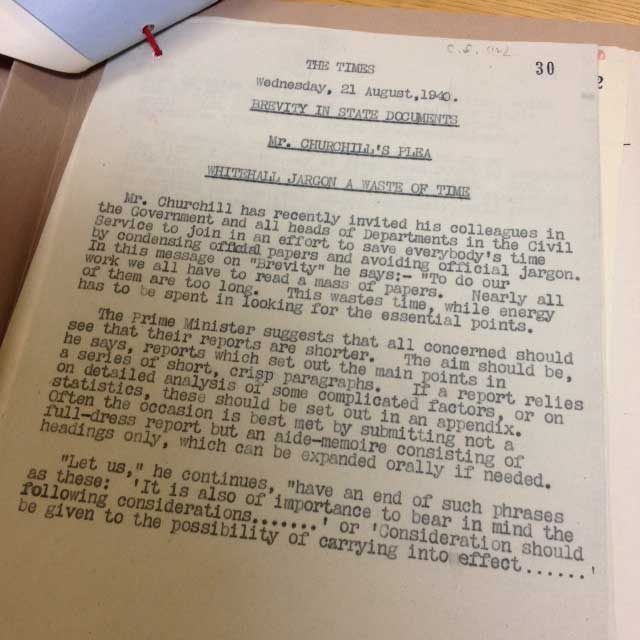
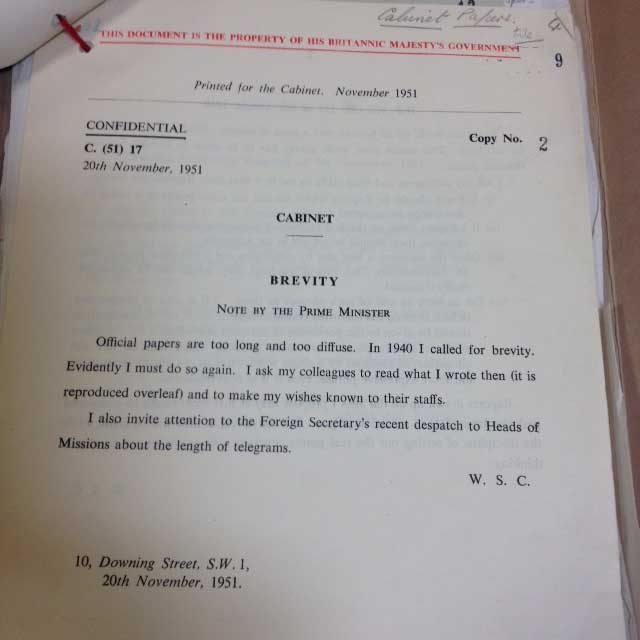
In 1940, Churchill issued a memo to his staff titled “Brevity.” He did not express concerns about creeping fascism in bureaucratic communiques, but decried the problem of wasted time, “while energy has to be spent in looking for the essential points.” He ends up, however, saying some of the same things as Orwell, in fewer words.
I ask my colleagues and their staffs to see to it that their Reports are shorter.
- The aim should be Reports which set out the main points in a series of short, crisp paragraphs.
- If a Report relies on detailed analysis of some complicated factors, or on statistics, these should be set out in an Appendix.
- Often the occasion is best met by submitting not a full-dress Report, but an Aide-memoire consisting of headings only, which can be expanded orally if needed.
- Let us have an end of such phrases as these: “It is also of importance to bear in mind the following considerations…,” or “Consideration should be given to the possibility of carrying into effect….” Most of these woolly phrases are mere padding, which can be left out altogether, or replaced by a single word. Let us not shrink from using the short expressive phrase, even if it is conversational.
Reports drawn up on the lines I propose may at first seem rough as compared with the flat surface of officialese jargon. But the saving in time will be great, while the discipline of setting out the real points concisely will prove an aid to clearer thinking.
The message “cascaded through the civil service,” writes Laura Cowdry at the UK National Archives. A 1940 article in the Times picked up the story. But the problem persisted, as it does today and maybe will till the end of time (or until machines start to do all our writing for us). Frustrated, Churchill issued another admonition, shorter even than the first, in 1951.
Official papers are too long and too diffuse. In 1940 I called for brevity. Evidently I must do so again. I ask my colleagues to read what I wrote then… and to make my wishes known to their staffs.
These memos, Cowdry notes, “may shed some light onto government communications work of the past,” and on the Churchillian style that may have taken hold for decades in government documents, as well as—of course—far beyond them. His emphatic statements also articulate “key elements of good communication that would resonate with the thinking of any modern communicator,” whether Orwell, Kurt Vonnegut, or Cormac McCarthy, who has become a sought-after scientific editor for his strict minimalism.
Churchill did not seem overly concerned with wordiness as a political problem. Orwell did not approach the problem philosophically. That task fell to the Logical Positivists of the early 20th century. In his attempt to explain the wordiness of both undergraduates and world-renowned thinkers, “neo-Positivist” philosopher David Stove goes so far as to ascribe overwriting to “defects of character… such things as an inability to shut up; determination to be thought deep; hunger for power; fear, especially the fear of an indifferent universe….”
Something to consider, maybe, when you’re looking at your next draft email, Facebook comment, or Slack message, and wondering whether it actually needs to be an essay….
Related Comment:
George Orwell’s Six Rules for Writing Clear and Tight Prose
Kurt Vonnegut Explains “How to Write With Style”
Josh Jones is a writer and musician based in Durham, NC. Follow him at @jdmagness
Read More...Food As Pop with Prof. C. Thi Nguyen (Pretty Much Pop: A Culture Podcast #55)

Your hosts Mark Linsenmayer, Erica Spyres, and Brian Hirt are joined by Utah philosophy prof and former food writer C. Thi Nguyen to talk food as art, foodies, elitism, food TV, cooking vs. eating, and how analyzing food is like analyzing games.
Read Thi’s work at objectionable.net, including the article on “outrage porn” we talk about that he co-wrote with Bekka Williams, and his general account of “the arts of action.” Also, check out his blog posts about cookbooks and his new book. Purchase Games: Agency As Art. Follow Thi @add_hawk.
Other sources we looked at include:
- “Welcome to Peak Food TV: Inside Hollywood’s Growing Hunger for Culinary Shows” by Michael O’Connell
- “Why People Loved Bourdain” by Jaron Gilinsky
- “What Was the Foodie?” by Josephine Livingstone
- The 2014 documentary film Foodies: The Culinary Jet Set
- “What Are the Best Food Podcasts Right Now?” by Maryse Chevriere
Learn more at prettymuchpop.com. This episode includes bonus discussion that you can only hear by supporting the podcast at patreon.com/prettymuchpop. This podcast is part of the Partially Examined Life podcast network.
Pretty Much Pop: A Culture Podcast is the first podcast curated by Open Culture. Browse all Pretty Much Pop posts.
Read More...Zamrock: An Introduction to Zambia’s 1970s Rich & Psychedelic Rock Scene
The story of popular music in the late 20th century is never complete without an account of the explosive psychedelic rock, funk, Afrobeat, and other hybrid styles that proliferated on the African continent and across Latin American and the Caribbean in the 1960s and 70s. It’s only lately, however, that large audiences are discovering how much pioneering music came out of Kenya, Ghana, Nigeria, and other postcolonial countries, thanks to UK labels like Strut and Soundway (named by The Guardian as “one of the 10 British Labels defining the sound of 2014” and named “Label of the Year” in 2017).
Germany’s Analogue Africa, a label that reissues classic albums from the era, puts it this way: “the future of music happened decades ago.” Only most Western audiences weren’t paying attention—with notable exceptions, of course: superstar drummer Ginger Baker apprenticed himself to Fela Kuti and became an evangelist for African drumming; Brian Eno and Talking Heads’ David Byrne (who also introduced thousands to “world music”) imported the sound of African rock to New Wave in the 80s, as did post-punk bands like Orange Juice and others in Britain, where music from Africa generally had a bigger impact.
But the fusion of African polyrhythms with rock instruments and song structures had been done, and done incredibly well, already by dozens of bands, including several in the East African country of Zambia, which had been British-controlled Northern Rhodesia until its independence in 1964. In the decade after, bands formed around the country to create a unique form of music known as “Zamrock,” as it came to be called, “forged by a particular set of national circumstances,” writes Calum MacNaughton at Music in Africa.
Zamrock bands were influenced by the funk and soul of James Brown and the heavy rock of Hendrix, Deep Purple, Led Zeppelin, The Who, and Cream—the same music everyone else was listening to. As Rikki Ililonga from the band Musi-O-Tunya says in the Vinyl Me, Please mini-documentary above, says, “the hippie time, the flowers, love and everything, Woodstock. We were a part of that culture too. If the record was in the Top 10 in the UK, it was in the Top 10 here.” But Zambia had its own concerns, and its own powerful musical traditions.
“As much as we wanted to play rock from the Western world, we are Africans,” says Jagari Chanda, vocalist for a band called WITCH (“we intend to cause havoc”), “so the other part is from Africa—Zambia. So it’s Zambian type of rock—Zamrock.” The term was coined by Zambian DJ Manasseh Phiri. The music itself “was the soundtrack of Kenneth Kaunda’s socialist ideology of Zambian Humanism,” MacNaughton notes. “In fact, Zamrock owed much of its existence to the nation’s first president and founding father. A guitar-picker who took great pleasure in song” and who promoted local music “via a quota system” imposed on the newly-formed Zambia Broadcasting Service (ZBS).
Vinyl Me, Please has collaborated with MacNaughton and others from Now-Again Records to release 8 Zamrock albums, “7 of which have never been reissued in their original form.” The video above, “The Story of Zamrock,” reflects their decade-long journey to rediscover the 70s scene and its pioneers. In the video at the top from Bandsplaining, you can learn more about Zamrock, which has been gaining prominence in album reissues for the last several years, and which “deserves to be a part of the musical history of Africa in a much bigger way than it has been up to now,” Henning Goranson Sandberg writes at The Guardian. See all of the music featured in the video at the top in the tracklist below.
0:00 WITCH — “Living In The Past”
0:40 Keith Mlevhu — “Love and Freedom”
1:05 Paul Ngozi — “Bamayo”
3:11 WITCH — “Introduction”
4:19 Musi-O-Tunya — “Mpondolo”
4:32 Musi-O-Tunya — “Dark Sunrise”
5:28 Rikki Ililonga — “Sheebeen Queen”
5:37 WITCH — “Lazy Bones”
6:00 Paul Ngozi — “Anasoni”
6:16 The Peace — “Black Power”
6:46 Keith Mlevhu — “Ubuntungwa”
7:06 Amanaz — “Khala my Friend”
7:24 WITCH — “Living In The Past”
8:19 The Blackfoot — “When I Needed You”
8:39 Salty Dog — “See The Storm”
9:30 Salty Dog — “Fast”
10:42 Rikki Ililonga & Derick Mbao — “Madzi A Moyo”
10:54 Paul Ngozi — “Nshaupwa Bwino”
11:43 Amanaz — “Sunday Morning”
12:38 The Blackfoot — “Lonley Highway”
Related Content:
Stream 8,000 Vintage Afropop Recordings Digitized & Made Available by The British Library
Josh Jones is a writer and musician based in Durham, NC. Follow him at @jdmagness
Read More...Why Fleetwood Mac’s Peter Green (RIP) Was the Most Underrated Guitarist in British Blues
Debates about whether a guitarist is underrated often involve a lot of posturing and needless name-dropping—they don’t tend to go anywhere, in other words. This is not the case with Peter Green, founder and former singer, songwriter, and guitarist for Fleetwood Mac, who died this past weekend. He is, probably most definitely, “the most underrated guitarist in British Blues,” argues the Happy Bluesman, or at least he became so in the last decades of his life.
Green experienced a tragic end to his career with Fleetwood Mac when his mental health declined precipitously in 1970, and he was eventually diagnosed with schizophrenia. His legend lived long among musicians (and fans of the band who preferred their early work), but Green more or less disappeared from public view, even after releasing a handful of solo albums in a period of recovery.
Fleetwood Mac, the group he founded and carried to its first years of major stardom became, of course, “a household name, widely recognized as one of the best soft rock bands ever for hits like ‘The Chain,’ ‘Go Your Own Way,’ and ‘Everywhere’”—songs Peter Green had nothing to do with, though he had the soft rock chops, as the melancholy “Man of the World” beautifully demonstrates. Hear him in some of his other finest moments in the band, including a phenomenal “Black Magic Woman” at the top, before Carlos Santana made the song his signature.
The argument for Green’s most underrated-ness as a blues guitarist is more than compelling, with endorsements from B.B. King—who said Green had “the sweetest tone I ever heard”—and John Mayall, who said he was better than Clapton when Green joined the Bluesbreakers at age 20. After founding Fleetwood Mac, Green wrote “Black Magic Woman,” sent a guitar instrumental, “Albatross,” to the top of the British Charts in 1969 and, that same year, recorded at Chess Records with, among other blues legends, Willie Dixon and Buddy Guy.
Was he the “best” British blues guitarist? He was “the only one who gave me the cold sweats,” King confessed, which sure is something, even if you prefer Clapton or Jeff Beck. Is he the most underrated? Probably most definitely. “Within a few short years, Peter Green had achieved greater commercial success than two of the world’s most famous bands,” selling more records in 1969 than “both The Rolling Stones and The Beatles, combined.” Then he disappeared.
Green is receiving the recognition in death that eluded him in his last years, though fame never seemed to truly motivate him at any time in his life. Fellow musicians have spared no superlatives in online memorials, including Metallica’s Kirk Hammett, not known for going anywhere near an early Fleetwood Mac sound. But Green was a consummate musician’s musician (he named his band after the rhythm section!), and he earned the respect of serious rock artists and serious blues artists and serious metal artists.
A longtime friend and admirer, Hammett owns Green’s ’59 Gibson Les Paul (nicknamed “Greeny”). He recently covered Green’s last Fleetwood Mac song—“The Green Manalishi (With the Two Prong Crown)”—live onstage and was collaborating on new material with his idol. “Our loss is total,” Hammett wrote in tribute, perhaps the most succinct and devastating tribute among so many. Fleetwood Mac would never have existed without him. And his influence on the British Blues and beyond goes even deeper. See Green revisit his lovely “Man of the World” in a more recent performance, just below. He steps back from the fiery leads, playing subtle rhythm parts, but he still has the old magic in his fingers.
Related Content:
The Thrill is Gone: See B.B. King Play in Two Electric Live Performances
Josh Jones is a writer and musician based in Durham, NC. Follow him at @jdmagness
Read More...Support Us
We're hoping to rely on loyal readers, rather than erratic ads. Please click the Donate button and support Open Culture. You can use Paypal, Venmo, Patreon, even Crypto! We thank you!

About Us

Open Culture scours the web for the best educational media. We find the free courses and audio books you need, the language lessons & educational videos you want, and plenty of enlightenment in between.
Advertise With Us
FREE UPDATES!
GET OUR DAILY EMAIL
Get the best cultural and educational resources on the web curated for you in a daily email. We never spam. Unsubscribe at any time.
FOLLOW ON SOCIAL MEDIA
Open Culture editor Dan Colman scours the web for the best educational media. He finds the free courses and audio books you need, the language lessons & movies you want, and plenty of enlightenment in between.
Advertise With Us

