The Bayeux Tapestry Animated
We had to do it. We had to bring back a wonderful little animation of The Bayeux Tapestry — you know, the famous embroidery that offers a pictorial interpretation of the Norman Conquest of England (1066) and the events leading up to this pivotal moment in medieval history. Currently residing in France, the tapestry measures 20 inches by 230 feet, and you can now see an animated version of the story it narrates. The clip above starts roughly halfway through the historical narrative, with the appearance of Halley’s Comet, and it concludes with the Battle of Hastings in 1066. The video created by David Newton began as a student project at Goldsmiths College.
P.S. Don’t miss the many courses in the History section of our big collection of Free Online Courses. They’re all from top flight universities.
Follow us on Facebook, Twitter and now Google Plus and share intelligent media with your friends! They’ll thank you for it.
Read More...The Animation of Billy Collins’ Poetry: Everyday Moments in Motion
The first time I saw Billy Collins speak, he appeared at my college convocation, toward the end of his years as United States Poet Laureate. Now, the second time I’ve seen Billy Collins speak, he appears giving this TEDTalk, “Everyday Moments, Caught in Time,” in which he makes fun of his own tendency to mention his years as United States Poet Laureate. But he mostly uses his fifteen minutes onstage in Long Beach in front of TED’s swooping cameras to talk about how the Sundance Channel animated five of his poems. A booster of poetry “off the shelf” and into public places — subways, billboards, cereal boxes — he figured that even such an “unnatural and unnecessary” merger could further the cause of eluding humanity’s “anti-poetry deflector shields that were installed in high school.”
Collins also notes that the idea for the project stirred the embers of his “cartoon junkie” childhood, when Bugs Bunny was his muse. Stylistically, however, the producers at the Sundance Channel kept quite far indeed from the Merrie Melodies. These animated poems opt instead for an aesthetic that takes pieces of visual reality and repurposes them in ways we don’t expect: look at the real arm slithering across the pages in the first poem, the tangible-looking dolls and doll environments of the second poem, or the drifting photographic cutouts of the third. Not to get too grand about it, but isn’t this what poetry itself is supposed to do? Don’t the words themselves also cut out fragments of actual existence and position them, recontextualize them, and move them around in ways that surprise us? The substance of these shorts — fountain pens, figurines, car keys, paper boats, matchsticks, mice — may seem like the last word in mundanity, but perceived through the differently “real” lenses of Collins’ poetry and this unusual animation, they inspire curiosity again.
Related content:
3 Year Old Recites Poem, “Litany” By Billy Collins
Bill Murray Reads Poetry At Construction Site
Colin Marshall hosts and produces Notebook on Cities and Culture. Follow him on Twitter at @colinmarshall.
Read More...RIP Peter Bergman; Hear the Firesign Theatre’s 1970 Masterpiece
“I’m too young to have been around when these were current,” reads one YouTube comment posted to a piece of Firesign Theatre material, “but as soon as I heard their first four albums or so, my dad’s jokes suddenly made sense.” Responding to another clip, someone else recalls, “My father quoted bits of their show throughout my entire childhood, and as we got older we asked where they came from.” A third commenter appears below yet another artifact from a Firesign record: “My dad has been listening to this since it came out in 1969, and I myself have been listening to it since he showed me it when I was seven in 1989… and we’re STILL finding new things about it.” I count myself in this parade of late-twenties-early-thirties listeners who embrace enthusiasm for the Firesign Theatre as their patrocliny. Having never known a world without all four of these guys whom Robert Christgau was calling “the grand old men of head comedy” even in 1977, we find ourselves not just dismayed but startled by the passing of founding member Peter Bergman last Friday.
For a refresher course — or even a first course — in the inimitable Firesign sensibility, look no further than the quartet’s 1970 album Don’t Crush That Dwarf, Hand Me the Pliers, available in four parts on YouTube. Enthusiasts of studio-recorded comedy consider it the Ulysses of the form (or even its Finnegans Wake), though you won’t have to perform quite so much scholarship before you’re allowed to laugh at the jokes.
In the late sixties and early seventies, Bergman and his co-surrealists Phil Austin, David Ossman, and Philip Proctor realized they could use then-modern recording studio technology not just as a facility for capturing comedy, but for creating comedy — a new kind of comedy nobody had ever heard before. Layering speech upon noise upon sonic abstraction, the Firesign Theatre did with the traditions of radio comedy what Steely Dan did with those of jazz and rock, crafting a dense satirical polyphony of jab, wordplay, allusion, and controlled inarticulacy that yields different laughs on different levels depending on where, when, and who you are. This proved the ideal way to tell the story of Don’t Crush That Dwarf’s protagonist George Leroy Tirebiter, former teen actor and current wee-hour channel-flipper in a dystopian future Los Angeles clouded with evangelism, hucksterism, and creeping paranoia.
Bergman himself said they made their records to be heard about eighty times. If we in this newest wave of adult Firesign Theatre fandom believe the college stories our fathers tell, Don’t Crush That Dwarf could play eighty times during the course of a single party. (Before the invention of the internet, I suppose you took your intellectual stimulation where you found it.) Unlike them, we didn’t come upon the album by way of an insistent friend sitting us down with a pair of headphones and a joint; we’ve been hearing Dad play the thing since we were in diapers. I find it impossible to imagine a childhood — indeed, an existence — without constant references to hot-buttered groat clusters, Morse Science High School, Ersatz Brothers Coffee, or the Department of Redundancy Department. I haven’t quite heard the Firesign Theatre’s masterpiece eighty times yet, but whenever I put on their interpretation of Hesiod’s five ages of man by way of the five ages of Tirebiter’s life, I listen with the confidence that it will last me through five of my own.
Links to each part of Don’t Crush That Dwarf, Hand Me the Pliers: one, two, three, four
Colin Marshall hosts and produces Notebook on Cities and Culture. Follow him on Twitter at @colinmarshall.
Read More...How Bertrand Russell Turned The Beatles Against the Vietnam War
The Beatles were so much a part of the youth movement that blossomed in the 1960s that it’s amusing to think that one of the main issues that energized the movement–peace–came to the Beatles through a 92-year-old man.
As Paul McCartney explains in this clip from a January 14, 2009 interview on The View, it happened when he decided to pay a visit to philosopher Bertrand Russell. A co-founder of analytic philosophy, Russell had been a life-long social and political activist. During World War I, he was not allowed to travel freely in Britain due to his anti-war views. He lost his fellowship at Trinity College, Cambridge, and was eventually jailed for six months for supposedly interfering with British Foreign Policy. After World War II, Russell lobbied strenuously for the abolition of nuclear weapons. In the 1960s, he opposed the Vietnam War.
After the Beatles became big in 1963 and 1964, McCartney began taking advantage of his celebrity status by calling on people he admired. In an interview with Barry Miles for the book Paul McCartney: Many Years From Now, McCartney describes his meeting with Russell:
Somehow I got his number and called him up. I figured him as a good speaker, I’d seen him on television, I’d read various bits and pieces and was very impressed by his dignity and the clarity of this thinking, so when I got a chance I went down and met him. Bertrand Russell lived in Chelsea in one of those little terrace houses, I think it was Flood Street. He had the archetypal American assistant who seemed always to be at everyone’s door that you wanted to meet. I sat round waiting, then went in and had a great little talk with him. Nothing earth-shattering. He just clued me in to the fact that Vietnam was a very bad war, it was an imperialist war and American vested interests were really all it was all about. It was a bad war and we should be against it. That was all. It was pretty good from the mouth of the great philosopher. “Slip it to me, Bert.”
McCartney reported his experience to the other members of the Beatles, and it was John Lennon who really took the anti-war message and ran with it. For a reminder of those days, watch the video below of Lennon and Yoko Ono at their “Bed-In” for peace in 1969:
If you would like to support the mission of Open Culture, consider making a donation to our site. It’s hard to rely 100% on ads, and your contributions will help us continue providing the best free cultural and educational materials to learners everywhere. You can contribute through PayPal, Patreon, and Venmo (@openculture). Thanks!
Read More...‘This Is Water’: Complete Audio of David Foster Wallace’s Kenyon Graduation Speech (2005)
Last month, on the occasion of the author’s 50th birthday, we posted a large collection of free essays and stories by David Foster Wallace. But we missed a rare item: the complete audio recording of the commencement address Wallace gave at Kenyon College, in Ohio, on May 21, 2005–three years before he took his own life. The text of the speech has been published on the Internet and as a book called This Is Water: Some Thoughts, Delivered on a Significant Occasion, about Living a Compassionate Life, but the complete audio version has been hard to find.
In the speech, Wallace talks about the challenge of moving beyond the superficial kind of freedom that can be acquired through power and wealth, toward a truer liberation that arises only when we become more fully conscious of the world outside our “tiny skull-sized kingdoms.” He says:
The really important kind of freedom involves attention, and awareness, and discipline, and effort, and being able truly to care about other people and to sacrifice for them, over and over, in myriad petty little unsexy ways, every day. That is real freedom. The alternative is unconsciousness, the default setting, the “rat race”–the constant gnawing sense of having had and lost some infinite thing.
You can listen to the first half of the speech above. And to delve deeper into Wallace’s worldview, be sure to watch the fascinating 84-minute interview he gave in 2003 to a German television station. H/T Avi Burstein.
If you would like to support the mission of Open Culture, consider making a donation to our site. It’s hard to rely 100% on ads, and your contributions will help us continue providing the best free cultural and educational materials to learners everywhere. You can contribute through PayPal, Patreon, and Venmo (@openculture). Thanks!
Related Content:
30 Free Essays & Stories by David Foster Wallace on the Web
David Foster Wallace on What’s Wrong with Postmodernism: A Video Essay
Read More...75 Free Philosophy Courses
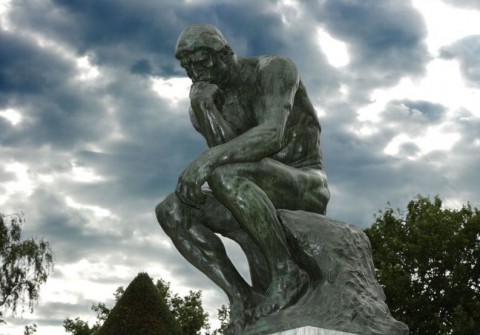
The Philosophy section of our big Free Courses collection just went through a major update, and it now lists more than 75 courses. Enough to give you a soup-to-nuts introduction to a timeless discipline. You can start with one of several introductory courses.
- Philosophy for Beginners – iTunes – Web Video – Marianne Talbot, Oxford
- Critical Reasoning for Beginners - iTunes Video – iTunes Audio – Web Video — Oxford
- A Romp through Ethics for Complete Beginners - iTunes Video –Web Video — Oxford
- Introduction to Political Philosophy – YouTube – iTunes – Web Video — Steven B. Smith, Yale
- The Art of Living — Web Video – Stanford
- The History of Philosophy Without Any Gaps - Multiple Formats– Peter Adamson, King’s College London
Then, once you’ve found your footing, you can head off in some amazing directions. As we mentioned many moons ago, you can access courses and lectures by modern day, rock star philosophers — Michel Foucault, Bertrand Russell, John Searle, Walter Kaufmann, Leo Strauss, Hubert Dreyfus and Michael Sandel. Then you can sit back and let them introduce you to the thinking of Aristotle, Socrates, Plato, Hobbes, Hegel, Heidegger, Kierkegaard, Kant, Nietzsche, Sartre and the rest of the gang. The courses listed here are generally available via YouTube, iTunes, or the web.
Explore our collection of 400 Free Courses to find topics in many other disciplines — History, Literature, Physics, Computer Science and beyond. As we like to say, it’s the most valuable single page on the web.
Read More...30 Free Essays & Stories by David Foster Wallace on the Web
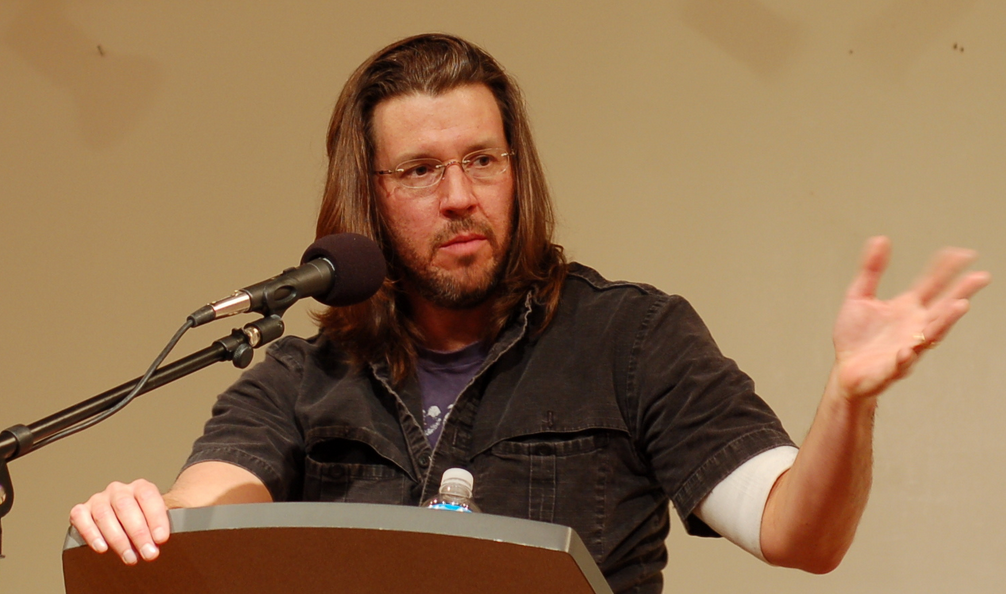
Image by Steve Rhodes, via Wikimedia Commons
We started the week expecting to publish one David Foster Wallace post. Then, because of the 50th birthday celebration, it turned into two. And now three. We spent some time tracking down free DFW stories and essays available on the web, and they’re all now listed in our collection, 800 Free eBooks for iPad, Kindle & Other Devices. But we didn’t want them to escape your attention. So here they are — 23 pieces published by David Foster Wallace between 1989 and 2011, mostly in major U.S. publications like The New Yorker, Harper’s, The Atlantic, and The Paris Review. Enjoy, and don’t miss our other collections of free writings by Philip K. Dick and Neil Gaiman.
- “9/11: The View From the Midwest” (Rolling Stone, October 25, 2001)
- “All That” (New Yorker, December 14, 2009)
- “An Interval” (New Yorker, January 30, 1995)
- “Asset” (New Yorker, January 30, 1995)
- “Backbone” An Excerpt from The Pale King (New Yorker, March 7, 2011)
- “Big Red Son” from Consider the Lobster & Other Essays
- “Brief Interviews with Hideous Men” (The Paris Review, Fall 1997)
- “Consider the Lobster” (Gourmet, August 2004)
- “David Lynch Keeps His Head” (Premiere, 1996)
- “Everything is Green” (Harpers, September 1989)
- “E Unibus Pluram: Television and U.S. Fiction” (The Review of Contemporary Fiction, June 22, 1993)
- “Federer as Religious Experience” (New York Times, August 20, 2006)
- “Good People” (New Yorker, February 5, 2007)
- “Host” (The Atlantic, April 2005)
- “Incarnations of Burned Children” (Esquire, April 21, 2009)
- “Laughing with Kafka” (Harper’s, January 1998)
- “Little Expressionless Animals” (The Paris Review, Spring 1988)
- “On Life and Work” (Kenyon College Commencement address, 2005)
- “Order and Flux in Northampton” (Conjunctions, 1991)
- “Rabbit Resurrected” (Harper’s, August 1992)
- “Several Birds” (New Yorker, June 17, 1994)
- “Shipping Out: On the (nearly lethal) comforts of a luxury cruise” (Harper’s, January 1996)
- “Tennis, trigonometry, tornadoes A Midwestern boyhood” (Harper’s, December 1991)
- “Tense Present: Democracy, English, and the wars over usage” (Harper’s, April 2001)
- “The Awakening of My Interest in Annular Systems” (Harper’s, September 1993)
- “The Compliance Branch” (Harper’s, February 2008)
- “The Depressed Person” (Harper’s, January 1998)
- “The String Theory” (Esquire, July 1996)
- “The Weasel, Twelve Monkeys And The Shrub” (Rolling Stone, April 2000)
- “Ticket to the Fair” (Harper’s, July 1994)
- “Wiggle Room” (New Yorker, March 9, 2009)
Related Content:
Free Philip K. Dick: Download 13 Great Science Fiction Stories
Neil Gaiman’s Free Short Stories
Read 17 Short Stories From Nobel Prize-Winning Writer Alice Munro Free Online
Read More...The David Foster Wallace Audio Archive: A Little Gift For the Novelist’s 50th Birthday
When we featured David Foster Wallace’s big, uncut interview yesterday, one important detail escaped us — the fact that the novelist would have turned 50 years old today. Kind of a stunning thought, especially if you vividly remember the wunderkind taking the literary world by storm with Infinite Jest in 1996. Seems like only yesterday.
To celebrate his 50th, we’re highlighting for you The David Foster Wallace Audio Project — a site that brings together most of the meaningful DFW audio available on the web. Built in 2009 by Jordyn Bonds and Ryan Walsh, a short while after the novelist committed suicide, the audio site is divided into four sections:
As you sift through the collection, you will find 70+ clips, including a segment of DFW’s 2005 commencement speech at Kenyon College, his first and second appearances on the Charlie Rose Show, his reading from “Consider the Lobster” at UCLA, and the author contemplating the play of Roger Federer. Dive into the full collection here.
Read More...An Animated History Of Aviation: From da Vinci’s Sketches to Apollo 11
It starts with Leonardo da Vinci’s famous sketches of flying machines, then moves to the first hot air balloon launched by the Montgolfier brothers in 1783, the gliders created by Sir George Cayley (1804), and the Wright brothers’ first flight at Kitty Hawk in 1903. These great moments and others all get covered in this Animated History of Aviation, an elegant little film produced by Utah Valley University, a college with a large aviation program of its own. We’ll add it to our collection of Great Science Videos.
If you would like to support the mission of Open Culture, consider making a donation to our site. It’s hard to rely 100% on ads, and your contributions will help us continue providing the best free cultural and educational materials to learners everywhere. You can contribute through PayPal, Patreon, and Venmo (@openculture). Thanks!
Read More...Harold Bloom Recites ‘Tea at the Palaz of Hoon’ by Wallace Stevens
Literary critic Harold Bloom once called Wallace Stevens (1879–1955) “the best and most representative American poet of our time.” In this video from Boston College’s Guestbook Project, Bloom recites a poem from Stevens’s first book, Harmonium, which was published in 1923:
Tea at the Palaz of Hoon
Not less because in purple I descended
The western day through what you called
The loneliest air, not less was I myself.
What was the ointment sprinkled on my beard?
What were the hymns that buzzed beside my ears?
What was the sea whose tide swept through me there?
Out of my mind the golden ointment rained,
And my ears made the blowing hymns they heard.
I was myself the compass of that sea:
I was the world in which I walked, and what I saw
Or heard or felt came not but from myself;
And there I found myself more truly and more strange.
“The palaz of Hoon is sky and space seen as a gaudy and ornate dwelling,” writes Bloom in Wallace Stevens: The Poems of Our Climate; “to have tea at the palaz is to watch the twilight while conversing with the setting sun, who is hardly lonely since all the air is his and since all directions are at home in him. He is himself when most imperial, in purple and gold, and his setting is a coronation.”
The video concludes with Bloom reciting the opening stanza from a later poem by Stevens that echoes the earlier one, a poem regrettably titled “Like Decorations in a Nigger Cemetery”:
In the far South the sun of autumn is passing
Like Walt Whitman walking along a ruddy shore.
He is singing and chanting the things that are part of him,
The worlds that were and will be, death and day.
Nothing is final, he chants. No man shall see the end.
His beard is of fire and his staff is a leaping flame.
“Whitman, like Hoon,” writes Bloom, “both contains everything else and is an idea of the sun, not as a god but as a god might be. Hoon is himself the compass of the sea whose tides sweep through him; Walt encompasses worlds but himself is not to be encompassed.”
Read More...Support Us
We're hoping to rely on loyal readers, rather than erratic ads. Please click the Donate button and support Open Culture. You can use Paypal, Venmo, Patreon, even Crypto! We thank you!

About Us

Open Culture scours the web for the best educational media. We find the free courses and audio books you need, the language lessons & educational videos you want, and plenty of enlightenment in between.
Advertise With Us
FREE UPDATES!
GET OUR DAILY EMAIL
Get the best cultural and educational resources on the web curated for you in a daily email. We never spam. Unsubscribe at any time.
FOLLOW ON SOCIAL MEDIA
Open Culture editor Dan Colman scours the web for the best educational media. He finds the free courses and audio books you need, the language lessons & movies you want, and plenty of enlightenment in between.
Advertise With Us


