J.R.R. Tolkien in His Own Words
Today is the birthday of J.R.R. (John Ronald Reuel) Tolkien, author of the fantasy novels The Hobbit and The Lord of the Rings. He was born on January 3, 1892 to British parents in Bloemfontein, South Africa. His father died when he was 3 years old, and he moved with his mother to England. The young boy took an early liking to stories of magic and myth. In his 1947 book On Fairy Stories, Tolkien wrote:
I had very little desire to look for buried treasure or fight pirates, and Treasure Island left me cool. Red Indians were better: there were bows and arrows (I had and have a wholly unsatisfied desire to shoot well with a bow), and strange languages, and glimpses of an archaic mode of life, and above all, forests in such stories. But the land of Merlin and Arthur were better than these, and best of all the nameless North of Sigurd and the Volsungs, and the prince of all dragons. Such lands were pre-eminently desirable.
The urge to compose his own tales came early, but Tolkien became sidetracked by an interest in the subtleties of language. In a letter to W.H. Auden in 1955 he wrote:
I first tried to write a story when I was about seven. It was about a dragon. I remember nothing about it except a philological fact. My mother said nothing about the dragon, but pointed out that one could not say “A green great dragon,” but had to say “a great green dragon.” I wondered why, and still do. The fact that I remember this is possibly significant, as I do not think I ever tried to write a story again for many years, and was taken up with language.
Tolkien became a philologist. He studied English Language and Literature at Exeter College, Oxford and–after a harrowing experience in the trenches of World War I–embarked on an academic career. He became an expert on Anglo Saxon and Norse mythology.
But the misty forests of Tolkien’s childhood imagination never left him. One day in the early 1930s, he was at home grading a large stack of student papers when his mind began to wander. On a blank sheet in one of the papers, the professor found himself writing, “In a hole in the ground there lived a hobbit.” He didn’t know what a hobbit was, but soon found himself spinning a tale, which he told to his young children. In 1937 it was published as The Hobbit.
The popularity of The Hobbit, not only with children but with adults, led to requests for a sequel, and in 1954 and 1955 Tolkien’s epic trilogy, The Lord of the Rings was published. It went on to become one of the most popular works of fiction of the 20th century, with over 150 million copies sold worldwide–and counting.
In celebration of Tolkien’s 120th birthday, we present a fascinating film on the author from the BBC series In Their Own Words: British Novelists. The 27-minute film was first broadcast in March of 1968, when Tolkien was 76 years old, and includes interviews and footage of the old man at his haunts in Oxford. H/T The Writer’s Almanac.
Related Content:
Free Audio: Download the Complete Chronicles of Narnia by C.S. Lewis
Read More...The Best of Open Culture 2011
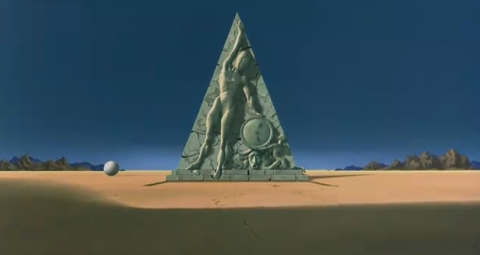
Before we rush headlong into a new year, it’s worth pausing, ever so briefly, to consider the ground we covered in 2011. What topics resonated with you … and jazzed us? Today, we’re highlighting 10 thematic areas (and 46 posts) that captured the imagination. Chances are you missed a few gems here. So please join us on our brief journey back into time. Tomorrow, we start looking forward again.
1) Universities Offer More Free Courses, Then Start Pushing Toward Certificates: The year started well enough. Yale released another 10 stellar open courses. (Find them on our list of 400 Free Courses). Then other universities started pushing the envelope on the open course format. This fall, Stanford launched a series of free courses that combined video lectures with more dynamic resources — short quizzes; the ability to pose questions to Stanford instructors; feedback on your overall performance; a statement of accomplishment from the instructor, etc. A new round of free courses will start in January and February. (Get the full list and enroll here.) Finally, keep your eyes peeled for this: In 2012, MIT will offer similar courses, but with one big difference. Students will get an official certificate at the end of the course, all at a very minimal charge. More details here.
2) Cultural Icons at Occupy Wall Street: OWS was a big national story, and we were always intrigued by its cultural dimension — by the cultural figures who championed the movement. You can revisit performances/speeches by: Philip Glass & Lou Reed; Willie Nelson, Pete Seeger, and Arlo Guthrie; David Crosby and Graham Nash; Joseph Stiglitz and Lawrence Lessig; Noam Chomsky; and Slavoj Zizek. Also check out: 8 Lectures from Occupy Harvard and Artistic Posters From Occupy Wall Street.
3) Books Intelligent People Should Read: Neil deGrasse Tyson’s list “8 (Free) Books Every Intelligent Person Should Read” ended up generating far more conversation and controversy than we would have expected. (Users have left 83 comments at last count.) No matter what you think of his rationale for choosing these texts, the books make for essential reading, and they’re freely available online.
Tyson’s list dovetails fairly nicely with another list of essential texts — The Harvard Classics, a 51 volume set that’s available online. According to Charles W. Eliot, the legendary Harvard president, if you were to spend just 15 minutes a day reading these books, you could give yourself a proper liberal education. And that could partly apply to another list we pulled together: 20 Popular High School Books Available as Free eBooks & Audio Books — the great literary classics taught in classrooms all across America, all free…
4) Christopher Hitchens and Stephen Fry: Christopher Hitchens left us this past month. And, until his last day, Hitchens was the same old Hitch — prolific, incisive, surly and defiant, especially when asked about whether he’d change his position on religion, spirituality and the afterlife. All of this was on display when he spoke at the American Jewish University in Los Angeles last February. We covered his comments in a post called, No Deathbed Conversion for Me, Thanks, But it was Good of You to Ask. And even from the grave, Hitchens did more of the same, forcing us to question the whole modern meaning of Christmas.
During Hitch’s final days, Stephen Fry emceed a large tribute to his friend in London, an event that brought together Richard Dawkins, Christopher Buckley, Salman Rushdie, Lewis Lapham, Martin Amis, poet James Fenton and actor Sean Penn. It’s well worth a watch. But you also shouldn’t miss some other great videos featuring the wisdom of Mr. Fry — his introduction to the strange world of nanoscience, his animated debate on the virtues (or lack thereof) of the Catholic Church, and his thoughtful reflection, What I Wish I Had Known When I Was 18.
5) Four for the Fab Four: John, Paul, Ringo and George. We sneak them in whenever we can. A sprinkling here and there. This year, we served up an ever-popular post, Guitarist Randy Bachman Demystifies the Opening Chord of ‘A Hard Day’s Night’, and a no less popular freebie: Download The Beatles’ Yellow Submarine as a Free, Interactive eBook. Trailing right behind are two other good Beatles picks: All Together Now: Every Beatles Song Played at Once and The Beatles’ Rooftop Concert: The Last Gig.
6) Wisdom from Great Philosophers: Want the chance to take courses from great philosophers? Here’s your opportunity. Our meta post brought together courses/lectures from Bertrand Russell, Michel Foucault, John Searle, Walter Kaufmann, Leo Strauss, Hubert Dreyfus, and Michael Sandel. You could get lost in this for days. Also while you’re at it, you should check out The History of Philosophy … Without Any Gaps, an ongoing podcast created by Peter Adamson (King’s College London) that moves from the Ancients to the Moderns. Plus we’d encourage you to revisit: Noam Chomsky & Michel Foucault Debate Human Nature & Power in 1971.
7) Vintage Film Collections: Scouring the web for vintage films. It’s something we love to do. In 2011, we brought you 22 films by Alfred Hitchcock, 25 Westerns with John Wayne, 32 Film Noir classics, and a series of films by the great Russian director Andrei Tarkovsky. All are listed in our big collection of Free Movies Online.
8) Back to the Future: We had fun going back — way back — and seeing how past generations imagined the future. Arthur C. Clarke Predicted the Future in 1964 … And Pretty Much Nailed It. Before that, American fashion designers looked roughly 70 years into the future and guessed how women might dress in Year 2000. Turns out fashion designers aren’t the best futurists. And, even before that (circa 1922), we get to see the world’s first mobile phone in action. Seriously!
9) Animated Films: 2011 started off on exactly the right note. On January 1, we featured Shel Silverstein’s animated version of The Giving Tree. Then some other gems followed: Destino, the Salvador Dalí – Disney collaboration that started in 1946 and finished in 1999; Spike Jonze’s Auprès de Toi (To Die By Your Side), a short stop motion film set inside the famous Parisian bookstore, Shakespeare and Company; John Turturro narrating an animated version of Italo Calvino’s fairy tale, “The False Grandmother;” and a series of animated films featuring the voice of Orson Welles. Also let’s not forget these splendid animation concepts for The Amazing Adventures of Kavalier and Clay and, just for good measure, Terry Gilliam’s vintage primer on making your own cut-out animation.
10) New Archives & Art on the Web: Last but not least — 2011’s new archival projects that brought great culture to the web.
- Google “Art Project” Brings Great Paintings & Museums to You
- Royal Society Opens Online Archive; Puts 60,000 Papers Online
- Google Puts The Dead Sea Scrolls Online (in Super High Resolution)
- The Smithsonian Launches Wildlife Photo Archive
- Sir Isaac Newton’s Papers & Annotated Principia Go Digital
And now onward into 2012.…
Read More...Why is the U.S. F’ed Up? 8 Lectures from Occupy Harvard Teach-In Provide Answers
Last Wednesday, the Occupy movement gained a little more intellectual momentum when eight faculty members from Harvard, Boston College, and N.Y.U. gathered in Cambridge to present a daylong Teach-In. In one talk, Archon Fung (Ford Foundation Professor of Democracy and Citizenship and Co-Director of Transparency Policy Project at Harvard) took a vague thesis of the Occupy movement — “Shit is Fucked Up and Bullshit” — and gave it some academic depth in a data-filled talk called “Why Has Inequality Grown in America? And What Should We Do About It?” The other talks are available on YouTube (see links below) or via audio stream:
Heterodox Economics: Alternatives to Mankiw’s Ideology - Stephen Marglin, Walter Barker Professor of Economics, Faculty of Arts and Sciences, Harvard University
Wall Street’s Role in the European Financial Crisis - Richard Parker, Lecturer in Public Policy and Senior Fellow at the Shorenstein Center, Kennedy School of Government, Harvard University
The Occupy Movement and Student Debt Refusal — Andrew Ross, Professor of Social and Cultural Analysis, New York University
Economics for the 99% — Juliet Schor, Professor of Sociology, Boston College
Booms and Busts: The Legal Dynamics of Modern Money — Christine Desan, Professor of Law, Harvard Law School, Harvard University
Fear and Power — Brad Epps, Professor of Romance Languages & Literatures and Department Chair for Studies in Women, Gender, and Sexuality, Faculty of Arts and Sciences, Harvard University
Vigilance, Inquiry, Alienation & Hope at Harvard and in the USA - John Womack, Robert Woods Bliss Professor of Latin American History and Economics, Faculty of Arts and Sciences, Harvard University
Related Content:
Noam Chomsky at Occupy Boston
Harvard Thinks Big, a TED-Esque Event
Read More...Philosophy in Prison: Weighty Conversations about Right and Wrong
When not founding tech companies, Damon Horowitz teaches philosophy through the Prison University Project, bringing college-level classes to inmates of San Quentin State Prison. In three minutes, Horowitz raps about philosophy meeting real life — about how prisoners convicted of serious crimes come to terms with Socrates (who finished his days in prison), Heidegger, Kant, categorical imperatives, questions of right and wrong, and the rest. The “talk” was originally presented at TED 2011 last March.
Related Content:
Download Free Courses from Famous Philosophers: From Bertrand Russell to Michel Foucault
Noam Chomsky & Michel Foucault Debate Human Nature & Power (1971)
The History of Philosophy Without Any Gaps
Bertrand Russell & Other Big Thinkers in BBC Lecture Series (Free)
Read More...Post-Apocalyptic Cover Art Created in Amazing Time-Lapse Film
Dei Gaztelumendi is a young Spanish artist. He was commissioned recently to create a cover illustration for the comic book magazine Xabiroi, and decided to make a time-lapse video of the process. The result is a fascinating look at how the artist begins with a rough sketch on paper and then builds layer upon layer of detail using the Adobe Creative Suite software. Thirty hours of work are compressed into 11 minutes. “A lot of emotion went into this painting,” Gaztelumendi said on his blog, “since I made it as a gift to one of my buddies, who tragically lost a leg in a motorbike accident about a year ago.” Gaztelumendi was born in San Sebastian, Basque Country, Spain in 1987, and began illustrating children’s books as a teenager. He studied animation at Sheridan College in Ontario, Canada, where his thesis film was a whimsical tale called Earlth & Moonch. Since graduating with high honors last year, Gaztelumendi has been working as a commercial illustrator, specializing in creature and character art. You can see more of his work at Deisign.com.
Read More...Striking Posters From Occupy Wall Street: Download Them for Free

Occupy Wall Street and the global Occupy Movement have inspired some striking artwork. Graphic artists from around the world (including Shepard Fairey mentioned here earlier today) have contributed their talents to the movement. Many of their posters are available for free or at low cost, either directly from the artist or through organizations like Occuprint and OccupyTogether. You can post them in your town.
New Yorker cover artist and book illustrator Eric Drooker has created several beautiful posters, including the one above. You can download a high-resolution copy suitable for printing at OccupyTogether.org.
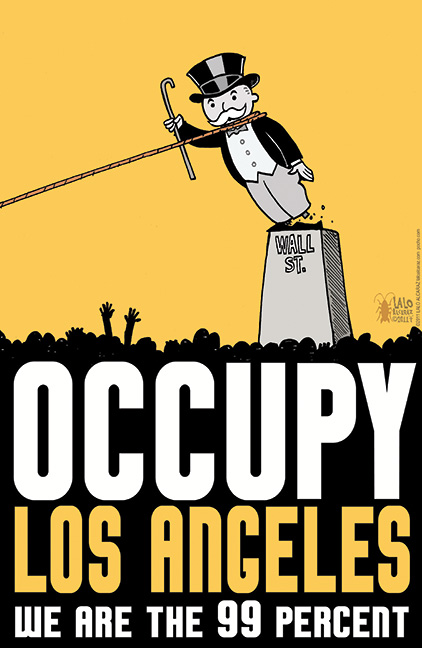
The noted Los Angeles graphic artist, cartoonist and radio personality Lalo Alcaraz created this parody of the toppling of the Saddam Hussein statue in Baghdad for Occupy Los Angeles. In a message on his website, Alcaraz invites people to distribute the image.

Alexandra Clotfelter is a student of advertising design and illustration at the Savannah College of Art and Design in Georgia. Since donating her design, “The Beginning is Near,” to Occuprint.org, it has become one of the most popular posters to emerge from the movement. In response to requests, Clotfelter is offering a high-quality Giclee print for sale, with a portion of the profits going to support Occuprint’s project of distributing free posters worldwide.

In this poster, Zucotti Park is portrayed as the “Tip of the Iceberg.” Indeed, the Occupy movement extends to places like Lawrence, Kansas, where muralist, printmaker and writer Dave Loewenstein is based. Loewenstein’s design is available for free at Occuprint.org.
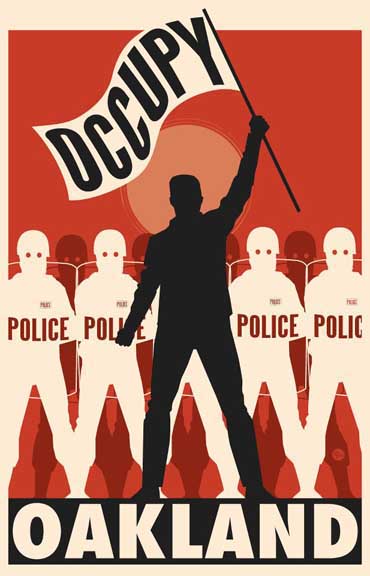
Poster artist Rich Black of Berkeley, California created this image for Occupy Oakland. It’s available for free download at Occuprint.org.
To see a variety of Occupy posters by other artists (and to download them for free) you can visit Occuprint.org and OccupyTogether.org.
And don’t miss our post earlier today: Shepard Fairey Caves In, Revises Occupy Wall Street Poster.
Read More...Steve Jobs Muses on What’s Wrong with American Education, 1995
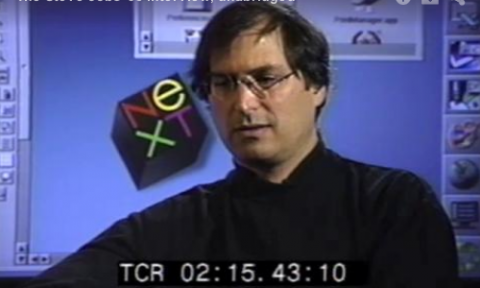
In late October, Computerworld unearthed a lengthy interview with Steve Jobs originally recorded back in 1995, when Jobs was at NeXT Computer, and still two years away from his triumphant return to Apple. Filmed as part of an oral history project, the wide-ranging interview begins with Jobs’ childhood and his early school days, and it all sets the stage for Jobs to muse on the state of public education in America. He began:
I’d like the people teaching my kids to be good enough that they could get a job at the company I work for, making a hundred thousand dollars a year. Why should they work at a school for thirty-five to forty thousand dollars if they could get a job here at a hundred thousand dollars a year? Is that an intelligence test? The problem there of course is the unions. The unions are the worst thing that ever happened to education because it’s not a meritocracy. It turns into a bureaucracy, which is exactly what has happened. The teachers can’t teach and administrators run the place and nobody can be fired. It’s terrible.
Asked what changes he would make, Jobs continued:
I’ve been a very strong believer in that what we need to do in education is to go to the full voucher system. I know this isn’t what the interview was supposed to be about but it is what I care about a great deal.… The problem that we have in this country is that [parents] went away. [They] stopped paying attention to their schools, for the most part. What happened was that mothers started working and they didn’t have time to spend at PTA meetings and watching their kids’ school. Schools became much more institutionalized and parents spent less and less and less time involved in their kids’ education. What happens when a customer goes away and a monopoly gets control … is that the service level almost always goes down.
And so the answer. Vouchers, entrepreneurship and market competition:
I’ve suggested as an example, if you go to Stanford Business School, they have a public policy track; they could start a school administrator track. You could get a bunch of people coming out of college tying up with someone out of the business school, they could be starting their own school. You could have twenty-five year old students out of college, very idealistic, full of energy instead of starting a Silicon Valley company, they’d start a school. I believe that they would do far better than any of our public schools would. The third thing you’d see is I believe, is the quality of schools again, just in a competitive marketplace, start to rise. Some of the schools would go broke. A lot of the public schools would go broke. There’s no question about it. It would be rather painful for the first several years.… The biggest complaint of course is that schools would pick off all the good kids and all the bad kids would be left to wallow together in either a private school or remnants of a public school system. To me that’s like saying “Well, all the car manufacturers are going to make BMWs and Mercedes and nobody’s going to make a ten thousand dollar car.” I think the most hotly competitive market right now is the ten thousand dollar car area. You’ve got all the Japanese playing in it. You’ve got General Motors who spent five million dollars subsidizing Saturn to compete in that market. You’ve got Ford which has just introduced two new cars in that market. You’ve got Chrysler with the Neon.…
The full transcript appears here. Or, if you want to watch the interview on video, you can jump to Computerworld, where, rather lamely, you will need to register before watching the actual talk. Bad job by Computerworld.
Related Content:
Download Free Copy of Steve Jobs Biography; Plus Interview with Author
Steve Jobs Demos the First Macintosh in 1984
Steve Jobs Narrates the First “Think Different” Ad (Never Aired)
Read More...20 Christian Academics Speaking About God
This summer, Jonathan Pararajasingham created 50 Renowned Academics Speaking About God and then Another 50 Renowned Academics Speaking About God. If you’re counting, that makes 100. Right alongside these twin videos came 20 Christian Academics Speaking About God, a montage featuring some respected figures (save Dinesh D’Souza) trying to square religious beliefs with their scientific work.
You could perhaps add Karl W. Giberson and Randall J. Stephens to this list, two professors who teach at a Christian liberal arts college in Boston. Earlier this week, Giberson and Stephens published The Anointed: Evangelical Truth in a Secular Age and an accompanying op-ed in The New York Times called The Evangelical Rejection of Reason. And it all points to a tension within America’s religious community — the one side that is “intellectually engaged, humble and forward-looking” (like some of the folks shown above) and the other side that is “literalistic, overconfident and reactionary” and often hostile to basic science. Unfortunately, the authors argue, this backward-looking view has become the mainstream within evangelical circles, and it does a struggling nation no favors.
Yesterday, Giberson appeared on NPR’s Talk of the Nation. You can listen to the interview here, or read the transcript here.
Read More...Legendary Folklorist Alan Lomax: ‘The Land Where the Blues Began’
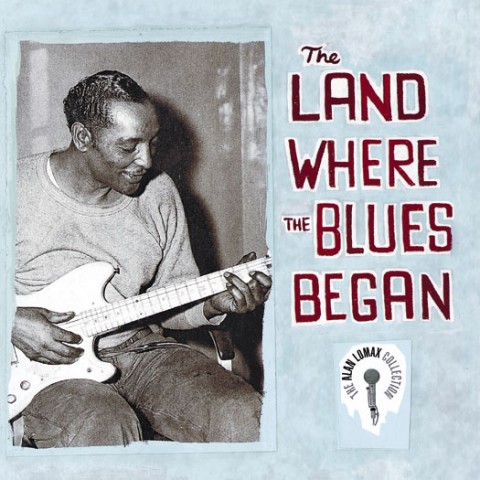
In 1933, 18-year-old Alan Lomax took a break from college to travel into the American South with his father, John Avery Lomax, on a quest to discover and record traditional folk songs for the Library of Congress. It was the beginning of a journey that would last the rest of his life.
With his father, and later on his own, Lomax traveled the back roads of Appalachia and the Mississippi Delta, from religious revival meetings to prison chain gangs, in pursuit of Southern folk music in all its forms. Along the way he discovered and recorded such singular artists as Mississippi Fred McDowell, Vera Hall and Lead Belly. Later, Lomax would widen his field of research to focus on European folk music, but in 1978 he went back to the Mississippi Delta with a camera crew to document a culture that was rapidly disappearing.
The result, The Land Where the Blues Began (watch it online here), is a fascinating look at traditional country blues in its native environment. Filmed in levee camps, churches, juke joints and on front porches across Mississippi, the documentary draws attention to musicians unknown outside the Delta. The Land Where the Blues Began is a must-see for blues fans, and is now part of our collection of Free Movies.
Related Content:
The Legend of Bluesman Robert Johnson Animated
The Rolling Stones Jam With Their Idol, Muddy Waters
Muddy Waters on the Blues and Gospel Train
Read More...The History of Philosophy … Without Any Gaps
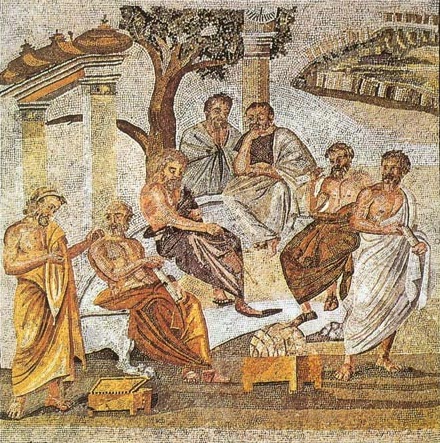 On Monday, we told you where you can download Free Courses from Top Philosophers (Foucault, Searle, Russell and the rest). As the day went along, our list grew thanks to reader suggestions, and we also discovered another promising resource — a podcast called “The History of Philosophy Without Any Gaps,” created by Peter Adamson, Professor of Ancient and Medieval Philosophy at King’s College London:
Beginning with the earliest ancient thinkers, the series will look at the ideas and lives of the major philosophers (eventually covering in detail such giants as Plato, Aristotle, Avicenna, Aquinas, Descartes, and Kant) as well as the lesser-known figures of the tradition.
That’s what Adamson promises, and he doesn’t disappoint. Over the past 34 months, Adamson has produced 136 episodes, each about 20 minutes long, covering the PreSocratics (Pythagoras, Zeno, Parmenides, etc) and then Socrates, Plato and Aristotle. That’s roughly 45 hours of audio, and there’s no telling how many more hours of audio will bring us to the modern period. The more, the better, we say.
You can access all episodes via these links: iTunes — RSS Feed — Web Site. Or find other free philosophy courses in our big collection of Free Courses Online.
If you would like to support the mission of Open Culture, consider making a donation to our site. It’s hard to rely 100% on ads, and your contributions will help us continue providing the best free cultural and educational materials to learners everywhere. You can contribute through PayPal, Patreon, and Venmo (@openculture). Thanks!
Related Content:
Free Online Philosophy Courses
Take First-Class Philosophy Courses Anywhere with Free Oxford Podcasts
Learn The History of Philosophy in 247 Podcasts (With More to Come)
Read More...Support Us
We're hoping to rely on loyal readers, rather than erratic ads. Please click the Donate button and support Open Culture. You can use Paypal, Venmo, Patreon, even Crypto! We thank you!

About Us

Open Culture scours the web for the best educational media. We find the free courses and audio books you need, the language lessons & educational videos you want, and plenty of enlightenment in between.
Advertise With Us
FREE UPDATES!
GET OUR DAILY EMAIL
Get the best cultural and educational resources on the web curated for you in a daily email. We never spam. Unsubscribe at any time.
FOLLOW ON SOCIAL MEDIA
Open Culture editor Dan Colman scours the web for the best educational media. He finds the free courses and audio books you need, the language lessons & movies you want, and plenty of enlightenment in between.
Advertise With Us

