Martin Scorsese Plays Vincent Van Gogh in a Short, Surreal Film by Akira Kurosawa
The idea of the auteur director has been a controversial one at times given the sheer number of people required at every stage to produce a film. But it hangs together for me when you look at the films of say, Martin Scorsese or Akira Kurosawa, both directors with very distinctive visual languages and ways of moving the camera. Granted, neither director would be who he is without their crack teams of actors, writers, composers, cinematographers, etc. But it is part of their genius to consistently pull those teams together to realize visions that none of the individuals involved could fully see on their own. Though the final product may be the result of millions of dollars and thousands of hours of work by hundreds of people, the films of an auteur take shape foremost in the directors’ mind’s eye (and paintings and storyboards) rather than the writer’s script or producer’s conference room.
These directors are driven, like painters, to realize their visions, and in Kurosawa’s case, that drive lasted right up until the end of his life. (It was his wish to die on set, though an accident left him unable to walk and put an end to his directing career three years before the end of his life.) A painter himself, his films have always been colorful and painterly, and his final few projects were intensely so. One of those last films, 1990’s Dreams, the first of his films for which he alone wrote the screenplay, not only originated fully in Kurosawa’s mind, but in his unconscious. A departure from his typically epic narratives, the film follows various Kurosawa surrogates through eight vignettes, based on eight recurring dreams, each one unfolding with a surreal logic all of its own. In the fifth short episode, “Crows,” Kurosawa casts Scorsese, his fellow auteur and his equal as a visual stylist, as Vincent Van Gogh.
The camera begins in a gallery, moving restlessly before several Van Gogh paintings and behind an art student—identifiable as a Kurosawa stand-in by the floppy white hat he puts on in the next scene, when he wanders into the French countryside of the paintings. The fields, bridge, and barns are rendered in Van Gogh’s brilliant colors and skewed lines—and the student journeys further in to meet the artist himself: Scorsese in red beard and bandaged ear. This is the only episode in the film not in Japanese; the student speaks French to a group of women, and Van Gogh speaks Scorsese’s New York-accented English, giving a lesson on “natural beauty” (the video above adds Spanish subtitles). It is not the most convincing performance from Scorsese, but that hardly seems to be the point. This is not so much Scorsese as Van Gogh, but rather Van Gogh as Scorsese, and Kurosawa dreams himself as a younger acolyte of his American counterpart.
“Crows,” writes Vincent Canby, is the “least characteristic segment ” of Dreams—the others manifest much more familiar, more Japanese, scenes and themes. But it is for that reason that “Crows” is perhaps the most revealing of Kurosawa’s statements on his status as an auteur and his relationship with his peers. He approaches Van Gogh/Scorsese not as a rival or even an equal, but as a student, filled with questions and a desire to understand the artist’s methods and motives. The short segment speaks to the way Kurosawa eagerly learned much from Western artists even as he mastered his own cinematic language with distinctly Japanese stories. In this way, he manifested yet another quality of the auteur: a truly international approach to film that transcends barriers of language and culture.
You can purchase a copy of Kurosawa’s complete film here.
Related Content:
The Paintings of Akira Kurosawa
Revisit Martin Scorsese’s Hand-Drawn Storyboards for Taxi Driver
Josh Jones is a writer and musician based in Durham, NC. Follow him at @jdmagness
Read More...Jimi Hendrix Unplugged: Two Great Recordings of Hendrix Playing Acoustic Guitar
As a young guitar player, perhaps no one inspired me as much as Jimi Hendrix, though I never dreamed I’d attain even a fraction of his skill. But what attracted me to him was his near-total lack of formality—he didn’t read music, wasn’t trained in any classical sense, played an upside-down right-handed guitar as a lefty, and fully engaged his head and heart in every note, never pausing for an instant (so it seemed) to second-guess whether it was the right one. I knew his raw emotive playing was firmly rooted in the Delta blues, but it wasn’t until later in my musical journey that I discovered his return to more traditional form after he disbanded The Experience and formed Band of Gypsys with Billy Cox and Buddy Miles. While most of the recordings he made with them didn’t see official release, they’ve appeared since his death in compilation after boxset after compilation, including one of the most beloved of Hendrix’s blues songs, “Hear My Train A Comin’.”
Originally titled “Get My Heart Back Together” when he played it at Woodstock in 1969, the song is pure roots, with lyrics that bespeak of both Hendrix’s loneliness and his playful dreams of greatness. (“I’m gonna buy this town / And put it all in my shoe.”) Several versions of the song float around on various posthumous releases—both live and as studio outtakes (including two different takes on the excellent 1994 Blues).
But we have the rare treat, above, of seeing Hendrix play the song on a twelve-string acoustic guitar, Lead Belly’s instrument of choice. The footage comes from the 1973 documentary film Jimi Hendrix (which you can watch on YouTube for $2.99). Hendrix first plays the intro, seated alone in an all-white studio, playing folk-style with the fingers of his left hand. It is, of course, flawless, yet still he stops and asks the filmmakers for a redo. “I was scared to death,” he says, betraying the shyness and self-doubt that lurked beneath his mind-blowing ability and flamboyant persona. His playing is no less perfect when he picks up the tune again and plays it through.
Solo acoustic recordings of Hendrix—film and audio—are incredibly rare. If like me you’re a fan of Hendrix, acoustic blues, or both, this video will make you hunger for more Jimi unplugged. While Hendrix did more than anyone before him to turn guitar amps into instruments with his squalls of electric feedback and distorted wah-wah squeals, when you strip his playing down to basics, he’s still pretty much as good as it gets.
If you would like to support the mission of Open Culture, consider making a donation to our site. It’s hard to rely 100% on ads, and your contributions will help us continue providing the best free cultural and educational materials to learners everywhere. You can contribute through PayPal, Patreon, and Venmo (@openculture). Thanks!
Related Content:
Jimi Hendrix Plays “Sgt. Pepper’s Lonely Hearts Club Band” Days After the Song Was Released (1967)
Behold Moebius’ Many Psychedelic Illustrations of Jimi Hendrix
Josh Jones is a writer and musician based in Durham, NC. Follow him at @jdmagness.
Read More...Watch Hardware Wars, the Original Star Wars Parody, in HD (1978)
This past May, YouTuber Jenny Nicholson set off waves of social-media discourse with “The Spectacular Failure of the Star Wars Hotel,” a four-hour-long video critique of Disney’s hugely expensive, now-shuttered Star Wars: Galactic Starcruiser in Orlando, Florida. Having gone viral enough to rack up over nine million views in less than two months, it’s arguably become more of a success than some recent Star Wars movies. In part, that owes to Nicholson’s having tapped into a growing discomfort, felt even among die-hard fans, with the transformation of an escapist space opera into an ever-vaster and less accountable business empire. The time has come, many seem to feel, to pop the Star Wars bubble.
Some, of course, have felt that way for a long time. “I dutifully thrilled to the earlier films, to their contrast of black-velvet skies and blinding white sands, but I was a little too old to worship them or study their variorum editions,” writes New Yorker film critic Anthony Lane in his review of The Phantom Menace, from 1999.
“Even in the late seventies, we had a suspicion that Star Wars was nerd territory.” That suspicion inspired such works as the Hardware Wars, the very first Star Wars parody. Released in 1978, this micro-budget production shot on Super 8 film spoofs the ramshackle bombast of the original Star Wars, then still playing in theaters, in the form of a thirteen-minute-long fictional trailer.
“Steam irons and toasters suspended by clearly visible strings were the spaceships, a basketball was a planet on the brink of destruction, and the robot Artie Decko was a defunct vacuum cleaner,” writes Salon’s Bob Calhoun. But “from its cardboard sets to the costumes, Hardware Wars is an amazing facsimile of its source material, despite obvious budget and time constraints.” The goal of its creators Ernie Fosselius and Michael Wiese had been to meet Star Wars creator George Lucas, who later called it his favorite Star Wars parody. And indeed, its humor holds up these 46 years later, though younger viewers may need some help understanding the joke in a name like Augie Ben-Doggie, to say nothing of the final line, delivered by famed voice actor Paul Frees: “You’ll laugh, you’ll cry, you’ll kiss three bucks goodbye.” Above, you can watch Hardware Wars in a brand new HD transfer.
Related content:
Watch the Very First Trailers for Star Wars, The Empire Strikes Back & Return of the Jedi (1976–83)
Fans Reconstruct Authentic Version of Star Wars, As It Was Shown in Theaters in 1977
The Making of Star Wars as Told by C‑3PO & R2-D2: The First-Ever Documentary on the Film (1977)
A Star Wars Film Made in a Wes Anderson Aesthetic
Based in Seoul, Colin Marshall writes and broadcasts on cities, language, and culture. His projects include the Substack newsletter Books on Cities and the book The Stateless City: a Walk through 21st-Century Los Angeles. Follow him on Twitter at @colinmarshall or on Facebook.
Read More...The Internet Archive Rescues MTV News’ Web Site, Making 460,000+ of Its Pages Searchable Again

Image via Internet Archive
Last month, MTV News’ web site went missing. Or at least almost all of it did, including an archive of stories going back to 1997. To some of us, and especially to those of us old enough to have grown up watching MTV on actual television, that won’t sound like an especially long time. But if you remember the hit singles of that year — “Barely Breathing,” “Semi-Charmed Life,” “MMMBop,” the Princess Diana-memorializing “Candle in the Wind” — you’ll start to feel a bit more historical distance. And if you consider all that’s happened in not just music but entertainment in general over the past 27 years, coverage of that period of great change in popular culture and technology will seem invaluable.
It will thus come as a relief to hear that, despite Paramount Global’s corporate decision to purge MTV News’ online content (as well as that of Comedy Central, TVLand and CMT), much of the site has been resurrected on the Internet Archive, which now offers “a searchable index of 460,575 web pages previously published at mtv.com/news.”
So reports Variety’s Todd Spangler, noting that the content “is not the full complement of what was published over the span of more than two decades. In addition, some images in the archived pages of MTV News on the service are unavailable. But the new collection at least ensures, for the time being, that much of MTV News’ articles remain accessible in some form.”
MTV News itself shut down in May of last year. It had begun in 1987 as a segment called “This Week in Rock” anchored by a print journalist named Kurt Loder. “I was working at Rolling Stone and everybody that wrote about rock music, as it was called at the time, had a very down point of view about MTV,” Loder recalls in an interview with that magazine. But choosing to throw himself into this new form of infotainment gave him the chance to get to know the likes of Madonna, Prince, and Nirvana (the death of whose singer Kurt Cobain became one of his career-defining stories). “You could just fly off anywhere you wanted and do all this stuff,” Loder says. “It was a great time. I’m not sure it’ll ever be back, but something else will.” Whatever it is, may the Internet Archive be here to preserve it.
Related content:
Watch the First Two Hours of MTV’s Inaugural Broadcast (August 1, 1981)
All the Music Played on MTV’s 120 Minutes: A 2,500-Video Youtube Playlist
Enter “The Magazine Rack,” the Internet Archive’s Collection of 34,000 Digitized Magazines
Based in Seoul, Colin Marshall writes and broadcasts on cities, language, and culture. His projects include the Substack newsletter Books on Cities and the book The Stateless City: a Walk through 21st-Century Los Angeles. Follow him on Twitter at @colinmarshall or on Facebook.
Read More...The Story of Lee Miller: From the Cover of Vogue to Hitler’s Bathtub
In late-twenties Manhattan, a nineteen-year-old woman named Elizabeth “Lee” Miller stepped off the curb and into the path of a car. She was pulled back to safety by none other than the magnate Condé Nast, founder of the eponymous publishing company. Not long thereafter, Miller, who’d been studying at the Art Students League of New York, appeared on the cover of Vogue. It’s tempting to call this the first major episode of a charmed life, though that descriptor fits uneasily with the arc of her seventy years, during the last few decades of which she could never quite recover from having witnessed first-hand the liberation of the concentration camps at Buchenwald and Dachau — sights she shared with the American public as a war photographer.
Miller took pictures of not just the concentration camps, but also events like the London Blitz and the liberation of Paris. At the end of the war, she posed for an even more famous picture, bathing in Hitler’s tub on the very same day that the Führer later shot himself in his bunker.
Behind the camera in that instance was Life correspondent David E. Scherman, one of the notable men in Miller’s life. Others included the artist-writer Roland Penrose, the businessman Aziz Eloui Bey, and, before all of them, the surrealist photographer Man Ray, each of whom corresponded to a phase of the professional journey that took her from fashion model to fearless photojournalist.
You can see and hear Lee Miller’s journey in the video from the Victoria & Albert Museum at the top of the post. Just above is a British Pathé newsreel that shows Miller at home with Penrose in 1946, the year between the end of the war and the birth of their son Antony Penrose, who re-discovered and re-publicized his mother’s photography after her death in 1977. However belated her public recognition, it’s still surprising that a life like Miller’s, the events of which stretch even Hollywood plausibility, only became a movie last year. Lee still awaits wide release, but much has been written about the passion of star Kate Winslet that got it made. She’ll undoubtedly impress as Miller — but neither, rumor has it, is Saturday Night Live alumnus Andy Samberg’s David E. Scherman a performance to be missed.
Related content:
The Forgotten Women of Surrealism: A Magical, Short Animated Film
Man Ray’s Portraits of Ernest Hemingway, Ezra Pound, Marcel Duchamp & Many Other 1920s Icons
Based in Seoul, Colin Marshall writes and broadcasts on cities, language, and culture. His projects include the Substack newsletter Books on Cities and the book The Stateless City: a Walk through 21st-Century Los Angeles. Follow him on Twitter at @colinmarshall or on Facebook.
Read More...Martin Mull (RIP) Satirically Interviews a Young Tom Waits on Fernwood 2 Night (1977)
These days, references to seventies television increasingly require prefatory explanation. Who under the age of 60 recalls, for example, the cultural phenomenon that was Mary Hartman, Mary Hartman, an absurdist satire so faithful to the soap-opera form it parodied that it aired every weeknight, putting out 325 episodes between early 1976 and mid-1977? And even for those who do remember the show, it would surely require a stretch of the memory to summon to mind its minor character Garth Gimble, an abusive husband who meets his grisly fate on the sharp end of an aluminum Christmas tree. (We’ll set the question of how many remember aluminum Christmas trees aside for the holiday season.)
Garth Gimble was the breakout role for a musical comedian turned actor called Martin Mull, who died last week at the age of 80. Tributes have mentioned the characters he played on shows from Roseanne and Sabrina the Teenage Witch to Arrested Development and Veep.
But to those who were watching TV in the summer of 1977, Mull has always been — and will always be — not Garth Gimble but his twin brother Barth, host of a low-budget late-night talk show in the small town of Fernwood, Ohio, the setting of Mary Hartman, Mary Hartman. Fernwood-2-Night premiered as a temporary replacement for that show (and thus as yet another expansion of the televisual universe created by mega-producer Norman Lear), but it soon took on a countercultural life of its own.
The fictional talk-show form of Fernwood-2-Night was ahead of its time; more daring still was its occasional arrangement of real-life guests. That roster included a young Tom Waits, himself a living embodiment of the blurred line between reality and fiction. As the show’s announcer Jerry Hubbard, Fred Willard puts all of his distinctive delivery into declaring Waits “very famous for Fernwood.” Mull plays Gimble as the kind of man on which the appeal of Waits’ art is wholly lost: “I know he sells a lot of albums, and he makes about half a million big ones in one year,” he says by way of introduction. “In my book, that spells talent.”
Naturally, Gimble is game to set the liquor-swigging singer up for an old groaner by remarking on the strangeness of talking to a guest with a bottle in front of him. “Well, I’d rather have a bottle in front of me than a frontal lobotomy,” Waits growls in compliance. This comes after his performance of the song “The Piano Has Been Drinking (Not Me) (An Evening with Pete King)” from his then-most recent album Small Change. It’s safe to say that many viewers on Fernwood-2-Night’s wavelength became fans of Waits as soon as they heard it. Nearly half a century later, they no doubt still remember his appearance fondly — at least as fondly as they remember the Wonderblender.
Related content:
Watch Tom Waits’ Classic Appearance on Australian TV, 1979
Watch Tom Waits For No One, the Pioneering Animated Music Video from 1979
Tom Waits Shows Us How Not to Get a Date on Valentine’s Day
Tom Waits’ Many Appearances on David Letterman, From 1983 to 2015
Based in Seoul, Colin Marshall writes and broadcasts on cities, language, and culture. His projects include the Substack newsletter Books on Cities and the book The Stateless City: a Walk through 21st-Century Los Angeles. Follow him on Twitter at @colinmarshall or on Facebook.
Read More...Watch Patti Smith Read from Virginia Woolf, and Hear the Only Surviving Recording of Woolf’s Voice
In the video above, poet, artist, National Book Award winner, and “godmother of punk” Patti Smith reads a selection from Virginia Woolf’s 1931 experimental novel The Waves, accompanied on piano and guitar by her daughter Jesse and son Jackson. The “reading” marked the opening of “Land 250,” a 2008 exhibition of Smith’s photography and artwork from 1965 to 2007, at the Fondation Cartier pour l’art contemporain in Paris.
I put the word “reading” in quotes above because Smith only reads a very short passage from Woolf’s novel. The rest of the dramatic performance is Smith in her own voice, possibly improvising, possibly reciting her homage to Woolf—occasioned by the fact that the start of the exhibition fell on the 67th anniversary of Woolf’s death by suicide. Of Woolf’s death, Smith says, “I do not think of this as sad. I just think that it’s the day that Virginia Woolf decided to say goodbye. So we are not celebrating the day, we are simply acknowledging that this is the day. If I had a title to call tonight, I would call it ‘Wave.’ We are waving to Virginia.”
Smith’s choice of a title for the evening is significant. She titled her 1979 album Wave, her last record before she went into semi-retirement in the 80s. And her exhibition included a set of beautiful photographs taken at Woolf’s Sussex retreat, Monk’s House. Her performance seems like an unusual confluence of voices, but Woolf might have enjoyed it, since so much of her work explored the uniting of separate minds, over the barriers of space and time. While Smith expresses her indebtedness to Woolf, one wonders what the upper-class Bloomsbury daughter of a well-connected and artistic family would have thought of the working-class punk-poet from the Lower East Side? It’s impossible to say, of course, but somehow it’s fitting that they meet through Woolf’s The Waves.
Woolf’s novel (she called it a “playpoem”) blends the voices of six characters, but Woolf didn’t think of them as characters at all, but as aspects of a greater, ever-shifting whole. As she once wrote in a letter:
The six characters were supposed to be one. I’m getting old myself now—I shall be fifty next year; and I come to feel more and more how difficult it is to collect oneself into one Virginia; even though the special Virginia in whose body I live for the moment is violently susceptible to all sorts of separate feelings. Therefore I wanted to give the sense of continuity.
Speculation over Woolf’s mental health aside, her references to voices in her letters, diaries, and in her eloquent letter to Leonard Woolf before she died, were also statements of her craft—which embraced the inner voices of others, not letting any one voice be dominant. I like to think Woolf would have been delighted with the fierceness of Smith—in some ways, Virginia Woolf anticipated punk, and Patti Smith. In her own voice below, you can hear her describe the words of the English language as “irreclaimable vagabonds,” who “if you start a Society for Pure English, they will show their resentment by starting another for impure English…. They are highly democratic.”
The recording below comes from an essay published in a collection—The Death of the Moth and Other Essays—the year after Woolf’s death. The talk was called “Craftsmanship,” part of a BBC radio broadcast from 1937, and it is the only surviving recording of Woolf’s voice.
Note: An earlier version of this post appeared on our site in 2013.
Related Content
Patti Smith’s Polaroids of Artifacts from Virginia Woolf, Arthur Rimbaud, Roberto Bolaño & More
Patti Smith’s 40 Favorite Books
Josh Jones is a writer, editor, and musician based in Washington, DC. Follow him @jdmagness
Read More...How Carl Jung Inspired the Creation of Alcoholics Anonymous
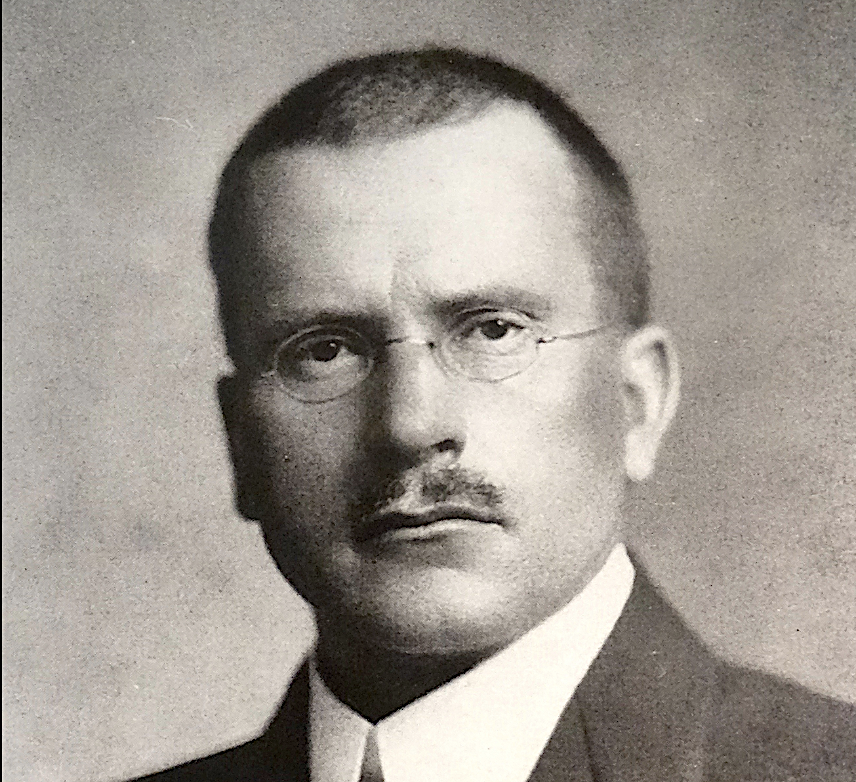
There may be as many doors into Alcoholics Anonymous in the 21st century as there are people who walk through them—from every world religion to no religion. The “international mutual-aid fellowship” has had “a significant and long-term effect on the culture of the United States,” writes Worcester State University professor of psychology Charles Fox at Aeon. Indeed, its influence is global. From its inception in 1935, A.A. has represented an “enormously popular therapy, and a testament to the interdisciplinary nature of health and wellness.”
A.A. has also represented, at least culturally, a remarkable synthesis of behavioral science and spirituality that translates into scores of different languages, beliefs, and practices. Or at least that’s the way it can appear from browsing the scores of books on A.A.’s 12-Steps and Buddhism, Yoga, Catholicism, Judaism, Indigenous faith traditions, shamanist practices, Stoicism, secular humanism, and, of course, psychology.
Historically, and often in practice, however, the (non)organization of worldwide fellowships has represented a much narrower tradition, inherited from the evangelical (small “e”) Christian Oxford Group, or as A.A. founder Bill Wilson called them, “the ‘O.G.’” Wilson credits the Oxford Group for the methodology of A.A.: “their large emphasis upon the principles of self-survey, confession, restitution, and the giving of oneself in service to others.”
The Oxford Group’s theology, though qualified and tempered, also made its way into many of A.A.’s basic principles. But for the recovery group’s genesis, Wilson cites a more secular authority, Carl Jung. The famous Swiss psychiatrist took a keen interest in alcoholism in the 1920s. Wilson wrote to Jung in 1961 to express his “great appreciation” for his efforts. “A certain conversation you once had with one of your patients, a Mr. Rowland H. back in the early 1930’s,” Wilson explains, “did play a critical role in the founding of our Fellowship.”
Jung may not have known his influence on the recovery movement, Wilson says, although alcoholics had accounted for “about 13 percent of all admissions” in his practice, notes Fox. One of his patients, Rowland H.—or Rowland Hazard, “investment banker and former state senator from Rhode Island”—came to Jung in desperation, saw him daily for a period of several months, stopped drinking, then relapsed. Brought back to Jung by his cousin, Hazard was told that his case was hopeless short of a religious conversion. As Wilson puts it in his letter:
[Y]ou frankly told him of his hopelessness, so far as any further medical or psychiatric treatment might be concerned. This candid and humble statement of yours was beyond doubt the first foundation stone upon which our Society has since been built.
Jung also told Hazard that conversion experiences were incredibly rare and recommended that he “place himself in a religious atmosphere and hope for the best,” as Wilson remembers. But he did not specify any particular religion. Hazard discovered the Oxford Group. He might, as far as Jung was concerned, have met God as he understood it anywhere. “His craving for alcohol was the equivalent,” wrote the psychiatrist in a reply to Wilson, “on a low level, of the spiritual thirst of our being for wholeness, expressed in medieval language: the union with God.”
In his reply letter to Wilson, Jung uses religious language allegorically. AA took the idea of conversion more literally. Though it wrestled with the plight of the agnostic, the Big Book concluded that such people must eventually see the light. Jung, on the other hand, seems very careful to avoid a strictly religious interpretation of his advice to Hazard, who started the first small group that would convert Wilson to sobriety and to Oxford Group methods.
“How could one formulate such an insight that is not misunderstood in our days?” Jung asks. “The only right and legitimate way to such an experience is that it happens to you in reality and it can only happen to you when you walk on a path which leads you to a higher understanding.” Sobriety could be achieved through “a higher education of the mind beyond the confines of mere rationalism”—through an enlightenment or conversion experience, that is. It might also occur through “an act of grace or through a personal and honest contact with friends.”
Though most founding members of AA fought for the stricter interpretation of Jung’s prescription, Wilson always entertained the idea that multiple paths might bring alcoholics to the same goal, even including modern medicine. He drew on the medical opinions of Dr. William D. Silkworth, who theorized that alcoholism was in part a physical disease, “a sort of metabolism difficulty which he then called an allergy.” Even after his own conversion experience, which Silkworth, like Jung, recommended he pursue, Wilson experimented with vitamin therapies, through the influence of Aldous Huxley.
His search to understand his mystical “white light” moment in a New York detox room also led Wilson to William James’ Varieties of Religious Experience. The book “gave me the realization,” he wrote to Jung, “that most conversion experiences, whatever their variety, do have a common denominator of ego collapse at depth.” He even thought that LSD could act as such a “temporary ego-reducer” after he took the drug under supervision of British psychiatrist Humphrey Osmond. (Jung likely would have opposed what he called “short cuts” like psychedelic drugs.)
In the letters between Wilson and Jung, as Ian McCabe argues in Carl Jung and Alcoholics Anonymous, we see mutual admiration between the two, as well as mutual influence. “Bill Wilson,” writes McCabe’s publisher, “was encouraged by Jung’s writings to promote the spiritual aspect of recovery,” an aspect that took on a particularly religious character in Alcoholics Anonymous. For his part, Jung, “influenced by A.A.’s success… gave ‘complete and detailed instructions’ on how the A.A. group format could be developed further and used by ‘general neurotics.’” And so it has, though more on the Oxford Group model than the more mystical Jungian. It might well have been otherwise.
Read more about Jung’s influence on AA over at Aeon.
Note: Note: An earlier version of this post appeared on our site in 2019.
Related Content:
Carl Jung Offers an Introduction to His Psychological Thought in a 3‑Hour Interview (1957)
Take Carl Jung’s Word Association Test, a Quick Route Into the Subconscious (1910)
Carl Jung’s Hand-Drawn, Rarely-Seen Manuscript The Red Book
Josh Jones is a writer and musician based in Durham, NC. Follow him at @jdmagness
Read More...About Us

What is Open Culture’s Mission?
Founded in 2006, Open Culture brings together high-quality cultural & educational media for the worldwide lifelong learning community. Web 2.0 has given us great amounts of intelligent audio and video. It’s all free. It’s all enriching. But it’s also scattered across the web, and not easy to find. Our whole mission is to centralize this content, curate it, and give you access to this high quality content whenever and wherever you want it. Some of our major resource collections include:
- 1,700 Free Online Courses from Top Universities
- 4,000+ Free Movies Online: Great Classics, Indies, Noir, Westerns, Documentaries & More
- 1,000 Free Audio Books: Download Great Books for Free
- 800 Free eBooks for iPad, Kindle & Other Devices
- Learn 46 Languages Online for Free: Spanish, Chinese, English & More
How Can I Contact Open Culture?
Feel free to drop us a line at ma**@*********re.com.
Do You Have a Copyright Policy?
Yes and you can find it here.
Do You Have a Privacy Policy?
Yes, read all about it here.
Can I Recommend Materials to List on Open Culture?
Yes. If you would like us to add links to relevant parts of our site, you can suggest materials/links via email and we will be happy to review them. Please read over our editorial guidelines and then let us know where you think your material should be listed, and try to provide all of the information that will help us list your material. For example, if you want us to include a link in one of our podcast directories, please look at the appropriate directory and include all of the information that we typically include in our entries.
Do The Courses Featured Here Give University Credit?
First and foremost, the MOOCs/Online courses appearing on this page sometimes offer students “statements of accomplishment” or “certificates of completion” if they successfully complete a given course. However, most traditional universities won’t give students credit for taking theses online courses, and students typically can’t use these courses as a way to satisfy requirements for a degree. It’s conceivable that some schools will give credit for these classes, but you would really need to check with the registar’s office at your institution.
Second, we should point out (in case it’s not clear) that Open Culture is not the builder/creator of these courses. Our site simply highlights MOOCs/Online Courses created by other educational ventures. You can get more information by reading our MOOC FAQ.
Read More...Watch the Earliest-Known Charles Dickens Film: The Death of Poor Joe
A little over a decade ago, a curator at the British Film Institute (BFI) discovered the oldest surviving film featuring a Charles Dickens character, “The Death of Poor Joe.” The silent film, directed by George Albert Smith in 1900, brings to life Dickens’ character Jo, the crossing sweeper from Bleak House. Prior to this find, the title of the oldest known Dickens film belonged to Scrooge, or, Marley’s Ghost, which premiered in November 1901.
Providing more context for the film, the BFI writes:
This tragic short film is based on the stage production of Poor Jo the Crossing Sweeper, which itself adapted one of the most affecting stories in Dickens’ epic novel Bleak House. This short film is very much an adaptation of the stage version, in which a follow-spot recreated the night watchman’s lamp. As Joe dies, never having been taught to pray, the light also represents the redemptive light of heaven.
The character of Joe was popularised in the 19th century by actress Jennie Lee, who toured her performance around Europe and the USA. Here Joe is played by Laura Bayley and the Night-watchman by Tom Green. Both actors were regular collaborators with the Brighton-based filmmaker GA Smith (Bayley was his wife).
You can watch the film, courtesy of BFI, above.
If you would like to support the mission of Open Culture, consider making a donation to our site. It’s hard to rely 100% on ads, and your contributions will help us continue providing the best free cultural and educational materials to learners everywhere. You can contribute through PayPal, Patreon, and Venmo (@openculture). Thanks!
Related Content
An Oscar-Winning Animation of Charles Dickens’ Classic Tale, A Christmas Carol (1971)
Frankenstein Hits the Silver Screen (1910)
Read More...Support Us
We're hoping to rely on loyal readers, rather than erratic ads. Please click the Donate button and support Open Culture. You can use Paypal, Venmo, Patreon, even Crypto! We thank you!

About Us

Open Culture scours the web for the best educational media. We find the free courses and audio books you need, the language lessons & educational videos you want, and plenty of enlightenment in between.
Advertise With Us
FREE UPDATES!
GET OUR DAILY EMAIL
Get the best cultural and educational resources on the web curated for you in a daily email. We never spam. Unsubscribe at any time.
FOLLOW ON SOCIAL MEDIA
Open Culture editor Dan Colman scours the web for the best educational media. He finds the free courses and audio books you need, the language lessons & movies you want, and plenty of enlightenment in between.
Advertise With Us

