Roger Federer’s Dartmouth Commencement Address: “Effortless Is a Myth” & Other Life Lessons from Tennis
In 2006, David Foster Wallace published a piece in the New York Times Magazine headlined “Roger Federer as Religious Experience.” Even then, he could declare Federer, “at 25, the best tennis player currently alive. Maybe the best ever.” Much had already been written about “his old-school stoicism and mental toughness and good sportsmanship and evident overall decency and thoughtfulness and charitable largess.” Less easily commented upon — because much less easily described — was the aesthetic transcendence of his performance on the court, which Wallace thought best witnessed in person.
“If you’ve watched tennis only on television, you simply have no idea how hard these pros are hitting the ball, how fast the ball is moving, how little time the players have to get to it, and how quickly they’re able to move and rotate and strike and recover,” Wallace writes. “And none are faster, or more deceptively effortless about it, than Roger Federer.” Was that one of the observations the champion had in mind this past weekend, eighteen years later — and two years after his own retirement from the game — when he took the tree-stump lectern before Dartmouth’s class of 2024 and declared that “Effortless is a myth”?
That was one of three “tennis lessons” — that is, lessons for life derived from his long and hugely successful experience in tennis — that Federer lays out in the commencement address above. The second, “It’s only a point,” is a notion of which it’s all too easy to lose sight of amid the balletic intensity of a match. The third, “Life is bigger than the court,” is one Federer himself now must learn in the daily life after his own “graduation” that stretches out before him. For a man still considered one of the greatest players ever to pick up a racket, is there life after professional tennis?
Federer acknowledges the irony of his not having gone to college, but choosing instead to leave school at sixteen in order to devote himself to his sport. “In many ways, professional athletes are our culture’s holy men,” Wallace writes in another essay. “They give themselves over to a pursuit, endure great privation and pain to actualize themselves at it, and enjoy a relationship to perfection that we admire and reward.” But when their athletic careers inevitably end, they find themselves in a greatly heightened version of the situation we all do when we come to the end of our institutionalized education, wondering what could or should come next.
Clearly, Federer doesn’t suffer from the kind of inarticulacy and unreflectiveness that Wallace diagnosed over and over in other professional athletes about whom he wrote. In profiling player Michael Joyce, for instance, Wallace saw that Joyce and his colleagues lived in “a world that, like a child’s world, is very serious and very small” — but which Federer has long displayed an uncommon ability to see beyond. Still, as he must know, that guarantees him a satisfying second act no more than even world-beating success in any given field guarantees any of us general well-being in life. Wallace, too, knew that full well — and of course, he was no mean commencement speaker himself.
Related content:
Animations Revive Lost Interviews with David Foster Wallace, Jim Morrison & Dave Brubeck
Marcel Proust Plays Air Guitar on a Tennis Racket (1891)
30 Free Essays & Stories by David Foster Wallace on the Web
Bob Dylan and George Harrison Play Tennis, 1969
Medieval Tennis: A Short History and Demonstration
Based in Seoul, Colin Marshall writes and broadcasts on cities, language, and culture. His projects include the Substack newsletter Books on Cities and the book The Stateless City: a Walk through 21st-Century Los Angeles. Follow him on Twitter at @colinmarshall or on Facebook.
Read More...Hear Edgar Allan Poe Stories Read by Iggy Pop, Jeff Buckley, Christopher Walken, Marianne Faithful & More
In 1849, a little over 175 years ago, Edgar Allan Poe was found dead in a Baltimore gutter under mysterious circumstances very likely related to violent election fraud. It was an ignominious end to a life marked by hardship, alcoholism, and loss. After struggling for years as the first American writer to try and make a living from his art, and failing in several publishing ventures and positions, Poe achieved few of his aims, barely getting by financially and only managing to attract a little—often negative—notice for now-famous poems like “The Raven.” Contemporaries like Ralph Waldo Emerson disparaged the poem and a later generation of writers, including William Butler Yeats, pronounced him “vulgar.”
But of course, as we know, a countercurrent of Poe appreciation took hold among writers, artists, and filmmakers interested in mystery, horror, and the supernatural—to such a degree that in the previous century, nearly every artist even passingly associated with darker themes has interpreted Poe as a rite of passage. We’ve featured a reading of “The Raven” by the often-sinister Christopher Walken.
At the top of the post, you can hear another version of the Queens-born actor reading Poe’s best-known work, a poem designed to produce what the author called a “unity of effect” with its incantatory repetitions. This recording comes from a collection of celebrity Poe readings called Closed on Account of Rabies, which also features such unique takes on the classic horror writer’s work as that above, “The Tell-Tale Heart” as read by Iggy Pop.
Just above, hear a lesser-known poem by Poe called “Ulalume” read by Jeff Buckley, with an accompanying soundtrack of low, pulsing, vaguely Western-inspired music that well suits Buckley’s formal, rhythmic recitation. The use of music on this album has divided many Poe fans, and admittedly, some tracks work better than others. On Buckley’s “Ulalume,” the music heightens tension and provides a perfect atmosphere for imagining “the misty mid region of Weir,” its “ghoul-haunted woodland,” and the “scoriac rivers” of lava pouring from the poet’s heart. On Marianne Faithful’s reading of “Annabelle Lee,” below, a score of keening synths can seem overwrought and unnecessary.
The remainder of the 1997 album, which you can purchase here, treats us to readings from 80s goth-rock stars Diamanda Galas and Gavin Friday, Bad Lieutenant director Abel Ferrara, Blondie singer Debbie Harry, and gravel-voiced New Orleans bluesman Dr. John, among others.
Related Content:
Why Should You Read Edgar Allan Poe? An Animated Video Explains
7 Tips from Edgar Allan Poe on How to Write Vivid Stories and Poems
Josh Jones is a writer and musician based in Durham, NC. Follow him at @jdmagness
Read More...How the 13th-Century Sufi Poet Rumi Became One of the World’s Most Popular Writers
The Middle East is hardly the world’s most harmonious region, and it only gets more fractious if you add in South Asia and the Mediterranean. But there’s one thing on which many residents of that wide geographical span can agree: Jalāl al-Dīn Muḥammad Rūmī. One might at first imagine that a thirteenth-century poet and mystical philosopher who wrote in Persian, with occasional forays into Turkish, Arabic, and Greek, would be a niche figure today, if known at all. In fact, Rumi, as he’s commonly known, is now one of the most popular writers in not just the Middle East but the world; English reinterpretations of his verse have even made him the best-selling poet in the United States.
“The transformative moment in Rumi’s life came in 1244, when he met a wandering mystic known as Shams of Tabriz,” writes the BBC’s Jane Ciabattari. She quotes Brad Gooch, author of Rumi’s Secret: The Life of the Sufi Poet of Love, describing them as having an “electric friendship for three years,” after which Shams disappeared. “Rumi coped by writing poetry,” which includes 3,000 poems written for “Shams, the prophet Muhammad and God. He wrote 2,000 rubayat, four-line quatrains. He wrote in couplets a six-volume spiritual epic, The Masnavi.” He did all this work in service of what, in the animated TED-Ed lesson above, Stephanie Honchell Smith calls his ultimate goal: “the reunification of his soul with God through the experience of divine love.”
How is such a love to be accessed? “Love resides not in learning, not in knowledge, not in pages in books,” Rumi declared. “Wherever the debates of men may lead, that is not the lover’s path.” He pursued it through devotion to Shams’ Sufism, “participating in ritualized dancing and preaching the religion of love through lectures, poetry, and prose.” Later in life, he shifted “from ecstatic expressions of divine love to verses that guide others to discover it for themselves,” incorporating “ideas, stories, and quotes from Islamic religious texts, Arabic and Persian literature and earlier Sufi writings and poetry.” Perhaps there can be no full appreciation of Rumi’s work without a scholar’s understanding of the languages and cultures he knew. But if his sales figures are anything to go by, the longing into which his complex work taps is universal.
Related content:
The Mystical Poetry of Rumi Read By Tilda Swinton, Madonna, Robert Bly & Coleman Barks
The Complex Geometry of Islamic Art & Design: A Short Introduction
500+ Beautiful Manuscripts from the Islamic World Now Digitized & Free to Download
The Birth and Rapid Rise of Islam, Animated (622‑1453)
Based in Seoul, Colin Marshall writes and broadcasts on cities, language, and culture. His projects include the Substack newsletter Books on Cities and the book The Stateless City: a Walk through 21st-Century Los Angeles. Follow him on Twitter at @colinmarshall or on Facebook.
Read More...Is Reality Real?: 8 Scientists Explain Whether We Can Ever Know What Objectively Exists
Ask aloud whether reality is real, and you’re liable to be regarded as never truly having left the freshman dorm. But that question has received, and continues to receive, consideration from actual scientists. The Big Think video above assembles seven of them to explain how they think about it, and how they see its relevance to the enterprise of human understanding. For the most part, they seem to agree that, even if we accept that something called “reality” objectively exists, of more immediate relevance is the fact that we can’t perceive that reality directly. Any information we receive about it comes to our brain through our senses, and they have their own ways of interpreting things.
As cognitive psychologist Donald Hoffman puts it, our senses are “making up the tastes, odors, and colors that we experience. They’re not properties of an objective reality; they’re actually properties of our senses that they’re fabricating.” What’s physically objective “would continue to exist even if there were no creatures to perceive it.”
Therefore, “colors, odors, tastes, and so on are not real in that sense,” yet they are “real experiences”; the trick of separating what exists in objective reality from what only exists in our minds as a result of that objective reality — “the beginning of the scientific method,” as evolutionary biologist Heather Heying describes it — is an even more complicated endeavor than it sounds.
“Reality, for us, is what we can sense without sensory surfaces, and what we can make sense of with the signals in our brain,” says Seven and a Half Lessons About the Brain author Lisa Feldman Barrett in the video just above. “Trapped in its own dark, silent box called your skull,” your brain “has no knowledge of what is going on around it in the world, or in the body.” It does receive signals from the senses, “which are the outcome of some changes in the world or in the body, but the brain doesn’t know what the changes are.” With only information about effects, it uses past experience to construct guesses about their causes and contexts. We might also call that function imagination, and no scientists worth their salt can do without a good deal of it.
Related content:
Is Consciousness an Illusion? Five Experts in Science, Religion & Technology Explain
Alan Watts On Why Our Minds And Technology Can’t Grasp Reality
The Simulation Theory Explained In Three Animated Videos
Based in Seoul, Colin Marshall writes and broadcasts on cities, language, and culture. His projects include the Substack newsletter Books on Cities and the book The Stateless City: a Walk through 21st-Century Los Angeles. Follow him on Twitter at @colinmarshall or on Facebook.
Read More...The Roads of Ancient Rome Visualized in the Style of Modern Subway Maps

Sasha Trubetskoy, formerly an undergrad at U. Chicago, has created a “subway-style diagram of the major Roman roads, based on the Empire of ca. 125 AD.” Drawing on Stanford’s ORBIS model, The Pelagios Project, and the Antonine Itinerary, Trubetskoy’s map combines well-known historic roads, like the Via Appia, with lesser-known ones (in somes cases given imagined names). If you want to get a sense of scale, it would take, Trubetskoy tells us, “two months to walk on foot from Rome to Byzantium. If you had a horse, it would only take you a month.”
You can view the map in a larger format here. And if you follow this link and send Trubetskoy a few bucks, he can email you a crisp PDF for printing. Find more focused, related maps by Trubetskoy right here:
- The Roman Roads of Britain Visualized as a Subway Map
- The Roman Roads of Spain & Portugal Visualized as a Subway Map: Ancient History Meets Modern Graphic Design
- All the Roman Roads of Italy, Visualized as a Modern Subway Map
If you would like to support the mission of Open Culture, consider making a donation to our site. It’s hard to rely 100% on ads, and your contributions will help us continue providing the best free cultural and educational materials to learners everywhere. You can contribute through PayPal, Patreon, and Venmo (@openculture). Thanks!
Related Content:
The Roman Roads and Bridges You Can Still Travel Today
An Interactive Map Shows Just How Many Roads Actually Lead to Rome
How to Make Roman Concrete, One of Human Civilization’s Longest-Lasting Building Materials
Read More...Patti Smith Reads Her Final Letter to Robert Mapplethorpe, Calling Him “the Most Beautiful Work of All”
If you go to hear Patti Smith in concert, you expect her to sing “Beneath the Southern Cross,” “Because the Night,” and almost certainly “People Have the Power,” the hit single from Dream of Life. Like her 1975 debut Horses, that album had a cover photo by Robert Mapplethorpe, whom Smith describes as “the artist of my life” in Just Kids, her memoir of their long and complex relationship. A highly personal work, that book also includes the text of the brief but powerful goodbye letter she wrote to Mapplethorpe, who died of AIDS in 1989. If you go to hear Smith read a letter aloud, there’s a decent chance it’ll be that one.
“Often as I lie awake I wonder if you are also lying awake,” Smith wrote to Mapplethorpe, then in his final hospitalization and already unable to receive any further communication. “Are you in pain, or feeling alone? You drew me from the darkest period of my young life, sharing with me the sacred mystery of what it is to be an artist. I learned to see through you and never compose a line or draw a curve that does not come from the knowledge I derived in our precious time together. Your work, coming from a fluid source, can be traced to the naked song of your youth. You spoke then of holding hands with God. Remember, through everything, you have always held that hand. Grip it hard, Robert, and don’t let it go.”
Smith speaks these words in the Letters Live video at the top of the post, shot just a few weeks ago in The Town Hall in Manhattan. “Of all your work, you are still your most beautiful,” she reads, “the most beautiful work of all,” and it’s clear that, 35 years after Mapplethorpe’s death, she still believes it. That may come across even more clearly than in Smith’s earlier reading of the letter featured here on Open Culture back in 2012. As the years pass, Robert Mapplethorpe remains frozen in time as a culturally transgressive young artist, but Patti Smith lives on, still playing the rock songs that made her name in the seventies while in her seventies. And unlike many cultural figures at her level of fame, she’s remained wholly herself all the while — no doubt thanks to inspiration from her old friend.
Related content:
Patti Smith Remembers Robert Mapplethorpe
Patti Smith’s Award-Winning Memoir Just Kids Now Available in a New Illustrated Edition
Based in Seoul, Colin Marshall writes and broadcasts on cities, language, and culture. His projects include the Substack newsletter Books on Cities and the book The Stateless City: a Walk through 21st-Century Los Angeles. Follow him on Twitter at @colinmarshall or on Facebook.
Read More...Behold the Codex Gigas (aka “Devil’s Bible”), the Largest Medieval Manuscript in the World
Bargain with the devil and you may wind up with a golden fiddle, supernatural guitar-playing ability, or a room full of gleaming alchemized straw.
Whoops, we misattributed that last one. It’s actually Rumpelstiltskin’s doing, but the by-morning-or-else deadline that drives the Brothers Grimm favorite is not dissimilar to the ultimatum posed to disgraced medieval monk Herman the Recluse: produce a giant book that glorifies your monastery and includes all human knowledge by sunrise, or we brick you up Cask of Amontillado-style.
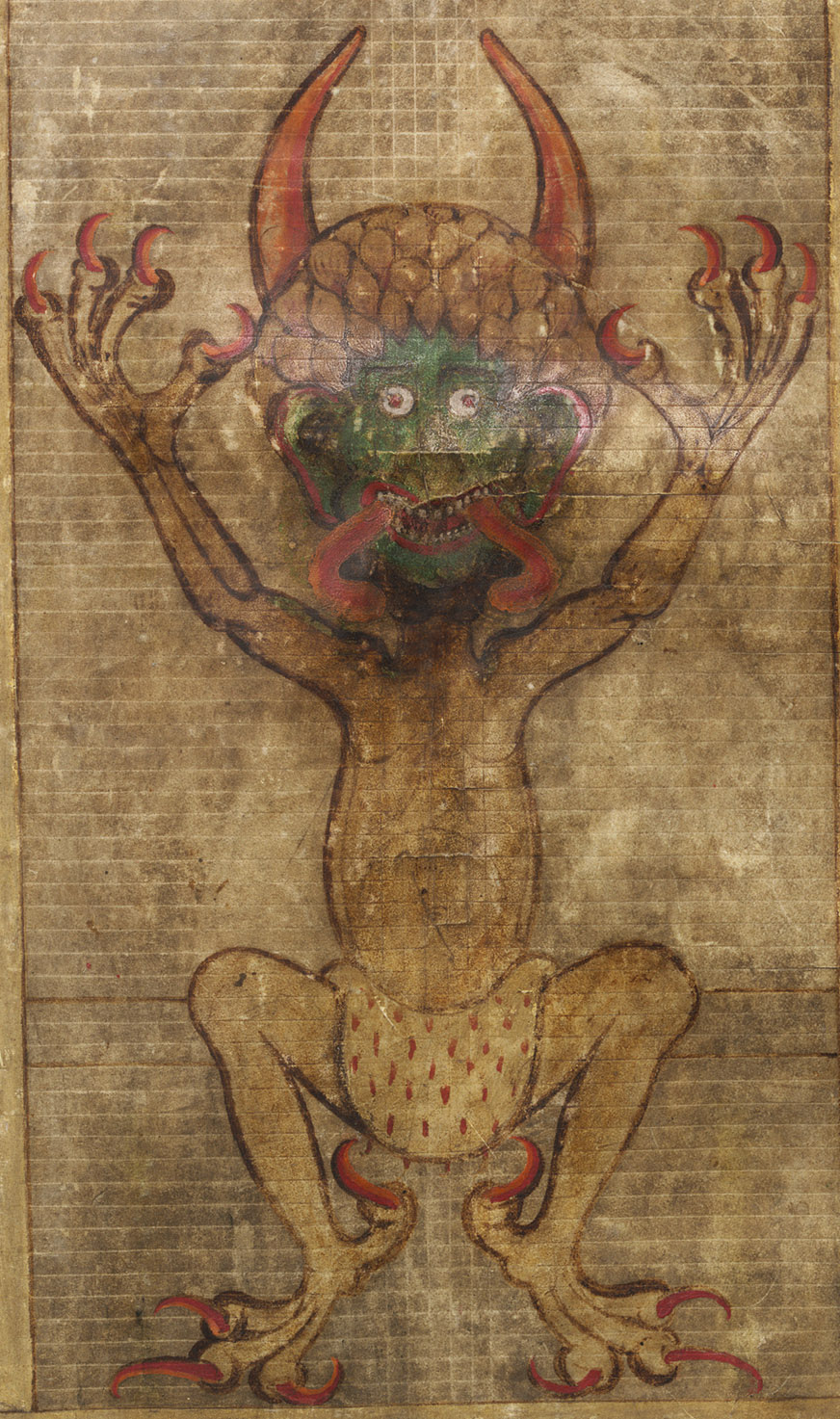
Why else would a book as high-minded as the Codex Gigas (Latin for Giant Book) contain a full-page glamour portrait of the devil garbed in an ermine loincloth and cherry red claws?
Perhaps it’s the 13th-century equivalent of “sex sells.” What better way to keep your book out of the remainder bin of history than to include an eye-catching glimpse of the Prince of Darkness? Hedge your bets by positioning a splendid vision of the Heavenly City directly opposite.
Notable illustrations aside, the Codex Gigas holds the distinction of being the largest extant medieval illuminated manuscript in the world.
Weighing in at 165 lbs, this 3‑foot-tall bound whale required the skins of 160 donkeys, at the rate of two pages per donkey. (Ten pages devoted to St. Benedict’s rules for monastic life were literally cut from the manuscript at an unknown date.)
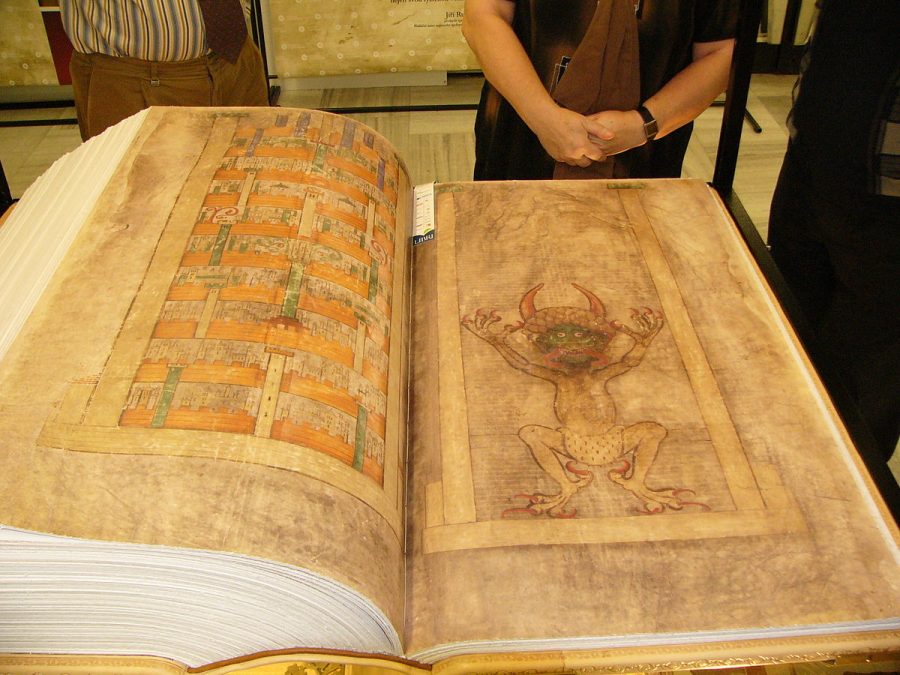
It’s a lot.
A National Geographic documentary concluded that the sprawling manuscript would’ve required a minimum of 5 years of full-time, single-minded labor. More likely, the work was spread out over 25 to 30 years, with various authors contributing to the different sections. In addition to a complete Bible, the “Devil’s Bible” includes an encyclopedia, medical information, a calendar of saints’ days, Flavius Josephus’ histories The Jewish War and Jewish Antiquities and some practical advice on exorcising evil spirits.
The actual lettering does seem to come down to a single scribe with very neat handwriting. Experts at the National Library of Sweden, where the Codex Gigas has come to a rest after centuries of adventures and misadventures, identify it as Carolingian minuscule, a popular and highly legible style of medieval script. Its uniform size would’ve required the scribe to rule each page before forming the letters, after which 100 lines a day would have been a reasonable goal.
You can have a look for yourself on the Library’s website, where the entire work is viewable in digitized form.
Certainly the devil is a great place to start, though his appearance may strike you as a bit comical, given all the fuss.
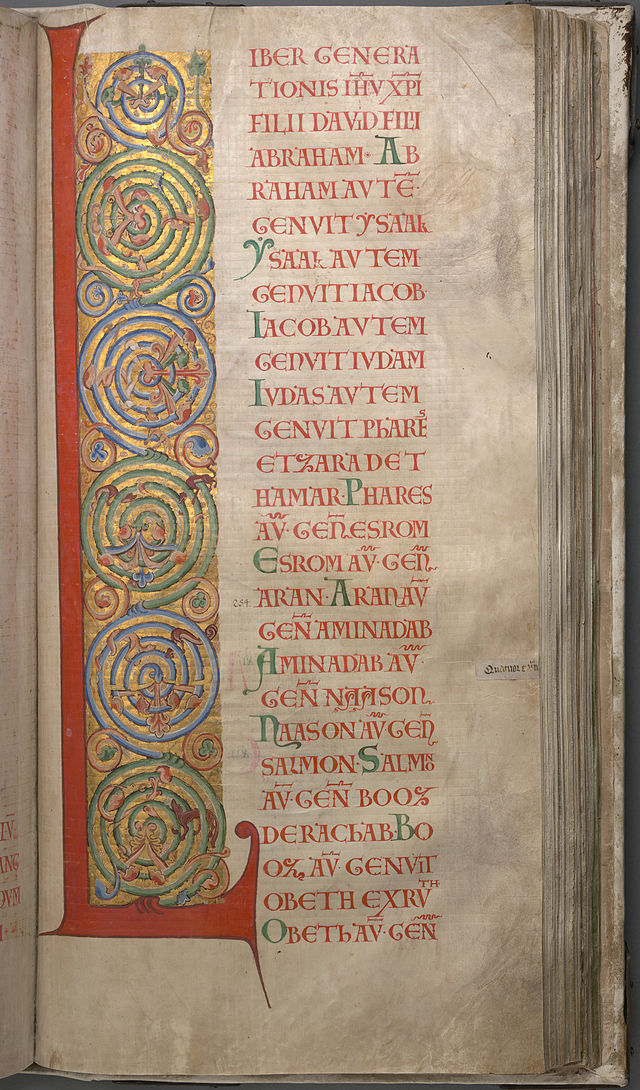
Begin your explorations of the Codex Gigas here.
Related Content:
The Medieval Ban Against the “Devil’s Tritone”: Debunking a Great Myth in Music Theory
Ayun Halliday is an author, illustrator, theater maker and Chief Primatologist of the East Village Inky zine. Follow her @AyunHalliday.
Read More...Stephen King Names His Five Favorite Works by Stephen King
Stephen King has no doubt forgotten writing more books than most of us will ever publish. But even now, in his prolific “late career,” if you ask him to name his own most favored works, he can do it without hesitation. Stephen Colbert tried that out a few years ago on The Late Show, when the writer made an appearance to promote his then-latest book Billy Summers. The first of Stephen King’s top five by Stephen King is “Survivor Type,” a 1982 short story about “a physician who gets stranded on a little island, and he’s smuggling heroin, and he’s starving, so he eats himself piece by piece.”
“Survivor Type” may be a deep cut — and one that initially struggled for publication, being so disturbing that King remembers “even men’s magazines” turning it down — but it’s nevertheless been adapted into five different films since the twenty-tens alone. King may have enjoyed massive book sales throughout almost the entirety of his career, but it certainly hasn’t hurt his brand that so many of his works have become movies and television shows, many of them cultural phenomena in their own right. Take the case of Misery, another of King’s selections, the 1990 feature-film version of which gave us Kathy Bates’ Oscar-winning performance as a crazed fan who kidnaps her favorite novelist.
Misery was directed by Rob Reiner, who’d worked with King’s material before: in 1986, he turned the story “The Body” into Stand by Me, which is now considered a high point in the categories of eighties teen-star vehicles and early-sixties nostalgia pictures. After seeing its first screening, King declared it “the best film ever made out of anything I’ve written” — before characteristically adding, “which isn’t saying much.” (That same year, recall, King not just wrote but directed Maximum Overdrive, a spectacle of malevolent machines taking over a truck stop that he later described as a “moron movie.”)
King also enthuses about his 2006 novel Lisey’s Story, as well as its Apple TV+ series adaptation, which had just come out at the time. Also still-new was the second televisual rendition of The Stand, King’s 1978 novel set in the aftermath of an apocalyptic pandemic. “Any similarities to what’s going on now are just too close for comfort,” he says to Colbert in this COVID-era clip, though it’s ambiguous whether the book actually makes his top five. Colbert suggests filling out the list with Billy Summers, presumably on the principle that every writer favors his most recent work. But where would King rank the three novels he’s cranked out since?
Related content:
Stephen King’s 22 Favorite Movies, Packed with Horror & Suspense
Stephen King Creates a List of His 10 Favorite Novels
Stephen King Recommends 96 Books for Aspiring Writers to Read
How Stanley Kubrick Adapted Stephen King’s The Shining into a Cinematic Masterpiece
Pretty Much Pop #18 Discusses Stephen King’s Media Empire
Based in Seoul, Colin Marshall writes and broadcasts on cities, language, and culture. His projects include the Substack newsletter Books on Cities and the book The Stateless City: a Walk through 21st-Century Los Angeles. Follow him on Twitter at @colinmarshall or on Facebook.
Read More...Sci-Fi Author J.G. Ballard Predicts the Rise of Social Media (1977)
Say you were a fan of Steven Spielberg’s moving coming-of-age drama Empire of the Sun, set in a Japanese internment camp during World War II and starring a young Christian Bale. Say you read the autobiographical novel on which that film is based, written by one J.G. Ballard. Say you enjoyed it so much, you decided to read more of the author’s work, like, say, 1973’s Crash, a novel about people who develop a sexual fetish around wounds sustained in staged automobile accidents. Or you pick up its predecessor, The Atrocity Exhibition, a book William S. Burroughs described as stirring “sexual depths untouched by the hardest-core illustrated porn.” Or perhaps you stumble upon Concrete Island, a warped take on Defoe that strands a wealthy architect and his Jaguar on a highway intersection.
You may experience some dissonance. Who was this Ballard? A realist chronicler of 20th century horrors; perverse explorer of—in Burroughs’ words—“the nonsexual roots of sexuality”; sci-fi satirist of the bleak post-industrial wastelands of modernity? He was all of these, and more. Ballard was a brilliant futurist and his dystopian novels and short stories anticipated the 80s cyberpunk of William Gibson, exploring with a twisted sense of humor what Jean Lyotard famously dubbed in 1979 The Postmodern Condition: a state of ideological, scientific, personal, and social disintegration under the reign of a technocratic, hypercapitalist, “computerized society.” Ballard had his own term for it: “media landscape,” and his dark visions of the future often correspond to the virtual world we inhabit today.
In addition to his fictional creations, Ballard made several disturbingly accurate predictions in interviews he gave over the decades (collected in a book titled Extreme Metaphors). In 1987, with the film adaptation of Empire of the Sun just on the horizon and “his most extreme work Crash re-released in the USA to warmer reaction,” he gave an interview to I‑D magazine in which he predicted the internet as “invisible streams of data pulsing down lines to produce an invisible loom of world commerce and information.” This may not seem especially prescient (see, for example, E.M. Forster’s 1909 “The Machine Stops” for a chilling futuristic scenario much further ahead of its time). But Ballard went on to describe in detail the rise of the Youtube celebrity:
Every home will be transformed into its own TV studio. We’ll all be simultaneously actor, director and screenwriter in our own soap opera. People will start screening themselves. They will become their own TV programmes.
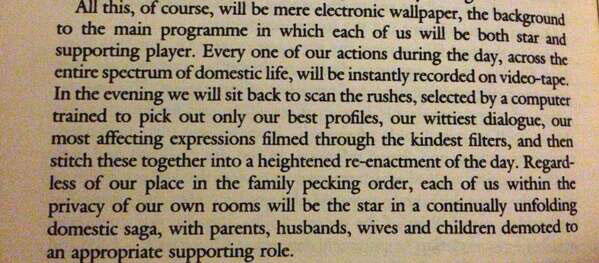
The themes of celebrity obsession and technologically constructed realities resonate in almost all of Ballard’s work and thought, and ten years earlier, in an essay for Vogue, he described in detail the spread of social media and its totalizing effects on our lives. In the technological future, he wrote, “each of us will be both star and supporting player.”
Every one of our actions during the day, across the entire spectrum of domestic life, will be instantly recorded on video-tape. In the evening we will sit back to scan the rushes, selected by a computer trained to pick out only our best profiles, our wittiest dialogue, our most affecting expressions filmed through the kindest filters, and then stitch these together into a heightened re-enactment of the day. Regardless of our place in the family pecking order, each of us within the privacy of our own rooms will be the star in a continually unfolding domestic saga, with parents, husbands, wives and children demoted to an appropriate supporting role.
Though Ballard thought in terms of film and television—and though we ourselves play the role of the selecting computer in his scenario—this description almost perfectly captures the behavior of the average user of Facebook, Instagram, etc. (See Ballard in the interview clip above discuss further “the possibilities of genuinely interactive virtual reality” and his theory of the 50s as the “blueprint” of modern technological culture and the “suburbanization” of reality.) In addition to the Vogue essay, Ballard wrote a 1977 short story called “The Intensive Care Unit,” in which—writes the site Ballardian—“ordinances are in place to prevent people from meeting in person. All interaction is mediated through personal cameras and TV screens.”
So what did Ballard, who died in 2009, think of the post-internet world he lived to see and experience? He discussed the subject in 2003 in an interview with radical publisher V. Vale (who re-issued The Atrocity Exhibition). “Now everybody can document themselves in a way that was inconceivable 30, 40, 50 years ago,” Ballard notes, “I think this reflects a tremendous hunger among people for ‘reality’—for ordinary reality. It’s very difficult to find the ‘real,’ because the environment is totally manufactured.” Like Jean Baudrillard, another prescient theorist of postmodernity, Ballard saw this loss of the “real” coming many decades ago. As he told I‑D in 1987, “in the media landscape it’s almost impossible to separate fact from fiction.”
Related Content:
A 1947 French Film Accurately Predicted Our 21st-Century Addiction to Smartphones
The Very First Film of J.G. Ballard’s Crash, Starring Ballard Himself (1971)
Hear Five JG Ballard Stories Presented as Radio Dramas
Josh Jones is a writer and musician based in Durham, NC. Follow him at @jdmagness
Read More...Hear the Song Written on a Sinner’s Buttock in Hieronymus Bosch’s Painting The Garden of Earthly Delights
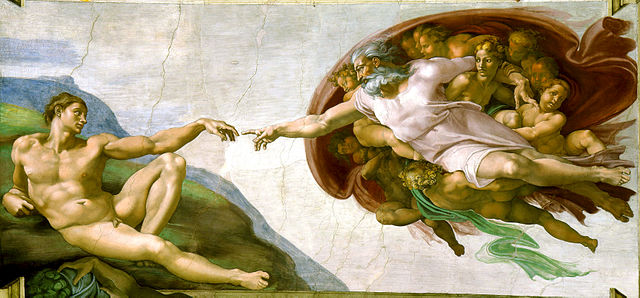
There’s something unusually exciting about finding a hidden or discreetly placed element in a well-known painting. I can only imagine the thrill of the physician who first noticed the curious presence of a human brain in Michelangelo’s The Creation of Adam: God, his retinue of angels, and their cloak map neatly onto some of the main neural structures, including the major sulci in the cerebellum, the pituitary gland, the frontal lobe, and the optic chiasm. It’s hard to gauge Michelangelo’s motivation for doing so, but considering his documented interest in dissection and physiology, the find is not particularly surprising.
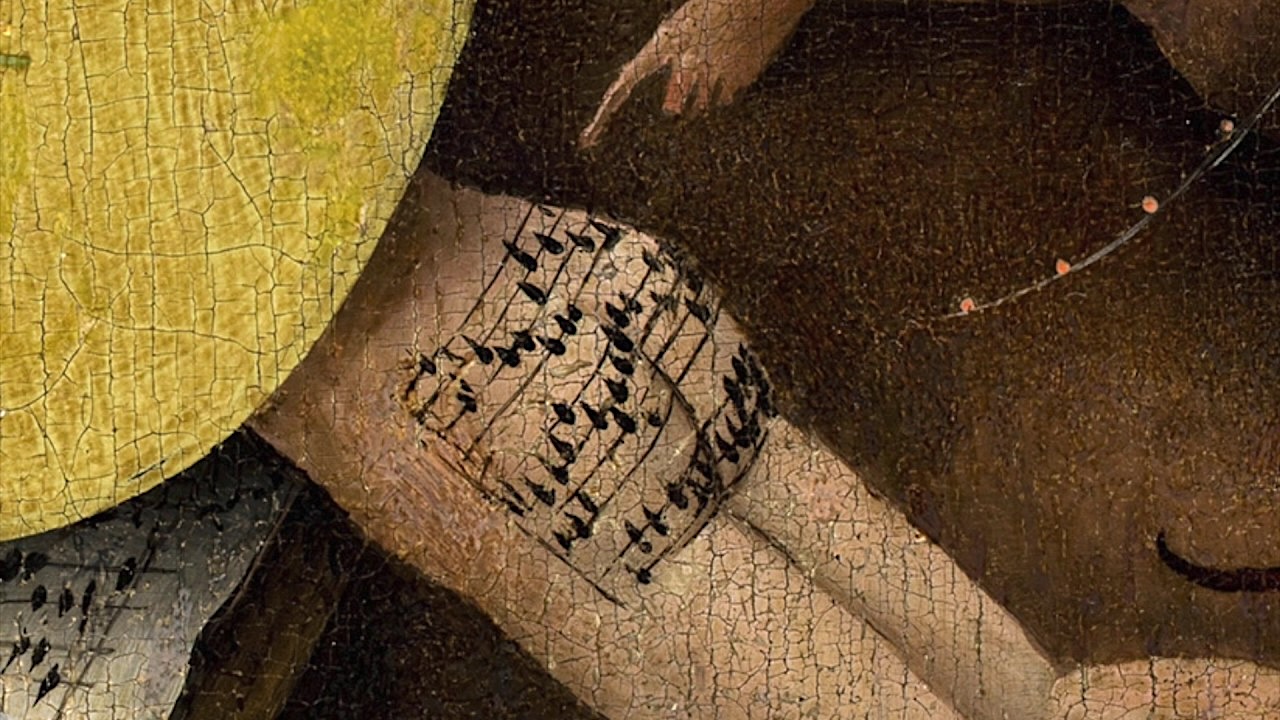
And then there’s another find. Several years ago, the Internet became excited when an enterprising blogger named Amelia transcribed, recorded, and uploaded a musical score straight out of Hieronymus Bosch’s The Garden of Earthly Delights, painted between 1490 and 1510. The kicker? Amelia found the score written on a suffering sinner’s butt.
The poor, musically-branded soul can be seen in the bottom left-hand corner of the painting’s third and final panel (below), wherein Bosch depicts the various torture methods of hell. The unfortunate hell-dweller lies prostrate atop an open music book, crushed by a gigantic lute, while a toad-like demon stretches his tongue towards his tuneful buttocks. Another inhabitant is strung up on a harp above the scene.
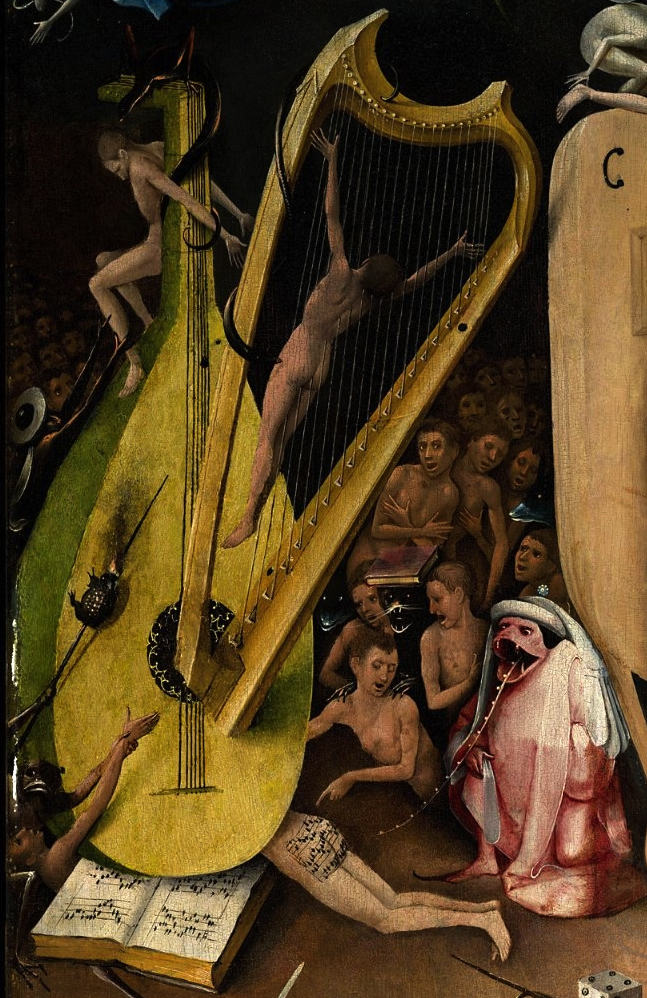
The piece can be heard in the video above. It is… unusual. Although we can’t ascertain why Bosch decided to write out this particular melody, since scant biographical information about the painter survives, it’s possible that he decided to include music in his depiction of the inferno because it was viewed as a sign of sinful pleasure. For those who haven’t yet had a chance to hear it, listen to Medieval-era butt music here.
Ilia Blinderman is a Montreal-based culture and science writer. Follow him at @iliablinderman or at Google, or read more of his writing at the Huffington Post.
Related Content:
The Meaning of Hieronymus Bosch’s The Garden of Earthly Delights Explained
Read More...
Support Us
We're hoping to rely on loyal readers, rather than erratic ads. Please click the Donate button and support Open Culture. You can use Paypal, Venmo, Patreon, even Crypto! We thank you!

About Us

Open Culture scours the web for the best educational media. We find the free courses and audio books you need, the language lessons & educational videos you want, and plenty of enlightenment in between.
Advertise With Us
FREE UPDATES!
GET OUR DAILY EMAIL
Get the best cultural and educational resources on the web curated for you in a daily email. We never spam. Unsubscribe at any time.
FOLLOW ON SOCIAL MEDIA
Open Culture editor Dan Colman scours the web for the best educational media. He finds the free courses and audio books you need, the language lessons & movies you want, and plenty of enlightenment in between.
Advertise With Us



.jpg)