Fritz Lang First Depicted Artificial Intelligence on Film in Metropolis (1927), and It Frightened People Even Then
Artificial intelligence seems to have become, as Michael Lewis labeled a previous chapter in the recent history of technology, the new new thing. But human anxieties about it are, if not an old old thing, then at least part of a tradition longer than we may expect. For vivid evidence, look no further than Fritz Lang’s Metropolis, which brought the very first cinematic depiction of artificial intelligence to theaters in 1927. It “imagines a future cleaved in two, where the affluent from lofty skyscrapers rule over a subterranean caste of laborers,” writes Synapse Analytics’ Omar Abo Mosallam. “The class tension is so palpable that the invention of a Maschinenmensch (a robot capable of work) upends the social order.”
The sheer tirelessness of the Maschinenmensch “sows havoc in the city”; later, after it takes on the form of a young woman called Maria — a transformation you can watch in the clip above — it “incites workers to rise up and destroy the machines that keep the city functioning. Here, there is a suggestion to associate this new invention with an unraveling of the social order.” This robot, which Guardian film critic Peter Bradshaw describes as “a brilliant eroticization and fetishization of modern technology,” has long been Metropolis’ signature figure, more iconic than HAL, Data, and WALL‑E put together.
Still, those characters all rate mentions of their own in the articles reviewing the history of AI in the movies recently published by the BFI, RTÉ, Pictory, and other outlets besides. The Day the Earth Stood Still, Alien, Blade Runner (and even more so its sequel Blade Runner 2049), Ghost in the Shell, The Matrix, and Ex Machina. Not all of these pictures present their artificially intelligent characters primarily as existential threats to the existing order; the BFI’s Georgina Guthrie highlights video essayist-turned-auteur Kogonada’s After Yang as an example that treats the role of AI could assume in society as a much more complex — indeed, much more human — matter.
From Metropolis to After Yang, as RTÉ’s Alan Smeaton points out, “AI is usually portrayed in movies in a robotic or humanoid-like fashion, presumably because we can easily relate to humanoid and robotic forms.” But as the public has come to understand over the past few years, we can perceive a technology as potentially or actually intelligent even it doesn’t resemble a human being. Perhaps the age of the fearsome mechanical Art Deco gynoid will never come to pass, but we now feel more keenly than ever both the seductiveness and the threat of Metropolis’ Maschinenmensch — or, as it was named in the original on which the film was based, Futura.
Related content:
Metropolis: Watch Fritz Lang’s 1927 Masterpiece
Amazon Offers Free AI Courses, Aiming to Help 2 Million People Build AI Skills by 2025
Based in Seoul, Colin Marshall writes and broadcasts on cities, language, and culture. His projects include the Substack newsletter Books on Cities, the book The Stateless City: a Walk through 21st-Century Los Angeles and the video series The City in Cinema. Follow him on Twitter at @colinmarshall or on Facebook.
Read More...9‑Year-Old Edward Hopper Draws a Picture on the Back of His 3rd Grade Report Card
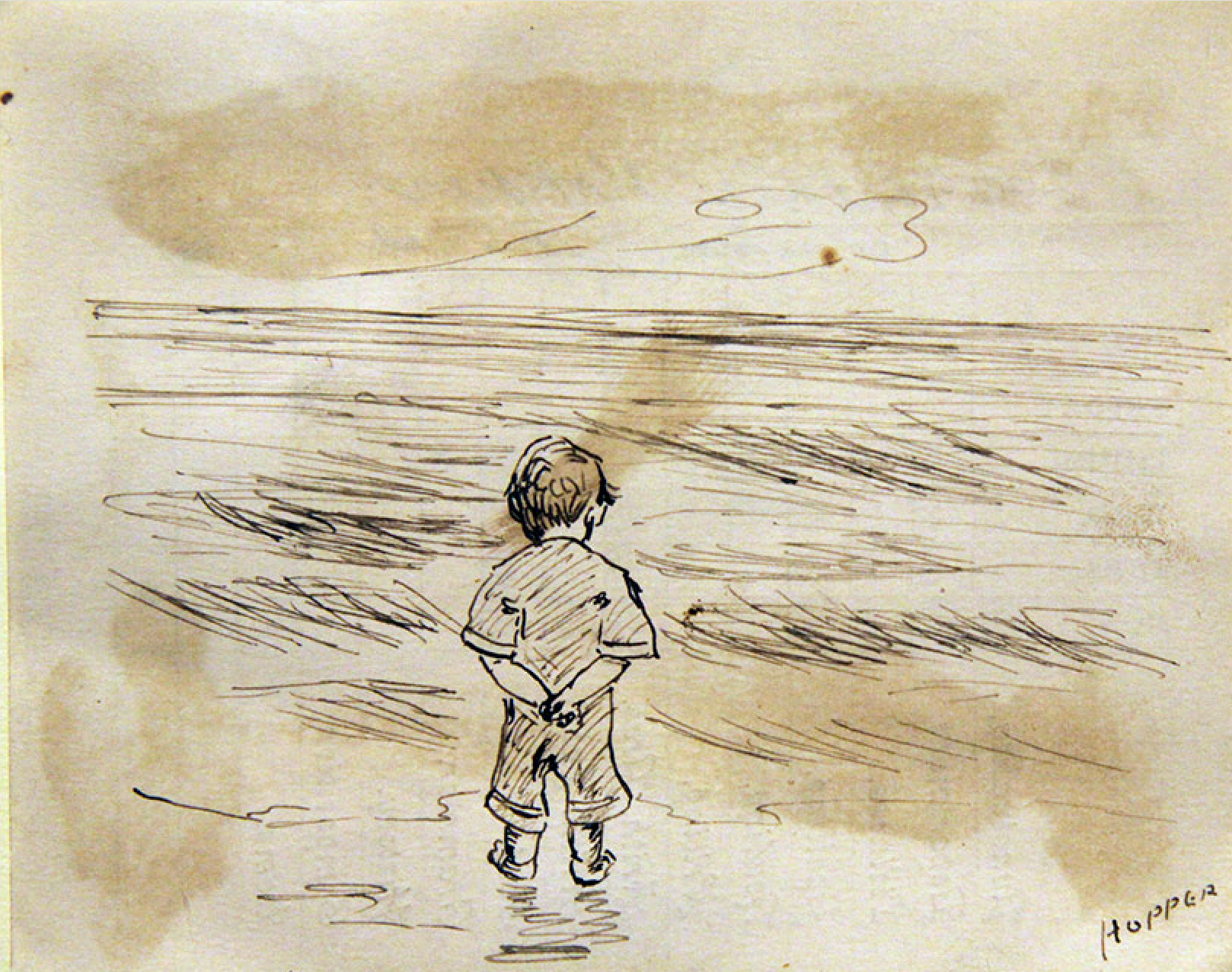
In a 2017 press release, the Edward Hopper House announced that it would receive over 1,000 artifacts and memorabilia documenting Edward Hopper’s family life and early years. The collection “consists of juvenilia and other materials from the formative years of Hopper’s life and includes original letters, drawings from his school years … photographs, original newspaper articles, and other items that allow visitors to experience firsthand how Hopper’s childhood and home environment shaped his art.”
Above you can find Exhibit A from the collection. A picture that young Hopper, only 9 years old, drew on the back of his 3rd grade report card in 1891. A sure early sign of his talents.
If you would like to support the mission of Open Culture, consider making a donation to our site. It’s hard to rely 100% on ads, and your contributions will help us continue providing the best free cultural and educational materials to learners everywhere. You can contribute through PayPal, Patreon, and Venmo (@openculture). Thanks!
Related Content:
What Makes Edward Hopper’s Nighthawks a Great Painting?: A Video Essay
How Edward Hopper “Storyboarded” His Iconic Painting Nighthawks
Edward Hopper’s Iconic Painting Nighthawks Explained in a 7‑Minute Video Introduction
Read More...The First Professional Footage of Pink Floyd Gets Captured in a 1967 Documentary (and the Band Also Provides the Soundtrack)
British filmmaker and novelist Peter Whitehead has been credited with inventing the music video with his promo films for the Rolling Stones in the mid-60s. According to Ali Catterall and Simon Wells, authors of Your Face Here, a study of “British Cult Film since the Sixties,” Whitehead was “a trusted confidant of the Rolling Stones… and a member of the inner circle.” In addition to the Stones, Whitehead had access to a surprising number of important figures in the countercultural scene of 60s London, including actors Michael Caine and Julie Christie, artist David Hockney, and a just-emerging (and then unknown) psychedelic band called Pink Floyd. All of these characters show up in Whitehead’s 1968 documentary Tonite Let’s All Make Love in London. Catterall and Wells describe the film thus:
If any one film truly reveals “Swinging London,” it is Peter Whitehead’s little-seen documentary Tonite Let’s All Make Love In London (1968). Beautifully shot, with a Syd Barrett-led Pink Floyd supplying the soundtrack, it is perhaps the only true masterpiece of the period, offering a visually captivating window on the ‘in’ crowd. Revealing, often very personal interviews with the era’s prime movers — Michael Caine, Julie Christie, David Hockney and Mick Jagger — are interspersed by dazzling images of the ‘dedicated followers of fashion’, patronising the clubs and discotheques of the day.
Departing from typical documentary styles, Tonite eschews neat narrative packaging and voice-over, and opts instead for a sometimes jarring montage of scenes from the London clubs and streets, rare footage of performances by the Stones, the Floyd (in one of their first-ever gigs at the UFO club), and others, and political rallies (with Vanessa Redgrave singing “Guantanamera”)–all intercut with the abovementioned interviews. One of the best of the latter is with a very young and charming David Hockney (below), who compares London to California and New York, and debunks ideas about the “swinging London” nightlife (“you need too much money”).
Overall, Tonite Let’s All Make Love in London is a unique portrait of the era and its rising stars, and Whitehead’s visual style replicates an insider’s perspective of watching (but not participating) as a new cultural moment unfolds. Whitehead, who “never missed a 60s happening,” has a knack for recording such moments. His 1965 Wholly Communion (see here) captures the spirited Albert Hall Poetry Festival in 65 (presided over by doyen Allen Ginsberg), and 1969’s The Fall documents some of the most incendiary political action of late-60s New York.
Josh Jones is a writer and musician based in Durham, NC. Follow him at @jdmagness
Related Content
Pink Floyd’s Debut on American TV, Restored in Color (1967)
Read More...RIP David Sanborn: See Him Play Alongside Miles Davis, Randy Newman, Sun Ra, Leonard Cohen and Others on His TV Show Night Music
It’s late in the evening of Saturday, October 28th, 1989. You flip on the television and the saxophonist David Sanborn appears onscreen, instrument in hand, introducing the eclectic blues icon Taj Mahal, who in turn declares his intent to play a number with “rural humor” and “world proportions.” And so he does, which leads into performances by Todd Rundgren, Nanci Griffith, the Pat Metheny Group, and proto-turntablist Christian Marclay (best known today for his 24-hour montage The Clock). At the end of the show — after a vintage clip of Count Basie from 1956 — everyone gets back onstage for an all-together-now rendition of “Never Mind the Why and Wherefore” from H.M.S. Pinafore.
This was a more or less typical episode of Night Music, which aired on NBC from 1988 to 1990, and in that time offered “some of the strangest musical line-ups ever broadcast on network television.” So writes E. Little at In Sheep’s Clothing Hi-Fi, who names just a few of its performers: “Sonic Youth, Miles Davis, the Residents, Charlie Haden and His Liberation Orchestra, Kronos Quartet, Pharoah Sanders, Karen Mantler, Diamanda Galas, John Lurie, and Nana Vasconcelos.”
One especially memorable broadcast featured “a 15-minute interview-performance by Sun Ra’s Arkestra that finds the composer-pianist-Afrofuturist at the peak of his experimental powers, moving from piano to Yamaha DX‑7 and back again while the Arkestra flexes its cosmic muscles.”
“Sanborn hosted the eminently hip TV show,” writes jazz journalist Bill Milkowski in his remembrance of the late saxman, who died last weekend, “not only providing informative introductions but also sitting in with the bands.” One night might see him playing with Al Jarreau, Paul Simon, Marianne Faithfull, Bootsy Collins, the Red Hot Chili Peppers, Dizzy Gillespie, — or indeed, some unlikely combination of such artists. “The idea of that show was that genres are secondary, an artificial division of music that really isn’t necessary; that musicians have more in common than people expect,” Sanborn told DownBeat in 2018. “We wanted to represent that by having a show where Leonard Cohen could sing a song, Sonny Rollins could play a song, and then they could do something together.”
Having wanted to pursue that idea further since the show’s cancellation — not the easiest task, given his ever-busy schedule of live performances and recording sessions across the musical spectrum — he created the YouTube channel Sanborn Sessions a few years ago, some of whose videos have been re-uploaded in recent weeks. But much also remains to be discovered in the archives of the original Night Music for broad-minded music lovers under the age of about 60 — or indeed, for those over that age who never tuned in back in the late eighties, a time period that’s lately come in for a cultural re-evaluation. Thanks to this YouTube playlist, you can watch more than 40 broadcasts of Night Music (which was at first titled Sunday Night) and listen like it’s 1989.
Related content:
How American Bandstand Changed American Culture: Revisit Scenes from the Iconic Music Show
All the Music Played on MTV’s 120 Minutes: A 2,500-Video Youtube Playlist
When Glenn O’Brien’s TV Party Brought Klaus Nomi, Blondie & Basquiat to Public Access TV (1978–82)
Based in Seoul, Colin Marshall writes and broadcasts on cities, language, and culture. His projects include the Substack newsletter Books on Cities, the book The Stateless City: a Walk through 21st-Century Los Angeles and the video series The City in Cinema. Follow him on Twitter at @colinmarshall or on Facebook.
Read More...George Orwell’s Political Views, Explained in His Own Words
Among modern-day liberals and conservatives alike, George Orwell enjoys practically sainted status. And indeed, throughout his body of work, including but certainly not limited to his oft-assigned novels Animal Farm and Nineteen Eighty-Four, one can find numerous implicitly or explicitly expressed political views that please either side of that divide — or, by definition, views that anger each side. The readers who approve of Orwell’s open advocacy for socialism, for example, are probably not the same ones who approve of his indictment of language policing. To understand what he actually believed, we can’t trust current interpreters who employ his words for their own ends; we must return to the words themselves.
Hence the structure of the video above from Youtuber Ryan Chapman, which offers “an overview of George Orwell’s political views, guided by his reflections on his own career.” Chapman begins with Orwell’s essay “Why I Write,” in which the latter declares that “in a peaceful age I might have written ornate or merely descriptive books, and might have remained almost unaware of my political loyalties. As it is I have been forced into becoming a sort of pamphleteer.”
His awakening occurred in 1936, when he went to cover the Spanish Civil War as a journalist but ended up joining the fight against Franco, a cause that aligned neatly with his existing pro-working class and anti-authoritarian emotional tendencies.
After a bullet in the throat took Orwell out of the war, his attention shifted to the grand-scale hypocrisies he’d detected in the Soviet Union. It became “of the utmost importance to me that people in western Europe should see the Soviet regime for what it really was,” he writes in the preface to the Ukrainian edition of the allegorical satire Animal Farm. “His concerns with the Soviet Union were part of a broader concern on the nature of truth and the way truth is manipulated in politics,” Chapman explains. An important part of his larger project as a writer was to shed light on the widespread “tendency to distort reality according to their political convictions,” especially among the intellectual classes.
“This kind of thing is frightening to me,” Orwell writes in “Looking Back on the Spanish War,” “because it often gives me the feeling that the very concept of objective truth is fading out of the world”: a condition for the rise of ideology “not only forbids you to express — even to think — certain thoughts, but it dictates what you shall think, it creates an ideology for you, it tries to govern your emotional life as well as setting up a code of conduct.” Such is the reality he envisions in Nineteen Eighty-Four, a reaction to the totalitarianism he saw manifesting in the USSR, Germany, and Italy. “But he also thought it was spreading in more subtle forms back home, in England, through socially enforced, unofficial political orthodoxy.” No matter how supposedly enlightened the society we live in, there are things we’re formally or informally not allowed to acknowledge; Orwell reminds us to think about why.
Related content:
An Animated Introduction to George Orwell
George Orwell Reveals the Role & Responsibility of the Writer “In an Age of State Control”
George Orwell Explains in a Revealing 1944 Letter Why He’d Write 1984
Based in Seoul, Colin Marshall writes and broadcasts on cities, language, and culture. His projects include the Substack newsletter Books on Cities, the book The Stateless City: a Walk through 21st-Century Los Angeles and the video series The City in Cinema. Follow him on Twitter at @colinmarshall or on Facebook.
Read More...Jerry Seinfeld Delivers Commencement Address at Duke University: You Will Need Humor to Get Through the Human Experience
This weekend, Jerry Seinfeld gave the commencement speech at Duke University and offered the graduates his three keys to life: 1. bust your ass, 2. pay attention, and 3. fall in love. Then, 10 minutes later, he added essentially a fourth key to life: “Do not lose your sense of humor. You can have no idea at this point in your life how much you’re going to need it to get through. Not enough of life makes sense for you to be able to survive it without humor.” “It is worth the sacrifice of an occasional discomfort to have some laughs. Don’t lose that.” “Humor is the most powerful, most survival-essential quality you will ever have or need to navigate through the human experience.” Amen.
Related Content
John Waters’ RISD Graduation Speech: Real Wealth Is Life Without A*Holes
Conan O’Brien Kills It at Dartmouth Graduation
Jon Stewart’s William & Mary Commencement Address: The Entire World is an Elective
Read More...The First Recording of Allen Ginsberg Reading “Howl” (1956)
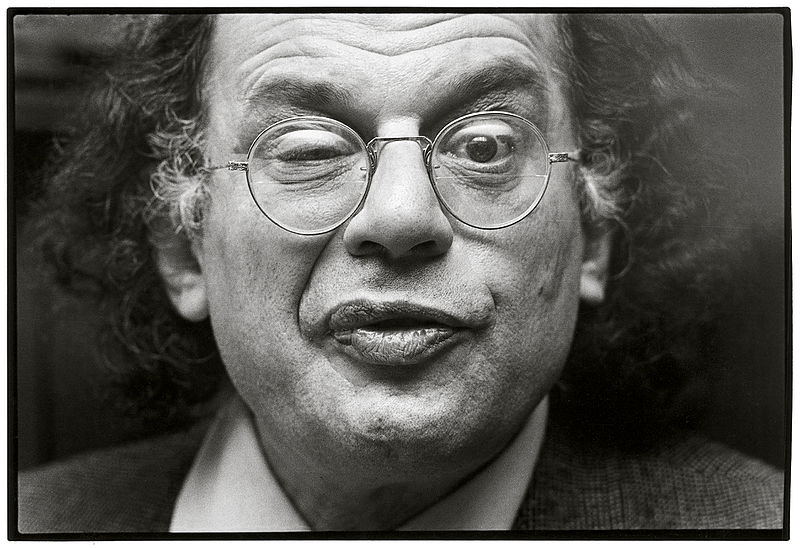
Image by Michiel Hendryckx, via Wikimedia Commons
Occasionally I slip into an ivory tower mentality in which the idea of a banned book seems quaint—associated with silly scandals over the tame sex scenes in James Joyce or D.H. Lawrence. After all, I think, we live in an age when bestseller lists are topped (no pun) by tawdry fan fiction like Fifty Shades of Grey. Nothing’s sacred. But this notion is a massive blind spot on my part; the whole awareness-raising mission of the annual Banned Books Week seeks to dispel such complacency. Books are challenged, suppressed, and banned all the time in public schools and libraries, even if we’ve moved past outright government censorship of the publishing industry.
It’s also easy to forget that Allen Ginsberg’s generation-defining poem “Howl” was once almost a casualty of censorship. The most likely successor to Walt Whitman’s vision, Ginsberg’s oracular utterances did not sit well with U.S. Customs, who in 1957 tried to seize every copy of the British second printing. When that failed, police arrested the poem’s publisher, Lawrence Ferlinghetti, and he and Ginsberg’s “Howl” were put on trial for obscenity. Apparently, phrases like “cock and endless balls” did not sit well with the authorities. But the court vindicated them all.
The story of Howl’s publication begins in 1955, when 29-year-old Ginsberg read part of the poem at the Six Gallery, where Ferlinghetti—owner of San Francisco’s City Lights bookstore—sat in attendance. Deciding that Ginsberg’s epic lament “knocked the sides out of things,” Ferlinghetti offered to publish “Howl” and brought out the first edition in 1956. Prior to this reading, “Howl” existed in the form of an earlier poem called “Dream Record, 1955,” which poet Kenneth Rexroth told Ginsberg sounded “too formal… like you’re wearing Columbia University Brooks Brothers ties.” Ginsberg’s rewrite jettisoned the ivy league decorum.
Unfortunately, no audio exists of that first reading, but above you can hear the first recorded reading of “Howl,” from February, 1956 at Portland’s Reed College. The recording sat dormant in Reed’s archives for over fifty years until scholar John Suiter rediscovered it in 2008. In it, Ginsberg reads his great prophetic work, not with the cadences of a street preacher or jazzman—both of which he had in his repertoire—but in an almost robotic monotone with an undertone of manic urgency. Ginsberg’s reading, before an intimate group of students in a dormitory lounge, took place only just before the first printing of the poem in the City Lights edition.
Note: This post originally appeared on our site in 2013. Over the years, the audio originally featured in the post, along with many of the links, went dead. So we gave everything a refresh and brought it back.
If you would like to support the mission of Open Culture, consider making a donation to our site. It’s hard to rely 100% on ads, and your contributions will help us continue providing the best free cultural and educational materials to learners everywhere. You can contribute through PayPal, Patreon, and Venmo (@openculture). Thanks!
Related Content:
Allen Ginsberg Recordings Brought to the Digital Age. Listen to Eight Full Tracks for Free
James Franco Reads a Dreamily Animated Version of Allen Ginsberg’s Epic Poem ‘Howl’
2,000+ Cassettes from the Allen Ginsberg Audio Collection Now Streaming Online
13 Lectures from Allen Ginsberg’s “History of Poetry” Course (1975)
Josh Jones is a writer and musician based in Washington, DC. Follow him at @jdmagness
Read More...What Is Religion Actually For?: Isaac Asimov and Ray Bradbury Weigh In
In the nineteen-sixties, the music media encouraged the notion that a young rock-and-roll fan had to side with either the Beatles or their rivals, the Rolling Stones. On some level, it must have made sense, given the growing aesthetic divide between the music the two world-famous groups were putting out. But, at bottom, not only was there no rivalry between the bands (it was an invention of the music papers), there was no real need, of course, to choose one or the other. In the fifties, something of the same dynamic must have obtained between Ray Bradbury and Isaac Asimov, two popular genre writers, each with his own worldview.
Bradbury and Asimov had much in common: both were (probably) born in 1920, both attended the very first World Science Fiction Convention in 1939, both began publishing in pulp magazines in the forties, and both had an aversion to airplanes. That Bradbury spent most of his life in California and Asimov in New York made for a potentially interesting cultural contrast, though it never seems to have been played up. Still, it may explain something of the basic difference between the two writers as it comes through in the video above, a compilation of talk-show clips in which Bradbury and Asimov respond to questions about their religious beliefs, or lack thereof.
Asimov may have written a guide to the Bible, but he was hardly a literalist, calling the first chapters of Genesis “the sixth-century BC version of how the world might have started. We’ve improved on that since. I don’t believe that those are God’s words. Those are the words of men, trying to make the most sense that they could out of the information they had at the time.” In a later clip, Bradbury, for his part, confesses to a belief in not just Genesis, but also Darwin and even Jean-Baptiste Lamarck, who theorized that characteristics acquired in an organism’s lifetime could be passed down to the next generation. “Nothing is proven,” he declares, “so there’s room for a religious delicatessen.”
One senses that Asimov wouldn’t have agreed, and indeed, would have been perfectly satisfied with a regular delicatessen. Though both he and Bradbury became famous as science-fiction writers around the same time — to say nothing of their copious writing in other genres — they possessed highly distinct imaginations. That works like Fahrenheit 451 and the Foundation trilogy attracted such different readerships is explicable in part through Bradbury’s insistence that “there’s room to believe it all” and Asimov’s dismissal of what he saw as every “get-rich quick scheme of the mind” peddled by “con men of the spirit”: each point of view as thoroughly American, in its way, as the Beatles and the Stones were thoroughly English.
Related content:
Isaac Asimov Explains His Three Laws of Robots
Carl Sagan Answers the Ultimate Question: Is There a God? (1994)
50 Famous Academics & Scientists Talk About God
Based in Seoul, Colin Marshall writes and broadcasts on cities, language, and culture. His projects include the Substack newsletter Books on Cities, the book The Stateless City: a Walk through 21st-Century Los Angeles and the video series The City in Cinema. Follow him on Twitter at @colinmarshall or on Facebook.
Read More...Watch Iconic Artists at Work: Rare Videos of Picasso, Matisse, Kandinsky, Renoir, Monet, Pollock & More
Claude Monet, 1915:
We’ve all seen their works in fixed form, enshrined in museums and printed in books. But there’s something special about watching a great artist at work. Over the years, we’ve posted film clips of some of the greatest artists of the 20th century caught in the act of creation. Today we’ve gathered together eight of our all-time favorites.
Above is the only known film footage of the French Impressionist Claude Monet, made when he was 74 years old, painting alongside a lily pond in his garden at Giverny. The footage was shot in the summer of 1915 by the French actor and dramatist Sacha Guitry for his patriotic World War I‑era film, Ceux de Chez Nous, or “Those of Our Land.” For more information, see our previous post, “Rare Film: Claude Monet at Work in His Famous Garden at Giverny, 1915.”
Pierre-Auguste Renoir, 1915:
You may never look at a painting by the French Impressionist Pierre-Auguste Renoir in quite the same way after seeing the footage above, which is also from Sacha Guitry’s Ceux de Chez Nous. Renoir suffered from severe rheumatoid arthritis during the last decades of his life. By the time this film was made in June of 1915, the 74-year-old Renoir was physically deformed and in constant pain. The painter’s 14-year-old son Claude is shown placing the brush in his father’s permanently clenched hand. To learn more about the footage and about Renoir’s terrible struggle with arthritis, be sure to read our post, “Astonishing Film of Arthritic Impressionist Painter, Pierre-Auguste Renoir (1915).”
Auguste Rodin, 1915:
The footage above, again by Sacha Guitry, shows the French sculptor Auguste Rodin in several locations, including his studio at the dilapidated Hôtel Biron in Paris, which later became the Musée Rodin. The film was made in late 1915, when Rodin was 74 years old. For more on Rodin and the Hôtel Biron, please see: “Rare Film of Sculptor Auguste Rodin working at his Studio in Paris (1915).”
Wassily Kandinsky, 1926:
In 1926, filmmaker Hans Cürlis took the rare footage above of the Russian abstract painter Wassily Kandinsky applying paint to a blank canvas at the Galerie Neumann-Nierendorf in Berlin. Kandinsky was about 49 years old at the time, and teaching at the Bauhaus. To learn more about Kandinsky and to watch a video of actress Helen Mirren discussing his work at the Museum of Modern Art in New York, see our post, “The Inner Object: Seeing Kandinsky.”
Henri Matisse, 1946:
The French artist Henri Matisse is shown above when he was 76 years old, making a charcoal sketch of his grandson, Gerard, at his home and studio in Nice. The clip is from a 26-minute film made by François Campaux for the French Department of Cultural Relations. To read a translation of Matisse’s spoken words and to watch a clip of the artist working on one of his distinctive paper cut-outs, go to “Vintage Film: Watch Henri Matisse Sketch and Make His Famous Cut-Outs (1946).”
Pablo Picasso, 1950:
In the famous footage above, Spanish artist Pablo Picasso paints on glass at his studio in the village of Vallauris, on the French Riviera. It’s from the 1950 film Visite à Picasso (A Visit with Picasso) by Belgian filmmaker Paul Haesaerts. Picasso was about 68 years old at the time. You can find the full 19-minute film here.
Jackson Pollock, 1951:
In the short film above, called Jackson Pollock 51, the American abstract painter talks about his work and creates one of his distinctive drip paintings before our eyes. The film was made by Hans Namuth when Pollock was 39 years old. To learn about Pollock and his fateful collaboration with Namuth, see “Jackson Pollock: Lights, Camera, Paint! (1951).”
Alberto Giacometti, 1965:
The Swiss artist Alberto Giacometti is most famous for his thin, elongated sculptures of the human form. But in the clip above from the 1966 film Alberto Giacometti by the Swiss photographer Ernst Scheidegger, Giacometti is shown working in another medium as he paints the foundational lines of a portrait at his studio in Paris. The footage was apparently shot in 1965, when Giacometti was about 64 years old and had less than a year to live. To learn about Giacometti’s approach to drawing and to read a translation of the German narration in this clip, be sure to see our post, “Watch as Alberto Giacometti Paints and Pursues the Elusive ‘Apparition,’ (1965).”
Related Content:
1922 Photo: Claude Monet Stands on the Japanese Footbridge He Painted Through the Years
Read More...Learn How to Create Your Own Custom AI Assistants Using OpenAI GPTs: A Free Course from Vanderbilt University
Last fall, OpenAI started letting users create custom versions of ChatGPT–ones that would let people create AI assistants to complete tasks in their personal or professional lives. In the months that followed, some users created AI apps that could generate recipes and meals. Others developed GPTs to create logos for their businesses. You get the picture.
If you’re interested in developing your own AI assistant, Vanderbilt computer science professor Jules White has released a free online course called “OpenAI GPTs: Creating Your Own Custom AI Assistants.” On average, the course should take seven hours to complete.
Here’s how he frames the course:
This cutting-edge course will guide you through the exciting journey of creating and deploying custom GPTs that cater to diverse industries and applications. Imagine having a virtual assistant that can tackle complex legal document analysis, streamline supply chain logistics, or even assist in scientific research and hypothesis generation. The possibilities are endless! Throughout the course, you’ll delve into the intricacies of building GPTs that can use your documents to answer questions, patterns to create amazing human and AI interaction, and methods for customizing the tone of your GPTs. You’ll learn how to design and implement rigorous testing scenarios to ensure your AI assistant’s accuracy, reliability, and human-like communication abilities. Prepare to be amazed as you explore real-world examples and case studies, such as:
1. GPT for Personalized Learning and Education: Craft a virtual tutor that adapts its teaching approach based on each student’s learning style, providing personalized lesson plans, interactive exercises, and real-time feedback, transforming the educational landscape.
2. Culinary GPT: Your Personal Recipe Vault and Meal Planning Maestro. Step into a world where your culinary creations come to life with the help of an AI assistant that knows your recipes like the back of its hand. The Culinary GPT is a custom-built language model designed to revolutionize your kitchen experience, serving as a personal recipe vault and meal planning and shopping maestro.
3. GPT for Travel and Business Expense Management: A GPT that can assist with all aspects of travel planning and business expense management. It could help users book flights, hotels, and transportation while adhering to company policies and budgets. Additionally, it could streamline expense reporting and reimbursement processes, ensuring compliance and accuracy.
4. GPT for Marketing and Advertising Campaign Management: Leverage the power of custom GPTs to analyze consumer data, market trends, and campaign performance, generating targeted marketing strategies, personalized messaging, and optimizing ad placement for maximum engagement and return on investment.
You can sign up for the course at no cost here. Or, alternatively, you can elect to pay $49 and receive a certificate at the end.
As a side note, Jules White (the professor) also designed another course previously featured here on OC. It focuses on prompt engineering for ChatPGPT.
Related Content
A New Course Teaches You How to Tap the Powers of ChatGPT and Put It to Work for You
Read More...
Support Us
We're hoping to rely on loyal readers, rather than erratic ads. Please click the Donate button and support Open Culture. You can use Paypal, Venmo, Patreon, even Crypto! We thank you!

About Us

Open Culture scours the web for the best educational media. We find the free courses and audio books you need, the language lessons & educational videos you want, and plenty of enlightenment in between.
Advertise With Us
FREE UPDATES!
GET OUR DAILY EMAIL
Get the best cultural and educational resources on the web curated for you in a daily email. We never spam. Unsubscribe at any time.
FOLLOW ON SOCIAL MEDIA
Open Culture editor Dan Colman scours the web for the best educational media. He finds the free courses and audio books you need, the language lessons & movies you want, and plenty of enlightenment in between.
Advertise With Us


