How the Berlin Wall Worked: The Engineering & Structural Design of the Wall That Formidably Divided East & West
More than thirty years after the formal dissolution of the Union of Soviet Socialist Republics, few around the world have a clear understanding of how life actually worked there. That holds less for the larger political and economic questions than it does for the routine mechanics of day-to-day existence. These had a way of being even more complex in the regions where the USSR came up against the rest of the world. Take the German capital of Berlin, which, as everyone knows, was formerly divided into East and West along with the country itself — but which, as not everyone knows, but as clarified in a nineteen-eighties informational video previously featured here on Open Culture, was entirely surrounded by East Germany.
You can learn much else about life on the edges of the Federal Republic of Germany and the German Democratic Republic from the new neo video above, “How the Berlin Wall Worked.” The first thing to clarify is that, even after the division of Germany, the Berlin Wall wasn’t always there; for a time the narrator explains, with “socialism and capitalism, two different nations, and even two different currencies, were separated only by streets.”
Many “lived in one part of the city but worked in the other: East Berliners took jobs in the West in order to benefit from the stronger currency, while West Berliners got their haircuts in the East at prices that were much cheaper to them.” Kurfürstendamm’s shop windows displayed the purchasable glories of capitalism; just a few streets away, Stalinallee swelled with proudly socialist architecture.
But on August 13th, 1961, “Berlin woke up to a divided city.” The GDR immediately began on a wall between East and West “made out of concrete and topped off with barbed wire,” though it couldn’t command the resources to build its whole length quite so solidly right away. Over time, however, the wall was “consistently upgraded with more and more increasing security features.” By 1975, it had become the structure we remember, consisting of not just one but two concrete walls, and between them a barbed-wire signal fence, tank traps, mats of steel needles known as “Stalin’s grass,” and watchtowers manned by armed guards. “Virtually impossible to cross” in its day, the formidable Berlin Wall now exists primarily as a cultural phenomenon: a memory, a series of tourist sites, a sometimes-misused cultural reference. Living in South Korea, I can’t help but ask myself if the same will ever be said of the DMZ.
Related content:
See Berlin Before and After World War II in Startling Color Video
Google Revisits the Fall of the Iron Curtain in New Online Exhibition
Louis Armstrong Plays Historic Cold War Concerts in East Berlin & Budapest (1965)
Watch Samuel Beckett Walk the Streets of Berlin Like a Boss, 1969
Based in Seoul, Colin Marshall writes and broadcasts on cities, language, and culture. His projects include the Substack newsletter Books on Cities, the book The Stateless City: a Walk through 21st-Century Los Angeles and the video series The City in Cinema. Follow him on Twitter at @colinmarshall or on Facebook.
Emily Dickinson’s Herbarium: A Beautiful Digital Edition of the Poet’s Pressed Plants & Flowers Is Now Online

So many writers have been gardeners and have written about gardens that it might be easier to make a list of those who didn’t. But even in this crowded company, Emily Dickinson stands out. She not only attended the fragile beauty of flowers with an artist’s eye—before she’d written any of her famous verse—but she did so with the keen eye of a botanist, a field of work then open to anyone with the leisure, curiosity, and creativity to undertake it.
“In an era when the scientific establishment barred and bolted its gates to women,” Brain Pickings’ Maria Popova writes, “botany allowed Victorian women to enter science through the permissible backdoor of art.”
In Dickinson’s case, this involved the pressing of plants and flowers in an herbarium, preserving their beauty, and in some measure, their color for over 150 years. The Harvard Gazette describes this very fragile book, made available in 2006 in a full-color digital facsimile on the Harvard Library site:
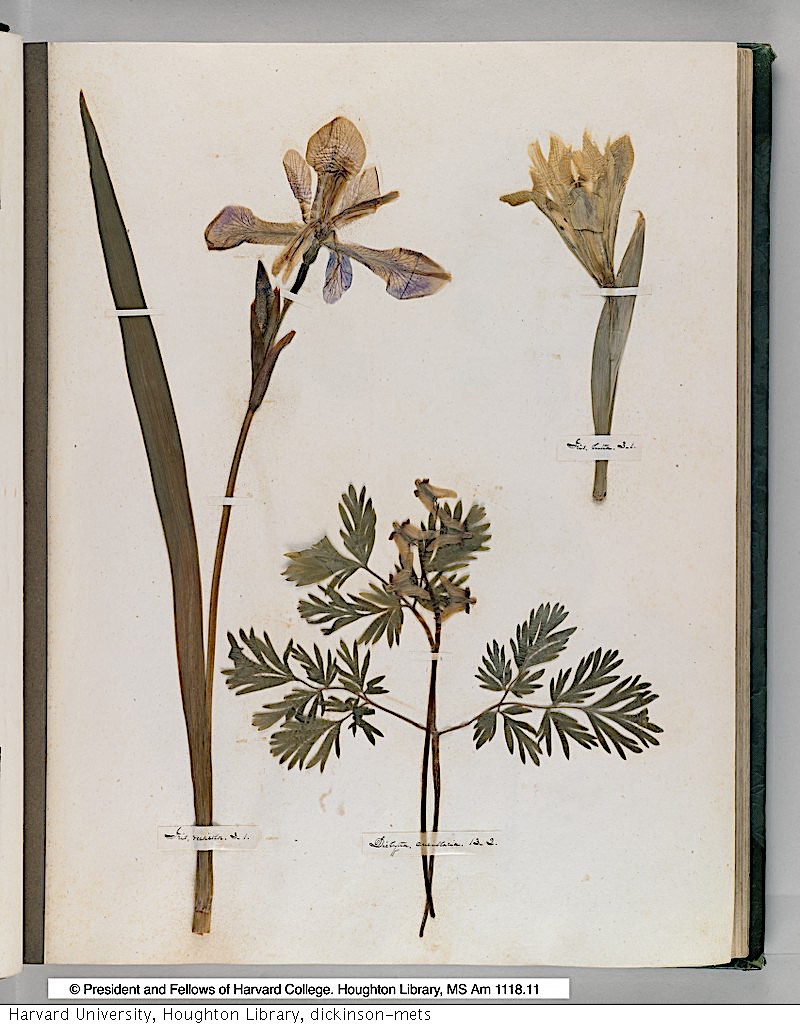
Assembled in a patterned green album bought from the Springfield stationer G. & C. Merriam, the herbarium contains 424 specimens arranged on 66 leaves and delicately attached with small strips of paper. The specimens are either native plants, plants naturalized to Western Massachusetts, where Dickinson lived, or houseplants. Every page is accompanied by a transcription of Dickinson’s neat handwritten labels, which identifies each plant by its scientific name.
The book is thought to have been finished by the time she was 14 years old. Long part of Harvard’s Houghton Library collection, it has also long been treated as too fragile for anyone to view. The only access has come in the form of grainy, black and white photographs. For the past few years, however, scholars and lovers of Dickinson’s work have been able to see the herbarium in these stunning reproductions.

The pages are so formally composed they look like paintings from a distance. Though mostly unknown as a poet in her life, Dickinson was locally renowned in Amherst as a gardener and “expert plant identifier,” notes Sara C. Ditsworth. The herbarium may or may not offer a window of insight into Dickinson’s literary mind. Houghton Library curator Leslie A. Morris, who wrote the forward to the facsimile edition, seems skeptical. “I think that you could read a lot into the herbarium if you wanted to,” she says, “but you have no way of knowing.”
And yet we do. It may be impossible to separate Dickinson the gardener and botanist from Dickinson the poet and writer. As Ditsworth points out, “according to Judith Farr, author of The Gardens of Emily Dickinson, one-third of Dickinson’s poems and half of her letters mention flowers. She refers to plants almost 600 times,” including 350 references to flowers. Both her herbarium and her poetry can be situated within the 19th century “language of flowers,” a sentimental genre that Dickinson made her own, with her elliptical entwining of passion and secrecy.

The first two specimens in Dickinson’s herbarium are the jasmine and the privet: “You have jasmine for poetry and passion” in the language of flowers, Morris points out, “and privet,” a hedge plant, “for privacy.” There is no need to see this arrangement as a prediction of the future from the teenage botanist Dickinson. Did she plan from adolescence to become a recluse poet in later life? Perhaps not. But we can certainly “read into” the language of her herbarium some of the same great themes that recur over and over in her work, carried across by images of plants and flowers. See Dickinson’s complete herbarium at Harvard Library’s digital collections here, or purchase a (very expensive) facsimile edition of the book here.
Note: Note: An earlier version of this post appeared on our site in 2019.
Related Content:
How Emily Dickinson Writes A Poem: A Short Video Introduction
The Second Known Photo of Emily Dickinson Emerges
Josh Jones is a writer and musician based in Durham, NC. Follow him at @jdmagness
Read More...When a Medieval Monk Crowdsourced the Most Accurate Map of the World, Creating “the Google Earth of the 1450s”
If we want to know the precise geographical location of, say, a particular church in Madrid, video arcade in Tokyo or coffee shop in Addis Ababa, we can figure it out in a matter of seconds. This is, in historical terms, a recent development indeed: many of us remember when the most detailed cartographical information we could get about distant lands (or for that matter, most of our own land) revealed to us only its cities and major roads — assuming we even had a world atlas at hand. Now, younger people take for granted the knowledge of not just where every place in the world is, but what it looks like, what its prices are, and what its visitors have said about it.
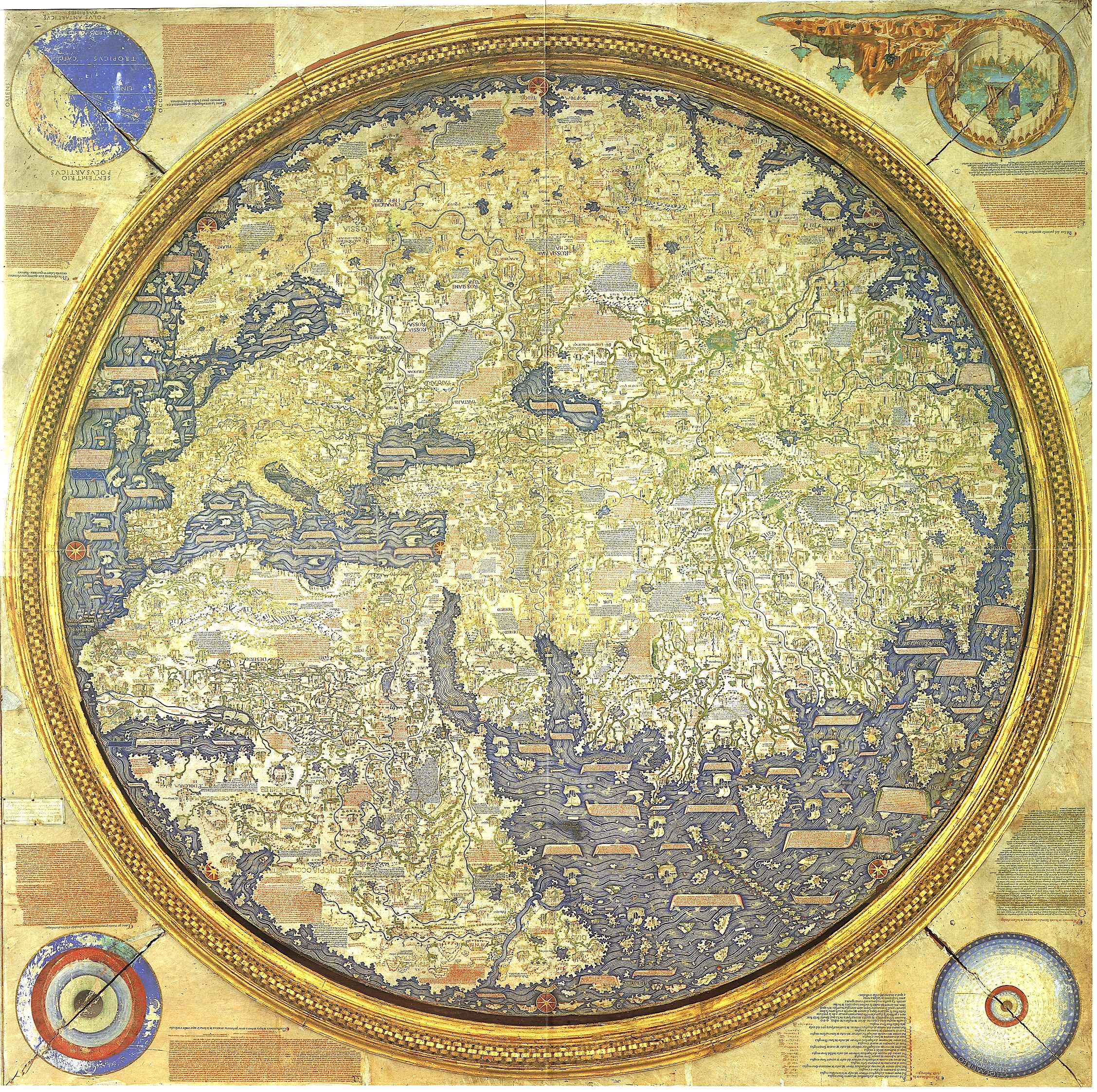
We live today, in other words, in the dream of Fra Mauro, the Venetian cartographer-monk of the late Middle Ages who created the most detailed and accurate world map to that point in human history. “As a young man, Fra Mauro had been a soldier and merchant of the famed Venice Merchant Fleet,” says the site of New World Cartographic. “His travels with the fleet around the Mediterranean and the Middle East resulted in his becoming interested in mapping, and he eventually settled in the monastery of San Michelle on the island of Murano, in the Venice Lagoon, where he became a lay brother.” In the early 1450s, “he was commissioned by King Afonso V of Portugal to create a map of the world.”
Portugal’s will to dominate world trade, which required the most detailed maps possible, was matched by Fra Mauro’s will to gather information about every corner of Earth, no matter how far-flung. And he could do that without leaving Venice: as Atlas Obscura’s Adam Kessler writes, “Arab traders and world explorers passed through the port, giving Fra Mauro an incomparable source of gossip and tall tales about the world. The fall of Constantinople, occurring a few years before the map was finished, would also have provided a rich source of well-traveled refugees, presumably willing to swap their stories for some bread or beer.” Not only did the map’s physical creation require a team of collaborators, the gathering of its contents relied upon the fifteenth-century equivalent of crowdsourcing.
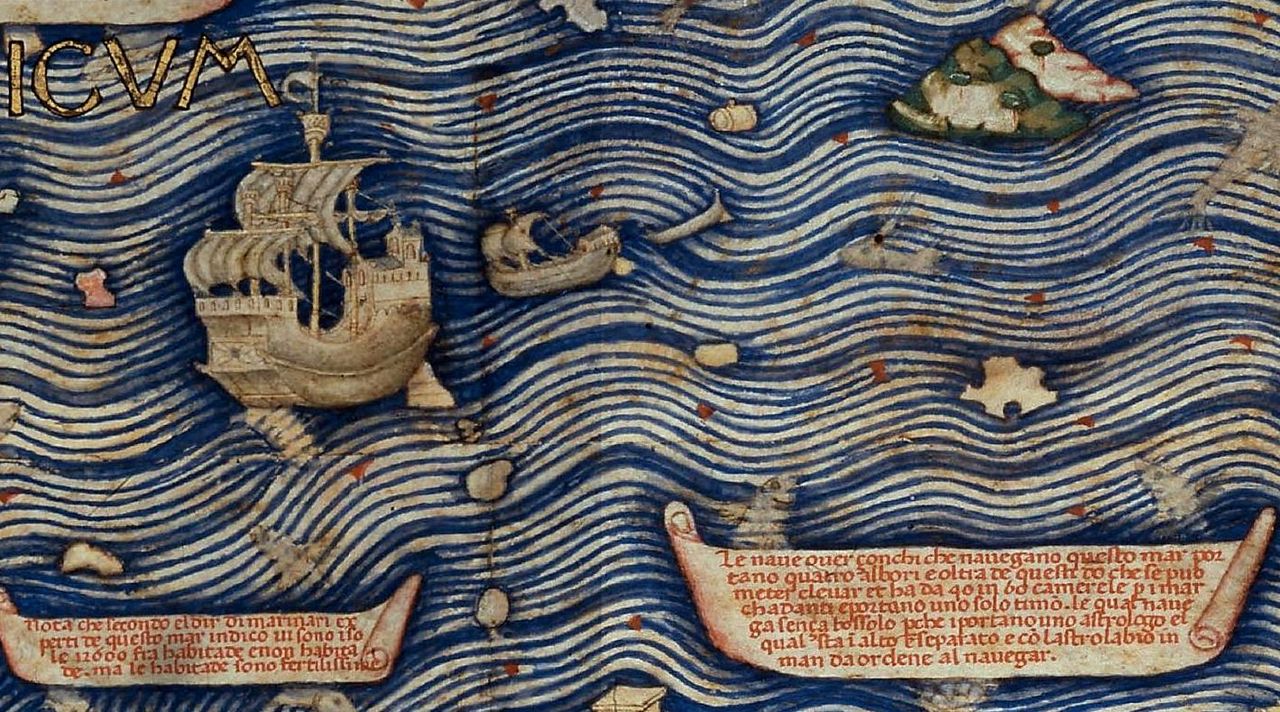
This chapter of cartographical history invites such technological analogies: Kessler calls Fra Mauro’s completed mappa mundi “the Google Earth of the 1450s.” Despite his religious affiliation with the monastery of San Michele, Fra Mauro’s efforts produced an unprecedentedly radical rendition of the world. Breaking with religious tradition, he didn’t put Jerusalem in the center; “the Garden of Eden was relegated to a sidebox, not shown in a real geographic location.” His scrupulousness made him the first cartographer “to depict Japan as an island, and the first European to show that you could sail all the way around Africa.” While his map was “the most accurate ever made at the time,” its more than 3,000 annotations do contain plenty of tall tales, often of literal giants. But are they really much less trustworthy than the average twenty-first-century user review?
Related Content:
The World Map That Introduced Scientific Mapmaking to the Medieval Islamic World (1154 AD)
Explore the Hereford Mappa Mundi, the Largest Medieval Map Still in Existence (Circa 1300)
Europe’s Oldest Map: Discover the Saint-Bélec Slab (Circa 2150–1600 BCE)
Based in Seoul, Colin Marshall writes and broadcasts on cities, language, and culture. His projects include the Substack newsletter Books on Cities, the book The Stateless City: a Walk through 21st-Century Los Angeles and the video series The City in Cinema. Follow him on Twitter at @colinmarshall or on Facebook.
Read More...Nobel Prize-Winning Psychologist Daniel Kahneman (RIP) Explains the Key Question Every Investor Must Ask, and Why It’s a Fool’s Errand to Pick Stocks
This past week, the influential psychologist and economist Daniel Kahneman passed away at age 90. The winner of the 2002 Nobel Prize in Economic Sciences, Kahneman wrote the bestselling book Thinking, Fast and Slow where he explained the two systems of thinking that shape human decisions. These include “System 1,” which relies on fast, automatic and unconscious thinking, and then “System 2,” which requires attention and concentration and works more slowly. And it’s the interplay of these two systems that profoundly shapes the quality of our decisions in different parts of our lives, including investing.
In the interview above, Steve Forbes asks why individual investors persist in believing that they can pick stocks successfully over time, despite ample evidence to the contrary. Drawing on his research, Kahneman describes the “illusion of skill,” where investors “get the immediate feeling that [they] understand something,” which is much “more compelling than the knowledge of statistics that tells you that you don’t know anything.” Here, System 1 creates the “illusion of skill,” and it overwhelms the slower analytical thinking found in System 2—the System that could use data to determine that stock picking is a fool’s errand. When Forbes asks if investors should ultimately opt for index funds instead of individual stocks, Kahneman replies “I am a believer in index funds,” that is, unless you have very rare information that allows you to pick stocks successfully.
Later in the interview, Kahneman touches on another important subject. In his mind, the first question every investor should ask is not how much money should I plan to make, but rather, “How much can I afford to lose.” Every investor should assess their risk tolerance, in part so that you can handle turbulence in the market and stick with your initial investment plan. If you are not aware of your risk tolerance, “when things go bad, you will want to change what you are doing, and that’s the disaster in investing… Loss aversion can kill you.” He continues, “Emotions are indeed your enemy. The worst thing that could happen to you … is to make a decision and not stick with it, so that you bail out when things go badly, so that you sell low and buy high. That is not a recipe for doing well in the stock market, or anywhere.” Ideally, you should figure out upfront how much you want to put in the stock market, and how much you want to keep out, so that you can psychologically manage the ups and downs of investing.
From here, Kahneman comes to his most important piece of advice for investors: Know yourself in terms of what you could regret. If you are prone to regret, if investing makes you feel insecure and lose sleep at night, then you should adopt a “regret minimization strategy” and create a more conservative portfolio to match it. Read more about that here. Also see Chapters 31 (Risk Policies) and 32 (Keep Score) in Thinking, Fast and Slow where Kahneman talks more about investing.
This post originally appeared on our sister/side-project site, Open Personal Finance.
Related Content on Open Personal Finance:
All the Financial Advice You’ll Ever Need Fits on a Single Index Card
Essential Advice for Any Investor from Jack Bogle, the Founder of Vanguard
Warren Buffett Explains the Power of Compound Interest
Read More...
The Song From the 1500’s That Blows Rick Beato Away: An Introduction to John Dowland’s Entrancing Music
In 2006, Sting released an album called Songs from the Labyrinth, a collaboration with Bosnian lutenist Edin Karamazov consisting mostly of compositions by Renaissance composer John Dowland. This was regarded by some as rather eccentric, but to listeners familiar with the early music revival that had already been going on for a few decades, it would have been almost too obvious a choice. For Dowland had long since been rediscovered as one of the late sixteenth and early seventeenth century’s musical superstars, thanks in part to the recordings of classical guitarist and lutenist Julian Bream.
“When I was a kid, I went to the public library in Fairport, New York, where I’m from, and I got this Julian Bream record,” says music producer and popular Youtuber Rick Beato (previously featured here on Open Culture) in the video above. Beato describes Bream as “one of the greatest classical guitarists who ever lived” and credits him with having “popularized the classical guitar and the lute and renaissance music.” The particular Bream recording that impressed the young Beato was of a John Dowland composition made exotic by distance in time called “The Earl of Essex Galliard,” a performance of which you can watch on Youtube.
Half a century later, Beato’s enjoyment for this piece seems undiminished — and indeed, so much in evidence that this practically turns into a reaction video. Listening gets him reminiscing about his early Dowland experiences: “I would put on this Julian Bream record of him playing lute, just solo lute, and I would sit there and I would putt” — his father having been golf enthusiast enough to have installed a small indoor putting green — and “imagine living back in the fifteen-hundreds, what it would be like.” These pretend time-travel sessions matured into a genuine interest in early music, one he pursued at the New England Conservatory of Music and beyond.
What a delight it would have been for him, then, to find that Sting had laid down his own version of “The Earl of Essex Galliard,” sometimes otherwise known as “Can She Excuse My Wrongs.” In one especially striking section, Sting takes “the soprano-alto-tenor-bass part” and records the whole thing using only layers of his own voice: “there’s four Stings here,” Beato says, referring to the relevant digitally manipulated scene in the music video, “but there’s actually more than four voices.” Songs from the Labyrinth may only have been a modestly successful album by Sting’s standards, but it has no doubt turned more than a few middle-of-the-road pop fans onto the beauty of English Renaissance music. If Beato’s enthusiasm has also turned a few classic-rock addicts into John Dowland connoisseurs, so much the better.
Related content:
The History of the Guitar: See the Evolution of the Guitar in 7 Instruments
Bach Played Beautifully on the Baroque Lute, by Preeminent Lutenist Evangelina Mascardi
Watch All of Vivaldi’s Four Seasons Performed on Original Baroque Instruments
Based in Seoul, Colin Marshall writes and broadcasts on cities, language, and culture. His projects include the Substack newsletter Books on Cities, the book The Stateless City: a Walk through 21st-Century Los Angeles and the video series The City in Cinema. Follow him on Twitter at @colinmarshall or on Facebook.
Read More...Radiohead’s “Creep” Sung by a 1,600-Person Choir in Australia
Everybody can sing. Maybe not well. But why should that stop you? That’s the basic philosophy of Pub Choir, an organization based in Brisbane, Australia. At each Pub Choir event, a conductor “arranges a popular song and teaches it to the audience in three-part harmony.” Then, the evening culminates with a performance that gets filmed and shared on social media. Anyone (18+) is welcome to attend.
Above, you can watch a PubChoir performance, with 1600 choir members singing a moving version of Radiohead’s “Creep.” On their YouTube channel, you can also find Pub Choir performances of Coldplay’s “Yellow,” Toto’s “Africa,” and The Bee Gees “How Deep Is Your Love.”
Find other choir performances in the Relateds below.
Related Content
A Big Choir Sings Patti Smith’s “Because the Night”
A Choir with 1,000 Singers Pays Tribute to Sinéad O’Connor & Performs “Nothing Compares 2 U”
Watch David Byrne Lead a Massive Choir in Singing David Bowie’s “Heroes”
Patti Smith Sings “People Have the Power” with a Choir of 250 Fellow Singers
Read More...3,000 Illustrations of Shakespeare’s Complete Works from Victorian England, Presented in a Digital Archive
“We can say of Shakespeare,” wrote T.S. Eliot—in what may sound like the most backhanded of compliments from one writer to another—“that never has a man turned so little knowledge to such great account.” Eliot, it’s true, was not overawed by the Shakespearean canon; he pronounced Hamlet “most certainly an artistic failure,” though he did love Coriolanus. Whatever we make of his ambivalent, contrarian opinions of the most famous author in the English language, we can credit Eliot for keen observation: Shakespeare’s universe, which can seem so sprawlingly vast, is actually surprisingly spare given the kinds of things it mostly contains.
This is due in large part to the visual limitations of the stage, but perhaps it also points toward an author who made great works of art from humble materials. Look, for example, at a search cloud of the Bard’s plays.
You’ll find one the front page of the Victorian Illustrated Shakespeare Archive, created by Michael John Goodman, an independent researcher, writer, educator, curator and image-maker. The cloud on the left features a galaxy composed mainly of elemental and archetypal beings: “Animals,” “Castles and Palaces,” “Crowns,” “Flora and Fauna,” “Swords,” “Spears,” “Trees,” “Water,” “Woods,” “Death.” One thinks of the Zodiac or Tarot.
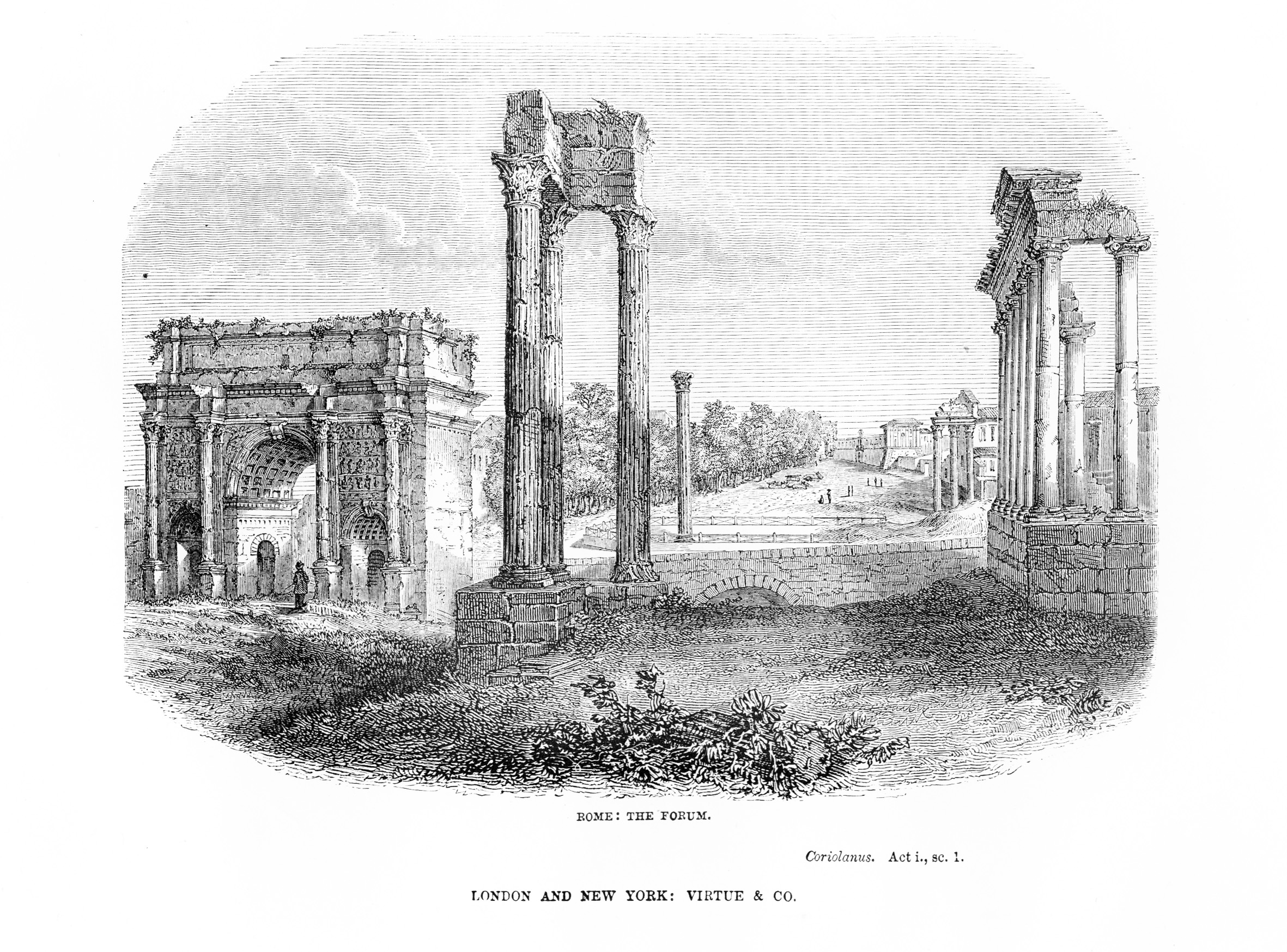
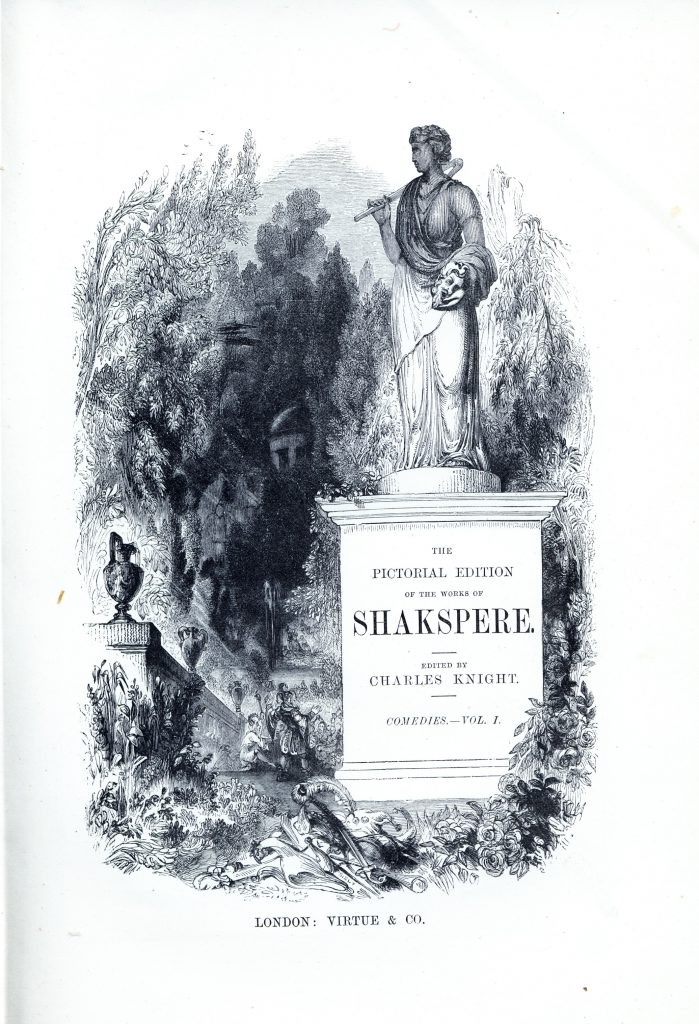
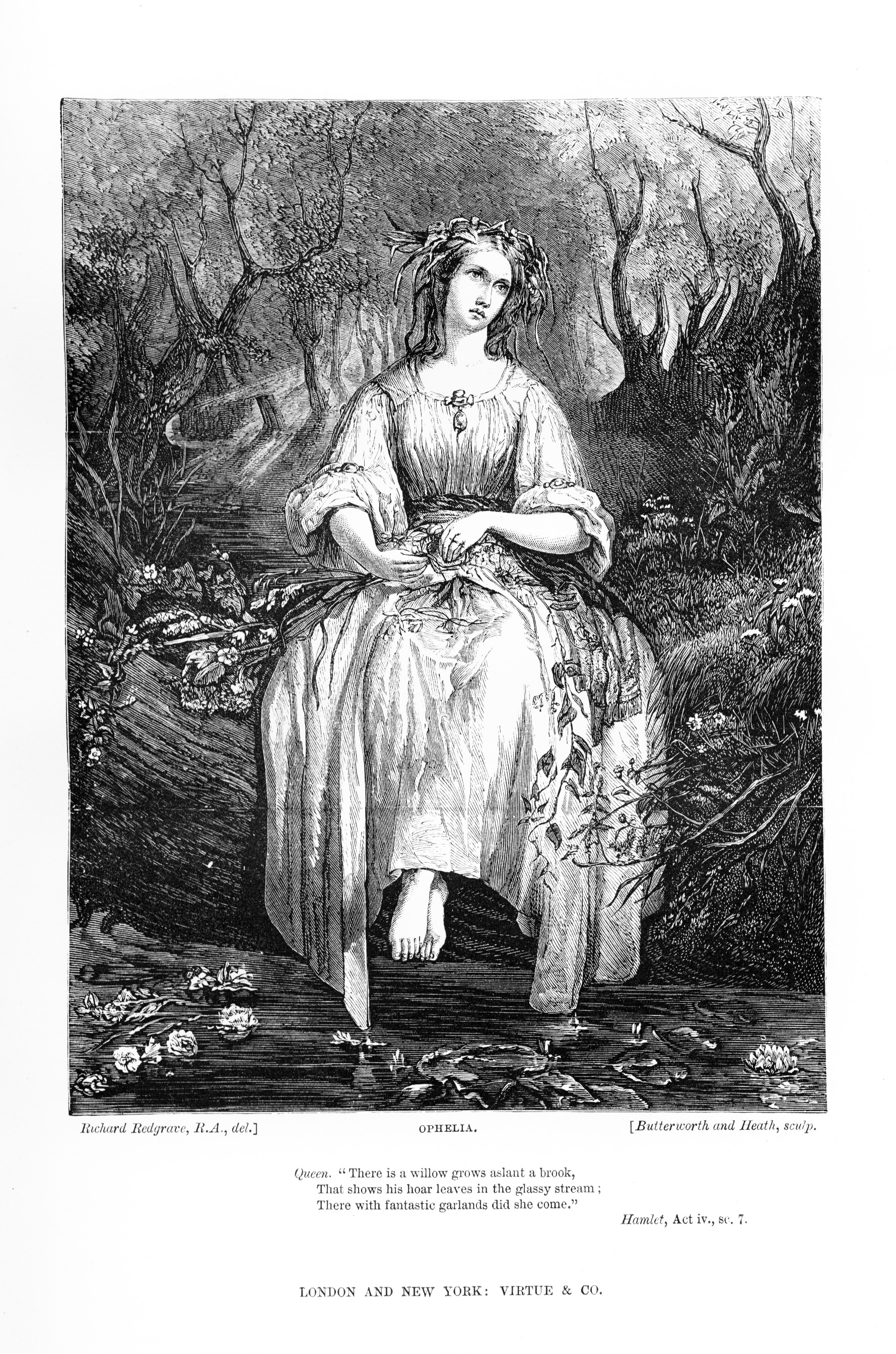
This particular search cloud, however, does not represent the most prominent terms in the text, but rather the most prominent images in four collections of illustrated Shakespeare plays from the Victorian period. Goodman’s site hosts over 3000 of these illustrations, taken from four major UK editions of Shakespeare’s Complete Works published in the mid-19th century. The first, published by editor Charles Knight, appeared in several volumes between 1838 and 1841, illustrated with conservative engravings by various artists. Knight’s edition introduced the trend of spelling Shakespeare’s name as “Shakspere,” as you can see in the title page to the “Comedies, Volume I,” at the top of the post. Further down, see two representative illustrations from the plays, the first of Hamlet’s Ophelia and second Coriolanus’ Roman Forum, above.
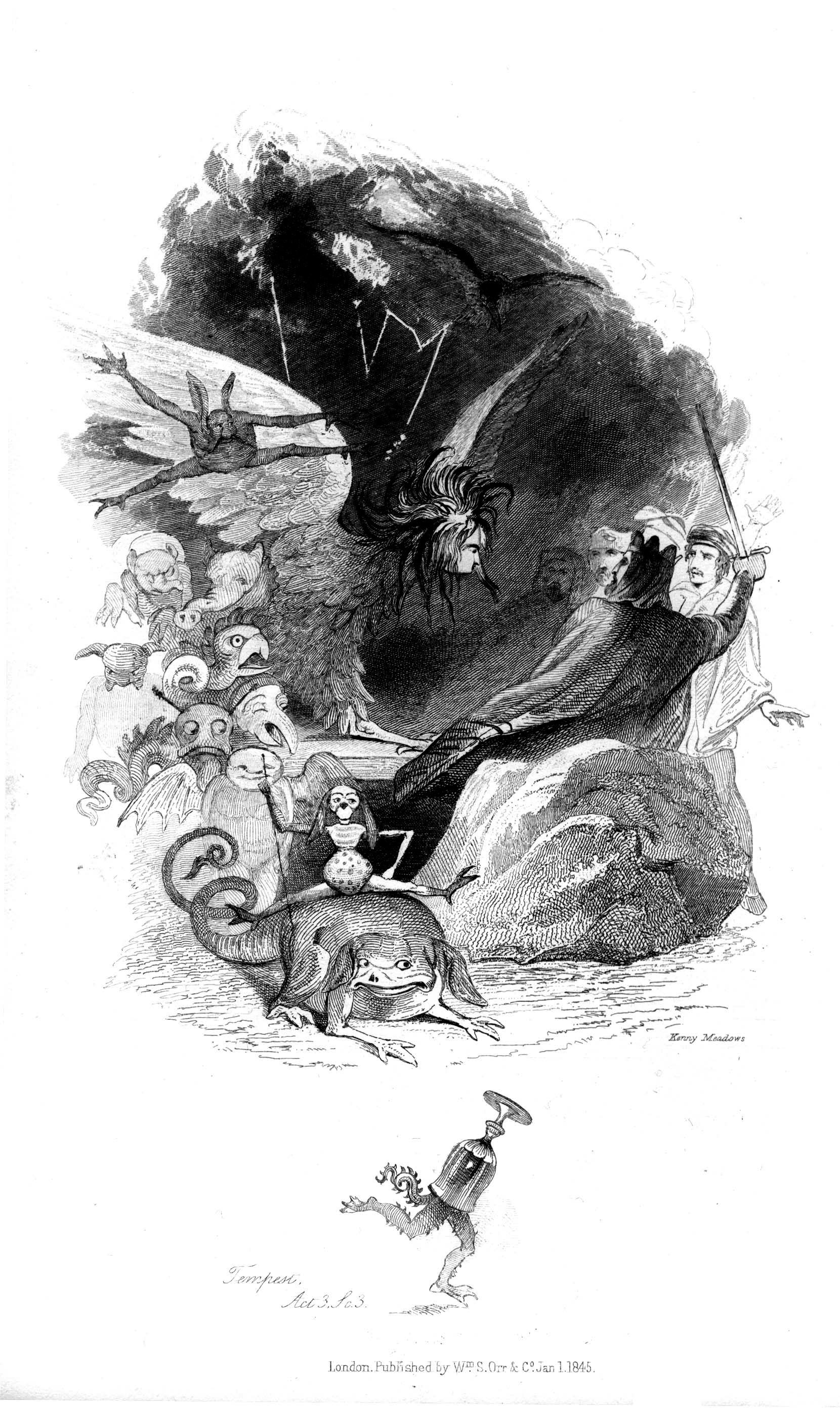
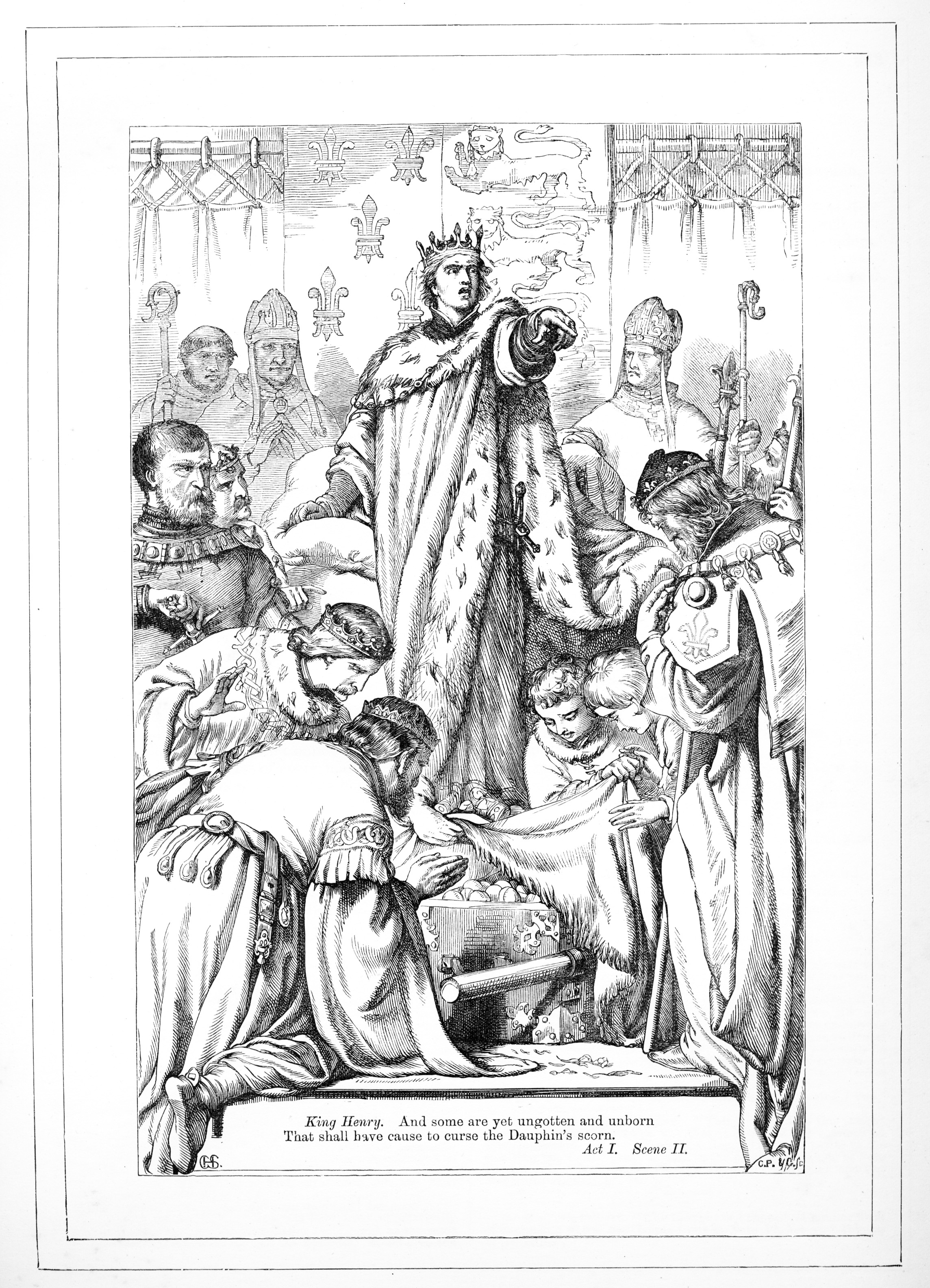
Part of a wave of “early Victorian populism” in Shakespeare publishing, Knight’s edition is joined by one from Kenny Meadows, who contributed some very different illustrations to an 1854 edition. Just above, see a Goya-like illustration from The Tempest. Later came an edition illustrated by H.C. Selous in 1864, which returned to the formal, faithful realism of the Knight edition (see a rendering of Henry V, below), and includes photograuvure plates of famed actors of the time in costume and an appendix of “Special Wood Engraved Illustrations by Various Artists.”
The final edition whose illustrations Goodman has digitized and catalogued on his site features engravings by artist John Gilbert. Also published in 1864, the Gilbert may be the most expressive of the four, retaining realist proportions and mise-en-scène, yet also rendering the characters with a psychological realism that is at times unsettling—as in his fierce portrait of Lear, below. Gilbert’s illustration of The Taming of the Shrew’s Katherina and Petruchio, further down, shows his skill for creating believable individuals, rather than broad archetypes. The same skill for which the playwright has so often been given credit.
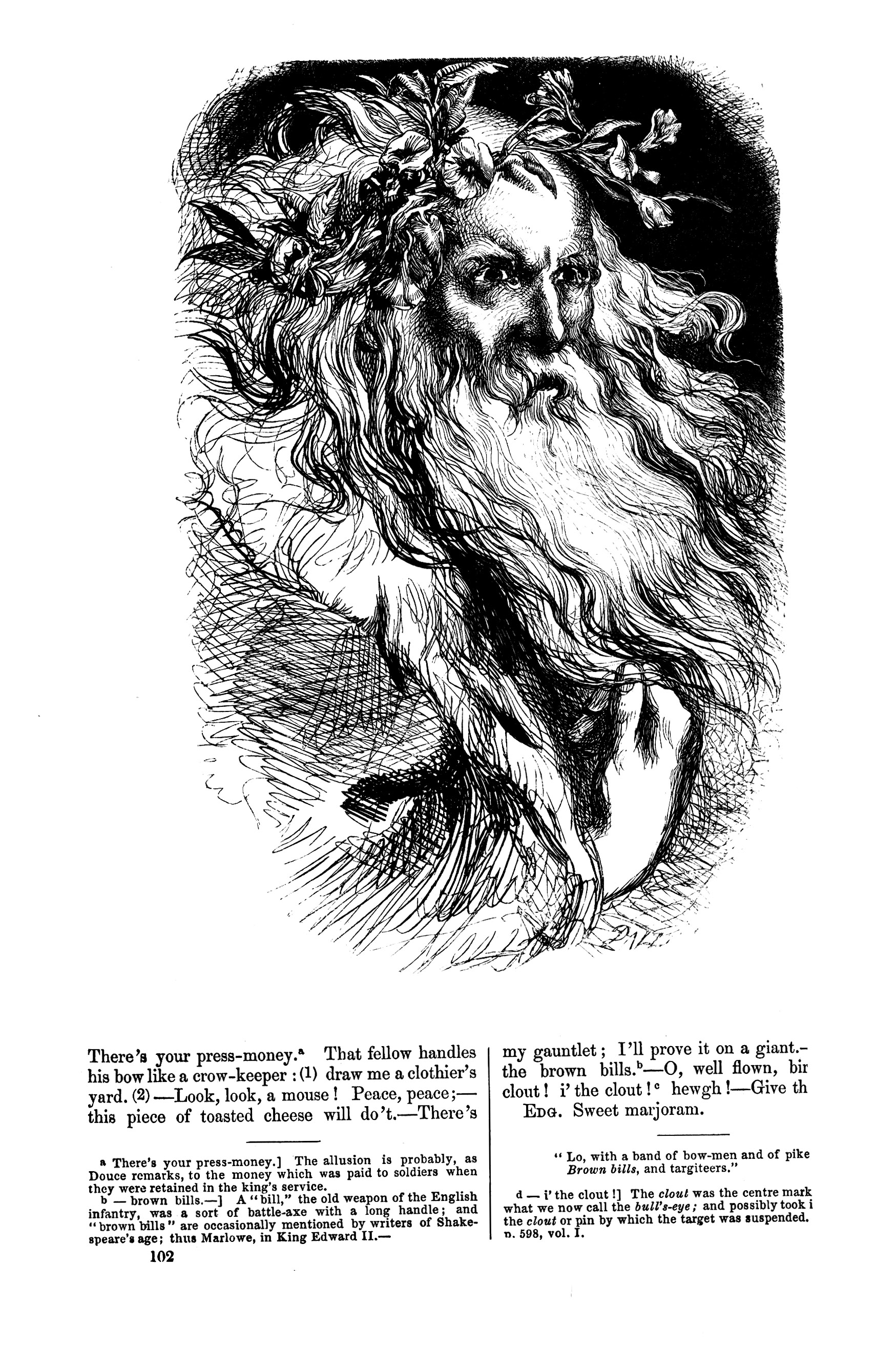
But Shakespeare worked both with rich, individual character studies and broader, archetypal, material: psychological realism and mythological classicism. What I think these illustrated editions show us is that Shakespeare, whoever he (or she) may have been, did indeed have a keen sense of what Eliot called the “objective correlative,” able to communicate complex emotions through “a skillful accumulation of imagined sensory impressions” that have impressed us as much on the canvas, stage, and screen as they do on the page. The emotional expressiveness of Shakespeare’s plays comes to us not only through eloquent verse speeches, but through images of both the starkly elemental and the uniquely personal.
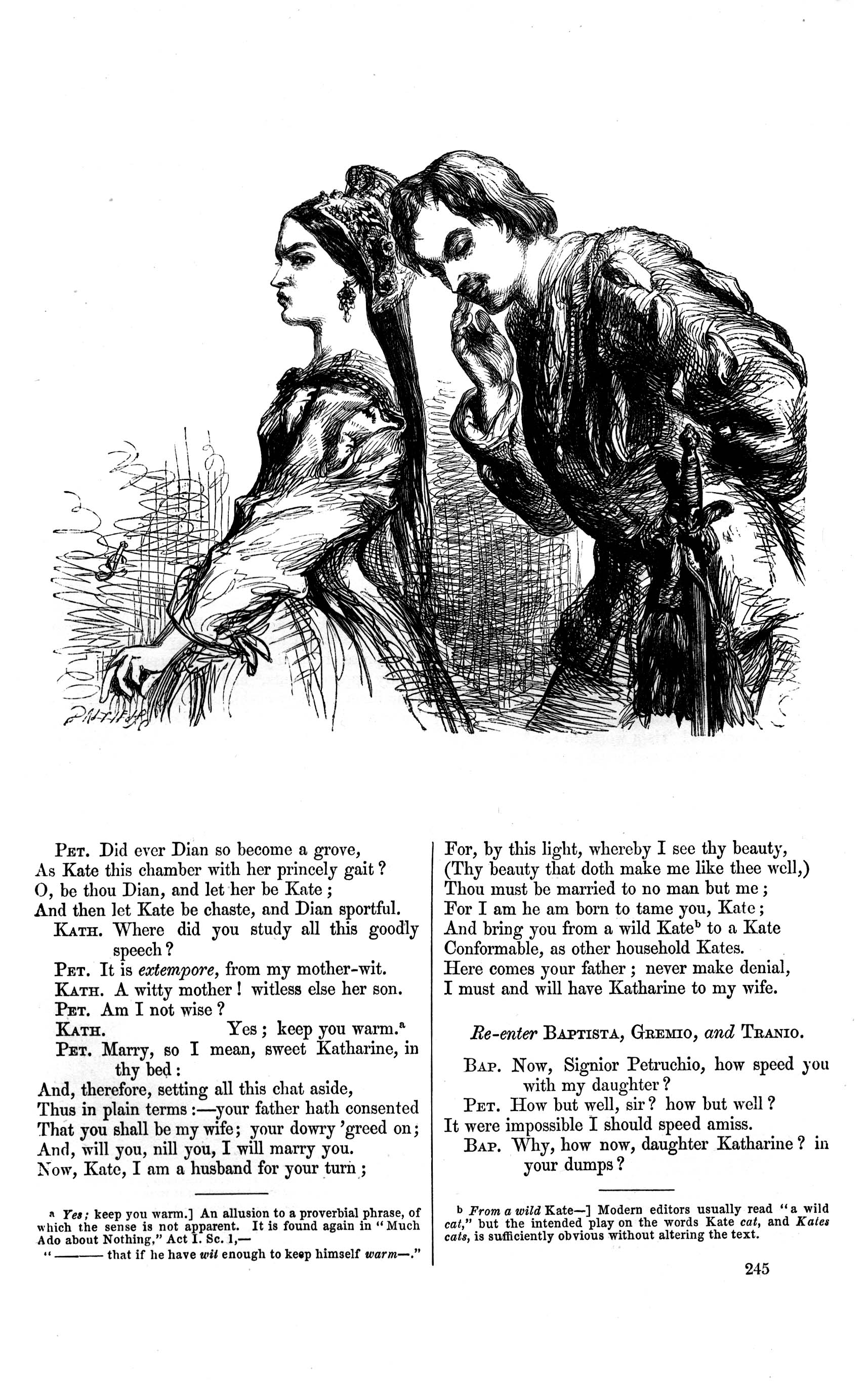
Spend some time with the illustrated editions on Goodman’s site, and you will develop an appreciation for how the plays communicate differently to the different artists. In addition to the search clouds, the site has a header at the top for each of the four editions. Click on the name and you will see front and back matter and title pages. In the pull-down menus, you can access each individual play’s digitized illustrations by type—“Histories,” “Comedies,” and “Tragedies.” All of the content on the site, Goodman writes, “is free through a CC license: users can share on social media, remix, research, create and just do whatever they want really!”
Update: This post originally appeared on our site in 2016. Since then, Goodman has been regularly updating the Victorian Illustrated Shakespeare Archive with more editions, giving it more richness and depth. These editions include “one published by John Tallis, which features famous actors of the time in character.” This also includes “the first ever comprehensive full-colour treatment of Shakespeare’s plays with the John Murdoch edition.” The archive, Goodman tells us, “now contains ten editions of Shakespeare’s plays and is fairly comprehensive in how people were experiencing Shakespeare, visually, in book form in the 19th Century.”
Related Content:
Take a Virtual Tour of Shakespeare’s Globe Theatre in London
Read All of Shakespeare’s Plays Free Online, Courtesy of the Folger Shakespeare Library
Josh Jones is a writer and musician based in Durham, NC. Follow him at @jdmagness
Read More...The Evolution of Animation, 1833–2017: From the Phenakistiscope to Pixar
This year has given us occasion to revisit the 1928 Disney cartoon Steamboat Willie, what with its entry — and thus, that of an early version of a certain Mickey Mouse — into the public domain. Though it may look comparatively primitive today, that eight-minute black-and-white film actually represents a great many advancements in the art and technology of animation since its inception. You can get a sense of that entire process, just about, from the video above, “The Evolution of Animation 1833–2017,” which ends up at The LEGO Batman Movie but begins with the humble phenakistiscope.
First introduced to the public in 1833, the phenakistiscope is an illustrated disc that, when spun, creates the illusion of motion. Essentially a novelty designed to create an optical illusion (the Greek roots of its name being phenakizein, or “deceiving,” and óps, or “eye”), it seems to have attained great popularity as a children’s toy in the nineteenth century, and it later became capable of projection and gained utility in scientific research. Pioneering motion photographer Eadweard Muybridge’s Zoopraxiscope, now immortalized in cinema history as a predecessor of the movie projector, was based on the phenakistiscope.
The first moments of “The Evolution of Animation” include a couple of phenakistiscopes, but soon the compilation moves on to clips starring somewhat better-known figures from the early twentieth century like Little Nemo and Gertie the Dinosaur. But it’s only after Steamboat Willie that animation undergoes its real creative explosion, bringing to whimsical and hyperkinetic life not just human characters but a host of animals, trees, and non-living objects besides. After releasing the monumental Snow White in 1937, Disney dominated the form both technologically and artistically for at least three decades. Though this video does contain plenty of Disney, it also includes the work of other studios that have explored quite different areas of the vast field of possibility in animation.
Take, for example, the psychedelic Beatles movie Yellow Submarine, the French-Czech surrealist science-fiction fable Fantastic Planet, the stop-motion between-holidays spectacle of The Nightmare Before Christmas, and of course, the depth and refinement of Hayao Miyazaki’s Studio Ghibli, beginning with Nausicaä of the Valley of the Wind (which came before the formation of the studio itself). From the mid-nineties — with certain notable exceptions, like Wallace & Gromit: The Movie and Charlie Kaufman’s AnomaLisa — computer-generated 3D animation more or less takes over from the traditional varieties. This has produced a number of features widely considered masterpieces, most of them from the now-Disney-owned Pixar. But after experiencing the history of the form in miniature, it’s tempting to hope that the next stage of the animation’s evolution will involve the rediscovery of its past.
Related content:
Behold the World’s Oldest Animation Made on a Vase in Iran 5,200 Years Ago
Gertie the Dinosaur: The Mother of all Cartoon Characters (1914)
Early Japanese Animations: The Origins of Anime (1917–1931)
Based in Seoul, Colin Marshall writes and broadcasts on cities, language, and culture. His projects include the Substack newsletter Books on Cities, the book The Stateless City: a Walk through 21st-Century Los Angeles and the video series The City in Cinema. Follow him on Twitter at @colinmarshall or on Facebook.
Read More...The Cult of the Criterion Collection: The Company Dedicated to Gathering & Distributing the Greatest Films from Around the World
There was a time, not so very long ago, when many Americans watching movies at home neither knew nor cared who directed those movies. Nor did they feel particularly comfortable with dialogue that sometimes came subtitled, or with the “black bars” that appeared below the frame. The considerable evolution of these audiences’ general relationship to film since then owes something to the adoption of widescreen televisions, but also to the Criterion Collection: the home-video brand that has been targeting its prestige releases of acclaimed films squarely at cinephiles — and even more so, at cinephiles with a collecting impulse — for four decades now.
“The company’s first release was a LaserDisc edition of Citizen Kane that included supplementary materials like a video essay and extensive liner notes on the provenance of the negative from which the restoration was made,” writes the New York Times’ Magazine’s Joshua Hunt in a recent piece on how Criterion became a (or perhaps the) cinematic tastemaker.
“Next came King Kong, which featured the first ever audio-commentary track, inspired, as an afterthought, by the stories that the film scholar Ronald Haver told while supervising the tedious process of transferring the film from celluloid.”
With the coming of the more successful DVD format in the late nineteen-nineties, such audio-commentary tracks became a staple feature of video releases, Criterion or otherwise. They were a godsend to the cinephiles of my generation coming of age in that era, a kind of informal but intensive film school taught by not just expert scholars but, often, the auteurs themselves. “Some of the earliest were recorded by Martin Scorsese for the Taxi Driver and Raging Bull LaserDiscs, which helped cement his influence on an entire generation of young directors” — including a certain Wes Anderson, who would go on to record commentary tracks for the Criterion releases of his own pictures.
At this point, Criterion has “become the arbiter of what makes a great movie, more so than any Hollywood studio or awards ceremony.” It’s also amassed an unusually dedicated customer base, as explained in the Royal Ocean Film Society video “The Cult of the Criterion Collection.” “We’re at a point in film culture where brands are increasingly more popular than products,” says host Andrew Saladino, a self-confessed Criterion devotee. “More and more, it seems as though the films and the people who made them are secondary to the name and logo of the company behind them,” a phenomenon that Criterion — itself a kind of media universe — somehow both participates in and rises above.
“While studios and streaming services chase audiences by producing endless sequels and spinoffs,” writes Hunt, “Criterion has built a brand that audiences trust to lead them.” I can testify to its having led me to the work of auteurs from Chris Marker to Jacques Tati, Akira Kurosawa to Yasujiro Ozu, Robert Altman to Nicolas Roeg. Today, budding cinema enthusiasts can even benefit from the advice of famous directors and actors for navigating its now‑1,650-title-strong catalog through its “Criterion closet” video series. Recently, that closet has hosted the likes of Paul Giamatti, Willem Dafoe, and Wim Wenders, who pulls off the shelf a copy of his own Until the End of the World — which Criterion released, of course, in its nearly five-hour-long director’s cut. “I always think this is maybe the best thing I’ve done in my life,” he says, “but then again, who am I to judge?”
Related content:
The Art of Restoring Classic Films: Criterion Shows You How It Refreshed Two Hitchcock Movies
Martin Scorsese Names His Top 10 Films in the Criterion Collection
Steve Buscemi’s Top 10 Film Picks (from The Criterion Collection)
Slavoj Žižek Names His Favorite Films from The Criterion Collection
120 Artists Pick Their Top 10 Films in the Criterion Collection
A Celebration of Retro Media: Vinyl, Cassettes, VHS, and Polaroid Too
Based in Seoul, Colin Marshall writes and broadcasts on cities, language, and culture. His projects include the Substack newsletter Books on Cities, the book The Stateless City: a Walk through 21st-Century Los Angeles and the video series The City in Cinema. Follow him on Twitter at @colinmarshall or on Facebook.
Read More...Laurence Fishburne Reads a Former Slave’s Incredible Letter to His Old Master (1865)
Lawrence Fishburne brings a degree of gravity to his roles offered by few other living actors. That has secured his place in pop culture as Morpheus from The Matrix, for example. But he could even marshal it early in his career, as evidenced by his role as Apocalypse Now’s “Mr. Clean,” which he took on at just fourteen years old. But it was a much more recent performance he gave for Letters Live, which you can see in the video above, that clearly brings out the qualities that have made him a beloved and enduring figure onscreen: not just his moral seriousness, but this sense of humor as well.
“To my old master,” Fishburne begins, getting a laugh right away. The letter in question, previously featured here on Open Culture, was originally written in 1865 by a man named Jourdon Anderson, who had escaped a life of slavery in Tennessee with his wife the previous year. Having since fallen on hard times, that former master had written to Anderson and asked him to come back to work on the plantation. “I have often felt uneasy about you,” Anderson writes. “I thought the Yankees would’ve hung you before this for harboring Rebs that they found at your house,” among other crimes he recalls.
Having set himself and his family up in Ohio, Anderson could hardly have felt tempted to go down South again. “I want to know particularly what the good chance is you propose to give me,” he writes. “I am doing tolerably well here. I get $25 a month, with victuals and clothing, have a comfortable home for Mandy — the folks call her Mrs. Anderson — and the children, Millie, Jane, and Grundy, go to school and are learning well.” But “if you will write and say what wages you will give me, I will better be able to decide whether it will be to my advantage to move back again.”
Fishburne delivers these lines with a thick layer of irony, as Anderson no doubt intended. “Mandy says she would be afraid to go back without some proof that you were disposed to treat us kindly and justly, and we have concluded to test your sincerity by asking you to send us our wages for the time that we served you.” When Fishburne says that, he practically gets a standing ovation, and indeed, the letter met with a favorable reception in its day as well — not from Colonel P. H. Anderson himself, but from the readers of the newspapers in which it was reprinted. In the end, Jourdon Anderson kept his freedom, and got fame lasting more than a century after his death to go with it.
Related content:
“Ask a Slave” by Azie Dungey Sets the Historical Record Straight in a New Web Series
Based in Seoul, Colin Marshall writes and broadcasts on cities, language, and culture. His projects include the Substack newsletter Books on Cities, the book The Stateless City: a Walk through 21st-Century Los Angeles and the video series The City in Cinema. Follow him on Twitter at @colinmarshall or on Facebook.
Read More...
Support Us
We're hoping to rely on loyal readers, rather than erratic ads. Please click the Donate button and support Open Culture. You can use Paypal, Venmo, Patreon, even Crypto! We thank you!

About Us

Open Culture scours the web for the best educational media. We find the free courses and audio books you need, the language lessons & educational videos you want, and plenty of enlightenment in between.
Advertise With Us
FREE UPDATES!
GET OUR DAILY EMAIL
Get the best cultural and educational resources on the web curated for you in a daily email. We never spam. Unsubscribe at any time.
FOLLOW ON SOCIAL MEDIA
Open Culture editor Dan Colman scours the web for the best educational media. He finds the free courses and audio books you need, the language lessons & movies you want, and plenty of enlightenment in between.
Advertise With Us

