A Day in Tokyo: A 1968 Film Captures a City Reborn 23 Years After Its Destruction
During World War II, Tokyo sustained heavy damage, especially with the bombings conducted by the U.S. military in March 1945. Known as Operation Meetinghouse, US air raids destroyed 16 square miles in central Tokyo, leaving 100,000 civilians dead and one million homeless. Tokyo didn’t recover quickly. It took until the 1950s for reconstruction to really gain momentum. But gain momentum it did. By 1964, Tokyo found itself largely rebuilt, modernized, and ready to host the Olympics. That brings us to the 1968 film above, A Day in Tokyo, created by the Japan National Tourism Organization (JNTO) to promote tourism in the rebuilt city.
The website Japanese Nostalgic Car sets the scene:
The year 1968 was a special time for Japan. It was emerging as a modern country. The Tokyo Olympics had just been held a few years prior. Bullet trains, high-speed expressways, and color television broadcasts were spreading throughout the land. The year before saw the Toyota 2000GT and Mazda Cosmo Sport, Japan’s contemporary sports cars, debut. It must have been incredibly exciting.
In the 23-minute film above, you can revisit this moment of transformation and renewal, when Tokyo—as the film’s narrator put it—combined the best of new and old. Here, in the “constant metabolic cycle of destruction and creation, Tokyo progresses at a dizzying pace.” And it’s a sight to behold. Enjoy.
Related Content
Behold the Unique Beauty of Japan’s Artistic Manhole Covers
Read More...180,000 Years of Religion Charted on a “Histomap” in 1943
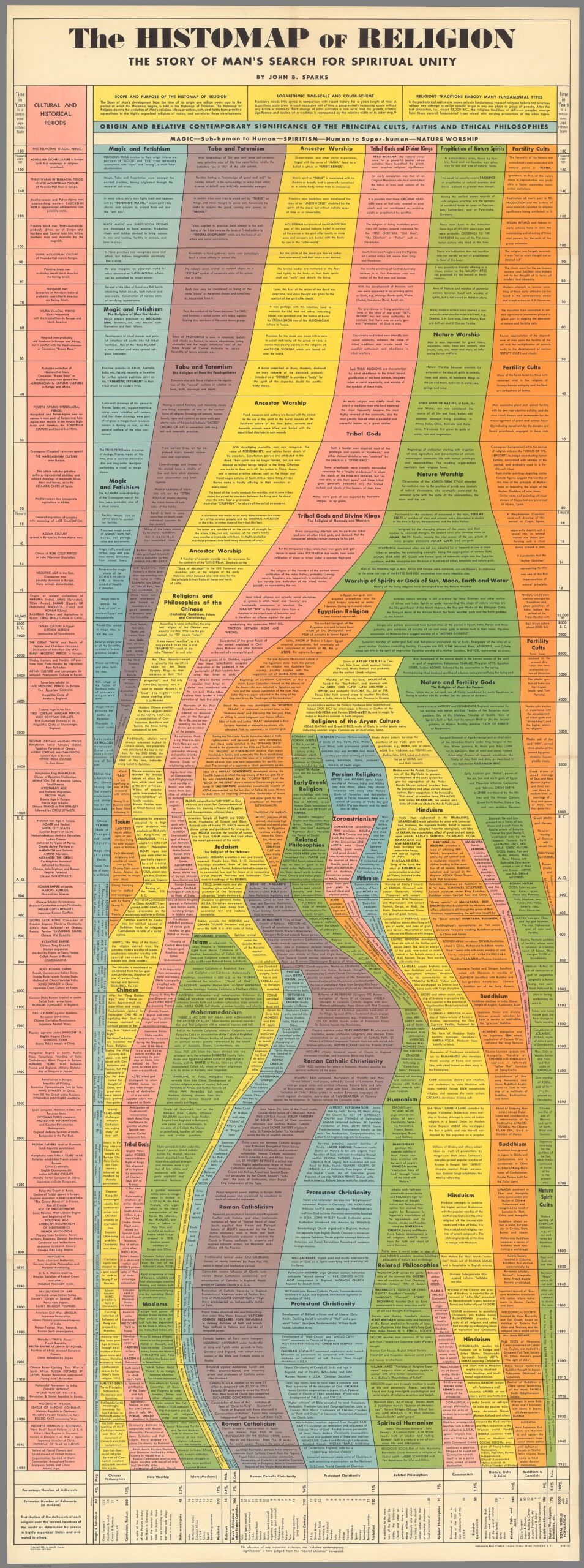
For many, even most of us moderns, the central religious choice is a simple one: adhere to the belief system in which you grew up, or stop adhering to it. But if you survey the variety of religions in the world, the situation no longer seems quite so binary; if you then add the variety of religions that have existed throughout human history, it starts looking downright kaleidoscopic. Or rather, it looks something like the faintly psychedelic but also information-rich Histomap of Religion above, created in 1943 by chemist John B. Sparks, whom we’ve previously featured here on Open Culture for his original Histomap depicting 4,000 Years of World History and his subsequent Histomap of Evolution.
The UsefulCharts video below explains Sparks’ Histomap of Religion in detail, but it also cites his Histomap of Evolution, an example of how his worldview fails to align with current perceptions of these subjects. Even the newer Histomap of Religion is by now more than 80 years old, during which time scholarship in religion and related fields has made certain discoveries and clarifications that necessarily go unreflected in Sparks’ work. But if you bear this in mind while looking at the Histomap of Religion, you can still gain a new and useful perspective on how the beliefs that mankind has held highest have changed and intermingled over the millennia.
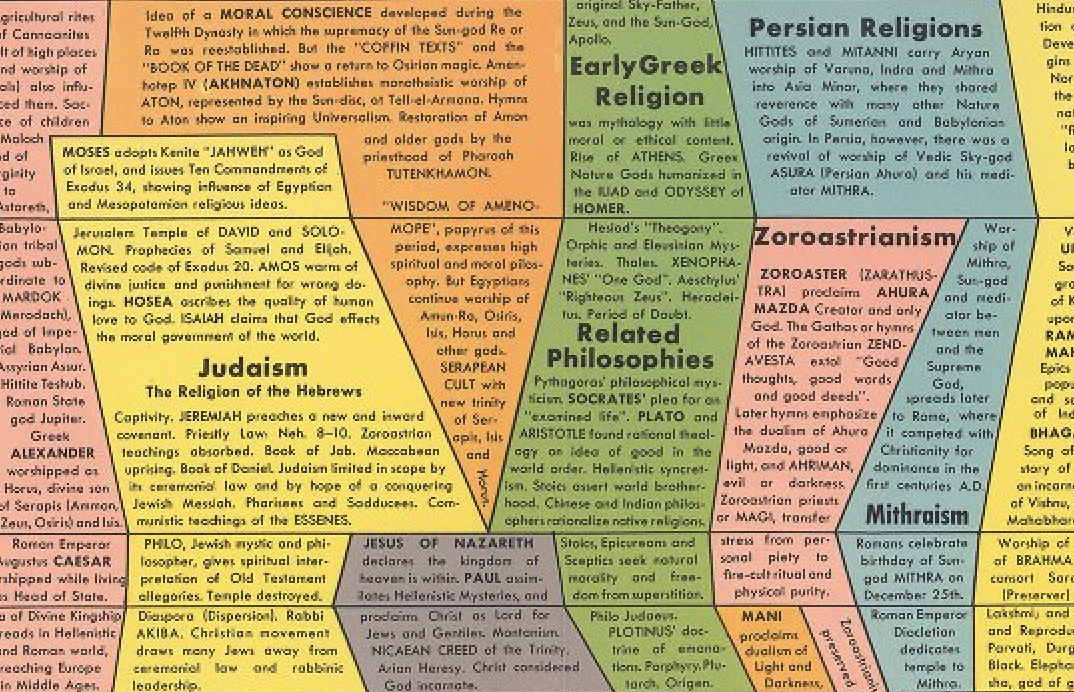
The chart begins in prehistory, dividing the then-extant faiths into the categories “magic and fetishism,” “tabu and totemism,” “ancestor worship,” “tribal gods and divine kings,” “propitiation of nature spirits,” and “fertility cults.” Though Sparks’ information may on the whole be “based on theories about the origins of religion which have now been either rejected or at least seriously revised,” explains UsefulCharts creator Matt Baker, “the general ideas expressed by these six types are still somewhat valid.” The expansion and contraction of adherence to these types of early religion through time are reflected by changes in the width of the colored columns that represent them. Follow these columns downward through history, and new, more familiar religions emerge: Taoism, Judaism, Hinduism, Buddhism, Christianity both Catholic and Protestant.
Thereafter come other movements and figures perhaps not immediately recognizable as religious in nature: “humanism,” for example, whose representatives include Shakespeare and Rousseau. Later, the ideas of Russian intellectuals Vissarion Belinsky and Alexander Herzen branch off to become, after about a century, the “corrupt philosophy” of communism, with its “God-less propaganda” supporting a “police state aimed at world domination.” Baker objects that, if Sparks counts communism as a religion, then surely he should count capitalism as a religion as well. This is a fair-enough point, though behold this dense chart of “cults, faiths, and ethical philosophies” long enough, and you’ll start to wonder if everything humanity has ever done isn’t, in some sense, ultimately religious in nature.
Related content:
Animated Map Shows How the Five Major Religions Spread Across the World (3000 BC — 2000 AD)
The Tree of Languages Illustrated in a Big, Beautiful Infographic
4000 Years of History Displayed in a 5‑Foot-Long “Histomap” (Early Infographic) From 1931
10 Million Years of Evolution Visualized in an Elegant, 5‑Foot Long Infographic from 1931
Based in Seoul, Colin Marshall writes and broadcasts on cities, language, and culture. His projects include the Substack newsletter Books on Cities, the book The Stateless City: a Walk through 21st-Century Los Angeles and the video series The City in Cinema. Follow him on Twitter at @colinmarshall or on Facebook.
Read More...The Founder of the Red Cross Creates a Diagram of the Apocalypse (1887)
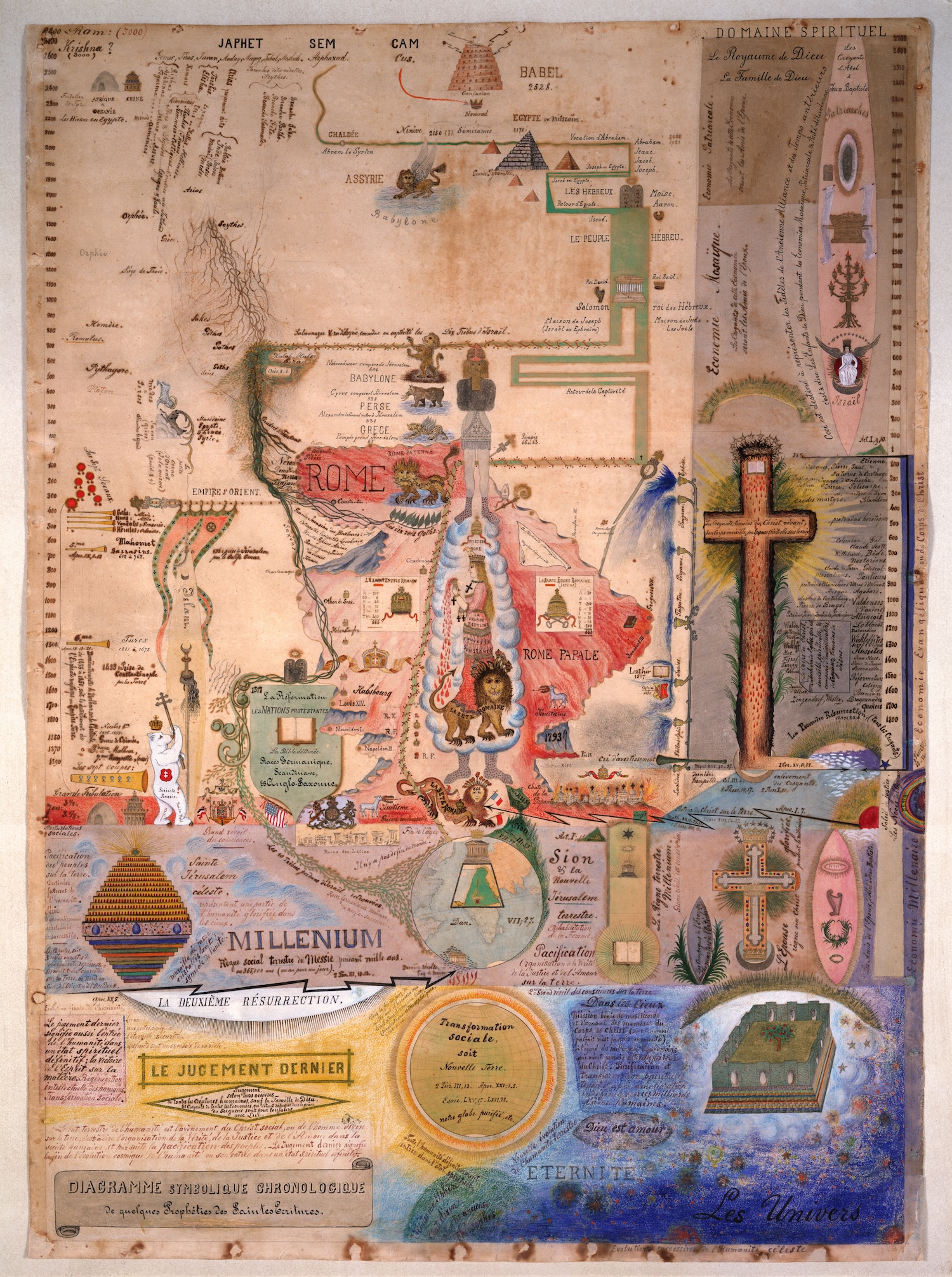
History remembers Henry Dunant (1828–1910) for two things–being the co-founder of the Red Cross movement and winning the first Nobel Peace Prize in 1901.
Less well known is his diagram of the Apocalypse. Between 1877 and 1890, notes the Red Cross Museum website, Henry Dunant “produced a series of diagrams reflecting his distinctive understanding of humanity’s past and future. Inspired by Christian revivalism, the drawings depict a timeline from the Flood of Noah to what Dunant believed was an impending Apocalypse. The diagrams fuse mystical references with biblical, historic and scientific events, while also setting up a clear opposition between Geneva, as the centre of the Reformation, and the Catholic Church.”
The image above is the first drawing out of a series of four, made with colored pencils, ink, India ink, wax crayons, and watercolors. Writes Messy Nessy, Dunant “spent considerable time on the drawings, organising the symbolic elements according to a strict logic, making preparatory sketches and painstakingly incorporating drawings and colourings into his chronology.” All along, he was driven by the belief that the Apocalypse was in the offing, just a short time way.
Related Content
In 1704, Isaac Newton Predicts the World Will End in 2060
A Survival Guide to the Biblical Apocalypse
Read More...Vincent Van Gogh’s Final Painting: Discover Tree Roots, the Last Creative Act of the Dutch Painter (1890)
The story of Vincent van Gogh’s life tends to be defined by his psychological condition and the not-unrelated manner of his death. (It does if we set aside the episode with the mutilated ear and the brothel, anyway.) The figure of the impoverished, neglected artist whose work would revolutionize his medium, and whose descent into madness ultimately drove him to take his own life, has proven irresistible to modern storytellers. That group includes painter-filmmaker Julian Schnabel, who told Van Gogh’s story a few years ago with At Eternity’s Gate, and Vincente Minnelli, who’d earlier given it the full CinemaScope treatment in 1956 with Lust for Life.
It is thanks in large part to Lust for Life that casual Van Gogh fans long regarded Wheatfield with Crows as his final painting. “The painting’s dark and gloomy subject matter seemed to perfectly encapsulate the last days of Van Gogh, full of foreboding of his eventual death,” says gallerist-Youtuber James Payne in his new Great Art Explained video above.
Recently, however, the consensus has shifted toward a different, lesser-known work, Tree Roots. Like Wheatfield with Crows, Van Gogh painted it in the rural village of Auvers-sur-Oise, to which he moved after checking out of the last asylum in which he’d received treatment. There, in his final weeks, he “worked on a series of landscapes on the hills above Auvers,” all rendered on wide-format canvases he’d never used before.
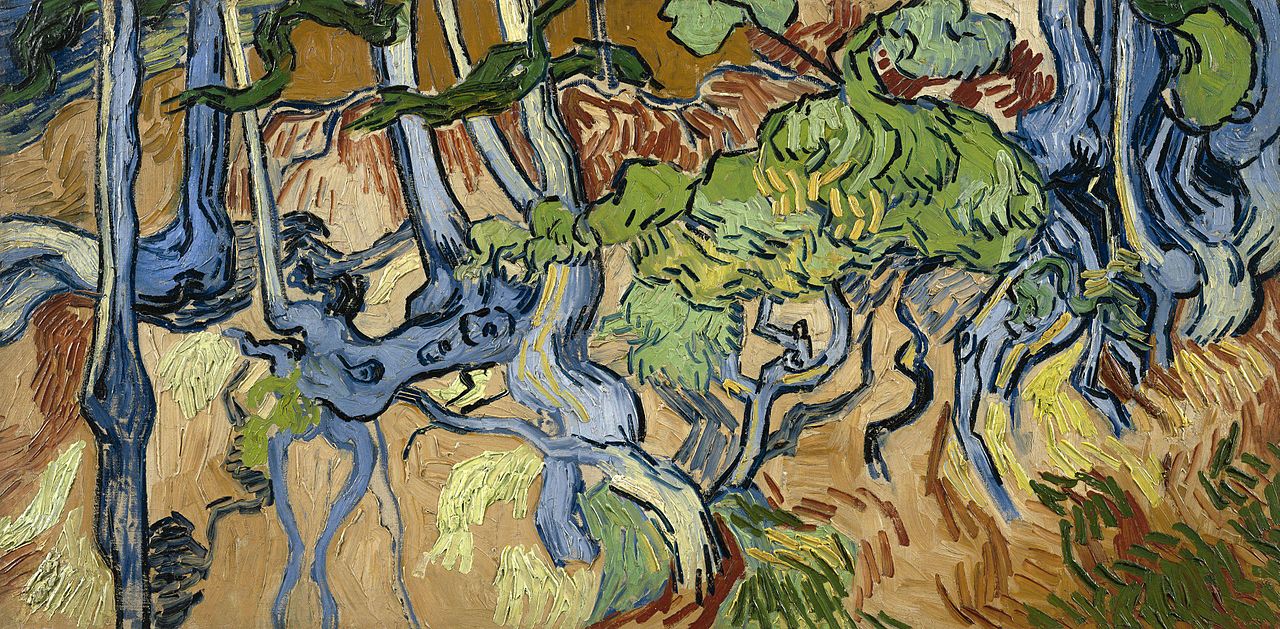
That this series consists of “vast expanses, totally devoid of any human figures” makes it look “as if he has given up on humanity.” What’s more, Tree Roots is also “devoid of form. It is unfinished, which is extremely unusual for Van Gogh, and a sign it was still being worked on when he died.” Its obscure location only became clear during the time of COVID-19, when Van Gogh specialist Wouter van der Veen was looking through a cache of old French postcards he’d received and happened to spot a highly familiar set of roots. Thanks to this coincidence, we can now visit the very spot in which Van Gogh painted what’s now thought to be his very last work on the morning of July 27th, 1890, the same day he chose to end his own life. This counts as a mystery solved, but surely the art Van Gogh made during his abbreviated but prodigious career still has much to reveal to us.
Related content:
1,500 Paintings & Drawings by Vincent van Gogh Have Been Digitized & Put Online
Vincent van Gogh’s The Starry Night: Why It’s a Great Painting in 15 Minutes
Vincent van Gogh’s Self Portraits: Explore & Download a Collection of 17 Paintings Free Online
Van Gogh’s Ugliest Masterpiece: A Break Down of His Late, Great Painting, The Night Café (1888)
Based in Seoul, Colin Marshall writes and broadcasts on cities, language, and culture. His projects include the Substack newsletter Books on Cities, the book The Stateless City: a Walk through 21st-Century Los Angeles and the video series The City in Cinema. Follow him on Twitter at @colinmarshall or on Facebook.
Read More...Salvador Dalí’s Surreal Cutlery Set from 1957
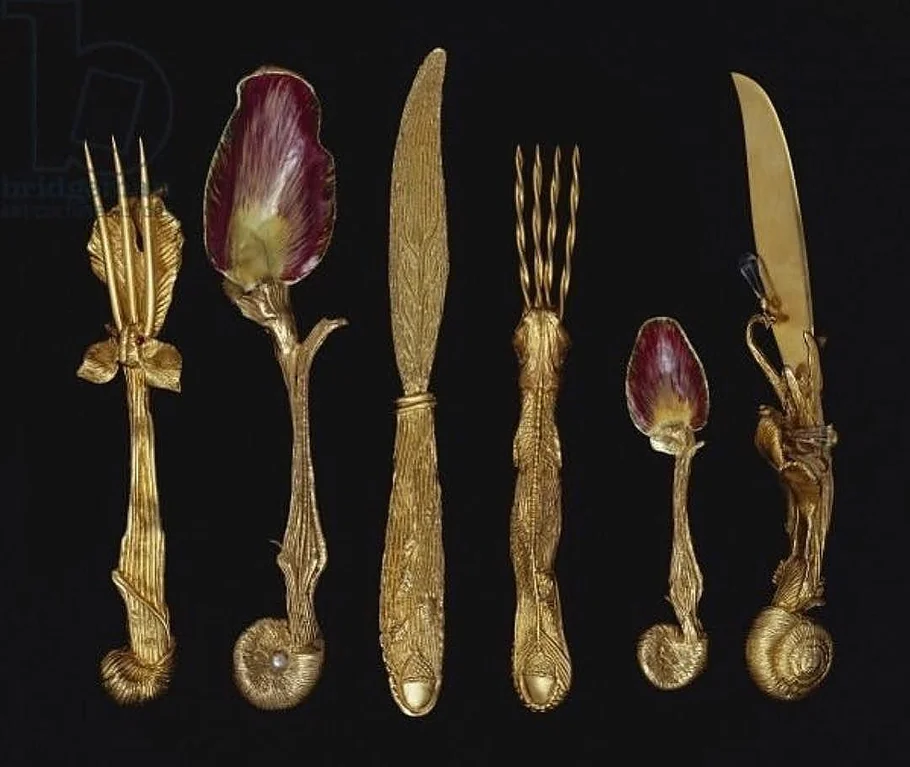
In 1957, Salvador Dalí created a tableware set consisting of 1) a four-tooth fork with a fish handle, 2) an elephant fork with three teeth, 3) a snail knife with tears, 4) a leaf knife, 5) a small artichoke spoon, and 6) an artichoke spoon. When the set went on auction in 2012, it sold for $28,125.
Information on the cutlery set remains hard to find, but we suspect that it sprang from Dalí’s desire to blur the lines between art and everyday life. It’s perhaps the same logic that led him to design a surrealist cookbook—Les Diners de Gala—16 years later. It’s not hard to imagine the utensils above going to work on his oddball recipes, like “Bush of Crawfish in Viking Herbs,” “Thousand-Year-Old Eggs,” and “Veal Cutlets Stuffed with Snails.” If you happen to know more about Dalí’s creation, please add any thoughts to the comments below.
Related Content
Salvador Dalí’s 1973 Cookbook Gets Reissued: Surrealist Art Meets Haute Cuisine
How to Actually Cook Salvador Dali’s Surrealist Recipes: Crayfish, Prawns, and Spitted Eggs
Read More...When François Truffaut Made a Film Adaptation of Ray Bradbury’s Fahrenheit 451 (1966)
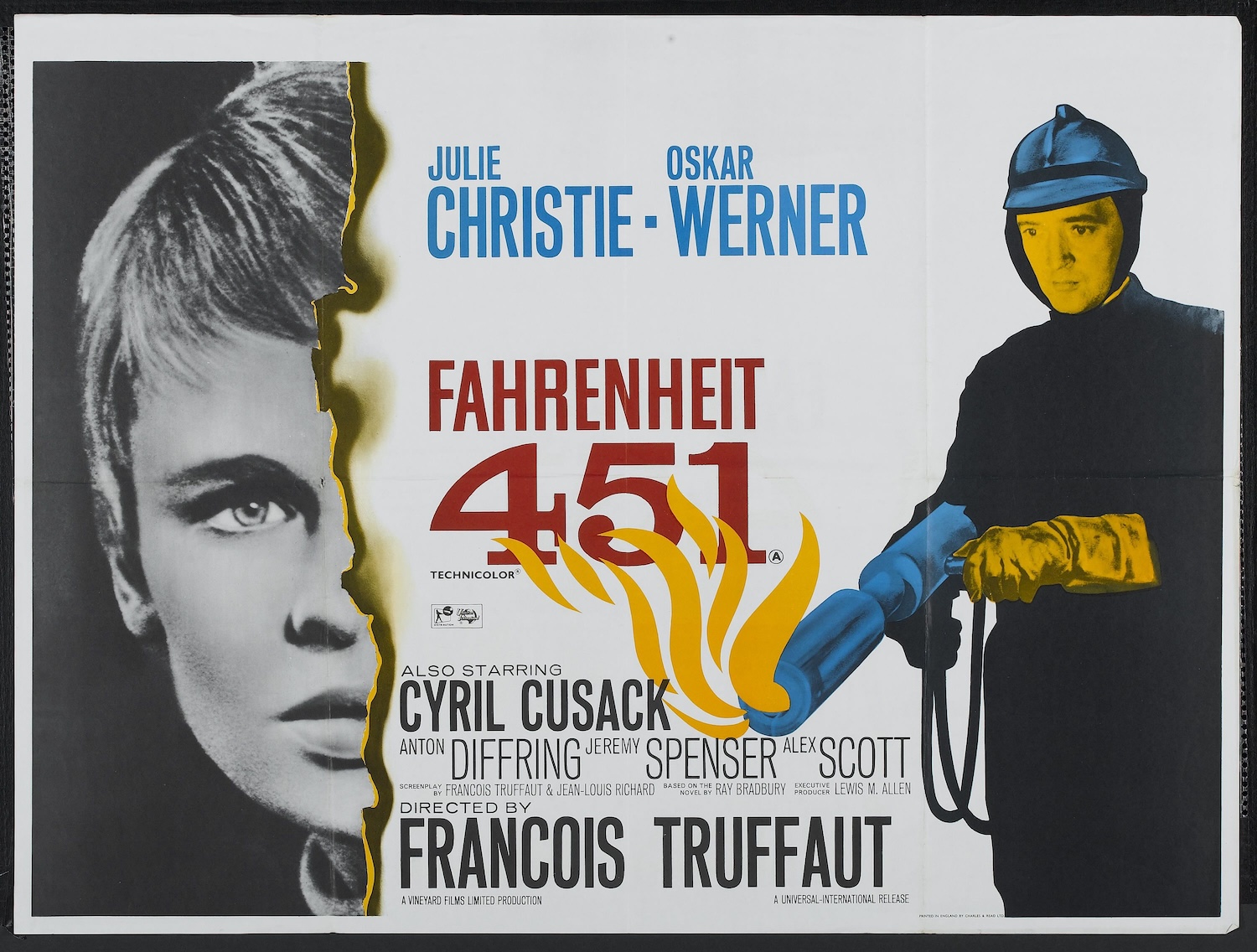
The protagonist of Ray Bradbury’s Fahrenheit 451 is a “fireman” tasked with incinerating what few books remain in a domestic-screen-dominated future society forced into illiteracy. Late in life, Ray Bradbury declared that he wrote the novel because he was “worried about people being turned into morons by TV.” This tinges with a certain irony given that the latest adaptation was made for HBO (2018). That project, which one critic likened it to “a GlaxoSmithKline production of Aldous Huxley’s Brave New World,” will probably not be the last Fahrenheit 451 movie. Nor was it the first: that title goes to the one Nouvelle Vague auteur François Truffaut’s film directed in 1966, though many count that as a dubious honor.
A contemporary review in Time magazine memorably called Truffaut’s Fahrenheit 451 a “weirdly gay little picture that assails with both horror and humor all forms of tyranny over the mind of man,” albeit one that “strongly supports the widely held suspicion that Julie Christie cannot actually act.”
Truffaut boldly cast Christie in a dual role, as both protagonist Guy Montag’s TV-and-pill-addicted wife and the young rebel who eventually lures him over to the pro-book liberation movement. Though some viewers see it as the picture’s fatal flaw, Scott Tobias, writing at The Dissolve, calls it a “masterstroke” that renders the nearly identical characters “the abstract representatives of conformity and non-conformity they had always been in the book.”
It’s easy to imagine what appeal the source material would have held for Truffaut, the most literary-minded leader of the French New Wave; recall the shrine to Balzac kept by young Antoine Doinel in Truffaut’s autobiographical debut The 400 Blows. By the time he went to work on Fahrenheit 451, his sixth feature, he’d become what the American behind-the-scenes trailer calls an “internationally famous French director.” But this time, circumstances conspired against him: his increasingly fractious relationship with Jules and Jim star Oskar Werner did the latter’s performance as Montag no favors, and the money having come from the U.K. forced him to work in English, a language of which he had scant command at the time.
Truffaut himself enumerates these and other difficulties in a production diary published over several issues of Cahiers du Cinéma (beginning with number 175). Yet nearly six decades later, his troubled interpretation of Fahrenheit 451 still fascinates. New Yorker critic Richard Brody calls it “one of Truffaut’s wildest films, a coldly flamboyant outpouring of visual invention in the service of literary passion and artistic memory as well as a repudiation of a world of uniform convenience and comfortable conformity.” Today we may wonder why the parasocial relationship Montag’s wife anxiously maintains with her television, which must have seemed fantastical in the mid-sixties, feels discomfitingly familiar — and how long it will be before Fahrenheit 451 gets re-adapted as a binge-ready prestige TV drama.
Related content:
How Truffaut Became Truffaut: From Petty Thief to Great Auteur
Behold Soviet Animations of Ray Bradbury Stories
Why Should We Read Ray Bradbury’s Fahrenheit 451? A New TED-Ed Animation Explains
Based in Seoul, Colin Marshall writes and broadcasts on cities, language, and culture. His projects include the Substack newsletter Books on Cities, the book The Stateless City: a Walk through 21st-Century Los Angeles and the video series The City in Cinema. Follow him on Twitter at @colinmarshall or on Facebook.
Read More...Hear Nirvana’s “Smells Like Teen Spirit” Performed in Classical Latin
By the early nineteen-nineties, at least in the United States, Latin instruction in schools wasn’t what it had once been. Students everywhere had long been showing impatience and irreverence about their having to study that “dead language,” of course. But surely it had never felt quite so irrelevant as it did in a world of shopping malls, cable television, and the emerging internet. Thirty years ago, few students would have freely chosen to do their Latin homework when they could have been, say, listening to Nirvana. But now, in the age of Youtube, they can have both at once.
In the video above, the_miracle_aligner covers “Smells Like Teen Spirit” in a medieval (or “bardcore”) style, using not just period instrumentation but also a translation of its lyrics into Latin. Since its release a few years ago, this Colosseum-worthy version of the song that defined grunge has drawn thousands upon thousands of appreciative comments from enthusiasts of Nirvana and Latin alike.
As one of the latter points out, “most Latin words rhyme because of conjugation,” and when they don’t, the language’s unusual freedom of word order provides plenty of opportunity to make it work. Still, the song contains more than its share of truly inspired choices: another commenter calls it “just immaculate” how “the ‘hello, how low’ rhymes as ‘salvé, parve.’ ”
As tends to be the way with those of us here in the twenty-first century inclined to dig deep into a language like Latin, some take the opportunity to get into character: “I vividly remember the night Gaius Kurtus Cobainius the Elder premiered this song at the Amphitheater of Pompey in the Summer of 91AD. The plebs went nuts and were throwing Sesterti and Denari on the stage. I even saw a patrician woman lift her tunic! Oh how I miss those days.” In whatever language it’s sung, the instantly recognizable “Smells Like Teen Spirit” will send any Generation-Xers in earshot right back to the strenuous slacking of their own youth. And the cry “Oblectáte, nunc híc sumus” would have cut as sharply in the age of bread and circuses as it did in the MTV era — or, for that matter, as it does now.
Related content:
Learn Latin, Old English, Sanskrit, Classical Greek & Other Ancient Languages in 10 Lessons
Nirvana’s “Come As You Are” Played By Musicians Around the World
The First Live Performance of Nirvana’s “Smells Like Teen Spirit” (1991)
What Ancient Latin Sounded Like, And How We Know It
Based in Seoul, Colin Marshall writes and broadcasts on cities, language, and culture. His projects include the Substack newsletter Books on Cities, the book The Stateless City: a Walk through 21st-Century Los Angeles and the video series The City in Cinema. Follow him on Twitter at @colinmarshall or on Facebook.
The Most Beautiful Shots in Cinema History: Scenes from 100+ Films
If you’re an even mildly enthusiastic filmgoer, these two short compilations from The Solomon Society will get your life flashing before your eyes. They transport me to my ninth birthday screening of The Nightmare Before Christmas; my VHS viewings of Ferris Bueller’s Day Off at home sick from school; the obsession with Blade Runner that put me on the road to cinephilia; the thrill I got in high school from aesthetically daring yet cineplex-screened major motion pictures like Fight Club and The Cell; my induction into auteur cinema through Stanley Kubrick’s Barry Lyndon, 2001: A Space Odyssey (seen at Seattle’s space-age Cinerama in the actual year of 2001), A Clockwork Orange, and The Shining; the surprise public debut Paul Thomas Anderson’s The Master — which happened to follow a revival screening of The Shining.
Of course, you’ll experience a flood of different movie-related memories than I did. Maybe these videos will bring back the exhilaration of seeing Quentin Tarantino’s Pulp Fiction, or even Reservoir Dogs, back in the nineties. The story of my own cinephile life could hardly be told without reference to early Wes Anderson pictures like Rushmore and The Royal Tenenbaums.
But perhaps you’ve felt more of an impact from the later, even more visually intricate work of his that appears here, like The Darjeeling Limited or The Grand Budapest Hotel. Or you could be a movie-lover of a different stripe altogether, for whom nothing satisfies quite like a classic blockbuster, be it the original Star Wars or a long-acclaimed drama like The Shawshank Redemption.
The second of these videos begins with a clip of an interview with no less an auteur than Orson Welles. Asked where he got the confidence to make Citizen Kane, he replies, “Ignorance. Sheer ignorance. There is no confidence to equal it. I thought you could do anything with a camera that the eye could do or the imagination could do. And I didn’t know that there were things you couldn’t do, so anything I could think up in my dreams, I attempted to photograph.” It’s safe to say that none of the dozens upon dozens of shots collected here could have been captured by filmmakers overly conscious of the impossible. But however striking they look individually, they’re all even more powerful in their proper context: their context within not just the film, but also the life of the beholder.
Related content:
The 100 Most Memorable Shots in Cinema Over the Past 100 Years
Signature Shots from the Films of Stanley Kubrick: One-Point Perspective
The Greatest Cut in Film History: Watch the “Match Cut” Immortalized by Lawrence of Arabia
Based in Seoul, Colin Marshall writes and broadcasts on cities, language, and culture. His projects include the Substack newsletter Books on Cities, the book The Stateless City: a Walk through 21st-Century Los Angeles and the video series The City in Cinema. Follow him on Twitter at @colinmarshall or on Facebook.
Read More...The US Postal Service to Release Stamp Collection Featuring the Photography of Ansel Adams
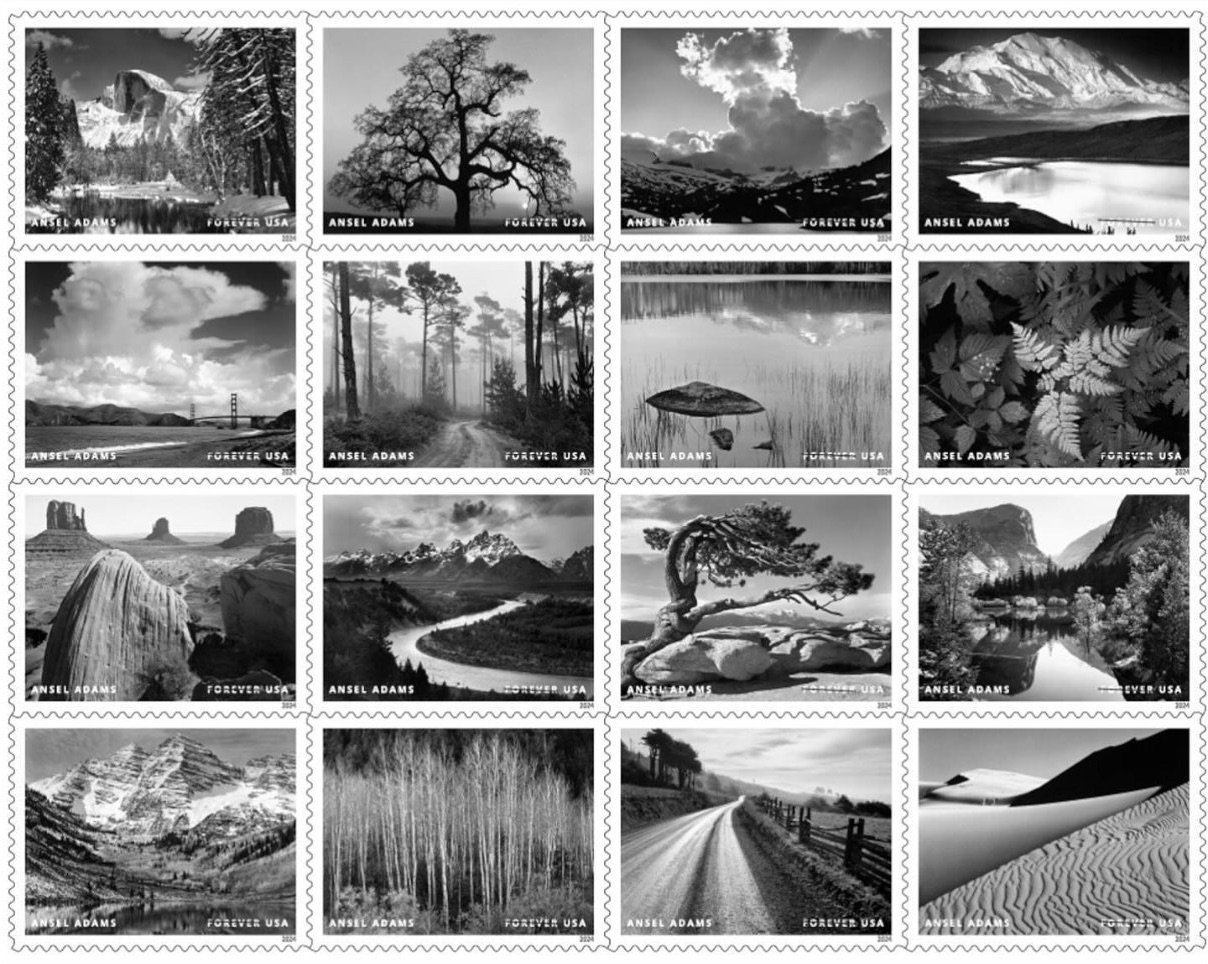
The US Postal Service will be classing up the joint, with the planned release of 16 stamps featuring the photography of Ansel Adams. They write:
Ansel Adams made a career of crafting photographs in exquisitely sharp focus and nearly infinite tonality and detail. His ability to consistently visualize a subject — not how it looked in reality but how it felt to him emotionally — led to some of the most famous images of America’s natural treasures including Half Dome in California’s Yosemite Valley, the Grand Tetons in Wyoming, and Denali in Alaska, the highest peak in the United States.
Due to be unveiled on May 15th, the stamps will feature iconic US landscapes, including Half Dome in Yosemite National Park, Monument Valley in Arizona, the Grand Tetons, the Snake River and more. Find more information on the stamps here.
Related Content
Ansel Adams Reveals His Creative Process in 1958 Documentary
200 Ansel Adams Photographs Expose the Rigors of Life in Japanese Internment Camps During WW II
Read More...Learn to Become a Digital Marketing Analyst with Unilever’s New Certificate Program

Unilever, the consumer goods company headquartered in London, owns over 400 brands. Dove, Lipton, Ben & Jerry’s, Hellmann’s and Knorr–you know and use many of Unilever’s products. The same goes for many people living across the globe. An estimated 3.4 billion people use Unilever products every day. How has Unilever established such vast reach? Through marketing. Like other consumer products companies, Unilever depends on marketing to build brand awareness for each product and to differentiate them from competitors. Marketing is part of the lifeblood of the organization, and digital marketing particularly allows the company to thrive here in the 21st century.
Happily, for any aspiring marketers out there, Unilever has just launched a new Digital Marketing Analyst certificate program. Offered on the Coursera platform, the program consists of four courses (each taking an estimated 20 hours to complete) that focus on helping students build job-ready skills in digital marketing analytics. The courses include:
- Customer Understanding and Digital Marketing Channels
- Measurement and Analysis
- Campaign Performance Reporting, Visualization, & Improvement
- Advanced Tools for Digital Marketing Analytics
As students move through the program, they will “learn in-demand skills like data analysis, customer segmentation, and SEO optimization.” They will also start “collecting and interpreting data to evaluate the performance of digital marketing efforts, improve strategies, and contribute to achieving marketing goals and objectives.”
Students can audit each course for free, or sign up to earn a shareable certificate. Students who select the latter option will be charged $49 per month. So, if you spend 10 hours per week, you can complete the 80-hour certificate program in two months, and pay about $100 in total.
Sign up for the Digital Marketing Analyst certificate program here.
Note: Open Culture has a partnership with Coursera. If readers enroll in certain Coursera courses and programs, it helps support Open Culture.
Related Content
Generative AI for Everyone: A Free Course from AI Pioneer Andrew Ng
Read More...Support Us
We're hoping to rely on loyal readers, rather than erratic ads. Please click the Donate button and support Open Culture. You can use Paypal, Venmo, Patreon, even Crypto! We thank you!

About Us

Open Culture scours the web for the best educational media. We find the free courses and audio books you need, the language lessons & educational videos you want, and plenty of enlightenment in between.
Advertise With Us
FREE UPDATES!
GET OUR DAILY EMAIL
Get the best cultural and educational resources on the web curated for you in a daily email. We never spam. Unsubscribe at any time.
FOLLOW ON SOCIAL MEDIA
Open Culture editor Dan Colman scours the web for the best educational media. He finds the free courses and audio books you need, the language lessons & movies you want, and plenty of enlightenment in between.
Advertise With Us

