When the Berlin Philharmonic Performed John Cage’s Iconic Piece 4′33″, Capturing the Solitude of the Pandemic (2020)
In late October 2020, amidst another surge of the COVID-19 virus, the German government asked the Berlin Philharmonic to close down for a month. On the eve of their closure, the Philharmonic performed John Cage’s modernist composition, 4′33″, which asks performers not to play their instruments throughout the entire duration of the piece, allowing the audience to experience the sometimes awkward, sometimes unexpected sounds of silence. In this particular moment, the Berlin Philharmonic offered a poignant commentary on the silence and isolation experienced during the pandemic.
The website, Classical Voice North America, breaks down the performance as follows: The conductor Kirill Petrenko “defined each of the three movements in 4’33” with a particular affect. In the first movement, he seemed to be conducting a conventional piece that wasn’t there. In the second movement, his hands were positioned near his face, as if asking for quiet or like a priest pronouncing a benediction. In the third movement, his hands stretched toward the orchestra, fingers splayed in one hand, with a searching facial expression. He was near tears with sorrow and grief. ‘What is this? What is happening?’ he seemed to ask. ‘I don’t understand!’ ” We all felt that way at some point.
Watch the performance above.
Related Content
Watch John Cage Play His “Silent” 4′33″ in Harvard Square, Presented by Nam June Paik (1973)
The Curious Score for John Cage’s “Silent” Zen Composition 4′33″
Watch John Cage’s 4′33″ Played by Musicians Around the World
Read More...Hear Grace Slick’s Hair-Raising Vocals in the Isolated Track for “White Rabbit” (1967)
“One pill makes you larger and one pill makes you small…”
Sometime in the summer of 2016, this isolated track of Grace Slick’s vocals for “White Rabbit”–probably the most famous Jefferson Airplane song and definitely one of the top ten psychedelic songs of the late ‘60s–popped up YouTube. As these things go, nobody took credit, but everybody on the Internet was thankful.
Drenched in echo, Slick sings with martial precision, completely in command of her vibrato and dipping and rising all through the Phrygian scale (also known as the Spanish or Gypsy scale.) And no wonder, the song was written in 1965 after an LSD trip at her Marin county home where Slick had listened to Miles Davis’ Sketches of Spain over and over again for 24 hours. Compare the original version to Davis’ track “Solea” to hear what I mean.
Bob Irwin, who was in charge of remastering Jefferson Airplane’s catalog in 2003, was the first to hear Slick’s isolated vocals after many, many years:
When you put up the multi- tracks of the performances to something like “White Rabbit” and isolate Grace’s vocal…you can’t believe the intensity in that vocal. It’s hair-raising, and absolutely unbelievable. I was telling Bill Thompson about that. It’s not that I’m so well-seasoned that nothing surprises me, but boy oh boy, when I put that multi up and I heard Grace’s vocal solo-ed—and it’s absolutely whisper-quiet, there’s not an ounce of leakage in there at all—-you can hear every breath drawn and the intensity and the concentration…
Interestingly, when Slick wrote the song, Airplane hadn’t started. Instead she was in a band called The Great Society, and the original jam version doesn’t do justice to the composition.
Rhythm guitarist David Minor recalled that the song came out of a songwriting request to the other members of the band.
“When we started working, nobody had anything because I couldn’t write any more,” he recalls. “I was too busy keeping up with my various jobs. So Grace’s husband Jerry challenged them: ‘What are you gonna do? Let David write all the songs?’ Y’know, ‘Do something!’. So Darby came back with a couple of songs and Grace came back with White Rabbit.”
When the Great Society fell apart, Jefferson Airplane chose Slick as their singer in 1966 and she brought with her “White Rabbit.” The rest is rock history, and a large part of the now-retired Slick’s income.
Note: An earlier version of this post appeared on our site in 2017. It’s a favorite, and today we’re bringing it back for an encore.
Related Content:
Jefferson Airplane Plays on a New York Rooftop; Jean-Luc Godard Captures It (1968)
Ted Mills is a freelance writer on the arts who currently hosts the artist interview-based FunkZone Podcast and is the producer of KCRW’s Curious Coast. You can also follow him on Twitter at @tedmills, read his other arts writing at tedmills.com and/or watch his films here.
Read More...Isaac Asimov Predicts the Future in 1982: Computers Will Be “at the Center of Everything;” Robots Will Take Human Jobs
Four decades ago, our civilization seemed to stand on the brink of a great transformation. The Cold War had stoked around 35 years of every-intensifying developments, including but not limited to the Space Race. The personal computer had been on the market just long enough for most Americans to, if not actually own one, then at least to wonder if they might soon find themselves in need of one. On New Year’s Eve of 1982, The MacNeil-Lehrer News Hour offered its viewers a glimpse of the shape of things to come by inviting a trio of forward-looking guests, Wasn’t the Future Wonderful author Tim Onosko; Omni magazine editor Dick Teresi; and, most distinguished of all, Isaac Asimov.
As the “author of more than 250 books, light and heavy, fiction and non-fiction, some of the most notable being about the future,” Asimov had long been a go-to interviewee for media outlets in need of long-range predictions about technology, society, and the dynamic relationship between the two. (Here on Open Culture, we’ve previously featured his speculations from 1983, 1980, 1978, 1967, and 1964.) Robert MacNeil opens with a natural subject for any science-fiction writer: mankind’s forays into outer space, and whether Asimov sees “anything left out there.” Asimov’s response: “Oh, everything.”
In the early eighties, the man who wrote the Foundation series saw humanity as “still in the Christopher Columbus stage as far as space is concerned,” foreseeing not just space stations but “solar power stations,” “laboratories and factories that can do things in space that are difficult or impossible to do on Earth,” and even “space settlements in which thousands of people can be housed more or less permanently.” In the fullness of time, the goal would be to “build a larger and more elaborate civilization and one which does not depend upon the resources of one world.”
As for “the computer age,” asks Jim Lehrer; “have we crested on that one as well”? Asimov knew full well that the computer would be “at the center of everything.” Just as had happened with television over the previous generation, “computers are going to be necessary in the house to do a great many things, some in the way of entertainment, some in the way of making life a little easier, and everyone will want it.” There were many, even then, who could feel real excitement at the prospect of such a future. But what of robots, which, as even Asimov knew, would come to “replace human beings?”
“It’s not that they kill them, but they kill their jobs,” he explains, and those who lose the old jobs may not be equipped to take on any of the new ones. “We are going to have to accept an important role — society as a whole — in making sure that the transition period from the pre-robotic technology to the post-robotic technology is as painless as possible. We have to make sure that people aren’t treated as though they’re used up dishrags, that they have to be allowed to live and retain their self-respect.” Today, the technology of the moment is artificial intelligence, which the news media haven’t hesitated to pay near-obsessive attention to. (I’m traveling in Japan at the moment, and saw just such a broadcast on my hotel TV this morning.) Would that they still had an Asimov to discuss it with a level-headed, far-sighted perspective.
Related content:
Isaac Asimov Predicts the Future on The David Letterman Show (1980)
Based in Seoul, Colin Marshall writes and broadcasts on cities, language, and culture. His projects include the Substack newsletter Books on Cities, the book The Stateless City: a Walk through 21st-Century Los Angeles and the video series The City in Cinema. Follow him on Twitter at @colinmarshall or on Facebook.
Read More...The Jazz Classic “Take Five” Played Beautifully on a 1959 Classical Guitar
Above we have George Sakellariou performing Paul Desmond’s jazz classic, “Take Five,” on a vintage 1959 Viuda y Sobrinos de Domingo Esteso (Conde Hermanos) classical guitar. First recorded in 1959 by the Dave Brubeck Quartet, the track eventually became the best-selling jazz song of all time. It’s also a song frequently covered by other talented musicians. Originally from Athens, George Sakellariou joined the San Francisco Conservatory of Music and later became chairman of their Guitar Department. As his bio notes, his guitar style places an emphasis “on clear tone and smooth lyrical lines,” all on display here. Enjoy…
Related Content
Watch an Incredible Performance of “Take Five” by the Dave Brubeck Quartet (1964)
How Dave Brubeck’s Time Out Changed Jazz Music
Pakistani Musicians Play a Wonderful Version of Dave Brubeck’s Jazz Classic, “Take Five”
Read More...A Web Site That Lets You Find Your Home Address on Pangea

A cool tool. Software engineer Ian Webster has created a website that lets you see how the land masses on planet Earth have changed over the course of 750 million years. And it has the added bonus of letting you plot modern addresses on these ancient land formations. Ergo, you can see where your home was located on the Big Blue Marble some 20, 100, 500, or 750 million years ago. Webster’s project (access it here) is open source. Have fun.
If you would like to support the mission of Open Culture, consider making a donation to our site. It’s hard to rely 100% on ads, and your contributions will help us continue providing the best free cultural and educational materials to learners everywhere. You can contribute through PayPal, Patreon, and Venmo (@openculture). Thanks!
Related Content:
Map Showing Where Today’s Countries Would Be Located on Pangea
Read More...Brian Eno’s Beautiful New Turntable Glows & Constantly Changes Colors as It Plays

When we think of Brian Eno’s work, we first think of his records. These include not just his own classics of “ambient music” — a term he popularized — like Discreet Music and Music for Airports, but also the albums he’s produced: Devo’s Q. Are We Not Men? A: We Are Devo!, Talking Heads’ Remain in Light, U2’s The Joshua Tree, David Bowie’s Outside. Yet even before he got into music, Eno was painting, and in some sense, he’s never stopped. He was describing his work with sound as the creation of “imaginary landscapes” even in the nineteen-eighties; in this century, he’s continued to put out records while creating ever-more-high-profile works of a more visual nature, from installations to apps.
A few years ago, Eno even got into the business of functional sculpture, designing a turntable that emanates LED light of various, gradually shifting colors while it plays records. “The light from it was tangible as if caught in a cloud of vapor,” said Eno about his early experience with the finished product, quoted at designboom upon the announcement of its limited production run in 2021.
“We sat watching for ages, transfixed by this totally new experience of light as a physical presence.” Now comes the sequel, Eno’s Turntable II, which will be produced in equally restricted numbers. “Those who can afford one of the 150 limited units also receive the musician’s signature and edition number engraved on the side of the neon turntable’s base,” says designboom.

Eno’s turntable design recently drew attention as the inspiration for U2’s stage set during their residency at Las Vegas’ brazen new venue The Sphere. In the home, it serves multiple functions: “When it doesn’t have to do anything in particular, like play a record, it is a sculpture,” Eno says, “and when it’s in action, it’s a generative artwork. Several overlapping light cycles will keep producing different color balances and blends — and different shadow formations that slowly evolve and never exactly repeat.” Die-hard fans who know how long Eno has been following this artistic and intellectual thread may consider Turntable II’s £20,000 (or more than $25,000 USD) price tag almost reasonable. And next to the $60,000 Linn Sondek LP12 Jony Ive redesigned last year, it’s practically a bargain.
Related content:
Brian Eno Explains the Origins of Ambient Music
Watch Brian Eno’s “Video Paintings,” Where 1980s TV Technology Meets Visual Art
Brian Eno on Creating Music and Art As Imaginary Landscapes (1989)
Brian Eno Shares His Critical Take on Art & NFTs: “I Mainly See Hustlers Looking for Suckers”
World Records: New Photo Exhibit Pays Tribute to the Era of Vinyl Records & Turntables
Pizza Box Becomes a Playable DJ Turntable Through the Magic of Conductive Ink
Based in Seoul, Colin Marshall writes and broadcasts on cities, language, and culture. His projects include the Substack newsletter Books on Cities, the book The Stateless City: a Walk through 21st-Century Los Angeles and the video series The City in Cinema. Follow him on Twitter at @colinmarshall or on Facebook.
Read More...A 3D Animation Shows the Evolution of New York City (1524 — 2023)
Nearly two and a half centuries after its founding, the United States of America is still both celebrated and derided as a young country. Examined on the whole, the US may or may not seem less mature than other lands in any obvious way, but the difference manifests much more clearly on the level of cities. For even among those founded before the independence of the country itself, no American city has yet attained 500 official years of age. But in the case of New York City, we can trace its formation through half a millennium of history, as rendered in the 3D animated video from InfoGeek above.
The long version of New York’s story begins in 1524, the year Giovanni da Verrazzano commanded the French ship La Dauphine into what we now know as New York Harbor. While he and his crew did not, of course, get the dramatic forest-of-skyscrapers view for which that approach would later be celebrated, they would, perhaps, have seen an actual forest, as well as other elements of a natural landscape that would have appeared sublimely untouched. A century later, the Dutch there founded the trading outpost of New Amsterdam, which commenced the written history of New York — as well as the aggressive development that would eventually come to characterize the city and its culture.
New Amsterdam became New York in 1664, one of the many historical events that scroll past in the window at the video’s lower-left corner. At that point in time, the population had grown to about 3,600, a figure counted at the bottom of the frame. Yet even as we see streets roll out, buildings rise, and trees sprout rapidly around us over the next 150 or so years of our stroll, and even after New York becomes America’s largest city in 1790, we must bear in mind that its century hasn’t even begun. It’s something of an irony that the hugely destructive Great Fire of 1835 precedes a developmental push that makes the city, even to our twenty-first-century eyes, look almost modern.
Later in the nineteenth century, we witness the appearance of Central Park and the introduction of motorcars; by the turn of the twentieth, New York’s population approaches three and a half million. Walking down Wall Street (and into the Great Depression), we pass just-materializing landmarks that remain iconic today, like the Chrysler Building, the Empire State Building and — after a somewhat dramatic fast-forward in time — Frank Lloyd Wright’s Solomon R. Guggenheim Museum and Minoru Yamasaki’s ill-fated World Trade Center. We’re now well into the New York of living memory, and even when the animation has passed the creative decrepitude of the seventies and eighties and arrives at the city as it was last year (population: 7,888,120), we sense that its evolution has only just begun.
Related content:
New York City: A Social History (A Free Online Course from N.Y.U.)
Immaculately Restored Film Lets You Revisit Life in New York City in 1911
Scenes of New York City in 1945 Colorized & Revived with Artificial Intelligence
The Lost Neighborhood Buried Under New York City’s Central Park
An Architect Demystifies the Art Deco Design of the Iconic Chrysler Building (1930)
Based in Seoul, Colin Marshall writes and broadcasts on cities, language, and culture. His projects include the Substack newsletter Books on Cities, the book The Stateless City: a Walk through 21st-Century Los Angeles and the video series The City in Cinema. Follow him on Twitter at @colinmarshall or on Facebook.
Read More...Beethoven’s 5th: Watch an Animated Graphical Score
Stephen Malinowski is a self-described “Music Animation Machine,” with a penchant for creating animated graphical scores. Above, he does his thing with the first movement of Beethoven’s Symphony 5.
How does he make this magic? Malinowski writes: “There were a lot of steps; here’s a short summary. I found a recording I could license and made the arrangements to use it. I found a MIDI file that was fairly complete, and imported that into the notation program Sibelius. I compared it to a printed copy of the score from my library and fixed things that were wrong… Then, I listened to the recording and compared that to the score, and modified the score so that the timings were more like what the orchestra was actually playing. I exported this as a MIDI file and ran it through my custom frame-rendering software. Then, I made a “reduction” of the score and colored it to match the colors I was planning to use in the bar-graph score. Unfortunately, when I squished the bar-graph score enough to make room for the notation score, too much detail was lost, so I ended up deciding not to use the notation. Then I put all the pieces (rendered frames, audio, titles) together in Adobe Premiere and exported the movie as a QuickTime file. Then, I used On2 Flix to convert the final file into Flash format (so that YouTube’s conversion to their Flash format wouldn’t change it in unpredictable ways), and uploaded the result.”
Enjoy!
Read More...Explore the Surface of Mars in Spectacular 4K Resolution
?si=RFbzFSzSNWzua3‑7
Could you use a mental escape? Maybe a trip to Mars will do the trick. Above, you can find high definition footage captured by NASA’s three Mars rovers–Spirit, Opportunity and Curiosity. The footage (also contributed by JPL-Caltech, MSSS, Cornell University and ASU) was stitched together by ElderFox Documentaries, creating what they call the most lifelike experience of being on Mars. Adding more context, Elder Fox notes:
The footage, captured directly by NASA’s Mars rovers — Spirit, Opportunity, Curiosity, and Perseverance — unveils the red planet’s intricate details. These rovers, acting as robotic geologists, have traversed varied terrains, from ancient lake beds to towering mountains, uncovering Mars’ complex geological history.
As viewers enjoy these images, they will notice informal place names assigned by NASA’s team, providing context to the Martian features observed. Each rover’s unique journey is highlighted, showcasing their contributions to Martian exploration.
Safe travels.
If you would like to support the mission of Open Culture, consider making a donation to our site. It’s hard to rely 100% on ads, and your contributions will help us continue providing the best free cultural and educational materials to learners everywhere. You can contribute through PayPal, Patreon, and Venmo (@openculture). Thanks!
Related Content:
Behold Colorful Geologic Maps of Mars Released by The United States Geological Survey
Carl Sagan Presents Six Lectures on Earth, Mars & Our Solar System … For Kids (1977)
Hear the Very First Sounds Ever Recorded on Mars, Courtesy of NASA
Read More...Pangea to the Present to the Future: Watch Animations Showing 500 Million Years of Continental Drift
Things change…
Especially when you’re tracking the continental movement from Pangea to the present day in 5 million years increments at the rate of 2.5 million years per second.
Wherever you are, 350 million years ago, your address would’ve been located on the mega-continent of Pangea.
Here’s a map of what things looked like back then.
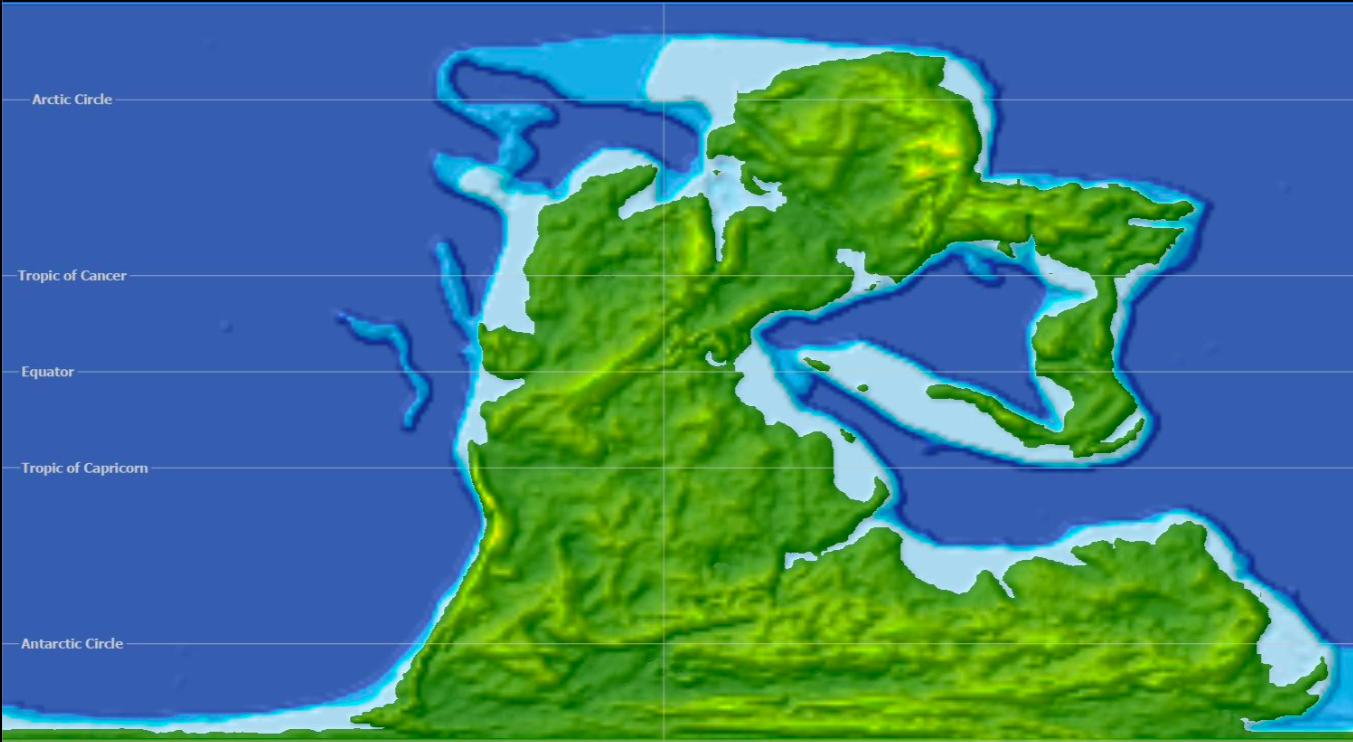
Those who’ve grown a bit fuzzy on their geography may require some indications of where future landmasses formed when Pangea broke apart. Your map apps can’t help you here.
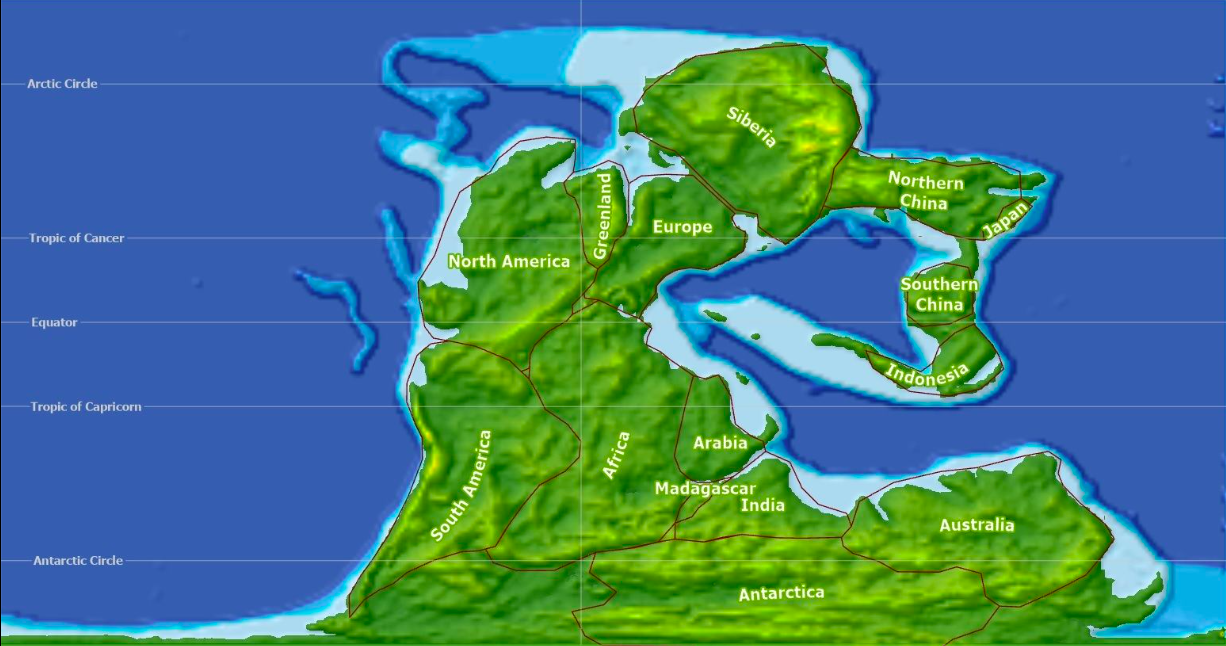
The first split occurred in the middle of the Jurassic period, resulting in two hemispheres, Laurasia to the north and Gondwana.
As the project’s story map notes, 175 million years ago Africa and South America already bore a resemblance to their modern day configurations.
North America, Asia, and Europe needed to stay in the oven a bit longer, their familiar shapes beginning to emerge between 150 and 120 million years ago.
India peeled off from its “mother” continent of Gondwana some 100 million years ago.
Its tectonic plate collided with the Eurasian Plate, giving rise to the Himalayas and the Tibetan Plateau, by which point, dinosaurs had been extinct for about 15 million years…)
Geography nerds may chafe at the seemingly inaccurate sizes of Greenland, Antarctica and Australia. Rest assured that the mapmakers are aware, chalking it to the “distortion of the cartographic projection that exaggerates areas close to the Poles.”
Just for fun, let’s run it backwards!
But enough of the past. What of the future?
Those who really want to know could jump ahead to the end of the story map to see PALEOMAP Project founder Christopher Scotese’s speculative configuration of earth 250 million years hence, should current tectonic plate motion trends continue.
Behold his vision of mega-continent, Pangea Proxima, a landmass “formed from all current continents, with an apparent exception of New Zealand, which remains a bit on the side:”
On the opposite side of the world, North America is trying to fit to Africa, but it seems like it does not have the right shape. It will probably need more time…
Not to bum you out, but a more recent study paints a grimmer picture of a coming supercontinent, Pangea Ultima, when extreme temperatures have rendered just 8 percent of Earth’s surface hospitable to mammals, should they survive at all.
As the study’s co-author, climatologist Alexander Farnsworth, told Nature News, humans might do well to get “off this planet and find somewhere more habitable.”

Related Content
Map Showing Where Today’s Countries Would Be Located on Pangea
– Ayun Halliday is the Chief Primatologist of the East Village Inky zine and author, most recently, of Creative, Not Famous: The Small Potato Manifesto and Creative, Not Famous Activity Book. Follow her @AyunHalliday.
Read More...Support Us
We're hoping to rely on loyal readers, rather than erratic ads. Please click the Donate button and support Open Culture. You can use Paypal, Venmo, Patreon, even Crypto! We thank you!

About Us

Open Culture scours the web for the best educational media. We find the free courses and audio books you need, the language lessons & educational videos you want, and plenty of enlightenment in between.
Advertise With Us
FREE UPDATES!
GET OUR DAILY EMAIL
Get the best cultural and educational resources on the web curated for you in a daily email. We never spam. Unsubscribe at any time.
FOLLOW ON SOCIAL MEDIA
Open Culture editor Dan Colman scours the web for the best educational media. He finds the free courses and audio books you need, the language lessons & movies you want, and plenty of enlightenment in between.
Advertise With Us

