Amazon Offers Free AI Courses, Aiming to Help 2 Million People Build AI Skills by 2025
Late last year, Amazon announced AI Ready, a new initiative “designed to provide free AI skills training to 2 million people globally by 2025.” This includes eight free AI and generative AI courses, some designed for beginners, and others designed for more advanced students.
As the Wall Street Journal podcast notes above, Amazon created the AI Ready initiative with three goals in mind: 1) to increase the overall number of people in the workforce who have a basic understanding of AI, 2.) to compete with Microsoft and other big companies for AI talent, and 3.) to expose a large number of people to Amazon’s AI systems.
For those new to AI, you may want to explore these AI Ready courses:
- Introduction to Generative AI: Art of the Possible: This course provides an introduction to generative AI, its applications, and need-to-know concepts, like foundation models.
- Introduction to Machine Learning — Art of the Possible: This digital course is designed to help business decision makers understand the fundamentals of machine learning (ML).
- Generative AI Learning Plan for Decision Makers: A three-course series covering how to plan a generative AI project and build a generative AI–ready organization.
- Introduction to Amazon CodeWhisperer: This short course teaches participants how to use Amazon’s AI code generator, which produces whole lines of code.
You can find more information (including more free courses) on this AI Ready page. We have other free AI courses listed in the Relateds below.
Note: Until February 1, 2024, Coursera is running a special deal where you can get $200 off of Coursera Plus and gain unlimited access to courses & certificates, including a lot of courses on AI. Get details here.
Related Content
A New Course Teaches You How to Tap the Powers of ChatGPT and Put It to Work for You
Generative AI for Everyone: A Free Course from AI Pioneer Andrew Ng
Read More...A Fan-Made Film Reconstructs an Entire Tom Waits Concert from His “Glitter and Doom Tour” (2008)
Everybody who’s been to a Tom Waits concert has stories to tell about it — no few of them heard straight from the mouth of Waits himself. The official live album for his 2008 Glitter and Doom tour actually devotes its entire second disc to “a selection of the comic bromides, strange musings, and unusual facts that Tom traditionally shares with his audience during the piano set,” with topics ranging from “the ritual of insects to the last dying breath of Henry Ford.” This after a first disc crafted from musical performances recorded in ten different cities, “from Paris to Birmingham; Tulsa to Milan; and Atlanta to Dublin.”
“Tom Waits — Glitter and Doom Concert Experience,” the fan video above, pulls off a similar feat of assemblage, but with a visual component as well. Its creator describes it as “a compilation of professional footage and fan films,” using “all the released soundboard audio that had footage to accompany it to make a concert film that should make a good experience of what it would have been like being in the audience.”
The resulting hour-and-three-quarters includes a few examples of Waits’ onstage oratory, and more importantly, such beloved numbers from his songbook as “Goin’ Out West,” Chocolate Jesus,” “Hold On”, and “Innocent When You Dream” — each one as much of a narrative of deepest, darkest Americana as his non-musical monologues.
“A trip through the world of Tom Waits can be disorienting,” writes NPR’s Robin Hilton (alongside a streamable recording of Waits’ July 5, 2008 show at Atlanta’s Fox Theater). “His ramshackle story-songs, with their creaky instrumentation and dusty poetry, usually leave listeners with more questions than answers, and his persona outside of his music revolves around a playful but guarded mix of fiction and reality.” To promote the Glitter and Doom tour, out came “a taped press conference, featuring Waits seated at a table of microphones, answering questions amid bursts of flashbulbs and murmurs” — all of which was soon revealed not to be what it seemed. But as Waits’ strangely captivating career demonstrates, the ambiguity between performance and reality is where it’s at.
via MetaFilter
Related content:
Stream All of Tom Waits’ Music in a 24 Hour Playlist: The Complete Discography
An Animated Tom Waits Talks About Laughing at Funerals & the Moles Under Stonehenge (1988)
Tom Waits’ Many Appearances on David Letterman, From 1983 to 2015
Tom Waits Reads Charles Bukowski
The Tom Waits Map: A Mapping of Every Place Waits Has Sung About, From L.A. to Africa’s Jungles
Based in Seoul, Colin Marshall writes and broadcasts on cities, language, and culture. His projects include the Substack newsletter Books on Cities, the book The Stateless City: a Walk through 21st-Century Los Angeles and the video series The City in Cinema. Follow him on Twitter at @colinmarshall or on Facebook.
Read More...
Before ChatGPT, There Was ELIZA: Watch the 1960s Chatbot in Action
In 1966, the sociologist and critic Philip Rieff published The Triumph of the Therapeutic, which diagnosed how thoroughly the culture of psychotherapy had come to influence ways of life and thought in the modern West. That same year, in the journal Communications of the Association for Computing Machinery, the computer scientist Joseph Weizenbaum published “ELIZA — A Computer Program For the Study of Natural Language Communication Between Man and Machine.” Could it be a coincidence that the program Weizenbaum explained in that paper — the earliest “chatbot,” as we would now call it — is best known for responding to its user’s input in the nonjudgmental manner of a therapist?
ELIZA was still drawing interest in the nineteen-eighties, as evidenced by the television clip above. “The computer’s replies seem very understanding,” says its narrator, “but this program is merely triggered by certain phrases to come out with stock responses.” Yet even though its users knew full well that “ELIZA didn’t understand a single word that was being typed into it,” that didn’t stop some of their interactions with it from becoming emotionally charged. Weizenbaum’s program thus passes a kind of “Turing test,” which was first proposed by pioneering computer scientist Alan Turing to determine whether a computer can generate output indistinguishable from communication with a human being.
In fact, 60 years after Weizenbaum first began developing it, ELIZA — which you can try online here — seems to be holding its own in that arena. “In a preprint research paper titled ‘Does GPT‑4 Pass the Turing Test?,’ two researchers from UC San Diego pitted OpenAI’s GPT‑4 AI language model against human participants, GPT‑3.5, and ELIZA to see which could trick participants into thinking it was human with the greatest success,” reports Ars Technica’s Benj Edwards. This study found that “human participants correctly identified other humans in only 63 percent of the interactions,” and that ELIZA, with its tricks of reflecting users’ input back at them, “surpassed the AI model that powers the free version of ChatGPT.”
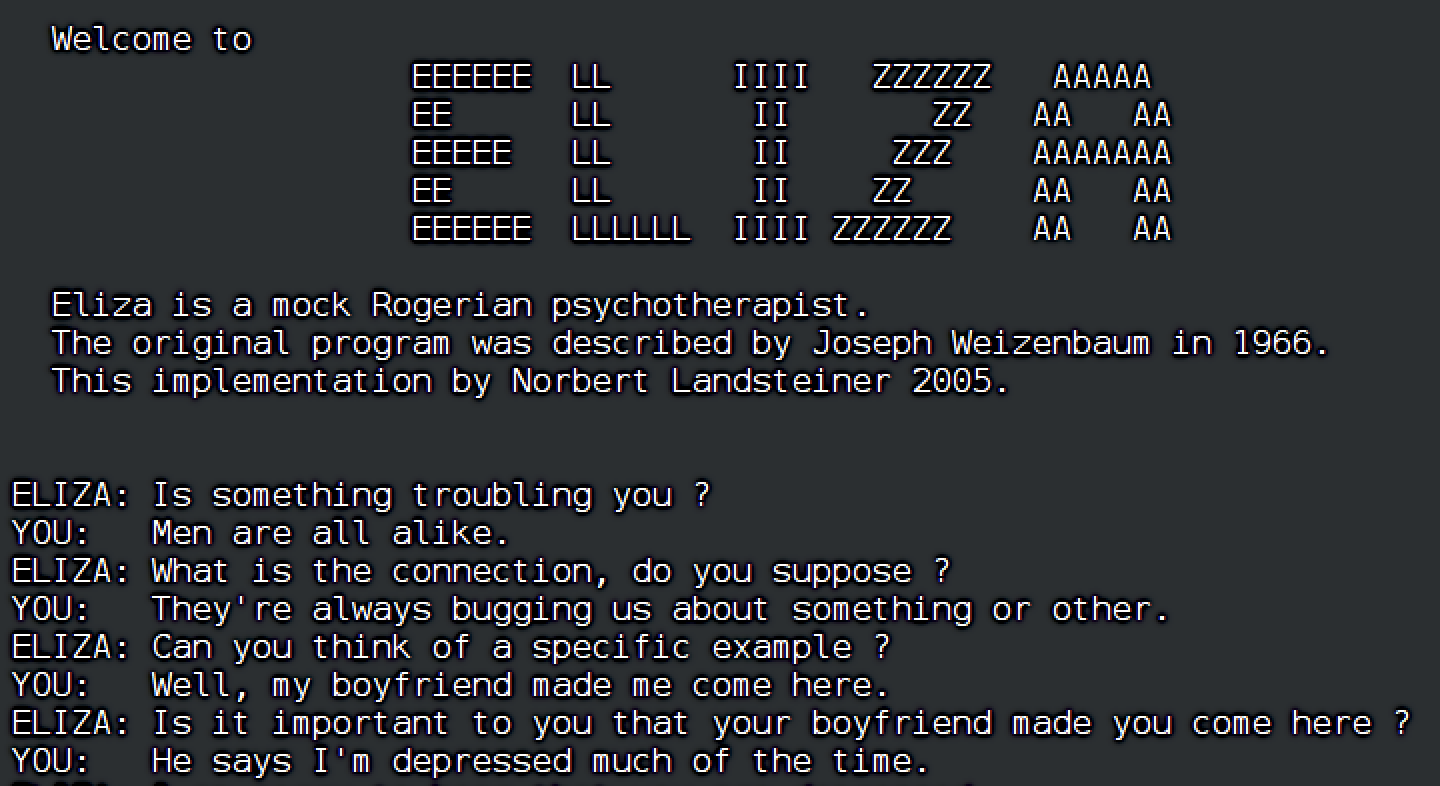
This isn’t to imply that ChatGPT’s users might as well go back to Weizenbaum’s simple novelty program. Still, we’d surely do well to revisit his subsequent thinking on the subject of artificial intelligence. Later in his career, writes Ben Tarnoff in the Guardian, Weizenbaum published “articles and books that condemned the worldview of his colleagues and warned of the dangers posed by their work. Artificial intelligence, he came to believe, was an ‘index of the insanity of our world.’ ” Even in 1967, he was arguing that “no computer could ever fully understand a human being. Then he went one step further: no human being could ever fully understand another human being” — a proposition arguably supported by nearly a century and a half of psychotherapy.
Related content:
A New Course Teaches You How to Tap the Powers of ChatGPT and Put It to Work for You
What Happens When Someone Crochets Stuffed Animals Using Instructions from ChatGPT
Noam Chomsky Explains Where Artificial Intelligence Went Wrong
Based in Seoul, Colin Marshall writes and broadcasts on cities, language, and culture. His projects include the Substack newsletter Books on Cities, the book The Stateless City: a Walk through 21st-Century Los Angeles and the video series The City in Cinema. Follow him on Twitter at @colinmarshall or on Facebook.
Read More...Stanford Continuing Studies Offering a Course on the History & Music of the Grateful Dead, Taught by David Gans: Starts on Monday, January 22
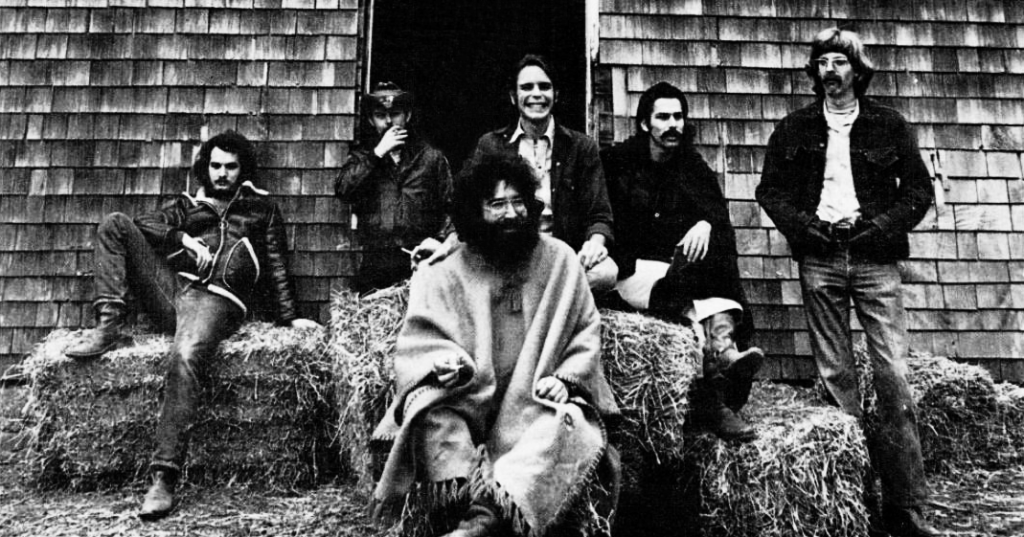
Image via Wikimedia Commons
A quick heads up: On Monday, Stanford Continuing Studies will kick off an online course called Psychedelia and Groove: The Music and Culture of the Grateful Dead. Taught by David Gans (author of Playing in the Band: An Oral and Visual Portrait of the Grateful Dead), the course got a nice shout out from drummer Mickey Hart on Instagram. Open to any adult, the course description reads:
The Grateful Dead’s groundbreaking fusion of music, counterculture, and community engagement forged an enduring legacy that transcends generations while shaping the evolution of music and cultural expression. Fresh off the farewell performance of Dead & Company in San Francisco in July, this course invites students to delve into the phenomenon that is the Grateful Dead through a captivating exploration of the band’s history, music, and cultural impact.
The course will start by tracing the band’s evolution, from its humble beginnings to its legendary status as one of the most influential bands in music history. We will explore the band’s formation, the early San Francisco music scene, its unique approach to touring, and the various eras of its existence. We’ll next embark on a sonic journey through the band’s diverse and ever-evolving musical catalog. Students will dissect the distinctive blend of rock, folk, blues, and improvisation that defined the Grateful Dead’s sound.
Finally, we’ll examine the band’s cultural impact on society, diving into the band’s connection to art, literature, and social change, as well as its unique fan culture and the phenomenon of the “Deadhead.” By the end of the course, students will have a well-rounded appreciation for the roots, struggles, and milestones that shaped the Grateful Dead’s trajectory, an understanding of its profound impact on music and culture, and insight into a legacy that still resonates deeply today.
Guest speakers for this course will include Steve Silberman, who was featured in the documentary Long Strange Trip and is a regular voice on the Good Ol’ Grateful Deadcast. He is also a co-author of Skeleton Key: A Dictionary for Deadheads.
Again, the course starts on Monday, January 22. Tuition is $405. You can enroll here.
Stanford Continuing Studies also offers many other courses online, across many disciplines, at a reasonable price. Check out the catalogue here.
Related Content
Stream a Massive Archive of Grateful Dead Concerts from 1965–1995
The Grateful Dead Movie: Watch It Free Online
Read More...Can You Crack the Uncrackable Code in Kryptos, the CIA’s Work of Public Art?
It can be challenging to parse the meaning of many non-narrative artworks.
Sometimes the title will offer a clue, or the artist will shed some light in an interview.
Is it a comment on the cultural, socio-economic or political context in which it was created?
Or is the act of creating it the artist’s most salient point?
Are multiple interpretations possible?
Artist Jim Sanborn’s massive sculpture Kryptos may inspire various reactions in its viewers, but there’s definitely a single correct interpretation.
But 78-year-old Sanborn isn’t saying what…
He wants someone else to identify it.
Kryptos’ main mystery — more like “a riddle wrapped in a mystery inside an enigma” to quote Winston Churchill — was hand cut into an S‑shaped copper screen using jigsaws.
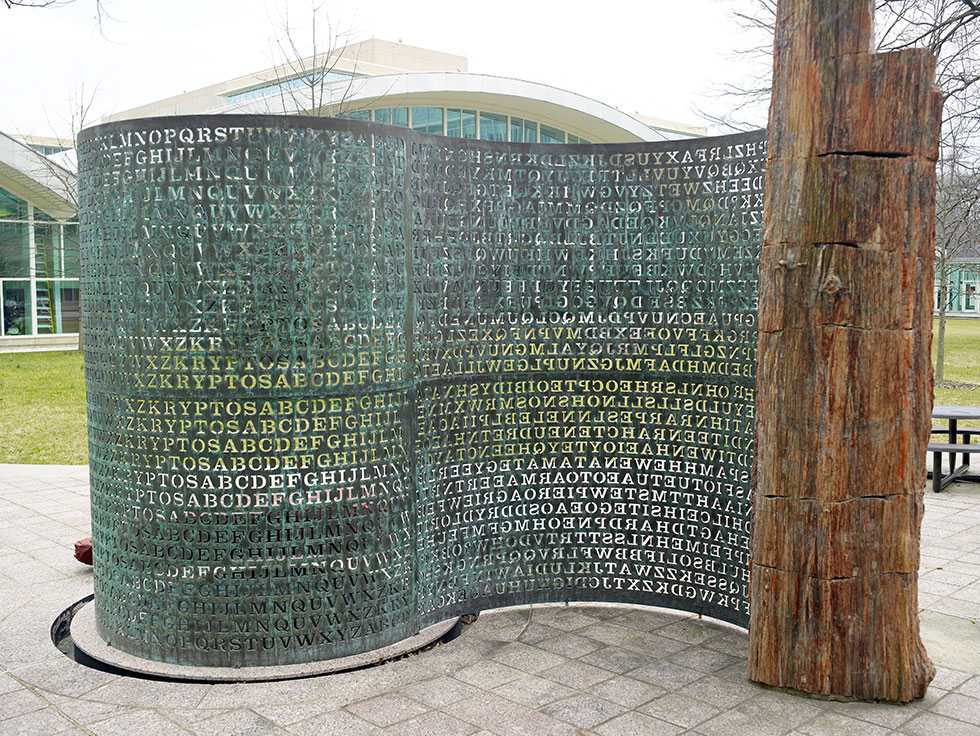
Image courtesy of the CIA
Professional cryptanalysts, hobbyists, and students have been attempting to crack the code of its 865 letters and 4 question marks since 1990, when it was installed on the grounds of CIA headquarters in Langley, Virginia.
The hands-on part fell well within Sanborn’s purview. But a Masters in sculpture from Pratt Institute does not automatically confer cryptography bonafides, so Sanborn enlisted Edward Scheidt, the retired chairman of the CIA’s Cryptographic Center, for a crash course in late 20th-century coding systems.
Sanborn sampled various coding methods for the finished piece, wanting the act of deciphering to feel like “peeling layers off an onion.”
That onion has been partially peeled for years.
Deciphering three of its four panels is a pelt shared by computer scientist and former president of the American Cryptogram Association, James Gillogly, and CIA analyst David Stein.
Gillogly arrived at his solution in 1999, using a Pentium II.
Stein reached the same conclusion a year earlier, after chipping away at it for some 400 hours with pencil and paper, though the CIA kept his achievement on the down low until Gillogly went public with his.
The following year the National Security Agency claimed that four of their employees, working collaboratively, had reached an identical solution in 1992, a fact corroborated by documents obtained through the Freedom of Information Act.
(On a related note, I got Wordle in three this morning…)
This still leaves the 97-character phrase from the final panel up for grabs. Cracking it will be the penultimate step in solving Kryptos’ puzzle. As Sanborn told NPR in 2020, “that phrase is in itself a riddle:”
It’s mysterious. It’s going to lead to something else. It’s not going to be finished when it’s decoded.
The public is welcome to continue making educated guesses.
Sanborn has leaked three clues over the years, all words that can be found in the final passage of decrypted text.
BERLIN, at positions 64 — 69 (2010)
CLOCK, at positions 70 — 74 (2014)
NORTHEAST, at position 26 — 34
Have you solved it, yet?
No?
Don’t feel bad…
Sanborn has been fielding incorrect answers daily for decades, though a rising tide of aggressive and racist messages led him to charge 50 bucks per submission, to which he responds via e‑mail, with absolutely no hope of hints.
Kryptos’ most dedicated fans, like game developer /cryptologist Elonka Dunin, seen plying Sanborn with copious quantities of sushi above in Great Big Story’s video, find value in working together and, sometimes, in person.
Their dream is that Sanborn might inadvertently let slip a valuable tidbit in their presence, though that seems like a long shot.
The artist claims to have gotten very skilled at maintaining a poker face.
(Wait, does that suggest his interlocutors have been getting warmer?)
Dunin has relinquished all fantasies of solving Kryptos solo, and now works to help someone — anyone — solve it.
(Please, Lord, don’t let it be chatGPT…)
Sanford has put a contingency plan in place in case no one ever manages to get to the bottom of the Kryptos (ancient Greek for “hidden”) conundrum.
He, or representatives of his estate, will auction off the solution. He is content with letting the winning bidder decide whether or not to share what’s been revealed to them.
“I do realize that the value of Kryptos is unknown and that perhaps this concept will bear little fruit,” he told the New York Times, though if one takes the masses of people desperate to learn the solution and factors in Sanford’s intention to donate all proceeds to climate research, it may well bear quite a healthy amount of fruit.
Join Elonka Dunin’s online community of Kryptos enthusiasts here.
To give you a taste of what you’re in for, here are the first two panels, followed by their solutions, with the artist’s intentional misspellings intact.
1.
Encrypted Text
EMUFPHZLRFAXYUSDJKZLDKRNSHGNFIVJ
YQTQUXQBQVYUVLLTREVJYQTMKYRDMFD
Decrypted Text
Between subtle shading and the absence of light lies the nuance of iqlusion.
2.
Encrypted Text
VFPJUDEEHZWETZYVGWHKKQETGFQJNCE
GGWHKK?DQMCPFQZDQMMIAGPFXHQRLG
TIMVMZJANQLVKQEDAGDVFRPJUNGEUNA
QZGZLECGYUXUEENJTBJLBQCRTBJDFHRR
YIZETKZEMVDUFKSJHKFWHKUWQLSZFTI
HHDDDUVH?DWKBFUFPWNTDFIYCUQZERE
EVLDKFEZMOQQJLTTUGSYQPFEUNLAVIDX
FLGGTEZ?FKZBSFDQVGOGIPUFXHHDRKF
FHQNTGPUAECNUVPDJMQCLQUMUNEDFQ
ELZZVRRGKFFVOEEXBDMVPNFQXEZLGRE
DNQFMPNZGLFLPMRJQYALMGNUVPDXVKP
DQUMEBEDMHDAFMJGZNUPLGEWJLLAETG
Decrypted Text
It was totally invisible Hows that possible? They used the Earths magnetic field X
The information was gathered and transmitted undergruund to an unknown location X
Does Langley know about this? They should Its buried out there somewhere X
Who knows the exact location? Only WW This was his last message X
Thirty eight degrees fifty seven minutes six point five seconds north
Seventy seven degrees eight minutes forty four seconds west ID by rows
View step by step solutions for the first three of Kryptos’ encrypted panels here.
Related Content
The Enigma Machine: How Alan Turing Helped Break the Unbreakable Nazi Code
– Ayun Halliday is the Chief Primatologist of the East Village Inky zine and author, most recently, of Creative, Not Famous: The Small Potato Manifesto and Creative, Not Famous Activity Book. Follow her @AyunHalliday.
Read More...The Pixies Perform a Hypnotic Version of “Gouge Away” at the BBC
In 2018, the Pixies performed live for BBC Radio 6 Music, playing some new songs (“In the Arms of Mrs. Mark of Cain”) and old classics (“Here Comes Your Man”). In that latter category, you’ll find a recording of “Gouge Away,” which I keep coming back to again, and yet again. About the video, one YouTuber had this to say: “This production is just badass. The bass, the drums, everything. This specific recording is a masterpiece. To see it taped is a revelation.” That kind of sums it up. Time to share it with you…
Related Content
Watch the German Expressionist Film, The Golem, with a Soundtrack by The Pixies’ Black Francis
Read More...51 Propaganda Techniques Explained in 11 Minutes: From Cognitive Dissonance to Appeal to Fear
The concept of propaganda has a great deal of power to fascinate. So does the very word propaganda, which to most of us today sounds faintly exotic, as if it referred mainly to phenomena from distant places and times. But in truth, can any one of us here in the twenty-first century go a day without being subjected to the thing itself? Watch the video above, in which The Paint Explainer lays out 51 different propaganda techniques in 11 minutes, and you’ll more than likely recognize many of the insidiously effective rhetorical tricks labeled therein from your recent everyday life.
You won’t be surprised to hear that these manifest most clearly in the media, both offline and on. The list begins with “agenda setting,” the “ability of the news to influence the importance placed on certain topics by public opinion, just by covering them frequently and prominently.”
Scattered throughout the news, or throughout your social-media feed, advertisements bring out the “beautiful people,” which “suggests that if people buy a product or follow a certain ideology, they, too will be happy or successful” – or, in its basest forms, operates through “classical conditioning,” in which “a natural stimulus is associated with a neutral stimulus enough times to create the same response by using just the neutral one.”
In the even more shameless realm of politics, the common “plain folk” strategy “attempts to convince the audience that the propagandist’s positions reflect the common sense of the people.” When “an individual uses mass media to create an idealized and heroic public image, often through unquestioning flattery and praise,” a powerful “cult of personality” can arise. And in propaganda for everything from presidential candidates to fast-food chains, you’ll hear and read no end of “glittering generalities,” or “emotionally appealing words that are applied to a product idea, but present no concrete argument or analysis.” You can find many of these strategies explained at Wikipedia’s list of propaganda techniques, or this list from the University of Virginia of “propaganda techniques to recognize” — and not just when the “other side” uses them.
Related content:
Sell & Spin: The History of Advertising, Narrated by Dick Cavett (1999)
Based in Seoul, Colin Marshall writes and broadcasts on cities, language, and culture. His projects include the Substack newsletter Books on Cities, the book The Stateless City: a Walk through 21st-Century Los Angeles and the video series The City in Cinema. Follow him on Twitter at @colinmarshall or on Facebook.
Read More...Watch a 106-Year-Old Wizard of Oz Book Get Magically Restored … By Cutting the Book’s Spine, Washing Pages & Recoloring Illustrations
Author, educator and book restoration expert Sophia Bogle is in a constant race against time. Her mission: to rescue and restore ill-treated books before their lamentable conditions can consign them to the landfill.
To the untrained eye, many of these volumes appear beyond repair, but Bogle has nerves of steel, preternatural patience, surgical precision, and over thirty years of experience.
In the Wired video above, she uses a 106-year-old first edition of Frank L. Baum’s The Lost Princess of Oz to demonstrate some of the steps of her craft — from cutting open an old book’s spine and washing dirty pages to repairing tears and recoloring illustrations.
Prior to taking the final step, she scrawls a hidden message on the backing material of the spine:
I do love the fact that there’s the story in the book, there’s the story of the restoration of the book, there’s the story of who has owned the book and now, I’m just in there just a little bit more.
This playful bit of hard-won license is a far cry from some shady restoration practices she mentions in an interview on the Welcome to Literary Ashland blog, in an attempt to arm the general public with tools for spotting potential fraud:
I am not sure that there is anything in the world that cannot be twisted with evil intent…Swapping out pages with publishers information in order to make the book appear to be a more valuable edition. Scratching out/removing numbers or words for the same purpose. And lastly, swapping out pages to insert the author’s signature. None of those things can be done without intent to defraud and it is the intent that matters most.
Bogle plies her trade using all sorts of specialized professional equipment — two sewing frames, a job backer, a gold finishing stove, a nipping press, a Kwikprint stamping machine and drawers full of stamps and dies — but she also offers free and low-cost virtual book repair courses to those whose binderies have yet to be established.
One reward for Kickstarter backers who helped her publish Book Restoration Unveiled: An Essential Guide for Bibliophiles was a bind-it-yourself printable pdf of the book.
Reattaching a paperback’s cover or deodorizing a musty old book may represent the extent of your hands on impulse.
Book lovers who have both the time and the temperament for bookbinding, as well as Bogle’s passion for preserving culture one book at a time, might consider applying for a Save Your Books scholarship.
See more of Sophia Bogle’s book restorations on her Save Your Books YouTube channel.
Related Content
How to Rescue a Wet, Damaged Book: A Handy Visual Primer
How Obsessive Artists Colorize Old Photographs & Restore the True Colors of the Past
The Art of Restoring a 400-Year-Old Painting: A Five-Minute Primer
Watch the Painstaking and Nerve-Racking Process of Restoring a Drawing by Michelangelo
– Ayun Halliday is the Chief Primatologist of the East Village Inky zine and author, most recently, of Creative, Not Famous: The Small Potato Manifesto and Creative, Not Famous Activity Book. Follow her @AyunHalliday.
Read More...How Walking Fosters Creativity: Stanford Researchers Confirm What Philosophers & Writers Have Always Known

Image via Diego Sevilla Ruiz
A certain Zen proverb goes something like this: “A five year old can understand it, but an 80 year old cannot do it.” The subject of this riddle-like saying has been described as “mindfulness”—or being absorbed in the moment, free from routine mental habits. In many Eastern meditative traditions, one can achieve such a state by walking just as well as by sitting still—and many a poet and teacher has preferred the ambulatory method.
This is equally so in the West, where we have an entire school of ancient philosophy—the “peripatetic”—that derives from Aristotle and his contemporaries’ penchant for doing their best work while in leisurely motion. Friedrich Nietzsche, an almost fanatical walker, once wrote, “all truly great thoughts are conceived by walking.” Nietzsche’s mountain walks were athletic, but walking—Frédéric Gros maintains in his A Philosophy of Walking—is not a sport; it is “the best way to go more slowly than any other method that has ever been found.”
Gros discusses the centrality of walking in the lives of Nietzsche, Rimbaud, Kant, Rousseau, and Thoreau. Likewise, Rebecca Solnit has profiled the essential walks of literary figures such as William Wordsworth, Jane Austen, and Gary Snyder in her book Wanderlust, which argues for the necessity of walking in our own age, when doing so is almost entirely unnecessary most of the time. As great walkers of the past and present have made abundantly clear—anecdotally at least—we see a significant link between walking and creative thinking.
More generally, writes Ferris Jabr in The New Yorker, “the way we move our bodies further changes the nature of our thoughts, and vice versa.” Applying modern research methods to ancient wisdom has allowed psychologists to quantify the ways in which this happens, and to begin to explain why. Jabr summarizes the experiments of two Stanford walking researchers, Marily Oppezzo and her mentor Daniel Schwartz, who found that almost two hundred students tested showed markedly heightened creative abilities while walking. Walking, Jabr writes in poetic terms, works by “setting the mind adrift on a frothing sea of thought.”
Oppezzo and Schwartz speculate, “future studies would likely determine a complex pathway that extends from the physical act of walking to physiological changes to the cognitive control of imagination.” They recognize that this discovery must also account for such variables as when one walks, and—as so many notable walkers have stressed—where. Researchers at the University of Michigan have tackled the where question in a paper titled “The Cognitive Benefits of Interacting with Nature.” Their study, writes Jabr, showed that “students who ambled through an arboretum improved their performance on a memory test more than students who walked along city streets.”
One wonders what James Joyce—whose Ulysses is built almost entirely on a scaffolding of walks around Dublin—would make of this. Or Walter Benjamin, whose concept of the flâneur, an archetypal urban wanderer, derives directly from the insights of that most imaginative decadent poet, Charles Baudelaire. Classical walkers, Romantic walkers, Modernist walkers—all recognized the creative importance of this simple movement in time and space, one we work so hard to master in our first years, and sometimes lose in later life if we acquire it. Going for a walk, contemporary research confirms—a mundane activity far too easily taken for granted—may be one of the most salutary means of achieving states of enlightenment, literary, philosophical, or otherwise, whether we roam through ancient forests, over the Alps, or to the corner store.
Note: An earlier version of this post appeared on our site in 2015.
via The New Yorker/Stanford News
Related Content:
Why You Do Your Best Thinking In The Shower: Creativity & the “Incubation Period”
Josh Jones is a writer and musician based in Durham, NC. Follow him at @jdmagness
Read More...Dance Like David Byrne! An Easy-to-Follow Instructional Video Shows You How
This dance is serious. This dance is necessary. Do you feel that change? — David Byrne
Everyone can dance, though some of us need a push from an enthusiastic, encouraging instructor…like singer-songwriter David Byrne.
Movement has long been a hallmark of the former Talking Heads frontman’s performances, when he was a palpably nervous 23-year-old soldiering through one of the band’s first New York City gigs.
Byrne drove the dancing in Talking Heads 1984 concert film, Stop Making Sense and has collaborated with several notable choreographers over the course of his long and varied career.
In 1981, Twyla Tharp commissioned him to write the score for her physically demanding, experimental ballet, The Catherine Wheel.
In 1999, he provided the soundtrack for In Spite of Wishing and Wanting, a 2‑hour work choreographer Wim Vandekeybus created for the men in his company, Ultima Vez.
His most fruitful collaboration has been with Big Dance Theater’s Annie‑B Parson, who choreographed Byrne’s 2012 Love this Giant world tour with St. Vincent, as well as Here Lies Love, his 2013 immersive rock musical about former First Lady of the Philippines Imelda Marcos. Most recently, the pair worked together to adapt Byrne’s American Utopia tour for Broadway.
In an interview with Vulture, Parson recalled questioning why someone with Byrne’s naturally cool physical instincts would seek an outside party to handle the dancing:
I was like, Huh, you’re my favorite choreographer, what are you doing!? Being able to make movement for yourself and being a choreographer are quite different, and he’s not interested in making movement for other people. He is a dancer. Some of the stuff he does in the show he totally made up for himself.
No question about it. The man has moves.
Here’s Parson’s favorite:
He does this thing where he slaps his hands while crossing the stage in Slippery People that’s so amusing to watch. He goes down on the ground at one point in Once in a Lifetime and I asked him what he was doing, and he was like, “Um, I’m going down to the water in the ground.” He’s imagining things and feeling the music. “Loose” wouldn’t be the word because neither of us are loose at all. He’s incredible as an artist in the way he thinks and acts on things. I’ve always felt that I have a huge amount of freedom.
Feel the Byrne next time you hit the dance floor by heading back up to the top of this post and following along with his instructional video for the socially distanced participatory dance experience he co-hosted for two weeks in New York City’s Park Avenue Armory’s 55,000-square-foot Drill Hall.
If only every dance teacher showed up in such a buoyant mood (not to mention a utility kilt and English sand shoes…)
Shake your hips!
Puppet legs!
Hold the traffic!
Vibrating arms!
Those lucky enough to score one of the nightly-assigned dancing spots that ensured SOCIAL! would be, as advertised, a socially distanced dance club, executed these, and other dance moves, that Byrne’s pre-recorded voice called for over the powerful P.A. system.
The New Yorker gave a feel for the proceedings:
Some parts were instructions for line dances; others were more abstract (“Let me see you move like you’re in a new world”) or historical (“This song is by the first interracial band to play Carnegie Hall”); some were idiosyncratic Byrnisms (“C’mon, baby, let’s think about your tendons”).
Reporters for Vanity Fair and the New York Times (who felt reassured that Byrne is “himself an invitingly imperfect dancer”) listed some of the steps they’d attempted at Byrne’s behest:
Hand-sanitizing (“You’ve got too much! Flick it front, flick it behind!”)
Threaded through crowds on a New York City sidewalk (“Don’t step on that pizza!”)
Move like a zombie
Double-dutch
Backstroke
Reach for the rafters (“Maybe you’re raising your hand in praise or to feel the light or to represent—or because you have a question. Is anybody answering your question? So much uncertainty these days.”)
Presumably, they, like Late Show host Stephen Colbert, below, also learned to “polish the plates.”
I Dance Like This by David Byrne
I’m working on my dancing
This is the best I can do
I’m tentatively shaking
You don’t have to look
Can’t say I’m sorry
I can’t say I’m ashamed
Can’t think of tomorrow
When it seems so far away
We dance like this
Because it feels so damn good
If we could dance better
Well you know that we would
For even more inspiration, check out the Instagram account Daily David Byrne Dances.
Related Content
Watch a Very Nervous, 23-Year-Old David Byrne and Talking Heads Performing Live in NYC (1976)
- Ayun Halliday is the Chief Primatologist of the East Village Inky zine and author, most recently, of Creative, Not Famous: The Small Potato Manifesto. Follow her @AyunHalliday.
Read More...Support Us
We're hoping to rely on loyal readers, rather than erratic ads. Please click the Donate button and support Open Culture. You can use Paypal, Venmo, Patreon, even Crypto! We thank you!

About Us

Open Culture scours the web for the best educational media. We find the free courses and audio books you need, the language lessons & educational videos you want, and plenty of enlightenment in between.
Advertise With Us
FREE UPDATES!
GET OUR DAILY EMAIL
Get the best cultural and educational resources on the web curated for you in a daily email. We never spam. Unsubscribe at any time.
FOLLOW ON SOCIAL MEDIA
Open Culture editor Dan Colman scours the web for the best educational media. He finds the free courses and audio books you need, the language lessons & movies you want, and plenty of enlightenment in between.
Advertise With Us


.png)