Prisencolinensinainciusol, the Catchy Italian Pop Song That Sounded Like It Had English Lyrics, But Was Actually Gibberish (1972)
Yesterday a friend and I were standing on a New York City sidewalk, waiting for the light, when Stayin’ Alive began issuing at top volume from a nearby car.
Pavlovian conditioning kicked in immediately. We’d been singing along with the Bee Gees for nearly a minute before realizing that neither of us knew the lyrics. Like, at all.
Italian actor and musician Adriano Celentano’s cult classic, Prisencolinensinainciusol, inspires a similar response.
The difference being that should I ever need to prep for karaoke, Stayin’ Alive’s lyrics are widely available online, whereas Prisencolinensinainciusol’s lyrics are kind of anyone’s guess…nonsense in any language.
Celentano improvised this gibberish in 1972 in an attempt to recreate how American rock and roll lyrics sound like to non-English-speaking Italian fans like himself.
As he told NPR’s All Things Considered through a translator during a 2012 interview:
Ever since I started singing, I was very influenced by American music and everything Americans did. So at a certain point, because I like American slang — which, for a singer, is much easier to sing than Italian — I thought that I would write a song which would only have as its theme the inability to communicate…I sang it with an angry tone because the theme was important. It was an anger born out of resignation. I brought to light the fact that people don’t communicate.
And yet, his 1974 appearance in the above sketch on the Italian variety series Formula Due spurs strangers to make stabs at communication by sharing their best guess transcriptions of Prisencolinensinainciusol’s lyrics in YouTube comments, 51 years after the song’s original release.
A sampling, anchored by the chorus’ iconic and unmistakeable “all right:”
@glassjester:
My eyes lie, senseless.
I guess I’m throwing pizza.
Eyes.
And the cold wind sailor,
freezing cold and icy in Tucson
Alright.
@emanueletardino8545:
My eyes are way so sensitive
And it gets so cold, it’s freezing
Ice
You’re the cold, main, the same one
Please let’s call ’em ‘n’ dance with my shoes off
All right
@sexydudeuk2172
My eyes smile senseless but it doesn’t go with diesel all right.
@leviathan3187:
I don’t know why but I want a maid to say I want pair of ice blue shoes with eyes…awight.
Prisencolinensinainciusol’s looping, throbbing beat is wildly catchy and imminently danceable, as evidenced by Celentano’s performance on Formula Due and that of the black clad dancers backing him up during an appearance on Milleluci, another mid-70s Italian variety show, below.
The attention generated by these variety show segments — both lip synched — sent Prisencolinensinainciusol up the charts in Italy, Belgium, Germany, France, the Netherlands, the UK, and even the United States.
Its mix of disco, hip hop and funk has proved surprisingly durable, inspiring remixes and covers, including the one that served as philosopher Slavoj Žižek’s Eurovision Song Contest entry.
Prisencolinensinainciusol has netted a whole new generation of fans by cropping up on Ted Lasso, Fargo, a commercial for spiced rum, and seemingly innumerable TikToks.
We’ll probably never get a firm grasp on the lyrics, despite Italian television host Paolo Bonolis’ puckish 2005 attempt to goad befuddled native English speaker Will Smith into deciphering them.
No matter.
Celentano’s supremely confident delivery of those indelible nonsense syllables is what counts, according to a YouTube viewer from Slovenia with fond memories of playing in a rock band as a teen in the 1960’s:
This is exactly how we non-English-speakers sung the then hit songs. You learned some beginning parts of lyrics so that the audience recognized the song. They heard it at Radio Luxembourg. From here on it was exactly the same style — outside the chorus of course. Adriano Celentano was always been a legend for us back in Slovenia.
h/t Erik B.
Related Content
Hear All of Finnegans Wake Read Aloud: A 35 Hour Reading
Watch La Linea, the Popular 1970s Italian Animations Drawn with a Single Line
– Ayun Halliday is the Chief Primatologist of the East Village Inky zine and author, most recently, of Creative, Not Famous: The Small Potato Manifesto and Creative, Not Famous Activity Book. Follow her @AyunHalliday.
Read More...The Evolution of Bugs Bunny’s Appearance Over His Eight Decade Career
Bugs Bunny is a quick-thinking, fast-talking, wascally force of nature, and a preternaturally gifted physical comedian, too.
But unlike such lasting greats as Charlie Chapin and Buster Keaton, it took him a while to find his iconic look.
His first appearance, as “Happy Rabbit” in the 1938 black and white theatrical short, Porky’s Hare Hunt, might remind you of those yearbook photos of celebrities before they were famous.
In a video essay considering how Bugs Bunny’s look has evolved over his eight-decade career, animation fan Dave Lee of the popular YouTube series Dave Lee Down Under breaks down some early characteristics, from an undefined, small body and oval-shaped head to white fur and a fluffy cotton ball of a tail.
His voice was also a work in progress, more Woody Woodpecker than the hybrid Brooklyn-Bronx patois that would make him, and voice actor Mel Blanc, famous.
The following year, the rabbit who would become Bugs Bunny returned in Prest‑o Change‑o, a Merry Melodies Technicolor short directed by Chuck Jones.
A few months later character designer (and former Disney animator) Charlie Thorson subjected him to a pretty noticeable makeover for Hare-um Scare-um, another rabbit hunting-themed romp.
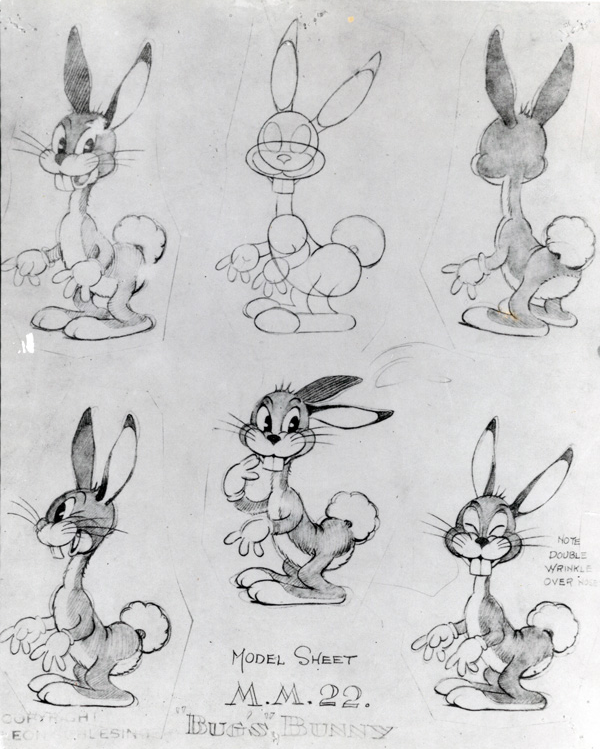
The two-toned grey and white coat, oval muzzle, and mischievous buck-toothed grin are much more aligned with the Bugs most of us grew up watching.
His pear-shaped bod’, long neck, high-rumped stance, and pontoon feet allowed for a much greater range of motion.
A notation on the model sheet alluding to director Ben Hardaway’s nickname — “Bugs” — gives some hint as to how the world’s most popular cartoon character came by his stage name.
For 1940’s Elmer’s Candid Camera, the pink-muzzled Bugs dropped the yellow gloves Thorsen had given him and affected some black ear tips.
Tex Avery, who was in line to direct the pair in the Academy Award-nominated short A Wild Hare, found this look objectionably cute.
He tasked animator Bob Givens with giving the rabbit, now officially known as Bugs Bunny, an edgier appearance.
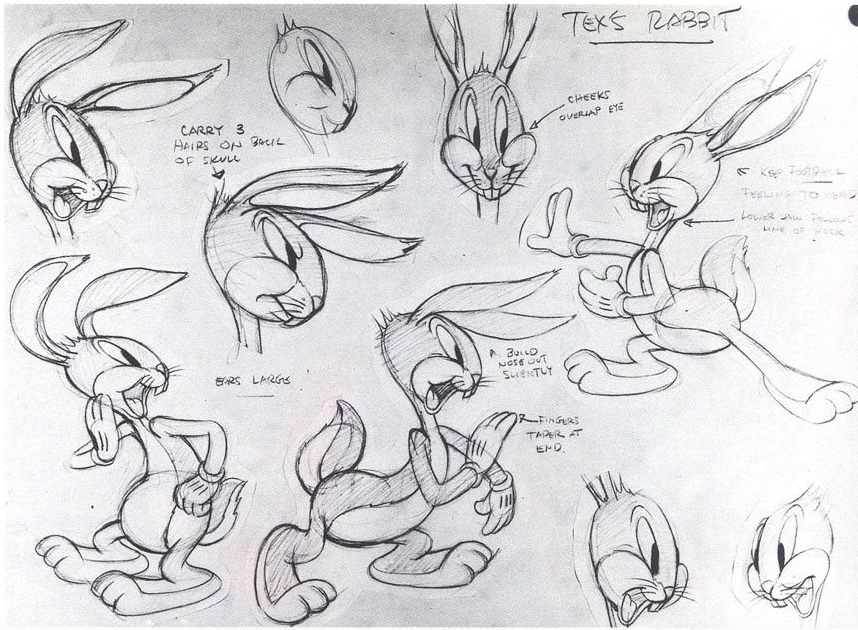
Animation historian Michael Barrier writes:
In the Givens design, Bugs was no longer defined by Thorson’s tangle of curves. His head was now oval, rather than round. In that respect, Bugs recalled the white rabbit in Porky’s Hare Hunt, but Givens’s design preserved so many of Thorson’s refinements—whiskers, a more naturalistic nose—and introduced so many others—cheek ruffs, less prominent teeth—that there was very little similarity between the new version of Bugs and the Hare Hunt rabbit.
Barrier also details a number of similarities between the titular rabbit character from Disney’s 1935 Silly Symphonies short, The Tortoise and the Hare, and former Disney employee Givens’ design.
While Avery boasted to cartoon historian Milt Gray in 1977 that “the construction was almost identical”, adding, “It’s a wonder I wasn’t sued,” Givens insisted in an interview with the Animation Guild’s oral history project that Bugs wasn’t a Max Hare rip off. ( “I was there. I ought to know.”)
Whatever parallels may exist between Givens’ Bugs and Disney’s Hare, YouTuber Lee sees A Wild Hare as the moment when Bugs Bunny’s character coalesced as “more of a lovable prankster than a malicious deviant,” nonchalantly chomping a carrot like Clark Gable in It Happened One Night, and turning a bit of regional Texas teen slang — “What’s up, Doc?”- into one of the most immortal catch phrases in entertainment history.
A star was born, so much so that four directors — Jones, Avery, Friz Freleng and Bob Clampett — were enlisted to keep up with the demand for Bugs Bunny vehicles.
This multi-pronged approach led to some visual inconsistencies, that were eventually checked by the creation of definitive model sheets, drawn by Bob McKimson, who animated the Clampett-directed shorts.
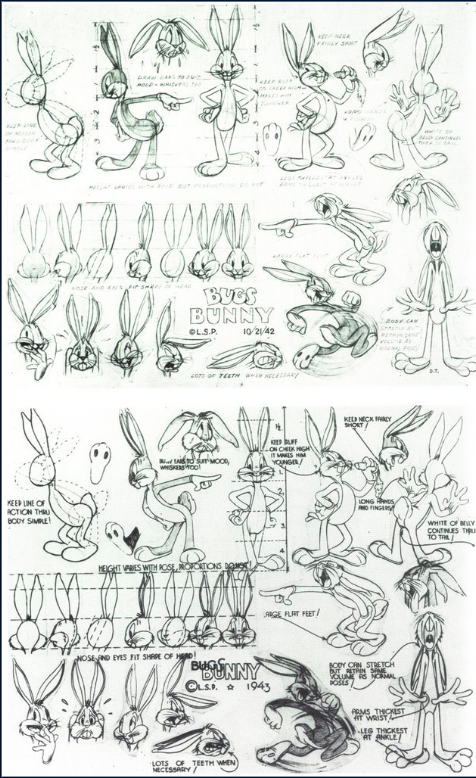
Historian Barrier takes stock:
Bugs’s cheeks were broader, his chin stronger, his teeth a little more prominent, his eyes larger and slanted a little outward instead of in. The most expressive elements of the rabbit’s face had all been strengthened …but because the triangular shape of Bugs’s head had been subtly accentuated, Bugs was, if anything, futher removed from cuteness than ever before. McKimson’s model sheet must be given some of the credit for the marked improvement in Bugs’s looks in all the directors’ cartoons starting in 1943. Not that everyone drew Bugs to match the model sheet, but the awkwardness and uncertainty of the early forties were gone; it was if everyone had suddenly figured out what Bugs really looked like.
Now one of the most recognizable stars on earth, Bugs remained unmistakably himself while spoofing Charles Dickens, Alfred Hitchcock and Wagner; held his own in live action appearances with such heavy hitters as Doris Day and Michael Jordan; and had a memorable cameo in the 1988 feature Who Framed Roger Rabbit, after producers agreed to a deal that guaranteed him the same amount of screen time as his far squarer rival, Mickey Mouse.
This millennium got off to a rockier start, owing to an over-reliance on low budget, simplified flash animation, and the truly execrable trend of shows that reimagine classic characters as cloying toddlers.
In 2011, on the strength of her 2‑minute animated short I Like Pandas, an initially reluctant 24-year-old Jessica Borutski was asked to “freshen up” Bugs’ look for The Looney Tunes Show, a series of longer format cartoons which required its cast to perform such 21st-century activities as texting:
I made their heads a bit bigger because I didn’t like [how] in the ’60s, ’70s Bugs Bunny’s head started to get really small and his body really long. He started to look like a weird guy in a bunny suit.
Lee’s Evolution of Bugs Bunny- 80 Years Explained was released in 2019.
He hasn’t stopped evolving. Gizmodo’s Sabina Graves “sat down with the creative teams shepherding Warner Bros.’ classic Looney Tunes characters into new and reimagined cartoons” at San Diego Comic-Con 2022:
In a push led by Looney Tunes Cartoons’ Alex Kirwan—who spearheads the franchise’s current slate of shorts on HBO Max—the beloved animation icons will soon expand into even more content. There’s the upcoming Tiny Toons Loooniversity revival, a Halloween special, Cartoonito’s Bugs Bunny Builders for kids, and two feature-length animated movies on the way—and we have a feeling that’s not all, folks!
…to quote Bugs, “I knew I shoulda taken that left turn at Albuquerque!”
Related Content
How to Draw Bugs Bunny: A Primer by Legendary Animator Chuck Jones
The Strange Day When Bugs Bunny Saved the Life of Mel Blanc
The Proof That Mel Blanc–the Voice Behind Bugs Bunny, Daffy Duck & Porky Pig–Was a Genius
- Ayun Halliday is the Chief Primatologist of the East Village Inky zine and author, most recently, of Creative, Not Famous: The Small Potato Manifesto. Follow her @AyunHalliday.
Read More...Astronomers Create a Digital Atlas of Over 380,000 Galaxies
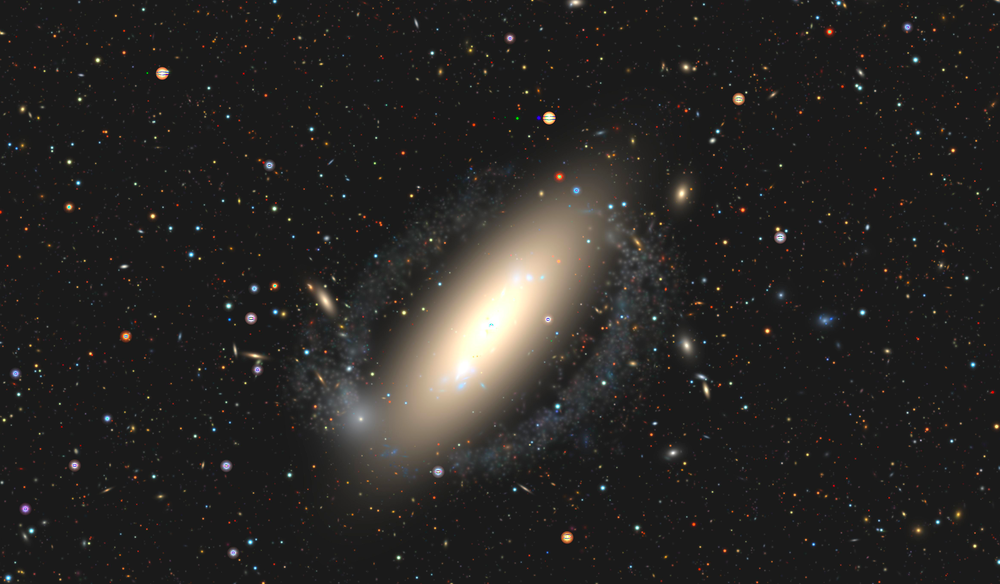
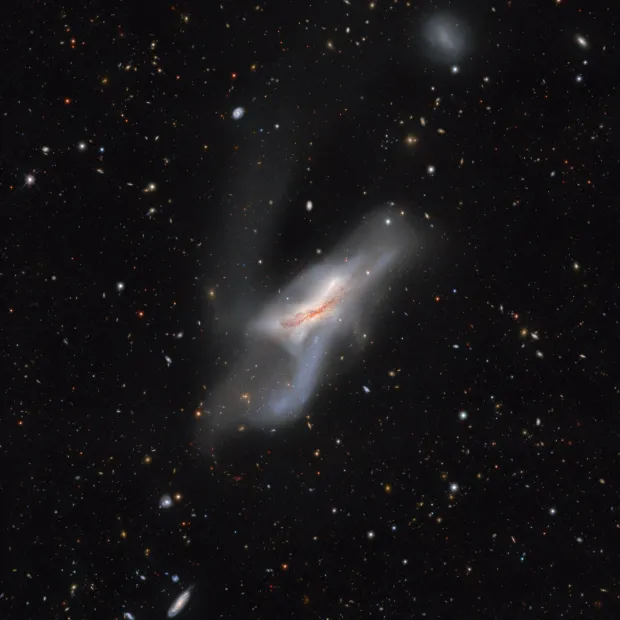
In the observable universe, there are estimated to be between 200 billion to two trillion galaxies. By comparison to these super-Saganian numbers, the 383,620 galaxies captured by the Siena Galaxy Atlas may seem like small potatoes. But the SGA actually represents a landmark achievement among digital astronomy catalogs: as Samantha Hill writes in Astronomy, it draws its data from three Dark Energy Spectroscopic Instrument Legacy Surveys, which together constitute “one of the largest surveys ever conducted.” Coming to 7,637 downloadable pages, it “presents a new possible naming convention for the galaxies, and captures images of the objects in optical and infrared wavelengths. Each of the target’s data set includes a whole slew of other information including its size and morphology.”

Though publicly accessible online, the formidably technical SGA may present the non-astronomer with a somewhat steep learning curve. One way to approach the archive through some of the especially impressive galaxies it captures is to organize the list below its search filters according to size. The images that result are not, of course, photographs of the kind any of us could take by pointing a camera up at the night sky, no matter how pricey the camera. Rather, they’re the results, processed into visual legibility, of enormous amounts of data collected by advanced telescope and satellite.
To get more technical, the SGA is also “the first cosmic atlas to feature the light profiles of galaxies — a curve that describes how the brightness of the galaxy changes from its brightest point, usually at the center, to its dimmest, commonly at its edge.”
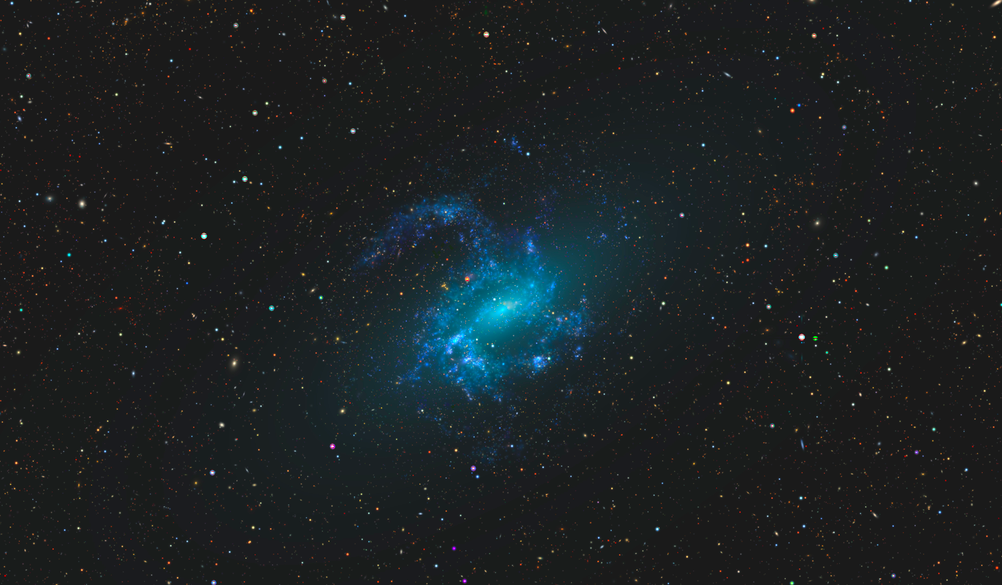
So writes Space.com’s Robert Lea, who also explains more about the SGA’s usefulness to scientific professionals. It “represents peak accuracy, promising to be a gold mine of galactic information for scientists aiming to investigate everything from the births and evolutions of galaxies to the distribution of dark matter and propagation of gravitational waves through space.” Its data could also help astronomers “find the sources of gravitational wave signals detected on Earth, because these faint ripples in the very fabric of space and time wash over our planet after traveling for millions of light years.” Even if you’re undertaking no such searches of your own, a trip through the SGA can still enhance your appreciation of how much humanity has come to learn about these “nearby” galaxies — and how much remains to be learned about all those that lie beyond. Enter the archive here.
Related content:
What Would It Be Like to Fly Through the Universe?
Lux Aeterna: A Journey of Light, From Distant Galaxies to Small Drops of Water
Based in Seoul, Colin Marshall writes and broadcasts on cities, language, and culture. His projects include the Substack newsletter Books on Cities, the book The Stateless City: a Walk through 21st-Century Los Angeles and the video series The City in Cinema. Follow him on Twitter at @colinmarshall or on Facebook.
Read More...Explore the Florentine Codex: A Brilliant 16th Century Manuscript Documenting Aztec Culture Is Now Digitized & Available Online
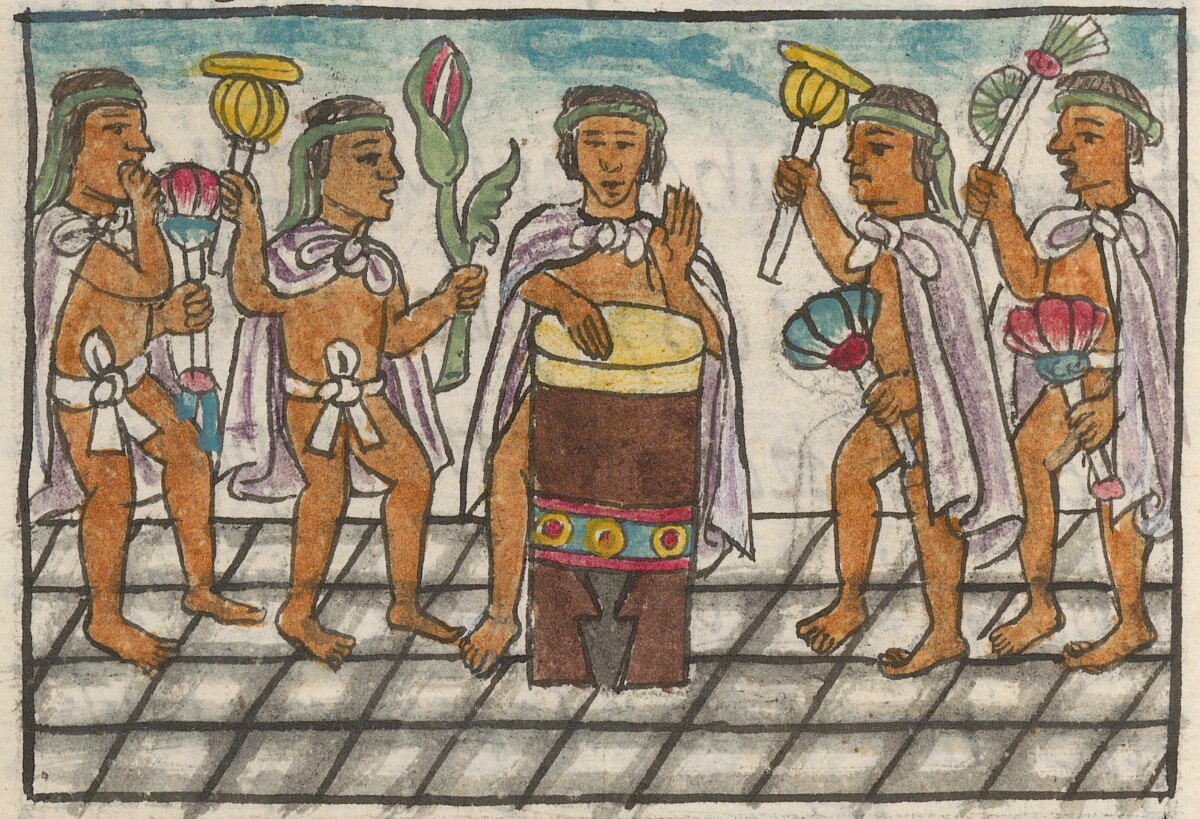
The Spanish conquista of the Americas happened long enough ago — and left behind a spotty enough body of historical records — that we tend to perceive it as much through simplifications, exaggerations, and distortions as we do through facts. What we now call Mexico underwent “essentially an internal conflict between different indigenous groups who saw the arrival of strangers as an opportunity to resist having to pay tribute to the Aztec Empire,” says Universidad Nacional Autónoma de Mexico history professor Berenice Alcántara Rojas. “When the Spaniards initially attacked the Mexica capital, they were swiftly driven out.”
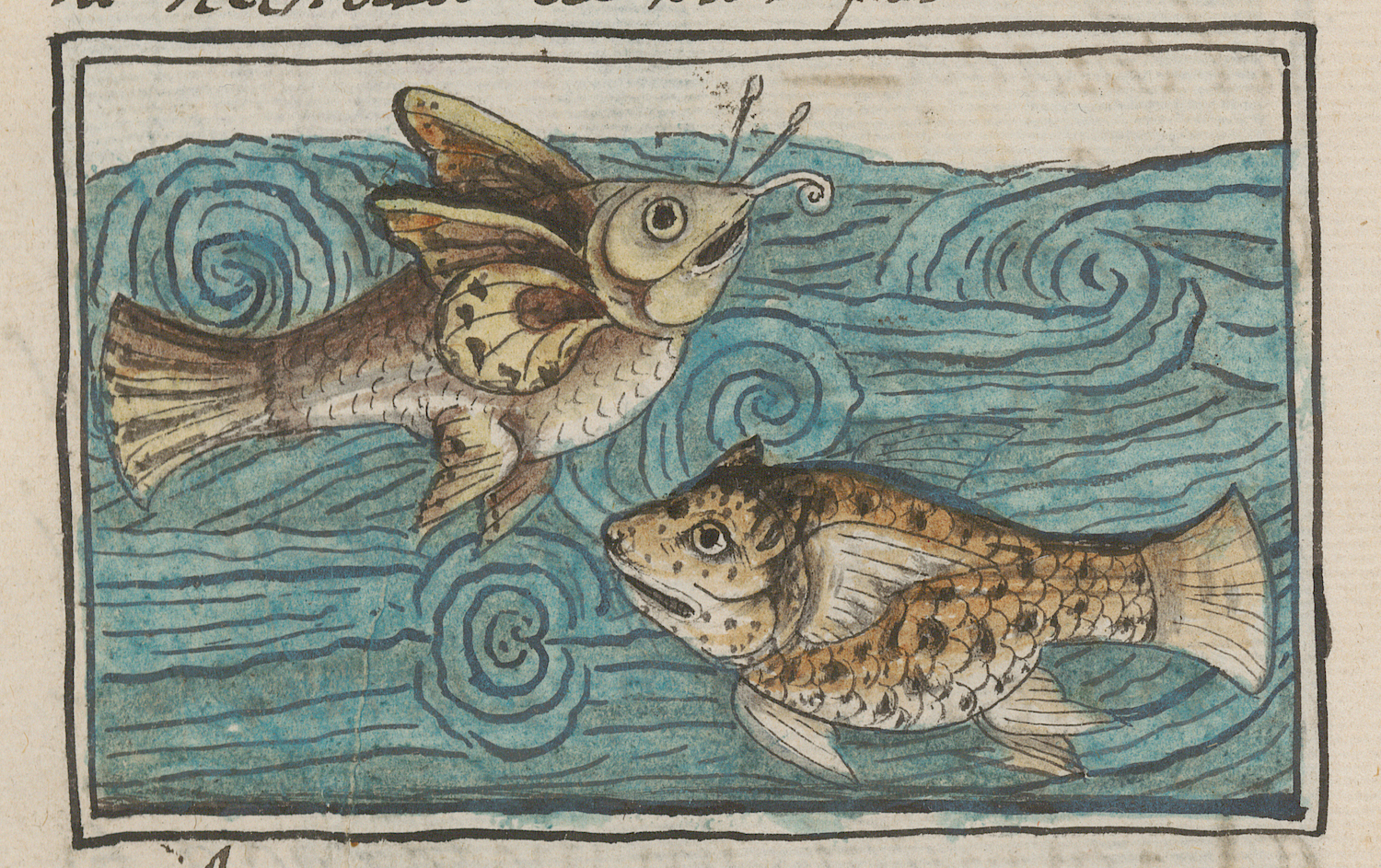
“Only when aided by various groups of Indigenous allies, as well as by the spread of a terrible smallpox epidemic, did they manage to force the ruler Cuauhtemoc and other Mexica leaders to capitulate,” Rojas continues, drawing upon details provided in the version of the events laid out in the Florentine Codex.
That encyclopedic series of twelve 16th-century illustrated manuscripts lavishly documents the known society and nature of that land at the time — and has now, nearly 450 years later, been acknowledged as “the most reliable source of information about Mexica culture, the Aztec Empire, and the conquest of Mexico.”
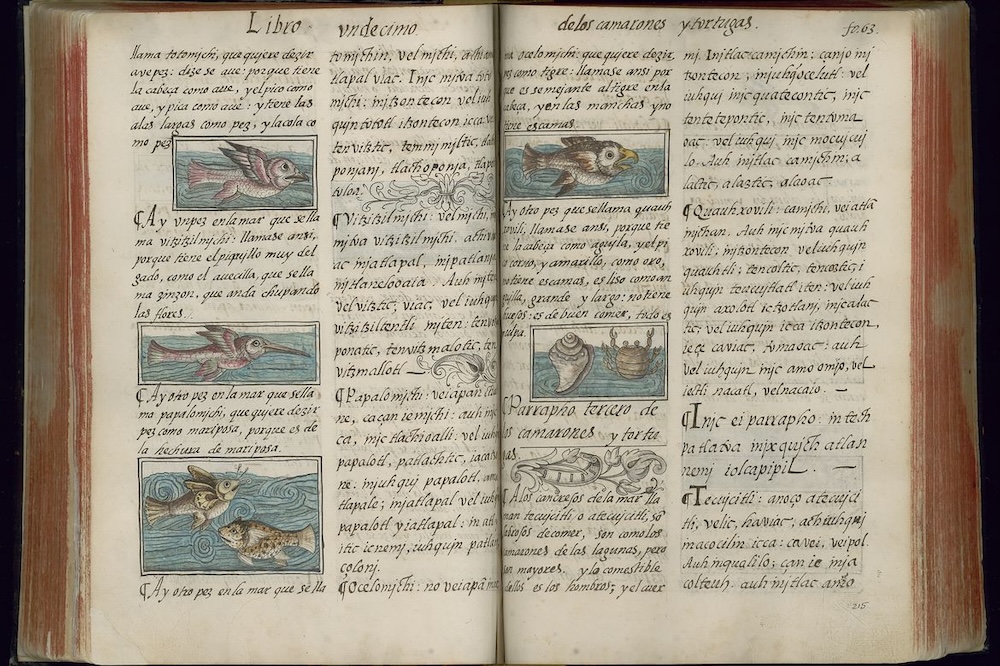
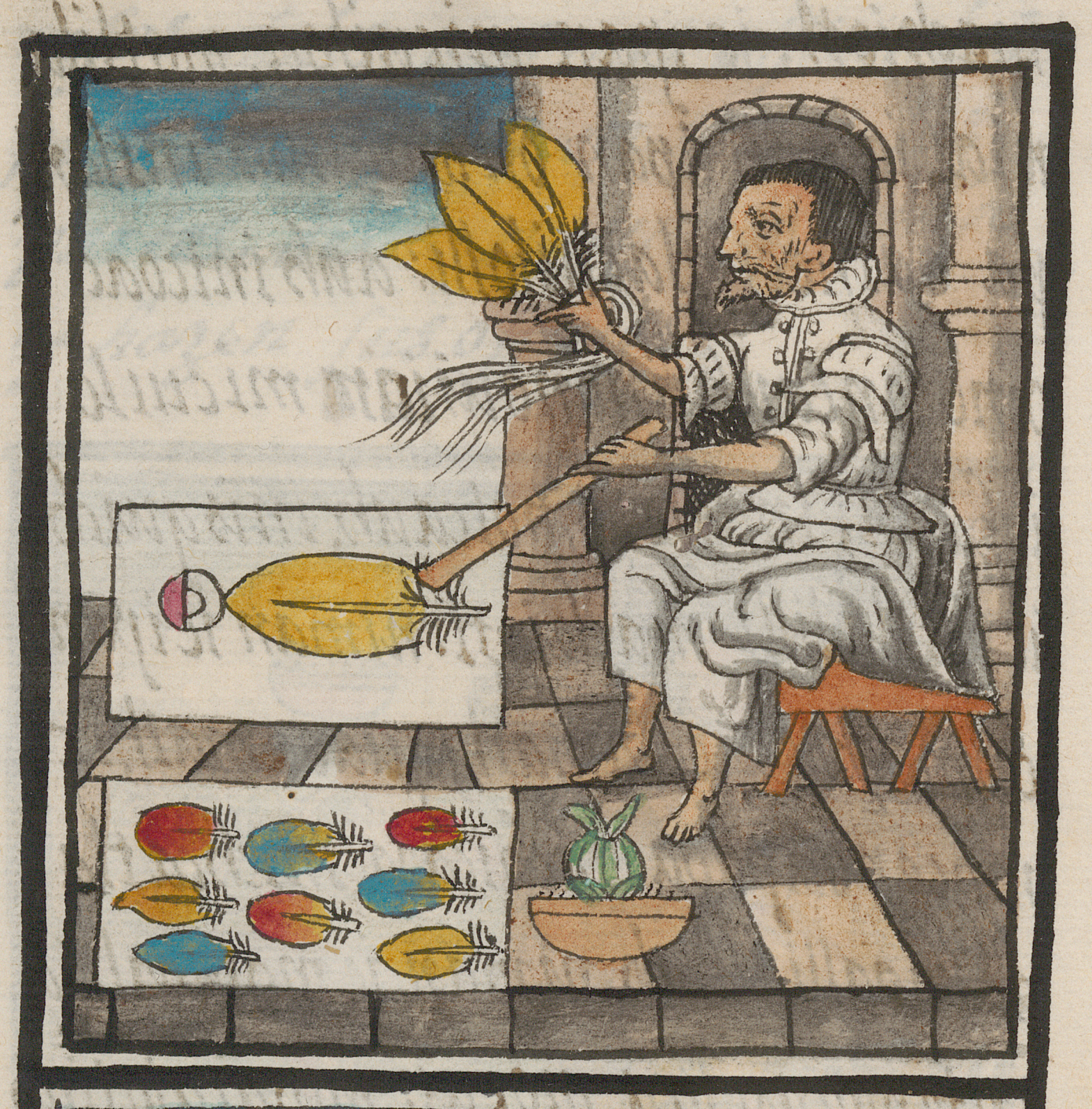
“In 1547, Bernardino de Sahagún, a Spanish Franciscan friar who committed most of his life to working closely with the Indigenous peoples of Mexico, began collecting information about central Mexican Nahua culture, life, people, history, astronomy, flora, fauna, and the Nahuatl language, among other topics,” says the Getty Research Institute. “Nahua elders, grammarians, scribes, and artists worked with Sahagún to compile a three-volume, 12-book, 2500-page illustrated manuscript, modeling its content on European encyclopedias, especially Pliny the Elder’s Natural History,” all of which has been digitized, translated, and made available at the Getty’s web site.
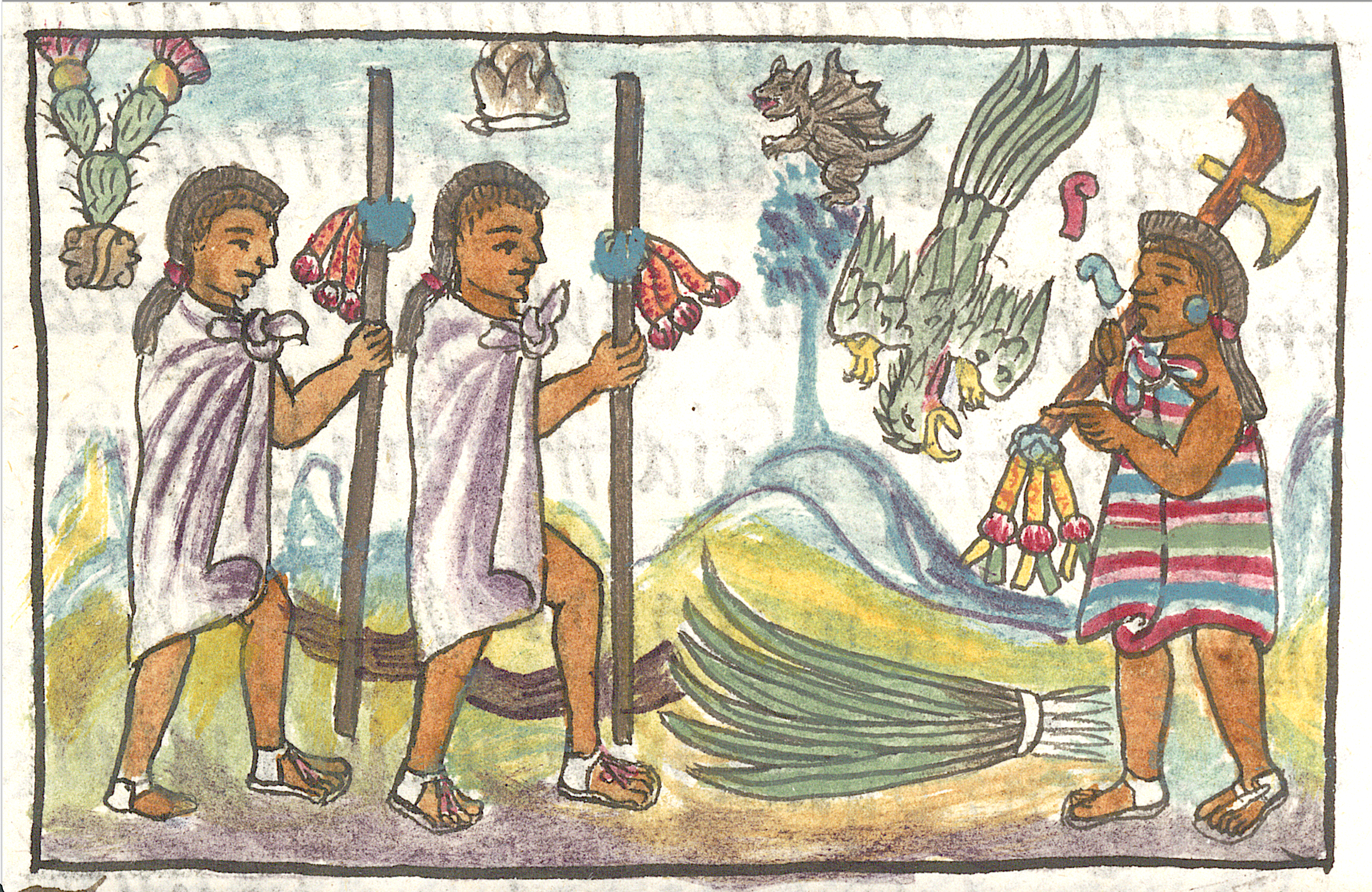
A thoroughly multicultural project avant la lettre, the Florentine Codex (named for the Medici family library in Florence, where it was sent upon its completion) has only just become accessible to a wide online readership. Though it’s “been digitally available via the World Digital Library since 2012, for most users it remained impenetrable because reading it requires knowledge of sixteenth-century Nahuatl and Spanish, and of pre-Hispanic and early modern European art traditions.” By offering searchable text in modern versions of both those languages as well as English — to say nothing of its browsable sections organized by people, animals, deities, and even by Nahuatl terms like coyote and tortilla — the Digital Florentine Codex re-illuminates an entire civilization.
Related content:
Native Lands: An Interactive Map Reveals the Indigenous Lands on Which Modern Nations Were Built
Explore the Codex Zouche-Nuttall: A Rare, Accordion-Folded Pre-Columbian Manuscript
How the Ancient Mayans Used Chocolate as Money
Based in Seoul, Colin Marshall writes and broadcasts on cities, language, and culture. His projects include the Substack newsletter Books on Cities, the book The Stateless City: a Walk through 21st-Century Los Angeles and the video series The City in Cinema. Follow him on Twitter at @colinmarshall or on Facebook.
Read More...Open Planet Lets You Download & Use 4,500 Free Videos That Document Nature & Climate Change
Plastic pollution in the Red Sea…
A melting glacier in Iceland…
Trees scorched by a wildfire in Australia…
As the effects of climate change become increasingly dire, we’ve grown accustomed to such grimly sobering visions.
Some look away.
Others work to heighten awareness of these clear and present environmental dangers.
And some strive to implement innovative solutions before it’s too late:
Solar panels in Costa Rica
Bubble barriers filtering plastic refuse from Amsterdam’s canals…
Sustainable agroforestry in the Amazon.
A classroom full of desks constructed from recycled one-time use plastics in India…
The creators of Open Planet, a soon-to-launch free footage library, hope to support change-making organizations and individuals by supplying video that can be edited together into narratives to “inspire optimism and action in this decisive decade for our planet.”
Caroline Petit, who prioritizes education and awareness in her position as Deputy Director for the United Nations Regional Information Centre for Europe, hails Open Planet for supplying worldwide free access to high-quality, accurate footage:
At this halfway point of the Sustainable Development Goals, it is crucial to provide all possible tools to supercharge the breakthroughs needed to achieve them. Capturing hearts and minds to motivate action is one powerful way to do so.
Enlisting some non-humans players to help achieve that end is a sound idea.
Behold a Nepal Gray Langur mother and baby hanging out in the treetops…
Cheetah cubs playfully sparring with each other in Kenya’s Masai Mara National Reserve…
A group of Pashmina goats peacefully grazing on wild sea buckthorn berries on the high plateaus of Ladakh.
Open Planet’s 4,500 clip strong collection also teems with photogenic birds, insects, and marine life, with more being added all the time.
Studio Silverback, which is collaborating with Carnegie Mellon University’s CREATE Lab on this project, created some of the footage specifically for the platform.
The remainder has been donated by outside filmmakers, broadcasters, and production companies who are credited in their clips’ content details.
In advance of its 2024 global launch, Open Planet has released a mostly uplifting 74-clip spotlight collection drawn from over 2000 pieces of footage filmed in India
A look at the platform’s searchable filter themes reminds us that the picture is not so overwhelmingly rosy, but also makes a strong case that change is possible:
Biodiversity
Climate
Consumption
Deforestation
Energy
Extreme Weather
Food
Human Health
Land Management
Natural Disasters
Nature-only
Pollution
Waste
Water
Sustainable Future
Technology
Explore Open Planet’s footage library and create a free account to download the clips of your choice here. The videos are free to use for educational, environmental and impact storytelling.
via Colossal
Related Content
Carl Sagan Warns Congress about Climate Change (1985)
Frank Capra’s Science Film The Unchained Goddess Warns of Climate Change in 1958
– Ayun Halliday is the Chief Primatologist of the East Village Inky zine and author, most recently, of Creative, Not Famous: The Small Potato Manifesto and Creative, Not Famous Activity Book. Follow her @AyunHalliday.
Read More...Political Scientist Ian Bremmer Breaks Down the Israeli-Palestinian Conflict
Ian Bremmer, a political scientist and president of Eurasia Group, has an intelligent, fair, and humane way of explaining crises around the world. That includes the current crisis in the Middle East. Above, he spends an hour discussing the Israeli-Palestinian conflict and its geo-political and historical context. Speaking with BigThink’s editor-in-chief, Robert Chapman-Smith, Bremmer delves “into internal politics in Israel — including growing dissent against the government, how the conflict in Gaza is being handled, the influence of hard-right political parties, and the impact of these factors on the relationship between Israel and the Palestinians.” Below you can find timestamps for the different subjects covered.
0:00 Palestinians forgotten
6:30 Israel’s domestic instability
13:17 Israel and Gulf states
19:28 Hamas’ strategy
27:06 Social media disinformation
37:20 Israel’s strategy and peace
44:40 U.S. support for Israel
49:32 World War 3?
54:07 Two-state solution
Related Content
Read More...How Rocky Horror Became a Cult Phenomenon
Call us old fashioned but invoking pumpkin spice and The Rocky Horror Picture Show in the same breath feels transgressive to the point of sacrilege.
The creator of the Polyphonic video, above, is on much firmer footing tying the film to queer liberation.
Prior to its now famous cinematic adaptation, The Rocky Horror Show was a low budget theatrical success, with nearly 3,000 performances and the 1973 Evening Standard Theatre Award for Best Musical to its name.
Reviewer Michael Billington lauded Tim Curry’s “garishly Bowiesque performance” as Dr. Frank-N-Furter, the self-proclaimed Sweet Transvestite from Transsexual, Transylvania, but also acknowledged some drabber peacocks defying gender expectations in that production:
…for me the actor of the evening was Jonathan Adams as the Narrator: a bulky, heavy-jowled Kissinger-like figure who enters into the rock numbers with the stately aplomb of a dowager duchess doing a strip.
Playwright Richard O’Brien, who doubled as Frank-N-Furter’s sepulchral butler, Riff Raff, conceived of the show as a spoof on campy sci fi and gothic horror films in the Hammer Productions vein. He also owed a debt to glam rock, which “allowed me to be myself more.”
(Hats off, here, to Polyphonic for one of the best nutshell descriptions of glam rock we’ve ever encountered:
Glam rock was a queer led movement that was built on the back of gender non-conformity. Visually it was a hodgepodge of style from early Hollywood glamour to 50s pinups and cabaret theater augmented by touches of ancient civilizations sci-fi and and the occult.)
“The element of transvestism wasn’t intended as a major theme,” O’Brien told interviewer Patricia Morrisroe, “although it turned out to be one:”
I’ve always thought of Frank as a cross between Ivan the Terrible and Cruella de Ville of Walt Disney’s 101 Dalmations. It’s that sort of evil beauty that’s attractive. I found Brad and Janet very appealing too, especially the whole fifties image of boy-girl relationships. In the end, you see that Janet is not the weak little thing that society demands her to be and Brad is not the pillar of strength.
Audiences and critics may have loved the original show, but the film version did not find immediate favor. Reviewer Roger Ebert reflected that “it would be more fun, I suspect, if it weren’t a picture show:
It belongs on a stage, with the performers and audience joining in a collective send-up…The choreography, the compositions and even the attitudes of the cast imply a stage ambiance. And it invites the kind of laughter and audience participation that makes sense only if the performers are there on the stage, creating mutual karma.
A prophetic statement, as it turns out…
Once the producers began marketing the film as a midnight movie, repeat customers started coming up with the snarky callbacks that have become a de rigueur part of the experience.
“All the characters appear to be sophisticated, knowledgeable people but they’re really not,” O’Brien observed:
That allows people of a similar adolescent nature to feel they could be part of the whole thing. And now, in fact, they are.
Shadow casts positioned themselves in front of the screen, mimicking the action in cobbled together versions of designer Sue Blane’s costumes.
Audiences also afforded themselves the opportunity to dress outside the norm, creating a safe space where attendees could mess around with their gender expressions. The film may not end happily but that final scene is a great excuse for anyone who wants to take a lap in a corset and fishnets.
Rocky Horror’s flamboyance, humor, and defiance of the mainstream made it a natural fit with the queer community, with folks costumed as Frank-N-Furter, Riff Raff, Magenta and Columbia regularly turning up at fundraisers and pride events.
The film also deserves some activist street cred for saving a number of small indie movie theaters by fattening midnight box office receipts, a trend that continues nearly 50 years after the original release.
Admittedly, certain aspects of the script haven’t aged well.
“Virgins” attending their first live screening may be more shocked at the dearth of consent than the spectacle of Frank-n-Furter murdering Columbia’s rocker boyfriend Eddy with a pickaxe, then serving his remains for dinner.
Will they also recoil from Frank as an embodiment of toxic masculity in the queer space?
Quoth Columbia:
My God! I can’t stand any more of this! First you spurn me for Eddie, and then you throw him like an old overcoat for Rocky! You chew people up and then you spit them out again… I loved you… do you hear me? I loved you! And what did it get me? Yeah, I’ll tell you: a big nothing. You’re like a sponge. You take, take, take, and drain others of their love and emotion.
We’re hoping Frank, problematic though he may now seem, won’t ultimately be consigned to the dust bin of history.
For context, O’Brien recently told The Hollywood Reporter that the character was informed by his own experiences of cross-dressing as he tried to get a grip on his gender identity in the early 70s:
I used to beat myself up about the hand I was dealt. I don’t know how it works. I have no idea. I’ve read many tomes about the subject of the transvestic nature. It’s the cards you’re dealt. In a binary world it’s a bit of curse, really. Especially in those days when homosexuality was a crime. It’s just one of those things that western society wasn’t very keen on.
Real Content
1978 News Report on the Rocky Horror Craze Captures a Teenage Michael Stipe in Drag
– Ayun Halliday is the Chief Primatologist of the East Village Inky zine and author, most recently, of Creative, Not Famous: The Small Potato Manifesto and Creative, Not Famous Activity Book. Follow her @AyunHalliday.
Read More...The Beatles Release Their Final Song, “Now and Then”: Hear the Song & Watch the Music Video Directed by Peter Jackson
The average music fan of the nineteen-sixties would surely have found it hard to believe that the Rolling Stones would put out a new album in 2023, let alone an album including a performance by Paul McCartney. Here in the twenty-twenties, of course, we’ve long since known that the “rivalry” between the young Stones and Beatles was ginned up by music media. Still, not to be outdone more than half a century after their breakup, the latter have put out the newly completed “Now and Then,” the last song featuring all the Fab Four that will ever be released.
“Now and Then,” or at least its title, will ring a bell in the minds of serious Beatles enthusiasts. For decades, it has been known as one of several promising songs John Lennon recorded without finishing. Others include “Free as a Bird” and “Real Love,” which McCartney, George Harrison, and Ringo Starr built upon in the studio and released in the mid-nineties to accompany the documentary The Beatles Anthology. At that time, Lennon’s home demo of “Now and Then” proved trickier to work with: “the piano was a little hard to hear,” says McCartney in its short making-of film, “and in those days, of course, we didn’t have the technology to do the separation” of one instrument or voice from the others.
Enter Peter Jackson, a Beatlemaniac possessed of uncommon resources and technological know-how. It turns out that the artificial intelligence-based system developed to separate out the audio tracks for the Get Back documentary project, which he directed, could also be used to salvage the muddy “Now and Then.” At last, McCartney says, “we could mix it and make a proper record of it,” a task that also included his laying down a new bass part and Starr doing the same for the drums. Each element led to another: “I’d been vaguely thinking, ‘Strings might be a good thing.’ The Beatles did lots of strings, you know?” This was a job for none other than Giles Martin, son of George. (See the making-of video below.)
As luck would have it, Harrison, who died in 2001, also recorded a guitar part back in 1995, which inspired McCartney to add a slide guitar solo in the same style. The New York Times Jon Pareles also notes “backing vocals from ‘Here, There and Everywhere,’ ‘Eleanor Rigby’ and ‘Because’: ‘oohs’ and ‘ahs’ in harmony.” The result is a genuine Beatles song as well as a genuine Beatles recording, not just in personnel but also in spirit. No sooner did the band get famous, remember, than they began incorporating into their work every advanced studio device and technique at their command. If high technology was a vital factor in their music then, it’s even more of one now.
Note: The official music video above was directed by Peter Jackson.
Related content:
The Making of the Last Beatles Song, “Now and Then”: A Short Film
Watch Paul McCartney Compose The Beatles Classic “Get Back” Out of Thin Air (1969)
A Sneak Peek of Peter Jackson’s New Beatles Documentary Get Back: Watch the New Trailer
Based in Seoul, Colin Marshall writes and broadcasts on cities, language, and culture. His projects include the Substack newsletter Books on Cities, the book The Stateless City: a Walk through 21st-Century Los Angeles and the video series The City in Cinema. Follow him on Twitter at @colinmarshall or on Facebook.
Read More...Hear Classic Readings of Poe’s “The Raven” by Vincent Price, James Earl Jones, Christopher Walken, Neil Gaiman & More
It can seem that the writing of literature and the theory of literature occupy separate great houses, Game of Thrones-style, or even separate countries held apart by a great sea. Perhaps they war with each other, perhaps they studiously ignore each other or obliquely interact at tournaments with acronymic names like MLA and AWP. Like Thomas Pynchon’s characterization of the political right and left, scholars and writers represent opposing poles, the hothouse and the street. That rare beast, the academic poet, can seem like something of a unicorn, or dragon.
…Or like the ominous talking raven in Edgar Allan Poe’s most famous of poems.
The divide between theory and practice is a recent development, a product of state budgeting, political brinksmanship, the relentless publishing mills of academia that force scholars to find a pigeonhole and stay there.… In days past, poets and scholar/theorists frequently occupied the same place at the same time—Wallace Stevens, T.S. Eliot, Samuel Taylor Coleridge, Percy Shelley, and, of course, Poe, whose perennially popular “The Raven” serves as a point-by-point illustration for his theory of composition just as thoroughly as Eliot’s great works bear out his notion of the “objective correlative.”
Poe’s object, the titular creature, is an “archetypal symbol,” writes Dana Gioia, in a poem that aims for what its author calls a “unity of effect.” In his 1846 essay “The Philosophy of Composition,” Poe the poet/theorist tells us in great detail how “The Raven” satisfies all of his other criteria for literature as well, such as achieving its intent in a single sitting, using a repeated refrain, and so on.
Should we have any doubt about how much Poe wanted us to see the poem as the deliberate outcome of a conceptual scheme, we find him three years later, in 1849, the year of his death, delivering a lecture on the “Poetic Principle,” and concluding with a reading of “The Raven.”
John Moncure Daniel of the Richmond Semi-Weekly Examiner remarked after attending one of these talks that “the attention of many in this city is now directed to this singular performance.” At that point, Poe, who hardly made a dime from “The Raven,” had to suffer the indignity of having all of his work go out of print during his brief, unhappy lifetime. Moncure and the Examiner thereby furnished readers “with the only correct copy ever published,” previous appearances, it seems, having contained punctuation errors.
Nonetheless, for all of Poe’s pedantry and penury, “The Raven“ ‘s first appearances made him semi-famous. His readings were a sensation, and it’s a sure bet that his audiences came to hear him read the poem, not deliver a lecture on its principles. Oh, for some proto-Edison in the room with an early recording device. What would it be like to hear the mournful, grief-stricken, alcoholic genius—master of the macabre and inventor of the detective story—intone the raven’s enigmatic “Nevermore”?
While Poe’s speaking voice has receded irretrievably into history, his poetic voice may live close to forever. So mesmerizing are his meter and diction that many great actors known especially for their voices have become possessed by “The Raven.”
Likely when we think of the poem, what first comes to the mind’s ear is the voice of Vincent Price, or James Earl Jones, Christopher Lee, or Christopher Walken, all of whom have given “The Raven” its due.
And so have many other notables, such as the great Stan Lee, Poe successor Neil Gaiman, original Gomez Addams actor John Astin, and venerable Beat poet/scholar Anne Waldman (listen here). You will find those recitations here at this round-up of notable “Raven” readings, and if this somehow doesn’t satiate you, then check out Lou Reed’s take on the poem, the Grateful Dead’s musical tribute, “Raven Space,” or a reading in 100 different celebrity impressions.
Finally, we would be remiss not to mention The Simpsons’ James Earl Jones-narrated parody, a worthy teaching tool for distracted young visual learners. Is it a shame that we now think of “The Raven” as a Halloween yarn fit for the Treehouse of Horror or any number of enjoyable exercises in spooky oratory—rather than the theoretical thought experiment its author seemed to intend? Does Poe rotisserie in his grave as Homer snores in a wingback chair? Probably. But as the author told us himself at length, the poem works! It still never fails to excite our morbid curiosity, enchant our gothic sensibility, and maybe send a chill or two down the spine. Maybe we never really needed Poe to explain it to us.
Note: An earlier version of this post appeared on our site in 2017. We’re bringing it back for Halloween.
Related Content:
Gustave Doré’s Splendid Illustrations of Edgar Allan Poe’s “The Raven” (1884)
The Raven: a Pop-up Book Brings Edgar Allan Poe’s Classic Supernatural Poem to 3D Paper Life
A Reading of Edgar Allan Poe’s “The Raven” in 100 Celebrity Voices
Josh Jones is a writer and musician based in Durham, NC. Follow him at @jdmagness
Read More...Jerry Garcia Explains How Abbott and Costello Meet Frankenstein Changed His Life (1995)
If you’re looking for a classic monster movie to watch this Halloween, and one that will also give you a few non-ironic laughs along the way, you’d do well to put on Abbott and Costello Meet Frankenstein. But don’t take this recommendation from me: take it from the Grateful Dead’s own Jerry Garcia, who recalls his own formative viewing experience in the clip above from a 1995 broadcast of AMC’s The Movie that Changed My Life. When Abbott and Costello Meet Frankenstein came out, in 1948, he was just six years old: too tender an age, it seems, to appreciate the monstrous spectacle to which his mother had taken him. “I mostly hid behind the seats,” he remembers. “It was just pure panic.”
Unaware even of who Abbott and Costello were, the young Garcia could hardly have perceived the outwardly horrific picture’s lighthearted comic intentions. Yet it compelled him nevertheless, and even resonated with him on other emotional levels not having to do with fear.
“My father had died the previous year, in ’47, so that also made it kind of a heavy time in my life, emotionally,” he says, and one that perhaps gave him a certain receptiveness to the notion of “a dead thing brought to life.” Abbott and Costello Meet Frankenstein features not just the titular doctor’s monster, played by Glenn Strange, but also Lon Chaney Jr. as the Wolf Man and Bela Lugosi as Dracula. “This was a juicy cast, and it was the last time these characters had dignity.”
For Garcia, these Hollywood monsters “became figures of tremendous fascination,” which led him to discover cultural movements like German expressionist theater and film. While they cast a spell of primal fear — “I think there was some desire on my part to embrace that, to not let that control me” — Abbott and Costello, for their part, suggested to him the great promise of comedy: “It’s a smart strategy to get by in life. If you’re not powerful, if you’re not huge, if you’re not muscular, if intimidation is too much work for you, it works good at disarming powerful adversaries.” Garcia’s “general fascination with the bizarre” also originated with Abbott and Costello Meet Frankenstein, which showed him that “there are things in this world that are really weird” — a fact of which we could all stand to remind ourselves each and every Halloween.
Related content:
Bela Lugosi Discusses His Drug Habit as He Leaves the Hospital in 1955
Stream a Massive Archive of Grateful Dead Concerts from 1965–1995
Based in Seoul, Colin Marshall writes and broadcasts on cities, language, and culture. His projects include the Substack newsletter Books on Cities, the book The Stateless City: a Walk through 21st-Century Los Angeles and the video series The City in Cinema. Follow him on Twitter at @colinmarshall or on Facebook.
Read More...Support Us
We're hoping to rely on loyal readers, rather than erratic ads. Please click the Donate button and support Open Culture. You can use Paypal, Venmo, Patreon, even Crypto! We thank you!

About Us

Open Culture scours the web for the best educational media. We find the free courses and audio books you need, the language lessons & educational videos you want, and plenty of enlightenment in between.
Advertise With Us
FREE UPDATES!
GET OUR DAILY EMAIL
Get the best cultural and educational resources on the web curated for you in a daily email. We never spam. Unsubscribe at any time.
FOLLOW ON SOCIAL MEDIA
Open Culture editor Dan Colman scours the web for the best educational media. He finds the free courses and audio books you need, the language lessons & movies you want, and plenty of enlightenment in between.
Advertise With Us

