101 Hidden Gems: The Greatest Films You’ve Never Seen
Last year, the British Film Institute’s Sight and Sound magazine conducted its once-a-decade poll to determine the greatest films of all time. As usual, the results were divided into two sections: one for the critics’ votes, and the other for the filmmakers’. The latter put Stanley Kubrick’s 2001: A Space Odyssey at the top, displacing Yasujirō Ozu’s Tokyo Story, which itself had displaced Orson Welles’ Citizen Kane. The former had their own reign of Kane, which came to an end in 2012 with the rise of Alfred Hitchcock’s Vertigo. All these pictures are well-known classics of cinema, and even if you haven’t seen them, you may feel as if you have. But did you have the same reaction to Chantal Akerman’s Jeanne Dielman, 23, quai du Commerce, 1080 Bruxelles when it came out number one in the critics poll last year?
This month, the BFI published a new list of 101 films that make Jeanne Dielman look like Home Alone. Léontine’s Electric Battery, My Survival as an Aboriginal, The 8 Diagram Pole Fighter, Qabyo 2, and all the rest of these “hidden gems” received just one vote in the latest S&S poll, meaning that just one participating critic or filmmaker ranks it among the ten best films ever made.
“Hailing from every continent but Antarctica and spanning more than 120 years, this selection is, in its way, as representative of the riches of cinema history as that other list we released at the end of last year,” writes contributor Thomas Flew. “Fiction rubs shoulders with nonfiction, films made by collectives sit alongside hand-crafted animation, and a healthy dose of comedy sidles up to heartbreaking drama — and then there are the films that defy all categorization.”
On this list you’ll find lesser-known works from brand-name directors like Oliver Assayas, whose Cold Water is to cinema “what The Catcher in the Rye is to literature,” or Kathryn Bigelow, whose The Loveless, “set in a generic 1950s Americana landscape, is saturated with libido, candid charm and formal invention.” Other films come recommended by major auteurs: Apichatpong Weerasethakul describes Bruce Baillie’s Quick Billy as “Muybridge’s horse resurrected, experiencing death, rebirth and death once more”; Guy Maddin picks Desire Me, which had four different directors, and “all of them were foolish enough to take their names off this thing because it’s pretty wild”; the late Terence Davies praises Curtis Bernhardt’s Possessed as a film in which “America has never seemed bleaker or less romantic.”
Perhaps you’re the type of cinephile who can imagine no more compelling recommendation than “David Lynch cites it as the first movie he remembers watching,” which Beatrice Loyaza writes of Henry King’s Wait till the Sun Shines, Nellie. Or perhaps you’re more intrigued by Henry Blake’s endorsement of Rolf de Heer’s Bad Boy Bubby: “If you can get past the incest and violence in the first 45 minutes of this film, it is an achingly powerful story about love and it urges the audience to never give up on anyone.” This is not to say that all of the BFI’s hidden gems are harrowing spectacles, though it’s a safe bet that none of them offer a viewing experience quite like any you’ve ever had before — except, perhaps, the earliest one, Le chat qui joue by cinema pioneers Auguste and Louis Lumière, a “cat video” avant la lettre.
Explore the BFI’s list of hidden gems here.
via Metafilter
Related content:
480 Filmmakers Reveal the 100 Greatest Movies in the World
The Nine Greatest Films You’ve Never Seen
The Ten Greatest Films of All Time According to 846 Film Critics
The Best 100 Movies of the 21st Century (So Far) Named by 177 Film Critics
The Top 100 American Films of All Time, According to 62 International Film Critics
Martin Scorsese Creates a List of 39 Essential Foreign Films for a Young Filmmaker
Based in Seoul, Colin Marshall writes and broadcasts on cities, language, and culture. His projects include the Substack newsletter Books on Cities, the book The Stateless City: a Walk through 21st-Century Los Angeles and the video series The City in Cinema. Follow him on Twitter at @colinmarshall or on Facebook.
Read More...Glen Hansard & Lisa O’Neill Perform a Stirring Version of “Fairytale of New York” at Shane MacGowan’s Funeral: Watch Their Send-Off
On Friday, Glen Hansard & Lisa O’Neill performed “Fairytale of New York” at Shane MacGowan’s funeral, giving the Pogues’ frontman quite the send-off. The moving performance took place before a packed church in Nenagh, a country town in Ireland. And it all ends, perhaps fittingly, with mourners dancing in the aisles. Below, you can also watch Nick Cave perform a Pogues song from 1986, “A Rainy Night in Soho.”
Related Content
Shane MacGowan & Sinéad O’Connor Duet Together, Performing a Moving Rendition of “Haunted”
The Wondrous Night When Glen Hansard Met Van Morrison
Read More...The Oldest Voices That We Can Still Hear: Hear Audio Recordings of Ghostly Voices from the 1800s
What history nerd doesn’t thrill to Thomas Edison speaking to us from beyond the grave in a 50th anniversary repeat of his groundbreaking 1877 spoken word recording of (those hoping for loftier stuff should dial it down now) Mary Had a Little Lamb?
The original represents the first time a recorded human voice was successfully captured and played back. We live in hope that the fragile tinfoil sheet on which it was recorded will turn up in someone’s attic someday.
Apparently Edison got it in the can on the first take. The great inventor later reminisced that he “was never so taken aback” in his life as when he first heard his own voice, issuing forth from the phonograph into which he’d so recently shouted the famous nursery rhyme:
Everybody was astonished. I was always afraid of things that worked the first time.
His achievement was a game changer, obviously, but it wasn’t the first time human speech was successfully recorded, as Kings and Things clarifies in the above video.
That honor goes to Édouard-Léon Scott de Martinville, whose phonautograph, patented in 1857, transcribed vocal sounds as wave forms etched onto lampblack-coated paper, wood, or glass.
Edison’s plans for his invention hinged on its ability to reproduce sound in ways that would be familiar and of service to the listening public. A sampling:
- A music player
- A device for creating audiobooks for blind people
- A linguistic tool
- An academic resource of archived lectures
- A record of telephone conversations
- A means of capturing precious family memories.
Léon Scott’s vision for his phonautograph reflects his preoccupation with the science of sound.
A professional typesetter, with an interest in shorthand, he conceived of the phonautograph as an artificial ear capable of reproducing every hiccup and quirk of pronunciation far more faithfully than a stenographer ever could. It was, in the words of audio historian Patrick Feaster, the “ultimate speech-to-text machine.”
As he told NPR’s Talk of the Nation, Léon Scott was driven to “get sounds down on paper where he could look at them and study them:”
…in terms of what we’re talking about here visually, anybody who’s ever used audio editing software should have a pretty good idea of what we’re talking about here, that kind of wavy line that you see on your screen that somehow corresponds to a sound file that you’re working with…He was hoping people would learn to read those squiggles and not just get the words out of them.
Although Léon Scott managed to sell a few phonautographs to scientific laboratories, the general public took little note of his invention. He was pained by the global acclaim that greeted Edison’s phonograph 21 years later, fearing that his own name would be lost to history.
His fear was not unfounded, though as Conan O’Brien, of all people, mused, “eventually, all our graves go unattended.”
But Léon Scott got a second act, as did several unidentified long-dead humans whose voices he had recorded, when Dr. Feaster and his First Sounds colleague David Giovannoni converted some phonautograms to playable digital audio files using non-contact optical-scanning technology from the Lawrence Berkeley National Laboratory.
Dr. Feaster describes the eerie experience of listening to the cleaned-up spoken word tracks after a long night of tweaking file speeds, using Léon Scott’s phonautograms of tuning forks as his guide:
I’m a sound recording historian, so hearing a voice from 100 years ago is no real surprise for me. But sitting there, I was just kind of stunned to be thinking, now I’m suddenly at last listening to a performance of vocal music made in France before the American Civil War. That was just a stunning thing, feeling like a ghost is trying to sing to me through that static.
Scanning technology also allowed historians to create playable digital files of fragile foil recordings made on Edison devices, like the St. Louis Tinfoil , made by writer and early adopter Thomas Mason in the summer of 1878, as a way of showing off his new-fangled phonograph, purchased for the whopping sum of $95.
The British Library’s Tinfoil Recording is thought to be the earliest in existence. It features an as-yet unidentified woman, who may or may not be quoting from social theorist Harriet Martineau… this garbled ghost is exceptionally difficult to pin down.
Far easier to decipher are the 1889 recordings of Prussian Field Marshall Helmuth Von Multke, who was born in 1800, the last year of the 18th century, making his the earliest-born recorded voice in audio history.
The nonagenarian recites from Hamlet and Faust, and congratulates Edison on his astonishing invention:
This phonograph makes it possible for a man who has already long rested in the grave once again to raise his voice and greet the present.
Related Content
Suzanne Vega, “The Mother of the MP3,” Records “Tom’s Diner” with the Edison Cylinder
A Beer Bottle Gets Turned Into a 19th Century Edison Cylinder and Plays Fine Music
400,000+ Sound Recordings Made Before 1923 Have Entered the Public Domain
– Ayun Halliday is the Chief Primatologist of the East Village Inky zine and author, most recently, of Creative, Not Famous: The Small Potato Manifesto and Creative, Not Famous Activity Book. Follow her @AyunHalliday.
Read More...All the Rivers of the World Shown in Rainbow Colors: A Data Visualization to Explore
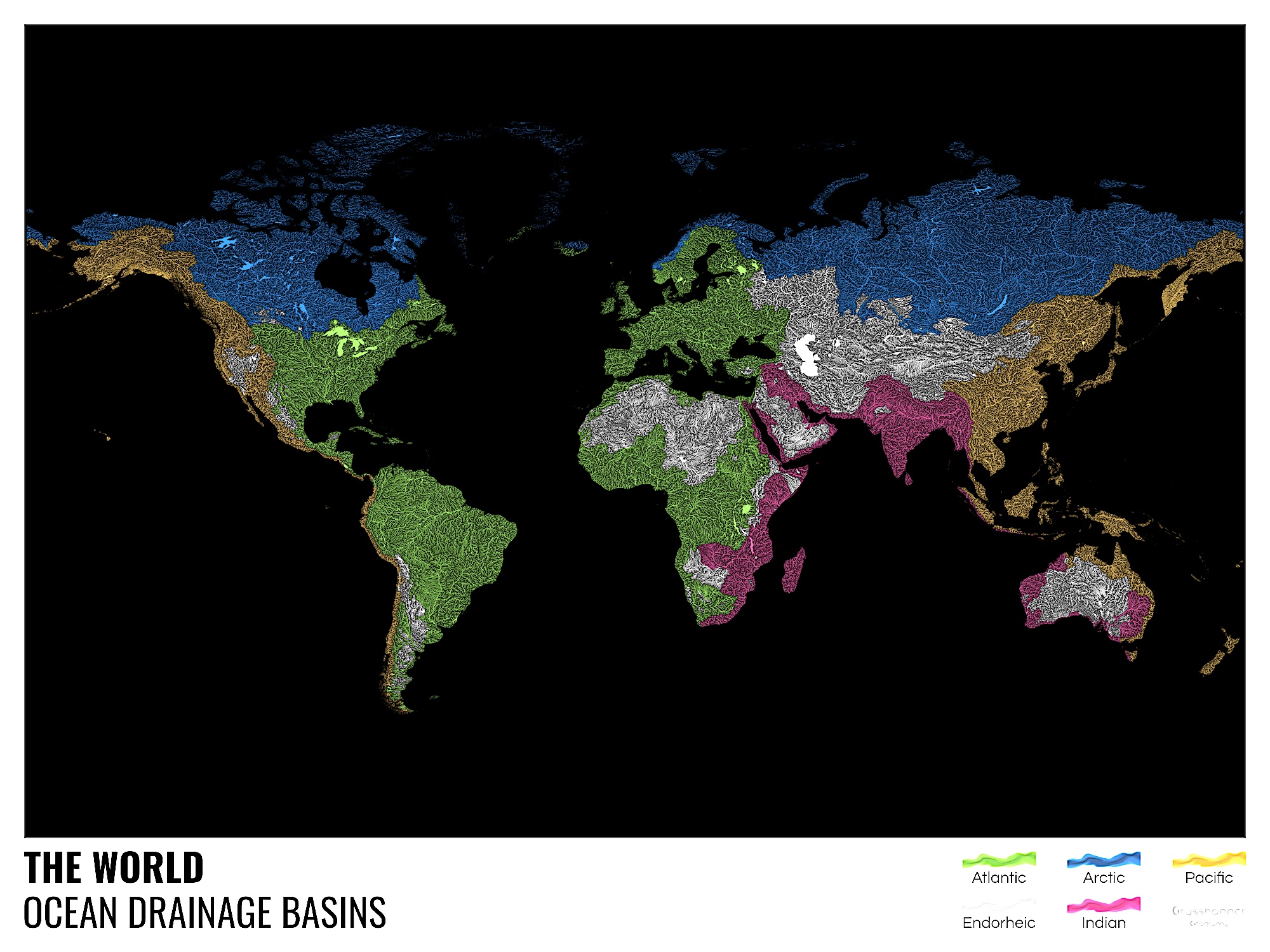
Even if you’ve never traveled the seas, you’ve surely known at least a few rivers in your time. And though you must be conscious of the fact that all of those rivers run, ultimately, to the sea, you may not have spent much time contemplating it. Now, thanks to the work of mapmaker and data analyst Robert Szucs, you won’t be able to come upon at a river without considering the particular sea into which it flows. He’s created what he calls “the first ever map of the world’s rivers divided into ocean drainage basins,” which appears just above.

This world map “shows, in different colors, all the rivers that flow into the Atlantic, Arctic, Indian or Pacific oceans, plus endorheic river basins which never reach the coast, mostly due to drying up in desert areas.”
Szucs has also broken it down into “a set of 43 maps in this style for different countries, states and continents,” all of them available to download (and to purchase as large-format posters) from his web site Grasshopper Geography.

We previously featured Szucs here on Open Culture back in 2017, when he published a river-and-stream-visualizing map of the United States made according to a similarly colorful and informative scheme. Examining that work of information design gave me a richer context in which to imagine the rivers around which I grew up in Washington State — the Sammamish, the Snoqualmie, the Columbia — as well as a clearer sense of just how much the United States’ larger, much more complex waterway network must have contributed to the development of the country as a whole.

Of course, having lived the better part of a decade in South Korea, I’ve lately had less reason to consider those particular geographical subjects. But Szucs’ new global ocean drainage maps have brought related ones to mind: it will henceforth be a rare day when I ride a train across the Han River (one of the more sublime everyday sights Seoul has to offer) and don’t imagine it making its way out to the Pacific — the very same Pacific that was the destination of all those rivers of my west-coast American youth. Oceanically speaking, even a move across the world doesn’t take you quite as far as it seems.
Related content:
All the Rivers & Streams in the U.S. Shown in Rainbow Colors: A Data Visualization to Behold
That Time When the Mediterranean Sea Dried Up & Disappeared: Animations Show How It Happened
A Radical Map Puts the Oceans — Not Land — at the Center of Planet Earth (1942)
Tour the Amazon with Google Street View; No Passport Needed
Based in Seoul, Colin Marshall writes and broadcasts on cities, language, and culture. His projects include the Substack newsletter Books on Cities, the book The Stateless City: a Walk through 21st-Century Los Angeles and the video series The City in Cinema. Follow him on Twitter at @colinmarshall or on Facebook.
Read More...RIP Shane MacGowan: Watch the Celtic Punk Rocker Perform with Nick Cave, Kirsty MacColl & the Dubliners
Shane MacGowan died yesterday, less than a month shy of his 66th birthday — and thus less than a month shy of Christmas, which happened to be the same day. Though coincidental, that association has made perfect sense since 1987, when the Pogues, the Celtic punk band fronted by MacGowan, released “Fairytale of New York.” That duet between MacGowan and Kirsty MacColl (the story of whose production we’ve previously featured here on Open Culture) still reigns supreme as the United Kingdom’s Christmas song, and by now it tends also to make it onto more than a few holiday-season playlists in America and across the world.
Given the popularity of “Fairytale of New York,” many listeners know MacGowan for nothing else. But he was, in fact, a figure of considerable importance to the punk rock of the nineteen-eighties and nineties, to which he brought not just a thoroughly Irish sensibility but also a strong sense of literary craft.
Few well-known punk rockers could inhabit a place with a song in the way he could, or tap into the proper vernacular to inhabit a particular character. (Even the words he gave MacColl to sing as a hard-bitten nineteen-forties woman of the streets have caused no end of struggles with censors.) For this reason, he had the respect of many another serious songwriter: Nick Cave, for instance, with whom he recorded a cover of “What a Wonderful World” in 1992.
During much of MacGowan’s lifetime, his musical achievements were at risk of being overshadowed by the harrowing facts of his life, including his massive, sustained consumption of drugs and alcohol and the variety of injuries and ailments it brought about. In 2015, British television even aired a special about the replacement of his long-lost teeth — which, to judge by the Pogues’ performance of the folk song “The Irish Rover” with the Dubliners above, were barely hanging on even in the late eighties. But in a way, this dissolute appearance was an inseparable part of a distinctive artistic spirit. Shane MacGowan was a rare thing in the world of punk rock (to say nothing of the world of hit Christmas songs): not just an Irish literary voice, but an Irish literary character.
Related content:
A Choir with 1,000 Singers Pays Tribute to Sinéad O’Connor & Performs “Nothing Compares 2 U”
James Joyce Plays the Guitar (1915)
Stream a Playlist of 68 Punk Rock Christmas Songs: The Ramones, The Damned, Bad Religion & More
Based in Seoul, Colin Marshall writes and broadcasts on cities, language, and culture. His projects include the Substack newsletter Books on Cities, the book The Stateless City: a Walk through 21st-Century Los Angeles and the video series The City in Cinema. Follow him on Twitter at @colinmarshall or on Facebook.
Read More...Napoleon’s Kindle: Discover the Miniaturized Traveling Library That the Emperor Took on Military Campaigns
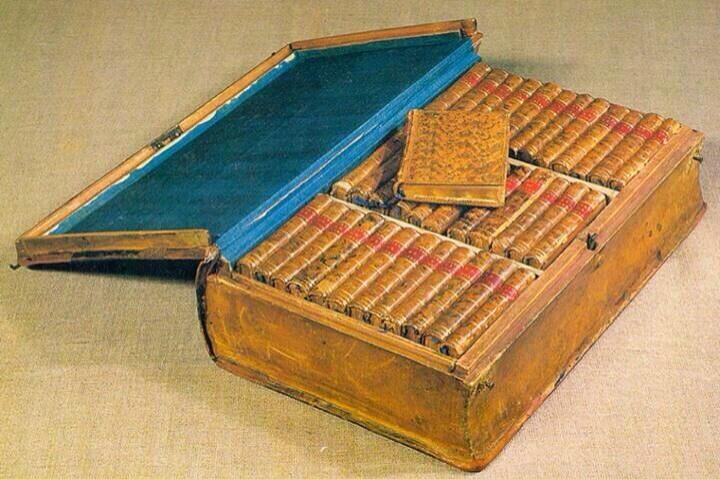
Every piece of technology has a precedent. Most have several different types of precedents. You’ve probably used (and may well own) an eBook reader, for instance, but what would have afforded you a selection of reading material two or three centuries ago? If you were a Jacobean Englishman of means, you might have used the kind of traveling library we featured in 2017, a handsome portable case custom-made for your books. (If you’re Tom Stoppard in the 21st century, you still do.) If you were Napoleon, who seemed to love books as much as he loved military power — he didn’t just amass a vast collection of them, but kept a personal librarian to oversee it — you’d take it a big step further.
“Many of Napoleon’s biographers have incidentally mentioned that he […] used to carry about a certain number of favorite books wherever he went, whether traveling or camping,” says an 1885 Sacramento Daily Union article posted by Austin Kleon, “but it is not generally known that he made several plans for the construction of portable libraries which were to form part of his baggage.” The piece’s main source, a Louvre librarian who grew up as the son of one of Napoleon’s librarians, recalls from his father’s stories that “for a long time Napoleon used to carry about the books he required in several boxes holding about sixty volumes each,” each box first made of mahogany and later of more solid leather-covered oak. “The inside was lined with green leather or velvet, and the books were bound in morocco,” an even softer leather most often used for bookbinding.
To use this early traveling library, Napoleon had his attendants consult “a catalogue for each case, with a corresponding number upon every volume, so that there was never a moment’s delay in picking out any book that was wanted.” This worked well enough for a while, but eventually “Napoleon found that many books which he wanted to consult were not included in the collection,” for obvious reasons of space. And so, on July 8, 1803, he sent his librarian these orders:
The Emperor wishes you to form a traveling library of one thousand volumes in small 12mo and printed in handsome type. It is his Majesty’s intention to have these works printed for his special use, and in order to economize space there is to be no margin to them. They should contain from five hundred to six hundred pages, and be bound in covers as flexible as possible and with spring backs. There should be forty works on religion, forty dramatic works, forty volumes of epic and sixty of other poetry, one hundred novels and sixty volumes of history, the remainder being historical memoirs of every period.
In sum: not only did Napoleon possess a traveling library, but when that traveling library proved too cumbersome for his many and varied literary demands, he had a whole new set of not just portable book cases but even more portable books made for him. (You can see how they looked packed away in the image tweeted by Cork County Library above.) This prefigured in a highly analog manner the digital-age concept of recreating books in another format specifically for compactness and convenience — the kind of compactness and convenience now increasingly available to all of us today, and to a degree Napoleon never could have imagined, let alone demanded. It may be good to be the Emperor, but in many ways, it’s better to be a reader in the 21st century.
Note: This post was originally published in 2017. Given that Napoleon is back in the news, with the new Ridley Scott film, we’re bringing it back.
Related Content:
Discover the Jacobean Traveling Library: The 17th Century Precursor to the Kindle
Why Is Napoleon’s Hand Always in His Waistcoat?: The Origins of This Distinctive Pose Explained
Based in Seoul, Colin Marshall writes and broadcasts on cities and culture. His projects include the book The Stateless City: a Walk through 21st-Century Los Angeles and the video series The City in Cinema. Follow him on Twitter at @colinmarshall or on Facebook.
Read More...The Surprisingly Long History of Auto-Tune, the Vocal-Processing Technology Music Critics Love to Hate
In the fall of 1998, pop music changed forever — or at least it seems that way today, a quarter-century later. The epochal event in question was the release of Cher’s comeback hit “Believe,” of whose jaggedly fractured vocal glissando no listener had heard the likes of before. “The glow-and-flutter of Cher’s voice at key points in the song announced its own technological artifice,” writes critic Simon Reynolds at Pitchfork, “a blend of posthuman perfection and angelic transcendence ideal for the vague religiosity of the chorus.” As for how that effect had been achieved, only the tech-savviest studio professionals would have suspected a creative misuse of Auto-Tune, a popular digital audio processing tool brought to market the year before.
As its name suggests, Auto-Tune was designed to keep a musical performance in tune automatically. This capability owes to the efforts of one Andy Hildebrand, a classical flute virtuoso turned oil-extraction engineer turned music-technology entrepreneur. Employing the same mathematical acumen he’d used to assist the likes of Exxon in determining the location of prime drilling sites from processed sonar data, he figured out a vast simplification of the calculations theoretically required for an algorithm to put a real vocal recording into a particular key.
Rapidly adopted throughout the music industry, Hildebrand’s invention soon became a generic trademark, like Kleenex, Jell‑O, or Google. Even if a studio wasn’t using Auto-Tune, it was almost certainly auto-tuning, and with such subtlety that listeners never noticed.
The producers of “Believe,” for their part, turned the subtlety (or, technically, the “smoothness”) down to zero. In an attempt to keep that discovery a secret, they claimed at first to have used a vocoder, a synthesizer that converts the human voice into manipulable analog or digital signals. Some would also have suspected the even more venerable talkbox, which had been made well-known in the seventies and eighties by Earth, Wind & Fire, Stevie Wonder, and Roger Troutman of Zapp. Though the “Cher effect,” as it was known for a time, could plausibly be regarded as an aesthetic descendant of those devices, it had an entirely different technological basis. A few years after that basis became widely understood, conspicuous Auto-Tune became ubiquitous, not just in dance music but also in hip-hop, whose artists (not least Rappa Ternt Sanga T‑Pain) used Auto-Tune to steer their genre straight into the currents of mainstream pop, if not always to high critical acclaim.
Used as intended, Auto-Tune constituted a godsend for music producers working with any singer less freakishly skilled than, say, Freddie Mercury. Producer-Youtuber Rick Beato admits as much in the video just above, though given his classic rock- and jazz-oriented tastes, it doesn’t come as a surprise also to hear him lament the technology’s overuse. But for those willing to take it to ever-further extremes, Auto-Tune has given rise to previously unimagined subgenres, bringing (as emphasized in a recent Arte documentary) the universal language of melody into the linguistically fragmented arena of global hip-hop. As a means of generating “digital soul, for digital beings, leading digital lives,” in Reynolds’ words, Auto-Tune does reflect our time, for better or for worse. Its detractors can at least take some consolation in the fact that recent releases have come with something called a “humanize knob.”
Related content:
The Evolution of Music: 40,000 Years of Music History Covered in 8 Minutes
How the Yamaha DX7 Digital Synthesizer Defined the Sound of 1980s Music
How Computers Ruined Rock Music
Brian Eno on the Loss of Humanity in Modern Music
Based in Seoul, Colin Marshall writes and broadcasts on cities, language, and culture. His projects include the Substack newsletter Books on Cities, the book The Stateless City: a Walk through 21st-Century Los Angeles and the video series The City in Cinema. Follow him on Twitter at @colinmarshall or on Facebook.
Read More...Watch Prince Bust Some Eye-Popping Moves in Rehearsal Footage from 1984
Dance was as much a baked-in part of Prince’s allure, as his suggestive lyrics and mastery of multiple instruments.
The public got its first taste of his affinity for the form at a John Hay elementary school talent show to which he contributed a tap routine, and again at a James Brown concert at the Minneapolis Armory, when the 10-year-old briefly hopped onstage to mash potato, an incident he recalled in a 1985 interview with MTV.
He received formal training at the Minnesota Dance Theatre, as a teenaged participant in the city’s Urban Arts Program, and rehearsed obsessively.
Choreographer Cat Glover, a frequent collaborator, told Mpls. St. Paul Magazine:
He would push himself to the limit all the time. He made it look easy, but everything that looked easy was three months’ rehearsal. It was never easy.
The above rehearsal footage from the summer of 1984 doesn’t show the sweat, but the choreography is obviously demanding. Prince leaps, squats, pirouettes, throws himself into James Brown splits, and executes a flurry of precision dance moves — in wicked high heeled boots.
“He ruined his hips on those damn high heels he used to wear” according to Minneapolis-area choreographer, John Command, who worked with Prince and the cast of Purple Rain, for nearly a year before shooting began:
We would do Broadway stuff, Bob Fosse, Jerry Robbins who did West Side Story. A lot of that is very difficult stuff and he loved it.
Glover recalled how Prince would visit dance clubs to check partygoers’ response to his music:
For one of his songs to get recorded it had to come with everything. If your feet aren’t tapping, if your feet aren’t bopping, it’s not good enough. If you can’t dance with music then it’s no good.
In 1989, when he opened his Glam Slam nightclub, he insisted on a resident dance troupe, and made them a priority. Its choreographer, Kat Carroll remembered how dancers were held to the same exacting standards Prince set for himself:
We worked very hard, and he treated us very well and he paid us very well. But he also expected us to be on top of things, just like his musicians. We worked long hours, many times during the week.
Prince kept up with the professional dance world, offering to write a piece for Chicago’s Joffrey Ballet, and waiving his royalties when they performed to it, a move that lifted the company from financial disaster in the 90s and increased their audience base.
He recruited ballerina Misty Copeland to tour with him beginning in 2009, six years before she made history as the first Black principal dancer in the American Ballet Theater, another company to which he donated generously.
He was a fan of avant-garde choreographer Moses Pendleton, founder of MOMIX and co-founder of Pilobolus Dance Theater, but also the dance stylings of Paul “Pee-wee Herman” Reubens.
As Copeland reminisced to GQ shortly after Prince’s death:
There was one Pee-wee Herman movie that he was obsessed with. It was silly, like him, and funny, and quirky—watching Pee-wee Herman dance he just thought was the funniest thing.
?si=tg6j-xzvIsoYCkiQ
For those wondering about the soundtrack to the rehearsal footage at the top of the page, it’s Prince’s original studio version of “Nothing Compares 2 U” recorded in that same room, that same summer. Six years later, Sinead O’Connor’s cover became a global hit.
Related Content
Hear a 19-Year-Old Prince Crushing It on Every Instrument in an Early Jam Session (1977)
Prince’s First Television Interview (1985)
Read Prince’s First Interview, Printed in His High School Newspaper (1976)
- Ayun Halliday is the Chief Primatologist of the East Village Inky zine and author, most recently, of Creative, Not Famous: The Small Potato Manifesto. Follow her @AyunHalliday.
Read More...Oculi Mundi: A Beautiful Online Archive of 130 Ancient Maps, Atlases & Globes
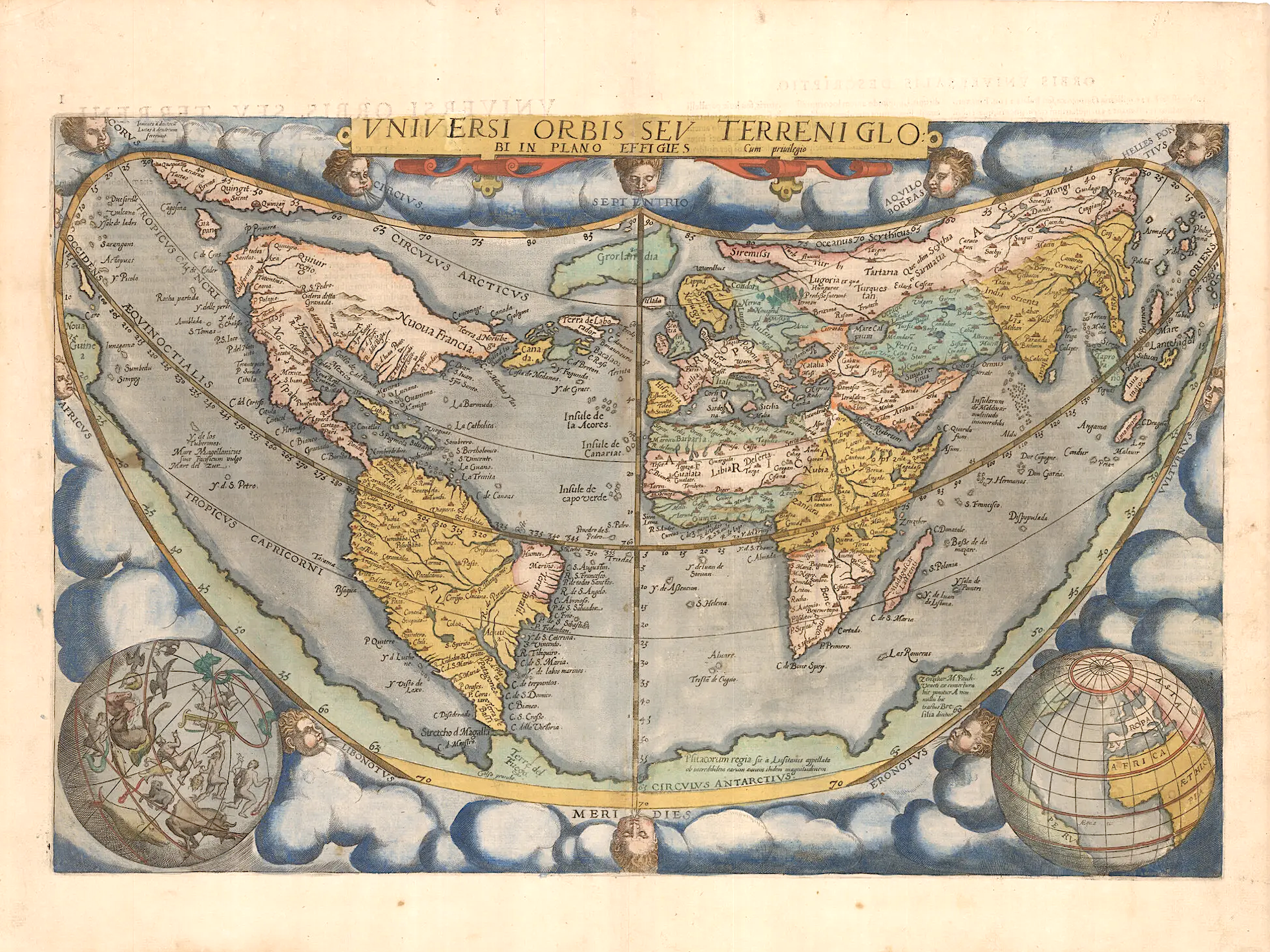
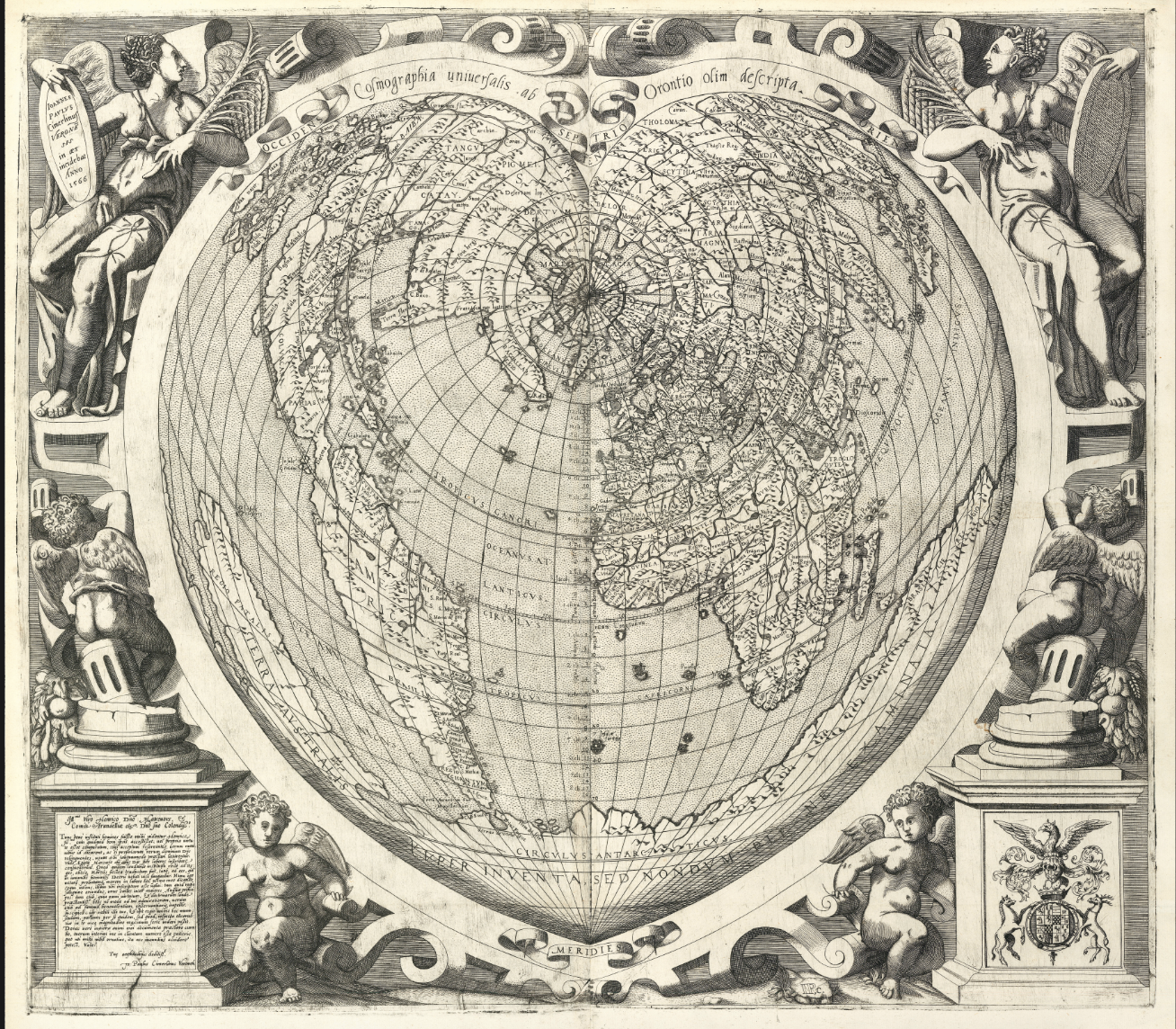
When it comes to maps, your first hit is always free. For you, maybe it was a Mercator projection of the world hung on the wall of an elementary-school classroom; maybe it was a road atlas in the glove box of your parents’ car. For Neil Sunderland, the earliest cartographic high seems to have come in childhood, from a humble map of Lancashire. When he found success in finance, his addiction grew in proportion to his means, and today his multi-million-dollar map collection includes the work of renowned sixteenth-century artists like Albrecht Dürer, Hans Holbein, and Giovanni Cimerlino, who in 1566 depicted the known world in the shape of a heart.
Cimerlino’s cordiform Earth (bottom) is just one of the 130 historic “world maps, celestial maps, atlases, books of knowledge and globes” now available for your perusal at Oculi Mundi, an elaborate web site with the digitized holdings of the Sunderland Collection. “A platform to explore high-resolution images of these beautiful objects, to peek inside the books, and to discover information and stories,” it offers both a chronologically ordered “research” mode and a more free-form “explore” mode for browsing.
Either way, with its oldest artifact dating to the early thirteenth century and its newest to the early nineteenth, it contains a great swath of cartographic history to behold.
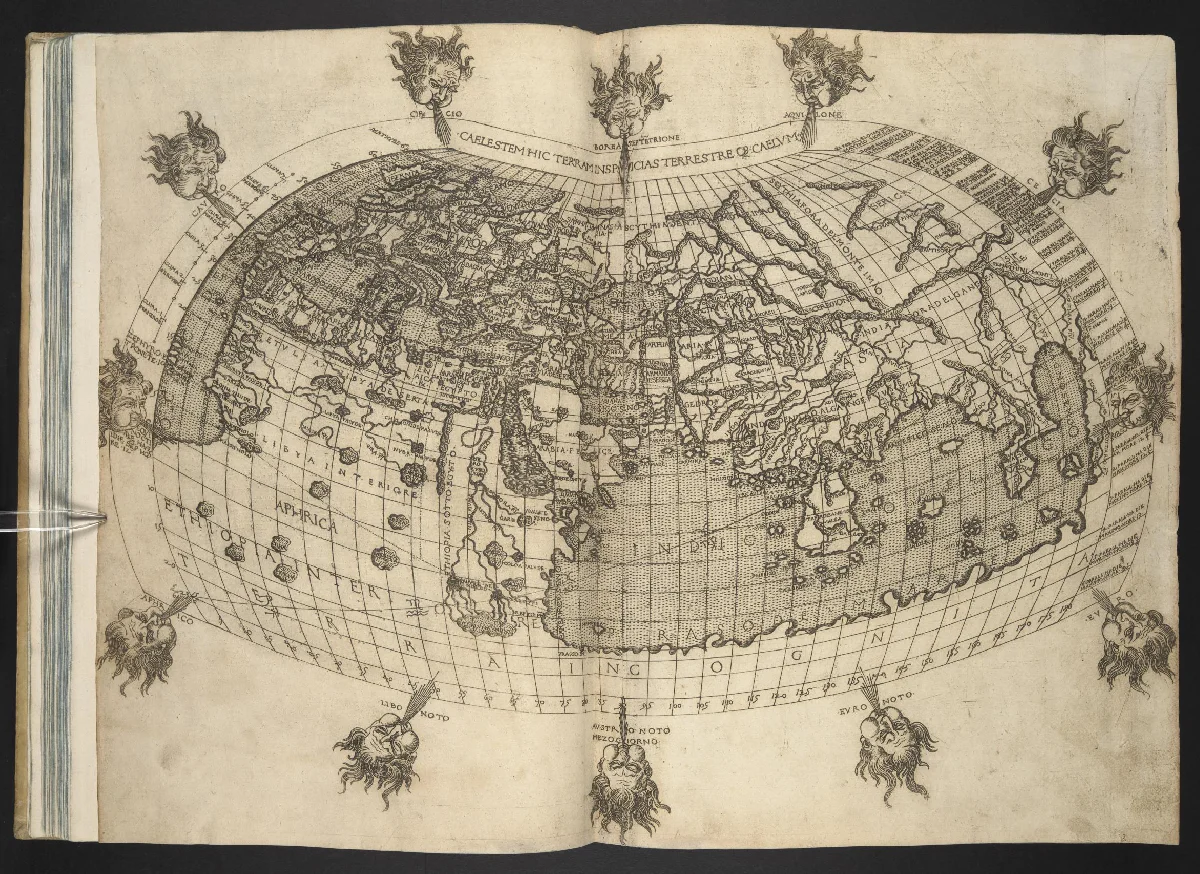
The New York Times’ Susanne Fowler quotes Sunderland’s daughter Helen Sunderland-Cohen, who oversees the Oculi Mundi project, describing a particularly venerable atlas by fifteenth-century humanist scholar Francesco Berlinghieri as “one of the earliest uses of copper plate, in atlases and in print. You can see how finely engraved the lines are, and how they’re learning to use copper plate.” All art may be inseparable from the state of technology of its time, but maps — the makers of which have always been driven to visualize and organize as much knowledge of the world as possible — reflect it with a special clarity.
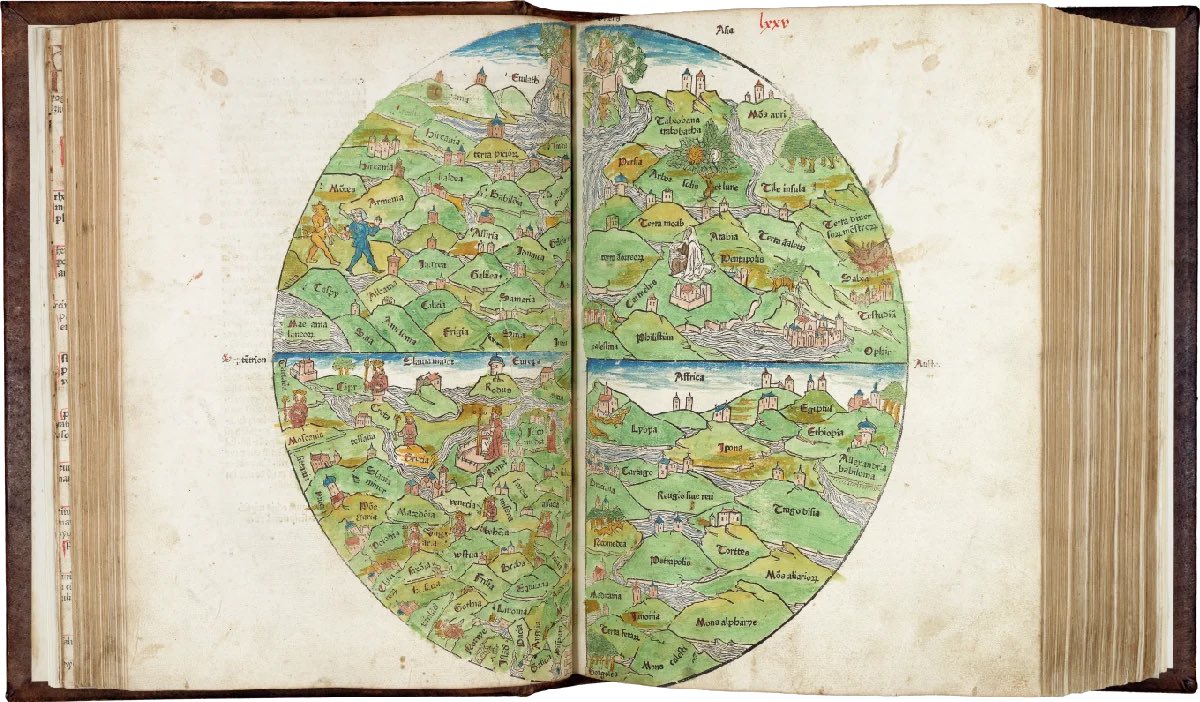
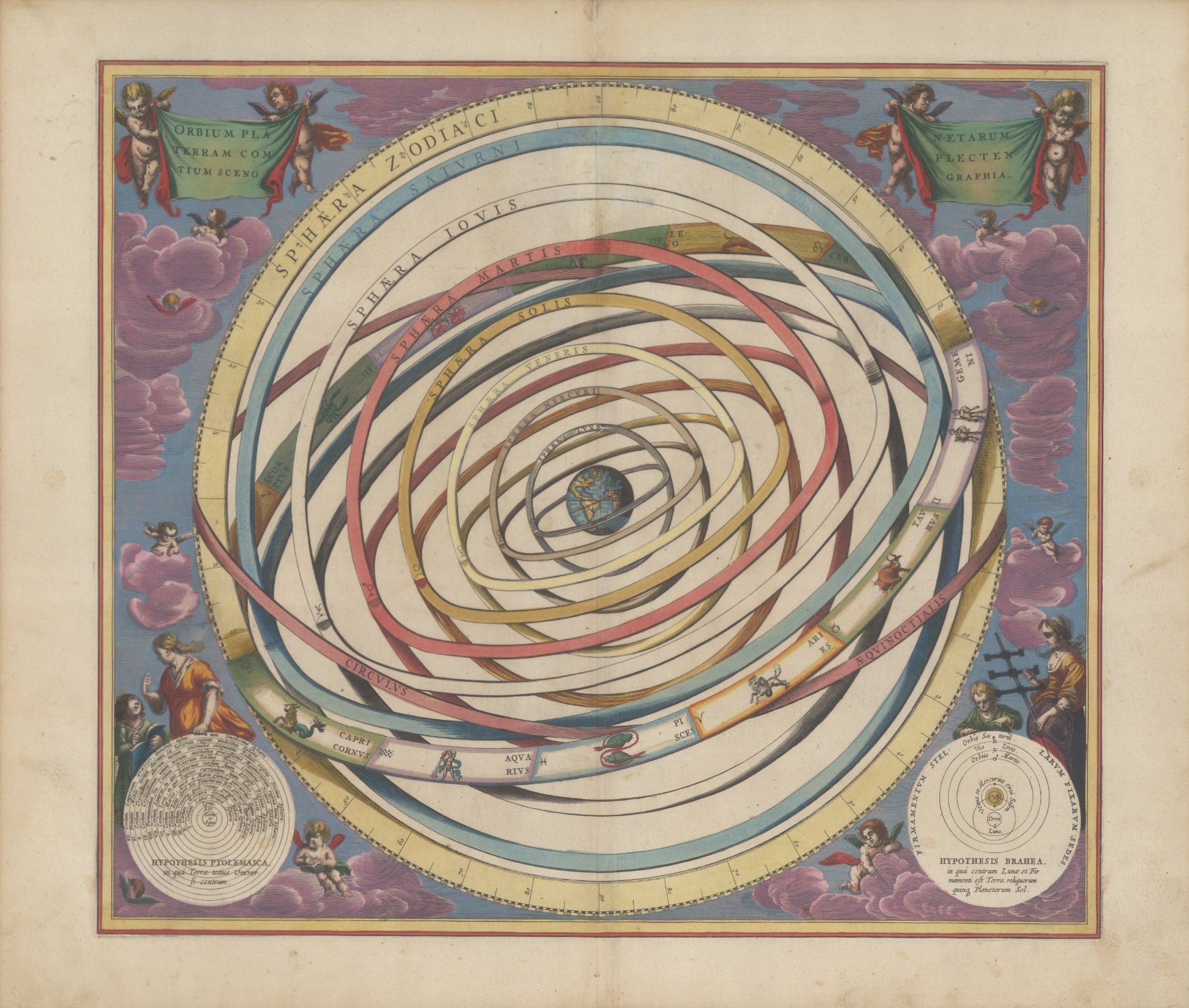
Exploring the Sunderland Collection through Oculi Mundi, you can also trace changes in what sort of knowledge belongs on maps in the first place. Sunderland-Cohen names as a personal favorite the “Rudimentum Novitiorum” from 1475 (above), “an illustrated chronicle in Latin used by monks as a teaching aid for novices.” Besides maps, it includes “Biblical history that is illustrated with lots of wonderful woodblock drawings, and everybody’s wearing clothing of the day, and in the houses of the day”; the connoisseur will notice techniques imported from illuminated manuscripts. As for what such a work costs today, well, if you have to ask, you’re not fully hooked on maps yet. Enter Oculi Mundi here.
Related content:
40,000 Early Modern Maps Are Now Freely Available Online (Courtesy of the British Library)
Download 91,000 Historic Maps from the Massive David Rumsey Map Collection
How Did Cartographers Create World Maps before Airplanes and Satellites? An Introduction
Based in Seoul, Colin Marshall writes and broadcasts on cities, language, and culture. His projects include the Substack newsletter Books on Cities, the book The Stateless City: a Walk through 21st-Century Los Angeles and the video series The City in Cinema. Follow him on Twitter at @colinmarshall or on Facebook.
Read More...Watch an Auroratone, a Psychedelic 1940s Film, Featuring Bing Crosby, That Helped WWII Vets Overcome PTSD & Other Mental Health Conditions
As Lisa Simpson once memorably remarked, “I can see the music.”
Pretty much anyone can these days.
Just switch on your device’s audio visualizer.
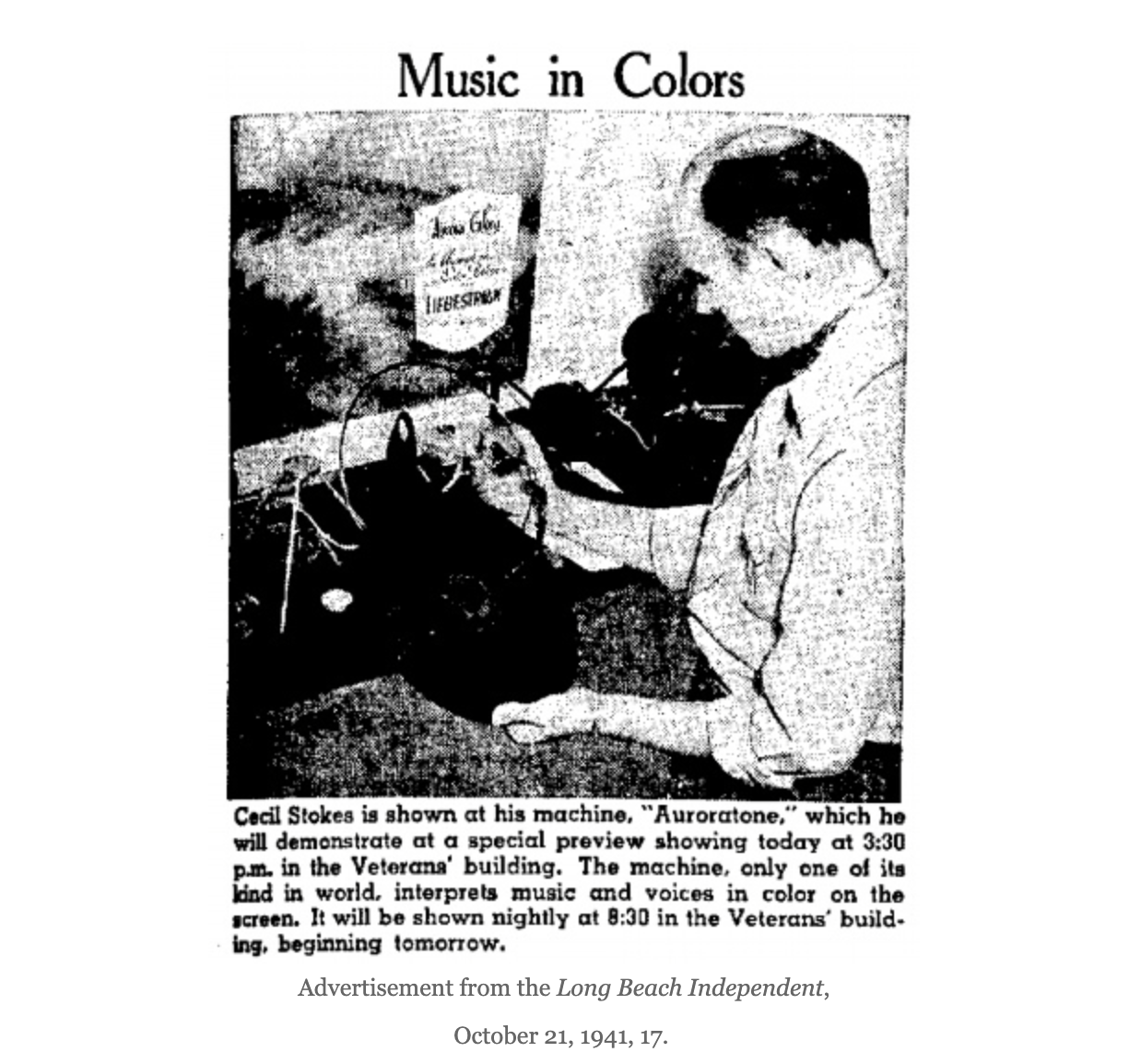
That wasn’t the case in the 1940s, when psychologist Cecil A. Stokes used chemistry and polarized light to invent soothing abstract music videos, a sort of cinematic synesthesia experiment such as can be seen above, in his only known surviving Auroratone.
(The name was suggested by Stokes’ acquaintance, geologist, Arctic explorer and Catholic priest, Bernard R. Hubbard, who found the result reminiscent of the Aurora Borealis.)
The trippy visuals may strike you as a bit of an odd fit with Bing Crosby’s cover of the sentimental crowdpleaser “Oh Promise Me,” but traumatized WWII vets felt differently.
Army psychologists Herbert E. Rubin and Elias Katz’s research showed that Auroratone films had a therapeutic effect on their patients, including deep relaxation and emotional release.
The music surely contributed to this positive outcome. Other Auroratone films featured “Moonlight Sonata,” “Clair de Lune,” and an organ solo of “I Dream of Jeannie with the Light Brown Hair.”
Drs. Rubin and Katz reported that patients reliably wept during Auroratones set to “The Lost Chord,” “Ave Maria,” and “Home on the Range” — another Crosby number.
In fact, Crosby, always a champion of technology, contributed recordings for a full third of the fifteen known Auroratones free of charge and footed the bill for overseas shipping so the films could be shown to soldiers on active duty and medical leave.
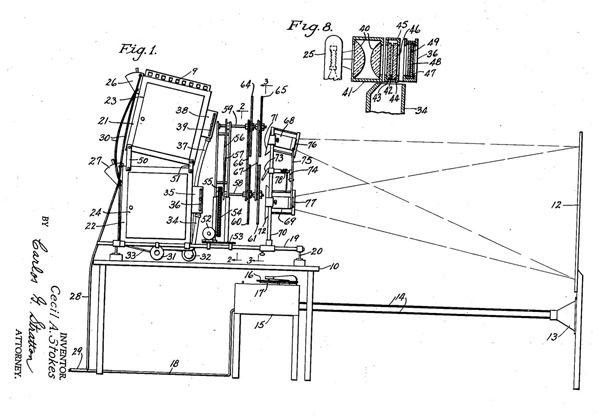
Technophile Crosby was well positioned to understand Stokes’ patented process and apparatus for producing musical rhythm in color — aka Auroratones — but those of us with a shakier grasp of STEM will appreciate light artist John Sonderegger’s explanation of the process, as quoted in filmmaker and media conservator Walter Forsberg’s history of Auroratones for INCITE Journal of Experimental Media:
[Stokes’] procedure was to cut a tape recorded melody into short segments and splice the resulting pieces into tape loops. The audio signal from the first loop was sent to a radio transmitter. The radio waves from the radio transmitter were confined to a tube and focused up through a glass slide on which he had placed a chemical mixture. The radio waves would interact with the solution and trigger the formation of the crystals. In this way each slide would develop a shape interpretive of the loop of music it had been exposed to. Each loop, in sequence, would be converted to a slide. Eventually a set of slides would be completed that was the natural interpretation of the complete musical melody.
Vets suffering from PTSD were not the only ones to embrace these unlikely experimental films.
Patients diagnosed with other mental disorders, youthful offenders, individuals plagued by chronic migraines, and developmentally delayed elementary schoolers also benefited from Auroratones’ soothing effects.
The general public got a taste of the films in department store screenings hyped as “the nearest thing to the Aurora Borealis ever shown”, where the soporific effect of the color patterns were touted as having been created “by MOTHER NATURE HERSELF.”
Auroratones were also shown in church by canny Christian leaders eager to deploy any bells and whistles that might hold a modern flock’s attention.
The Guggenheim Museum’s brass was vastly less impressed by the Auroratone Foundation of America’s attempts to enlist their support for this “new technique using non-objective art and musical compositions as a means of stimulating the human emotions in a manner so as to be of value to neuro-psychiatrists and psychologists, as well as to teachers and students of both objective and non-objective art.”
Co-founder Hilla Rebay, an abstract artist herself, wrote a letter in which she advised Stokes to “learn what is decoration, accident, intellectual confusion, pattern, symmetry… in art there is conceived law only –never an accident.”
A plan for projecting Auroratones in maternity wards to “do away with the pains of child-birth” appears to have been a similar non-starter.
While only one Auroratone is known to have survived — and its discovery by Robert Martens, curator of Grandpa’s Picture Party, is a fascinating tale unto itself — you can try cobbling together a 21st-century DIY approximation by plugging any of the below tunes into your preferred music playing software and turning on the visualizer:
- Adeste Fidelis, sung by Bing Crosby
- American Prayer by Ginny Simms
- Ave Maria, sung by Bing Crosby with organ accompaniment by Edward Dunstedter
- Clair de Lune, played by Andre Kostalanetz and his orchestra
- Going My Way, sung by Bing Crosby with organ accompaniment by Edward Dunstedter
- Home on the Range, sung by Bing Crosby with organ accompaniment by Edward Dunstedter
- I Dream of Jeannie with the Light Brown Hair, organ solo
- The Lone Star Trail, sung by Bing Crosby
- Prelude to Lonegrin, by the Philadelphia Symphony
- The Lord’s Prayer, sung by John Charles Thomas with music by Albert Hay Malotte
- The Lost Chord organ solo
- Moonlight Sonata, played by Miss April Ayres
- None But the Lonely Heart, by Lawrence Tibbett
- The Old Rugged Cross, sung by the Phil Spitalny all-girl chorus
- Silent Night, sung by Bing Crosby
via Boing Boing / INCITE
Related Content
How the 1968 Psychedelic Film Head Destroyed the Monkees & Became a Cult Classic
The Psychedelic Animated Video for Kraftwerk’s “Autobahn” (1979)
– Ayun Halliday is the Chief Primatologist of the East Village Inky zine and author, most recently, of Creative, Not Famous: The Small Potato Manifesto and Creative, Not Famous Activity Book. Follow her @AyunHalliday.
Read More...Support Us
We're hoping to rely on loyal readers, rather than erratic ads. Please click the Donate button and support Open Culture. You can use Paypal, Venmo, Patreon, even Crypto! We thank you!

About Us

Open Culture scours the web for the best educational media. We find the free courses and audio books you need, the language lessons & educational videos you want, and plenty of enlightenment in between.
Advertise With Us
FREE UPDATES!
GET OUR DAILY EMAIL
Get the best cultural and educational resources on the web curated for you in a daily email. We never spam. Unsubscribe at any time.
FOLLOW ON SOCIAL MEDIA
Open Culture editor Dan Colman scours the web for the best educational media. He finds the free courses and audio books you need, the language lessons & movies you want, and plenty of enlightenment in between.
Advertise With Us

