Frank Herbert Explains the Origins of Dune (1969)
Dune: Part Two has been playing in theaters for less than a week, but that’s more than enough time for its viewers to joke about the aptness of its title. For while it comes, of course, as the second half of Denis Villeneuve’s adaptation of Frank Herbert’s influential sci-fi novel, it also contains a great many heaps of sand. Such visuals honor not just the story’s setting, but also the form of Herbert’s inspiration to write Dune and its sequels in the first place. The idea for the whole saga came about, he says in the 1969 interview above, because he’d wanted to write an article “about the control of sand dunes.”
“I’m always fascinated by the idea of something that is either seen in miniature and that can be expanded to the macrocosm or which, but for the difference in time, in the flow rate, and the entropy rate, is similar to other features which we wouldn’t think were similar,” he goes on to explain. When viewed the right way, sand dunes turn out to behave “like waves in a large body of water; they just are slower. And the people treating them as fluid learn to control them.” After enough research on this subject, “I had something enormously interesting going for me about the ecology of deserts, and it was — for a science fiction writer, anyway — it was an easy step from that to think: What if I had an entire planet that was a desert?”
That may have turned out to be one of the defining ideas of Dune, but there are plenty of others in there with it. “We all know that many religions began in a desert atmosphere,” Herbert says, “so I decided to put the two together because I don’t think that any one story should have any one thread. I build on a layer technique, and of course putting in religion and religious ideas you can play one against the other.” And “of course, in studying sand dunes, you immediately get into not just the Arabian mystique but the Navajo mystique and the mystique of the Kalahari primitives and all.” From his technical curiosity about sand, the story’s host of ecological, religious, linguistic, political, and indeed civilizational themes emerged.
Conducted in Herbert’s Fairfax, California home in 1969 by literature professor and science-fiction enthusiast Willis E. McNelly (who would later compile The Dune Encyclopedia), the interview goes down a number of intellectual byways that will be fascinating to curious fans. In its eighty minutes, Herbert reflects on everything from corporations to hippies, the tarot to Zen, and Lawrence of Arabia to John F. Kennedy. The late president’s then-just-beginning sanctification in America gets him talking about one of Dune’s threads in particular, about the “way a messiah is created in our society.” The elevation of a messiah is an act of myth-making, after all, and “man must recognize the myth he is living in.”
Related content:
The Dune Franchise Tries Again — Pretty Much Pop: A Culture Podcast #110
Based in Seoul, Colin Marshall writes and broadcasts on cities, language, and culture. His projects include the Substack newsletter Books on Cities, the book The Stateless City: a Walk through 21st-Century Los Angeles and the video series The City in Cinema. Follow him on Twitter at @colinmarshall or on Facebook.
Read More...Almost 500 Etchings by Rembrandt Now Free Online, Courtesy of the Morgan Library & Museum
Seventeenth-century Dutch painter Rembrandt van Rijn may have more name recognition than nearly any other European artist, his popularity due in large part to what art historian Alison McQueen identifies in her book of the same name as “the rise of the cult of Rembrandt.” Popular Rembrandt veneration brought us in the 20th century such corporate appropriations of the painter’s legacy as Rembrandt toothpaste and money market firm Rembrandt Funds (particularly ironic, “given the notoriety of Rembrandt’s bankruptcy in 1656”). “In contemporary popular culture,” writes McQueen, “Rembrandt’s name has such resonance that the headline of an article in the New York Times Magazine in 1995 referred to the trendy barber Franky Avila as ‘the Rembrandt of Barbers.’”
By invoking Rembrandt’s name, the author knew his readers would understand that this connection implies that Avila’s skill with a razor equals that of Rembrandt’s with his paintbrush or etching needle… even if a reader has never actually seen any work by Rembrandt.
Indeed, though any person on the street will likely know the artist’s name, most would be hard-pressed to name any of his paintings, except perhaps his well-known self-portraits, which have adorned t‑shirts, posters, and iPhone cases. I might not have known much more about Rembrandt than those self-portraits either had I not lived in Washington, DC, where I had free access to many of his paintings at the National Gallery of Art. The Dutch master was astonishingly prolific, painting, drawing, and etching hundreds of portraits of himself and his patrons, as well as hundreds of still lifes, landscapes, scenes from mythology, and many, many Biblical subjects.

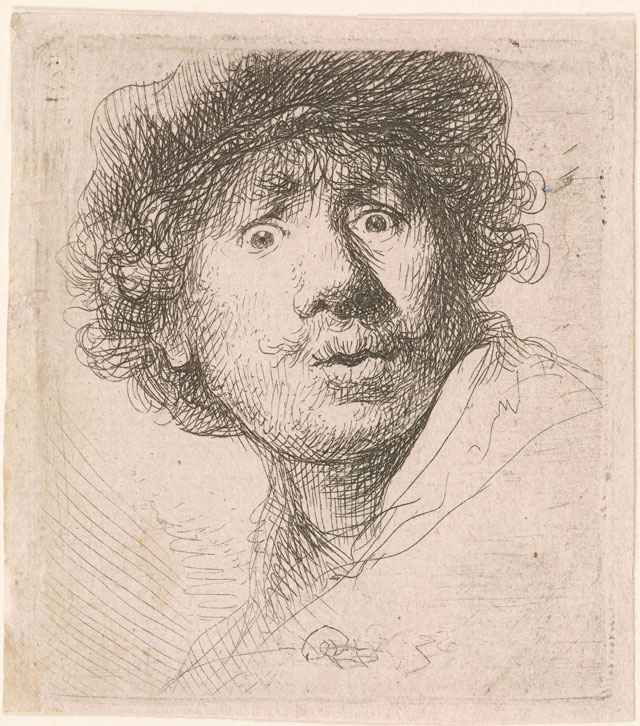
Nowadays, you can see Rembrandt’s paintings for free online, whether from the National Gallery of Art’s collection, that of the National Gallery in London, or of the Dutch Rijksmuseum. And for another side of his genius, you can now go to the site of New York’s Morgan Library and Museum, who have digitized “almost 500 images from the Morgan’s exceptional collection of Rembrandt etchings,” celebrating his “unsurpassed skill and inventiveness as a master storyteller.” There are, of course, plenty of self-portraits, like the 1630 “Self Portrait in a Cap, Open-Mouthed” at the top of the post, and there are portraits of others, like that of the artist’s mother, above, from 1633. There are religious scenes like the 1655 “Abraham’s Sacrifice” below, and landscapes like “The Three Trees,” further down, from 1643.
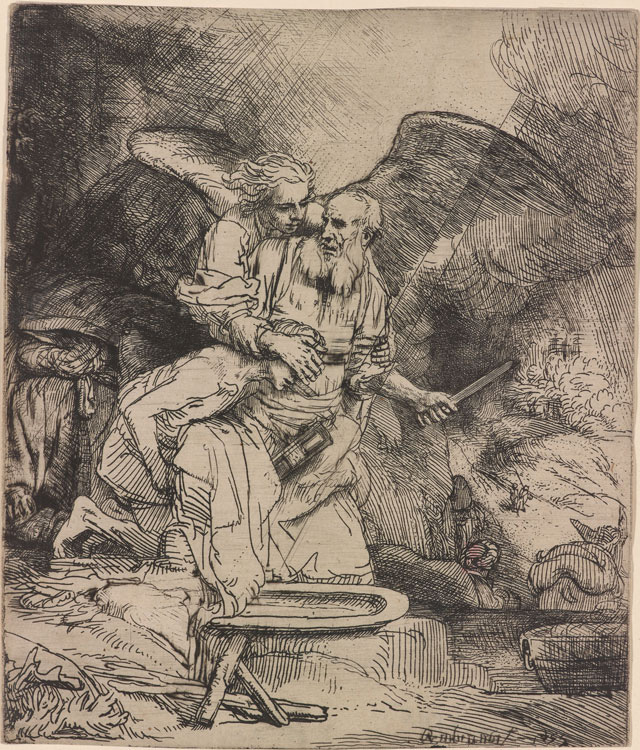
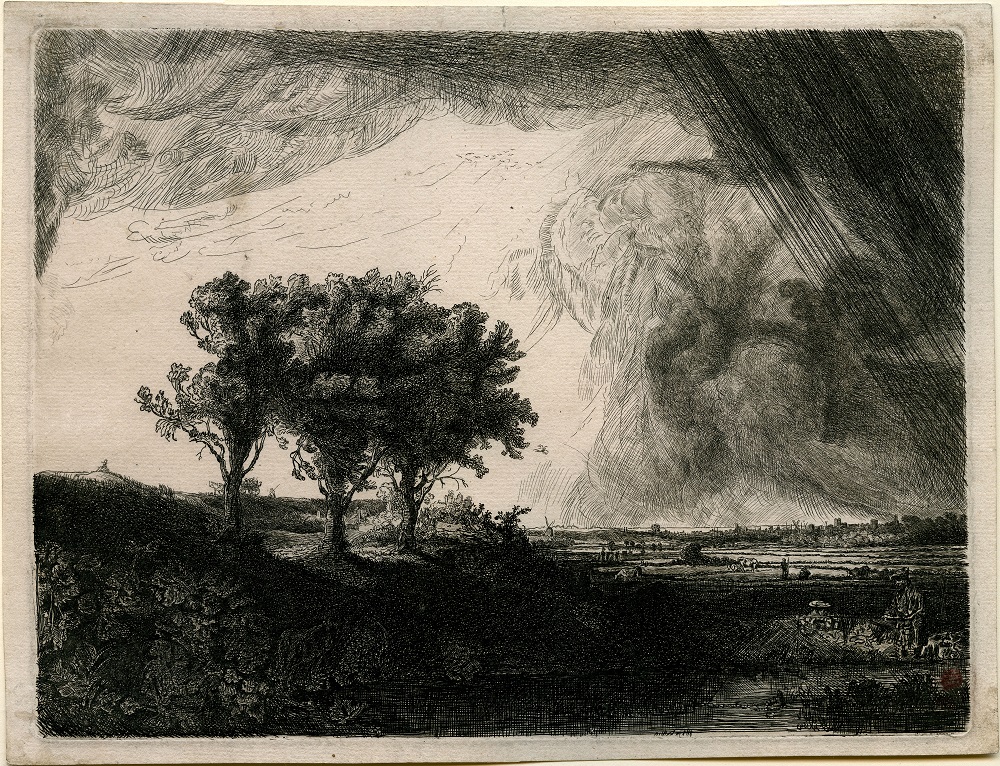
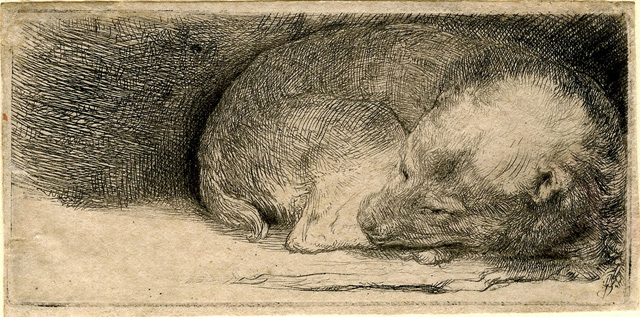
These are the four main categories that the Morgan uses to organize this impressive collection, but you’ll also find there more humble, domestic subjects, like the 1640 “Sleeping Puppy,” below. Writes Hyperallergic, “The Morgan holds in its collection most of the roughly 300 known etchings by Rembrandt, including rare, multiple versions (hence the discrepancy in number of etchings versus number of images.)” Like his highly accomplished paintings, Rembrandt’s etchings “are famous for their dramatic intensity, penetrating psychology, and touching humanity,” as well as, of course, for the extraordinary skill with which the artist made these works of art. Thanks to the “cult of Rembrandt,” we all know the artist’s name and reputation; now, thanks to digital collections from National Galleries, the Rijksmuseum, and now the Morgan, we can become experts in his work as well. Enter the Morgan collection of sketches here.
Note: Note: An earlier version of this post appeared on our site in 2015.
Related Content:
What Makes The Night Watch Rembrandt’s Masterpiece
Two Tiny Rembrandt Paintings Have Been Rediscovered & Put On Display in Amsterdam
Josh Jones is a writer and musician based in Durham, NC. Follow him at @jdmagness
Read More...The Decimal Point Is 150 Years Older Than We Thought, Emerging in Renaissance Italy
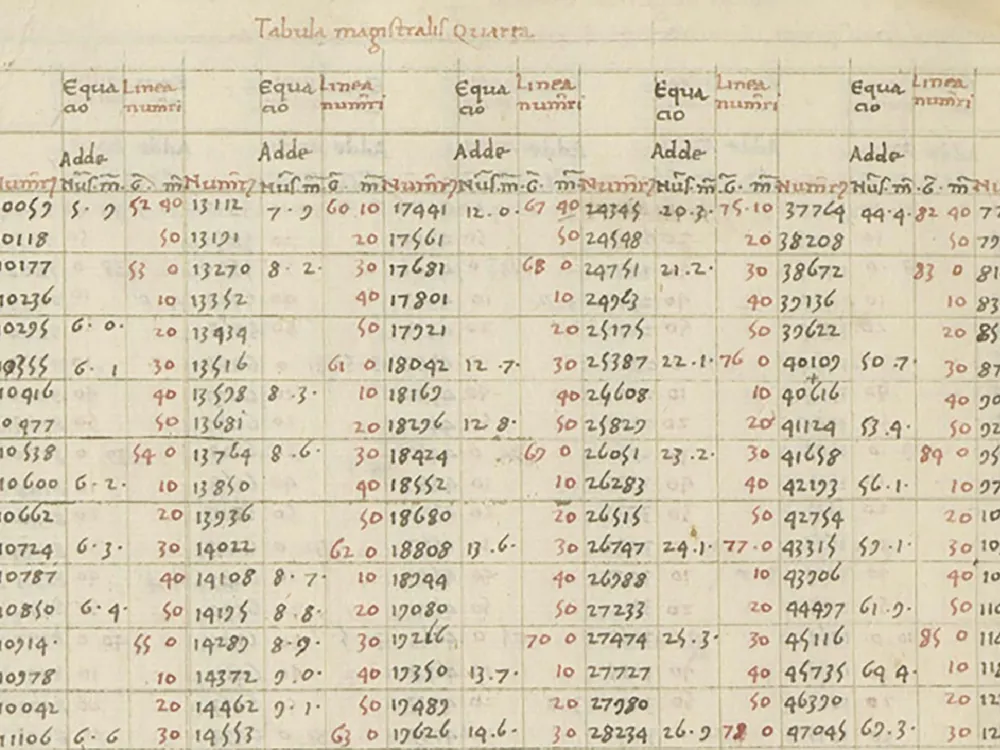
Historians have long thought that the decimal point first came into use in 1593, when the German mathematician Christopher Clavius wrote an astronomy text called Astrolabium. It turns out, however, that the history of the decimal point stretches back another 150 years–to the work of the Venetian merchant Giovanni Bianchini. In his text Tabulae primi mobilis, written during the 1440s, Bianchini used the decimal point to calculate the coordinates of planets. In so doing, he invented a system of decimal fractions, which, in turn, made the calculations underpinning modern science more efficient and less complex, notes Scientific American.
Glen Van Brummelen, a historian of mathematics, recently recounted to NPR how he discovered Bianchini’s innovation:
I was working on the manuscript of this astronomer, Giovanni Bianchini. I saw the dots inside of a table — in a numerical table. And when he explained his calculations, it became clear that what he was doing was exactly the same thing as we do with the decimal point. And I’m afraid I got rather excited at that point. I grabbed my computer, ran up and down the dorm hallway looking for colleagues who still hadn’t gone to bed, saying, this person’s working with the decimal point in the 1440s. I think they probably thought I was crazy.
In a new article appearing in the journal Historia Mathematica, Van Brummelen explains the historical significance of the decimal point, and what this discovery means for the historical development of mathematics. You can read it online.
Related Content
Trigonometry Discovered on a 3700-Year-Old Ancient Babylonian Tablet
How the Ancient Greeks Shaped Modern Mathematics: A Short, Animated Introduction
Read More...The Puzzle of Docudramas — Pretty Much Pop: A Culture Podcast #167

When we’ve already heard about someone’s personal scandal in the news, do we need to also see it dramatized with A‑list actors? Your hosts Mark Linsenmayer, Lawrence Ware, Sarahlyn Bruck, and Al Baker discuss Todd Haynes’ 2023 film May December fictionalizing the long-aftermath of the much publicized Mary Kay Letourneau story.
The main events of May December are fictional (based on a story by screenwriter Samy Burch along with Alex Mechanik): An actress (Natalie Portman) researching her future role visits the renamed Letourneau (Julianne Moore) and her now-adult husband (Charles Melton), whom she seduced (molested) starting at age 12. So is this art film fundamentally unlike the other recent dramatizations that we touch on, including Joe vs. Carole, Inventing Anna, Dirty John, The Act, The Shrink Next Door, and The Thing About Pam? We also talk about Reality. as an example of films depicting how horrible it is to be arrested.
Note that while Amanda Knox’s story was made into a TV movie, the prestige TV drama version is still in process. Her podcast is called Labyrinths.
One of the articles we reviewed about May December is this one from Vox.
Follow us @law_writes, @sarahlynbruck, @ixisnox, @MarkLinsenmayer.
Hear more Pretty Much Pop, including recent episodes that you haven’t seen on this site. Support the show and hear bonus talking for this and nearly every other episode at patreon.com/prettymuchpop or by choosing a paid subscription through Apple Podcasts.
This podcast is part of the Partially Examined Life podcast network.
Pretty Much Pop: A Culture Podcast is the first podcast curated by Open Culture. Browse all Pretty Much Pop posts.
Read More...The Most Beautiful Shots in Cinema History: Scenes from 100+ Films
If you’re an even mildly enthusiastic filmgoer, these two short compilations from The Solomon Society will get your life flashing before your eyes. They transport me to my ninth birthday screening of The Nightmare Before Christmas; my VHS viewings of Ferris Bueller’s Day Off at home sick from school; the obsession with Blade Runner that put me on the road to cinephilia; the thrill I got in high school from aesthetically daring yet cineplex-screened major motion pictures like Fight Club and The Cell; my induction into auteur cinema through Stanley Kubrick’s Barry Lyndon, 2001: A Space Odyssey (seen at Seattle’s space-age Cinerama in the actual year of 2001), A Clockwork Orange, and The Shining; the surprise public debut Paul Thomas Anderson’s The Master — which happened to follow a revival screening of The Shining.
Of course, you’ll experience a flood of different movie-related memories than I did. Maybe these videos will bring back the exhilaration of seeing Quentin Tarantino’s Pulp Fiction, or even Reservoir Dogs, back in the nineties. The story of my own cinephile life could hardly be told without reference to early Wes Anderson pictures like Rushmore and The Royal Tenenbaums.
But perhaps you’ve felt more of an impact from the later, even more visually intricate work of his that appears here, like The Darjeeling Limited or The Grand Budapest Hotel. Or you could be a movie-lover of a different stripe altogether, for whom nothing satisfies quite like a classic blockbuster, be it the original Star Wars or a long-acclaimed drama like The Shawshank Redemption.
The second of these videos begins with a clip of an interview with no less an auteur than Orson Welles. Asked where he got the confidence to make Citizen Kane, he replies, “Ignorance. Sheer ignorance. There is no confidence to equal it. I thought you could do anything with a camera that the eye could do or the imagination could do. And I didn’t know that there were things you couldn’t do, so anything I could think up in my dreams, I attempted to photograph.” It’s safe to say that none of the dozens upon dozens of shots collected here could have been captured by filmmakers overly conscious of the impossible. But however striking they look individually, they’re all even more powerful in their proper context: their context within not just the film, but also the life of the beholder.
Related content:
The 100 Most Memorable Shots in Cinema Over the Past 100 Years
Signature Shots from the Films of Stanley Kubrick: One-Point Perspective
The Greatest Cut in Film History: Watch the “Match Cut” Immortalized by Lawrence of Arabia
Based in Seoul, Colin Marshall writes and broadcasts on cities, language, and culture. His projects include the Substack newsletter Books on Cities, the book The Stateless City: a Walk through 21st-Century Los Angeles and the video series The City in Cinema. Follow him on Twitter at @colinmarshall or on Facebook.
Read More...Keith Richards Performs “I’m Waiting For The Man”: A New Tribute to Lou Reed
“To me, Lou stood out. The real deal! Something important to American music and to ALL MUSIC! I miss him and his dog.” — Keith Richards
On what would have been Lou Reed’s 82nd birthday (March 2), Keith Richards released a cover of “I’m Waiting for the Man,” a track originally written by Reed in 1966, then recorded by the Velvet Underground the next year. Previously covered by David Bowie, OMD, and French singer Vanessa Paradis, the song makes sense in Keith Richards’ hands. As one YouTuber put it, “Seeing Keith perform this Velvet Underground classic is watching him take a victory lap over his addiction. He’s been away from that life for decades and now he’s telling the story about someone else, even though he lived it for a long time. This is a triumph for him.”
Richards’ cover will appear on the forthcoming album The Power of the Heart: A Tribute to Lou Reed, where songs move from Reed’s “groundbreaking years with the Velvets into his majestic solo career.” Contributors include Joan Jett and the Blackhearts, Rufus Wainwright, Lucinda Williams, Rickie Lee Jones, Bobby Rush, and Rosanne Cash. The album will be released on Record Store Day (April 20th). Get more deets here.
Below, as a bonus, watch Reed and Bowie perform “I’m Waiting for the Man” together, apparently at Reed’s 50th birthday bash in 1997.
Related Content
Keith Richards Shows Us How to Play the Blues, Inspired by Robert Johnson, on the Acoustic Guitar
Chuck Berry Takes Keith Richards to School, Shows Him How to Rock (1987)
Read More...How Jane Austen Changed Fiction Forever
Though Jane Austen hasn’t published a novel since 1817 — with her death that same year being a reasonable excuse — her appeal as a literary brand remains practically unparalleled in its class. This century has offered its own film and television versions of all her major novels from Sense and Sensibility to Persuasion, and even minor ones like Sandition and Lady Susan. As for the looser adaptations and Austen-inspired works in other media, it would be difficult even to count them. But to understand why Austen endures, we must go back to Austen herself: to novels, that is, and to the entertainingly innovative manner in which she wrote them.
At the beginning of her very first book says Evan Puschak, Austen “did something that changed fiction forever.” Puschak, better known as the Nerdwriter, has in his latest video chosen Sense and Sensibility as an example with which to explain the key technique that set its author’s work apart. When, in the scene in question, the dying Henry Dashwood makes his son John promise to take care of his three half-sisters, the younger man inwardly resolves to himself to give them a thousand pounds each. “Yes, he would give them three thousand pounds,” Austen writes. “It would be liberal and handsome! It would be enough to make them completely easy. Three thousand pounds! He could spare so little a sum with a little inconvenience.”
What, exactly, is going on here? Before this passage, Puschak explains, “the narrator is describing the thoughts and feelings of John Dashwood.” But then, “something changes: it’s suddenly as if we’re inside John’s mind. And yet, the point of view doesn’t change: we’re still in the third person.” This is a notable early example of what’s called “free indirect style,” which literary critic D. A. Miller describes as a “technique of close writing that Austen more or less invented for the English novel.” When she employs it, “the narration’s way of saying is constantly both mimicking, and distancing itself from, the character’s way of seeing.”
In his book Jane Austen, or The Secret of Style, Miller pays a good deal of attention to the later Emma, with its “unprecedented prominence of free indirect style.” When, in Austen’s hand, that style “mimics Emma’s thoughts and feelings, it simultaneously inflects them into keener observations of its own; for our benefit, if never for hers, it identifies, ridicules, corrects all the secret vanities and self-deceptions of which Emma, pleased as Punch, remains comically unconscious. And this is generally what being a character in Austen means: to be slapped silly by a narration whose constant battering; however satisfying — or terrifying — to readers, its recipient is kept from even noticing.” Austen may have been a novelist of great technical proficiency and social acuity, but she also understood the eternal human pleasure of sharing a laugh at the delusional behind their back.
Related content:
An Animated Introduction to Jane Austen
Download the Major Works of Jane Austen as Free eBooks & Audio Books
This Is Your Brain on Jane Austen: The Neuroscience of Reading Great Literature
Based in Seoul, Colin Marshall writes and broadcasts on cities, language, and culture. His projects include the Substack newsletter Books on Cities, the book The Stateless City: a Walk through 21st-Century Los Angeles and the video series The City in Cinema. Follow him on Twitter at @colinmarshall or on Facebook.
Read More...The US Postal Service to Release Stamp Collection Featuring the Photography of Ansel Adams
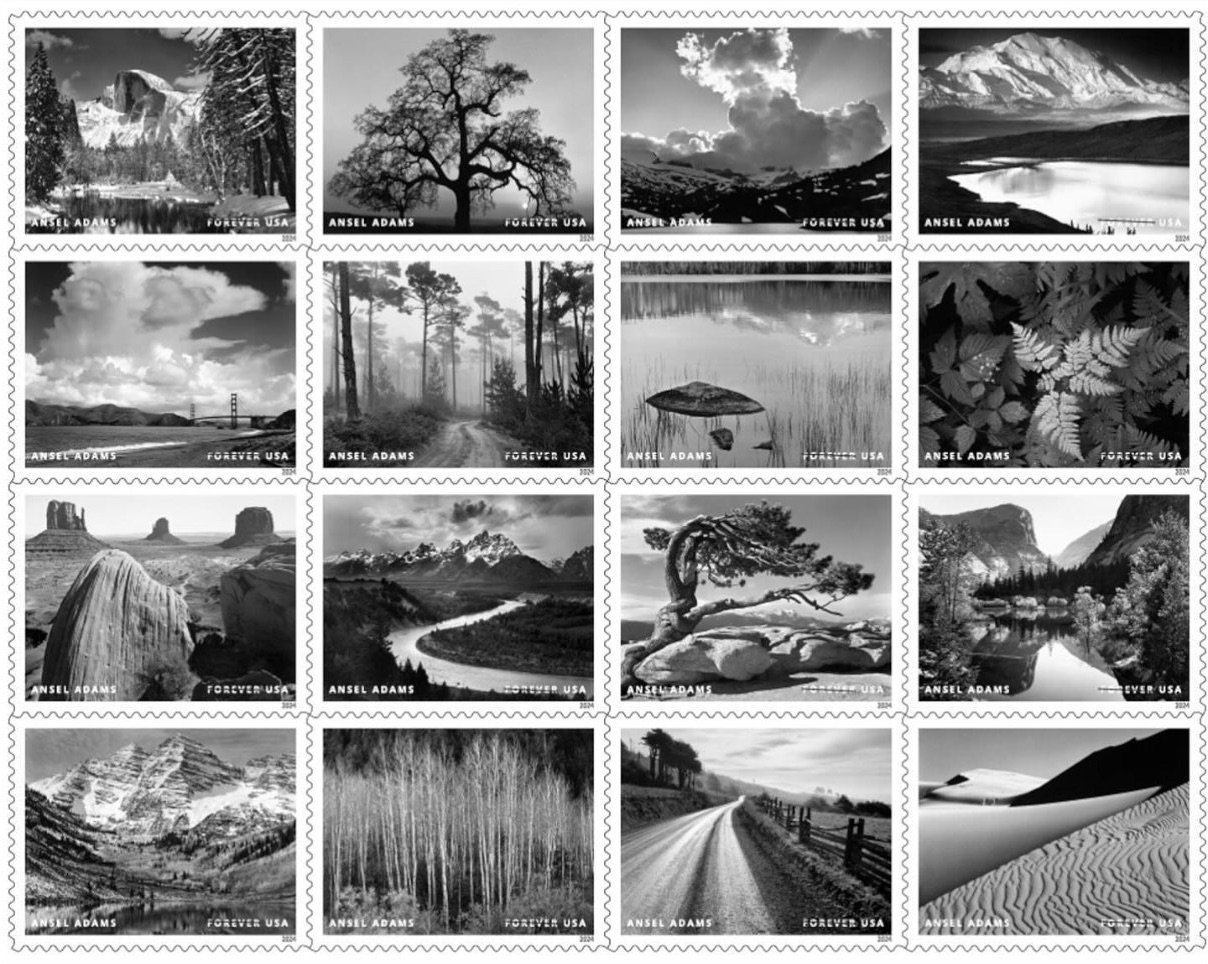
The US Postal Service will be classing up the joint, with the planned release of 16 stamps featuring the photography of Ansel Adams. They write:
Ansel Adams made a career of crafting photographs in exquisitely sharp focus and nearly infinite tonality and detail. His ability to consistently visualize a subject — not how it looked in reality but how it felt to him emotionally — led to some of the most famous images of America’s natural treasures including Half Dome in California’s Yosemite Valley, the Grand Tetons in Wyoming, and Denali in Alaska, the highest peak in the United States.
Due to be unveiled on May 15th, the stamps will feature iconic US landscapes, including Half Dome in Yosemite National Park, Monument Valley in Arizona, the Grand Tetons, the Snake River and more. Find more information on the stamps here.
Related Content
Ansel Adams Reveals His Creative Process in 1958 Documentary
200 Ansel Adams Photographs Expose the Rigors of Life in Japanese Internment Camps During WW II
Read More...Learn to Become a Digital Marketing Analyst with Unilever’s New Certificate Program

Unilever, the consumer goods company headquartered in London, owns over 400 brands. Dove, Lipton, Ben & Jerry’s, Hellmann’s and Knorr–you know and use many of Unilever’s products. The same goes for many people living across the globe. An estimated 3.4 billion people use Unilever products every day. How has Unilever established such vast reach? Through marketing. Like other consumer products companies, Unilever depends on marketing to build brand awareness for each product and to differentiate them from competitors. Marketing is part of the lifeblood of the organization, and digital marketing particularly allows the company to thrive here in the 21st century.
Happily, for any aspiring marketers out there, Unilever has just launched a new Digital Marketing Analyst certificate program. Offered on the Coursera platform, the program consists of four courses (each taking an estimated 20 hours to complete) that focus on helping students build job-ready skills in digital marketing analytics. The courses include:
- Customer Understanding and Digital Marketing Channels
- Measurement and Analysis
- Campaign Performance Reporting, Visualization, & Improvement
- Advanced Tools for Digital Marketing Analytics
As students move through the program, they will “learn in-demand skills like data analysis, customer segmentation, and SEO optimization.” They will also start “collecting and interpreting data to evaluate the performance of digital marketing efforts, improve strategies, and contribute to achieving marketing goals and objectives.”
Students can audit each course for free, or sign up to earn a shareable certificate. Students who select the latter option will be charged $49 per month. So, if you spend 10 hours per week, you can complete the 80-hour certificate program in two months, and pay about $100 in total.
Sign up for the Digital Marketing Analyst certificate program here.
Note: Open Culture has a partnership with Coursera. If readers enroll in certain Coursera courses and programs, it helps support Open Culture.
Related Content
Generative AI for Everyone: A Free Course from AI Pioneer Andrew Ng
Read More...Watch the Film That Invented Cinema: Workers Leaving the Lumière Factory in Lyon (1895)
The brothers Auguste and Louis Lumière are often referred to as pioneers of cinema, and their 45-second La Sortie de l’Usine Lumière à Lyon, or Workers Leaving the Lumière Factory in Lyon (1895), is often referred to as the first film. But history turns out to present a more complicated picture. As previously featured here on Open Culture, Louis Le Prince’s Roundhay Garden Scene predates the Lumière brothers’ work by six and a half years. But it is La Sortie that cinema historians regard as the more important picture, and indeed, as “the invention of movies for mass audiences.”
So writes Ryan Lattanzio at IndieWire, who goes on to explain that “the Lumière brothers were among the first filmmakers in world history, pioneering cinematic technology as well as establishing the common grammar of film.”
In an essay re-printed on Senses of Cinema, the director Haroun Farocki frames La Sortie as having established the grand subjects like regimentation and individuality with which motion pictures have dealt ever since. “For over a century cinematography had been dealing with just one single theme,” he writes. “Like a child repeating for more than a hundred years the first words it has learned to speak in order to immortalize the joy of first speech.”
Farocki also draws an analogy with “painters of the Far East, always painting the same landscape until it becomes perfect and comes to include the painter within it.” And just as Hokusai painted several different versions of his famous The Great Wave off Kanagawa, the Lumière brothers didn’t shoot just one La Sortie, but three. Though each one may look the same at first glance to the eyes of twenty-first century viewers, they’re actually distinguished by many subtle differences, including the season-reflecting attire of the workers and the number of horses drawing the carriage. And so, if we choose to credit the Lumière brothers with inventing cinema as we know it, we must also credit them with a more dubious creation, one we’ve come to know all too well in recent decades: the remake.
Related content:
Watch the Films of the Lumière Brothers & the Birth of Cinema (1895)
The History of the Movie Camera in Four Minutes: From the Lumière Brothers to Google Glass
Based in Seoul, Colin Marshall writes and broadcasts on cities, language, and culture. His projects include the Substack newsletter Books on Cities, the book The Stateless City: a Walk through 21st-Century Los Angeles and the video series The City in Cinema. Follow him on Twitter at @colinmarshall or on Facebook.
Read More...
Support Us
We're hoping to rely on loyal readers, rather than erratic ads. Please click the Donate button and support Open Culture. You can use Paypal, Venmo, Patreon, even Crypto! We thank you!

About Us

Open Culture scours the web for the best educational media. We find the free courses and audio books you need, the language lessons & educational videos you want, and plenty of enlightenment in between.
Advertise With Us
FREE UPDATES!
GET OUR DAILY EMAIL
Get the best cultural and educational resources on the web curated for you in a daily email. We never spam. Unsubscribe at any time.
FOLLOW ON SOCIAL MEDIA
Open Culture editor Dan Colman scours the web for the best educational media. He finds the free courses and audio books you need, the language lessons & movies you want, and plenty of enlightenment in between.
Advertise With Us


