Kino Lorber Lets You Stream 146 Films on YouTube: Tilda Swinton, Samuel L. Jackson, Steve Buscemi, Buster Keaton & More
The film distribution company Kino Lorber now allows you to stream complete films on YouTube for free. Since we first mentioned this initiative back in 2022, the list of streamable films has grown. Among the now 146 films, you will find a mixture of documentaries and cinematic works, including Derek Jarman’s Blue; Fela Kuti: Music Is The Weapon (a documentary exploring the life and work of the African musician); The Search for One-Eye Jimmy with Steve Buscemi, Samuel L. Jackson, and John Turturro; Buster Keaton’s Three Ages; Gary Cooper in A Farewell to Arms; Genius Within: The Inner Life of Glenn Gould; and War Requiem with Tilda Swinton, Derek Jarman and Laurence Olivier.
Find the list of 146 films here, or stream them all above.
Related Content
How to Watch Hundreds of Free Movies on YouTube
Watch 70+ Soviet Films Free Online, Courtesy of Mosfilm, the Hollywood of the Soviet Union
Read More...When the Berlin Philharmonic Performed John Cage’s Iconic Piece 4′33″, Capturing the Solitude of the Pandemic (2020)
In late October 2020, amidst another surge of the COVID-19 virus, the German government asked the Berlin Philharmonic to close down for a month. On the eve of their closure, the Philharmonic performed John Cage’s modernist composition, 4′33″, which asks performers not to play their instruments throughout the entire duration of the piece, allowing the audience to experience the sometimes awkward, sometimes unexpected sounds of silence. In this particular moment, the Berlin Philharmonic offered a poignant commentary on the silence and isolation experienced during the pandemic.
The website, Classical Voice North America, breaks down the performance as follows: The conductor Kirill Petrenko “defined each of the three movements in 4’33” with a particular affect. In the first movement, he seemed to be conducting a conventional piece that wasn’t there. In the second movement, his hands were positioned near his face, as if asking for quiet or like a priest pronouncing a benediction. In the third movement, his hands stretched toward the orchestra, fingers splayed in one hand, with a searching facial expression. He was near tears with sorrow and grief. ‘What is this? What is happening?’ he seemed to ask. ‘I don’t understand!’ ” We all felt that way at some point.
Watch the performance above.
Related Content
Watch John Cage Play His “Silent” 4′33″ in Harvard Square, Presented by Nam June Paik (1973)
The Curious Score for John Cage’s “Silent” Zen Composition 4′33″
Watch John Cage’s 4′33″ Played by Musicians Around the World
Read More...How French Artists in 1899 Envisioned What Life Would Look Like in the Year 2000
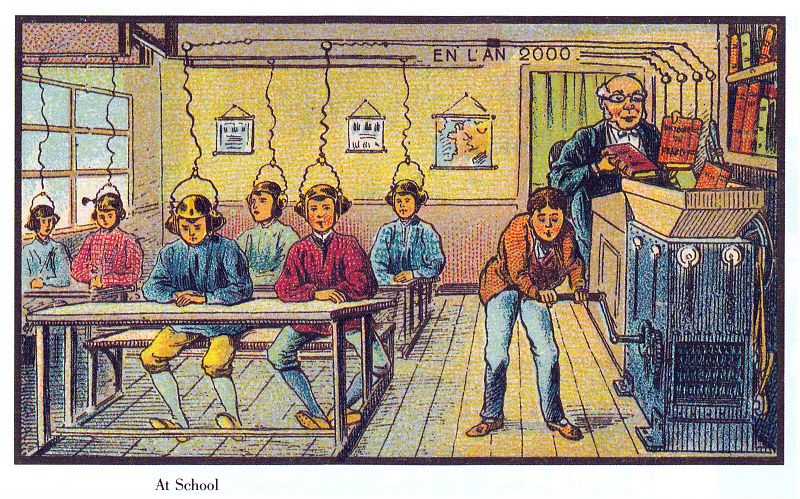
Atomic physicist Niels Bohr is famously quoted as saying, “Prediction is very difficult, especially if it’s about the future.” Yet despite years of getting things wrong, magazines love think pieces on where we’ll be in several decades, even centuries in time. It gives us comfort to think great things await us, even though we’re long overdue for the personal jetpack and moon colonies.
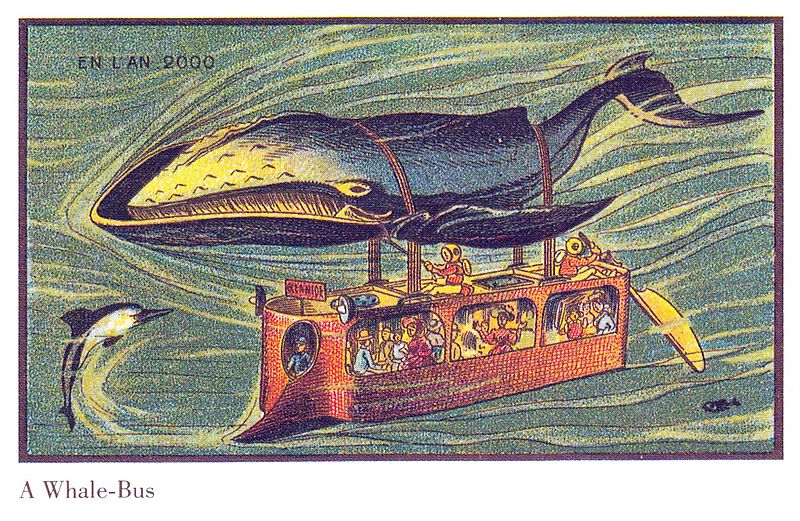
And yet it’s Asimov who apparently owned the only set of postcards of En L’An 2000, a set of 87 (or so) collectible artist cards that first appeared as inserts in cigar boxes in 1899, right in time for the 1900 World Exhibition in Paris. Translated as “France in the 21st Century,” the cards feature Jean-Marc Côté and other illustrators’ interpretations of the way we’d be living…well, 23 years ago.
The history of the card’s production is very convoluted, with the original commissioning company going out of business before they could be distributed, and whether that company was a toy manufacturer or a cigarette company, nobody seems to know. And were the ideas given to the artists, or did they come up with them on their own? We don’t know.
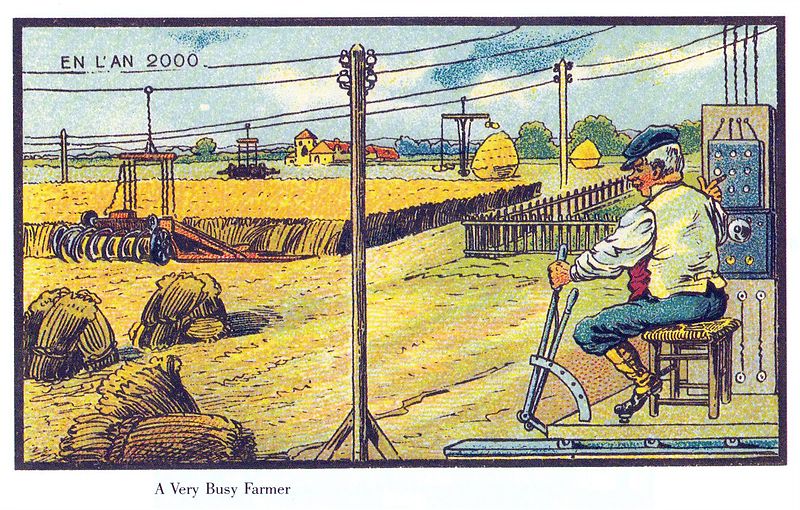
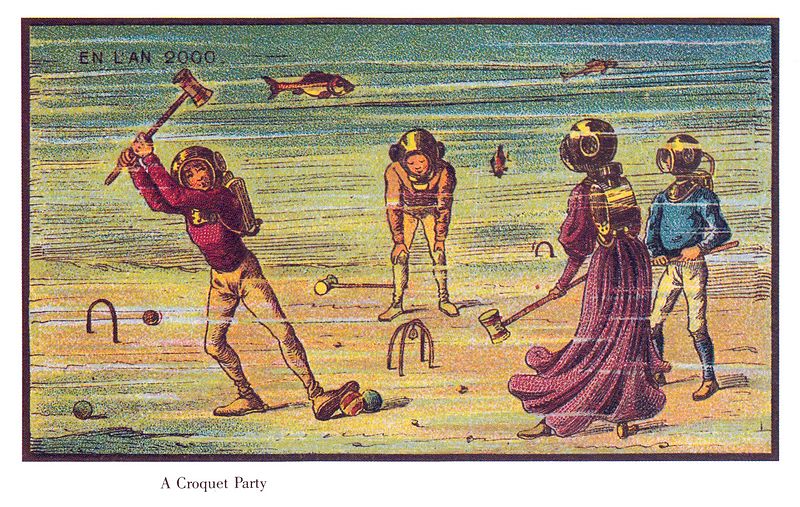
One of the first things that stands out scanning through these prints, now hosted at The Public Domain Review, is a complete absence of space travel, despite Jules Verne having written From the Earth to the Moon in 1865 (which would influence Georges Méliès’ A Voyage to the Moon in 1902). However, the underwater world spawned many a flight of fancy, including a whale-drawn bus, a croquet party at the bottom of the ocean, and large fish being raced like thoroughbred horses.
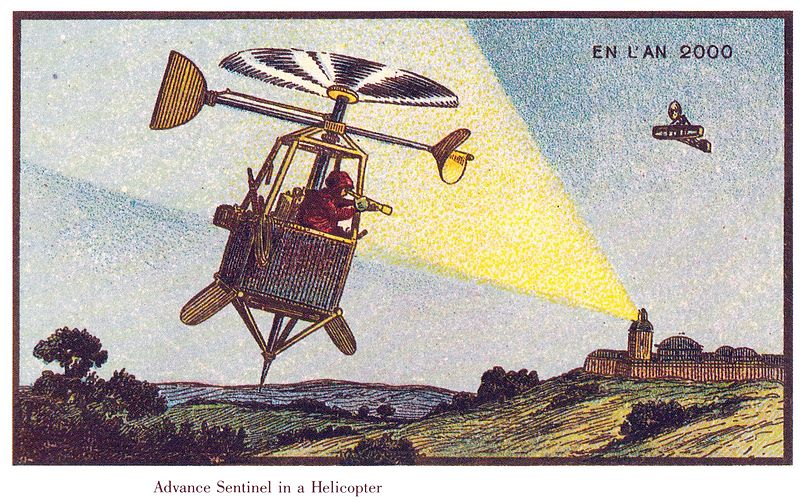
There are a few inventions we can say came true. The “Advance Sentinel in a Helicopter” has been documenting traffic and car chases for decades now, fed right into our televisions. A lot of farm work is now automated. And “Electric Scrubbing” is now called a Roomba.
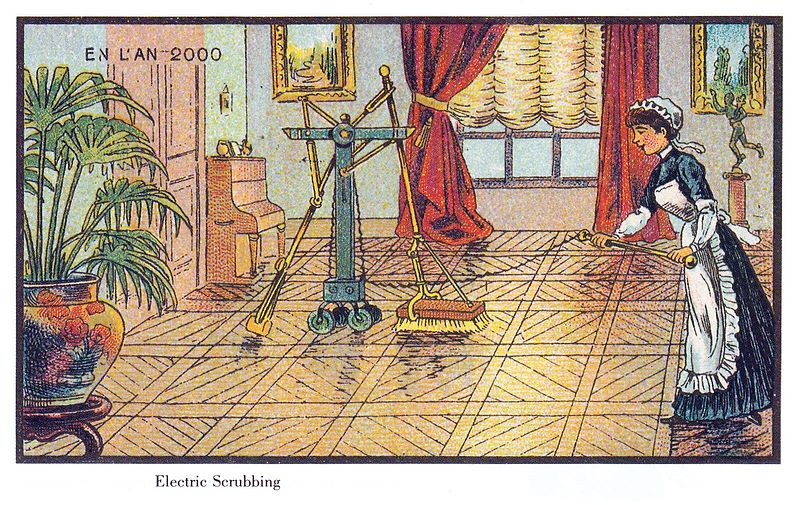
For a card-by-card examination of these future visions, one should hunt out Isaac Asimov’s 1986 Futuredays: A Nineteenth Century Vision of the Year 2000, which can be found on Amazon right now. (Or see the nice gallery of images at The Public Domain Review.) And who knows? Maybe next year, your order will come to your door by drone. Just a prediction.
Note: Note: An earlier version of this post appeared on our site in 2015.
Related Content:
Author Imagines in 1893 the Fashions That Would Appear Over the Next 100 Years
In 1900, Ladies’ Home Journal Publishes 28 Predictions for the Year 2000
Ted Mills is a freelance writer on the arts who currently hosts the FunkZone Podcast. You can also follow him on Twitter at @tedmills, read his other arts writing at tedmills.com and/or watch his films here.
Read More...A Walking Tour of Los Angeles Architecture: From Art Deco to California Bungalow
When architectural historian Reyner Banham wrote Los Angeles: The Architecture of Four Ecologies (1971), quite possibly the most influential book published about the Southern Californian metropolis, he saw fit to dismiss the center of the city with what he called “a note on downtown.” He concedes that it has its landmarks, like the Cathedral of Santa Vibiana and the much-filmed Bradbury Building, “one of the most magnificent relics of nineteenth-century commercial architecture anywhere in the world.” But he finds the urban scene that surrounds them hopelessly depleted: “Many US cities have had their downtown areas fall into this kind of desuetude,” but “in none of the others does one have quite such a strong feeling that this is where the action cannot possibly be.”
Things have changed since The Architecture of Four Ecologies came out more than half a century ago. After countless aborted attempts at revival, downtown Los Angeles seems finally to have found its way to becoming a true city center once again.
This has to do with a number of factors, including its positioning as the hub of the rail transit that’s been opening in stages since the early nineties, its levels of commercial and residential density at which today’s zoning laws make difficult or impossible to build, and the sheer diversity of its built environment. In the Architectural Digest video above, Los Angeles architect Valéry Augustin provides a walking tour of that diversity, introducing a striking building from each era of the city’s development.
Banham and Agustin agree on the importance of Los Angeles’ City Hall and Union Station. But Augustin also highlights the Art Deco Eastern Columbia Building, the Churrigueresque Million Dollar Theater, and a couple of major structures that Banham didn’t live to see, the Broad Museum and Ramon C. Cortines School Of Visual And Performing Arts. (Notably absent is Frank Gehry’s Walt Disney Concert Hall, whose once-shocking metallic curves have perhaps been overexposed over these past couple of decades.) But whatever the wonders of downtown, it’s long been argued that Los Angeles’ has more of a private architectural heritage than a public one; to understand the city’s architecture, in other words, you can’t ignore its houses.
Hence Architectural Digest’s having also put out a video in which Augustin breaks down the five most common types of Los Angeles home. These include example of the romanticized Mission Revival style, the idyllic California bungalow, the boardwalk beach house (as seen in ocean enclaves like Santa Monica and Venice), and more culturally representative housing forms such as bungalow courts (as seen in Party of Five) and postwar dingbat apartments. With their broad carports, their playfully exotic names, and their boxlike construction fronted, as Banham observes, by a range of styles from “from Tacoburger Aztec to Wavy-Line Moderne, from Cod Cape Cod to un-supported Jaoul vaults, from Gourmet Mansardic to Polynesian Gabled and even — in extremity — Modern Architecture,” they may well be the most Los Angeles buildings of all.
Related content:
The Story of Googie Architecture, the Iconic Architectural Style of Los Angeles
That Far Corner: Frank Lloyd Wright in Los Angeles – A Free Online Documentary
1,300 Photos of Famous Modern American Homes Now Online, Courtesy of USC
Take a Drive Through 1940s, 50s & 60s Los Angeles with Vintage Through-the-Car-Window Films
Watch Randy Newman’s Tour of Los Angeles’ Sunset Boulevard, and You’ll Love L.A. Too
Based in Seoul, Colin Marshall writes and broadcasts on cities, language, and culture. His projects include the Substack newsletter Books on Cities, the book The Stateless City: a Walk through 21st-Century Los Angeles and the video series The City in Cinema. Follow him on Twitter at @colinmarshall or on Facebook.
Read More...“Hello Vincent”: A Generative AI Project Brings Vincent Van Gogh to Life at the Musée D’Orsay
?si=aoRK422gthc62UZE
If you attend the “Van Gogh in Auvers-sur-Oise” exhibition at the Musée D’Orsay, in Paris, you can spend time with “Hello Vincent,” a generative Artificial Intelligence project that allows visitors to have “a unique, personalized encounter” with Vincent van Gogh. According to CBS Sunday Morning, whose report we’ve included above, “Hello Vincent” allows museum visitors to converse with Van Gogh and ask him questions. His responses draw on a corpus of 900 letters where Van Gogh talks about his life and work. And apparently “the more questions you ask, the more the AI learns and improves.”
The “Hello Vincent” project was developed by Jumbo Mana, a startup specializing in generative AI that brings characters to life.
If you would like to support the mission of Open Culture, consider making a donation to our site. It’s hard to rely 100% on ads, and your contributions will help us continue providing the best free cultural and educational materials to learners everywhere. You can contribute through PayPal, Patreon, and Venmo (@openculture). Thanks!
Related Content
Download Hundreds of Van Gogh Paintings, Sketches & Letters in High Resolution
Martin Scorsese Plays Vincent Van Gogh in a Short, Surreal Film by Akira Kurosawa
Read More...Discover the World’s Oldest University, Which Opened in 427 CE, Housed 9 Million Manuscripts, and Then Educated Students for 800 Years
In the Buddhist Asia of a dozen centuries ago, the equivalent of going off to study at an Ivy League school was going off to study at Nalanda. It was founded in the year 427 in what’s now the Indian state of Bihar, making it “the world’s first residential university,” as Sugato Mukherjee writes at BBC travel. As it developed, Nalanda became a “home to nine million books that attracted 10,000 students from across Eastern and Central Asia. They gathered here to learn medicine, logic, mathematics and – above all – Buddhist principles from some of the era’s most revered scholars.”
Alas, despite being much older than the famously venerable universities of Bologna, Oxford, or Cambridge, Nalanda can’t claim to have been in continuous operation since the fifth century. Destroyed by marauders during Turko-Afghan general Bakhtiyar Khilji’s conquest of northern and eastern India in the 1190s, its vast campus lay in obscure ruins until Scottish surveyor Francis Buchanan-Hamilton and British Army engineer Sir Alexander Cunningham rediscovered and identified it, respectively, in the nineteenth century.
In its nearly eight centuries of initial activity, writes Mukherjee, Nalanda attracted proto-international students from all over Asia, and “regularly sent some of its best scholars and professors to places like China, Korea, Japan, Indonesia and Sri Lanka to propagate Buddhist teachings and philosophy.” Its notable faculty members included Aryabhata, “the father of Indian mathematics,” who may have been its head in the sixth century, and Chinese Buddhist monk Xuanzang, who returned to his homeland in 645 with “a wagonload of 657 Buddhist scriptures from Nalanda.” Later “he would translate a portion of these volumes into Chinese to create his life’s treatise.”
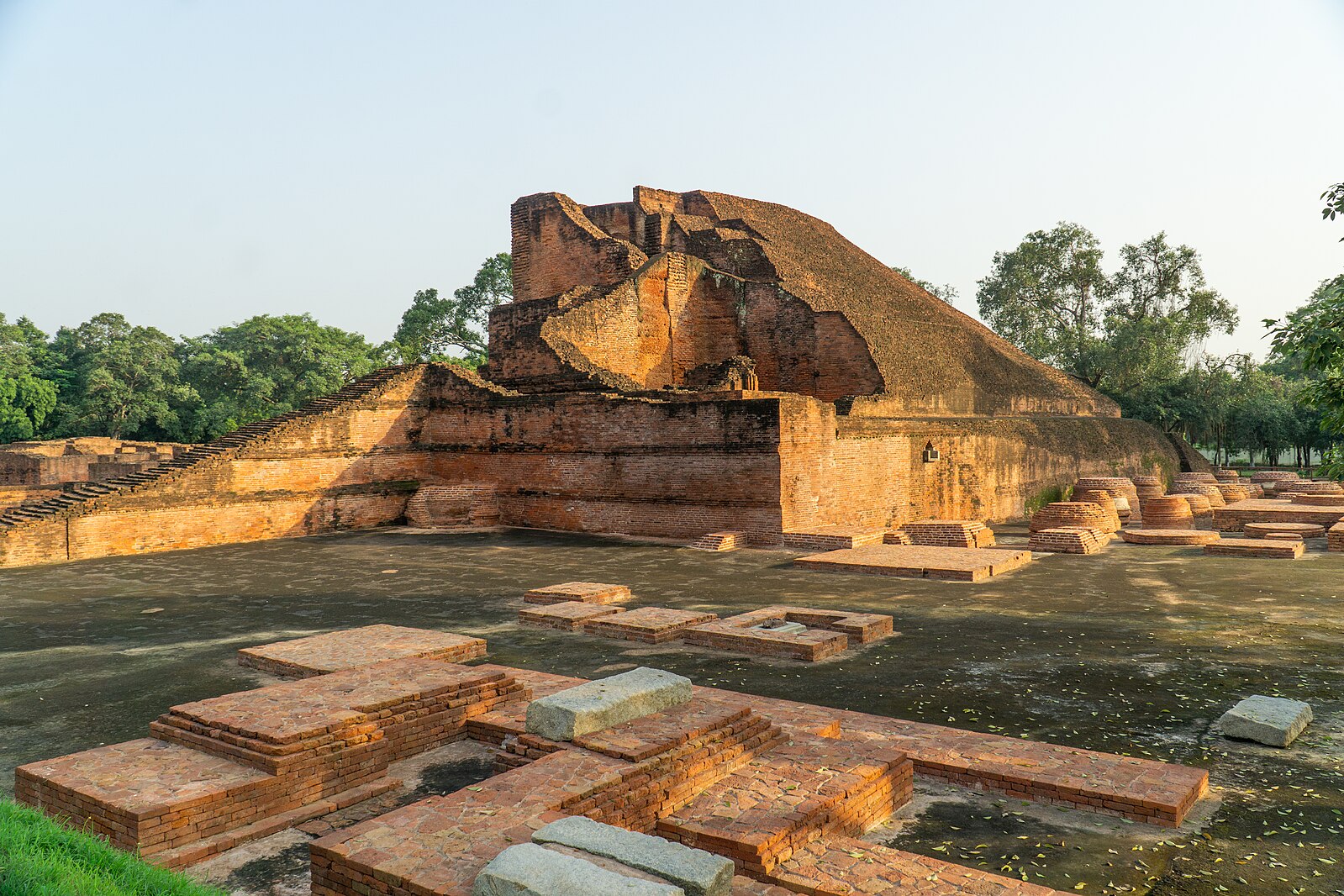
Image by Sumitsurai, via Wikimedia Commons
Of the nine million handwritten Buddhist manuscripts in Nalanda’s library at the time of its destruction, “only a handful” survived. Some of them eventually made their way to the Los Angeles County Museum of Art, a fitting enough tribute to the world-spanning outlook of the institution. Not far from its original location, now a UNESCO World Heritage site, Nalanda is making a comeback as an international place of learning for the twenty-first century. You can get a sense of how that project is shaping up from the BBC Reel video above. “I think we are already a university of the future,” says its Vice Chancellor Sunaina Singh, and indeed, a promising vision of the future needs nothing quite so much as a sufficiently deep past.
Related content:
Introduction to Indian Philosophy: A Free Online Course
How 99% of Ancient Literature Was Lost
Based in Seoul, Colin Marshall writes and broadcasts on cities, language, and culture. His projects include the Substack newsletter Books on Cities, the book The Stateless City: a Walk through 21st-Century Los Angeles and the video series The City in Cinema. Follow him on Twitter at @colinmarshall or on Facebook.
Read More...Isaac Asimov Predicts the Future in 1982: Computers Will Be “at the Center of Everything;” Robots Will Take Human Jobs
Four decades ago, our civilization seemed to stand on the brink of a great transformation. The Cold War had stoked around 35 years of every-intensifying developments, including but not limited to the Space Race. The personal computer had been on the market just long enough for most Americans to, if not actually own one, then at least to wonder if they might soon find themselves in need of one. On New Year’s Eve of 1982, The MacNeil-Lehrer News Hour offered its viewers a glimpse of the shape of things to come by inviting a trio of forward-looking guests, Wasn’t the Future Wonderful author Tim Onosko; Omni magazine editor Dick Teresi; and, most distinguished of all, Isaac Asimov.
As the “author of more than 250 books, light and heavy, fiction and non-fiction, some of the most notable being about the future,” Asimov had long been a go-to interviewee for media outlets in need of long-range predictions about technology, society, and the dynamic relationship between the two. (Here on Open Culture, we’ve previously featured his speculations from 1983, 1980, 1978, 1967, and 1964.) Robert MacNeil opens with a natural subject for any science-fiction writer: mankind’s forays into outer space, and whether Asimov sees “anything left out there.” Asimov’s response: “Oh, everything.”
In the early eighties, the man who wrote the Foundation series saw humanity as “still in the Christopher Columbus stage as far as space is concerned,” foreseeing not just space stations but “solar power stations,” “laboratories and factories that can do things in space that are difficult or impossible to do on Earth,” and even “space settlements in which thousands of people can be housed more or less permanently.” In the fullness of time, the goal would be to “build a larger and more elaborate civilization and one which does not depend upon the resources of one world.”
As for “the computer age,” asks Jim Lehrer; “have we crested on that one as well”? Asimov knew full well that the computer would be “at the center of everything.” Just as had happened with television over the previous generation, “computers are going to be necessary in the house to do a great many things, some in the way of entertainment, some in the way of making life a little easier, and everyone will want it.” There were many, even then, who could feel real excitement at the prospect of such a future. But what of robots, which, as even Asimov knew, would come to “replace human beings?”
“It’s not that they kill them, but they kill their jobs,” he explains, and those who lose the old jobs may not be equipped to take on any of the new ones. “We are going to have to accept an important role — society as a whole — in making sure that the transition period from the pre-robotic technology to the post-robotic technology is as painless as possible. We have to make sure that people aren’t treated as though they’re used up dishrags, that they have to be allowed to live and retain their self-respect.” Today, the technology of the moment is artificial intelligence, which the news media haven’t hesitated to pay near-obsessive attention to. (I’m traveling in Japan at the moment, and saw just such a broadcast on my hotel TV this morning.) Would that they still had an Asimov to discuss it with a level-headed, far-sighted perspective.
Related content:
Isaac Asimov Predicts the Future on The David Letterman Show (1980)
Based in Seoul, Colin Marshall writes and broadcasts on cities, language, and culture. His projects include the Substack newsletter Books on Cities, the book The Stateless City: a Walk through 21st-Century Los Angeles and the video series The City in Cinema. Follow him on Twitter at @colinmarshall or on Facebook.
Read More...The Jazz Classic “Take Five” Played Beautifully on a 1959 Classical Guitar
Above we have George Sakellariou performing Paul Desmond’s jazz classic, “Take Five,” on a vintage 1959 Viuda y Sobrinos de Domingo Esteso (Conde Hermanos) classical guitar. First recorded in 1959 by the Dave Brubeck Quartet, the track eventually became the best-selling jazz song of all time. It’s also a song frequently covered by other talented musicians. Originally from Athens, George Sakellariou joined the San Francisco Conservatory of Music and later became chairman of their Guitar Department. As his bio notes, his guitar style places an emphasis “on clear tone and smooth lyrical lines,” all on display here. Enjoy…
Related Content
Watch an Incredible Performance of “Take Five” by the Dave Brubeck Quartet (1964)
How Dave Brubeck’s Time Out Changed Jazz Music
Pakistani Musicians Play a Wonderful Version of Dave Brubeck’s Jazz Classic, “Take Five”
Read More...Scenes from Life in Paris During the 1920s, Colorized and Restored: Cafés, Notre Dame, Street Life & More
Few cities have been as romanticized as Paris, and few eras in Paris have been as romanticized as the nineteen-twenties. This owes much to the famous expatriate artistic and literary figures residing there in that decade: Ernest Hemingway, Salvador Dalí, F. Scott and Zelda Fitzgerald, Pablo Picasso, Gertrude Stein, and Man Ray, to name just a few of the figures revived in Woody Allen’s Midnight in Paris. It’s still difficult, a century later, not to feel at least some curiosity about the real Paris in the twenties, footage of which you can see colorized and enhanced to play at a smooth 60 frames per second in the video above.
In some respects, Paris hasn’t changed much over the past hundred or so years. Notre-Dame, the bridges across the Seine, and the colonne Vendôme will be immediately recognizable to anyone who’s been there.
And though the attire of Parisians may be unrecognizable, their habits certainly aren’t: then as now, they clearly spent considerable amounts of time on les terrasses of their cafés of choice. (And in some cases, they’re just the same cafés, as in the case of Le Dôme and Le Café de la Paix.) And though a few of them still read newspapers there in the twenty-twenties, many more did in the nineteen twenties, the invention of the smartphone lying about eighty years in the future.
For some of us, the absence of screens alone may feel like reason enough to time-travel back, as Owen Wilson’s disaffected Hollywood screenwriter does in Midnight in Paris. If we consider the state of plumbing, heating and dentistry in the France after World War I, we may have second thoughts, and surely our foreknowledge of World War II would also put a damper on the experience. But romance is romance, and if we could successfully manage to integrate ourselves into the urban life captured by these film clips, we might just get used to it, and even want to stick around for a few more decades after Hemingway, Picasso, the Fitzgeralds, et al leave the scene. After all, les Trente Glorieuses were still to come.
via MyModernMet
Related content:
Paris, New York & Havana Come to Life in Colorized Films Shot Between 1890 and 1931
Color Footage of the Liberation of Paris, Shot by Hollywood Director George Stevens (1944)
Based in Seoul, Colin Marshall writes and broadcasts on cities, language, and culture. His projects include the Substack newsletter Books on Cities, the book The Stateless City: a Walk through 21st-Century Los Angeles and the video series The City in Cinema. Follow him on Twitter at @colinmarshall or on Facebook.
Read More...Watch a 1915 Film Adaptation of Alice in Wonderland Enhanced in 4K, with Costumes Based on Original Illustrations by Sir John Tenniel
Alice’s Adventures in Wonderland predates the invention of cinema by a couple of decades. Nevertheless, much like the “Drink me” bottle and “Eat me” presented to its young protagonist, Lewis Carroll’s fantastical tale has called out the same message to generations of filmmakers around the world: “Adapt me.” This century, though not even a quarter of the way over, has already brought us full-length Alice movies (to say nothing of television productions) from Europe, South America, and of course the United States. Those last include separate adaptations of Alice’s Adventures in Wonderland and its sequel Alice Through the Looking Glass by no less an auteur than Tim Burton.
Both of those books were also taken on by a writer-director named W. W. Young more than a century ago, though he simply combined portions of both novels into a single feature. You can watch this silent Alice in Wonderland from 1915 above, in a version its uploader calls “by far the highest quality version of this film on the internet,” assembled “primarily from two prints scanned by the Library of Congress, along with a few other sources.
Enhanced with “scene-by-scene image stabilization,” it also excises “many title cards which were not part of the original film” added to subsequent versions, “and which slowed down the film considerably.”
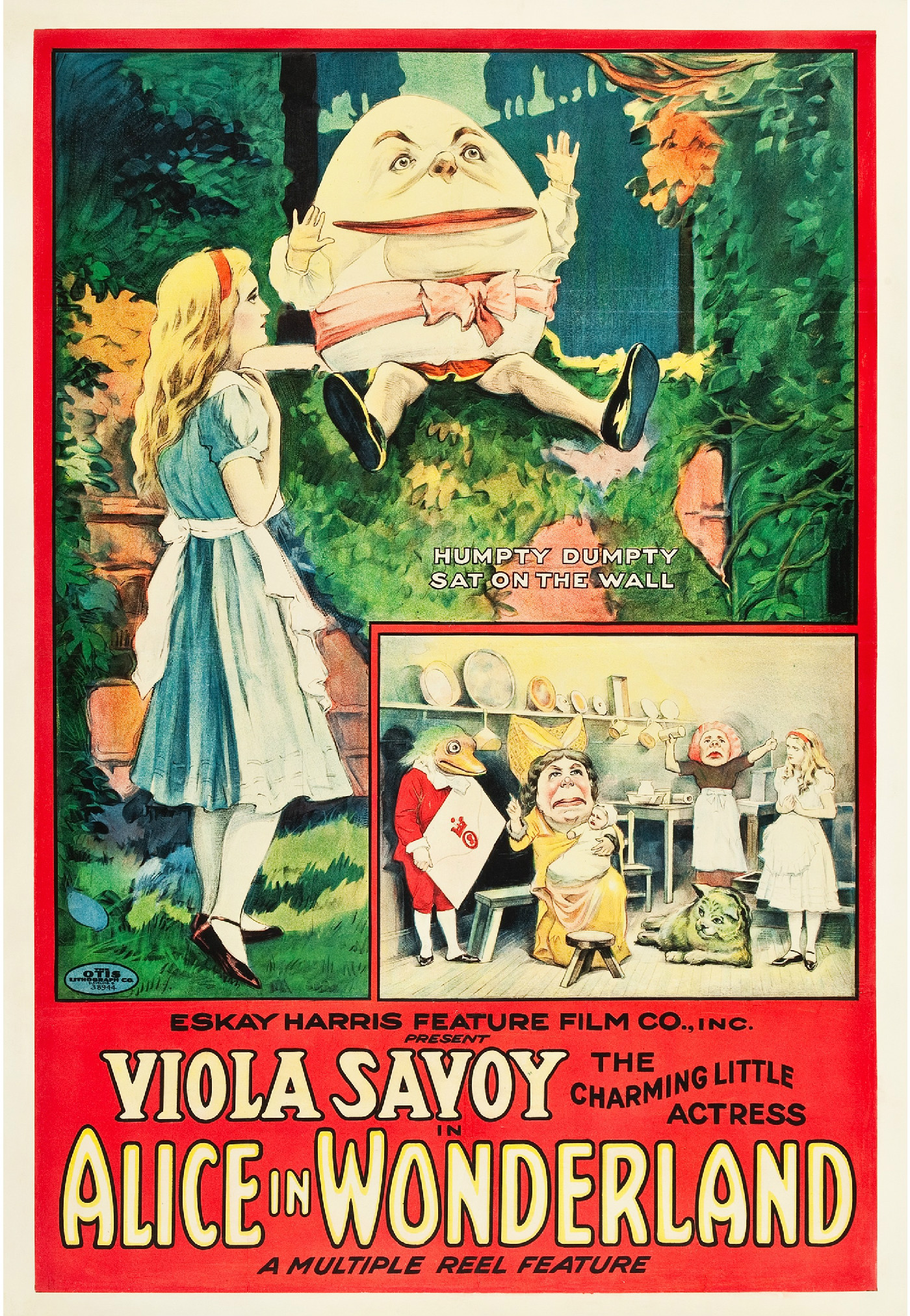
Running just under an hour, this reconstruction includes scenes with such widely known characters as the Caterpillar, the Cheshire Cat, the Mock Turtle and the Queen of Hearts. Young’s footage of such figures as Tweedledee and Tweedledum and Humpty Dumpty has, alas, been lost to time. Still, unusually for a film adaptation, this version includes much of Carroll’s parodic poem “You Are Old, Father William” — more, even, than made it into Disney’s beloved animated feature of 1951. With its stiff costumes (based on the original illustrations by Sir John Tenniel) and Long Island backdrops, Alice in Wonderland may not boast quite the same production value, but watching it now, long after the silent era, one can’t help but feel transported to another reality altogether.
Related content:
The First-Ever Film Version of Lewis Carroll’s Tale Alice in Wonderland (1903)
Alice’s Adventures in Wonderland Read by Sir John Gielgud
When Aldous Huxley Wrote a Script for Disney’s Alice in Wonderland
Based in Seoul, Colin Marshall writes and broadcasts on cities, language, and culture. His projects include the Substack newsletter Books on Cities, the book The Stateless City: a Walk through 21st-Century Los Angeles and the video series The City in Cinema. Follow him on Twitter at @colinmarshall or on Facebook.
Read More...Support Us
We're hoping to rely on loyal readers, rather than erratic ads. Please click the Donate button and support Open Culture. You can use Paypal, Venmo, Patreon, even Crypto! We thank you!

About Us

Open Culture scours the web for the best educational media. We find the free courses and audio books you need, the language lessons & educational videos you want, and plenty of enlightenment in between.
Advertise With Us
FREE UPDATES!
GET OUR DAILY EMAIL
Get the best cultural and educational resources on the web curated for you in a daily email. We never spam. Unsubscribe at any time.
FOLLOW ON SOCIAL MEDIA
Open Culture editor Dan Colman scours the web for the best educational media. He finds the free courses and audio books you need, the language lessons & movies you want, and plenty of enlightenment in between.
Advertise With Us


.jpg)