Countries and Coastlines: A Dramatic View of Earth from Outer Space
We’ve shown you What a Hurricane Looks Like From Outer Space and NASA’s 7 Minute Tour of the Earth from Space (in HD). Now comes new high resolution footage from the International Space Station that gives you a dramatic view of coastlines and countries around the world. Produced by Space Rip, this clip will give you an extraordinary view of England, France, Italy, Egypt, Algeria, Tunisia, Greece, the island of Crete, Taiwan, South Korea, Japan, the United States, Mexico, Ecuador, Peru, Chile, Argentina, and Cuba. Find this video housed in our collection of 125 Great Science Videos. If you love space travel, astronomy, physics, neuroscience or technology, then you will definitely want to spend time rummaging through the collection.
Follow us on Facebook, Twitter and now Google Plus and we’ll deliver intelligent media right to your virtual doorstep.
Read More...Underground Cartoonist R. Crumb Introduces Us to His Rollicking Album Cover Designs
Music and comic book art are the two passions of Robert Crumb’s creative life. In this video from W.W. Norton, Crumb talks about his obsessive interest in the old-time blues, folk and country music of the 1920s and 1930s. “I think it’s neurological,” he says. “Some quirky types of nervous systems are just attracted to that old music.”
As one of the pioneers of the underground comix movement in the late 1960s, Crumb’s work often related in some way to his love of music. His famous “Keep on Truckin’ ” comic of 1968 was inspired by the lyrics of Blind Boy Fuller’s song, “Truckin’ My Blues Away.” That same year Janis Joplin, who was singing with Big Brother & the Holding Company, asked Crumb to design the cover of the band’s album Cheap Thrills.
Since then, Crumb has designed hundreds of album covers and music posters. His new book, R. Crumb: The Complete Record Cover Collection, brings together all the covers and many related works. The book contains portraits of famous artists like Robert Johnson and Woody Guthrie, along with works featuring obscure artists with names like “Ukelele Ike” and “Big John Wrencher and his Maxwell Street Blues Boys.” There are also covers and posters made for Crumb’s own band, the Cheap Suit Serenaders.
Crumb is a banjo and mandolin player. One group he has sat in with in recent years is Eden & John’s East River String Band. This video was directed by the group’s co-leader, John Heneghan, and includes appearances by himself and his partner Eden Brower. The video features the following songs:
- “Sing Song Girl” by Leroy Sheild (1930)
- “Some of these Days” by Cab Calloway (1930)
- “Lindberg Hop” by the Memphis Jug Band (1928)
- “Down On Me” by Eddie Head and His Family (1930)
- “Chasin’ Rainbows” by R. Crumb and his Cheap Suit Serenaders (1976)
- “Singing in the Bathtub” by R. Crumb and his Cheap Suit Serenaders (1978)
- “So Sorry Dear” by Eden & John’s East River String Band, featuring R. Crumb
Related Content:
Robert Crumb Illustrates Philip K. Dick’s Infamous, Hallucinatory Meeting with God (1974)
A Short History of America, According to the Irreverent Comic Satirist Robert Crumb
Read More...Tim Burton’s The World of Stainboy: Watch the Complete Animated Series

In his 1997 book of drawings and verse, The Melancholy Death of Oyster Boy & Other Stories, Tim Burton imagines a bizarre menagerie of misfits with names like Toxic Boy, Junk Girl, the Pin Cushion Queen and the Boy with Nails in his Eyes.
“Inspired by such childhood heroes as Dr. Seuss and Roald Dahl,” writes James Ryan in the New York Times, “Mr. Burton’s slim volume exquisitely conveys the pain of an adolescent outsider. Like his movies, the work manages to be both childlike and sophisticated, blending the innocent with the macabre.”
One of those adolescent outsiders is Stain Boy, a strange kind of superhero:
He can’t fly around tall buildings,
or outrun a speeding train,
the only talent he seems to have
is to leave a nasty stain.
Sometimes I know it bothers him,
that he can’t run or swim or fly,
and because of this one ability,
his dry cleaning bill is sky-high.
In 2000, Burton extended Stain Boy’s adventures (and compressed his name into one word) with The World of Stainboy, a series of short animations commissioned for the Internet by Shockwave.com. “For some stories you have to wait for the right medium,” Burton said at the time. “I think (the Internet’s) the perfect forum to tell a sad little story like this one. Stainboy is a character that doesn’t do much. He’s just perfect for four-minute animations.”
Burton created a series of sketches, watercolors and pastel-accented gray-on-gray washes and brought them, along with a script and storyboards, to Flinch Studio for translation into Macromedia Flash animation. Twenty-six episodes were planned, but only six were completed. “Stainboy was an experiment in developing revenue streams for the Web,” writes Alison McMahan in The Films of Tim Burton: Animating Live Action in Contemporary Hollywood, “but it did not succeed, at least not financially.”
The Stainboy character was resurrected briefly in late 2010, when Burton invited fans to compose a new Stainboy adventure in brief installments via Twitter. Burton pieced together a story using the best tweets. (You can read the final result here.) Meanwhile, the original Web animations have continued to attract a following. You can watch the complete six-part series below in HD. As you will see, some episodes introduce new characters — Stare Girl, Toxic Boy, Bowling Ball Head and the rest:
Episode 1: Stare Girl
Episode 2: Toxic Boy
Episode 3: Bowling Ball Head
Episode 4: Robot Boy
Episode 5: Matchstick Girl
Episode 6: The Origin of Stainboy
You can find the Stainboy videos on our list of Free Online Animations, a subset of our meta collection, 4,000+ Free Movies Online: Great Classics, Indies, Noir, Westerns, Documentaries & More.
Related Content:
Vincent: Tim Burton’s Early Animated Film
Tim Burton: A Look Inside His Visual Imagination
Read More...Harry Houdini’s Great Rope Escape (Circa 1920)
Harry Houdini (né Erik Weisz) emigrated from Hungary to the United States as a youngster, settling first in Wisconsin, then later in New York City. Captivated by magic from an early age, Houdini (1874–1926) began performing small-time magic shows and experimenting with escape acts, eventually honing his ability to escape from handcuffs. Then he never looked back:
Arriving in a new town, Houdini would claim the ability to escape from any handcuffs provided by the local police. His easy escapes provided excellent publicity for his shows. Houdini offered $100 to anyone who provided handcuffs from which he could not escape, but he never had to pay. Through his increasingly complex escapes and his shrewd use of publicity, Houdini became a headliner on the vaudeville circuit, playing in cities across the country. Not satisfied with that low level of fame, however, Houdini decided to gamble by taking his act to Europe.
When he returned from Europe, Houdini performed increasingly high-profile stunts — e.g., freeing himself from chains after jumping into Boston’s Charles River, escaping from a strait jacket while hanging upside down in Times Square, breaking out of a prison cell that held the assassin of President James Garfield. Today, we have Houdini performing a more straightforward escape — from a simple chair and rope. Below, in an image appearing in Ladies’ Home Journal (1918), Houdini tells you a little about how he made his great rope escape. He offers more details here. The video above was shot circa 1920.
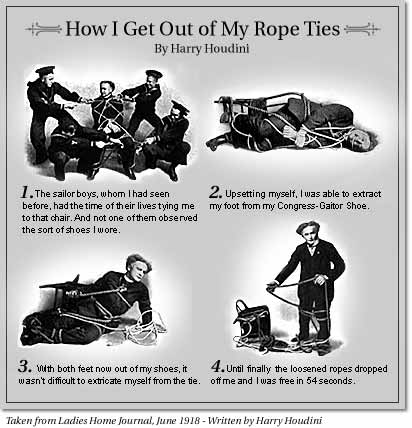
If you would like to support the mission of Open Culture, consider making a donation to our site. It’s hard to rely 100% on ads, and your contributions will help us continue providing the best free cultural and educational materials to learners everywhere. You can contribute through PayPal, Patreon, and Venmo (@openculture). Thanks!
Related Content:
Watch Houdini Escape From a Strait Jacket, Then See How He Did It (Circa 1917)
Read More...Dave Brubeck Gets an Uplifting Musical Surprise from a Young Violinist in Moscow (1997)
December 2, 1997. Exactly ten years after his first visit to Moscow, jazz legend Dave Brubeck returned to perform before the faculty and students of the Moscow Conservatory. During his concert, an audience member asked him to improvise on the old Russian sea shanty “Ej, Uhnem.” About two minutes into the improvisation, a young violinist rose from his seat and started to play along. You just have to love Dave’s surprised look at 2:09.
This young man turned out to be a student at the conservatory. His name is Denis Kolobov and he is now a violinist of international renown. Denis must have mustered up all of his courage to cut into the performance of one of the great jazz pianists. But the day before, French jazz violinist Stéphane Grappelli had died in Paris and Denis decided to honor Grappelli’s memory in this way. What a great idea!
By profession, Matthias Rascher teaches English and History at a High School in northern Bavaria, Germany. In his free time he scours the web for good links and posts the best finds on Twitter.
Read More...Katharine Hepburn Rearranges the Furniture on The Dick Cavett Show
Earlier this week, we brought you Audrey Hepburn’s Screen Test for Roman Holiday (1953). Next up, we have Katharine Hepburn appearing on the very 70s set of The Dick Cavett Show. In case you’re wondering, the two Hepburns were only distantly related. According to Salon, they shared one common ancestor, James Hepburn, Earl of Bothwell, the third husband of Mary, Queen of Scots.
Anyway, here’s the backstory on the Cavett interview that aired on September 14, 1973:
Hepburn rarely granted interviews, and when she did, she wanted them under her terms. When she agreed to appear on the Dick Cavett Show they went in the studio a day early so she could get the feel of things. They ended up doing the interview right then and there, without an audience.
Watch a clip of the actual interview here.
In the past, we have featured Cavett’s interviews with Ingmar Bergman, Woody Allen, John Lennon & Yoko Ono, and George Harrison. And don’t forget this feud between Norman Mailer and Gore Vidal. Through Amazon, you can also purchase highlights of conversations with Marlon Brando, Fred Astaire, Robert Mitchum, Orson Welles, Groucho Marx, Kirk Douglas, Bette Davis, and others. h/t Peter Kaufman
Follow us on Facebook, Twitter and now Google Plus and share intelligent media with your friends! They’ll thank you for it.
Read More...Watch A Brief History of Time, Errol Morris’ Film About the Life & Work of Stephen Hawking
Brilliant but unmotivated, Stephen Hawking was a 21-year-old PhD student at Cambridge when he first noticed something was wrong. He was falling down a lot, and dropping things. He went into the hospital for tests, and learned he had amyotrophic lateral sclerosis, or ALS. The doctors told him he would gradually lose control of every muscle in his body.
“My dreams at that time were rather disturbed,” Hawking said. “Before my condition had been diagnosed, I had been very bored with life. There had not seemed to be anything worth doing. But shortly after I came out of hospital, I dreamt that I was going to be executed. I suddenly realized that there were a lot of worthwhile things I could do if I were reprieved.”
The doctors gave the young man two and a half years to live. That was in early 1963. Over the next half century, Hawking defied all odds and went on to become one of the most celebrated scientists of the era, making major contributions to quantum cosmology and the understanding of black holes. Along the way, the wheelchair-bound Hawking became a cultural icon, a symbol of disembodied intellect and indomitable spirit.
This coming Sunday, 49 years after his grim diagnosis, Hawking will turn 70. A scientific conference in his honor got underway today at the University of Cambridge’s Centre for Theoretical Cosmology, and will culminate on Sunday with a public symposium, “The State of the Universe,” featuring some of the world’s greatest astronomers and physicists, including Martin Rees, Kip Thorne and Saul Perlmutter. You can watch live streaming video of the events at the official website.
To help celebrate, we present Errol Morris’s 1992 film of A Brief History of Time (above), Hawking’s bestselling book. Morris weaves biography in with the science, interviewing members of Hawking’s family–his mother, sister and aunt–along with friends and colleagues, including Roger Penrose, Dennis Sciama and John Archibald Wheeler.
A Brief History of Time was Morris’s first film as a director-for-hire (he was recruited by Steven Spielberg for Amblin Entertainment), which created some difficulties, but Morris was pleased with the outcome. He later said, “It’s actually one of the most beautiful films I ever shot.” The film won the Grand Jury Prize for Documentary Filmmaking and the Documentary Filmmaker’s Trophy at the Sundance Film Festival.
In 1992 Morris told the New York Times Magazine that A Brief History of Time was “less cerebral and more moving” than anything he had worked on before. “This feeling of time, of aging, of mortality combined with this search for the most basic and deep questions about the world around us and ourselves,” Morris said, “is pretty persuasive stuff.” Find it listed in our Free Movies Online collection, within the Documentary section.
Read More...Remembering Eve Arnold, Pioneering Photojournalist
Eve Arnold, one of the pioneering women of photojournalism, died Wednesday at the age of 99.
Widely known for her photographs of Marilyn Monroe and other celebrities, Arnold just as often photographed the poor and the unknown. “I don’t see anybody as either ordinary or extraordinary,” she told the BBC in 1990. “I see them simply as people in front of my lens.”
Born Eve Cohen in Philadelphia on April 21, 1912, she was one of nine children of Ukrainian immigrant parents. When she was 28 years old she gave up plans to become a doctor after a boyfriend gave her a camera. She studied photography for a brief time under Alexey Brodovitch at the New School for Social Research before going out on her own and finding her style.
“I didn’t work in a studio, I didn’t light anything,” Arnold would later say. “I found a way of working which pleased me because I didn’t have to frighten people with heavy equipment. It was that little black box and me.”
A series of photographs Arnold took of fashion shows in Harlem attracted the attention of Henri Cartier-Bresson, one of the founders of Magnum Photos, and she was invited to contribute to the agency. In 1957 Arnold became the first woman photographer to join Magnum as a full member. She worked often for Life and later, after moving to England in 1961, for The Sunday Times Magazine, traveling to places like Afghanistan, South Africa, Mongolia and Cuba while always maintaining a personal point of view. In her 1976 book, The Unretouched Woman, Arnold wrote:
Themes recur again and again in my work. I have been poor and I wanted to document poverty; I had lost a child and I was obsessed with birth; I was interested in politics and I wanted to know how it affected our lives; I am a woman and I wanted to know about women.
Arnold published 15 books in her lifetime, including the National Book Award-winning In China. In 2003 she was awarded the Order of the British Empire by Queen Elisabeth II, whom she had once photographed. In the 2007 book Magnum Magnum, photographer Elliott Erwitt summed things up:
Eve Arnold’s legacy is as varied as it is fascinating. It is hard to fathom how one person’s work can be so diverse. I covers the humblest to the most exalted, the meanest to the kindest, and everything in between. The subjects are all there in Eve Arnold’s photographs and they are treated with intelligence, consideration and sympathy. Most important is Eve’s ability to visually communicate her concerns directly, without fanfare or pretense, in the best humanistic tradition.
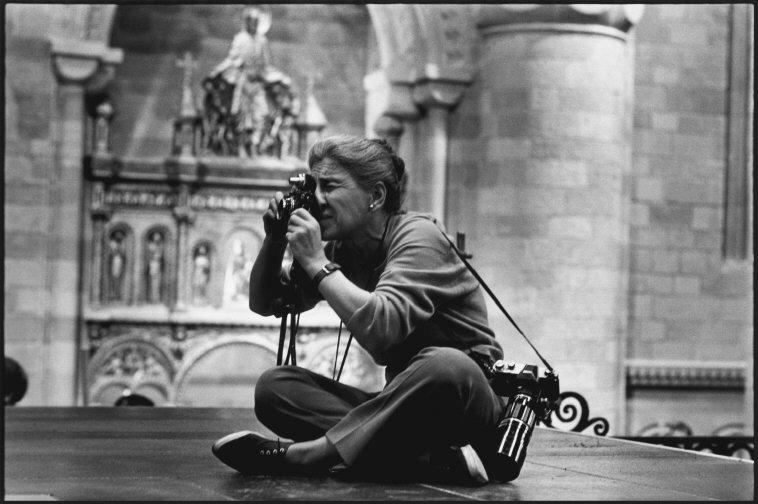
Eve Arnold on the set of Beckett, 1963, by Robert Penn. (© Copyright Eve Arnold/Magnum Photos)
Read More...Ancient Greek Punishments: The Retro Video Game

When you have a sense of humor and some free time, this is what you can come up with: Let’s Play Ancient Greek Punishment!
This amusing little creation lets users play vintage-style video games based on Ancient Greek mythology. You’re asked to toggle the “G” and “H” keys as rapidly as you can … until you realize something: the games, like the punishments meted out in Greek mythology, have no end. They go on for eternity.
The Theoi Greek Mythology internet encyclopedia will tell you more about the suffering of Sisyphus, Prometheus and others.
Ready for more retro-cultural video games? Here you go:
The Great Gatsby and Waiting for Godot: The Video Game Editions
The Long Lost Video Game of Paris Review Editor George Plimpton?
via Metafilter
Read More...Free: Isaac Asimov’s Epic Foundation Trilogy Dramatized in Classic Audio
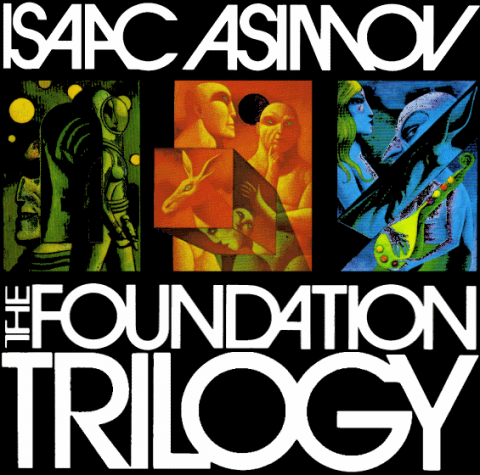
Permit us to stay on our recent sci-fi tangent just a tad bit longer.…
Between 1951 and 1953, Isaac Asimov published three books that formed the now legendary Foundation Trilogy. Many considered it a masterwork in science fiction, and that view became official doctrine in 1966 when the trilogy received a special Hugo Award for Best All-Time Series, notably beating out Tolkien’s The Lord of the Rings. (Don’t miss the vintage Tolkien documentary we featured yesterday.)
Eventually, the BBC decided to adapt Asimov’s trilogy to the radio, dramatizing the series in eight one-hour episodes that aired between May and June 1973. Years later, you can buy the radio drama on iTunes for $9.99. Or your can stream it on Spotify (above) or via the Internet Archive below.
More Free Sci-Fi & Fantasy:
Download the Complete Chronicles of Narnia by C.S. Lewis for Free
Aldous Huxley Reads Dramatized Version of Brave New World
Free Philip K. Dick: Download 11 Great Science Fiction Stories
Neil Gaiman’s Free Short Stories
Read More...Support Us
We're hoping to rely on loyal readers, rather than erratic ads. Please click the Donate button and support Open Culture. You can use Paypal, Venmo, Patreon, even Crypto! We thank you!

About Us

Open Culture scours the web for the best educational media. We find the free courses and audio books you need, the language lessons & educational videos you want, and plenty of enlightenment in between.
Advertise With Us

FREE UPDATES!
GET OUR DAILY EMAIL
Get the best cultural and educational resources on the web curated for you in a daily email. We never spam. Unsubscribe at any time.
FOLLOW ON SOCIAL MEDIA

Open Culture editor Dan Colman scours the web for the best educational media. He finds the free courses and audio books you need, the language lessons & movies you want, and plenty of enlightenment in between.
Advertise With Us

