The Bloody Olive: A Wickedly Fun Homage to the Film Noir Tradition
Shortly after finishing film school, the young Belgian director Vincent Bal shot The Bloody Olive (1996), a 10 minute film based on a comic book by the French artist Lewis Trondheim. It was an instant hit, winning over 20 awards at film festivals worldwide. Wanting to keep things spoiler-free around here, let us just say this: the short film pays a fun little tribute to the film noir tradition — its aesthetic, conventions and all of the rest.
For more film noir fun, don’t miss Key Lime Pie, a 2007 animated film in the noir tradition, or our collection of 31 Free Noir Films. The noir collection features classics by John Huston, Elia Kazan, Fritz Lang, Ida Lupino, Otto Preminger, Orson Welles and others. You can find great classics from other genres within our list of Free Movies Online.
Read More...Lawrence Krauss on the Mysterious Allure of Extra Dimensions
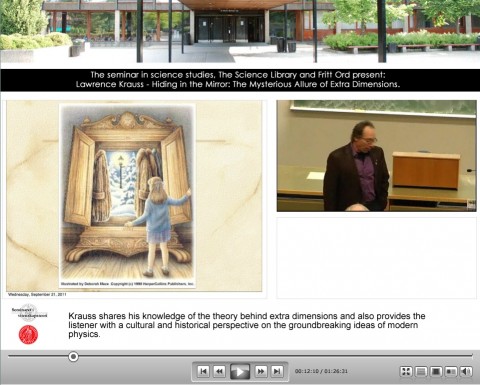
In the world of everyday experience we conceive of three dimensions of space. Through any point, no more than three perpendicular lines may pass. The notion that there might be more than three dimensions has traditionally been the domain of science fiction shows like The Twilight Zone.
In this engaging lecture (click image above to watch), theoretical physicist Lawrence Krauss explains the growing respectability of extra-dimensional theories in physics, tracing the evolution of the idea from Plato’s cave through Edwin A. Abbott’s Flatland, and from Einstein-Minkowski spacetime through Kaluza-Klein theory, on into modern-day string theory.
Titled “Hiding in the Mirror: The Mysterious Allure of Extra Dimensions,” Krauss’s presentation was given in September at a conference in Oslo, Norway, organized by the Fritt Ord Foundation. The speech lasts about an hour and is followed by a question-and-answer session.
via Richard Dawkins
Related Content:
Lawrence Krauss Explains How You Get ‘A Universe From Nothing’
Lawrence Krauss: Every Atom in Your Body Comes From a Star
Free Physics Courses (From our big collection of Free Online Courses)
Read More...A Young Frank Zappa Turns the Bicycle into a Musical Instrument on The Steve Allen Show (1963)
Last week we gave you John Cage performing his avant-garde composition Water Walk on the CBS game show “I’ve Got a Secret” in 1960. Now, this week, we’re following up with a nice complement — Frank Zappa bringing his own brand of offbeat music to the American airwaves in 1963. Only 22 years old and not yet famous, Zappa appeared on The Steve Allen Show and made music with some drumsticks, a bass bow, and two garden-variety bicycles — and nothing more.
The video above gives you mostly the prelude to the actual music. Then, in the first video below, Zappa gives a demo of the instruments. Next comes the Concerto for Two Bicycles, which features the show’s house orchestra joining the cacophonous fun. The clips run a good 15 minutes.
If you would like to support the mission of Open Culture, consider making a donation to our site. It’s hard to rely 100% on ads, and your contributions will help us continue providing the best free cultural and educational materials to learners everywhere. You can contribute through PayPal, Patreon, and Venmo (@openculture). Thanks!
Related Content:
Frank Zappa Explains the Decline of the Music Business (1987)
Frank Zappa’s Amazing Final Concerts: Prague and Budapest, 1991
Read More...The Best of Open Culture 2011
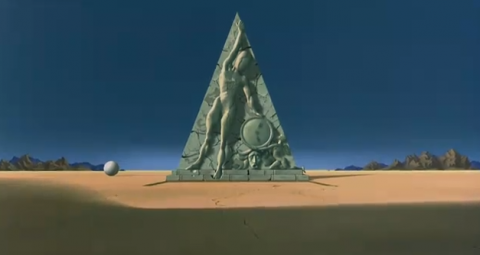
Before we rush headlong into a new year, it’s worth pausing, ever so briefly, to consider the ground we covered in 2011. What topics resonated with you … and jazzed us? Today, we’re highlighting 10 thematic areas (and 46 posts) that captured the imagination. Chances are you missed a few gems here. So please join us on our brief journey back into time. Tomorrow, we start looking forward again.
1) Universities Offer More Free Courses, Then Start Pushing Toward Certificates: The year started well enough. Yale released another 10 stellar open courses. (Find them on our list of 400 Free Courses). Then other universities started pushing the envelope on the open course format. This fall, Stanford launched a series of free courses that combined video lectures with more dynamic resources — short quizzes; the ability to pose questions to Stanford instructors; feedback on your overall performance; a statement of accomplishment from the instructor, etc. A new round of free courses will start in January and February. (Get the full list and enroll here.) Finally, keep your eyes peeled for this: In 2012, MIT will offer similar courses, but with one big difference. Students will get an official certificate at the end of the course, all at a very minimal charge. More details here.
2) Cultural Icons at Occupy Wall Street: OWS was a big national story, and we were always intrigued by its cultural dimension — by the cultural figures who championed the movement. You can revisit performances/speeches by: Philip Glass & Lou Reed; Willie Nelson, Pete Seeger, and Arlo Guthrie; David Crosby and Graham Nash; Joseph Stiglitz and Lawrence Lessig; Noam Chomsky; and Slavoj Zizek. Also check out: 8 Lectures from Occupy Harvard and Artistic Posters From Occupy Wall Street.
3) Books Intelligent People Should Read: Neil deGrasse Tyson’s list “8 (Free) Books Every Intelligent Person Should Read” ended up generating far more conversation and controversy than we would have expected. (Users have left 83 comments at last count.) No matter what you think of his rationale for choosing these texts, the books make for essential reading, and they’re freely available online.
Tyson’s list dovetails fairly nicely with another list of essential texts — The Harvard Classics, a 51 volume set that’s available online. According to Charles W. Eliot, the legendary Harvard president, if you were to spend just 15 minutes a day reading these books, you could give yourself a proper liberal education. And that could partly apply to another list we pulled together: 20 Popular High School Books Available as Free eBooks & Audio Books — the great literary classics taught in classrooms all across America, all free…
4) Christopher Hitchens and Stephen Fry: Christopher Hitchens left us this past month. And, until his last day, Hitchens was the same old Hitch — prolific, incisive, surly and defiant, especially when asked about whether he’d change his position on religion, spirituality and the afterlife. All of this was on display when he spoke at the American Jewish University in Los Angeles last February. We covered his comments in a post called, No Deathbed Conversion for Me, Thanks, But it was Good of You to Ask. And even from the grave, Hitchens did more of the same, forcing us to question the whole modern meaning of Christmas.
During Hitch’s final days, Stephen Fry emceed a large tribute to his friend in London, an event that brought together Richard Dawkins, Christopher Buckley, Salman Rushdie, Lewis Lapham, Martin Amis, poet James Fenton and actor Sean Penn. It’s well worth a watch. But you also shouldn’t miss some other great videos featuring the wisdom of Mr. Fry — his introduction to the strange world of nanoscience, his animated debate on the virtues (or lack thereof) of the Catholic Church, and his thoughtful reflection, What I Wish I Had Known When I Was 18.
5) Four for the Fab Four: John, Paul, Ringo and George. We sneak them in whenever we can. A sprinkling here and there. This year, we served up an ever-popular post, Guitarist Randy Bachman Demystifies the Opening Chord of ‘A Hard Day’s Night’, and a no less popular freebie: Download The Beatles’ Yellow Submarine as a Free, Interactive eBook. Trailing right behind are two other good Beatles picks: All Together Now: Every Beatles Song Played at Once and The Beatles’ Rooftop Concert: The Last Gig.
6) Wisdom from Great Philosophers: Want the chance to take courses from great philosophers? Here’s your opportunity. Our meta post brought together courses/lectures from Bertrand Russell, Michel Foucault, John Searle, Walter Kaufmann, Leo Strauss, Hubert Dreyfus, and Michael Sandel. You could get lost in this for days. Also while you’re at it, you should check out The History of Philosophy … Without Any Gaps, an ongoing podcast created by Peter Adamson (King’s College London) that moves from the Ancients to the Moderns. Plus we’d encourage you to revisit: Noam Chomsky & Michel Foucault Debate Human Nature & Power in 1971.
7) Vintage Film Collections: Scouring the web for vintage films. It’s something we love to do. In 2011, we brought you 22 films by Alfred Hitchcock, 25 Westerns with John Wayne, 32 Film Noir classics, and a series of films by the great Russian director Andrei Tarkovsky. All are listed in our big collection of Free Movies Online.
8) Back to the Future: We had fun going back — way back — and seeing how past generations imagined the future. Arthur C. Clarke Predicted the Future in 1964 … And Pretty Much Nailed It. Before that, American fashion designers looked roughly 70 years into the future and guessed how women might dress in Year 2000. Turns out fashion designers aren’t the best futurists. And, even before that (circa 1922), we get to see the world’s first mobile phone in action. Seriously!
9) Animated Films: 2011 started off on exactly the right note. On January 1, we featured Shel Silverstein’s animated version of The Giving Tree. Then some other gems followed: Destino, the Salvador Dalí – Disney collaboration that started in 1946 and finished in 1999; Spike Jonze’s Auprès de Toi (To Die By Your Side), a short stop motion film set inside the famous Parisian bookstore, Shakespeare and Company; John Turturro narrating an animated version of Italo Calvino’s fairy tale, “The False Grandmother;” and a series of animated films featuring the voice of Orson Welles. Also let’s not forget these splendid animation concepts for The Amazing Adventures of Kavalier and Clay and, just for good measure, Terry Gilliam’s vintage primer on making your own cut-out animation.
10) New Archives & Art on the Web: Last but not least — 2011’s new archival projects that brought great culture to the web.
- Google “Art Project” Brings Great Paintings & Museums to You
- Royal Society Opens Online Archive; Puts 60,000 Papers Online
- Google Puts The Dead Sea Scrolls Online (in Super High Resolution)
- The Smithsonian Launches Wildlife Photo Archive
- Sir Isaac Newton’s Papers & Annotated Principia Go Digital
And now onward into 2012.…
Read More...John Lennon Sums Up Elvis, Yoko & Howard Cosell in One Word
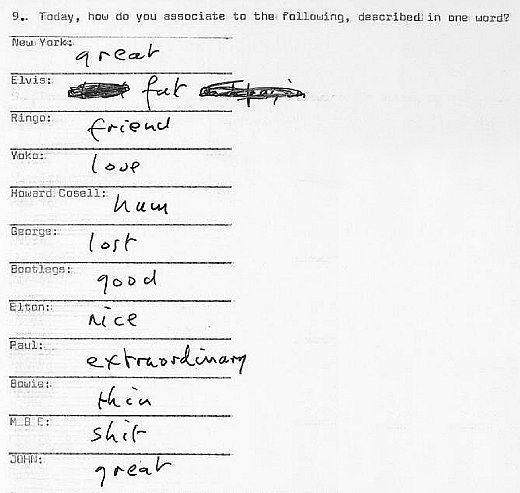
In 1976 a youthful fan named Stuart sent John Lennon a six-page list of questions. The former Beatle responded with answers, along with a child-like drawing of a lamb standing on a cloud, saying, “Hi Stuart.”
Stuart wanted to know a few things, like what sort of album Lennon was working on. “Until it’s been on tape,” Lennon replied, “I never know what it will be.” He also wondered if the famous musician was writing anything, like perhaps an autobiography. “Yes, I have been writing, but not an autobiography. I’ve noticed that people tend to DIE after writing their life story.”
The young fan included a list of words and names, along with the question: How would you characterize the following figures in one word?
- John: “Great”
- Paul: “Extraordinary”
- George: “Lost”
- Ringo: “Friend”
- Elvis: “Fat”
- Yoko: “Love”
- Howard Cosell: “Hum”
Lennon signed off with, “It was a pleasure, hope ya dig it/John Lennon.”
via Lists of Note
Read More...Drinking with William Faulkner: The Writer Had a Taste for The Mint Julep & Hot Toddy
“Civilization begins with distillation,” William Faulkner once said, and like many of the great writers of the 20th century — Ernest Hemingway, F. Scott Fitzgerald, James Joyce — the bard of Oxford, Mississippi certainly had a fondness for alcohol.
Unlike many of the others, though, Faulkner liked to drink while he was writing. In 1937 his French translator, Maurice Edgar Coindreau, was trying to decipher one of Faulkner’s idiosyncratically baroque sentences. He showed the passage to the writer, who puzzled over it for a moment and then broke out laughing. “I have absolutely no idea of what I meant,” Faulkner told Coindreau. “You see, I usually write at night. I always keep my whiskey within reach; so many ideas that I can’t remember in the morning pop into my head.”
Every now and then Faulkner would embark on a drunken binge. His publisher, Bennett Cerf, recalled:
The maddening thing about Bill Faulkner was that he’d go off on one of those benders, which were sometimes deliberate, and when he came out of it, he’d come walking into the office clear-eyed, ready for action, as though he hadn’t had a drink in six months. But during those bouts he didn’t know what he was doing. He was helpless. His capacity wasn’t very great; it didn’t take too much to send him off. Occasionally, at a good dinner, with the fine wines and brandy he loved, he would miscalculate. Other times I think he pretended to be drunk to avoid doing something he didn’t want to do.
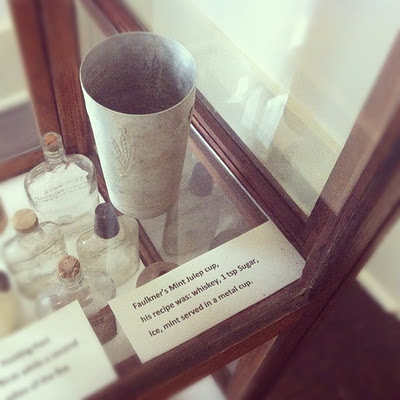
Wine and brandy were not Faulkner’s favorite spirits. He loved whiskey. His favorite cocktail was the mint julep. Faulkner would make one by mixing whiskey–preferably bourbon–with one teaspoon of sugar, a sprig or two of crushed mint, and ice. He liked to drink his mint julep in a frosty metal cup. (See image above.) The word “julep” first appeared in the late 14th century to describe a syrupy drink used to wash down medicine. Faulkner believed in the medicinal efficacy of alcohol. Lillian Ross once visited the author when he was ailing, and quoted him as saying, “Isn’t anythin’ Ah got whiskey won’t cure.”
On a cold winter night, Faulkner’s medicine of choice was the hot toddy. His niece, Dean Faulkner Wells, described the recipe and ritual for hot toddies favored by her uncle (whom she called “Pappy”) in The Great American Writers’ Cookbook, quoted last week by Maud Newton:
Pappy alone decided when a Hot Toddy was needed, and he administered it to his patient with the best bedside manner of a country doctor.
He prepared it in the kitchen in the following way: Take one heavy glass tumbler. Fill approximately half full with Heaven Hill bourbon (the Jack Daniel’s was reserved for Pappy’s ailments). Add one tablespoon of sugar. Squeeze 1/2 lemon and drop into glass. Stir until sugar dissolves. Fill glass with boiling water. Serve with potholder to protect patient’s hands from the hot glass.
Pappy always made a small ceremony out of serving his Hot Toddy, bringing it upstairs on a silver tray and admonishing his patient to drink it quickly, before it cooled off. It never failed.
Related Content:
William Faulkner Audio Archive Goes Online
William Faulkner Reads from As I Lay Dying
Read More...Errol Morris: Two Essential Truths About Photography
In this video created by the Guardian, writer and award-winning documentary filmmaker Errol Morris talks about the nature of truth, art, and propaganda in photography. He draws examples from the photographs of Abu Ghraib and the Crimean War, both cited in his book Believing is Seeing, and he asks the viewer to consider a most fundamental question: how does a photograph relate to the physical world? Unlike a verbal or written statement, a photograph cannot be true or false. It simply is.
Then comes another argument worth considering — the idea that all photographs are posed. By way of example, Morris cites an instance where a photographer (in this case Roger Fenton) omits an elephant standing outside the frame. And it leads Morris to suggest that we shouldn’t take photos at face value. Rather we should do our due diligence to find out whether there isn’t always a metaphorical elephant looming beyond the frame. As Morris states, a photograph decontextualizes everything. It reveals to us a two dimensional reality that’s “been torn out of the fabric of the world.”
This video is part of the Guardian’s “Comment is Free” series, in which the world’s top thinkers, newsmakers, and people with stories to tell are interviewed. For more meditations on photography, give some time to Errol Morris’ speech at the Harvard Bookstore. Find the transcript here.
Eugene Buchko is a blogger and photographer living in Atlanta, GA. He maintains a photoblog, Erudite Expressions, and writes about what he reads on his reading blog.
Related Content:
Werner Herzog Loses a Bet to Errol Morris, and Eats His Shoe (Literally)
“They Were There” — Errol Morris Finally Directs a Film for IBM
Read More...The Blade Runner Sketchbook Features The Original Art of Syd Mead & Ridley Scott (1982)
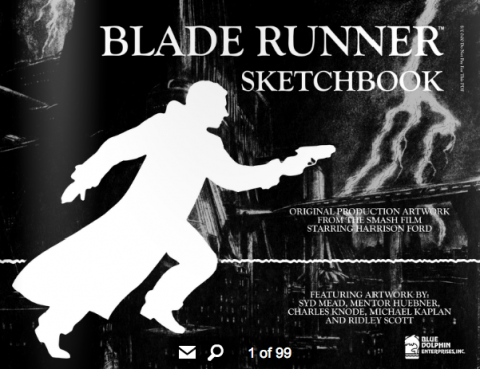
Coinciding with the release of Blade Runner in 1982, David Scroggy published the Blade Runner Sketchbook, a book with 100+ production drawings and artwork for Ridley Scott’s classic sci-fi film. The sketchbook features visual work by Scott himself, artist Mentor Huebner, and costume designer Charles Knode, but most notably a slew of drawings by artist, futurist, and illustrator Syd Mead.
As Comics Alliance notes, this sketchbook has been out of print for years and scant few paper copies remain available for purchase. So digital versions have filled the void online, and now comes this: a version that lets you revel in the Blade Runner artwork in full-screen mode. Enter the sketchbook by clicking the image above or below. (The book itself is hosted at Isuu.com). Once you get there, click the images and they’ll fill your screen.
Enjoy, and while you’re at it, don’t miss some related items:
Blade Runner is a Waste of Time: Siskel & Ebert in 1982
Read More...The Mind & Art of Maurice Sendak: A Video Sketch
Like the children in his books, Maurice Sendak, at age 83, is doing the best he can to navigate a frightening and bewildering world. “We all have to find our way,” Sendak says in this revealing little film from the Tate museums. “If I could find my way through picture-making and book illustration, or whatever you want to call it, I’d be okay.”
In books like In the Night Kitchen, Where the Wild Things Are and Outside, Over There, Sendak has explored the wonders–and terrors–of childhood. “No one,” wrote Dave Eggers recently in Vanity Fair, “has been more uncompromising, more idiosyncratic, and more in touch with the unhinged and chiaroscuro subconscious of a child.”
Sendak’s own childhood in Brooklyn, New York, was a time of emotional trauma. His parents were Polish immigrants who had trouble adjusting to life in America. On the day of Sendak’s barmitzvah, his father learned that his entire family had been killed in the Holocaust. He remembered the sadness of looking through family scrapbooks. “The shock of thinking I would never know them was terrible,” Sendak told the Guardian earlier this year. “Who were they?”
This early sense of the precariousness of life carried over into his work. As the playwright Tony Kushner wrote of Sendak in 2003:
Maurice, among the best of the best, shocks deeply, touching on the mortal, the insupportably sad or unjust, even on the carnal, on the primal rather than the merely primitive. He pitches children, including aged children, out of the familiar and into mystery, and then into understanding, wisdom even. He pitches children through fantasy into human adulthood, that rare, hard-won and, let’s face it, tragic condition.
Read More...David Lynch in Four Movements: A Video Tribute
Last year, Richard Vezina created a popular video tribute to Stanley Kubrick (A Stanley Kubrick Odyssey). Now he returns with David Lynch in Four Movements. Accompanied by musical pieces from Angelo Badalamenti & David Lynch, each movement revolves around a distinctive theme or visual trend in Lynch’s works. Here’s how the 20 minute video unfolds:
- First Movement: Melancholy and Sadness — Questions In A World Of Blue
- Second Movement: Action, Violence, and Sex — The Pink Room
- Third Movement: Dreams and Nightmares — Into The Night
- Fourth Movement: Love and Hope — Mysteries of Love
Related Content:
David Lynch’s Organic Coffee (Barbie Head Not Included)
David Lynch on his Favorite Movies and Filmmakers
David Lynch Debuts Lady Blue Shanghai
Read More...Support Us
We're hoping to rely on loyal readers, rather than erratic ads. Please click the Donate button and support Open Culture. You can use Paypal, Venmo, Patreon, even Crypto! We thank you!

About Us

Open Culture scours the web for the best educational media. We find the free courses and audio books you need, the language lessons & educational videos you want, and plenty of enlightenment in between.
Advertise With Us

FREE UPDATES!
GET OUR DAILY EMAIL
Get the best cultural and educational resources on the web curated for you in a daily email. We never spam. Unsubscribe at any time.
FOLLOW ON SOCIAL MEDIA

Open Culture editor Dan Colman scours the web for the best educational media. He finds the free courses and audio books you need, the language lessons & movies you want, and plenty of enlightenment in between.
Advertise With Us

