Slavoj Zizek Takes the Stage at Occupy Wall Street
When Slovenia’s hip Marxist/Lacanian critical theorist takes center stage at a Wall Street protest, it’s news for a culture site. No doubt. How can we not observe a rare moment of praxis? But, what it all means for the Occupy Wall Street movement, we’ll let you wrestle with that. Part 2 appears here. H/T Biblioklept.
Related Stuff: It looks like the 2005 documentary Zizek! has found its way on YouTube, and if you want to understand the essence of Occupy Wall Street, it’s worth listening to this recent episode of Planet Money. They do a good job of demystifying things…
Read More...How the King James Bible Forever Changed English: 400th Anniversary Celebrated with Fun Videos
This year marks the 400th anniversary of the King James Bible, a translation that influenced the development of the English language as much as it did the Christian faith. Right alongside many other anniversary celebrations taking place this year, Glen Scrivener, a minister in the Church of England, has started a blog about the linguistic impact of the text, focusing on 365 phrases that have passed in common parlance. A lot of this gets artfully distilled by Scrivener’s short video, The King’s English — 100 phrases in 3 Minutes (above).
Scrivener’s work is nicely complemented by a witty animated video taken from The History of English in 10 Minutes, a sequence created by The Open University earlier this year.
H/T Metafilter
Related Content:
Google Puts the Dead Sea Scrolls Online
Introduction to the New and Old Testaments
Read More...The Nobel Prize: Saul Perlmutter & the Accelerating Expansion of the Universe
When two teams of scientists announced in 1998 that the expansion of the Universe was not slowing down due to gravity but was in fact accelerating, the worldwide scientific community was shocked. The discovery turned many of the prevailing assumptions about the universe upside down. Looking back, perhaps the only thing that wasn’t a surprise was that the Nobel Prize Committee should take notice.
Last Tuesday the Swedish Academy of Sciences announced that the 2011 Nobel Prize in Physics would go to three American-born scientists from two rival teams: physicist Saul Permutter, head of the Supernova Cosmology Project at Lawrence Berkeley National Laboratory and the University of California, Berkeley, would receive half of the prize, while Brian P. Schmidt, head of the High‑z Supernova Search Team and an astronomer at the Research School of Astronomy and Astrophysics at the Australian National University, Weston Creek, would share the other half with a colleague who wrote the original paper announcing the team’s findings in 1998, astronomer Adam G. Riess of Johns Hopkins University and the Space Telescope Science Institute.
Despite popular belief, the two teams did not “discover” dark energy. As Perlmutter points out in the short film above, “People are using the term ‘dark energy’ basically as a place holder to describe any explanation for why it is that we seem to be seeing the universe’s expansion getting faster and faster.” What is actually known is that the universe has been expanding for as far back as we can observe, and about 7 billion years ago–roughly half the estimated age of the universe–the expansion began to accelerate.
“Why is it speeding up?” Perlmutter asked during a press conference on the morning his Nobel Prize was announced. “It could be that most of the universe is dominated by a dark energy that pervades all of space and is causing this acceleration. It could be, perhaps even more surprising, that Einstein’s Theory of General Relativity needs a little bit of a tweak, perhaps acting slightly differently on these very large scales of the universe. But at this moment I would say that the question is wide open.”
The 11-minute documentary above, produced in 2008 by KQED in San Francisco, gives a good overview of how Perlmutter and his rivals measured the red-shift and brightness of light from Type 1a supernovae to plot the universe’s rate of expansion across billions of years. For an in-depth history of the project, you can read this three-part article from the Berkeley Lab. Or, if you only have a minute (1:39 to be exact) you can watch this “Minute Physics” episode narrated by Caltech physicist Sean Carroll.
To bone up on physics, don’t miss this collection of 25 Free Physics Courses, part of our larger collection of 400+ Free Online Courses.
Read More...
Noam Chomsky & Michel Foucault Debate Human Nature & Power (1971)
Once again, we’re heading back to 1971. Yesterday we had Dick Cavett’s 1971 interview with George Harrison. Today, it’s the clash of two intellectual titans, Noam Chomsky and Michel Foucault. In ’71, at the height of the Vietnam War, the American linguist and French historian/social theorist appeared on Dutch TV to debate a fundamental question: Is there such a thing as innate human nature? Or are we shaped by experiences and the power of cultural and social institutions around us?
40 years later, you can find the classic debate on YouTube. If you need subtitles, make sure you turn on the captions function at the bottom of the video.
A full transcript of the debate can be read online, or you can purchase a copy in book format. Finally, a recent BBC program revisits and analyzes the Chomsky-Foucault encounter. H/T Metafilter
Related Content:
Free Online Courses in Philosophy
Jacques Lacan Speaks; Zizek Provides Free Cliffs Notes
Download Free Courses from Famous Philosophers: From Bertrand Russell to Michel Foucault
Noam Chomsky vs. William F. Buckley, 1969
Ali G and Noam Chomsky Talk Linguistics
Read More...Stream It: Title Track of David Lynch’s Upcoming Solo Album
David Lynch has been busy lately, creating everything except the feature films that made him famous. Earlier this year, he “directed” Duran Duran’s concert in LA and collaborated with Interpol to create an animated sequence for the 2011 Coachella Festival. Then came his puzzling video response to the Washington Debt Deal, a creepy commercial for his new line of coffee products, a new nightclub opened in Paris, and now this: a haunting electronic album called Crazy Clown Time that brings his strange aesthetic to a whole new medium. The album is due out on November 8th, and above you can listen to the title track for free.
via BoingBoing
Read More...Haruki Murakami: New Short Story. New Book. And Perhaps Nobel Prize?
It’s a good time to be a fan of Haruki Murakami. Last month, his short story, “Town of Cats,” was published in The New Yorker. Later in October, his new book 1Q84 hits the stands in the US. (Watch the book trailer above.) And, right now, the British bookmaker Ladbrokes is giving Murakami 7‑to‑1 odds of winning the Nobel Prize in Literature, to be named tomorrow morning. They’re strong odds. But the Syrian poet Adonis (read three poems here) is the actual favorite right now with 4‑to‑1 odds. Stay tuned. We’ll know more soon …
Read More...Richard Feynman on Beauty
After dismissing the popular notion that scientists are unable to truly appreciate beauty in nature, physicist Richard Feynman (1918 — 1988) explains what a scientist really is and does. Here are some of the most memorable lines from this beautiful mix of Feynman quotes and (mostly) BBC and NASA footage:
- People say to me, Are you looking for the ultimate laws of physics? — No, I’m not. I’m just looking to find out more about the world.
- When we’re going to investigate [nature], we shouldn’t predecide what it is we’re trying to do, except to find out more about it.
- I can live with doubt and uncertainty and not knowing. I think it’s much more interesting to live not knowing than to have answers that might be wrong. (…) I don’t feel frightened by not knowing things, by being lost in the mysterious universe without having any purpose.
- When you doubt and ask, it gets a little harder to believe.
Beauty is the first video in The Feynman Series, along with Honours and Curiosity. The sequence is a companion to The Sagan Series, which pays tribute to the late Carl Sagan. H/T Kottke
By profession, Matthias Rascher teaches English and History at a High School in northern Bavaria, Germany. In his free time he scours the web for good links and posts the best finds on Twitter.
Related Content:
Richard Feynman’s Physics Lectures Online
The Pleasure of Finding Things Out
The Last Journey Of A Genius: Richard Feynman Dreams of Tannu Tuva
Read More...
Martin Scorsese: Why I Made The George Harrison Documentary
Just a quick reminder, Martin Scorsese’s two-part documentary on George Harrison airs tonight and tomorrow night on HBO. After making films about Bob Dylan and The Rolling Stones, the legendary filmmaker now turns somewhat unexpectedly to the silent Beatle, and you have to wonder why. Why George? So Scorsese recalls when things originally clicked, the first moment when he realized the “picture had to be made.”
Read More...Kickstarter: the Future of Self-Publishing?
 We all know where books come from: a human and a muse meet, fall in love, and two months to twenty years later, a book is born. Then, as with other varieties of babies, the sleepless nights start as a writer searches for a home for the book, collecting rejections like badges of honor, testaments to determination.
Well, that was the old-fashioned way. We’ve all heard how the internet has leveled the playing field, allowing anybody to publish work and find an audience. However, this easier path to publication hasn’t necessarily solved an even older writer’s conundrum: How to pay for it.
That is, how to make enough money to sustain yourself as you write (day jobs aside). And so writers must become even wilier. Though you may make money from the sale of a book, how do you fund yourself before the book?
Seth Harwood, the author of three books, is at the front of the movement to find alternate and creative ways of not only reaching audiences, but pursuing the writing life. Since graduating from the Iowa Writers Workshop in 2002, Harwood has built up a loyal fan base—his “Palms Mamas and Palms Daddies” (named for one of his protagonists, Jack Palms)—through social media and free podcasting. Harwood is sustaining a writing life along a path that is likely to be more and more common for writers.
After offering his first novel, Jack Wakes Up, as a free audiobook, Harwood published it in paperback with Breakneck Books in 2008. The Amazon sales, pushed by Palms Mamas and Palms Daddies, landed the book in #1 in Crime/Mystery and #45 overall, bringing the attention of Random House, who re-published the book one year later.
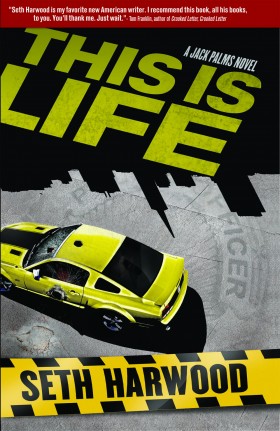
Looking outside mainstream avenues, Harwood secured funding for publication of his next venture, Young Junius, with Tyrus Books by preselling signed copies through Paypal—before the books existed in physical form. And now he is one of the early adopters of using Kickstarter to pay for the gestation and birth of not one book—but five previously-written works in the next six months–as he puts it, “raising the fixed costs of bringing these books to the marketplace.” His Kickstarter campaign based around This Is Life, the sequel to Jack Wakes Up was—impressively—fully funded within 25 hours—and with a few days still left to go, it has exceeded the original goal by over $2000.
What can a writer offer besides an autographed copy of the to-be-written book, or a mention in the acknowledgements? For Harwood’s project, the pledges range from a dollar to $999, with thank-yous spanning from the aforementioned to—at the $999 end—an original novella written according to the donor’s wishes and published as a one-off hardcover.
As more and more writers become cynical about the mainstream publishing industry, and the limits it places on writers, and as the internet breaks down barriers between writers and readers, alternate paths of drawing audiences to the writing/publishing process may become more and more popular. In none other than the New York Times Book Review, Neal Pollack recently declared his intention to self-publish his next book using Kickstarter to generate his fixed costs and “an advance,” and last week bestseller Paulo Coelho discussed his decision to offer his novels for free online. (You can find free ebooks by Coelho here.)
Indeed, now more than ever, it seems essential for authors to meet readers at least half-way. Harwood considers himself an “author-preneur,” developing new business models as he publishes his books. As he sees it, innovation comes much more easily to an author acting alone, than to a large publishing company or big corporation. He aims for the new models as he sees them developing, knowing he’s got to go out and find readers himself. As Coelho declares, “The ivory tower does not exist anymore.”
This post was contributed by Shawna Yang Ryan. Her novel Water Ghosts was a finalist for the 2010 Asian American Literary Award. In 2012, she will be the Distinguished Writer in Residence at the University of Hawai’i at Manoa.
Read More...The Mechanical Monsters: Seminal Superman Animated Film from 1941
In 1941, director Dave Fleischer and Paramount Pictures animators Steve Muffati and George Germanetti produced Superman: The Mechanical Monsters — a big-budget animated adaptation of the popular Superman comics of that period, in which a mad scientist unleashes robots to rob banks and loot museums, and Superman, naturally, saves the day. It was one of seventeen films that raised the bar for theatrical shorts and are even considered by some to have given rise to the entire Anime genre.
More than a mere treat of vintage animation, the film captures the era’s characteristic ambivalence in reconciling the need for progress with the fear of technology in a culture on the brink of incredible technological innovation. It was the dawn of the techno-paranoia that persisted through the 1970s, famously captured in the TV series Future Shock narrated by Orson Welles, and even through today. Take for example books like Nicholas Carr’s The Shallows and Sherry Turkle’s Alone Together: Why We Expect More from Technology and Less from Each Other.
Superman: The Mechanical Monsters is available for download on The Internet Archive, and Toonami Digital Arsenal has the complete series of all seventeen films. Find more vintage animation in Open Culture’s collection of Free Movies Online.
Maria Popova is the founder and editor in chief of Brain Pickings, a curated inventory of cross-disciplinary interestingness. She writes for Wired UK, The Atlantic and DesignObserver, and spends a great deal of time on Twitter.
Read More...Support Us
We're hoping to rely on loyal readers, rather than erratic ads. Please click the Donate button and support Open Culture. You can use Paypal, Venmo, Patreon, even Crypto! We thank you!

About Us

Open Culture scours the web for the best educational media. We find the free courses and audio books you need, the language lessons & educational videos you want, and plenty of enlightenment in between.
Advertise With Us

FREE UPDATES!
GET OUR DAILY EMAIL
Get the best cultural and educational resources on the web curated for you in a daily email. We never spam. Unsubscribe at any time.
FOLLOW ON SOCIAL MEDIA

Open Culture editor Dan Colman scours the web for the best educational media. He finds the free courses and audio books you need, the language lessons & movies you want, and plenty of enlightenment in between.
Advertise With Us

